

The DOI matches its Crossref record; 36 of the 36 references it cites were found in a registry or an index.
Dissociating Inhibition, Attention, and Response Control in the Frontoparietal Network Using Functional Magnetic Resonance Imaging
Open accessAbstract
Evidence suggests that the right inferior frontal cortex (IFC) plays a specialized role in response inhibition. However, more recent findings indicate a broader role for this region in attentional control. Here, we used functional magnetic resonance imaging to examine the functional role of the right IFC in attention, inhibition, and response control in 2 experiments that employed novel variations of the go/no-go task. Across the 2 experiments, we observed a graded response in the right insula/IFC, whereby increasing response control demands led to an increase in activation. The results are consistent with the hypothesis that this region plays a key role in the integration of bottom-up, sensory information with top-down, response-related information to facilitate flexible, goal-directed behavior.
Overview
The claims and statistics of this paper haven’t been checked yet.
Run the check — free, no account needed. It reads the open-access text and checks the sources it cites.
Integrity signals
Registry
Cites
Statistics
Figures
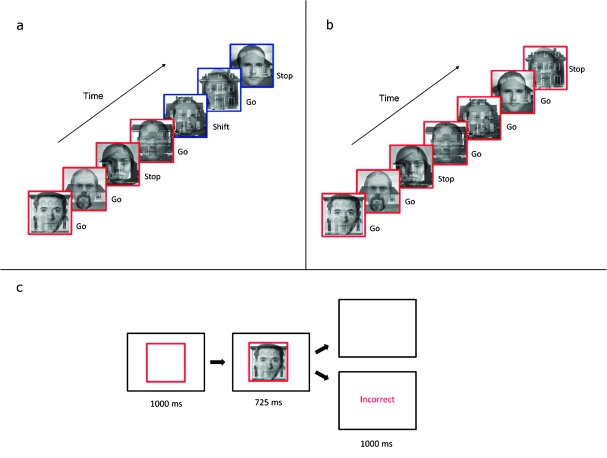
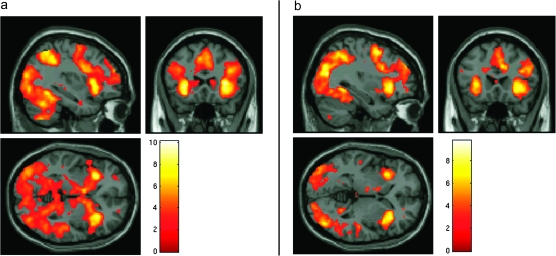
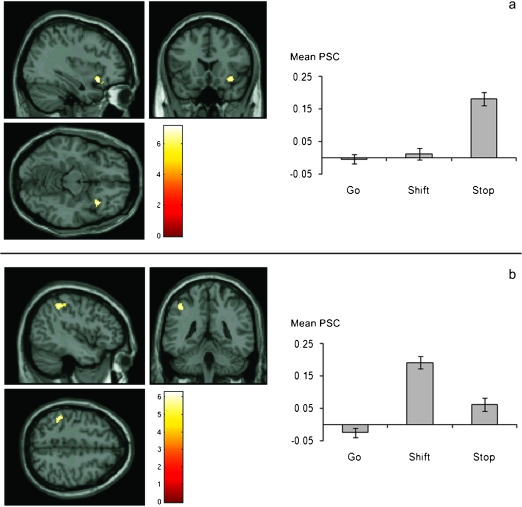
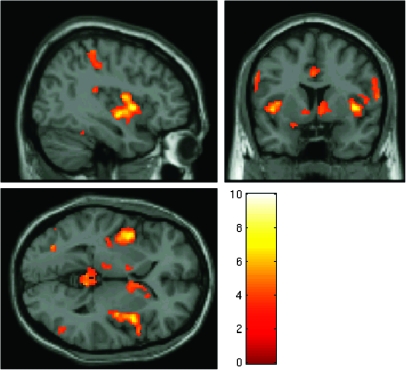
Verification
Claims the paper makes
The claims and statistics of this paper haven’t been checked yet.
Run the check — free, no account needed. It reads the open-access text and checks the sources it cites.
Claims other papers make about this one
Each is checked against this paper’s own text: does it say what the citing paper says it does?
In the citing paper
“The right IFG, besides detecting changes in stimulus features (Sharp et al. 2010; Dodds et al. 2010), facilitates infrequent action-related events by activating nondominant but relevant responses while inhibiting automatic but irrelevant actions at the same time.”
From Large-scale functional neural network correlates of response inhibition: an fMRI meta-analysis (2017) · cites this paper as Dodds et al. 2010
Self-check
Percentages, sums and reported differences re-computed from the paper’s own numbers.
The self-check needs the paper’s full text.
Citations
Cites
Control of goal-directed and stimulus-driven attention in the brain
Corbetta, M., & Shulman, G. L. (2002) · Nature Reviews Neuroscience · doi:10.1038/nrn755 · Cited by 12,881 · cited 1×
“Cerebral Cortex May 2011;21:1155--1165 doi:10.1093/cercor/bhq187 Advance Access publication October 5, 2010 Dissociating Inhibition, Attention, and Response Control in the Frontoparietal Network”
BackgroundInfluentialCommon regions of the human frontal lobe recruited by diverse cognitive demands
Duncan, J., & Owen, A. M. (2000) · Trends in Neurosciences · doi:10.1016/s0166-2236(00)01633-7 · Cited by 2,498
The Prefrontal Cortex—An Update
Fuster, J. M. (2001) · Neuron · doi:10.1016/s0896-6273(01)00285-9 · Cited by 1,837
Stop-signal inhibition disrupted by damage to right inferior frontal gyrus in humans
Aron, A. R., Fletcher, P. C., Bullmore, E. T., Sahakian, B. J., & Robbins, T. W. (2003) · Nature Neuroscience · doi:10.1038/nn1003 · Cited by 1,771 · cited 2×
“Cerebral Cortex May 2011;21:1155--1165 doi:10.1093/cercor/bhq187 Advance Access publication October 5, 2010 Dissociating Inhibition, Attention, and Response Control in the Frontoparietal Network”
BackgroundInfluentialSelf-citationAron, A. R., & Poldrack, R. A. (2006) · The Journal of Neuroscience · doi:10.1523/jneurosci.4682-05.2006 · Cited by 1,630 · cited 1×
“Cerebral Cortex May 2011;21:1155--1165 doi:10.1093/cercor/bhq187 Advance Access publication October 5, 2010 Dissociating Inhibition, Attention, and Response Control in the Frontoparietal Network”
BackgroundInfluentialRight hemispheric dominance of inhibitory control: An event-related functional MRI study
Garavan, H., Ross, T. J., & Stein, E. A. (1999) · Proceedings of the National Academy of Sciences · doi:10.1073/pnas.96.14.8301 · Cited by 1,394 · cited 2×
“Cerebral Cortex May 2011;21:1155--1165 doi:10.1093/cercor/bhq187 Advance Access publication October 5, 2010 Dissociating Inhibition, Attention, and Response Control in the Frontoparietal Network”
BackgroundInfluentialThe role of the right inferior frontal gyrus: inhibition and attentional control
Hampshire, A., Chamberlain, S. R., Monti, M. M., Duncan, J., & Owen, A. M. (2010) · NeuroImage · doi:10.1016/j.neuroimage.2009.12.109 · Cited by 1,327 · cited 2×
“In another study, Hampshire et al. (2010) compared different versions of a stop-signal task and found that the right IFC was activated regardless of the specific output required— response inhibition, response initiation, or internal counting— but that activation was greater in blocks requiring a…”
BackgroundResultProjections to the frontal cortex from the posterior parietal region in the rhesus monkey
Petrides, M., & Pandya, D. (1984) · The Journal of comparative neurology · doi:10.1002/cne.902280110 · Cited by 1,101
Rubia, K., Russell, T., Overmeyer, S., Brammer, M. J., Bullmore, E. T., Sharma, T., Simmons, A., Williams, S. C. R., Giampietro, V., Andrew, C. M., et al. (2001) · NeuroImage · doi:10.1006/nimg.2000.0685 · Cited by 999 · cited 1×
“…frontal cortex (IFC) in the inhibition of motor responses (Kawashima et al. 1996; Garavan et al. 1999; Konishi et al. 1999; Menon et al. 2001; Rubia et al. 2001; Aron et al. 2003; Kelly et al. 2004; Aron and Poldrack 2006; Li et al. 2006; Hodgson et al. 2007; Leung and Cai 2007), suggesting…”
BackgroundA multimodal cortical network for the detection of changes in the sensory environment
Downar, J., Crawley, A. P., Mikulis, D. J., & Davis, K. D. (2000) · Nature Neuroscience · doi:10.1038/72991 · Cited by 947 · cited 2×
“…attentional reorienting and shifting (Corbetta and Shulman 2002; Hampshire and Owen 2006), oddball and target detection (McCarthy et al. 1997; Downar et al. 2000; Bledowski et al. 2004; Hampshire et al. 2007) and updating attended information (Hon et al. 2006), and is often coactivated with…”
BackgroundInfluential
Research works printed but not linked: 4
- 2009, Biological psychiatry, 67, 919
- 2001, 30, 319
- Kawashima, 1996, Brain research, 728, 79
- 2001, 13, 250
Cited by
Sorted by citations
Inhibition and the right inferior frontal cortex: one decade on
Aron, A. R., Robbins, T. W., & Poldrack, R. A. (2014) · Trends in Cognitive Sciences · doi:10.1016/j.tics.2013.12.003 · Cited by 2,166
Self-citationInhibition and impulsivity: behavioral and neural basis of response control
Bari, A., & Robbins, T. W. (2013) · Progress in Neurobiology · doi:10.1016/j.pneurobio.2013.06.005 · Cited by 1,921
Self-citationThe role of prefrontal cortex in cognitive control and executive function
Friedman, N. P., & Robbins, T. W. (2022) · Neuropsychopharmacology · doi:10.1038/s41386-021-01132-0 · Cited by 1,737
“The concept of diversity as well as unity of PFC functions can be illustrated in a typical fMRI study [144] which had defined task components of response inhibition and cognitive flexibility, finding increased BOLD activity in the FPN including both the RIFG region and in the parietal cortex.”
BackgroundSelf-citationImpulsivity, compulsivity, and top-down cognitive control
Dalley, J. W., Everitt, B. J., & Robbins, T. W. (2011) · Neuron · doi:10.1016/j.neuron.2011.01.020 · Cited by 1,589
“…for functional dissociations within the RIFG region that correspond to attentional and response inhibitory zones, and Dodds et al. have explicitly contrasted attentional and response control functions associated with the posterior parietal cortex and RIFG, respectively (Dodds et al., 2010).”
BackgroundSelf-citationA unified framework for inhibitory control
Munakata, Y., Herd, S. A., Chatham, C. H., Depue, B. E., Banich, M. T., & O’Reilly, R. C. (2011) · Trends in Cognitive Sciences · doi:10.1016/j.tics.2011.07.011 · Cited by 699
Metadata
- Authors
- Dodds, C. M., Morein-Zamir, S., & Robbins, T. W.
- Affiliations
- GlaxoSmithKline (United Kingdom) (GB)
- University of Cambridge (GB)
- Corresponding author
- Dodds, C. M.
- ORCID
- Robbins, T. W.
- Venue
- Cerebral Cortex
- Publisher
- Oxford University Press (OUP)
- Published
- 2010-10-05
- Volume
- 21
- Issue
- 5
- Pages
- 1155-1165
- ISSN
- 1047-3211 (ISSN-L)
- 1460-2199
- PMC
- PMC3077432
- OpenAlex
- W2101475053
- Cited by
- 270
- References
- 36
- Citations by year
- 2026: 4 · 2025: 10 · 2024: 7 · 2023: 7 · 2022: 19 · 2021: 20 · 2020: 67 · 2019: 14 · 2018: 15 · 2017: 15 · 2016: 6 · 2015: 18 · 2014: 26 · 2013: 17 · 2012: 15
- FWCI
- 7.93
- Type
- journal article
- Language
- en
- Open access
- hybrid
- doi.org
- Licence
- cc-by-nc
- Locations
- Cerebral Cortex (publishedVersion, cc-by-nc)
- Europe PMC (PubMed Central) (publishedVersion, cc-by-nc)
- PubMed Central (publishedVersion, cc-by-nc)
- PubMed (publishedVersion)
- Funders
- Wellcome Trust (089589/Z/09/Z, 089589, 093875)
- Medical Research Council (089589/Z/09/Z)
- Topics
- Life Sciences › Neuroscience › Cognitive Neuroscience › Neural and Behavioral Psychology Studies
- Life Sciences › Neuroscience › Cognitive Neuroscience › Neurobiology of Language and Bilingualism
- Social Sciences › Arts and Humanities › Philosophy › Free Will and Agency
- Keywords
- response inhibition, attentional control, response control, right inferior frontal cortex, right insula, frontoparietal network, go/no-go task, top-down control, goal-directed behavior, cognitive flexibility
- MeSH terms
- Adolescent, Adult, Attention, Female, Humans, Magnetic Resonance Imaging, Male, Models, Neurological, Nerve Net, Neural Inhibition, Parietal Lobe, Prefrontal Cortex, Young Adult, Executive Function
About these checks
Registry, retraction, Cites and statistics results are computed, not judged, with one exception: a printed reference that no index lists is read once by a model before it counts as a citation error. Claims are extracted by a model and kept only when their quote appears verbatim in the text; each cited source is then checked, with a model’s help, for whether it says what the claim relies on. Those verdicts can be wrong — read the claim’s quote and the cited source before relying on one.
Statistics and arithmetic are recomputed, not judged.
Confidence bands are shown only for fields calibrated on our annotated test set. None is calibrated yet, so no band is shown.
What counts as a claim ›How we measure confidence ›How we check this ›
Are you an author, or do you see a problem with this page? Request a review
