

The DOI matches its Crossref record; 80 of the 80 references it cites were found in a registry or an index.
The Dopaminergic Midbrain Encodes the Expected Certainty about Desired Outcomes
Open accessAbstract
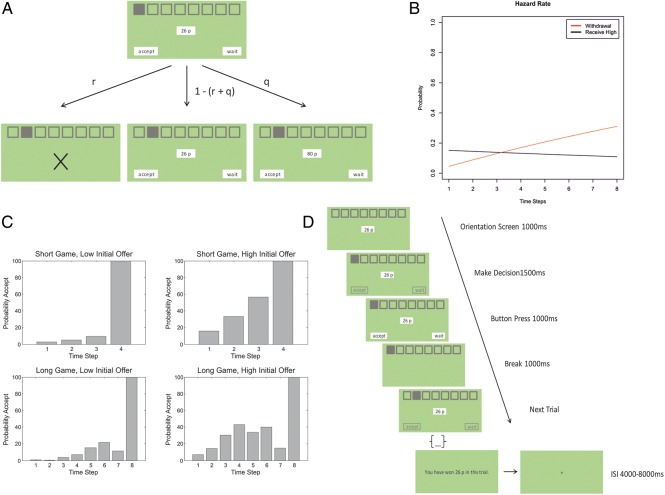
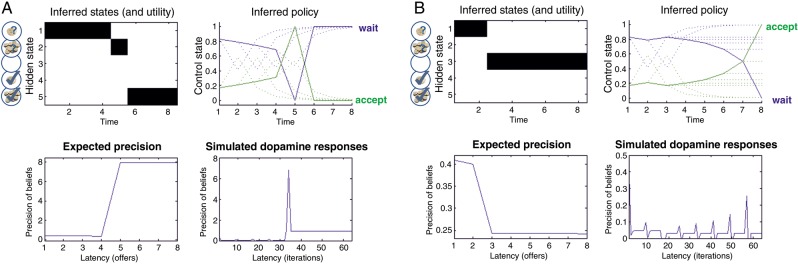
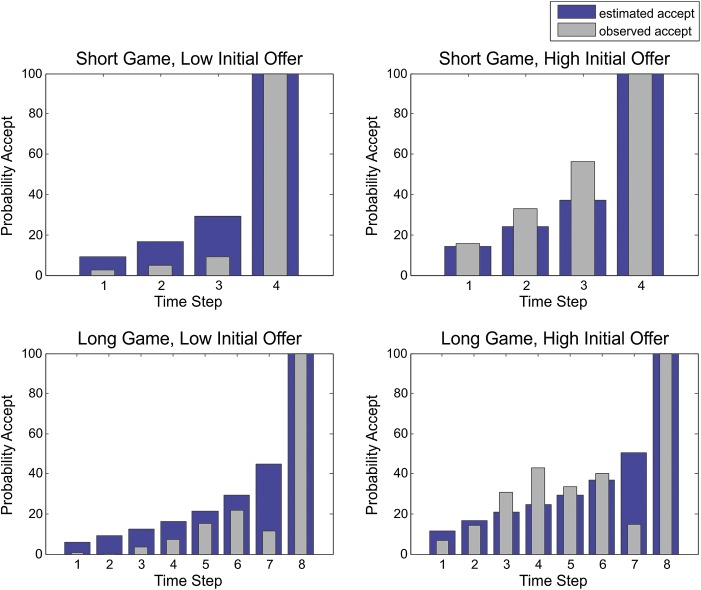
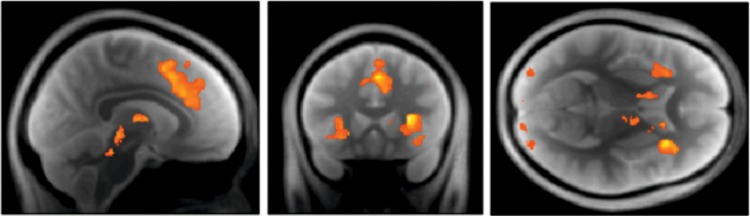
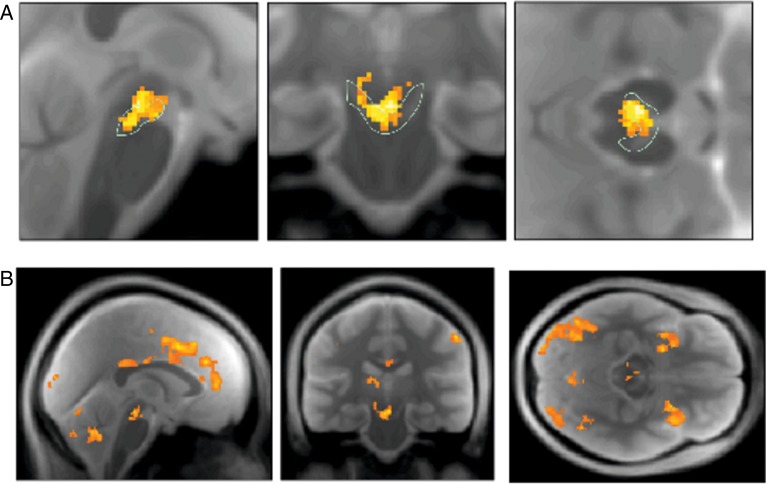
Dopamine plays a key role in learning; however, its exact function in decision making and choice remains unclear. Recently, we proposed a generic model based on active (Bayesian) inference wherein dopamine encodes the precision of beliefs about optimal policies. Put simply, dopamine discharges reflect the confidence that a chosen policy will lead to desired outcomes. We designed a novel task to test this hypothesis, where subjects played a "limited offer" game in a functional magnetic resonance imaging experiment. Subjects had to decide how long to wait for a high offer before accepting a low offer, with the risk of losing everything if they waited too long. Bayesian model comparison showed that behavior strongly supported active inference, based on surprise minimization, over classical utility maximization schemes. Furthermore, midbrain activity, encompassing dopamine projection neurons, was accurately predicted by trial-by-trial variations in model-based estimates of precision. Our findings demonstrate that human subjects infer both optimal policies and the precision of those inferences, and thus support the notion that humans perform hierarchical probabilistic Bayesian inference. In other words, subjects have to infer both what they should do as well as how confident they are in their choices, where confidence may be encoded by dopaminergic firing.
Overview
The claims and statistics of this paper haven’t been checked yet.
Run the check — free, no account needed. It reads the open-access text and checks the sources it cites.
Integrity signals
Registry
Cites
Statistics
Figures
Verification
Claims the paper makes
The claims and statistics of this paper haven’t been checked yet.
Run the check — free, no account needed. It reads the open-access text and checks the sources it cites.
Claims other papers make about this one
Each is checked against this paper’s own text: does it say what the citing paper says it does?
In the citing paper
“This approach has been used, for example, to identify links between activity in neuromodulatory nuclei and computational trajectories, such as (precision-weighted) prediction errors or uncertainty (111, 115–117).”
From Can Bayesian Theories of Autism Spectrum Disorder Help Improve Clinical Practice? (2016) · cites this paper as [117]
Self-check
Percentages, sums and reported differences re-computed from the paper’s own numbers.
The self-check needs the paper’s full text.
Citations
Cites
Reinforcement Learning: An Introduction
Sutton, R. S., & Barto, A. G. (1998) · IEEE Transactions on Neural Networks · doi:10.1109/tnn.1998.712192 · Cited by 27,225
Reinforcement Learning: An Introduction
Sutton, R. S., & Barto, A. (2005) · IEEE Transactions on Neural Networks · doi:10.1109/tnn.2004.842673 · Cited by 25,268
Tzourio-Mazoyer, N., Landeau, B., Papathanassiou, D., Crivello, F., Etard, O., Delcroix, N., Mazoyer, B., & Joliot, M. (2002) · NeuroImage · doi:10.1006/nimg.2001.0978 · Cited by 16,319
A Stochastic Approximation Method
Robbins, H., & Monro, S. (1951) · The Annals of Mathematical Statistics · doi:10.1214/aoms/1177729586 · Cited by 9,643
A neural substrate of prediction and reward
Schultz, W., Dayan, P., & Montague, P. R. (1997) · Science · doi:10.1126/science.275.5306.1593 · Cited by 9,388
A fast diffeomorphic image registration algorithm
Ashburner, J. (2007) · NeuroImage · doi:10.1016/j.neuroimage.2007.07.007 · Cited by 8,122
Conflict monitoring and cognitive control
Botvinick, M. M., Braver, T. S., Barch, D. M., Carter, C. S., & Cohen, J. D. (2001) · Psychological Review · doi:10.1037/0033-295x.108.3.624 · Cited by 7,351
Rao, R. P. N., & Ballard, D. H. (1999) · Nature Neuroscience · doi:10.1038/4580 · Cited by 5,483 · cited 2×
“It can be thought of as the discrete time version of predictive coding—that now predominates in models of perceptual inference and learning (Srinivasan 1982; Rao and Ballard 1999; Seth 2011; Bastos et al. 2012).”
BackgroundMaldjian, J. A., Laurienti, P. J., Kraft, R., & Burdette, J. H. (2003) · NeuroImage · doi:10.1016/s1053-8119(03)00169-1 · Cited by 5,066
A theory of cortical responses.
Friston, K. (2005) · Philosophical Transactions of the Royal Society B: Biological Sciences · doi:10.1098/rstb.2005.1622 · Cited by 4,578
Self-citation
Cited by
Sorted by citations
Items 101–200 of 219
Manrique, H. M., & WALKER, M. J. (2023) · Physics of Life Reviews · doi:10.1016/j.plrev.2023.02.005 · Cited by 31
Marković, D., Goschke, T., & Kiebel, S. J. (2020) · Cognitive Affective & Behavioral Neuroscience · doi:10.3758/s13415-020-00837-x · Cited by 24
Categorical evidence, confidence, and urgency during probabilistic categorization
Braunlich, K., & Seger, C. A. (2015) · NeuroImage · doi:10.1016/j.neuroimage.2015.11.011 · Cited by 24
Barriers and solutions to the adoption of translational tools for computational psychiatry
Benrimoh, D. A., Fisher, V., Mourgues, C., Sheldon, A. D., Smith, R. S., & Powers, A. R. (2023) · Molecular Psychiatry · doi:10.1038/s41380-023-02114-y · Cited by 27
The computational pharmacology of oculomotion
Parr, T., & Friston, K. J. (2019) · Psychopharmacology · doi:10.1007/s00213-019-05240-0 · Cited by 21
Self-citationA beautiful loop: An active inference theory of consciousness.
Laukkonen, R., Friston, K., & Chandaria, S. (2025) · Neuroscience & Biobehavioral Reviews · doi:10.1016/j.neubiorev.2025.106296 · Cited by 45
“…chosen parameters: e.g., “ likelihood precision ” or “ policy precision ” (Allen et al., 2019; Hesp et al., 2019; Parr and Friston, 2017, 2019; Schwartenbeck et al., 2015; Smith et al., 2019), epistemic depth is about the entire deep generative model being “ aware ” of how it ’ s…”
Self-citationA hierarchical model for integrating unsupervised generative embedding and empirical Bayes
Raman, S., Deserno, L., Schlagenhauf, F., & Stephan, K. E. (2016) · Journal of Neuroscience Methods · doi:10.1016/j.jneumeth.2016.04.022 · Cited by 21
The Many Roles of Precision in Action
Limanowski, J., Adams, R. A., Kilner, J. M., & Parr, T. (2024) · Entropy · doi:10.3390/e26090790 · Cited by 25
Schizophrenia: from neurophysiological abnormalities to clinical symptoms
Castelnovo, A., Ferrarelli, F., & D’Agostino, A. (2015) · Frontiers in Psychology · doi:10.3389/fpsyg.2015.00478 · Cited by 21
A Bayesian Account of Psychopathy: A Model of Lacks Remorse and Self-Aggrandizing
Prosser, A., Friston, K. J., Bakker, N., & Parr, T. (2018) · Computational Psychiatry · doi:10.1162/cpsy_a_00016 · Cited by 21
Self-citationSandved-Smith, L., Bogotá, J. D., Hohwy, J., Kiverstein, J. D., & Antoine Lutz, A. (2025) · Neuroscience of Consciousness · doi:10.1093/nc/niaf016 · Cited by 31
Predictive coding I: Introduction
Sprevak, M. D. (2023) · Philosophy Compass · doi:10.1111/phc3.12950 · Cited by 22
Smith, R. S., Lavalley, C. A., Taylor, S., Stewart, J. L., Khalsa, S. S., Berg, H. E., Ironside, M., Paulus, M. P., & Aupperle, R. L. (2023) · Journal of Psychiatry and Neuroscience · doi:10.1503/jpn.220226 · Cited by 19
Resilience and active inference
Miller, M. M., Albarracin, M., Pitliya, R. J., Kiefer, A. B., Mago, J., Gorman, C., Friston, K. J., & Ramstead, M. J. D. (2022) · Frontiers in Psychology · doi:10.3389/fpsyg.2022.1059117 · Cited by 20
Self-citationThe Homeostatic Logic of RewardPreprint
Morville, T., Friston, K. J., Burdakov, D., Siebner, H. R., & Hulme, O. J. (2018) · bioRxiv (Cold Spring Harbor Laboratory) · doi:10.1101/242974 · Cited by 22
Self-citationCosta, L. D., Sajid, N., Parr, T., Friston, K. J., & Smith, R. S. (2020) · arXiv (Cornell University) · Cited by 19
Self-citationSpee, B. T. M., Sladky, R., Fingerhut, J., Laciny, A., Kraus, C., Carls‐Diamante, S., Brücke, C., Pelowski, M. J., & Treven, M. (2022) · Frontiers in Psychology · doi:10.3389/fpsyg.2022.930293 · Cited by 18
Structure learning enhances concept formation in synthetic Active Inference agents
Neacsu, V., Mirza, M. B., Adams, R. A., & Friston, K. J. (2022) · PLoS ONE · doi:10.1371/journal.pone.0277199 · Cited by 17
Self-citationMikuš, N., Eisenegger, C., Mathys, C. D., Clark, L., Müller, U., Robbins, T. W., Lamm, C., & Naef, M. (2023) · Nature Communications · doi:10.1038/s41467-023-39823-5 · Cited by 17
Self-citationModeling Driver Responses to Automation Failures With Active Inference
Wei, R., McDonald, A. D., Garcia, A., & Alambeigi, H. (2022) · IEEE Transactions on Intelligent Transportation Systems · doi:10.1109/tits.2022.3155381 · Cited by 18
Bistable perception, precision and neuromodulation
Novický, F., Parr, T., Friston, K. J., Mirza, M. B., & Sajid, N. (2023) · Cerebral Cortex · doi:10.1093/cercor/bhad401 · Cited by 18
Self-citationIntrinsic and extrinsic motivators of attachment under active inference
Cittern, D., Nolte, T., Friston, K. J., & Edalat, A. (2018) · PLoS ONE · doi:10.1371/journal.pone.0193955 · Cited by 20
Self-citationActive inference and the two-step task
Gijsen, S., Grundei, M., & Blankenburg, F. (2022) · Scientific Reports · doi:10.1038/s41598-022-21766-4 · Cited by 16
Contextual perception under active inference
Mirza, M. B., Cullen, M., Parr, T., Shergill, S. S., & Moran, R. (2021) · Scientific Reports · doi:10.1038/s41598-021-95510-9 · Cited by 14
Pathologies of precision: A Bayesian account of goals, habits, and episodic foresight in addiction
Kinley, I., Amlung, M. T., & Becker, S. (2022) · Brain and Cognition · doi:10.1016/j.bandc.2022.105843 · Cited by 16
Pupil dilation indexes automatic and dynamic inference about the precision of stimulus distributions
Silvestrin, F., Penny, W. D., & FitzGerald, T. H. B. (2021) · Journal of Mathematical Psychology · doi:10.1016/j.jmp.2021.102503 · Cited by 12
Self-citationZeidman, P., Ashburner, J., Barnes, G. R., Kowalczyk, O. S., Lambert, C., Vladimir Litvak, A., Nichols, T. E., Parr, T., Tierney, T. M., & Friston, K. J. (2025) · Cerebral Cortex · doi:10.1093/cercor/bhaf234 · Cited by 13
Self-citationYu, N., & Canavier, C. C. (2015) · The Journal of Mathematical Neuroscience · doi:10.1186/s13408-015-0017-6 · Cited by 14
A Computational Neuroscience Perspective on the Change Process in Psychotherapy
Smith, R. P., Lane, R. D., Nadel, L., & Moutoussis, M. (2020) · Oxford University Press eBooks · doi:10.1093/oso/9780190881511.003.0015 · Cited by 13
An active inference approach to second-person neurosciencePreprint
Lehmann, K., Bolis, D., Ramstead, M. J. D., Friston, K. J., & Kanske, P. (2022) · doi:10.31234/osf.io/6y5ve · Cited by 13
Self-citationLonging to act: Bayesian inference as a framework for craving in behavioral addiction
Kulkarni, K. R., O'Brien, M., & Gu, X. (2023) · Addictive Behaviors · doi:10.1016/j.addbeh.2023.107752 · Cited by 12
Survival in a world of complex dangers
Mobbs, D., Wise, T., Tashjian, S. M., Zhang, J., Friston, K. J., & Headley, D. B. (2024) · Neuroscience & Biobehavioral Reviews · doi:10.1016/j.neubiorev.2024.105924 · Cited by 13
Self-citationProietti, R., Parr, T., Tessari, A., Friston, K. J., & Pezzulo, G. (2025) · Physics of Life Reviews · doi:10.1016/j.plrev.2025.05.008 · Cited by 17
Self-citationBenrimoh, D. A., Sheldon, A. D., Sibarium, E., & Powers, A. R. (2021) · Frontiers in Psychiatry · doi:10.3389/fpsyt.2021.685390 · Cited by 11
Hartwig, M., Bhat, A., & Peters, A. (2022) · Frontiers in Psychology · doi:10.3389/fpsyg.2022.865203 · Cited by 11
Smith, R. S., Kirlić, N., Stewart, J. L., Touthang, J., Kuplicki, R., Khalsa, S. S., Paulus, M. P., T Investigators, & Aupperle, R. L. (2020) · PsyArXiv (OSF Preprints) · doi:10.31234/osf.io/t2dhn · Cited by 9
Understanding music and aging through the lens of Bayesian inference
Heng, G. J., Zhang, J., Bonetti, L., Lim, W. P. H., Vuust, P., Agres, K., & Chen, S. A. (2024) · Neuroscience & Biobehavioral Reviews · doi:10.1016/j.neubiorev.2024.105768 · Cited by 9
Dopamine modulates prediction error forwarding in the nonlemniscal inferior colliculusPreprint
Valdés‐Baizabal, C., Carbajal, G. V., Pérez‐González, D., & Malmierca, M. S. (2019) · bioRxiv (Cold Spring Harbor Laboratory) · doi:10.1101/824656 · Cited by 8
Active Tree Search in Large POMDPs.Preprint
Maisto, D., Gregoretti, F., Friston, K. J., & Pezzulo, G. (2021) · arXiv (Cornell University) · Cited by 9
Self-citationDynamic integration of forward planning and heuristic preferences during multiple goal pursuit
Ott, F., Marković, D., Strobel, A., & Kiebel, S. J. (2020) · PLoS Computational Biology · doi:10.1371/journal.pcbi.1007685 · Cited by 8
Active inference tree search in large POMDPs
Maisto, D., Gregoretti, F., Friston, K. J., & Pezzulo, G. (2025) · Neurocomputing · doi:10.1016/j.neucom.2024.129319 · Cited by 22
Self-citationAn active inference approach to modeling structure learning: concept learning as an example casePreprint
Smith, R., Schwartenbeck, P., Parr, T., & Friston, K. J. (2019) · bioRxiv (Cold Spring Harbor Laboratory) · doi:10.1101/633677 · Cited by 8
Self-citationHow mood shapes belief updating bias in depression
Bottemanne, H., Frileux, S., Sévoz‐Couche, C., Pelloux, Y., Colle, R., & Corruble, E. (2025) · Cognitive Affective & Behavioral Neuroscience · doi:10.3758/s13415-025-01297-x · Cited by 8
Resilience phenotypes derived from an active inference account of allostasis
Harrison, L., Gracias, A. J., Friston, K. J., & Buckwalter, J. G. (2025) · Frontiers in Behavioral Neuroscience · doi:10.3389/fnbeh.2025.1524722 · Cited by 11
Self-citationParvizi-Wayne, D., & Severs, L. (2024) · Cognitive Affective & Behavioral Neuroscience · doi:10.3758/s13415-024-01189-6 · Cited by 8
Context-Dependent Risk Aversion: A Model-Based Approach
Rivera, D. C., Ott, F., Marković, D., Strobel, A., & Kiebel, S. J. (2018) · Frontiers in Psychology · doi:10.3389/fpsyg.2018.02053 · Cited by 7
Natural selection finds natural gradientPreprint
Costa, L. D., Parr, T., Sengupta, B., & Friston, K. J. (2020) · arXiv (Cornell University) · Cited by 8
Self-citationOn the minimal theory of consciousness implicit in active inference
Whyte, C. J., Corcoran, A. W., Robinson, J., Smith, R., Moran, R. J., Parr, T., Friston, K. J., Seth, A. K., & Hohwy, J. (2026) · Physics of Life Reviews · doi:10.1016/j.plrev.2025.11.002 · Cited by 15
Self-citationCognitive ecology of surprise in predator–prey interactions
Penacchio, O., Hämäläinen, L., Rojas, B., Summers, K., Yeager, J., Sherratt, T. N., & Exnerová, A. (2025) · Functional Ecology · doi:10.1111/1365-2435.14750 · Cited by 6
Modeling Dynamic Allocation of Effort in a Sequential Task Using Discounting Models
Rivera, D. C., Strobel, A., Goschke, T., & Kiebel, S. J. (2020) · Frontiers in Neuroscience · doi:10.3389/fnins.2020.00242 · Cited by 4
Dutta, C. N., Christov‐Moore, L., Ombao, H., & Douglas, P. K. (2022) · Frontiers in Human Neuroscience · doi:10.3389/fnhum.2022.938501 · Cited by 8
Humor Improves Women’s but Impairs Men’s Iowa Gambling Task Performance
Flores-Torres, J., Gómez‐Pérez, L., McRae, K., López, V., Rubio, I., & Rodríguez, E. (2019) · Frontiers in Psychology · doi:10.3389/fpsyg.2019.02538 · Cited by 6
Inferring What to Do (And What Not to)
Parr, T. (2020) · Entropy · doi:10.3390/e22050536 · Cited by 6
The role of affective states in computational psychiatry
Benrimoh, D. A., Smith, R. S., Diaconescu, A. O., Friesen, T., Jalali, S., Mikuš, N., Gschwandtner, L. P., Gandhi, J., Horga, G., & Powers, A. R. (2025) · The International Journal of Neuropsychopharmacology · doi:10.1093/ijnp/pyaf049 · Cited by 7
Predictive coding in the primate brain: From visual to fronto-limbic systems
Ito, R., Amemori, S., & Amemori, K. (2025) · Neuroscience Research · doi:10.1016/j.neures.2025.104972 · Cited by 5
Towards a theory of biological intelligence
Trapp, S., Friston, K. J., Schröger, E., & Parr, T. (2025) · New Ideas in Psychology · doi:10.1016/j.newideapsych.2025.101156 · Cited by 5
Self-citationNeeding: An Active Inference Process for Physiological Motivation
Bosulu, J., Pezzulo, G., & Hétu, S. (2024) · Journal of Cognitive Neuroscience · doi:10.1162/jocn_a_02209 · Cited by 5
Chou, K.-P., Hakimi, N., Hsu, T., & Smith, R. (2026) · Journal of Mathematical Psychology · doi:10.1016/j.jmp.2026.103011 · Cited by 5
Variational Free Energy and Economics Optimizing With Biases and Bounded Rationality
Henriksen, M. (2020) · Frontiers in Psychology · doi:10.3389/fpsyg.2020.549187 · Cited by 7
Qiao, L., Zhang, L., & Chen, A. (2022) · Cerebral Cortex · doi:10.1093/cercor/bhac187 · Cited by 7
Xiaobin, D. I. N. G., Liu, J., Yapeng, W. A. N. G., Tiejun, K. A. N. G., & Dang, C. (2019) · Advances in Psychological Science · doi:10.3724/sp.j.1042.2020.00085 · Cited by 5
A cognitive neuroscience perspective on insight as a memory process: encoding the solutionPreprint
Kizilirmak, J. M., & Becker, M. (2022) · PsyArXiv (OSF Preprints) · doi:10.31234/osf.io/bevjm · Cited by 5
Parr, T., Oswal, A., & Manohar, S. (2024) · Neuroscience & Biobehavioral Reviews · doi:10.1016/j.neubiorev.2024.105984 · Cited by 5
Smith, R. S., Alkozei, A., & Killgore, W. D. S. (2019) · Frontiers in Psychology · doi:10.3389/fpsyg.2019.00848 · Cited by 4
Prediction error minimization as a common computational principle for curiosity and creativity
Becker, M., & Cabeza, R. E. L. (2024) · Behavioral and Brain Sciences · doi:10.1017/s0140525x23003540 · Cited by 6
Dopamine regulates decision thresholds in human reinforcement learningPreprint
Chakroun, K., Wiehler, A., Wagner, B., Mathar, D., Ganzer, F., van Eimeren, T., Sommer, T., & Peters, J. (2022) · bioRxiv (Cold Spring Harbor Laboratory) · doi:10.1101/2022.09.29.509499 · Cited by 4
Servajean, P., & Wiese, W. (2024) · Topics in Cognitive Science · doi:10.1111/tops.12776 · Cited by 3
Wiest, M. C., & Puniani, A. S. (2025) · Computational and Structural Biotechnology Journal · doi:10.1016/j.csbj.2025.09.017 · Cited by 6
Synthetic Spatial Foraging With Active Inference in a Geocaching Task
Neacsu, V., Convertino, L., & Friston, K. J. (2022) · Frontiers in Neuroscience · doi:10.3389/fnins.2022.802396 · Cited by 3
Self-citationLearning of irrelevant stimulus-response associations modulates cognitive control
Xia, X., Guo, M., & Wang, L. E. (2023) · NeuroImage · doi:10.1016/j.neuroimage.2023.120206 · Cited by 3
The Variational Principles of Action
Friston, K. J. (2017) · Springer tracts in advanced robotics · doi:10.1007/978-3-319-51547-2_10 · Cited by 3
Self-citationBlocking D2/D3 dopamine receptors increases volatility of beliefs when we learn to trust othersPreprint
Mikuš, N., Eisenegger, C., Mathys, C. D., Clark, L., Müller, U., Robbins, T. W., Lamm, C., & Naef, M. (2022) · bioRxiv (Cold Spring Harbor Laboratory) · doi:10.1101/2022.06.21.496956 · Cited by 3
Self-citationActive Inference of Interpersonal Trust Within and Across Mental DisordersPreprint
Eckert, A.-L., Pawlowski, J., Rief, W., Endres, D., & Kirchner, L. (2023) · PsyArXiv (OSF Preprints) · doi:10.31234/osf.io/8aexf · Cited by 2
Pathfinding: a neurodynamical account of intuition
Kotler, S., Mannino, M., Friston, K. J., Buzsáki, G., Kelso, J. A. S., & Dumas, G. (2025) · Communications Biology · doi:10.1038/s42003-025-08612-9 · Cited by 6
Self-citationThe evolutionary and organizational bases of active affordance
Luu, P., Tucker, D. M., & Friston, K. J. (2026) · Cerebral Cortex · doi:10.1093/cercor/bhag057 · Cited by 2
Self-citationFiltered States: Active Inference, Social Media and Mental Health
White, B. P., & Miller, M. M. (2021) · Communications in computer and information science · doi:10.1007/978-3-030-93736-2_54 · Cited by 3
Martin, S. L., Jones, A. K. P., Brown, C. A., Kobylecki, C., Whitaker, G. A., El‐Deredy, W., & Silverdale, M. (2022) · Brain Sciences · doi:10.3390/brainsci12030351 · Cited by 2
Revealing human sensitivity to a latent temporal structure of changes
Marković, D., Reiter, A. M. F., & Kiebel, S. J. (2022) · Frontiers in Behavioral Neuroscience · doi:10.3389/fnbeh.2022.962494 · Cited by 2
Human-inspired models for tactile computing
Christel Baier, A., Rivera, D. C., Dubslaff, C., & Kiebel, S. J. (2021) · Elsevier eBooks · doi:10.1016/b978-0-12-821343-8.00019-8 · Cited by 2
Forward planning driven by context-dependant conflict processing in anterior cingulate cortex
Ott, F., Legler, E., & Kiebel, S. J. (2022) · NeuroImage · doi:10.1016/j.neuroimage.2022.119222 · Cited by 4
Reward signalling in brainstem nuclei under glycemic fluxPreprint
Morville, T., Madsen, K. H., Siebner, H. R., & Hulme, O. J. (2018) · bioRxiv (Cold Spring Harbor Laboratory) · doi:10.1101/243006 · Cited by 2
A Meta-Bayesian Model of Intentional Visual SearchPreprint
Cullen, M., Monney, J., Mirza, M. B., & Moran, R. (2020) · arXiv (Cornell University) · doi:10.48550/arxiv.2006.03531 · Cited by 4
Active Inference as a Framework for Brain-Computer InterfacesPreprint
Ather, S. H. (2021) · bioRxiv (Cold Spring Harbor Laboratory) · doi:10.1101/2021.02.02.429272 · Cited by 2
Born to act: Deferred action and desire as active inference
Krupnik, V. (2025) · Cognitive Affective & Behavioral Neuroscience · doi:10.3758/s13415-025-01334-9 · Cited by 1
de Jager, S. (2025) · Philosophical Psychology · doi:10.1080/09515089.2025.2571045 · Cited by 1
The active construction of past episodes
Parr, T., Pezzulo, G., & Friston, K. J. (2026) · Translational Neuroscience · doi:10.1515/tnsci-2025-0391 · Cited by 1
Self-citationPrediction in action: Toward an empirical science of active inference
Lageman, J., Fahrenfort, J. J., & Slagter, H. A. (2026) · Neuroscience & Biobehavioral Reviews · doi:10.1016/j.neubiorev.2026.106817 · Cited by 1
Reviewing Structure Learning in and Out of the Active Inference Framework
Neacsu, V., So, W. Y., Rutar, D., Costa, L. D., Adams, R. A., & Friston, K. J. (2026) · Minds and Machines · doi:10.1007/s11023-026-09787-8 · Cited by 1
Self-citationAlbert, O. M. (2026) · Frontiers in Psychiatry · doi:10.3389/fpsyt.2026.1819543 · Cited by 4
Uncertainty reduction as a candidate primary reinforcer: an evolutionary and neural account
Lincoln, A. (2026) · Academia Neuroscience and Brain Research · doi:10.20935/acadneurosci8451 · Cited by 1
Meta-learning in active inference
Penacchio, O., & Clemente, A. (2024) · Behavioral and Brain Sciences · doi:10.1017/s0140525x24000074 · Cited by 1
Parvizi-Wayne, D., & Severs, L. (2024) · doi:10.31234/osf.io/65en8 · Cited by 1
The status of the simulative method in cognitive science: current debates and future prospects
Santucci, V. G., Cilia, N. D., & Pezzulo, G. (2016) · PARADIGMI · doi:10.3280/para2015-003004
Nazzal, A. M. (2017) · eDiss (Georg-August-Universität Göttingen) · doi:10.53846/goediss-6405
Toward a naturalistically explicable folk psychology
Hougaard, D. S. (2019) · SUNScholar (Stellenbosch University)
(2021) · Elsevier eBooks · doi:10.1016/b978-0-12-821343-8.00030-7
The Bayesian Brain hypothesis: an evolutionary approach to cognition?Preprint
Jean Daunizeau, A. (2022) · PsyArXiv (OSF Preprints) · doi:10.31234/osf.io/vgw6q
Survival Decisions in a Multidimensional WorldPreprint
Mobbs, D., Wise, T., Tashjian, S. M., Friston, K. J., & Headley, D. B. (2023) · PsyArXiv (OSF Preprints) · doi:10.31234/osf.io/jkmpq
Self-citationThe path forward for modeling action-oriented cognition as active inference
Smith, R. S. (2023) · Physics of Life Reviews · doi:10.1016/j.plrev.2023.06.010
Burdening the Predictive Mind: A Predictive Processing Approach to Health-Related BurdensPreprint
Smart, P. R., Fair, N., Fraser, S. D., & Boniface, M. (2024) · doi:10.31234/osf.io/h8scp
Metadata
- Authors
- Schwartenbeck, P., FitzGerald, T. H. B., Mathys, C., Dolan, R., & Friston, K.
- Affiliations
- Wellcome Centre for Human Neuroimaging (GB)
- Corresponding author
- Schwartenbeck, Philipp
- Venue
- Cerebral Cortex
- Publisher
- Oxford University Press (OUP)
- Published
- 2014-07-23
- Volume
- 25
- Issue
- 10
- Pages
- 3434-3445
- ISSN
- 1047-3211 (ISSN-L)
- 1460-2199
- PMC
- PMC4585497
- OpenAlex
- W2128918015
- Cited by
- 219
- References
- 80
- Citations by year
- 2026: 20 · 2025: 19 · 2024: 13 · 2023: 19 · 2022: 26 · 2021: 19 · 2020: 26 · 2019: 15 · 2018: 20 · 2017: 12 · 2016: 17 · 2015: 10 · 2014: 3
- FWCI
- 7.81
- Type
- journal article
- Language
- en
- Open access
- hybrid
- doi.org
- Licence
- cc-by
- Locations
- Cerebral Cortex (publishedVersion, cc-by)
- PubMed Central (publishedVersion, cc-by)
- PubMed (publishedVersion)
- SDL (submittedVersion, cc-by)
- UEA Digital Repository (University of East Anglia) (submittedVersion, other-oa)
- UCL Discovery (University College London) (submittedVersion)
- MPG.PuRe (Max Planck Society) (submittedVersion)
- Funders
- Wellcome Trust (091593, 091593/Z/10/, 098362, 098362/Z/12/Z, 091593/Z/10/Z, 088130, 098362/Z/12/)
- University College London (098362/Z/12/Z)
- Max-Planck-Gesellschaft (098362/Z/12/Z)
- Topics
- Life Sciences › Neuroscience › Cognitive Neuroscience › Neural and Behavioral Psychology Studies
- Life Sciences › Neuroscience › Cellular and Molecular Neuroscience › Neurotransmitter Receptor Influence on Behavior
- Social Sciences › Decision Sciences › General Decision Sciences › Decision-Making and Behavioral Economics
- Keywords
- dopamine, midbrain, Bayesian inference, active inference, decision-making, surprise minimization, utility maximization, hierarchical Bayesian inference
- MeSH terms
- Adult, Bayes Theorem, Brain Mapping, Cerebral Cortex, Choice Behavior, Conflict, Psychological, Dopamine, Female, Humans, Magnetic Resonance Imaging, Male, Middle Aged, Risk, Substantia Nigra, Ventral Tegmental Area, Young Adult
About these checks
Registry, retraction, Cites and statistics results are computed, not judged, with one exception: a printed reference that no index lists is read once by a model before it counts as a citation error. Claims are extracted by a model and kept only when their quote appears verbatim in the text; each cited source is then checked, with a model’s help, for whether it says what the claim relies on. Those verdicts can be wrong — read the claim’s quote and the cited source before relying on one.
Statistics and arithmetic are recomputed, not judged.
Confidence bands are shown only for fields calibrated on our annotated test set. None is calibrated yet, so no band is shown.
What counts as a claim ›How we measure confidence ›How we check this ›
Are you an author, or do you see a problem with this page? Request a review
