

The DOI matches its Crossref record; 80 of the 80 references it cites were found in a registry or an index.
The Dopaminergic Midbrain Encodes the Expected Certainty about Desired Outcomes
Open accessAbstract
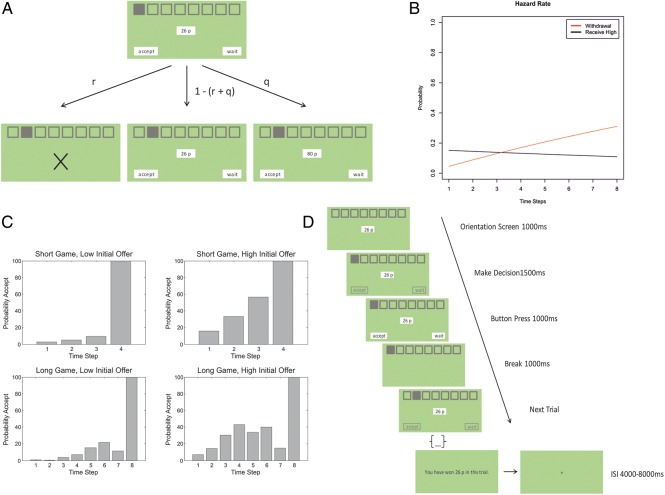
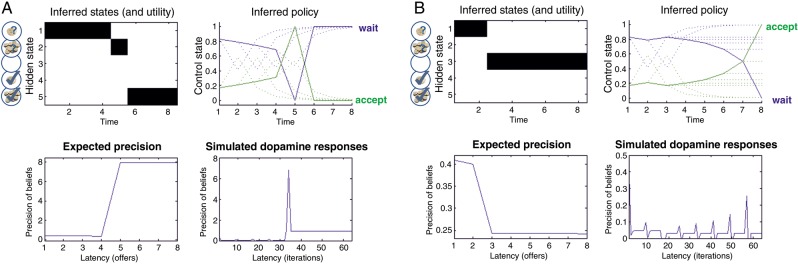
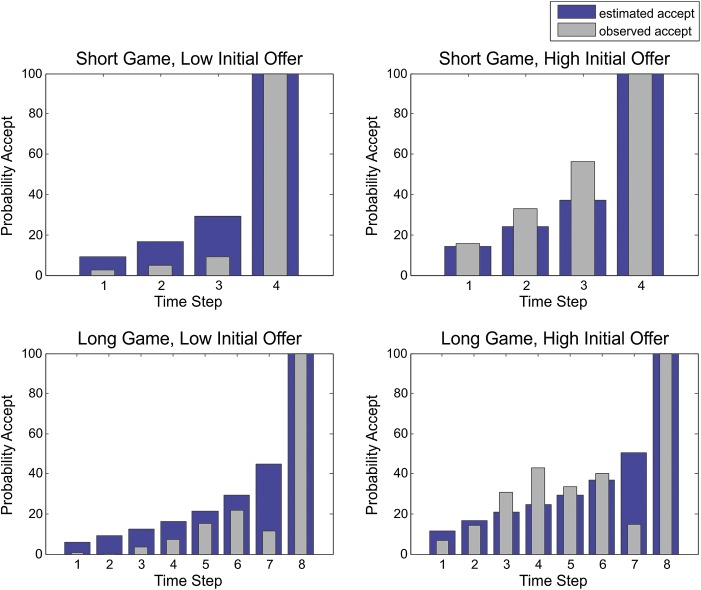
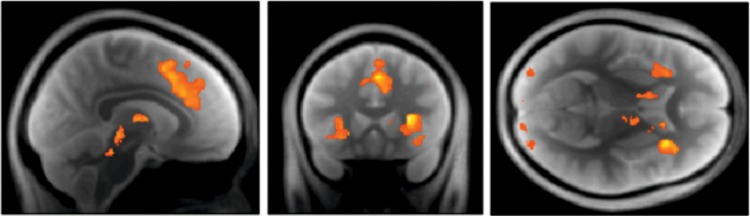
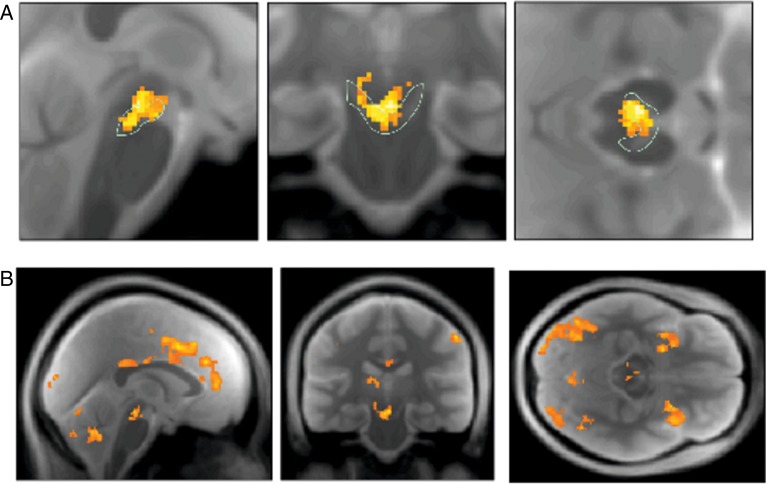
Dopamine plays a key role in learning; however, its exact function in decision making and choice remains unclear. Recently, we proposed a generic model based on active (Bayesian) inference wherein dopamine encodes the precision of beliefs about optimal policies. Put simply, dopamine discharges reflect the confidence that a chosen policy will lead to desired outcomes. We designed a novel task to test this hypothesis, where subjects played a "limited offer" game in a functional magnetic resonance imaging experiment. Subjects had to decide how long to wait for a high offer before accepting a low offer, with the risk of losing everything if they waited too long. Bayesian model comparison showed that behavior strongly supported active inference, based on surprise minimization, over classical utility maximization schemes. Furthermore, midbrain activity, encompassing dopamine projection neurons, was accurately predicted by trial-by-trial variations in model-based estimates of precision. Our findings demonstrate that human subjects infer both optimal policies and the precision of those inferences, and thus support the notion that humans perform hierarchical probabilistic Bayesian inference. In other words, subjects have to infer both what they should do as well as how confident they are in their choices, where confidence may be encoded by dopaminergic firing.
Overview
The claims and statistics of this paper haven’t been checked yet.
Run the check — free, no account needed. It reads the open-access text and checks the sources it cites.
Integrity signals
Registry
Cites
Statistics
Figures
Verification
Claims the paper makes
The claims and statistics of this paper haven’t been checked yet.
Run the check — free, no account needed. It reads the open-access text and checks the sources it cites.
Claims other papers make about this one
Each is checked against this paper’s own text: does it say what the citing paper says it does?
In the citing paper
“This approach has been used, for example, to identify links between activity in neuromodulatory nuclei and computational trajectories, such as (precision-weighted) prediction errors or uncertainty (111, 115–117).”
From Can Bayesian Theories of Autism Spectrum Disorder Help Improve Clinical Practice? (2016) · cites this paper as [117]
Self-check
Percentages, sums and reported differences re-computed from the paper’s own numbers.
The self-check needs the paper’s full text.
Citations
Cites
Reinforcement Learning: An Introduction
Sutton, R. S., & Barto, A. G. (1998) · IEEE Transactions on Neural Networks · doi:10.1109/tnn.1998.712192 · Cited by 27,225
Reinforcement Learning: An Introduction
Sutton, R. S., & Barto, A. (2005) · IEEE Transactions on Neural Networks · doi:10.1109/tnn.2004.842673 · Cited by 25,268
Tzourio-Mazoyer, N., Landeau, B., Papathanassiou, D., Crivello, F., Etard, O., Delcroix, N., Mazoyer, B., & Joliot, M. (2002) · NeuroImage · doi:10.1006/nimg.2001.0978 · Cited by 16,319
A Stochastic Approximation Method
Robbins, H., & Monro, S. (1951) · The Annals of Mathematical Statistics · doi:10.1214/aoms/1177729586 · Cited by 9,643
A neural substrate of prediction and reward
Schultz, W., Dayan, P., & Montague, P. R. (1997) · Science · doi:10.1126/science.275.5306.1593 · Cited by 9,388
A fast diffeomorphic image registration algorithm
Ashburner, J. (2007) · NeuroImage · doi:10.1016/j.neuroimage.2007.07.007 · Cited by 8,122
Conflict monitoring and cognitive control
Botvinick, M. M., Braver, T. S., Barch, D. M., Carter, C. S., & Cohen, J. D. (2001) · Psychological Review · doi:10.1037/0033-295x.108.3.624 · Cited by 7,351
Rao, R. P. N., & Ballard, D. H. (1999) · Nature Neuroscience · doi:10.1038/4580 · Cited by 5,483 · cited 2×
“It can be thought of as the discrete time version of predictive coding—that now predominates in models of perceptual inference and learning (Srinivasan 1982; Rao and Ballard 1999; Seth 2011; Bastos et al. 2012).”
BackgroundMaldjian, J. A., Laurienti, P. J., Kraft, R., & Burdette, J. H. (2003) · NeuroImage · doi:10.1016/s1053-8119(03)00169-1 · Cited by 5,066
A theory of cortical responses.
Friston, K. (2005) · Philosophical Transactions of the Royal Society B: Biological Sciences · doi:10.1098/rstb.2005.1622 · Cited by 4,578
Self-citation
Cited by
Sorted by citations
Active inference: a process theory
Friston, K., FitzGerald, T., Rigoli, F., Schwartenbeck, P., & Pezzulo, G. (2017) · Neural Computation · doi:10.1162/neco_a_00912 · Cited by 1,156
Self-citationActive inference and epistemic value
Friston, K., Rigoli, F., Ognibene, D., Mathys, C., Fitzgerald, T., & Pezzulo, G. (2015) · Cognitive Neuroscience · doi:10.1080/17588928.2015.1020053 · Cited by 731
Self-citationSerotonin and brain function: a tale of two receptors
Carhart-Harris, R., & Nutt, D. (2017) · Journal of Psychopharmacology · doi:10.1177/0269881117725915 · Cited by 739
Friston, K., FitzGerald, T., Rigoli, F., Schwartenbeck, P., O⿿Doherty, J., & Pezzulo, G. (2016) · Neuroscience & Biobehavioral Reviews · doi:10.1016/j.neubiorev.2016.06.022 · Cited by 674
Self-citationAllostatic Self-efficacy: A Metacognitive Theory of Dyshomeostasis-Induced Fatigue and Depression
Stephan, K. E., Manjaly, Z. M., Mathys, C. D., Weber, L. A. E., Paliwal, S., Gard, T., Tittgemeyer, M., Fleming, S. M., Haker, H., Seth, A. K., et al. (2016) · Frontiers in Human Neuroscience · doi:10.3389/fnhum.2016.00550 · Cited by 437
Self-citation
Metadata
- Authors
- Schwartenbeck, P., FitzGerald, T. H. B., Mathys, C., Dolan, R., & Friston, K.
- Affiliations
- Wellcome Centre for Human Neuroimaging (GB)
- Corresponding author
- Schwartenbeck, Philipp
- Venue
- Cerebral Cortex
- Publisher
- Oxford University Press (OUP)
- Published
- 2014-07-23
- Volume
- 25
- Issue
- 10
- Pages
- 3434-3445
- ISSN
- 1047-3211 (ISSN-L)
- 1460-2199
- PMC
- PMC4585497
- OpenAlex
- W2128918015
- Cited by
- 219
- References
- 80
- Citations by year
- 2026: 20 · 2025: 19 · 2024: 13 · 2023: 19 · 2022: 26 · 2021: 19 · 2020: 26 · 2019: 15 · 2018: 20 · 2017: 12 · 2016: 17 · 2015: 10 · 2014: 3
- FWCI
- 7.81
- Type
- journal article
- Language
- en
- Open access
- hybrid
- doi.org
- Licence
- cc-by
- Locations
- Cerebral Cortex (publishedVersion, cc-by)
- PubMed Central (publishedVersion, cc-by)
- PubMed (publishedVersion)
- SDL (submittedVersion, cc-by)
- UEA Digital Repository (University of East Anglia) (submittedVersion, other-oa)
- UCL Discovery (University College London) (submittedVersion)
- MPG.PuRe (Max Planck Society) (submittedVersion)
- Funders
- Wellcome Trust (091593, 091593/Z/10/, 098362, 098362/Z/12/Z, 091593/Z/10/Z, 088130, 098362/Z/12/)
- University College London (098362/Z/12/Z)
- Max-Planck-Gesellschaft (098362/Z/12/Z)
- Topics
- Life Sciences › Neuroscience › Cognitive Neuroscience › Neural and Behavioral Psychology Studies
- Life Sciences › Neuroscience › Cellular and Molecular Neuroscience › Neurotransmitter Receptor Influence on Behavior
- Social Sciences › Decision Sciences › General Decision Sciences › Decision-Making and Behavioral Economics
- Keywords
- dopamine, midbrain, Bayesian inference, active inference, decision-making, surprise minimization, utility maximization, hierarchical Bayesian inference
- MeSH terms
- Adult, Bayes Theorem, Brain Mapping, Cerebral Cortex, Choice Behavior, Conflict, Psychological, Dopamine, Female, Humans, Magnetic Resonance Imaging, Male, Middle Aged, Risk, Substantia Nigra, Ventral Tegmental Area, Young Adult
About these checks
Registry, retraction, Cites and statistics results are computed, not judged, with one exception: a printed reference that no index lists is read once by a model before it counts as a citation error. Claims are extracted by a model and kept only when their quote appears verbatim in the text; each cited source is then checked, with a model’s help, for whether it says what the claim relies on. Those verdicts can be wrong — read the claim’s quote and the cited source before relying on one.
Statistics and arithmetic are recomputed, not judged.
Confidence bands are shown only for fields calibrated on our annotated test set. None is calibrated yet, so no band is shown.
What counts as a claim ›How we measure confidence ›How we check this ›
Are you an author, or do you see a problem with this page? Request a review
