

Objective Morphological Classification of Neocortical Pyramidal Cells
Open accessPublished version of a preprint
The DOI matches its Crossref record; 88 of the 88 references it cites were found in a registry or an index.
Abstract
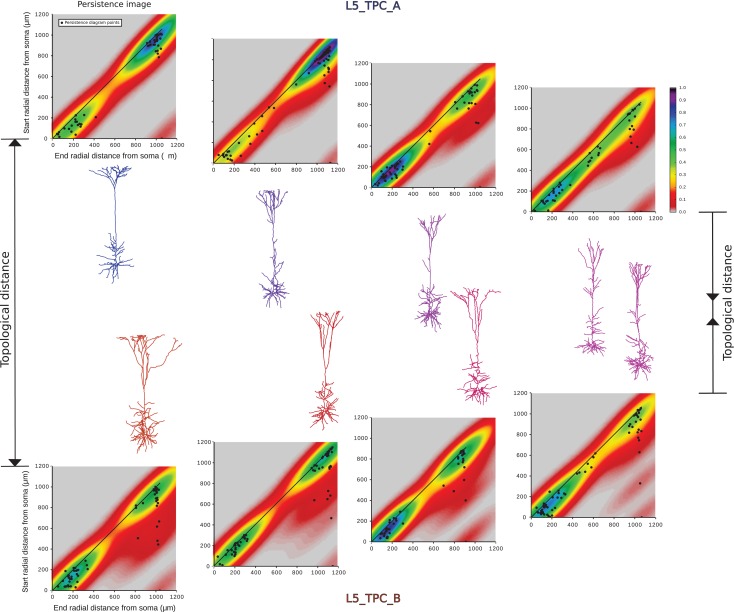
A consensus on the number of morphologically different types of pyramidal cells (PCs) in the neocortex has not yet been reached, despite over a century of anatomical studies, due to the lack of agreement on the subjective classifications of neuron types, which is based on expert analyses of neuronal morphologies. Even for neurons that are visually distinguishable, there is no common ground to consistently define morphological types. The objective classification of PCs can be achieved with methods from algebraic topology, and the dendritic arborization is sufficient for the reliable identification of distinct types of cortical PCs. Therefore, we objectively identify 17 types of PCs in the rat somatosensory cortex. In addition, we provide a solution to the challenging problem of whether 2 similar neurons belong to different types or to a continuum of the same type. Our topological classification does not require expert input, is stable, and helps settle the long-standing debate on whether cell-types are discrete or continuous morphological variations of each other.
Overview
The claims and statistics of this paper haven’t been checked yet.
Free: it reads the open-access text and checks the first 5 claims that cite a source we can check. Create a free account to check every claim.
Integrity signals
Registry
Cites
Statistics
Figures




Verification
Claims the paper makes
The claims and statistics of this paper haven’t been checked yet.
Free: it reads the open-access text and checks the first 5 claims that cite a source we can check. Create a free account to check every claim.
Claims other papers make about this one
Each is checked against this paper’s own text: does it say what the citing paper says it does?
The check wasn’t confident either way, so it gives no verdict — never disputed.
In the citing paper
“these cells are expected to have the Sst-Chodl t-type, linked to deep long-range projecting interneurons12,14,36,37 (Fig. 7h).”
From Classification of electrophysiological and morphological neuron types in the mouse visual cortex (2019) · cites this paper as [37]
Experimental — accuracy not yet measured
Self-check
Percentages, sums and reported differences re-computed from the paper’s own numbers.
The self-check needs the paper’s full text.
Citations
Cites
Topics in Optimal Transportation
Villani, C. (2003) · Graduate Studies in Mathematics · doi:10.1090/gsm/058 · Cited by 4,412 · cited 1×
“To evaluate TMD-classification performance, we computed the bottleneck distance (Edelsbrunner and Harer 2008), the Wasserstein distance (Villani 2003, Edelsbrunner and Harer 2010), the sliced-Wasserstein distance (Carrière et al. 2017), and a number of distances on the vectorized persistence…”
MethodRegulation of Synaptic Efficacy by Coincidence of Postsynaptic APs and EPSPs
Markram, H., Lübke, J., Frotscher, M., & Sakmann, B. (1997) · Science · doi:10.1126/science.275.5297.213 · Cited by 3,832 · cited 2×
“2003; Spruston 2008), and spike-timing dependent plasticity (Markram 1997; Sjöström et al. 2001; Froemke et al. 2005).”
BackgroundSelf-citationCarlsson, G. (2009) · Bulletin of the American Mathematical Society · doi:10.1090/s0273-0979-09-01249-x · Cited by 2,302 · cited 2×
“We have developed an alternative representation of morphologies based on persistent homology (Carlsson 2009) that provides a standardized quantification of neuronal branching structure.”
BackgroundMethodSelecting and interpreting measures of thematic classification accuracy
Stehman, S. V. (1997) · Remote Sensing of Environment · doi:10.1016/s0034-4257(97)00083-7 · Cited by 1,729
Computational topology an introduction
Edelsbrunner, H., & Harer, J. (2010) · Cited by 1,718
Pyramidal neurons: dendritic structure and synaptic integration
Spruston, N. (2008) · Nature Reviews Neuroscience · doi:10.1038/nrn2286 · Cited by 1,688 · cited 3×
“1995), integration of synaptic inputs from different cortical layers (Larkum et al. 1999, 2001; Schaefer et al. 2003; Spruston 2008), and spike-timing dependent plasticity (Markram 1997; Sjöström et al.”
BackgroundReconstruction and Simulation of Neocortical Microcircuitry
Markram, H., Muller, E., Ramaswamy, S., Reimann, M. W., Abdellah, M., Sanchez, C. A., Ailamaki, A., Alonso-Nanclares, L., Antille, N., Arsever, S., et al. (2015) · Cell · doi:10.1016/j.cell.2015.09.029 · Cited by 1,557 · cited 2×
“Therefore, it appears that the geometry of basal dendrites does not generalize across cortical layers, regions, and species (Ramaswamy and Markram 2015).”
BackgroundSelf-citationPetilla terminology: nomenclature of features of GABAergic interneurons of the cerebral cortex
The Petilla Interneuron Nomenclature Group (PING) (2008) · Nature Reviews Neuroscience · doi:10.1038/nrn2402 · Cited by 1,491
Active propagation of somatic action potentials into neocortical pyramidal cell dendrites
Stuart, G. J., & Sakmann, B. (1994) · Nature · doi:10.1038/367069a0 · Cited by 1,289 · cited 1×
“2007, van Elburg and van Ooyen 2010, Cuntz 2012, Ooyen and Elburg 2013, Bird and Cuntz 2016) and synaptic events, such as back-propagating action potentials (Stuart and Sakmann 1994), calcium transients in dendrites (Markram and Sakmann 1994; Schiller et al.”
BackgroundMarkram, H. (2006) · Nature Reviews Neuroscience · doi:10.1038/nrn1848 · Cited by 1,185
Self-citation
Cited by
Items 101–116 of 116
Reimann, M. W., Bolanõs-Puchet, S., Courcol, J.-D., et al. (2024) · eLife · doi:10.7554/elife.99688.1.sa2
Reimann, M. W., Bolanõs-Puchet, S., Courcol, J.-D., et al. (2024) · eLife · doi:10.7554/elife.99688.1.sa0
Reimann, M. W., Bolanõs-Puchet, S., Courcol, J.-D., et al. (2024) · eLife · doi:10.7554/elife.99688.1.sa1
Innocenti, G. M., & Rockland, K. S. (2025) · Elsevier eBooks · doi:10.1016/b978-0-12-818894-1.00033-1
Ecker, A., Santander, D. E., Abdellah, M., Alonso, J. B., Bolaños‐Puchet, S., Chindemi, G., Mariyappan, D. P. G., Isbister, J. B., King, J. G., Kumbhar, P., et al. (2025) · eLife · doi:10.7554/elife.101850.2
Self-citationIntrinsic Bottleneck Distance for Merge TreesPreprint
Beers, D., & Grindstaff, G. (2025) · arXiv (Cornell University) · doi:10.48550/arxiv.2509.02755
“The last ingredient for the proof of Theorem 19 we need is an arbitrarily small perturbation of a path in MT contained in MT n for some n .”
Kukkar, K. K., Kim, H., Parikh, P. J., & Miyakoshi, M. (2026) · medRxiv · doi:10.64898/2026.01.23.26344529
A morphology-spatial awareness network for neuronal classification and retrieval
Fu, Y., Sun, M., Qi, S., Ma, F., Li, D., Liu, C., & Meng, J. (2026) · Journal of Innovative Optical Health Sciences · doi:10.1142/s1793545826500057
Emissah, H., Tecuatl, C., & Ascoli, G. A. (2026) · Journal of Integrative Neuroscience · doi:10.64898/2026.03.27.714818
Zhang, Y., Xu, W., Zhou, X., Cao, S., & Zhang, Q. (2026) · arXiv (Cornell University) · doi:10.48550/arxiv.2608.04460
“The Topological Morphology Descriptor summarizes branching by a radial persistence barcode (Kanari et al., 2018; 2019).”
Ke, L., Shen, Y., Shao, M., Hu, C., Wei, Y., Liu, R.-F., & Liu, S. (2026) · Biomedical Signal Processing and Control · doi:10.1016/j.bspc.2026.111534
Reconstruction of astrocyte morphology based on the fast marching method with a new speed profile
Goslavskit, L. N., & Brazhe, A. R. (2026) · Computer Research and Modeling · doi:10.20537/2076-7633-2026-18-5-1365-1377
Metadata
- Authors
- Kanari, L., Ramaswamy, S., Shi, Y., Morand, S., Meystre, J., Perin, R., Abdellah, M., Wang, Y., Hess, K., & Markram, H.
- Affiliations
- École Polytechnique Fédérale de Lausanne (CH)
- Allen Institute for Brain Science (US)
- Corresponding author
- Kanari, Lida
- Markram, Henry
- ORCID
- Venue
- Cerebral Cortex
- Publisher
- Oxford University Press (OUP)
- Published
- 2019-01-31
- Volume
- 29
- Issue
- 4
- Pages
- 1719-1735
- ISSN
- 1047-3211 (ISSN-L)
- 1460-2199
- PMC
- PMC6418396
- OpenAlex
- W2911934184
- Cited by
- 94
- References
- 88
- Citations by year
- 2026: 9 · 2025: 12 · 2024: 18 · 2023: 11 · 2022: 14 · 2021: 9 · 2020: 16 · 2019: 5
- FWCI
- 5.33
- Type
- journal article
- Language
- en
- Open access
- hybrid
- doi.org
- Licence
- Locations
- Cerebral Cortex (publishedVersion, cc-by-nc)
- bioRxiv (Cold Spring Harbor Laboratory) (acceptedVersion)
- Europe PMC (PubMed Central) (publishedVersion, cc-by-nc)
- PubMed Central (publishedVersion, cc-by-nc)
- PubMed (publishedVersion)
- Infoscience (Ecole Polytechnique Fédérale de Lausanne) (submittedVersion, cc-by-nc-nd)
- Funders
- European Union Seventh (604102)
- HBP (720270)
- HBP SGA1
- National Natural Science Foundation (No. 31070951)
- Topics
- Life Sciences › Biochemistry, Genetics and Molecular Biology › Biophysics › Cell Image Analysis Techniques
- Physical Sciences › Computer Science › Computational Theory and Mathematics › Topological and Geometric Data Analysis
- Life Sciences › Neuroscience › Cognitive Neuroscience › Neural dynamics and brain function
- Keywords
- neocortical pyramidal cells, dendritic branching, algebraic topology, topological classification, somatosensory cortex, rats
- MeSH terms
- Supervised Machine Learning, Animals, Lysine, Pattern Recognition, Automated, Somatosensory Cortex, Pyramidal Cells, Neocortex, Imaging, Three-Dimensional, Rats
About these checks
Registry, retraction, Cites and statistics results are computed, not judged, with one exception: a printed reference that no index lists is read once by a model before it counts as a citation error. Claims are extracted by a model and kept only when their quote appears verbatim in the text; each cited source is then checked, with a model’s help, for whether it says what the claim relies on. Those verdicts can be wrong — read the claim’s quote and the cited source before relying on one.
Statistics and arithmetic are recomputed, not judged.
Confidence bands are shown only for fields calibrated on our annotated test set. None is calibrated yet, so no band is shown.
What counts as a claim ›How we measure confidence ›How we check this ›
Are you an author, or do you see a problem with this page? Request a review
Data sources
Bibliographic data: Semantic Scholar, OpenAlex, Crossref.
Contains information from the Semantic Scholar Academic Graph Datasets, made available under the ODC Attribution License (ODC-BY 1.0).
Semantic Scholar’s data is described in: Kinney, R., et al. (2023). The Semantic Scholar Open Data Platform. arXiv:2301.10140.
