

Objective Morphological Classification of Neocortical Pyramidal Cells
Open accessPublished version of a preprint
The DOI matches its Crossref record; 88 of the 88 references it cites were found in a registry or an index.
Abstract
A consensus on the number of morphologically different types of pyramidal cells (PCs) in the neocortex has not yet been reached, despite over a century of anatomical studies, due to the lack of agreement on the subjective classifications of neuron types, which is based on expert analyses of neuronal morphologies. Even for neurons that are visually distinguishable, there is no common ground to consistently define morphological types. The objective classification of PCs can be achieved with methods from algebraic topology, and the dendritic arborization is sufficient for the reliable identification of distinct types of cortical PCs. Therefore, we objectively identify 17 types of PCs in the rat somatosensory cortex. In addition, we provide a solution to the challenging problem of whether 2 similar neurons belong to different types or to a continuum of the same type. Our topological classification does not require expert input, is stable, and helps settle the long-standing debate on whether cell-types are discrete or continuous morphological variations of each other.
Overview
The claims and statistics of this paper haven’t been checked yet.
Free: it reads the open-access text and checks the first 5 claims that cite a source we can check. Create a free account to check every claim.
Integrity signals
Registry
Cites
Statistics
Figures




Verification
Claims the paper makes
The claims and statistics of this paper haven’t been checked yet.
Free: it reads the open-access text and checks the first 5 claims that cite a source we can check. Create a free account to check every claim.
Claims other papers make about this one
Each is checked against this paper’s own text: does it say what the citing paper says it does?
The check wasn’t confident either way, so it gives no verdict — never disputed.
In the citing paper
“these cells are expected to have the Sst-Chodl t-type, linked to deep long-range projecting interneurons12,14,36,37 (Fig. 7h).”
From Classification of electrophysiological and morphological neuron types in the mouse visual cortex (2019) · cites this paper as [37]
Experimental — accuracy not yet measured
Self-check
Percentages, sums and reported differences re-computed from the paper’s own numbers.
The self-check needs the paper’s full text.
Citations
Cites
Topics in Optimal Transportation
Villani, C. (2003) · Graduate Studies in Mathematics · doi:10.1090/gsm/058 · Cited by 4,412 · cited 1×
“To evaluate TMD-classification performance, we computed the bottleneck distance (Edelsbrunner and Harer 2008), the Wasserstein distance (Villani 2003, Edelsbrunner and Harer 2010), the sliced-Wasserstein distance (Carrière et al. 2017), and a number of distances on the vectorized persistence…”
MethodRegulation of Synaptic Efficacy by Coincidence of Postsynaptic APs and EPSPs
Markram, H., Lübke, J., Frotscher, M., & Sakmann, B. (1997) · Science · doi:10.1126/science.275.5297.213 · Cited by 3,832 · cited 2×
“2003; Spruston 2008), and spike-timing dependent plasticity (Markram 1997; Sjöström et al. 2001; Froemke et al. 2005).”
BackgroundSelf-citationCarlsson, G. (2009) · Bulletin of the American Mathematical Society · doi:10.1090/s0273-0979-09-01249-x · Cited by 2,302 · cited 2×
“We have developed an alternative representation of morphologies based on persistent homology (Carlsson 2009) that provides a standardized quantification of neuronal branching structure.”
BackgroundMethodSelecting and interpreting measures of thematic classification accuracy
Stehman, S. V. (1997) · Remote Sensing of Environment · doi:10.1016/s0034-4257(97)00083-7 · Cited by 1,729
Computational topology an introduction
Edelsbrunner, H., & Harer, J. (2010) · Cited by 1,718
Pyramidal neurons: dendritic structure and synaptic integration
Spruston, N. (2008) · Nature Reviews Neuroscience · doi:10.1038/nrn2286 · Cited by 1,688 · cited 3×
“1995), integration of synaptic inputs from different cortical layers (Larkum et al. 1999, 2001; Schaefer et al. 2003; Spruston 2008), and spike-timing dependent plasticity (Markram 1997; Sjöström et al.”
BackgroundReconstruction and Simulation of Neocortical Microcircuitry
Markram, H., Muller, E., Ramaswamy, S., Reimann, M. W., Abdellah, M., Sanchez, C. A., Ailamaki, A., Alonso-Nanclares, L., Antille, N., Arsever, S., et al. (2015) · Cell · doi:10.1016/j.cell.2015.09.029 · Cited by 1,557 · cited 2×
“Therefore, it appears that the geometry of basal dendrites does not generalize across cortical layers, regions, and species (Ramaswamy and Markram 2015).”
BackgroundSelf-citationPetilla terminology: nomenclature of features of GABAergic interneurons of the cerebral cortex
The Petilla Interneuron Nomenclature Group (PING) (2008) · Nature Reviews Neuroscience · doi:10.1038/nrn2402 · Cited by 1,491
Active propagation of somatic action potentials into neocortical pyramidal cell dendrites
Stuart, G. J., & Sakmann, B. (1994) · Nature · doi:10.1038/367069a0 · Cited by 1,289 · cited 1×
“2007, van Elburg and van Ooyen 2010, Cuntz 2012, Ooyen and Elburg 2013, Bird and Cuntz 2016) and synaptic events, such as back-propagating action potentials (Stuart and Sakmann 1994), calcium transients in dendrites (Markram and Sakmann 1994; Schiller et al.”
BackgroundMarkram, H. (2006) · Nature Reviews Neuroscience · doi:10.1038/nrn1848 · Cited by 1,185
Self-citationA new cellular mechanism for coupling inputs arriving at different cortical layers
Larkum, M. E., Zhu, J. J., & Sakmann, B. (1999) · Nature · doi:10.1038/18686 · Cited by 1,180
Rate, Timing, and Cooperativity Jointly Determine Cortical Synaptic Plasticity
Sjöström, P. J., Turrigiano, G. G., & Nelson, S. B. (2001) · Neuron · doi:10.1016/s0896-6273(01)00542-6 · Cited by 1,174 · cited 1×
“2003; Spruston 2008), and spike-timing dependent plasticity (Markram 1997; Sjöström et al. 2001; Froemke et al. 2005).”
BackgroundDeFelipe, J., & Fariñas, I. (1992) · Progress in Neurobiology · doi:10.1016/0301-0082(92)90015-7 · Cited by 975 · cited 1×
“The mammalian neocortex is comprised of about 85% excitatory pyramidal cells (PCs), and around 15% inhibitory interneurons (Cajal Santiago Ramon yy 1911; DeFelipe and Fariñas 1992; Spruston 2008; Markram et al. 2015; Ramaswamy and Markram 2015).”
BackgroundMarkram, H., Lübke, J., Frotscher, M., Roth, A., & Sakmann, B. (1997) · The Journal of Physiology · doi:10.1113/jphysiol.1997.sp022031 · Cited by 960 · cited 1×
“…transients in dendrites (Markram and Sakmann 1994; Schiller et al. 1995), integration of synaptic inputs from different cortical layers (Larkum et al. 1999, 2001; Schaefer et al. 2003; Spruston 2008), and spike-timing dependent plasticity (Markram 1997; Sjöström et al. 2001; Froemke et al. 2005).”
BackgroundSelf-citationEdelsbrunner, H., & Harer, J. (2008) · Contemporary Mathematics · doi:10.1090/conm/453/08802 · Cited by 848 · cited 1×
“To evaluate TMD-classification performance, we computed the bottleneck distance (Edelsbrunner and Harer 2008), the Wasserstein distance (Villani 2003, Edelsbrunner and Harer 2010), the sliced-Wasserstein distance (Carrière et al.”
MethodNew insights into the classification and nomenclature of cortical GABAergic interneurons
DeFelipe, J., López-Cruz, P. L., Benavides-Piccione, R., Bielza, C., Larrañaga, P., Anderson, S., Burkhalter, A., Cauli, B., Fairén, A., Feldmeyer, D., et al. (2013) · Nature Reviews Neuroscience · doi:10.1038/nrn3444 · Cited by 833 · cited 4×
“A striking indication of this problem, as described previously (DeFelipe et al. 2013), is the fact that experts assign a different cell type to a neuron from the one they had chosen in their original study for the same neuron, independently of the reconstruction quality (DeFelipe et al.”
BackgroundInfluentialSelf-citationExcitatory cortical neurons form fine-scale functional networks
Yoshimura, Y., Dantzker, J. L. M., & Callaway, E. M. (2005) · Nature · doi:10.1038/nature03252 · Cited by 613 · cited 1×
“2017) and form distinct synaptic subnetworks within and across layers (Yoshimura et al. 2005; Kampa et al. 2006).”
BackgroundAction potential initiation and propagation in rat neocortical pyramidal neurons
Stuart, G., Schiller, J., & Sakmann, B. (1997) · The Journal of Physiology · doi:10.1111/j.1469-7793.1997.617ba.x · Cited by 583
Heterogeneity in the pyramidal network of the medial prefrontal cortex
Wang, Y., Markram, H., Goodman, P. H., Berger, T. K., Ma, J., & Goldman-Rakic, P. S. (2006) · Nature Neuroscience · doi:10.1038/nn1670 · Cited by 503
Self-citationWang, Y., Toledo‐Rodriguez, M., Gupta, A., Wu, C., Silberberg, G., Luo, J., & Markram, H. (2004) · The Journal of Physiology · doi:10.1113/jphysiol.2004.073353 · Cited by 491
Self-citationMason, A., & Larkman, A. (1990) · The Journal of Neuroscience · doi:10.1523/jneurosci.10-05-01415.1990 · Cited by 481 · cited 2×
“A growing body of evidence suggests a strong correlation between locally defined types of PCs and their target regions, which are genetically determined early on during differentiation and prior to the migration of the neurons to their destination layers (Mason and Larkman 1990; O’leary and Koester 1993, Kasper et al.…”
BackgroundStatistical topological data analysis using persistence landscapes
Bubenik, P. (2012) · arXiv (Cornell University) · doi:10.48550/arxiv.1207.6437 · Cited by 476
Cortex, Cognition and the Cell: New Insights into the Pyramidal Neuron and Prefrontal Function
Elston, G. N. (2003) · Cerebral Cortex · doi:10.1093/cercor/bhg093 · Cited by 440
Larkum, M. E., Zhu, J. J., & Sakmann, B. (2001) · The Journal of Physiology · doi:10.1111/j.1469-7793.2001.0447a.x · Cited by 418
Spike-timing-dependent synaptic plasticity depends on dendritic location
Froemke, R. C., Poo, M.-M., & Dan, Y. (2005) · Nature · doi:10.1038/nature03366 · Cited by 402 · cited 1×
“2003; Spruston 2008), and spike-timing dependent plasticity (Markram 1997; Sjöström et al. 2001; Froemke et al. 2005).”
BackgroundMarkram, H., Helm, P. J., & Sakmann, B. (1995) · The Journal of Physiology · doi:10.1113/jphysiol.1995.sp020708 · Cited by 383
Self-citationWang, Y. (2002) · Cerebral Cortex · doi:10.1093/cercor/12.4.395 · Cited by 376 · cited 1×
“…as previously described (Markram et al. 1997, Hughes et al. 2000, 1720 | Cerebral Cortex, 2019, Vol. 29, No. 4 D ow nloaded from https://academ ic.oup.com /cercor/article-abstract/29/4/1719/5304727 by guest on 07 M ay 2020 Pawelzik et al. 2002, Wang 2002, Wang et al. 2004, Be et al. 2006).”
MethodSelf-citationGong, H., Xu, D., Yuan, J., Li, X., Guo, C., Peng, J., Li, Y., Schwarz, L. A., Li, A., Hu, B., et al. (2016) · Nature Communications · doi:10.1038/ncomms12142 · Cited by 368
O'Leary, D. D. M., & Koester, S. E. (1993) · Neuron · doi:10.1016/0896-6273(93)90049-w · Cited by 361
Intracortical circuits of pyramidal neurons reflect their long-range axonal targets
Brown, S. P., & Hestrin, S. (2009) · Nature · doi:10.1038/nature07658 · Cited by 357 · cited 1×
“Indeed, long-range axonal projection of PCs is an important feature that enables different computational functions and should therefore be taken into account for their classification (Larsen and Callaway 2005; Hattox and Nelson 2007; Larsen 2008; Brown and Hestrin 2009; Boudewijns et al. 2011).”
BackgroundHattox, A. M., & Nelson, S. B. (2007) · Journal of Neurophysiology · doi:10.1152/jn.00397.2007 · Cited by 342
Larkman, A., & Mason, A. (1990) · The Journal of Neuroscience · doi:10.1523/jneurosci.10-05-01407.1990 · Cited by 307
The theory of multidimensional persistence
Carlsson, G., & Zomorodian, A. (2007) · Proceedings of the twenty-third annual symposium on Computational geometry - SCG '07 · doi:10.1145/1247069.1247105 · Cited by 299
Markram, H., & Sakmann, B. (1994) · Proceedings of the National Academy of Sciences · doi:10.1073/pnas.91.11.5207 · Cited by 293 · cited 1×
“2007, van Elburg and van Ooyen 2010, Cuntz 2012, Ooyen and Elburg 2013, Bird and Cuntz 2016) and synaptic events, such as back-propagating action potentials (Stuart and Sakmann 1994), calcium transients in dendrites (Markram and Sakmann 1994; Schiller et al. 1995), integration of synaptic inputs from different cortica…”
BackgroundSelf-citationRecurrent Connection Patterns of Corticostriatal Pyramidal Cells in Frontal Cortex
Morishima, M., & Kawaguchi, Y. (2006) · The Journal of Neuroscience · doi:10.1523/jneurosci.0252-06.2006 · Cited by 275 · cited 2×
“…differentiation and prior to the migration of the neurons to their destination layers (Mason and Larkman 1990; O’leary and Koester 1993, Kasper et al. 1994; Franceschetti et al. 1998; Gao and Zheng 2004; Larsen and Callaway 2005; Morishima 2006; Kumar and Ohana 2008; Marx and Feldmeyer 2012).”
BackgroundThe Theory of Multidimensional Persistence
Carlsson, G., & Zomorodian, A. (2009) · Discrete & Computational Geometry · doi:10.1007/s00454-009-9176-0 · Cited by 270
Coincidence Detection in Pyramidal Neurons Is Tuned by Their Dendritic Branching Pattern
Schaefer, A. T., Larkum, M. E., Sakmann, B., & Roth, A. (2003) · Journal of Neurophysiology · doi:10.1152/jn.00046.2003 · Cited by 266 · cited 1×
“1995), integration of synaptic inputs from different cortical layers (Larkum et al. 1999, 2001; Schaefer et al. 2003; Spruston 2008), and spike-timing dependent plasticity (Markram 1997; Sjöström et al.”
BackgroundPawelzik, H., Hughes, D. I., & Thomson, A. M. (2002) · Journal of Comparative Neurology · doi:10.1002/cne.10118 · Cited by 262
Ecker, J. R., Geschwind, D. H., Kriegstein, A. R., Ngai, J., Osten, P., Polioudakis, D., Regev, A., Sestan, N., Wickersham, I. R., & Zeng, H. (2017) · Neuron · doi:10.1016/j.neuron.2017.10.007 · Cited by 261 · cited 1×
“To evaluate TMD-classification performance, we computed the bottleneck distance (Edelsbrunner and Harer 2008), the Wasserstein distance (Villani 2003, Edelsbrunner and Harer 2010), the sliced-Wasserstein distance (Carrière et al. 2017), and a number of distances on the vectorized persistence…”
MethodRegulation by gastric acid of the processing of progastrin‐derived peptides in rat antral mucosa
Macro, J. A., Bate, G. W., Varro, A., Vaillant, C., Seidah, N. G., Dimaline, R., & Dockray, G. J. (1997) · The Journal of Physiology · doi:10.1111/j.1469-7793.1997.409bk.x · Cited by 257
Staiger, J. F. (2004) · Cerebral Cortex · doi:10.1093/cercor/bhh029 · Cited by 226
Kasper, E. M., Larkman, A. U., Lübke, J., & Blakemore, C. (1994) · Journal of Comparative Neurology · doi:10.1002/cne.903390402 · Cited by 224
Schiller, J., Helmchen, F., & Sakmann, B. (1995) · The Journal of Physiology · doi:10.1113/jphysiol.1995.sp020902 · Cited by 222 · cited 1×
“2007, van Elburg and van Ooyen 2010, Cuntz 2012, Ooyen and Elburg 2013, Bird and Cuntz 2016) and synaptic events, such as back-propagating action potentials (Stuart and Sakmann 1994), calcium transients in dendrites (Markram and Sakmann 1994; Schiller et al. 1995), integration of synaptic inputs from different cortica…”
BackgroundThe fractions of short- and long-range connections in the visual cortex
Stepanyants, A., Martinez, L. M., Ferecskó, A. S., & Kisvárday, Z. F. (2009) · Proceedings of the National Academy of Sciences · doi:10.1073/pnas.0810390106 · Cited by 208
CBRAIN: a web-based, distributed computing platform for collaborative neuroimaging research
Sherif, T., Rioux, P., Rousseau, M.-E., Kassis, N., Beck, N., Adalat, R., Das, S., Glatard, T., & Evans, A. C. (2014) · Frontiers in Neuroinformatics · doi:10.3389/fninf.2014.00054 · Cited by 208
A Topological Representation of Branching Neuronal Morphologies
Kanari, L., Dłotko, P., Scolamiero, M., Levi, R., Shillcock, J., Hess, K., & Markram, H. (2018) · Neuroinformatics · doi:10.1007/s12021-017-9341-1 · Cited by 189 · cited 1×
“novel metric based on persistent homology (Kanari et al. 2018), which quantifies the branching structure of neuronal trees, to establish an objective standardized classification of PCs in the juvenile rat somatosensory cortex.”
BackgroundSelf-citationAnatomy and physiology of the thick-tufted layer 5 pyramidal neuron
Ramaswamy, S., & Markram, H. (2015) · Frontiers in Cellular Neuroscience · doi:10.3389/fncel.2015.00233 · Cited by 185 · cited 1×
“The mammalian neocortex is comprised of about 85% excitatory pyramidal cells (PCs), and around 15% inhibitory interneurons (Cajal Santiago Ramon yy 1911; DeFelipe and Fariñas 1992; Spruston 2008; Markram et al. 2015; Ramaswamy and Markram 2015).”
BackgroundSelf-citationSliced Wasserstein Kernel for Persistence DiagramsPreprint
Carrière, M., Cuturi, M., & Oudot, S. (2017) · arXiv (Cornell University) · doi:10.48550/arxiv.1706.03358 · Cited by 170 · cited 2×
“To evaluate TMD-classification performance, we computed the bottleneck distance (Edelsbrunner and Harer 2008), the Wasserstein distance (Villani 2003, Edelsbrunner and Harer 2010), the sliced-Wasserstein distance (Carrière et al. 2017), and a number of distances on the vectorized persistence diagrams: the distance bet…”
BackgroundMethodImpact of Dendritic Size and Dendritic Topology on Burst Firing in Pyramidal Cells
van Elburg, R. A. J., & van Ooyen, A. (2010) · PLoS Computational Biology · doi:10.1371/journal.pcbi.1000781 · Cited by 168
A persistence landscapes toolbox for topological statistics
Bubenik, P., & Dłotko, P. (2017) · Journal of Symbolic Computation · doi:10.1016/j.jsc.2016.03.009 · Cited by 166 · cited 1×
“2017), and a number of distances on the vectorized persistence diagrams: the distance between landscapes (Bubenik and Dłotko 2017) and the distance between signatures (Carrière et al.”
BackgroundPersistence Images: A Stable Vector Representation of Persistent Homology
Adams, H., Chepushtanova, S., Emerson, T., Hanson, E., Kirby, M. J. L., Motta, F. C., Neville, R., Peterson, C., Shipman, P. D., & Ziegelmeier, L. (2015) · arXiv (Cornell University) · doi:10.48550/arxiv.1507.06217 · Cited by 165 · cited 1×
“the “persistence image” (Adams et al. 2017) of the tree, which summarizes the density of components at different radial distances from the soma and can be used as input to various machine learning algorithms.”
MethodSeki, Y., Rybak, J., Wicher, D., Sachse, S., & Hansson, B. S. (2010) · Journal of Neurophysiology · doi:10.1152/jn.00249.2010 · Cited by 147
Ascoli, G. A., & Krichmar, J. L. (2000) · Neurocomputing · doi:10.1016/s0925-2312(00)00272-1 · Cited by 147 · cited 2×
“The standard morphometrics (such as section length, bifurcation angles, etc.) (Ascoli and Krichmar 2000, Petilla Interneuron Nomenclature Group et al. 2008) that are commonly used as input measurements for objective classification, focus on different local aspects of the neuronal morphology and…”
MethodLe Be, J.-V., Silberberg, G., Wang, Y., & Markram, H. (2007) · Cerebral Cortex · doi:10.1093/cercor/bhl127 · Cited by 145
Self-citationStable Topological Signatures for Points on 3D Shapes
Carrière, M., Oudot, S., & Ovsjanikov, M. (2015) · Computer Graphics Forum · doi:10.1111/cgf.12692 · Cited by 139 · cited 1×
“2017), and a number of distances on the vectorized persistence diagrams: the distance between landscapes (Bubenik and Dłotko 2017) and the distance between signatures (Carrière et al. 2015).”
BackgroundOptimization principles of dendritic structure
Cuntz, H., Borst, A., & Segev, I. (2007) · Theoretical Biology and Medical Modelling · doi:10.1186/1742-4682-4-21 · Cited by 139
Cortical feed-forward networks for binding different streams of sensory information
Kampa, B. M., Letzkus, J. J., & Stuart, G. J. (2006) · Nature Neuroscience · doi:10.1038/nn1798 · Cited by 136 · cited 1×
“2017) and form distinct synaptic subnetworks within and across layers (Yoshimura et al. 2005; Kampa et al. 2006).”
BackgroundOberlaender, M., Boudewijns, Z. S. R. M., Kleele, T., Mansvelder, H. D., Sakmann, B., & de Kock, C. P. J. (2011) · Proceedings of the National Academy of Sciences · doi:10.1073/pnas.1100647108 · Cited by 132
Deitcher, Y., Eyal, G., Kanari, L., Verhoog, M. B., Atenekeng Kahou, G. A., Mansvelder, H. D., de Kock, C. P. J., & Segev, I. (2017) · Cerebral Cortex · doi:10.1093/cercor/bhx226 · Cited by 119 · cited 1×
“The characteristic morphological shapes of apical dendrites are associated with their unique functional properties, as objectively defined types of PCs also express unique firing patterns (Deitcher et al. 2017) and form distinct synaptic subnetworks within and across layers (Yoshimura et al.”
BackgroundSelf-citationTree asymmetry—A sensitive and practical measure for binary topological trees
van Pelt, J., Uylings, H. B. M., Verwer, R. W. H., Pentney, R. J., & Woldenberg, M. J. (1992) · Bulletin of Mathematical Biology · doi:10.1007/bf02459929 · Cited by 115
Towards the automatic classification of neurons
Armañanzas, R., & Ascoli, G. A. (2015) · Trends in Neurosciences · doi:10.1016/j.tins.2015.02.004 · Cited by 107
Cell Type-Specific Structural Organization of the Six Layers in Rat Barrel Cortex
Narayanan, R. T., Udvary, D., & Oberlaender, M. (2017) · Frontiers in Neuroanatomy · doi:10.3389/fnana.2017.00091 · Cited by 100
Development of layer-specific axonal arborizations in mouse primary somatosensory cortex
Larsen, D. D., & Callaway, E. M. (2006) · The Journal of Comparative Neurology · doi:10.1002/cne.20754 · Cited by 95
Kumar, P., & Ohana, O. (2008) · Journal of Neurophysiology · doi:10.1152/jn.90684.2008 · Cited by 94 · cited 1×
“A growing body of evidence suggests a strong correlation between locally defined types of PCs and their target regions, which are genetically determined early on during differentiation and prior to the migration of the neurons to their destination layers (Mason and Larkman 1990; O’leary and Koester 1993, Kasper et al.…”
BackgroundProperties of Layer 6 Pyramidal Neuron Apical Dendrites
Ledergerber, D., & Larkum, M. E. (2010) · The Journal of Neuroscience · doi:10.1523/jneurosci.2254-10.2010 · Cited by 93
Larsen, D. D. (2008) · Frontiers in Neural Circuits · doi:10.3389/neuro.04.005.2007 · Cited by 85
Morphology and Physiology of Excitatory Neurons in Layer 6b of the Somatosensory Rat Barrel Cortex
Marx, M., & Feldmeyer, D. (2013) · Cerebral Cortex · doi:10.1093/cercor/bhs254 · Cited by 78 · cited 2×
“A growing body of evidence suggests a strong correlation between locally defined types of PCs and their target regions, which are genetically determined early on during differentiation and prior to the migration of the neurons to their destination layers (Mason and Larkman 1990; O’leary and Koester 1993, Kasper et al.…”
BackgroundResultFranceschetti, S., Sancini, G., Panzica, F., Radici, C., & AVANZINI, G. (1998) · Neuroscience · doi:10.1016/s0306-4522(97)00463-6 · Cited by 70 · cited 1×
“A growing body of evidence suggests a strong correlation between locally defined types of PCs and their target regions, which are genetically determined early on during differentiation and prior to the migration of the neurons to their destination layers (Mason and Larkman 1990; O’leary and Koester 1993, Kasper et al.…”
BackgroundGao, W., & Zheng, Z. (2004) · Journal of Comparative Neurology · doi:10.1002/cne.20224 · Cited by 70
Multidimensional Persistence and Noise
Scolamiero, M., Chachólski, W., Lundman, A., Ramanujam, R., & Öberg, S. (2016) · Foundations of Computational Mathematics · doi:10.1007/s10208-016-9323-y · Cited by 68
BlastNeuron for Automated Comparison, Retrieval and Clustering of 3D Neuron Morphologies
Wan, Y., Long, F., Qu, L., Xiao, H., Hawrylycz, M., Myers, E. W., & Peng, H. (2015) · Neuroinformatics · doi:10.1007/s12021-015-9272-7 · Cited by 65
Morphological Diversity Strongly Constrains Synaptic Connectivity and Plasticity
Reimann, M. W., Horlemann, A.-L., Ramaswamy, S., Muller, E. B., & Markram, H. (2017) · Cerebral Cortex · doi:10.1093/cercor/bhx150 · Cited by 58
Self-citationWang, Y., Ye, M., Kuang, X., Li, Y., & Hu, S. (2018) · IBRO Reports · doi:10.1016/j.ibror.2018.10.001 · Cited by 49 · cited 1×
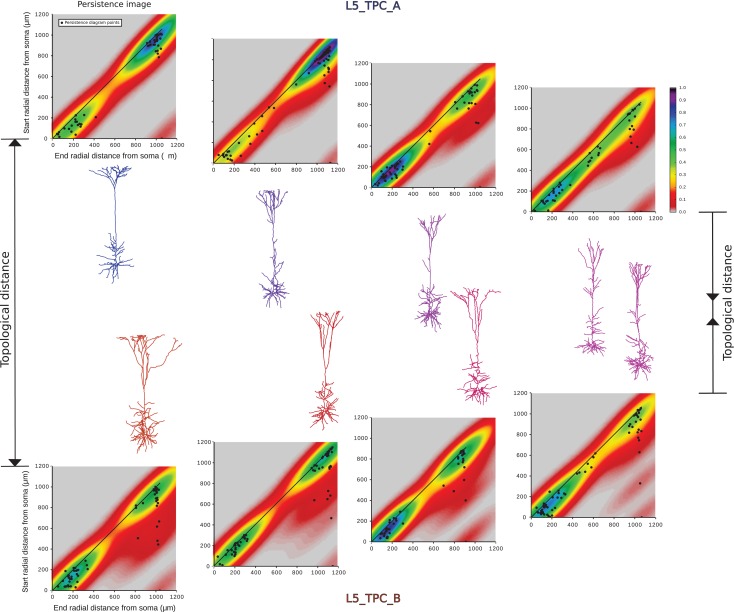
“We compared the results of the topological classification to the expert-proposed cell types (Wang et al. 2018) and illustrate that the majority of subjective cell types can be objectively supported, with the exception of L5 subtypes (TPC_A and TPC_B) and the rare horizontal PCs that are found in L6.”
ResultSelf-citationVisible rodent brain-wide networks at single-neuron resolution
Yuan, J., Gong, H., Li, A., Li, X., Chen, S., Zeng, S., & Luo, Q. (2015) · Frontiers in Neuroanatomy · doi:10.3389/fnana.2015.00070 · Cited by 41
Hughes, D. I., Bannister, A. P., Pawelzik, H., & Thomson, A. M. (2000) · Journal of Neuroscience Methods · doi:10.1016/s0165-0270(00)00254-5 · Cited by 38
Gillette, T. A., & Ascoli, G. A. (2015) · BMC Bioinformatics · doi:10.1186/s12859-015-0604-2 · Cited by 35
The Dendritic Density Field of a Cortical Pyramidal Cell
Cuntz, H. (2012) · Frontiers in Neuroanatomy · doi:10.3389/fnana.2012.00002 · Cited by 34 · cited 1×
“…unique functional properties to PCs and form the basis for the generation of active dendritic (Cuntz et al. 2007, van Elburg and van Ooyen 2010, Cuntz 2012, Ooyen and Elburg 2013, Bird and Cuntz 2016) and synaptic events, such as back-propagating action potentials (Stuart and Sakmann 1994),…”
BackgroundOptimal Current Transfer in Dendrites
Bird, A. D., & Cuntz, H. (2016) · PLoS Computational Biology · doi:10.1371/journal.pcbi.1004897 · Cited by 31
Ascoli, G. A., & Wheeler, D. W. (2016) · BioEssays · doi:10.1002/bies.201600067 · Cited by 27
Gillette, T. A., Hosseini, P., & Ascoli, G. A. (2015) · BMC Bioinformatics · doi:10.1186/s12859-015-0605-1 · Cited by 26
A robot for high yield electrophysiology and morphology of single neurons in vivo
Li, L., Ouellette, B., Stoy, W. A., Garren, E. J., Daigle, T. L., Forest, C. R., Koch, C., & Zeng, H. (2017) · Nature Communications · doi:10.1038/ncomms15604 · Cited by 19
Bielza, C., Benavides‐Piccione, R., López-Cruz, P. L., Larrañaga, P., & DeFelipe, J. (2014) · Scientific Reports · doi:10.1038/srep05909 · Cited by 18 · cited 1×
“This is in agreement with a previous study in rodents that reports common morphological features of basal dendrites across different cortical regions (Bielza et al. 2014).”
ResultAxonal and dendritic density field estimation from incomplete single-slice neuronal reconstructions
van Pelt, J., van Ooyen, A., & Uylings, H. B. M. (2014) · Frontiers in Neuroanatomy · doi:10.3389/fnana.2014.00054 · Cited by 14
Abdellah, M., Hernando, J., Antille, N., Eilemann, S., Markram, H., & Schürmann, F. (2017) · BMC Bioinformatics · doi:10.1186/s12859-017-1788-4 · Cited by 13 · cited 1×
“This method simulates the soma growth using Hooke’s law and mass-spring systems (Abdellah et al. 2017).”
MethodSelf-citationBoudewijns, Z. S. R. M., Kleele, T., Mansvelder, H. D., Sakmann, B. J., de Kock, C. P. J., & Oberlaender, M. (2011) · Communicative & Integrative Biology · doi:10.4161/cib.15670 · Cited by 8 · cited 2×
“Indeed, long-range axonal projection of PCs is an important feature that enables different computational functions and should therefore be taken into account for their classification (Larsen and Callaway 2005; Hattox and Nelson 2007; Larsen 2008; Brown and Hestrin 2009; Boudewijns et al. 2011).”
BackgroundIn Silico Brain Imaging Physically-plausible Methods for Visualizing Neocortical Microcircuitry
Abdellah, M. (2017) · Infoscience (Ecole Polytechnique Fédérale de Lausanne) · doi:10.13140/rg.2.2.27464.21767 · Cited by 6
Self-citationAxonal and dendritic density field estimation from incomplete single-slice neuronal reconstructions
van Pelt, J., van Ooyen, A., & Uylings, H. B. M. (2014) · Pure Amsterdam UMC · doi:10.7490/f1000research.1096568.1 · Cited by 4
Dendritic Size and Topology Influence Burst Firing in Pyramidal Cells
van Ooyen, A., & van Elburg, R. A. J. (2013) · Springer series in computational neuroscience · doi:10.1007/978-1-4614-8094-5_23 · Cited by 3
Cited by
Classification of electrophysiological and morphological neuron types in the mouse visual cortex
Gouwens, N. W., Sorensen, S. A., Berg, J., Lee, C., Jarsky, T., Ting, J., Sunkin, S. M., Feng, D., Anastassiou, C. A., Barkan, E., et al. (2019) · Nature Neuroscience · doi:10.1038/s41593-019-0417-0 · Cited by 456
Phenotypic variation of transcriptomic cell types in mouse motor cortex
Scala, F., Kobak, D., Bernabucci, M., Bernaerts, Y., Cadwell, C. R., Castro, J. R., Hartmanis, L., Jiang, X., Laturnus, S., Miranda, E., et al. (2021) · Nature · doi:10.1038/s41586-020-2907-3 · Cited by 398
“…near-projecting (NP) subclasses [4], Morphologically they have been classified Into big-tufted, small-tufted, untufted neurons, depending on the shape of the apical dendrite tuft, stellate neurons without an apical dendrite, and horizontal/inverted neurons in L6 [62, 63, 64, 65], Abundant in L2/3.”
Inhibitory specificity from a connectomic census of mouse visual cortex
Schneider-Mizell, C. M., Bodor, Á. L., Brittain, D., Buchanan, J., Bumbarger, D. J., Elabbady, L., Gamlin, C. R., Kapner, D., Kinn, S., Mahalingam, G., et al. (2025) · Nature · doi:10.1038/s41586-024-07780-8 · Cited by 165
Topological data analysis of task-based fMRI data from experiments on schizophrenia
Stolz, B. J., Emerson, T., Nahkuri, S., Porter, M. A., & Harrington, H. A. (2021) · Journal of Physics Complexity · doi:10.1088/2632-072x/abb4c6 · Cited by 83
Primate Neuronal Connections are Sparse as Compared to Mouse
Wildenberg, G. A., Rosen, M. C., Lundell, J., Paukner, D., Freedman, D. J., & Kasthuri, N. (2020) · Cell Reports · doi:10.1016/j.celrep.2021.109709 · Cited by 53
Metadata
- Authors
- Kanari, L., Ramaswamy, S., Shi, Y., Morand, S., Meystre, J., Perin, R., Abdellah, M., Wang, Y., Hess, K., & Markram, H.
- Affiliations
- École Polytechnique Fédérale de Lausanne (CH)
- Allen Institute for Brain Science (US)
- Corresponding author
- Kanari, Lida
- Markram, Henry
- ORCID
- Venue
- Cerebral Cortex
- Publisher
- Oxford University Press (OUP)
- Published
- 2019-01-31
- Volume
- 29
- Issue
- 4
- Pages
- 1719-1735
- ISSN
- 1047-3211 (ISSN-L)
- 1460-2199
- PMC
- PMC6418396
- OpenAlex
- W2911934184
- Cited by
- 94
- References
- 88
- Citations by year
- 2026: 9 · 2025: 12 · 2024: 18 · 2023: 11 · 2022: 14 · 2021: 9 · 2020: 16 · 2019: 5
- FWCI
- 5.33
- Type
- journal article
- Language
- en
- Open access
- hybrid
- doi.org
- Licence
- Locations
- Cerebral Cortex (publishedVersion, cc-by-nc)
- bioRxiv (Cold Spring Harbor Laboratory) (acceptedVersion)
- Europe PMC (PubMed Central) (publishedVersion, cc-by-nc)
- PubMed Central (publishedVersion, cc-by-nc)
- PubMed (publishedVersion)
- Infoscience (Ecole Polytechnique Fédérale de Lausanne) (submittedVersion, cc-by-nc-nd)
- Funders
- European Union Seventh (604102)
- HBP (720270)
- HBP SGA1
- National Natural Science Foundation (No. 31070951)
- Topics
- Life Sciences › Biochemistry, Genetics and Molecular Biology › Biophysics › Cell Image Analysis Techniques
- Physical Sciences › Computer Science › Computational Theory and Mathematics › Topological and Geometric Data Analysis
- Life Sciences › Neuroscience › Cognitive Neuroscience › Neural dynamics and brain function
- Keywords
- neocortical pyramidal cells, dendritic branching, algebraic topology, topological classification, somatosensory cortex, rats
- MeSH terms
- Supervised Machine Learning, Animals, Lysine, Pattern Recognition, Automated, Somatosensory Cortex, Pyramidal Cells, Neocortex, Imaging, Three-Dimensional, Rats
About these checks
Registry, retraction, Cites and statistics results are computed, not judged, with one exception: a printed reference that no index lists is read once by a model before it counts as a citation error. Claims are extracted by a model and kept only when their quote appears verbatim in the text; each cited source is then checked, with a model’s help, for whether it says what the claim relies on. Those verdicts can be wrong — read the claim’s quote and the cited source before relying on one.
Statistics and arithmetic are recomputed, not judged.
Confidence bands are shown only for fields calibrated on our annotated test set. None is calibrated yet, so no band is shown.
What counts as a claim ›How we measure confidence ›How we check this ›
Are you an author, or do you see a problem with this page? Request a review
Data sources
Bibliographic data: Semantic Scholar, OpenAlex, Crossref.
Contains information from the Semantic Scholar Academic Graph Datasets, made available under the ODC Attribution License (ODC-BY 1.0).
Semantic Scholar’s data is described in: Kinney, R., et al. (2023). The Semantic Scholar Open Data Platform. arXiv:2301.10140.
