

The DOI matches its Crossref record; 29 of the 34 references it cites were found in a registry or an index, and 2 are not checked yet.
Longitudinal Dynamics of the Neutralizing Antibody Response to Severe Acute Respiratory Syndrome Coronavirus 2 (SARS-CoV-2) Infection
Open accessPublished version of a preprint
Abstract
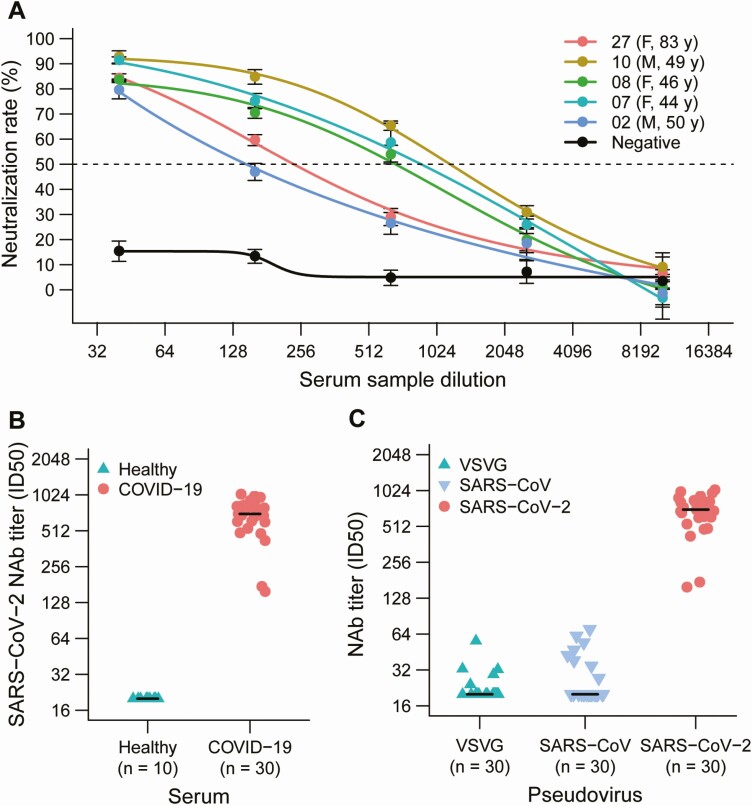
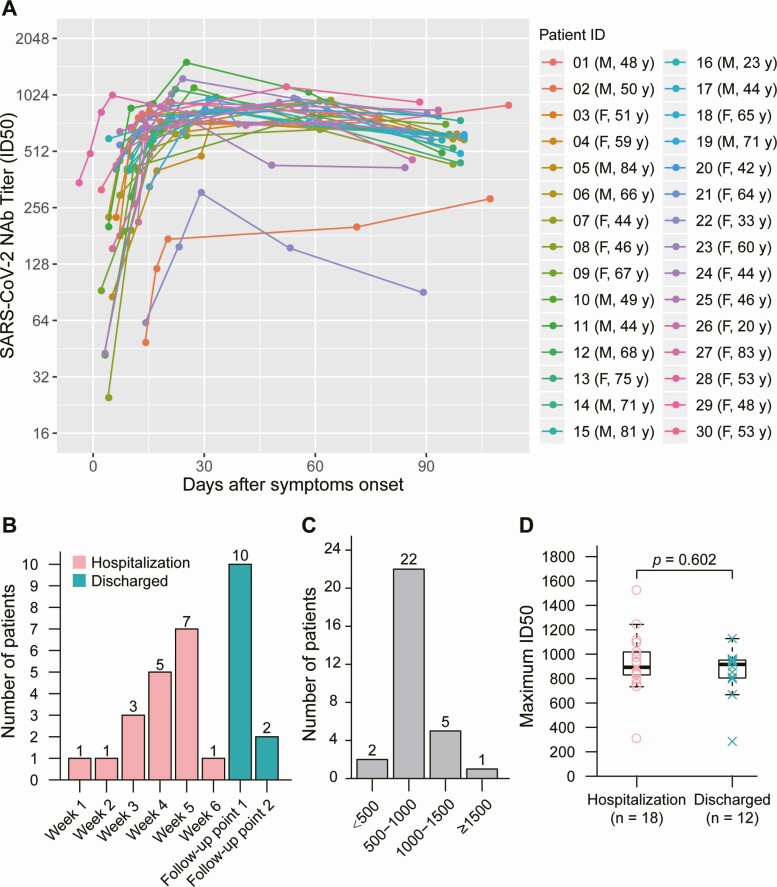
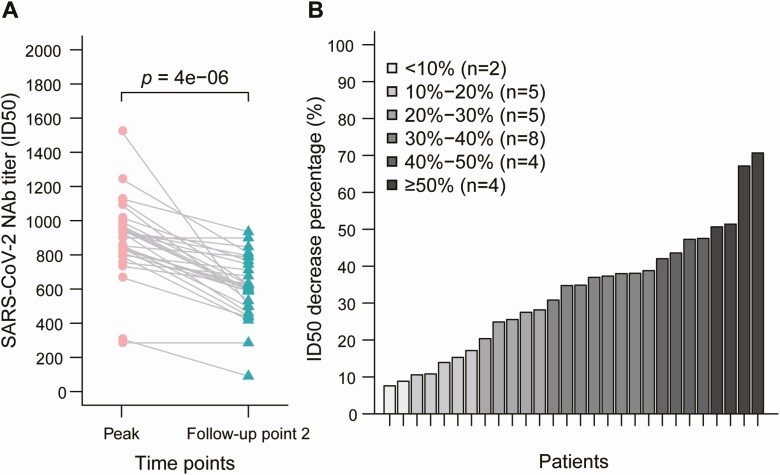
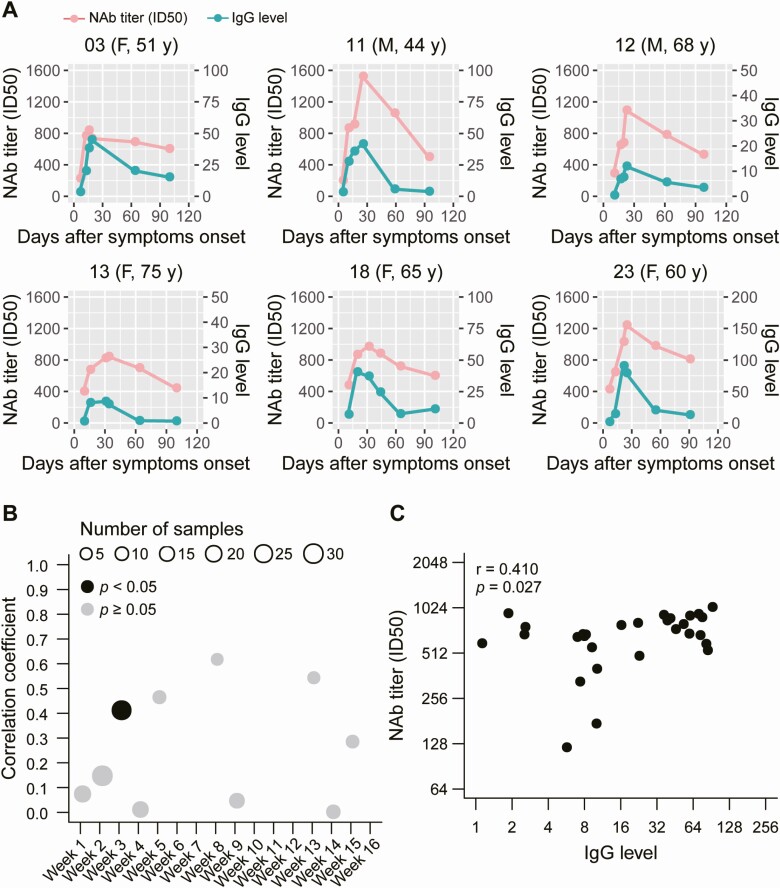
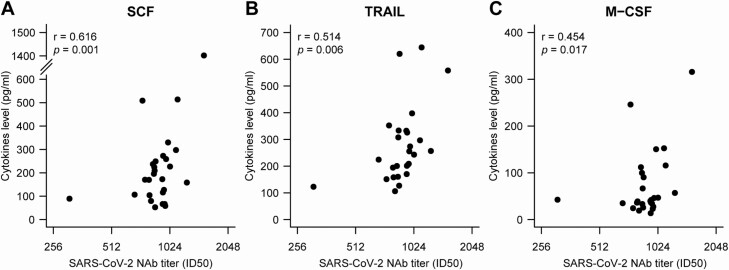
Background: Coronavirus disease 2019 (COVID-19) is a global pandemic with no licensed vaccine or specific antiviral agents for therapy. Little is known about the longitudinal dynamics of severe acute respiratory syndrome coronavirus 2 (SARS-CoV-2)–specific neutralizing antibodies (NAbs) in patients with COVID-19. Methods: Blood samples (n = 173) were collected from 30 patients with COVID-19 over a 3-month period after symptom onset and analyzed for SARS-CoV-2–specific NAbs using the lentiviral pseudotype assay, coincident with the levels of IgG and proinflammatory cytokines. Results: SARS-CoV-2–specific NAb titers were low for the first 7–10 days after symptom onset and increased after 2–3 weeks. The median peak time for NAbs was 33 days (interquartile range [IQR], 24–59 days) after symptom onset. NAb titers in 93.3% (28/30) of the patients declined gradually over the 3-month study period, with a median decrease of 34.8% (IQR, 19.6–42.4%). NAb titers increased over time in parallel with the rise in immunoglobulin G (IgG) antibody levels, correlating well at week 3 (r = 0.41, P < .05). The NAb titers also demonstrated a significant positive correlation with levels of plasma proinflammatory cytokines, including stem cell factor (SCF), TNF-related apoptosis-inducing ligand (TRAIL), and macrophage colony-stimulating factor (M-CSF). Conclusions: These data provide useful information regarding dynamic changes in NAbs in patients with COVID-19 during the acute and convalescent phases.
Overview
The claims and statistics of this paper haven’t been checked yet.
Run the check — free, no account needed. It reads the open-access text and checks the sources it cites.
Integrity signals
Registry
Cites
Statistics
Figures
Verification
Claims the paper makes
The claims and statistics of this paper haven’t been checked yet.
Run the check — free, no account needed. It reads the open-access text and checks the sources it cites.
Claims other papers make about this one
Each is checked against this paper’s own text: does it say what the citing paper says it does?
The source backs part of the claim, not all of it — or backs it for a different population, condition or comparison.
In the citing paper
“However, interpretation of the significance of those comparisons must account for the variability in Covid-19 convalescent antibody titers according to factors such as patient age, disease severity, and time since disease onset and for the number of samples in the panel.12,13”
From An mRNA Vaccine against SARS-CoV-2 — Preliminary Report (2020) · cites this paper as [12]
Experimental — accuracy not yet measured
Self-check
Percentages, sums and reported differences re-computed from the paper’s own numbers.
The self-check needs the paper’s full text.
Citations
Cites
A pneumonia outbreak associated with a new coronavirus of probable bat origin
Zhou, P., Yang, X.-L., Wang, X.-G., Hu, B., Zhang, L., Zhang, W., Si, H.-R., Zhu, Y., Li, B., Huang, C.-L., et al. (2020) · Nature · doi:10.1038/s41586-020-2012-7 · Cited by 21,969
Self-citationAn mRNA Vaccine against SARS-CoV-2 — Preliminary Report
Jackson, L. A., Anderson, E. J., Rouphael, N. G., Roberts, P. C., Makhene, M., Coler, R. N., McCullough, M. P., Chappell, J. D., Denison, M. R., Stevens, L. J., et al. (2020) · New England Journal of Medicine · doi:10.1056/nejmoa2022483 · Cited by 3,237
Ou, X., Liu, Y., Lei, X., Li, P., Mi, D., Ren, L., Guo, L., Guo, R., Chen, T., Hu, J., et al. (2020) · Nature Communications · doi:10.1038/s41467-020-15562-9 · Cited by 3,097
Self-citationAntibody responses to SARS-CoV-2 in patients with COVID-19
Long, Q.-X., Liu, B.-Z., Deng, H.-J., Wu, G.-C., Deng, K., Chen, Y.-K., Liao, P., Qiu, J.-F., Lin, Y., Cai, X.-F., et al. (2020) · Nature Medicine · doi:10.1038/s41591-020-0897-1 · Cited by 2,876
Self-citationTreatment of 5 Critically Ill Patients With COVID-19 With Convalescent Plasma
Shen, C., Wang, Z., Zhao, F., Yang, Y., Li, J., Yuan, J., Wang, F., Li, D., Yang, M., Xing, L., et al. (2020) · JAMA · doi:10.1001/jama.2020.4783 · Cited by 2,298
Effectiveness of convalescent plasma therapy in severe COVID-19 patients
Duan, K., Liu, B., Li, C., Zhang, H., Yu, T., Qu, J., Zhou, M., Chen, L., Meng, S., Hu, Y., et al. (2020) · Proceedings of the National Academy of Sciences · doi:10.1073/pnas.2004168117 · Cited by 1,968
A human neutralizing antibody targets the receptor-binding site of SARS-CoV-2
Shi, R., Shan, C., Duan, X., Chen, Z., Liu, P., Song, J., Song, T., Bi, X., Han, C., Wu, L., et al. (2020) · Nature · doi:10.1038/s41586-020-2381-y · Cited by 1,286
Connor, R. I., Chen, B. K., Choe, S., & Landau, N. R. (1995) · Virology · doi:10.1006/viro.1995.1016 · Cited by 1,253
Cao, Y., Su, B., Guo, X., Sun, W., Deng, Y., Bao, L., Zhu, Q., Zhang, X., Zheng, Y., Geng, C., et al. (2020) · Cell · doi:10.1016/j.cell.2020.05.025 · Cited by 1,188
Convalescent plasma as a potential therapy for COVID-19
Chen, L., Xiong, J., Bao, L., & Shi, Y. (2020) · The Lancet Infectious Diseases · doi:10.1016/s1473-3099(20)30141-9 · Cited by 1,038
Research works printed but not linked: 1
- Luchsinger, 2020, Serological analysis of New York City COVID19 convalescent plasma donors, medRxiv
Cited by
Sorted by citations
An mRNA Vaccine against SARS-CoV-2 — Preliminary Report
Jackson, L. A., Anderson, E. J., Rouphael, N. G., Roberts, P. C., Makhene, M., Coler, R. N., McCullough, M. P., Chappell, J. D., Denison, M. R., Stevens, L. J., et al. (2020) · New England Journal of Medicine · doi:10.1056/nejmoa2022483 · Cited by 3,237
Evolution of antibody immunity to SARS-CoV-2
Gaebler, C., Wang, Z., Lorenzi, J. C. C., Muecksch, F., Finkin, S., Tokuyama, M., Cho, A., Jankovic, M., Schaefer-Babajew, D., Oliveira, T. Y., et al. (2021) · Nature · doi:10.1038/s41586-021-03207-w · Cited by 1,674
Seow, J., Graham, C., Merrick, B., Acors, S., Pickering, S., Steel, K. J. A., Hemmings, O., O’Byrne, A., Kouphou, N., Galao, R. P., et al. (2020) · Nature Microbiology · doi:10.1038/s41564-020-00813-8 · Cited by 1,419
Viral targets for vaccines against COVID-19
Dai, L., & Gao, G. F. (2020) · Nature reviews. Immunology · doi:10.1038/s41577-020-00480-0 · Cited by 1,056
SARS-CoV-2 infection induces long-lived bone marrow plasma cells in humans
Turner, J. S., Kim, W., Kalaidina, E., Goss, C. W., Rauseo, A. M., Schmitz, A. J., Hansen, L., Haile, A., Klebert, M. K., Pusic, I., et al. (2021) · Nature · doi:10.1038/s41586-021-03647-4 · Cited by 532
Metadata
- Authors
- Wang, K., Long, Q.-X., Deng, H.-J., Hu, J., Gao, Q.-Z., Zhang, G.-J., He, C.-L., Huang, L.-Y., Hu, J.-L., Chen, J., Tang, N., & Huang, A.-L.
- Affiliations
- Second Affiliated Hospital of Chongqing Medical University (CN)
- Key Laboratory of Molecular Biology for Infectious Diseases (Ministry of Education), Institute for Viral Hepatitis, Department of Infectious Diseases, The Second Affiliated Hospital, Chongqing Medical University, Chongqing, China
- Corresponding author
- Huang, Ai-Long
- Venue
- Clinical Infectious Diseases
- Publisher
- Oxford University Press (OUP)
- Published
- 2020-08-03
- Volume
- 73
- Issue
- 3
- Pages
- e531-e539
- ISSN
- 1058-4838 (ISSN-L)
- 1537-6591
- PMC
- PMC7454328
- OpenAlex
- W3046309975
- Cited by
- 218
- References
- 34
- Citations by year
- 2026: 1 · 2025: 8 · 2024: 15 · 2023: 26 · 2022: 37 · 2021: 101 · 2020: 30
- FWCI
- 6.36
- Type
- journal article
- Language
- en
- Open access
- hybrid
- doi.org
- Licence
- Locations
- Clinical Infectious Diseases (publishedVersion, cc-by-nc-nd)
- medRxiv (acceptedVersion, cc-by-nc-nd)
- PubMed Central (publishedVersion, cc-by-nc-nd)
- PubMed (publishedVersion)
- Funders
- Science and Technology Commission of Chongqing (cstc2020jscx-fyzx0053)
- Chongqing Medical University (CQMUNCP0302, CQMUNCP0304)
- Leading Talent Program of Chongqing Science and Technology Commission (CSTCCXLJRC201719)
- Major National Science and Technology Program (2017ZX10202203)
- Topics
- Health Sciences › Medicine › Infectious Diseases › SARS-CoV-2 and COVID-19 Research
- Health Sciences › Medicine › Infectious Diseases › COVID-19 Clinical Research Studies
- Health Sciences › Medicine › Infectious Diseases › SARS-CoV-2 detection and testing
- Keywords
- SARS-CoV-2, COVID-19 pandemic, neutralizing antibodies, antibody kinetics, IgG, inflammatory cytokines, stem cell factor, TRAIL, macrophage colony-stimulating factor, convalescence
- MeSH terms
- COVID-19, SARS-CoV-2, Antibodies, Viral, Humans, Antibodies, Neutralizing, Pandemics
About these checks
Registry, retraction, Cites and statistics results are computed, not judged, with one exception: a printed reference that no index lists is read once by a model before it counts as a citation error. Claims are extracted by a model and kept only when their quote appears verbatim in the text; each cited source is then checked, with a model’s help, for whether it says what the claim relies on. Those verdicts can be wrong — read the claim’s quote and the cited source before relying on one.
Statistics and arithmetic are recomputed, not judged.
Confidence bands are shown only for fields calibrated on our annotated test set. None is calibrated yet, so no band is shown.
What counts as a claim ›How we measure confidence ›How we check this ›
Are you an author, or do you see a problem with this page? Request a review
