

The architecture and dynamics of industrial ecosystems: diversification and innovative industrial renewal in Emilia Romagna
Open accessThe DOI matches its Crossref record; 93 of the 96 references it cites were found in a registry or an index.
Abstract
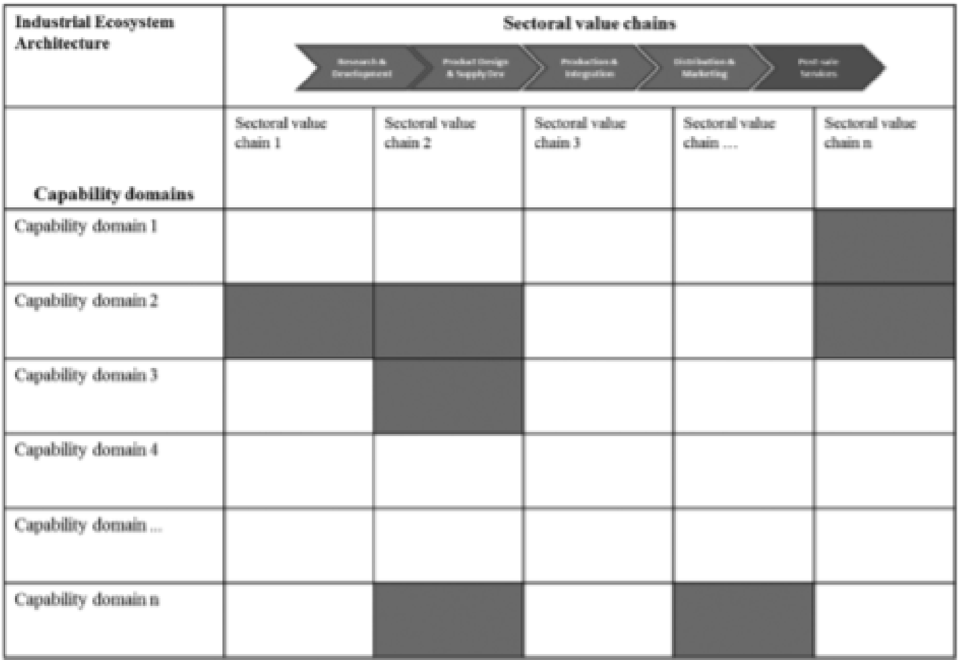
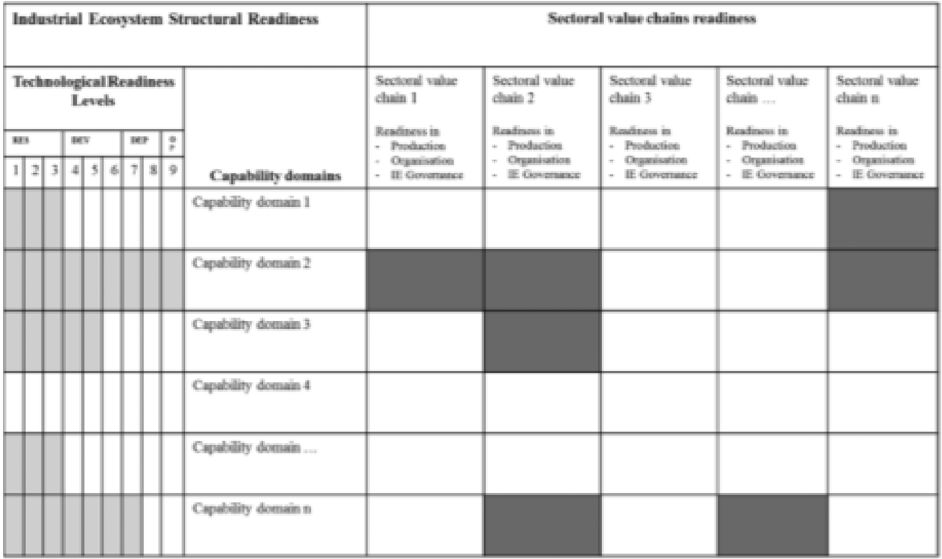
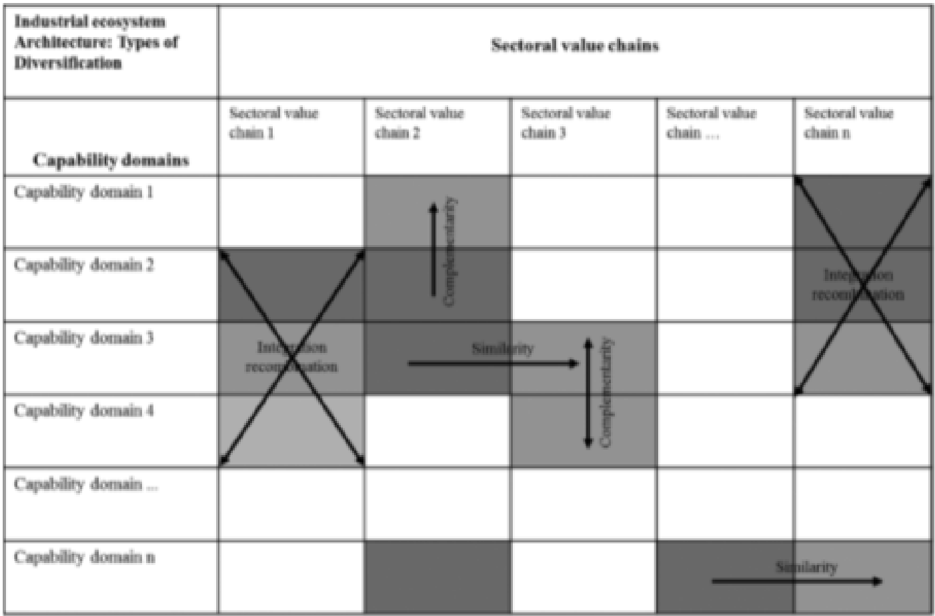
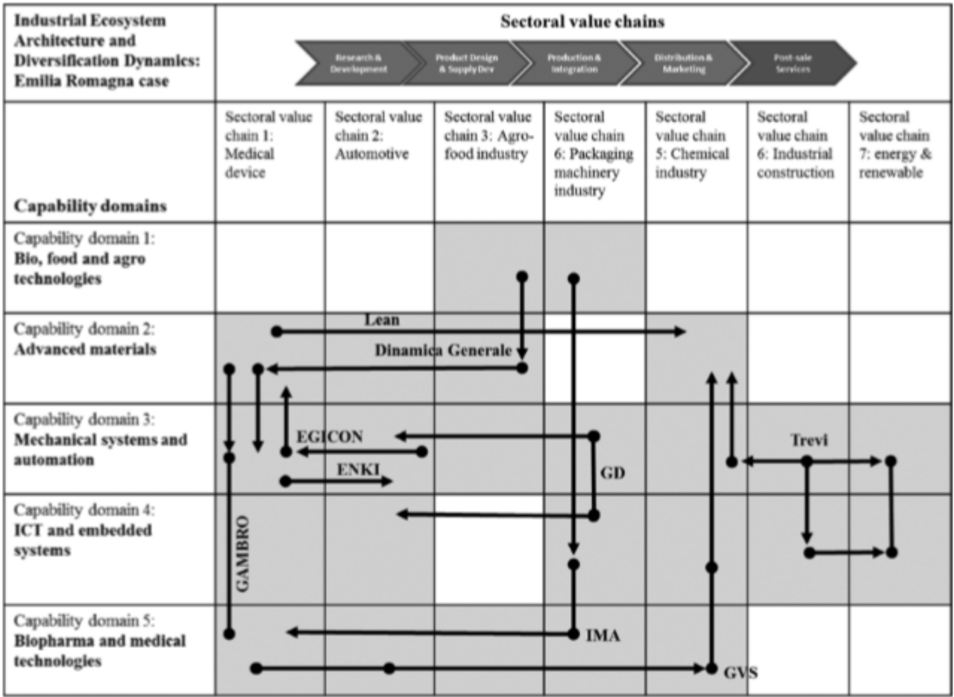
The paper aims at advancing our understanding of the architecture and diversification dynamics of industrial ecosystems, and identifying policies for the innovative industrial renewal of mature economies. Industrial ecosystems are here defined as multi-tiered production systems involving heterogeneous agents operating in sectoral value chains and contributing to the capability domains of the ecosystem (and its participants) with closely complementary but dissimilar sets of resources and capabilities. The geographical boundaries of the industrial ecosystem are shaped by the evolving interdependencies linking organisations within the ecosystem and by the new linkages consolidating beyond that. Thus, the industrial ecosystem is a structured production space centred mainly on its productive organisations, as well as other institutions, intermediaries and demand-side actors, purposefully involved in co-value creation processes along various types of diversification and innovative industrial renewal trajectories. Drawing on a five-year research programme in the Emilia Romagna industrial ecosystem, a number of case studies are introduced to highlight these trajectories and the underpinning structural learning dynamics. The paper concludes by identifying a number of policy implications, focusing on strategies for enhancing the structural readiness of the industrial ecosystem and promoting smart diversification and innovative industrial renewal policies.
Overview
The claims and statistics of this paper haven’t been checked yet.
Free: it reads the open-access text and checks the first 5 claims that cite a source we can check. Create a free account to check every claim.
Integrity signals
Registry
Cites
Statistics
Figures
Verification
Claims the paper makes
The claims and statistics of this paper haven’t been checked yet.
Free: it reads the open-access text and checks the first 5 claims that cite a source we can check. Create a free account to check every claim.
Claims other papers make about this one
Each is checked against this paper’s own text: does it say what the citing paper says it does?
The check wasn’t confident either way, so it gives no verdict — never disputed.
In the citing paper
“The number of bilateral free trade agreements also started increasing in the 1990s and exploded in the 2000s; they numbered around 50 in the mid-1990s but there are now over 250 of them.5”
From Industrial Policy in the 21st Century (2020) · cites this paper as [5]
Experimental — accuracy not yet measuredThe check wasn’t confident either way, so it gives no verdict — never disputed.
In the citing paper
“As a result, the developing countries are today much more constrained in the use of many 5 See: http://www.economist.com/blogs/graphicdetail/2015/10/global-trade-graphicsindustrial policy measures that were the standard fares of the early post-colonial era between the mid-1940s and the mid-1970s.”
From Industrial Policy in the 21st Century (2020) · cites this paper as [5]
Experimental — accuracy not yet measuredIn the citing paper
“Learning in production is mainly triggered by three supply-side (or technology-pull) mechanisms and two demand-side (market-pull) mechanisms, and involves reconfiguration of production at the shop-floor level as much as at the level of the industrial ecosystem (Andreoni, 2014(Andreoni, , 2018;;Rosenberg, 1979Rosenberg, , 1982)).”
From Industrial Policy in the 21st Century (2020) · cites this paper as Andreoni, 2018
In the citing paper
“These external economies are often associated with the advantages of geographically 'localized learning', based on local supplydemand relationships, entailing 'technological pollination' and other forms of learning in production, within an industrial ecosystem (Andreoni, 2018).”
From Industrial Policy in the 21st Century (2020) · cites this paper as Andreoni, 2018
Self-check
Percentages, sums and reported differences re-computed from the paper’s own numbers.
The self-check needs the paper’s full text.
Citations
Cites
Teece, D. J. (2007) · Strategic Management Journal · doi:10.1002/smj.640 · Cited by 16,825
The theory of the growth of the firm
Penrose, E. (1996) · Long Range Planning · doi:10.1016/s0024-6301(96)90295-2 · Cited by 13,770
The Architecture of Complexity
Simon, H. A. (1991) · Facets of Systems Science · doi:10.1007/978-1-4899-0718-9_31 · Cited by 4,433
From sectoral systems of innovation to socio-technical systems
Geels, F. W. (2004) · Research Policy · doi:10.1016/j.respol.2004.01.015 · Cited by 4,098
(1993) · doi:10.1093/oso/9780195076165.001.0001 · Cited by 3,069
The Product Space Conditions the Development of Nations
Hidalgo, C. A., Klinger, B., Barabási, A.-L., & Hausmann, R. (2007) · Science · doi:10.1126/science.1144581 · Cited by 2,925
Recombinant Uncertainty in Technological Search
Fleming, L. (2001) · Management Science · doi:10.1287/mnsc.47.1.117.10671 · Cited by 2,873 · cited 1×
“…can also result in completely new forms of integration and recombination of resources/capabilities far beyond two capability domains, indeed in some cases can lead to the development of a new capability domain or processes of technological speciation (Fleming, 2001; Frenken, et al. 2012).”
BackgroundFunctions of innovation systems: A new approach for analysing technological change
Hekkert, M. P., Suurs, R. A. A., Negro, S. O., Kuhlmann, S., & Smits, R. E. H. M. (2007) · Technological Forecasting and Social Change · doi:10.1016/j.techfore.2006.03.002 · Cited by 2,741
Adner, R., & Kapoor, R. (2010) · Strategic Management Journal · doi:10.1002/smj.821 · Cited by 2,627
Richardson, G. B. (1972) · The Economic Journal · doi:10.2307/2230256 · Cited by 2,200 · cited 2×
“Since the seminal work of Richardson (1972), research in industrial organisation and regional agglomeration, have stressed how (under specific conditions) firms would have an advantage in establishing interfirms cooperative arrangements if the development of a new production/technology base require…”
Background
Research works printed but not linked: 16
- Adner, R. 2012. The Wide Lense, London, Penguin.
- Adner, R., Oxley, J., and Silverman, B. 2013. (eds.), Collaboration and Competition in Business Ecosystems. Emerald Group.
- Andreoni, A. 2017. Strategies for Emerging Technologies and Strategic Sectors, L'Industria, 1,1-13
- Andreoni, A. and Chang, H.-J. 2017. Bringing production and employment back into development, Cambridge Journal of Regions, Economy and Society, 10,173-187.
- Andreoni, A. and Landesmann, M. 2018. Industrial policy for Europe peripheries, Cambridge Journal of Regions, Economy and Society Annual Conference, Cambridge, July.
- Andreoni, A. and O'Sullivan, E. 2014. Vectors of innovation in industrial ecosystems, Edith Penrose Centenary Conference, SOAS University of London.
- Babbage, C. 1830. Reflection on the Decline of Science in England, and Some of its Causes, London, Fellowes.
- Best, M. 2016. Regional capabilities and industrial resiliency, in Begley, J., Dinnelly, D., and T. Thornley (eds.), Global Economic Crisis and Local Development, Routledge.
- Chang, H-J. and Andreoni, A. 2016. Industrial Policy in a Changing World, Cambridge Journal of Economics 40 Years Conference, Cambridge.
- Freeman, C. 1987. Technology and Economic Performance: Lessons from Japan, London, Pinter.
- Garnsey, E. and Heffernan, P. 2005. High-technology Clustering through Spin-out and Attraction: The Cambridge Case, Regional Studies, 39,8,1127-1144.
- Hirschman, A.O. 1977. A generalized linkage approach to economic development with special reference to staples, Economic Development and Cultural Change, 25,67-97.
- Marshall, A. 1920. Principles of Economics, Eight Edition, London, Macmillan.
- Pisano, G. and Shih, W. 2012. Producing Prosperity, Boston, MA, HBRP.
- Rosenberg, N. 1982. Inside the Black Box, Cambridge, Cambridge University Press.
- Saxenian, A. 1994. Regional Advantage, Harvard, Harvard University Press.
Cited by
Industrial Policy in the 21st Century
Chang, H., & Andreoni, A. (2020) · Development and Change · doi:10.1111/dech.12570 · Cited by 455
“…costs, more interconnectedness via ICTs), cost-reduction opportunities associated with offshoring of labour-intensive manufacturing processes, and the increasing openness to trade and investments (Gereffi, 2014, 2018; Milberg and Winkler, 2013; Nolan, 2001; Ponte et al., 2019; Storm, 2015).”
BackgroundInfluentialSelf-citationAndreoni, A., & Chang, H.-J. (2019) · Structural Change and Economic Dynamics · doi:10.1016/j.strueco.2018.10.007 · Cited by 314
“…the new patters of value creation, capture and distribution determined by global value chains (Milberg and Winkler, 2013; Chang and Andreoni, 2016; Andreoni, 2018; Landesmann and Stollinger in this special issue); how new international rules are affecting countries’ policy space (Andreoni et al.,…”
BackgroundInfluentialSelf-citationOrchestrating a smart circular economy: Guiding principles for digital product passports
Langley, D. J., Rosca, E., Angelopoulos, M., Kamminga, O., & Hooijer, C. (2023) · Journal of Business Research · doi:10.1016/j.jbusres.2023.114259 · Cited by 231
“…production space centered mainly on its productive organizations, as well as other institutions, intermediaries and demand-side actors, purposefully involved in co-value creation processes along various types of diversification and innovative industrial renewal trajectories (Andreoni, 2018, 10).”
BackgroundAndreoni, A., & Tregenna, F. (2020) · Structural Change and Economic Dynamics · doi:10.1016/j.strueco.2020.05.008 · Cited by 209
Self-citationAndreoni, A., Mondliwa, P., Roberts, S., & Tregenna, F. (2021) · doi:10.1093/oso/9780192894311.001.0001 · Cited by 103
Self-citation
Metadata
- Authors
- Andreoni, A.
- Affiliations
- SOAS University of London (GB)
- Corresponding author
- Andreoni, Antonio
- ORCID
- Andreoni, Antonio
- Venue
- Cambridge Journal of Economics
- Publisher
- Oxford University Press (OUP)
- Published
- 2018-10-10
- Volume
- 42
- Issue
- 6
- Pages
- 1613-1642
- ISSN
- 0309-166X (ISSN-L)
- 1464-3545
- OpenAlex
- W2896036562
- Cited by
- 53
- References
- 96
- Citations by year
- 2026: 2 · 2025: 8 · 2024: 6 · 2023: 7 · 2022: 6 · 2021: 10 · 2020: 7 · 2019: 2 · 2018: 5
- FWCI
- 22.01
- Type
- journal article
- Language
- en
- Open access
- green
- doi.org
- Licence
- Locations
- Cambridge Journal of Economics (publishedVersion)
- SOAS Research Online (SOAS University of London) (acceptedVersion)
- SOAS Research Online (SOAS University of London) (submittedVersion, other-oa)
- SOAS Research Online (SOAS University of London) (submittedVersion, cc-by)
- RePEc: Research Papers in Economics (submittedVersion)
- Funders
- Gatsby Charitable Foundation
- Topics
- Social Sciences › Development › Regional Development and Innovation
- Social Sciences › Business, Management and Accounting › Management of Technology and Innovation › University-Industry-Government Innovation Models
- Physical Sciences › Engineering › Industrial and Manufacturing Engineering › Sustainable Industrial Ecology
- Keywords
- industrial ecosystems, diversification, structural learning, value chain, industrial policy, mature economies, Emilia-Romagna, structural readiness
About these checks
Registry, retraction, Cites and statistics results are computed, not judged, with one exception: a printed reference that no index lists is read once by a model before it counts as a citation error. Claims are extracted by a model and kept only when their quote appears verbatim in the text; each cited source is then checked, with a model’s help, for whether it says what the claim relies on. Those verdicts can be wrong — read the claim’s quote and the cited source before relying on one.
Statistics and arithmetic are recomputed, not judged.
Confidence bands are shown only for fields calibrated on our annotated test set. None is calibrated yet, so no band is shown.
What counts as a claim ›How we measure confidence ›How we check this ›
Are you an author, or do you see a problem with this page? Request a review
Data sources
Bibliographic data: Semantic Scholar, OpenAlex, Crossref.
Contains information from the Semantic Scholar Academic Graph Datasets, made available under the ODC Attribution License (ODC-BY 1.0).
Semantic Scholar’s data is described in: Kinney, R., et al. (2023). The Semantic Scholar Open Data Platform. arXiv:2301.10140.
