

The DOI matches its Crossref record; 44 of the 44 references it cites were found in a registry or an index.
The role of the FPR2/ALX receptor in atherosclerosis development and plaque stability
Open accessAbstract
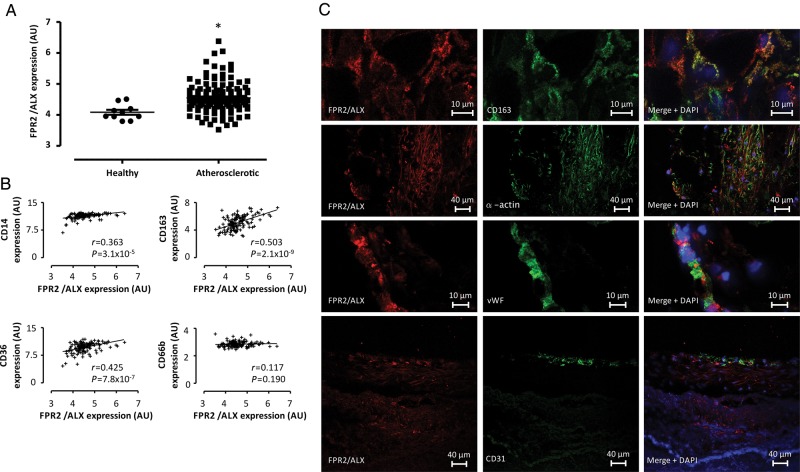
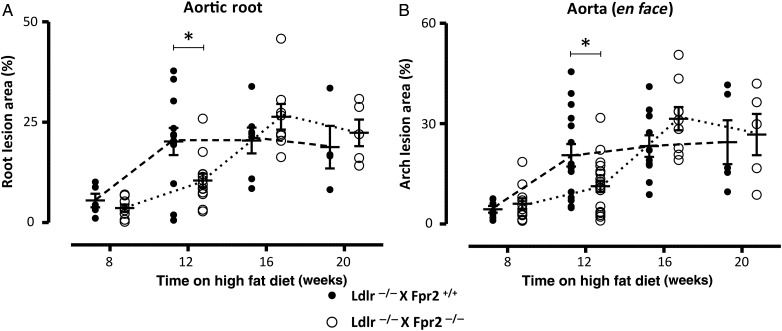
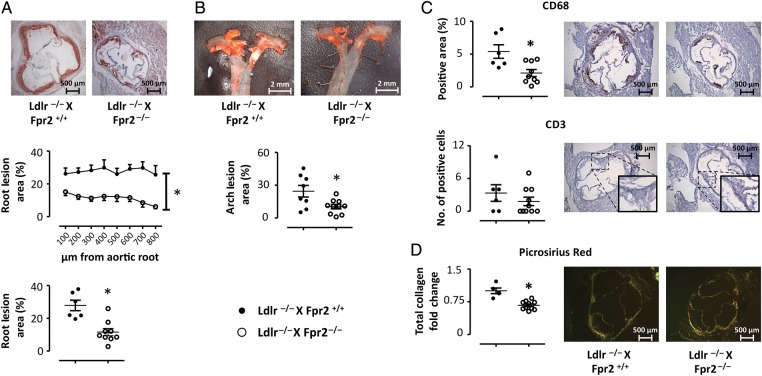
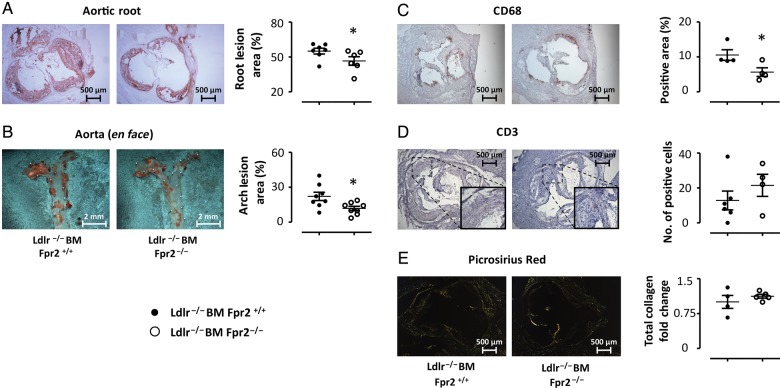
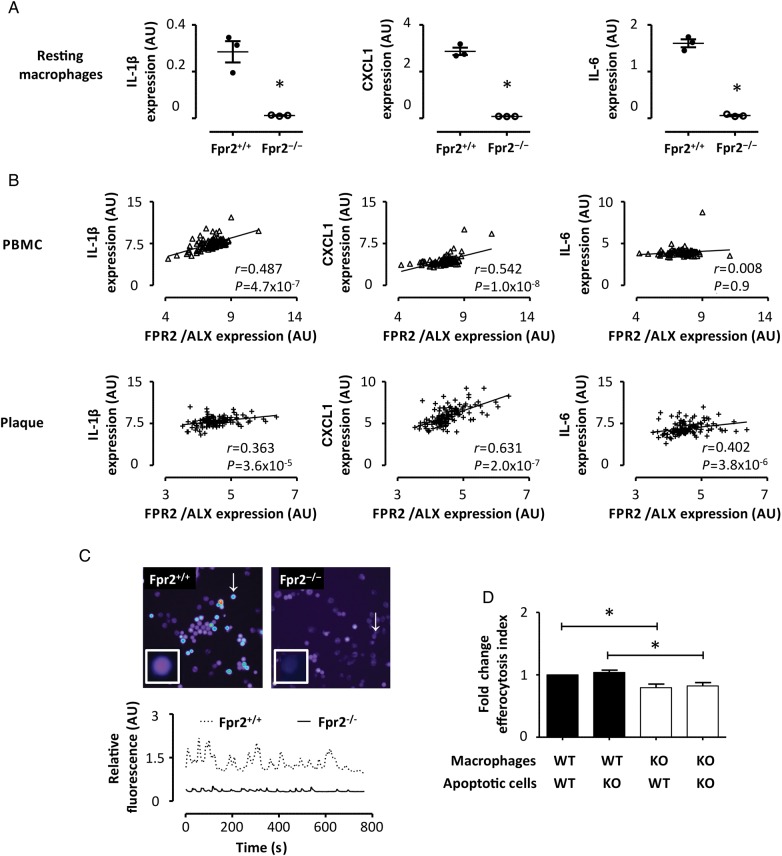
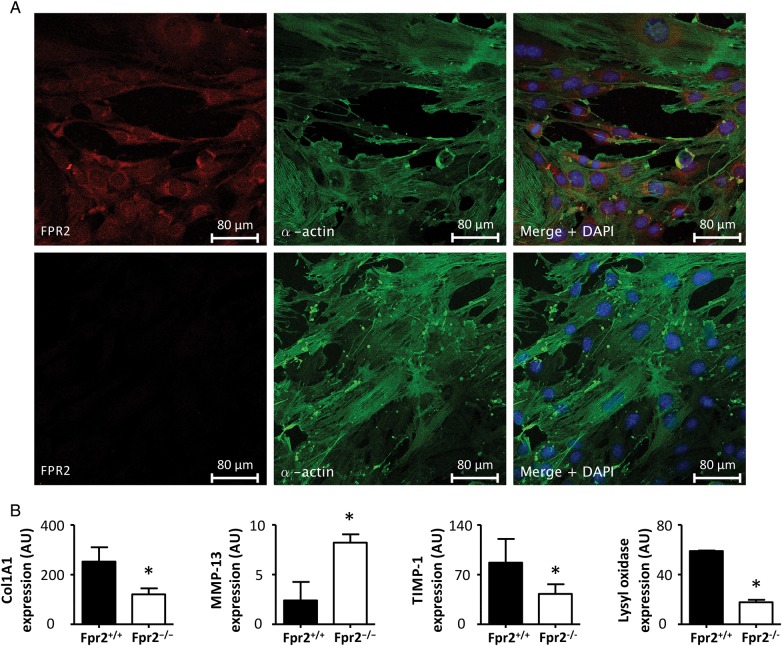
AIMS: The formyl peptide receptor (FPR) subtype FPR2/ALX transduces pro-inflammatory responses and participates in the resolution of inflammation depending on activation. The aim of the present study was to unravel the role of FPR2/ALX signalling in atherosclerosis. METHODS AND RESULTS: Expression of FPR2/ALX was analysed in 127 human carotid atherosclerotic lesions and revealed that this receptor was expressed on macrophages, smooth muscle cells (SMCs), and endothelial cells. Furthermore, FPR2/ALX mRNA levels were significantly up-regulated in atherosclerotic lesions compared with healthy vessels. In multiple regression, age, creatinine, and clinical signs of increased cerebral ischaemia were independent predictors of FPR2/ALX expression. To provide mechanistic insights into these observations, we generated Ldlr(-/-)xFpr2(-/-) mice, which exhibited delayed atherosclerosis development and less macrophage infiltration compared with Ldlr(-/-)xFpr2(+/+) mice. These findings were reproduced by transplantation of Fpr2(-/-) bone marrow into Ldlr(-/-) mice and further extended by in vitro experiments, demonstrating a lower inflammatory state in Fpr2(-/-) macrophages. FPR2/ALX expression correlated with chemo- and cytokines in human atherosclerotic lesions and leucocytes. Finally, atherosclerotic lesions in Ldlr(-/-)xFpr2(-/-) mice exhibited decreased collagen content, and Fpr2(-/-) SMCs exhibited a profile of increased collagenase and decreased collagen production pathways. CONCLUSION: FPR2/ALX is proatherogenic due to effects on bone marrow-derived cells, but promoted a more stable plaque phenotype through effects on SMCs. Taken together, these results suggest a dual role of FPR2/ALX signalling in atherosclerosis by way of promoting disease progression and but increasing plaque stability.
Overview
The claims and statistics of this paper haven’t been checked yet.
Run the check — free, no account needed. It reads the open-access text and checks the sources it cites.
Integrity signals
Registry
Cites
Statistics
Figures
Verification
Claims the paper makes
The claims and statistics of this paper haven’t been checked yet.
Run the check — free, no account needed. It reads the open-access text and checks the sources it cites.
Claims other papers make about this one
Each is checked against this paper’s own text: does it say what the citing paper says it does?
In the citing paper
“These receptors are expressed in human aortic, coronary and carotid atherosclerotic lesions104–106, indicating that their pro-resolving ligands exert local effects within the vascular wall (TABLE 1).”
From Inflammation and its resolution in atherosclerosis: mediators and therapeutic opportunities (2019) · cites this paper as [104]
In the citing paper
“A study on genetic targeting of the murine ALX/FPR2 homologue in hyperlipidaemic mice provided arguments in favour of this hypothesis by showing that ALX/FPR2 deficiency reduced atherosclerosis consistently in different mouse models99,104.”
From Inflammation and its resolution in atherosclerosis: mediators and therapeutic opportunities (2019) · cites this paper as [104]
Self-check
Percentages, sums and reported differences re-computed from the paper’s own numbers.
The self-check needs the paper’s full text.
Citations
Cites
Ridker, P. M., Hennekens, C. H., Buring, J. E., & Rifai, N. (2000) · New England Journal of Medicine · doi:10.1056/nejm200003233421202 · Cited by 5,850
Serhan, C. N., Hong, S., Gronert, K., Colgan, S. P., Devchand, P. R., Mirick, G., & Moussignac, R.-L. (2002) · The Journal of Experimental Medicine · doi:10.1084/jem.20020760 · Cited by 1,650
Macrophage death and defective inflammation resolution in atherosclerosis
Tabas, I. (2010) · Nature Reviews Immunology · doi:10.1038/nri2675 · Cited by 1,120
Ye, R. D., Boulay, F., Wang, J. M., Dahlgren, C., Gerard, C. J., Parmentier, M., Serhan, C. N., & Murphy, P. M. (2009) · Pharmacological Reviews · doi:10.1124/pr.109.001578 · Cited by 778
Resolvin D1 binds human phagocytes with evidence for proresolving receptors
Krishnamoorthy, S., Recchiuti, A., Chiang, N., Yacoubian, S., Lee, C., Yang, R., Petasis, N. A., & Serhan, C. N. (2010) · Proceedings of the National Academy of Sciences · doi:10.1073/pnas.0907342107 · Cited by 752
Immune Effector Mechanisms Implicated in Atherosclerosis: From Mice to Humans
Libby, P., Lichtman, A. H., & Hansson, G. K. (2013) · Immunity · doi:10.1016/j.immuni.2013.06.009 · Cited by 685
Self-citationDisruption of the 12/15-lipoxygenase gene diminishes atherosclerosis in apo E–deficient mice
Cyrus, T., Witztum, J. L., Rader, D. J., Tangirala, R., Fazio, S., Linton, M. F., & Funk, C. D. (1999) · Journal of Clinical Investigation · doi:10.1172/jci5897 · Cited by 523
The Lipoxin Receptor ALX: Potent Ligand-Specific and Stereoselective Actions in Vivo
Chiang, N., Serhan, C. N., Dahlén, S., Drazen, J. M., Hay, D. W. P., Rovati, G. E., Shimizu, T., Yokomizo, T., & Brink, C. (2006) · Pharmacological Reviews · doi:10.1124/pr.58.3.4 · Cited by 464
Elssner, A., Duncan, M., Gavrilin, M. A., & Wewers, M. D. (2004) · The Journal of Immunology · doi:10.4049/jimmunol.172.8.4987 · Cited by 425
Merched, A. J., Ko, K., Gotlinger, K. H., Serhan, C. N., & Chan, L. (2008) · The FASEB Journal · doi:10.1096/fj.08-112201 · Cited by 414
Cited by
Sorted by citations
Items 101–127 of 127
The role of lipoxins in cardiometabolic physiology and disease
Börgeson, E. (2015) · Cardiovascular Endocrinology · doi:10.1097/xce.0000000000000068 · Cited by 3
Gonçalves, W. A., Melão, A. C. R., Teixeira, M. M., Rezende, B. M., & Pinho, V. (2018) · Springer eBooks · doi:10.1007/978-3-319-77658-3_6 · Cited by 3
Sajid, S., Zariwala, M. G., Mackenzie, R., Turner, M. C., Nell, T. A., Bellary, S., & Renshaw, D. W. (2022) · Nutrients · doi:10.3390/nu14112360 · Cited by 3
Vastrad, B. M., Tengli, A., Vastrad, C. M., & Kotturshetti, I. (2020) · bioRxiv (Cold Spring Harbor Laboratory) · doi:10.1101/2020.12.25.424383 · Cited by 3
Formylpeptide receptors: A novel target to treat cardiometabolic complications
Leo, C. H., Vecchio, E. A., Fu, T., Yi, X., Peng, C., Zhao, P., Woodman, O. L., Baell, J. B., Ritchie, R. H., & Qin, C. X. (2025) · Pharmacology & Therapeutics · doi:10.1016/j.pharmthera.2025.108941 · Cited by 2
Tsai, Y.-F., Yang, S.-C., & Hwang, T. (2025) · Expert Opinion on Therapeutic Patents · doi:10.1080/13543776.2025.2515882 · Cited by 2
Editorial highlights from Cardiovascular Research
Gal, D., Sipido, K. R., & Vandevelde, W. (2017) · Cardiovascular Research · doi:10.1093/cvr/cvx210 · Cited by 2
Lipoxygenases and Cardiovascular Diseases
Laguna-Fernández, A., Petri, M. H., Thul, S., & Bäck, M. (2016) · Springer eBooks · doi:10.1007/978-3-319-27766-0_6 · Cited by 1
Self-citation‘A picture is worth a thousand words’: image highlights from Cardiovascular Research
Gal, D., Sipido, K. R., & Vandevelde, W. (2016) · Cardiovascular Research · doi:10.1093/cvr/cvw226 · Cited by 1
17. Cellular cholesterol retention in atherosclerosis
El‐Sayyad, H. I. (2016) · Wageningen Academic Publishers eBooks · doi:10.3920/978-90-8686-821-6_17 · Cited by 1
Du, C., Lv, H., Meng, G., Wang, X., & Cao, H. (2018) · Biomedical Research - India · doi:10.4066/biomedicalresearch.29-17-3435 · Cited by 1
Martos, S. N., Campbell, M. R., Lozoya, O. A., Bennett, B. D., Thompson, I. J. B., Wan, M., Pittman, G. S., & Bell, D. A. (2019) · bioRxiv (Cold Spring Harbor Laboratory) · doi:10.1101/783126 · Cited by 1
Immune-Mediated Mechanisms of Atherosclerosis
Bäck, M., Ketelhuth, D. F. J., Malin, S., Olofsson, P. S., Paulsson‐Berne, G., Yan, Z.-Q., & Hansson, G. K. (2017) · Elsevier eBooks · doi:10.1016/b978-0-12-809657-4.99556-5 · Cited by 1
Self-citationThe role of FPR2/ALX in the vascular wall
Petri, M. H. (2015) · Figshare
Self-citationOBSOLETE: Immune-mediated Mechanisms of Atheroslcerosis
Bäck, M. (2017) · Elsevier eBooks · doi:10.1016/b978-0-12-801238-3.99556-4
Self-citationLipoxin Alleviates Diabetic Vascular Calcification via the YAP PathwayPreprint
Han, B., Yang, M., Liu, Q., Wang, G., Ma, X., Liu, D., Huang, X., Wang, X., Zhang, R., Hou, J., et al. (2021) · Research Square · doi:10.21203/rs.3.rs-1179483/v1
Arnardottir, H. H., & Bäck, M. (2021) · Springer eBooks · doi:10.1007/978-3-030-57401-7_10037
Self-citationArnardottir, H. H., & Bäck, M. (2021) · Springer eBooks · doi:10.1007/978-3-030-21573-6_10037-1
Self-citationVastrad, B. M., & Vastrad, C. M. (2024) · bioRxiv (Cold Spring Harbor Laboratory) · doi:10.1101/2024.08.15.608116 · Cited by 1
La résolution de l’inflammaging et le processus du vieillissement vasculaire
Bäck, M. (2025) · Bulletin de l Académie Nationale de Médecine · doi:10.1016/j.banm.2025.03.008
Self-citationImpacts of Oxylipins on ischemic stroke: from pathophysiology to clinical phenotypes
Cheng, L., & Xia, J. (2025) · Metabolomics · doi:10.1007/s11306-025-02324-1 · Cited by 1
Chen, R., Liu, W., Zhao, X., Li, N., Liu, C., Zhou, P., Chen, Y., Yan, S., Li, J., Song, L., et al. (2025) · Diabetology & Metabolic Syndrome · doi:10.1186/s13098-025-01967-3
Bouhadoun, A. (2022) · theses.fr (ABES) · doi:10.70675/774cb3d0z938ez4b96z85ffze9119702485e
Immune-Mediated Mechanisms of Atherosclerosis
Graber, M. K., Ameli, S., & Major, A. S. (2026) · Elsevier eBooks · doi:10.1016/b978-0-443-15734-9.00080-7
Kotlyarov, S. (2026) · Studies in natural products chemistry · doi:10.1016/b978-0-443-51068-7.00014-3
Metadata
- Authors
- Petri, M. H., Laguna-Fernández, A., Gonzalez-Diez, M., Paulsson-Berne, G., Hansson, G. K., & Bäck, M.
- Affiliations
- Karolinska University Hospital (SE)
- Corresponding author
- Bäck, Magnus
- Venue
- Cardiovascular Research
- Publisher
- Oxford University Press (OUP)
- Published
- 2014-10-23
- Volume
- 105
- Issue
- 1
- Pages
- 65-74
- ISSN
- 0008-6363 (ISSN-L)
- 1755-3245
- PMC
- PMC4277257
- OpenAlex
- W2000987582
- Cited by
- 125
- References
- 44
- Citations by year
- 2026: 3 · 2025: 11 · 2024: 9 · 2023: 13 · 2022: 20 · 2021: 14 · 2020: 7 · 2019: 10 · 2018: 13 · 2017: 10 · 2016: 7 · 2015: 6 · 2014: 2
- FWCI
- 3.81
- Type
- journal article
- Language
- en
- Open access
- hybrid
- doi.org
- Licence
- cc-by-nc
- Locations
- Cardiovascular Research (publishedVersion, cc-by-nc)
- PubMed Central (publishedVersion, cc-by-nc)
- PubMed (publishedVersion)
- Funders
- Stockholms Läns Landsting (20120297)
- Vetenskapsrådet (2011-02988, 20120827, 2012-02577, 20120474)
- Topics
- Life Sciences › Immunology and Microbiology › Immunology › Atherosclerosis and Cardiovascular Diseases
- Health Sciences › Medicine › Cardiology and Cardiovascular Medicine › Cerebrovascular and Carotid Artery Diseases
- Life Sciences › Biochemistry, Genetics and Molecular Biology › Biochemistry › Cholesterol and Lipid Metabolism
- Keywords
- FPR2/ALX, formyl peptide receptor, atherosclerosis, plaque stability, macrophage infiltration, smooth muscle cells, collagen synthesis, collagenase, inflammation, bone marrow-derived cells, Ldlr knockout mice, cerebral ischemia
- MeSH terms
- Aged, Aged, 80 and over, Animals, Carotid Artery Diseases, Collagen, Female, Humans, Macrophages, Male, Middle Aged, Receptors, LDL, RNA, Messenger, Signal Transduction, Up-Regulation, Bone Marrow Transplantation, Carotid Stenosis, Mice, Knockout, Myocytes, Smooth Muscle, Receptors, Formyl Peptide, Receptors, Lipoxin, Atherosclerosis, Mice, Plaque, Atherosclerotic
About these checks
Registry, retraction, Cites and statistics results are computed, not judged, with one exception: a printed reference that no index lists is read once by a model before it counts as a citation error. Claims are extracted by a model and kept only when their quote appears verbatim in the text; each cited source is then checked, with a model’s help, for whether it says what the claim relies on. Those verdicts can be wrong — read the claim’s quote and the cited source before relying on one.
Statistics and arithmetic are recomputed, not judged.
Confidence bands are shown only for fields calibrated on our annotated test set. None is calibrated yet, so no band is shown.
What counts as a claim ›How we measure confidence ›How we check this ›
Are you an author, or do you see a problem with this page? Request a review
