

The DOI matches its Crossref record; 103 of the 105 references it cites were found in a registry or an index.
Cardiac troponins: from myocardial infarction to chronic disease
Open accessAbstract
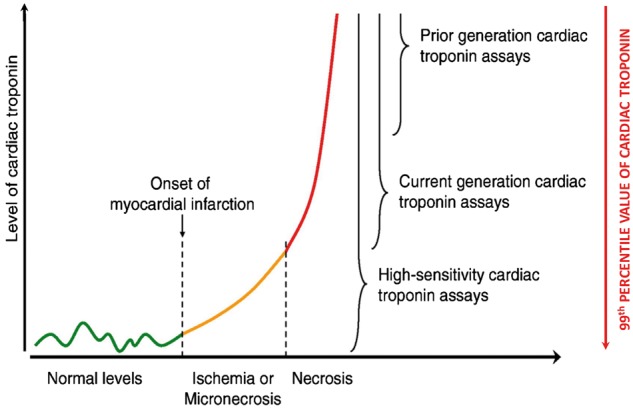
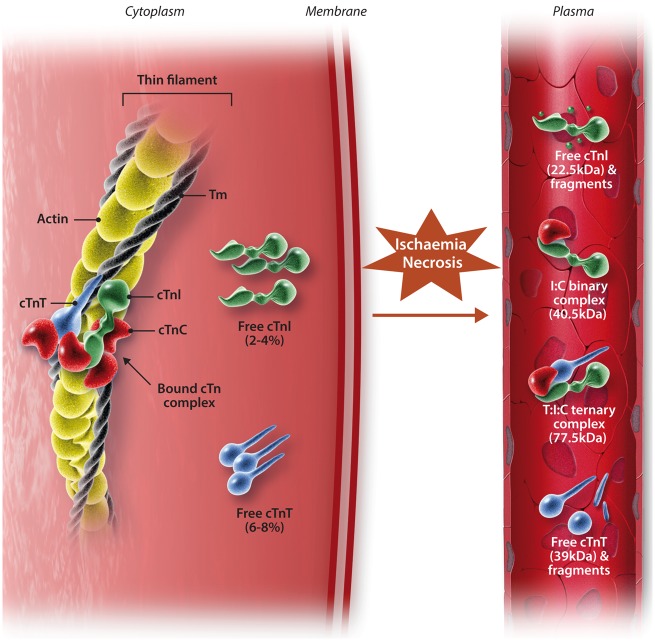
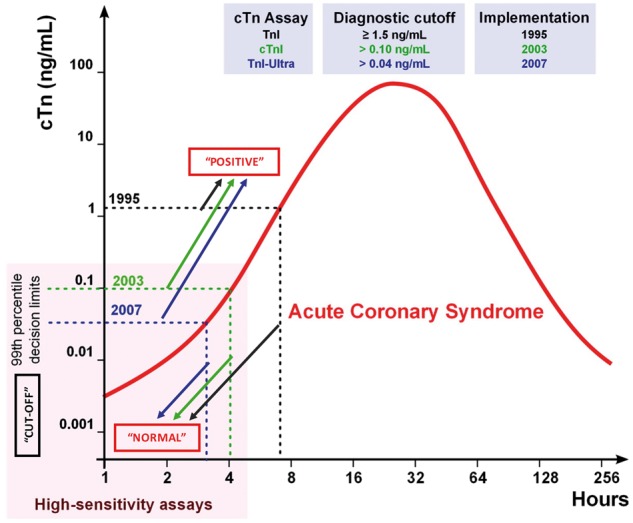
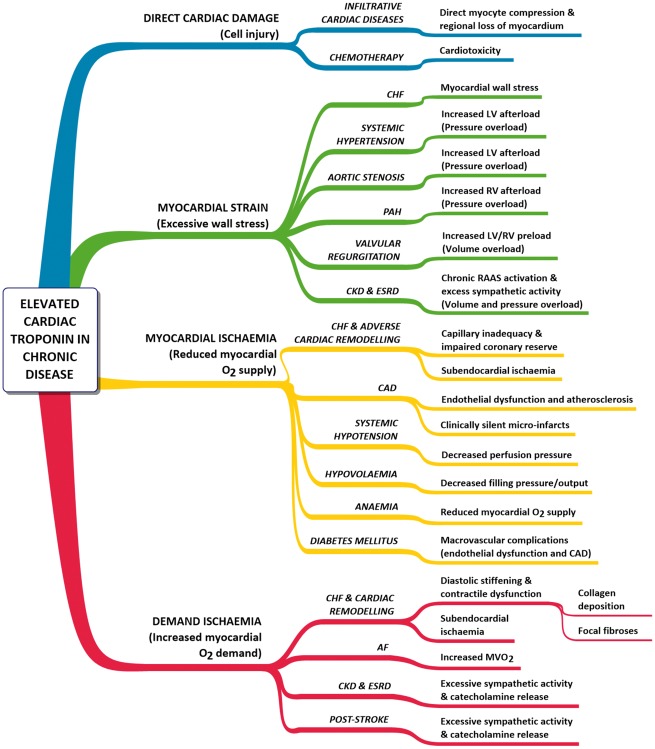
Elucidation of the physiologically distinct subunits of troponin in 1973 greatly facilitated our understanding of cardiac contraction. Although troponins are expressed in both skeletal and cardiac muscle, there are isoforms of troponin I/T expressed selectively in the heart. By exploiting cardiac-restricted epitopes within these proteins, one of the most successful diagnostic tests to date has been developed: cardiac troponin (cTn) assays. For the past decade, cTn has been regarded as the gold-standard marker for acute myocardial necrosis: the pathological hallmark of acute myocardial infarction (AMI). Whilst cTn is the cornerstone for ruling-out AMI in patients presenting with a suspected acute coronary syndrome (ACS), elevated cTn is frequently observed in those without clinical signs indicative of AMI, often reflecting myocardial injury of 'unknown origin'. cTn is commonly elevated in acute non-ACS conditions, as well as in chronic diseases. It is unclear why these elevations occur; yet they cannot be ignored as cTn levels in chronically unwell patients are directly correlated to prognosis. Paradoxically, improvements in assay sensitivity have meant more differential diagnoses have to be considered due to decreased specificity, since cTn is now more easily detected in these non-ACS conditions. It is important to be aware cTn is highly specific for myocardial injury, which could be attributable to a myriad of underlying causes, emphasizing the notion that cTn is an organ-specific, not disease-specific biomarker. Furthermore, the ability to detect increased cTn using high-sensitivity assays following extreme exercise is disconcerting. It has been suggested troponin release can occur without cardiomyocyte necrosis, contradicting conventional dogma, emphasizing a need to understand the mechanisms of such release. This review discusses basic troponin biology, the physiology behind its detection in serum, its use in the diagnosis of AMI, and some key concepts and experimental evidence as to why cTn can be elevated in chronic diseases.
Overview
The claims and statistics of this paper haven’t been checked yet.
Run the check — free, no account needed. It reads the open-access text and checks the sources it cites.
Integrity signals
Registry
Cites
Statistics
Figures
Verification
Claims the paper makes
The claims and statistics of this paper haven’t been checked yet.
Run the check — free, no account needed. It reads the open-access text and checks the sources it cites.
Claims other papers make about this one
Each is checked against this paper’s own text: does it say what the citing paper says it does?
In the citing paper
“Cardiac troponin I (cTnI) is a gold-standard biomarker for cardiovascular diseases (the leading cause of death worldwide)22–25.”
From Nanoproteomics enables proteoform-resolved analysis of low-abundance proteins in human serum (2020) · cites this paper as [25]
In the citing paper
“Note that the estimated levels of cTnI released after cardiac injury events such as AMI are typically in the range of 0.5–50 ng/mL25,27.”
From Nanoproteomics enables proteoform-resolved analysis of low-abundance proteins in human serum (2020) · cites this paper as [25]
Self-check
Percentages, sums and reported differences re-computed from the paper’s own numbers.
The self-check needs the paper’s full text.
Citations
Cites
Roffi, M., Patrono, C., Collet, J.-P., Mueller, C., Valgimigli, M., Andreotti, F., Bax, J. J., Borger, M. A., Brotons, C., Chew, D. P., et al. (2016) · European Heart Journal · doi:10.1093/eurheartj/ehv320 · Cited by 8,261
Third universal definition of myocardial infarction
the Writing Group on behalf of the Joint ESC/ACCF/AHA/WHF Task Force for the Universal Definition of Myocardial Infarction, Thygesen, K., Alpert, J. S., Jaffe, A. S., Simoons, M. L., CHAITMAN, B. R., & White, H. D. (2012) · Nature Reviews Cardiology · doi:10.1038/nrcardio.2012.122 · Cited by 6,585
Yellon, D. M., & Hausenloy, D. J. (2007) · New England Journal of Medicine · doi:10.1056/nejmra071667 · Cited by 3,797
Third universal definition of myocardial infarction
Thygesen, K. A., Alpert, J. S., Jaffe, A. S., Simoons, M. L., Chaitman, B. R., White, H. D., the Writing Group on behalf of the Joint ESC/ACCF/AHA/WHF Task Force for the Universal Definition of Myocardial Infarction, Authors/Task Force Members Chairpersons, Thygesen, K., Alpert, J. S., et al. (2012) · European Heart Journal · doi:10.1093/eurheartj/ehs184 · Cited by 3,095
Task Force Members, Thygesen, K. A., Alpert, J. S., White, H. D., Biomarker Group, Jaffe, A. S., Apple, F. S., Galvani, M., Katus, H. A., Newby, L. K., et al. (2007) · European Heart Journal · doi:10.1093/eurheartj/ehm355 · Cited by 2,536
Chronic Kidney Disease: Effects on the Cardiovascular System
Schiffrin, E. L., Lipman, M. L., & Mann, J. F. E. (2007) · Circulation · doi:10.1161/circulationaha.106.678342 · Cited by 1,448
Evolving Therapies for Myocardial Ischemia/Reperfusion Injury
Ibáñez, B., Heusch, G., Ovize, M., & de Werf, F. V. (2015) · Journal of the American College of Cardiology · doi:10.1016/j.jacc.2015.02.032 · Cited by 1,014
Analytical Characteristics of High-Sensitivity Cardiac Troponin Assays
Apple, F. S., Collinson, P. O., & for the IFCC Task Force on Clinical Applications of Cardiac Biomarkers (2012) · Clinical Chemistry · doi:10.1373/clinchem.2011.165795 · Cited by 861
Self-citationBlebs lead the way: how to migrate without lamellipodia
Charras, G., & Paluch, E. K. (2008) · Nature Reviews Molecular Cell Biology · doi:10.1038/nrm2453 · Cited by 822
Research works printed but not linked: 2
- Bernard, 1979, Nomenclature and criteria for diagnosis of ischaemic heart disease, Circulation, 59, 607
- Vasile, 2009, The biological basis of troponin in heart disease: possible uses for troponin fragmentology, Heart Metab, 43, 5
Cited by
Sorted by citations
Items 501–509 of 509
Esparza, R. A. R., Milan, R. R., Abbas, M. S., Ahmad, A., de la Rosa, D. Q., Retana, E. P., & Fuentes-Puga, V. (2026) · Journal of Cardiothoracic and Vascular Anesthesia · doi:10.1053/j.jvca.2026.07.057
zheming, Z., wenjia, H., & Pei, M. (2026) · Research Square · doi:10.21203/rs.3.rs-10447902/v1
Li, M., Su, K., Hu, R., Gao, K., Liu, Y., Zhang, L., Fan, N., Chen, Y., Cheng, W., Ding, S., et al. (2026) · Advanced Science · doi:10.1002/advs.77696
Troponin: biology, molecular mechanisms, and multidimensional clinical applications
Adamcová, M., & Petráň, L. (2026) · Molecular Biomedicine · doi:10.1186/s43556-026-00597-z
Biomarkers and Risk Prediction in Cardiovascular–Kidney–Metabolic Syndrome: A Comprehensive Review
Lu, Y., Yang, M., Yu, J., Lin, P., Ji, J., Ding, X., Wang, Y., & Xu, X. (2026) · Reviews in Cardiovascular Medicine · doi:10.31083/rcm50631
Yu, Z., Chen, X., Xie, K., Xu, X., Pan, J., Li, T., Ma, W., & Sun, D. (2026) · Advanced Healthcare Materials · doi:10.1002/adhm.71807
Prohászka, B., Sándor, Z., Ferenci, T., Gráf, L., Lohinszky, J., Horváth, A., Tegze, B., Tóth, K. É., Masszi, T., Drobni, Z. D., et al. (2026) · Frontiers in Cardiovascular Medicine · doi:10.3389/fcvm.2026.1943142
Chen, Z., Chen, J., Zhou, J., & Yao, Z. (2026) · Frontiers in Cardiovascular Medicine · doi:10.3389/fcvm.2026.1881009
Liu, W., Jiang, Y., Li, S., Song, C., Liu, K., Hou, M., Zhao, L., Li, W., Yan, B., & Mao, S. (2026) · Frontiers in Medicine · doi:10.3389/fmed.2026.1987083
Metadata
- Authors
- Park, K. C., Gaze, D. C., Collinson, P. O., & Marber, M. S.
- Affiliations
- King's College London (GB)
- St George's, University of London (GB)
- Corresponding author
- Marber, Michael S
- Venue
- Cardiovascular Research
- Publisher
- Oxford University Press (OUP)
- Published
- 2017-09-14
- Volume
- 113
- Issue
- 14
- Pages
- 1708-1718
- ISSN
- 0008-6363 (ISSN-L)
- 1755-3245
- PMC
- PMC5852618
- OpenAlex
- W2755269296
- Cited by
- 510
- References
- 105
- Citations by year
- 2026: 41 · 2025: 59 · 2024: 80 · 2023: 53 · 2022: 70 · 2021: 74 · 2020: 70 · 2019: 49 · 2018: 12 · 2017: 2
- FWCI
- 5.12
- Type
- journal article
- Language
- en
- Open access
- hybrid
- doi.org
- Licence
- Locations
- Cardiovascular Research (publishedVersion, cc-by)
- PubMed Central (publishedVersion, cc-by)
- PubMed (publishedVersion)
- St George's Online Research Archive (St George's University of London) (acceptedVersion)
- WestminsterResearch (University of Westminster) (acceptedVersion, cc-by)
- Funders
- Medical Research Council (G1000737)
- British Heart Foundation (TG/15/1/31518 and FS/15/13/31320)
- Topics
- Health Sciences › Medicine › Cardiology and Cardiovascular Medicine › Acute Myocardial Infarction Research
- Health Sciences › Medicine › Radiology, Nuclear Medicine and Imaging › Cardiac Imaging and Diagnostics
- Health Sciences › Medicine › Cardiology and Cardiovascular Medicine › Takotsubo Cardiomyopathy and Associated Phenomena
- Keywords
- cardiac troponin, troponin I, troponin T, acute myocardial infarction, acute coronary syndrome, myocardial injury, high-sensitivity troponin assays, chronic disease, cardiac contraction
- MeSH terms
- Animals, Chronic Disease, Humans, Myocardial Infarction, Myocardium, Biomarkers, Troponin T, Acute Coronary Syndrome
About these checks
Registry, retraction, Cites and statistics results are computed, not judged, with one exception: a printed reference that no index lists is read once by a model before it counts as a citation error. Claims are extracted by a model and kept only when their quote appears verbatim in the text; each cited source is then checked, with a model’s help, for whether it says what the claim relies on. Those verdicts can be wrong — read the claim’s quote and the cited source before relying on one.
Statistics and arithmetic are recomputed, not judged.
Confidence bands are shown only for fields calibrated on our annotated test set. None is calibrated yet, so no band is shown.
What counts as a claim ›How we measure confidence ›How we check this ›
Are you an author, or do you see a problem with this page? Request a review
