

Body image concerns in women with polycystic ovary syndrome: a systematic review and meta-analysis
Open accessThe DOI matches its Crossref record; 26 of the 27 references it cites were found in a registry or an index, and 1 are not checked yet.
Abstract
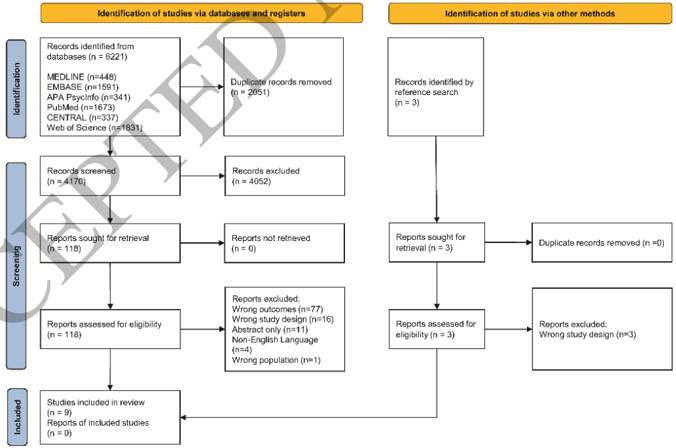
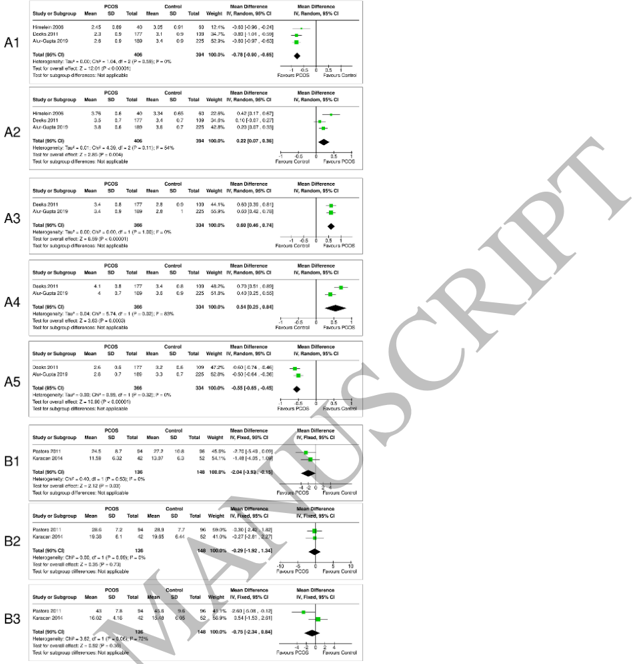
OBJECTIVE: To assess differences in body image concerns among women with and without polycystic ovary syndrome (PCOS). DESIGN: This is a systematic review and meta-analysis. METHODS: Electronic databases (MEDLINE, EMBASE, APA PsychInfo, PUBMED, Web-of-Science Core Collection, and Cochrane Controlled Register of Trials [CENTRAL]) were searched from inception through July 2022. Outcome measures included validated questionnaires reporting on body image concerns. Methodological quality was assessed by the Grading of Recommendations, Assessment, Development and Evaluations (GRADE) system, and included studies were assessed for risk of bias. Meta-analyses were performed using the inverse variance method based on random or fixed effects models (Review Manager, Version 5). RESULTS: A total of 918 women with PCOS and 865 women without PCOS from 9 studies were included. Meta-analysis of 3 studies using Multidimensional Body-Self Relations Questionnaire Appearance Scale (MBSRQ-AS) showed those with PCOS reported higher dissatisfaction with appearance evaluation and appearance orientation compared to those without PCOS (mean difference [MD] = -0.78, I2 = 0%, P < .00001, and MD = 0.22, I2 = 54%, P = .004, respectively). Meta-analysis of 2 studies showed higher dissatisfaction with overweight preoccupation, lower body area satisfaction, and body weight classification on MBSRQ-AS subscales in those with PCOS compared to those without PCOS (all P < .001). Meta-analysis of 2 studies using the Body Esteem Scale for Adolescents and Adults (BESAA) showed significantly lower scores for the weight subscale in those with PCOS compared to those without PCOS (P = .03). CONCLUSIONS: Those with PCOS experience more significant body image concerns, emphasising the importance of awareness in the clinical care of PCOS. Considering the limited evidence, further studies are warranted to identify drivers and mitigating factors.
Overview
The claims and statistics of this paper haven’t been checked yet.
Free: it reads the open-access text and checks the first 5 claims that cite a source we can check. Create a free account to check every claim.
Integrity signals
Registry
Cites
Statistics
Figures
Verification
Claims the paper makes
The claims and statistics of this paper haven’t been checked yet.
Free: it reads the open-access text and checks the first 5 claims that cite a source we can check. Create a free account to check every claim.
Claims other papers make about this one
Each is checked against this paper’s own text: does it say what the citing paper says it does?
The cited source says what the claim attributes to it.
In the citing paper
“While not entirely negative, this type marketing can be misleading and harmful for individuals with vulnerabilities such as body image concerns [60], which are prevalent among women with PCOS [61].”
From Availability and Use of Digital Technology Among Women With Polycystic Ovary Syndrome: Scoping Review (2025) · cites this paper as [61]
The cited source says what the claim attributes to it.
In the citing paper
“Women with PCOS often experience greater body dissatisfaction compared to those without the condition (Davitadze et al., 2023)”
From Mindfulness acting with awareness and emotional eating among polycystic ovary syndrome women with infertility: the mediating role of depression (2024) · cites this paper as Davitadze et al., 2023
Self-check
Percentages, sums and reported differences re-computed from the paper’s own numbers.
The self-check needs the paper’s full text.
Citations
Cites
Wan, X., Wang, W., Liu, J., & Tong, T. (2014) · BMC Medical Research Methodology · doi:10.1186/1471-2288-14-135 · Cited by 11,735
Teede, H. J., Misso, M. L., Costello, M. F., Dokras, A., Laven, J., Moran, L., Piltonen, T., Norman, R. J., International PCOS Network, Andersen, M., et al. (2018) · Human Reproduction · doi:10.1093/humrep/dey256 · Cited by 1,593
Self-citationPolivy, J., & Herman, C. P. (2002) · Annual Review of Psychology · doi:10.1146/annurev.psych.53.100901.135103 · Cited by 1,228
Body-Esteem Scale for Adolescents and Adults
Mendelson, B. K., Mendelson, M. J., & White, D. R. (2001) · Journal of Personality Assessment · doi:10.1207/s15327752jpa7601_6 · Cited by 1,003
Yildiz, B. O., Bozdag, G., Yapici, Z., Esinler, I., & Yarali, H. (2012) · Human Reproduction · doi:10.1093/humrep/des232 · Cited by 704
Clinical and psychological correlates of quality-of-life in polycystic ovary syndrome
Hahn, S., Janssen, O. E., Tan, S., Pleger, K., Mann, K., Schedlowski, M., Kimmig, R., Benson, S., Balamitsa, E., & Elsenbruch, S. (2005) · European Journal of Endocrinology · doi:10.1530/eje.1.02024 · Cited by 387
Body Image: Body Image: A Handbook of Theory, Research, and Clinical Practice
Tamburrino, M. B. (2003) · JAMA · doi:10.1001/jama.289.14.1861 · Cited by 377
Depression and Body Image among Women with Polycystic Ovary Syndrome
Himelein, M. J., & Thatcher, S. S. (2006) · Journal of Health Psychology · doi:10.1177/1359105306065021 · Cited by 248
Deeks, A. A., Gibson-Helm, M. E., Paul, E., & Teede, H. J. (2011) · Human Reproduction · doi:10.1093/humrep/der071 · Cited by 202
Self-citationComparison of four heterogeneity measures for meta‐analysis
Lin, L. (2020) · Journal of Evaluation in Clinical Practice · doi:10.1111/jep.13159 · Cited by 184
Research works printed but not linked: 4
- Hosseini SA, Padhy RK. Body Image Distortion. StatPearls [Internet]. 2022 Sep 5 [cited 2022 Dec 11]; Available from: https://www.ncbi.nlm.nih.gov/books/NBK546582/
- Himelein MJ, Thatcher SS. Depression and body image among women with polycystic ovary syndrome. J Health Psychol. 2006 Jul;11(4):613-25.
- Deeks AA, Gibson-Helm ME, Paul E, Teede HJ. Is having polycystic ovary syndrome a predictor of poor psychological function including anxiety and depression? Human Reproduction [Internet]. 2011 Jun 1 [cited 2022 Nov 5];26(6):1399-407. Available from: https://academic.oup.com/humrep/article/26/6/1399/2914254
- Alur-Gupta S, Chemerinski A, Liu C, Lipson J, Allison K, Sammel MD, et al. Body image distress increased in women with PCOS and mediates depression and anxiety. Fertil Steril [Internet]. 2019 Nov 1 [cited 2022 Oct 22];112(5):930. Available from: /pmc/articles/PMC6858949/
Cited by
Stener-Victorin, E., Teede, H., Norman, R. J., Legro, R., Goodarzi, M. O., Dokras, A., Laven, J., Hoeger, K., & Piltonen, T. T. (2024) · Nature Reviews Disease Primers · doi:10.1038/s41572-024-00511-3 · Cited by 495
Self-citationAlur-Gupta, S., Dokras, A., & Cooney, L. G. (2024) · Fertility and Sterility · doi:10.1016/j.fertnstert.2024.01.018 · Cited by 65
Anxiety, depression, and body image among infertile women with and without polycystic ovary syndrome
Jannink, T. I., Bordewijk, E. M., Aalberts, J. L., Hendriks, J., Lehmann, V., Hoek, A., Goddijn, M., van Wely, M., ANDES study group, de Bruin, J. P., et al. (2024) · Human Reproduction · doi:10.1093/humrep/deae016 · Cited by 46
Cooney, L. G., Gyorfi, K. M., Sanneh, A., Bui, L. M., Mousa, A., Tay, C. T., Teede, H. J., Stener‐Victorin, E., & Brennan, L. (2024) · The Journal of Clinical Endocrinology & Metabolism · doi:10.1210/clinem/dgae462 · Cited by 45
Self-citationBody image and mental health in women with polycystic ovary syndrome–a cross-sectional study
Hofmann, K., Decrinis, C., Bitterlich, N., Tropschuh, K., Stute, P., & Bachmann, A. (2025) · Archives of Gynecology and Obstetrics · doi:10.1007/s00404-024-07913-4 · Cited by 37
“A meta-analysis by Davitadze et al., which included studies using the MBSRQ-AS as a measurement tool and involved 918 women with PCOS and 865 women without PCOS, found that women with PCOS have significantly greater body image concerns compared to women without PCOS [8].”
Influential
Metadata
- Authors
- Davitadze, M., Malhotra, K., Khalil, H., Hebbar, M., Tay, C. T., Mousa, A., PCOS SEva team, Robinson, L., Sheikh, J., Melson, E., Lathia, T., Selvan, C., Teede, H., Brennan, L., Stener-Victorin, E., & Kempegowda, P.
- Affiliations
- University of Birmingham (GB)
- Dayanand Medical College & Hospital (IN)
- Dudley Group NHS Foundation Trust (GB)
- Monash University (AU)
- La Trobe University (AU)
- Department of Physiology and Pharmacology, Karolinska Institute , Stockholm , Sweden
- University Hospitals Birmingham NHS Foundation Trust (GB)
- Corresponding author
- Kempegowda, Punith
- ORCID
- Venue
- European Journal of Endocrinology
- Publisher
- Oxford University Press (OUP)
- Published
- 2023-08
- Volume
- 189
- Issue
- 2
- Pages
- R1-R9
- ISSN
- 0804-4643 (ISSN-L)
- 1479-683X
- OpenAlex
- W4386153906
- Cited by
- 57
- References
- 26
- Citations by year
- 2026: 22 · 2025: 23 · 2024: 11 · 2023: 1
- FWCI
- 2.32
- Type
- journal article
- Language
- en
- Open access
- hybrid
- doi.org
- Licence
- Locations
- European Journal of Endocrinology (publishedVersion, cc-by-nc)
- PubMed (publishedVersion)
- University of Birmingham Research Portal (University of Birmingham) (submittedVersion, cc-by-nc)
- Figshare (submittedVersion, cc-by-nc)
- La Trobe University
- Funders
- National Health and Medical Research Council
- Topics
- Health Sciences › Medicine › Reproductive Medicine › Ovarian function and disorders
- Social Sciences › Psychology › Clinical Psychology › Eating Disorders and Behaviors
- Social Sciences › Psychology › Clinical Psychology › Body Image and Dysmorphia Studies
- Keywords
- polycystic ovary syndrome, body image concern, body dissatisfaction, appearance evaluation, appearance orientation, body weight classification, body area satisfaction, body esteem, women's health
- MeSH terms
- Adolescent, Adult, Body Image, Female, Humans, Polycystic Ovary Syndrome, Databases, Factual, PubMed, Overweight
About these checks
Registry, retraction, Cites and statistics results are computed, not judged, with one exception: a printed reference that no index lists is read once by a model before it counts as a citation error. Claims are extracted by a model and kept only when their quote appears verbatim in the text; each cited source is then checked, with a model’s help, for whether it says what the claim relies on. Those verdicts can be wrong — read the claim’s quote and the cited source before relying on one.
Statistics and arithmetic are recomputed, not judged.
Confidence bands are shown only for fields calibrated on our annotated test set. None is calibrated yet, so no band is shown.
What counts as a claim ›How we measure confidence ›How we check this ›
Are you an author, or do you see a problem with this page? Request a review
How to cite
Cite CoChat for the checks on this page, and the paper for its own findings.
- This page
- CoChat. (2026). Citation check: Body image concerns in women with polycystic ovary syndrome: a systematic review and meta-analysis. https://app.cochat.ai/papers/10.1093/ejendo/lvad110
- The paper
- Davitadze, M., Malhotra, K., Khalil, H., Hebbar, M., Tay, C. T., Mousa, A., PCOS SEva team, Robinson, L., Sheikh, J., Melson, E., Lathia, T., Selvan, C., Teede, H., Brennan, L., Stener-Victorin, E., & Kempegowda, P. (2023). Body image concerns in women with polycystic ovary syndrome: a systematic review and meta-analysis. European Journal of Endocrinology. https://doi.org/10.1093/ejendo/lvad110
Data sources
Bibliographic data: Semantic Scholar, OpenAlex, Crossref.
Contains information from the Semantic Scholar Academic Graph Datasets, made available under the ODC Attribution License (ODC-BY 1.0).
Semantic Scholar’s data is described in: Kinney, R., et al. (2023). The Semantic Scholar Open Data Platform. arXiv:2301.10140.
