

Prevalence of Posttraumatic Stress Disorder in Prisoners
Open accessThe DOI matches its Crossref record; 66 of the 67 references it cites were found in a registry or an index.
Abstract
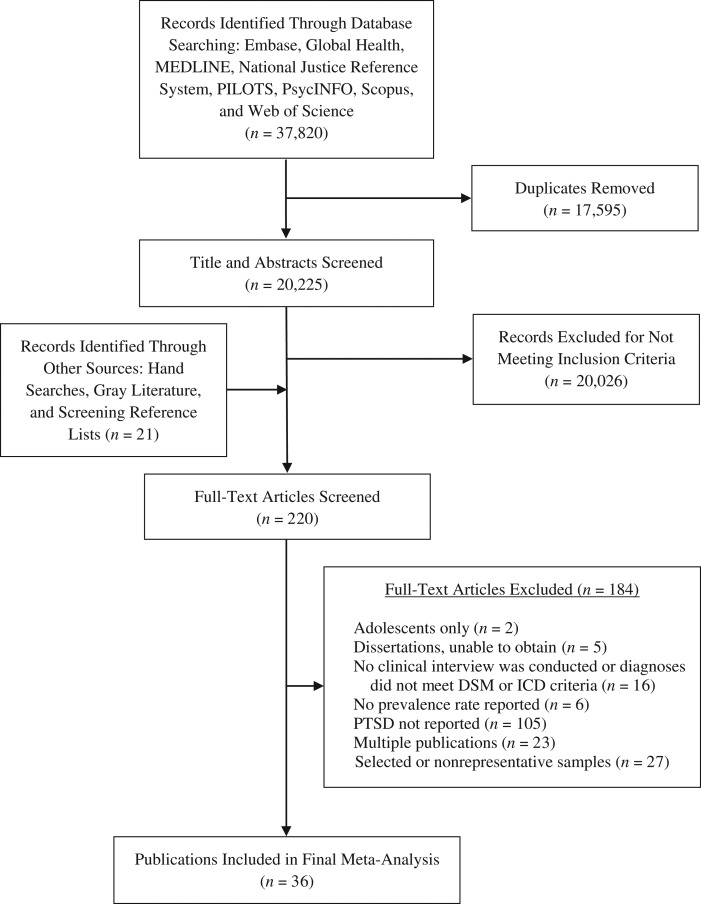
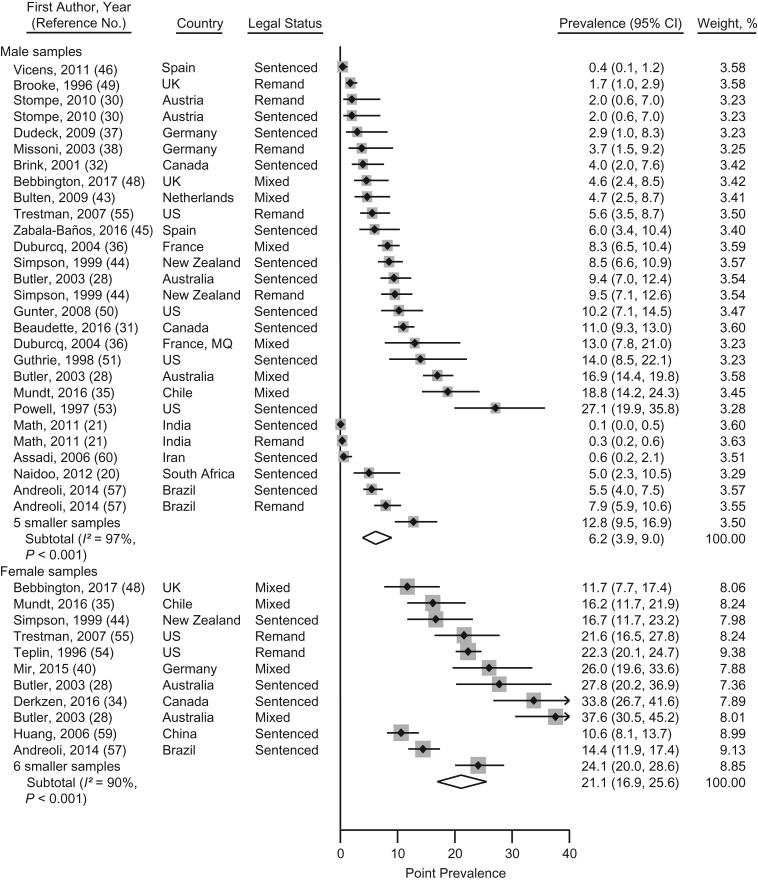
People involved with criminal justice frequently are exposed to violence and traumatic experiences. This may lead to posttraumatic stress disorder (PTSD); however, no review, to our knowledge, has synthetized findings in this setting. We conducted a systematic review and meta-analysis to estimate prevalence rates of PTSD in prison populations. Original studies in which prevalence rates of PTSD in unselected samples of incarcerated people were reported were systematically searched between 1980 and June 2017. Data were pooled using random-effects meta-analysis, and sources of heterogeneity for prespecified characteristics were assessed by meta-regression. We identified 56 samples comprising 21,099 imprisoned men and women from 20 countries. Point prevalence of PTSD ranged from 0.1% to 27% for male, and from 12% to 38% for female prisoner populations. The random-effects pooled point prevalence was 6.2% (95% confidence interval: 3.9, 9.0) in male prisoners and 21.1% (95% confidence interval: 16.9, 25.6) in female prisoners. The heterogeneity between the included studies was very high. Higher prevalence was reported in samples of female prisoners, smaller studies (n ≤ 200), and for investigations based in high-income countries. Existing evidence shows high levels of PTSD among imprisoned people, especially women. Psychosocial interventions to prevent violence, especially against children and women, and to mitigate its consequences in marginalized communities must be improved. Trauma-informed approaches for correctional programs and scalable PTSD treatments in prisons require further consideration.
Overview
The claims and statistics of this paper haven’t been checked yet.
Free: it reads the open-access text and checks the first 5 claims that cite a source we can check. Create a free account to check every claim.
Integrity signals
Registry
Cites
Statistics
Figures
Verification
Claims the paper makes
The claims and statistics of this paper haven’t been checked yet.
Free: it reads the open-access text and checks the first 5 claims that cite a source we can check. Create a free account to check every claim.
Claims other papers make about this one
Each is checked against this paper’s own text: does it say what the citing paper says it does?
The cited source says what the claim attributes to it.
In the citing paper
“The prevalence of PTSD in women prisoners tended to increase compared to males and the general population.”
From A Scoping Review of Correctional-Based Interventions for Women Prisoners with Mental Health Problems (2023) · cites this paper as Baranyi et al. 2018
The cited source says what the claim attributes to it.
In the citing paper
“Male prisoners had a five-time greater point frequency of PTSD than the general population, while female prisoners had an 8-fold higher point prevalence of PTSD (Baranyi et al. 2018).”
From A Scoping Review of Correctional-Based Interventions for Women Prisoners with Mental Health Problems (2023) · cites this paper as Baranyi et al. 2018
Self-check
Percentages, sums and reported differences re-computed from the paper’s own numbers.
The self-check needs the paper’s full text.
Citations
Cites
Preferred Reporting Items for Systematic Reviews and Meta-Analyses: the PRISMA statement
Moher, D., Liberati, A., Tetzlaff, J., Altman, D. G., & for the PRISMA Group (2009) · BMJ · doi:10.1136/bmj.b2535 · Cited by 83,823
Measuring inconsistency in meta-analyses
Higgins, J. P. T., Thompson, S. G., Deeks, J. J., & Altman, D. G. (2003) · BMJ · doi:10.1136/bmj.327.7414.557 · Cited by 63,139
Bias in meta-analysis detected by a simple, graphical test
Egger, M., Smith, G. D., Schneider, M., & Minder, C. (1997) · BMJ · doi:10.1136/bmj.315.7109.629 · Cited by 56,722 · cited 1×
“Differences of the study quality and small study bias were explored as possible reasons for asymmetric funnel plots (27).”
BackgroundMeta-analysis of Observational Studies in Epidemiology<SUBTITLE>A Proposal for Reporting</SUBTITLE>
Stroup, D. F. (2000) · JAMA · doi:10.1001/jama.283.15.2008 · Cited by 20,623
Stang, A. (2010) · European Journal of Epidemiology · doi:10.1007/s10654-010-9491-z · Cited by 17,396 · cited 2×
“) who used a modified checklist, based on the Newcastle-Ottawa Scale (22), from a meta-analysis on the prevalence of depression (23).”
MethodPreferred reporting items for systematic reviews and meta-analyses: The PRISMA statement
Moher, D., Liberati, A., Tetzlaff, J., & Altman, D. G. (2010) · International Journal of Surgery · doi:10.1016/j.ijsu.2010.02.007 · Cited by 12,156
Posttraumatic Stress Disorder in the National Comorbidity Survey
Kessler, R. C. (1995) · Archives of General Psychiatry · doi:10.1001/archpsyc.1995.03950240066012 · Cited by 10,379 · cited 1×
“4% in women in the general population (63).”
BackgroundA basic introduction to fixed-effect and random-effects models for meta-analysis
Borenstein, M., Hedges, L. V., Higgins, J. P. T., & Rothstein, H. R. (2010) · Research Synthesis Methods · doi:10.1002/jrsm.12 · Cited by 6,793 · cited 1×
“samples, we used random-effects models to balance the weighting of studies for data syntheses (24).”
MethodSerious mental disorder in 23 000 prisoners: a systematic review of 62 surveys
Fazel, S., & Danesh, J. (2002) · The Lancet · doi:10.1016/s0140-6736(02)07740-1 · Cited by 2,201 · cited 1×
“Prevalence rates of substance use disorders (3) and personality disorders (4) also have been found to be much higher in the prison population than in the general population.”
BackgroundSelf-citationMetaprop: a Stata command to perform meta-analysis of binomial data
Nyaga, V. N., Arbyn, M., & Aerts, M. (2014) · Archives of Public Health · doi:10.1186/2049-3258-72-39 · Cited by 2,139 · cited 2×
“Freeman-Tukey double arcsine transformation was used to stabilize the variance before pooling (25).”
Method
Research works printed but not linked: 6
- Walmsley R World Prison Population List. 11th ed. London, UK: Institute for Criminal Policy Research; 2016.
- Stompe T, Brandstatter N, Ebner N, et al Psychiatric disorders in prison inmates. J Neurol Neurochir Psychiatr. 2010; 11(2): 20– 23.
- Derkzen D, Barker J, McMillan K, et al Rates of Current Mental Disorders Among Women Offenders in Custody in CSC. Ottawa, Canada: Correctional Service Canada; 2016.
- Duburcq A, Coulomb S, Bonte J, et al Enquête de Prévalence sur les Troubles Psychiatriques en Milieu Carcéral (Phase 1 de l’Étude Épidémiologique) Rapport Final. Paris, France: CEMKA-EVAL; 2004.
- Missoni L, Utting F, Konrad N Psychi(atri)sche Störungen bei Untersuchungsgefangenen. Ergebnisse und Probleme einer epidemiologischen Studie. ZfStrVo. 2003; 52(6): 323– 332.
- Guthrie RK The Prevalence of Posttraumatic Stress Disorder Among Federal Prison Inmates [dissertation]. Morgantown, WV: West Virginia University; 1998.
Cited by
Items 101–200 of 247
Trauma‐informed Care in the Criminal Justice System
Walker, T. (2021) · Wiley eBooks · doi:10.1002/9781394260669.ch35 · Cited by 7
Zhong, S., Zhu, X., Mellsop, G. W., Zhou, J., & Wang, X. (2021) · Frontiers in Psychiatry · doi:10.3389/fpsyt.2021.748518 · Cited by 9
“A systematic review published in 2018 reported that the prevalence of PTSD in imprisoned women is 3 times that in men (9).”
BackgroundBlack, N., & Trounson, J. (2019) · Journal of Australian indigenous issues · doi:10.3316/informit.142952174119362 · Cited by 6
Ray, I., Fulham, L., Simpson, A. I. F., Vogel, T., Gerritsen, C. J., Patel, K., & Jones, R. M. (2022) · Criminal Behaviour and Mental Health · doi:10.1002/cbm.2263 · Cited by 7
Exploring masculinity, experience of distress and help-seeking within a UK male prison
Ramesh, T., Mercieca, M., Curran, V. H., & Cabourne, J. (2023) · Journal of Men s Health · doi:10.22514/jomh.2023.134 · Cited by 24
Trauma History in a Medium-Secure Adult Male Forensic Mental Health Setting
Jeffery, G., Alves-Costa, F., & Livanou, M. (2024) · International Journal of Forensic Mental Health · doi:10.1080/14999013.2024.2405971 · Cited by 6
“…found that no patient had a primary diagnosis of PTSD, and only one had a secondary diagnosis of PTSD - suggesting a lack of exploration and an under-recognition of the extent of the effects of trauma histories within this population in clinical settings (Baranyi et al., 2018; Sarkar et al., 2005).”
InfluentialCo-morbid psychological distress groups among incarcerated men
Wolff, N., & Sánchez, F. C. (2020) · Journal of Criminal Psychology · doi:10.1108/jcp-01-2020-0002 · Cited by 4
Incarcerated Women in Spain: The Salience of Traumatic Exposure
Caravaca-Sánchez, F., Vidovic, K. R., Fearn, N. E., & Vaughn, M. G. (2021) · Journal of Interpersonal Violence · doi:10.1177/0886260520985483 · Cited by 9
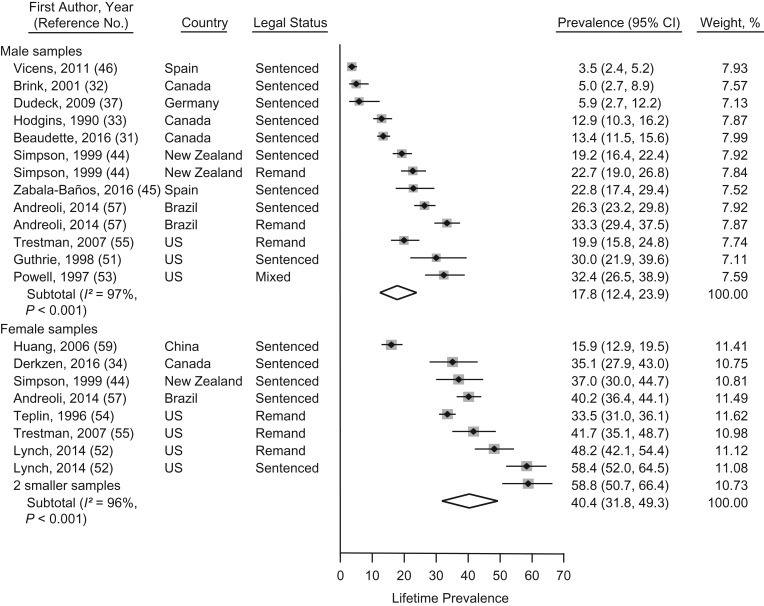
“More recently, Baranyi et al. (2018) conducted a study with approximately 5,000 women inmates, finding a wide-ranging point-prevalence of PTSD between 12 and 38% and lifetime prevalence of PTSD between 16 and 58%.”
BackgroundMaking Sense of Offense-Related Trauma: Exploring Two Patients’ Lived Experience
Rew, G., Clark, L., & Rogers, G. (2022) · Journal of EMDR Practice and Research · doi:10.1891/emdr-2022-0004 · Cited by 7
Evaluating the use of PTSD Assessment Tools Within the U.S. Prison Setting: An Exploratory Analysis
Dulisse, B. C., Logan, M. W., & Hazelwood, A. R. (2023) · The Prison Journal · doi:10.1177/00328855231173144 · Cited by 4
“The findings indicate substantial variation across departments of correction regarding PTSD assessments for inmates housed within respective facilities; a point worthy of further examination given (1) the prevalence of PTSD among inmates (Baranyi et al., 2018; Briere et al., 2016; Facer-Irwin et al., 2019; Harner et a…”
BackgroundResultInfluentialBali, P., Willgoose, A., & Perkins, E. (2023) · Journal of Forensic Psychiatry and Psychology · doi:10.1080/14789949.2023.2245808 · Cited by 4
“Research investigating trauma-related needs found that PTSD symptoms are more prevalent in prison than in the general population (Baranyi et al., 2018; Jakobowitz et al., 2017).”
BackgroundMental health of prerelease incarcerated women
Eck, M., Lancelevée, C., Wathelet, M., Amad, A., Benradia, I., D’Ovidio, K., Duhem, S., Thomas, P., & Fovet, T. (2025) · Psychiatry Research · doi:10.1016/j.psychres.2025.116485 · Cited by 3
The Mental Health Outcomes of Trauma-Informed Intervention Programs in Prisons: A Systematic Review
Coelho, J., Barros, S., Dias, D., Martinho, G., & Santos, A. (2025) · Criminal Justice and Behavior · doi:10.1177/00938548251350114 · Cited by 5
“…(PTSD), a condition that may develop following exposure to potentially traumatic events and cause ongoing symptoms that lead to significant suffering or functional impairment (APA, 2013), is more prevalent among people who are incarcerated than in the general population (Baranyi et al., 2018).”
InfluentialSchnyder, N., Endrass, J., Albrecht, J. N., Dreyer, J., Graf, M., Habermeyer, E., & Rossegger, A. (2025) · BMC Psychiatry · doi:10.1186/s12888-025-07255-8 · Cited by 8
“Comparably high is the point prevalence of posttraumatic stress disorder which reached up to 21%, with females being at particular risk [12].”
Gender and Malingering in Defendants Deemed Incompetent to Stand Trial.
Nesbit-Bartsch, A. E., McDermott, B. E., & Warburton, K. D. (2021) · PubMed · doi:10.29158/jaapl.200083-20 · Cited by 6
Dogan, J. N., Thrasher, S. S., Thorpe, S. Y., Wheeler, P. B., & Stevens-Watkins, D. J. (2023) · Journal of Community Psychology · doi:10.1002/jcop.23093 · Cited by 3
Ancely, A., Laurencin‐Dalicieux, S., Baussois, C., Blanc, A., Nabet, C., Thomas, C., & Fournier, G. (2024) · International Journal of Prison Health · doi:10.1108/ijoph-10-2022-0066 · Cited by 5
Dehumanization in the United States carceral system: Pathways to policy reform
Carriere, K. R., & Ravn, M. (2024) · Analyses of Social Issues and Public Policy · doi:10.1111/asap.12420 · Cited by 4
PTSD Prevalence in US Prisons: A Systematic Review and Meta-Analysis
Young, L., Trinidad, A., & Azabal, M. (2025) · The European Journal of Psychology Applied to Legal Context · doi:10.5093/ejpalc2025a7 · Cited by 5
Mental disorders in adults deprived of liberty in American countries: a scoping review
Orth, G. M. N., Serpeloni, F., de Assis, S. G., Andrade, T. A., Rabe, E. M., & de Moura, A. A. A. (2025) · Cadernos de Saúde Pública · doi:10.1590/0102-311xen200624 · Cited by 6
“Research consistently shows a significantly higher prevalence of mental disorders and substance use among incarcerated populations compared to the general public 7,8,9,10 .”
Characteristics and neuropsychological impact of traumatic brain injury in female prisoners
O’Sullivan, M., Fitzsimons, S., Ramos, S. D. S., Oddy, M., & Sterr, A. (2020) · Brain Injury · doi:10.1080/02699052.2020.1858344 · Cited by 8
“A meta-analysis (61) demonstrated a pooled point prevalence of post-traumatic stress disorder (PTSD) of 21.”
BackgroundScreening for mental disorders in police custody settings
McKinnon, I., Moore, J. R., Lyall, A., & Forrester, A. (2022) · BJPsych Advances · doi:10.1192/bja.2022.25 · Cited by 3
Enriching Prison Environments via Peer-Led Activities
Seel, C. J., May, R. J., & Austin, J. L. (2023) · Behavior Analysis in Practice · doi:10.1007/s40617-023-00851-8 · Cited by 4
“These issues, combined with the greater prevalence of trauma histories among prisoners, have led to calls for prisons to engage with trauma-informed practices (e.g., Baranyi et al., 2018; Levenson & Willis, 2019).”
Instilling Character Education Through Habituation at School with the Help of Parents
Sutrisno, S., Isrohmawati, I., Munif, E. B., Jemmy, J., & Wahab, A. A. (2023) · Journal Emerging Technologies in Education · doi:10.55849/jete.v1i6.532 · Cited by 23
Bonato, P. D. P. Q., Ventura, C. A. A., Reis, R. K., Amaral, C. D. P., Smet, S. D., Grossi, S., de Brito, E. S., & Craveiro, I. M. R. (2024) · Social Sciences · doi:10.3390/socsci13050249 · Cited by 3
“Health professionals who care for women while they are in prison have reported an increase in the number of cases of mental disorders, they see in everyday prison care (Fazel and Seewald 2012; Baranyi et al. 2018).”
BackgroundKnowledge of evidence-based practices for PTSD among mental health court judges
Brown, L. A., AlRabiah, R., Terasse, M., Aksianiuk, V., & Sisti, D. A. (2022) · Medicine Science and the Law · doi:10.1177/00258024221096250 · Cited by 4
“Between 15–48% of women and 27% of men incarcerated in prisons meet criteria for PTSD, reflecting a significantly elevated risk for PTSD compared to the general population (approximately 8%).(24,25) Thus, the link between exposure to trauma, PTSD, and incarceration is well-established.”
BackgroundCharlson, F., Gynther, B., Obrecht, K., Heffernan, E., David, M., Young, J. T., & Hunter, E. M. (2021) · Australian & New Zealand Journal of Psychiatry · doi:10.1177/0004867420985247 · Cited by 3
RE: “PREVALENCE OF POSTTRAUMATIC STRESS DISORDER IN PRISONERS”
(2018) · Epidemiologic Reviews · doi:10.1093/epirev/mxy007 · Cited by 3
Gaba, A., Helm, A. F., Shaffer, P. M., Pridgen, B. E., Drawbridge, D. C., & Smelson, D. A. (2023) · International Journal of Law and Psychiatry · doi:10.1016/j.ijlp.2023.101924 · Cited by 3
Comben, C., Rutherford, Z. H., Meurk, C., John, J., Fjeldsoe, K., Gossip, K., & Diminic, S. (2024) · Psychiatry Psychology and Law · doi:10.1080/13218719.2024.2330049 · Cited by 2
“Justice-involved populations often have other health or complex social needs (Baranyi et al., 2018; Binswanger et al., 2009; Fazel et al., 2006; Productivity Commission, 2021).”
Psychiatry in Prisons and Corrections
Fovet, T., Mundt, A. P., & Fazel, S. (2024) · Springer eBooks · doi:10.1007/978-3-030-51366-5_103 · Cited by 4
Self-citationGrummitt, L. R., Coote, T., Howard, M. V. A., Nahleen, S., Doyle, M., McEntyre, E., Lawler, S., Bower, M., Stapinski, L. A., Kaye, S. S., et al. (2025) · Advances in Dual Diagnosis · doi:10.1108/add-08-2025-0038 · Cited by 2
Nacher, M., Melle, A. V., Thomas, E., Pavie, J., Solignat, B., Benradia, I., Sebbane, D., Aernout, E., Roelandt, J.-L., Janvier, C., et al. (2025) · Frontiers in Public Health · doi:10.3389/fpubh.2025.1668105 · Cited by 2
Winsor, M., Gobbett, M. J., & Davies, J. (2025) · International Journal of Offender Therapy and Comparative Criminology · doi:10.1177/0306624x251405449 · Cited by 3
“Within the prison context, whilst Trauma prevalence rates vary by data collection method and country, a pooled point prevalence rate for PTSD of 6.2% has been reported in male prisoners (based on 50 samples from 20 countries; Baranyi et al., 2018).”
InfluentialHonegger, L. N., & Dewald, S. (2023) · Journal of Forensic Social Work · doi:10.15763/issn.1936-9298.2023.7.1.72-90 · Cited by 4
Barber‐Rioja, V., & Anderson, G. (2023) · doi:10.1093/oso/9780197524794.003.0001 · Cited by 2
PERSONALITY DISORDERS AND CRIME
Teimuraz, S., & Rusudan, J. (2023) · World Science · doi:10.31435/rsglobal_ws/30062023/7982 · Cited by 4
“According to international scientific literature and systematic reviews, in prison population there is a high prevalence of mental disorders such as psychotic disorders [8,9,14,16], affective disorders [8,9,14,16], PTSD [2,3,7,20], personality disorders [8,11,13, 15], substance use disorders [9,10, 13, 14, 15] and/or…”
BackgroundCan prisons be trauma-informed? Reflections on the development of a trauma-informed approach
Crole-Rees, C., Kalebic, N., Tomlin, J., & Forrester, A. (2023) · Journal of Forensic and Legal Medicine · doi:10.1016/j.jflm.2023.102609 · Cited by 3
Épidémiologie des troubles psychiatriques en milieu pénitentiaire en France
Fovet, T., Eck, M., & Amad, A. (2024) · Annales Médico-psychologiques revue psychiatrique · doi:10.1016/j.amp.2023.10.004 · Cited by 2
A pilot study of SEE FAR CBT in prison settings: Effects on PTSD symptoms and recidivism rates
Gur, A., Bavly, G., & Lahad, M. (2025) · Journal of Behavioral and Cognitive Therapy · doi:10.1016/j.jbct.2025.100536 · Cited by 2
Zanalda, E., Cori, D. D., Ala, G., Sodano, A. J., & Zuffranieri, M. (2019) · Comprehensive approach to psychiatry · doi:10.1007/978-3-030-33188-7_12 · Cited by 4
Kherabi, Y., Mollo, B., Gerard, S., Lescure, F.-X., Rioux, C., & Yazdanpanah, Y. (2022) · PLOS Global Public Health · doi:10.1371/journal.pgph.0000313 · Cited by 2
“Moreover, past detention is an additional factor for anxiety and behavioral disorders [25, 26].”
BackgroundMental and Physical Well Being in Prisoners
Presley, B., & Cuthrell, K. M. (2022) · International Neuropsychiatric Disease Journal · doi:10.9734/indj/2022/v18i4360 · Cited by 3
Walsh, S. D., Dohrenwend, B. P., Levav, I., Weiser, M., & Gal, G. (2019) · Psychological Medicine · doi:10.1017/s0033291719002009 · Cited by 2
Editorial: Synthesizing the Evidence on Prisoner Health—Taking Stock and Moving Forward
Fazel, S. (2018) · American Journal of Epidemiology · doi:10.1093/aje/kwx375 · Cited by 5
“(8) are at the upper end of the range from a previous 2007 systematic review (17).”
BackgroundSelf-citationExperiencias traumáticas y síntomas psicopatológicos en población penitenciaria y población general
Molina-Coloma, V., & Reyes-Sosa, H. (2023) · Acta Colombiana de Psicología · doi:10.14718/acp.2023.26.2.6 · Cited by 2
Psychiatrie en prison : quel avenir pour les patients et pour les soins ?
Touitou, D., & Léculée, C. (2024) · Bulletin de l Académie Nationale de Médecine · doi:10.1016/j.banm.2024.06.019 · Cited by 1
Maity, K., Majumdar, V., Patra, S., & Anand, A. (2025) · Frontiers in Human Neuroscience · doi:10.3389/fnhum.2025.1553845 · Cited by 3
“Incarceration, is in general associated with mental distress; prisoners exhibit varying degrees of psychiatric symptoms such as posttraumatic stress disorder (PTSD) ranging from 0.1 to 27% for males, and from 12 to 38% for female prisoners (Baranyi et al., 2018).”
InfluentialCrole-Rees, C., Kalebic, N., Tomlin, J., Popovic, I., Berrington, C., & Forrester, A. (2025) · Review Journal of Autism and Developmental Disorders · doi:10.1007/s40489-025-00517-x · Cited by 2
“As in the community, female prisoners have a higher prevalence of PTSD than male prisoners, and in one international meta-analysis, this was found to be 21% (Baranyi et al., 2018; Shalev et al., 2019).”
Carey, M. T., & Mueller, K. C. (2026) · Crime & Delinquency · doi:10.1177/00111287261419424 · Cited by 1
The Paris Conference on Education 2022: Official Conference Proceedings
(2022) · The Paris Conference on Education, official conference proceedings · doi:10.22492/issn.2758-0962.2022 · Cited by 5
Zielinski, M. J., Alkov, D., McCauley, E., Aminawung, J. A., Shavit, S., & Wang, E. A. (2023) · Psychological Trauma Theory Research Practice and Policy · doi:10.1037/tra0001427 · Cited by 2
Kurniadi, P., Kurdi, M. S., Arifin, N. Y., & Mohammad, W. (2023) · Journal Emerging Technologies in Education · doi:10.55849/jete.v1i6.630 · Cited by 3
“Actions have been taken resulting in quite serious and cannot be considered a simple matter because things like this have led to crimes (Baranyi et al., 2018; Vitunskaite et al., 2019; Reuter, Caulkins and Midgette, 2021).”
BackgroundUtilization of Facebook as an Online Platform-Based Learning Media
Muhammadiah, M., Hamsiah, A., Fatmayati, F., Utami, Y. R. W., & Prabowo, I. A. (2023) · Journal Emerging Technologies in Education · doi:10.55849/jete.v1i6.631 · Cited by 3
“Actions have been taken resulting in quite serious and cannot be considered a simple matter because things like this have led to crimes (Baranyi et al., 2018; Vitunskaite et al., 2019; Reuter, Caulkins and Midgette, 2021).”
BackgroundEfficiency of Learning Methods in Building the Character of Madrasah Aliyah Students
Hartono, N. R., Muharam, S., Abdullah, D., Mohammad, W., & Wahab, A. A. (2023) · Journal Emerging Technologies in Education · doi:10.55849/jete.v1i6.629 · Cited by 9
“Actions have been taken resulting in quite serious and cannot be considered a simple matter because things like this have led to crimes (Baranyi et al., 2018; Vitunskaite et al., 2019; Reuter, Caulkins and Midgette, 2021).”
BackgroundRecognising the Relationships Between Trauma and Offending
McLachlan, K. J. (2024) · Springer eBooks · doi:10.1007/978-3-031-59290-4_3 · Cited by 1
Fazel, S., & Favril, L. (2024) · Criminal Behaviour and Mental Health · doi:10.1002/cbm.2349 · Cited by 1
Self-citationDeitert, S., & Glaesmer, H. (2024) · Trauma und Gewalt · doi:10.21706/tg-18-3-234 · Cited by 1
Mundt, A. P., Paiman, M. A., Dalky, H. F., El‐Khoury, J., Ghuloum, S., Mohammed, M., Delhey, S., Fekih‐Romdhane, F., Elsabbahy, M., Marie, M., et al. (2025) · Frontiers in Psychiatry · doi:10.3389/fpsyt.2025.1539662 · Cited by 2
“In prison populations, mental health and substance use disorders are highly prevalent globally (13 – 17) and often remain underestimated, undetected, and untreated, especially in low-income and middle-income countries (LMICs) (18 – 20).”
Self-citationTrauma Care for Justice-Involved Persons
Bryant, M. K., Scarlet, S., & Dreesen, E. B. (2020) · Springer eBooks · doi:10.1007/978-3-030-31246-6_21 · Cited by 1
Wheeler, P. B., Miller-Roenigk, B. D., Jester, J. K., & Stevens-Watkins, D. J. (2022) · Journal of Ethnicity in Substance Abuse · doi:10.1080/15332640.2022.2101575 · Cited by 1
“In particular, African American incarcerated men have elevated rates of PTSD (Baranyi et al., 2018), one of the most common substance use comorbidities (Blanco et al., 2013; Goldstein et al., 2016; Hassan et al., 2017; Pietrzak et al., 2011).”
Modern Approaches to Addressing the Mass Incarceration of America's Mentally Ill Population
Bice, C., & Terry, A. N. (2023) · Academic Leadership Journal in Student Research · doi:10.58809/fcuy5269 · Cited by 1
Rinaldi, K. (2023) · Mimbar Keadilan · doi:10.30996/mk.v16i2.8476 · Cited by 1
Troubles Upon Troubles: Do Adverse Childhood Experiences Impact Rehabilitation?
Hiwi, E. T. (2023) · Open Access Victoria University of Wellington | Te Herenga Waka (Figshare) · doi:10.26686/wgtn.22335778 · Cited by 3
Coping Strategy on Recidivism Prisoners in Penitentiary Class II B of Garut, West Jawa Indonesia
Agustin, Y. M., Hidayati, N. O., & Shalahuddin, I. (2019) · Jurnal Aisyah Jurnal Ilmu Kesehatan · doi:10.30604/jika.v4i1.173
Wood, R. J. (2019) · DiVA (Digitala Vetenskapliga Arkivet) · Cited by 1
Bringing Personality Into the Public Health Conversation: Evidence From a Correctional Population
Dumont, D. M., Brousseau, E. C., Shuford, S. H., van den Berg, J. J., Stein, L. A. R., & Clarke, J. G. (2019) · Journal of Correctional Health Care · doi:10.1177/1078345819881993
Pagel, J. F. (2020) · Springer eBooks · doi:10.1007/978-3-030-55909-0_17
Women Who Commit Sexual Offences and Their Trauma-Informed Care
Kelman, J., & Sutcliffe, G. (2020) · Springer eBooks · doi:10.1007/978-3-030-49068-3_5
Frater, A. P. (2020) · Springer eBooks · doi:10.1007/978-3-030-46401-1_11
Fovet, T., van Eck, M., Touitou, D., & Bodon-Bruzel, M. (2020) · Cited by 4
Fasanmi, A. O. (2021) · Springer eBooks · doi:10.1007/978-3-319-77030-7_100-1
Mental Health Problems in Prison Populations
Mundt, A. P., & Delhey, S. (2021) · Elsevier eBooks · doi:10.1016/b978-0-12-818697-8.00180-1 · Cited by 1
Self-citationPTSD: equity in diagnostic practice
Federico, L. E., & Martin, J. D. (2021) · The Lancet Psychiatry · doi:10.1016/s2215-0366(21)00366-7
Forensic Mental Health Interventions
Glorney, E. (2021) · Cambridge University Press eBooks · doi:10.1017/9781108848916.031
Interventions with Violent Offenders
Polaschek, D. L. L. (2021) · Cambridge University Press eBooks · doi:10.1017/9781108848916.036
Brown, J. M., & Horvath, M. A. H. (2021) · Cambridge University Press eBooks · doi:10.1017/9781108848916.030
Fasanmi, A. O. (2021) · Springer eBooks · doi:10.1007/978-3-030-28099-4_100
Dudeck, M. (2020) · Elsevier eBooks · doi:10.1016/b978-3-437-21273-4.00024-0
Emerging challenges to prisoners vaccination of covid-19: Historical, legal and humanitarian view
Irawan, B. B., & Yulia, R. (2022) · Journal of Public Health Research · doi:10.1177/22799036221115769
“In recent times, a tremendous increase in the number of old adult prisoners in developed countries has been witnessed, that is, in England and Wales, 17 people of the prisoners R aged 50 years or older (13,890).”
BackgroundWolff, N. (2022) · Oxford University Press eBooks · doi:10.1093/oso/9780197653135.002.0003
Wolff, N. (2022) · Oxford University Press eBooks · doi:10.1093/oso/9780197653135.003.0003
Wolff, N. (2022) · Oxford University Press eBooks · doi:10.1093/oso/9780197653135.003.0004
Transformative Corrections: Post-harm Growth for All
Wolff, N. (2022) · Oxford University Press eBooks · doi:10.1093/oso/9780197653135.003.0009
Wolff, N. (2022) · Oxford University Press eBooks · doi:10.1093/oso/9780197653135.002.0008
Harm: Definition and Measurement
Wolff, N. (2022) · Oxford University Press eBooks · doi:10.1093/oso/9780197653135.003.0002
Supply of Behavioral Health Treatment
Wolff, N. (2022) · Oxford University Press eBooks · doi:10.1093/oso/9780197653135.003.0007
Wolff, N. (2022) · Oxford University Press eBooks · doi:10.1093/oso/9780197653135.002.0005
Wolff, N. (2022) · Oxford University Press eBooks · doi:10.1093/oso/9780197653135.002.0011
Wolff, N. (2022) · Oxford University Press eBooks · doi:10.1093/oso/9780197653135.003.0005
Demand for Behavioral Health Treatment
Wolff, N. (2022) · Oxford University Press eBooks · doi:10.1093/oso/9780197653135.003.0006
Wolff, N. (2022) · Oxford University Press eBooks · doi:10.1093/oso/9780197653135.002.0007
Wolff, N. (2022) · Oxford University Press eBooks · doi:10.1093/oso/9780197653135.002.0004
The Curse: Harm in All Its Ingloriousness
Wolff, N. (2022) · Oxford University Press eBooks · doi:10.1093/oso/9780197653135.003.0001
A Community-Engagement Strategy for Harm Recovery in Correctional Settings
Wolff, N. (2022) · Oxford University Press eBooks · doi:10.1093/oso/9780197653135.003.0008
Scott, C. L. (2023) · Elsevier eBooks · doi:10.1016/b978-0-323-91497-0.00242-3 · Cited by 1
Alexander-Ashley, B. M. (2023) · Advances in early childhood and K-12 education · doi:10.4018/978-1-6684-5713-9.ch007
Schincariol, A., Orrù, G., Otgaar, H., Sartori, G., & Scarpazza, C. (2023) · Research Square · doi:10.21203/rs.3.rs-2922069/v1
Special Considerations in the Assessment and Treatment of Women in Jails
Pearson, J. K., & Kois, L. E. (2023) · Oxford University Press eBooks · doi:10.1093/oso/9780197524794.003.0010
Radically Rethinking Equity in Higher Education: Lessons from Project Rebound
Barragan, M., Escobar, M. D., Gonzalez, L., & Terriquez, P. (2023) · About Campus Enriching the Student Learning Experience · doi:10.1177/10864822231182085 · Cited by 2
“Not only are people with disabilities over-represented among incarcerated people, but the conditions in prisons often lead to worsened mental health, including posttraumatic stress disorder (Baranyi et al., 2018).”
Background
Metadata
- Authors
- Baranyi, G., Cassidy, M., Fazel, S., Priebe, S., & Mundt, A. P.
- Affiliations
- Center for Research on Environment Society and Health, School of GeoSciences, The University of Edinburgh, Edinburgh, United Kingdom
- Queen Mary University of London (GB)
- University of Oxford (GB)
- Universidad San Sebastián (CL)
- Corresponding author
- Mundt, Adrian P
- Venue
- Epidemiologic Reviews
- Publisher
- Oxford University Press (OUP)
- Published
- 2018
- Volume
- 40
- Issue
- 1
- Pages
- 134-145
- ISSN
- 0193-936X (ISSN-L)
- 1478-6729
- PMC
- PMC5982805
- OpenAlex
- W2794707138
- Cited by
- 247
- References
- 67
- Citations by year
- 2026: 23 · 2025: 30 · 2024: 27 · 2023: 42 · 2022: 45 · 2021: 25 · 2020: 28 · 2019: 22 · 2018: 3
- FWCI
- 2.30
- Type
- journal article
- Language
- en
- Open access
- hybrid
- doi.org
- Licence
- Locations
- Epidemiologic Reviews (publishedVersion, cc-by)
- Europe PMC (PubMed Central) (publishedVersion, cc-by)
- PubMed Central (publishedVersion, cc-by)
- PubMed (publishedVersion)
- Edinburgh Research Explorer (University of Edinburgh) (submittedVersion, cc-by)
- Queen Mary Research Online (Queen Mary University of London) (submittedVersion, cc-by)
- Funders
- Wellcome Trust (202836/Z/16/Z)
- Topics
- Social Sciences › Psychology › Clinical Psychology › Posttraumatic Stress Disorder Research
- Social Sciences › Sociology and Political Science › Criminal Justice and Corrections Analysis
- Social Sciences › Psychology › Clinical Psychology › Migration, Health and Trauma
- Keywords
- post-traumatic stress disorder, prisoners, prevalence, women prisoners, incarcerated men, violence exposure, trauma, prison environment, trauma-informed care, psychosocial interventions
- MeSH terms
- Humans, Prisoners, Stress Disorders, Post-Traumatic, Global Health, Models, Statistical, Prevalence
About these checks
Registry, retraction, Cites and statistics results are computed, not judged, with one exception: a printed reference that no index lists is read once by a model before it counts as a citation error. Claims are extracted by a model and kept only when their quote appears verbatim in the text; each cited source is then checked, with a model’s help, for whether it says what the claim relies on. Those verdicts can be wrong — read the claim’s quote and the cited source before relying on one.
Statistics and arithmetic are recomputed, not judged.
Confidence bands are shown only for fields calibrated on our annotated test set. None is calibrated yet, so no band is shown.
What counts as a claim ›How we measure confidence ›How we check this ›
Are you an author, or do you see a problem with this page? Request a review
Data sources
Bibliographic data: Semantic Scholar, OpenAlex, Crossref.
Contains information from the Semantic Scholar Academic Graph Datasets, made available under the ODC Attribution License (ODC-BY 1.0).
Semantic Scholar’s data is described in: Kinney, R., et al. (2023). The Semantic Scholar Open Data Platform. arXiv:2301.10140.
