

Prevalence of Posttraumatic Stress Disorder in Prisoners
Open accessThe DOI matches its Crossref record; 66 of the 67 references it cites were found in a registry or an index.
Abstract
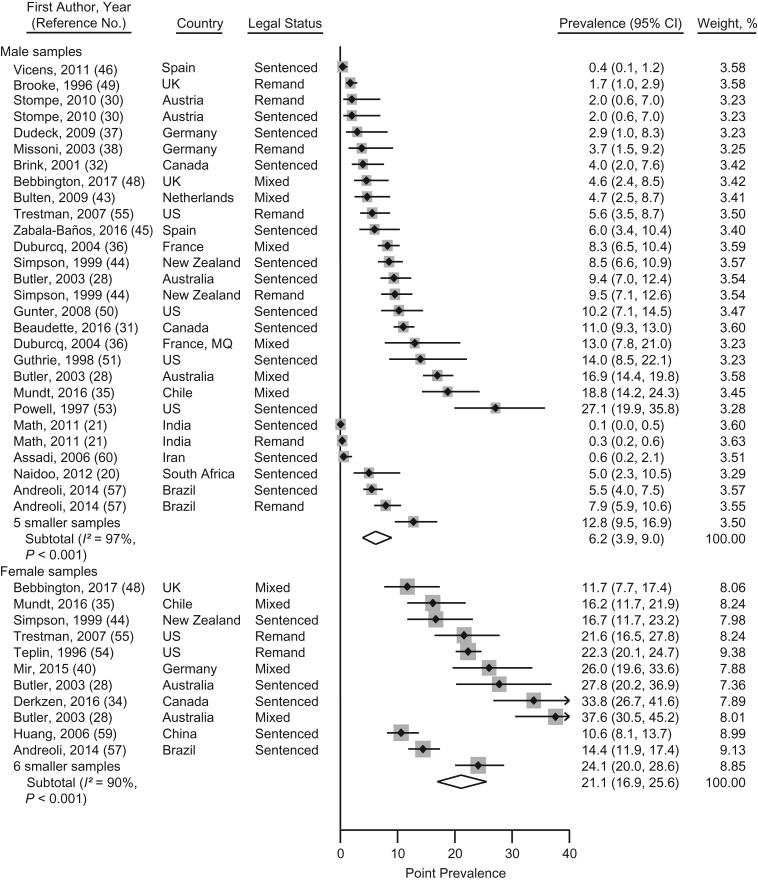
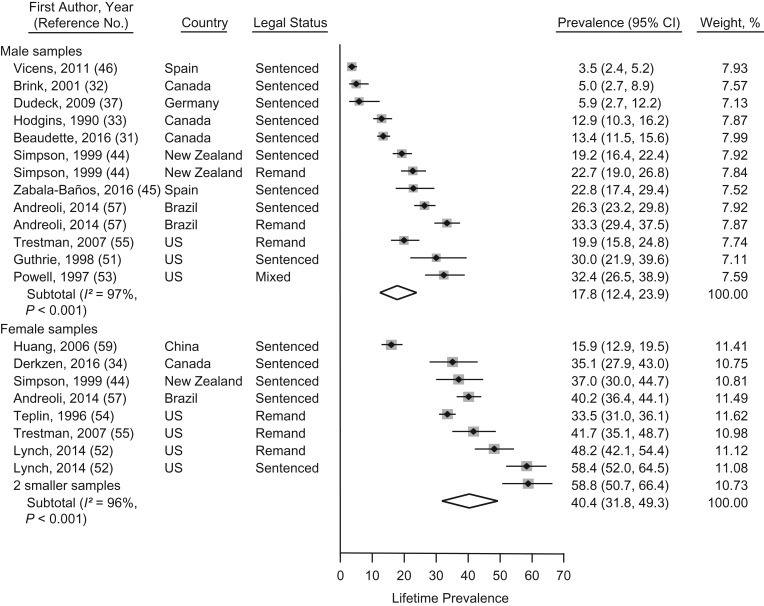
People involved with criminal justice frequently are exposed to violence and traumatic experiences. This may lead to posttraumatic stress disorder (PTSD); however, no review, to our knowledge, has synthetized findings in this setting. We conducted a systematic review and meta-analysis to estimate prevalence rates of PTSD in prison populations. Original studies in which prevalence rates of PTSD in unselected samples of incarcerated people were reported were systematically searched between 1980 and June 2017. Data were pooled using random-effects meta-analysis, and sources of heterogeneity for prespecified characteristics were assessed by meta-regression. We identified 56 samples comprising 21,099 imprisoned men and women from 20 countries. Point prevalence of PTSD ranged from 0.1% to 27% for male, and from 12% to 38% for female prisoner populations. The random-effects pooled point prevalence was 6.2% (95% confidence interval: 3.9, 9.0) in male prisoners and 21.1% (95% confidence interval: 16.9, 25.6) in female prisoners. The heterogeneity between the included studies was very high. Higher prevalence was reported in samples of female prisoners, smaller studies (n ≤ 200), and for investigations based in high-income countries. Existing evidence shows high levels of PTSD among imprisoned people, especially women. Psychosocial interventions to prevent violence, especially against children and women, and to mitigate its consequences in marginalized communities must be improved. Trauma-informed approaches for correctional programs and scalable PTSD treatments in prisons require further consideration.
Overview
The claims and statistics of this paper haven’t been checked yet.
Free: it reads the open-access text and checks the first 5 claims that cite a source we can check. Create a free account to check every claim.
Integrity signals
Registry
Cites
Statistics
Figures
Verification
Claims the paper makes
The claims and statistics of this paper haven’t been checked yet.
Free: it reads the open-access text and checks the first 5 claims that cite a source we can check. Create a free account to check every claim.
Claims other papers make about this one
Each is checked against this paper’s own text: does it say what the citing paper says it does?
The cited source says what the claim attributes to it.
In the citing paper
“The prevalence of PTSD in women prisoners tended to increase compared to males and the general population.”
From A Scoping Review of Correctional-Based Interventions for Women Prisoners with Mental Health Problems (2023) · cites this paper as Baranyi et al. 2018
The cited source says what the claim attributes to it.
In the citing paper
“Male prisoners had a five-time greater point frequency of PTSD than the general population, while female prisoners had an 8-fold higher point prevalence of PTSD (Baranyi et al. 2018).”
From A Scoping Review of Correctional-Based Interventions for Women Prisoners with Mental Health Problems (2023) · cites this paper as Baranyi et al. 2018
Self-check
Percentages, sums and reported differences re-computed from the paper’s own numbers.
The self-check needs the paper’s full text.
Citations
Cites
Preferred Reporting Items for Systematic Reviews and Meta-Analyses: the PRISMA statement
Moher, D., Liberati, A., Tetzlaff, J., Altman, D. G., & for the PRISMA Group (2009) · BMJ · doi:10.1136/bmj.b2535 · Cited by 83,823
Measuring inconsistency in meta-analyses
Higgins, J. P. T., Thompson, S. G., Deeks, J. J., & Altman, D. G. (2003) · BMJ · doi:10.1136/bmj.327.7414.557 · Cited by 63,139
Bias in meta-analysis detected by a simple, graphical test
Egger, M., Smith, G. D., Schneider, M., & Minder, C. (1997) · BMJ · doi:10.1136/bmj.315.7109.629 · Cited by 56,722 · cited 1×
“Differences of the study quality and small study bias were explored as possible reasons for asymmetric funnel plots (27).”
BackgroundMeta-analysis of Observational Studies in Epidemiology<SUBTITLE>A Proposal for Reporting</SUBTITLE>
Stroup, D. F. (2000) · JAMA · doi:10.1001/jama.283.15.2008 · Cited by 20,623
Stang, A. (2010) · European Journal of Epidemiology · doi:10.1007/s10654-010-9491-z · Cited by 17,396 · cited 2×
“) who used a modified checklist, based on the Newcastle-Ottawa Scale (22), from a meta-analysis on the prevalence of depression (23).”
MethodPreferred reporting items for systematic reviews and meta-analyses: The PRISMA statement
Moher, D., Liberati, A., Tetzlaff, J., & Altman, D. G. (2010) · International Journal of Surgery · doi:10.1016/j.ijsu.2010.02.007 · Cited by 12,156
Posttraumatic Stress Disorder in the National Comorbidity Survey
Kessler, R. C. (1995) · Archives of General Psychiatry · doi:10.1001/archpsyc.1995.03950240066012 · Cited by 10,379 · cited 1×
“4% in women in the general population (63).”
BackgroundA basic introduction to fixed-effect and random-effects models for meta-analysis
Borenstein, M., Hedges, L. V., Higgins, J. P. T., & Rothstein, H. R. (2010) · Research Synthesis Methods · doi:10.1002/jrsm.12 · Cited by 6,793 · cited 1×
“samples, we used random-effects models to balance the weighting of studies for data syntheses (24).”
MethodSerious mental disorder in 23 000 prisoners: a systematic review of 62 surveys
Fazel, S., & Danesh, J. (2002) · The Lancet · doi:10.1016/s0140-6736(02)07740-1 · Cited by 2,201 · cited 1×
“Prevalence rates of substance use disorders (3) and personality disorders (4) also have been found to be much higher in the prison population than in the general population.”
BackgroundSelf-citationMetaprop: a Stata command to perform meta-analysis of binomial data
Nyaga, V. N., Arbyn, M., & Aerts, M. (2014) · Archives of Public Health · doi:10.1186/2049-3258-72-39 · Cited by 2,139 · cited 2×
“Freeman-Tukey double arcsine transformation was used to stabilize the variance before pooling (25).”
MethodMata, D. A., Ramos, M. A., Bansal, N., Khan, R., Guille, C., Di Angelantonio, E., & Sen, S. (2015) · JAMA · doi:10.1001/jama.2015.15845 · Cited by 1,255
Gender differences in posttraumatic stress disorder.
Olff, M., Langeland, W., Draijer, N., & Gersons, B. P. R. (2007) · Psychological Bulletin · doi:10.1037/0033-2909.133.2.183 · Cited by 1,058
Full and partial posttraumatic stress disorder: findings from a community survey
(1997) · American Journal of Psychiatry · doi:10.1176/ajp.154.8.1114 · Cited by 1,013 · cited 1×
“7% in women (62), and the lifetime prevalence of PTSD has been estimated to be 5.”
BackgroundSevere mental illness in 33 588 prisoners worldwide: systematic review and meta-regression analysis
Fazel, S., & Seewald, K. (2012) · British Journal of Psychiatry · doi:10.1192/bjp.bp.111.096370 · Cited by 985 · cited 7×
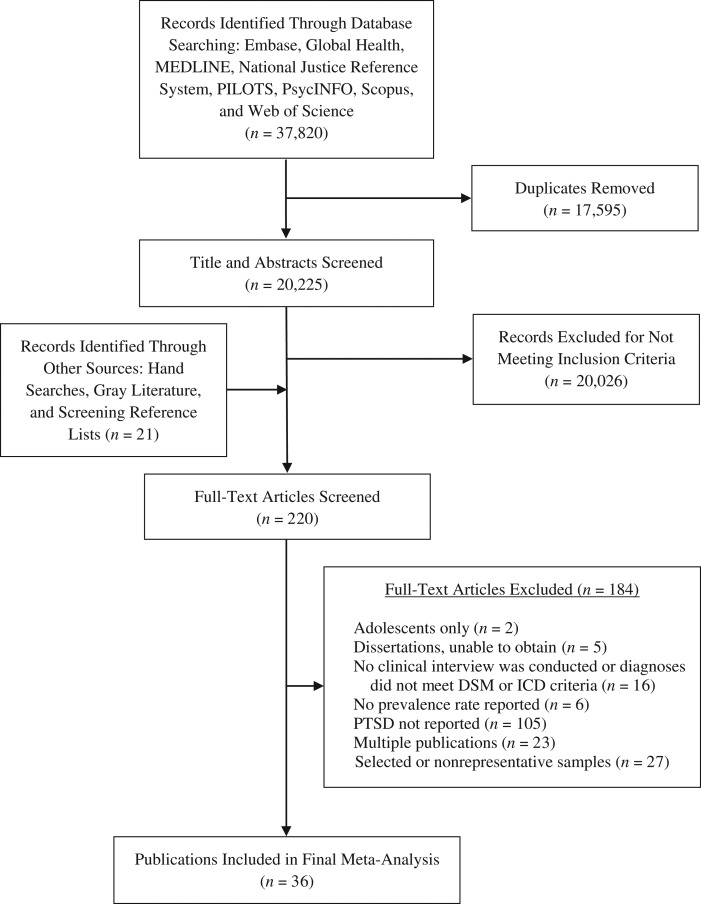
“, Criminal Behavior and Mental Health, International Journal of Law and Psychiatry, Journal of Traumatic Stress); 3) reference lists of identified papers and relevant systematic reviews (2, 11); and 4) unpublished literature (OpenGrey) and correspondence with authors (Figure 1).”
BackgroundResultInfluentialSelf-citationSubstance abuse and dependence in prisoners: a systematic review
Fazel, S., Bains, P., & Doll, H. (2006) · Addiction · doi:10.1111/j.1360-0443.2006.01316.x · Cited by 839
Self-citationPrevalence of Psychiatric Disorders Among Incarcerated Women: I. Pretrial Jail Detainees
Teplin, L. A. (1996) · Archives of General Psychiatry · doi:10.1001/archpsyc.1996.01830060047007 · Cited by 718
Childhood victimization and lifetime revictimization
Widom, C. S., Czaja, S. J., & Dutton, M. A. (2008) · Child Abuse & Neglect · doi:10.1016/j.chiabu.2007.12.006 · Cited by 680 · cited 1×
“PTSD may be associated with a risk for repeat victimization, within and outside of the prison system (68).”
BackgroundPosttraumatic stress disorder: a state-of-the-science review
Nemeroff, C. B., Bremner, J. D., Foa, E. B., Mayberg, H. S., North, C. S., & Stein, M. B. (2006) · Journal of Psychiatric Research · doi:10.1016/j.jpsychires.2005.07.005 · Cited by 675 · cited 2×
“We conducted a systematic search of the literature covering the time from 1980, when PTSD as a diagnostic category was introduced in the Diagnostic and Statistical Manual of Mental Disorders, Third Edition (14), until June 2017.”
MethodResultWidom, C. S. (1989) · American Journal of Orthopsychiatry · doi:10.1111/j.1939-0025.1989.tb01671.x · Cited by 592
Morina, N., Wicherts, J. M., Lobbrecht, J., & Priebe, S. (2014) · Clinical Psychology Review · doi:10.1016/j.cpr.2014.03.002 · Cited by 314 · cited 1×
“Rates of spontaneous long-term remission from PTSD are modest (71); therefore, methods of identifying prisoners with PTSD and providing effective treatments on a large scale would be desirable.”
MethodSelf-citationTrauma and substance abuse: Causes, consequences, and treatment of comorbid disorders.
(2003) · American Psychological Association eBooks · doi:10.1037/10460-000 · Cited by 310
Point prevalence of mental disorder in unconvicted male prisoners in England and Wales
Brooke, D., Taylor, C., Gunn, J., & Maden, A. (1996) · BMJ · doi:10.1136/bmj.313.7071.1524 · Cited by 274 · cited 5×
“Author affiliations: Center for Research on Environment Society and Health, School of GeoSciences, The University of Edinburgh, Edinburgh, United Kingdom (Gergő Baranyi); Unit for Social and Community Psychiatry, WHO Collaborating Center for Mental Health Services Development, Queen Mary University of London, London,…”
BackgroundInfluentialWolff, N., & Shi, J. (2012) · International Journal of Environmental Research and Public Health · doi:10.3390/ijerph9051908 · Cited by 252
Trestman, R. L., Ford, J. D., Zhang, W., & Wiesbrock, V. (2007) · PubMed · Cited by 193
Does PTSD occur in sentenced prison populations? A systematic literature review
Goff, A., Rose, E., Rose, S., & Purves, D. (2007) · Criminal Behaviour and Mental Health · doi:10.1002/cbm.653 · Cited by 188 · cited 3×
“To our knowledge, 1 systematic review (11) has been published on the prevalence of PTSD in sentenced prison populations; it included only 4 studies published until 2004, and the study authors suggested the prevalence of PTSD in sentenced prisoners is likely to be higher than in the general population and that women we…”
BackgroundResultLynch, S. M., DeHart, D. D., Belknap, J. E., Green, B. L., Dass-Brailsford, P., Johnson, K. A., & Whalley, E. (2014) · Psychiatric Services · doi:10.1176/appi.ps.201300172 · Cited by 185 · cited 4×
“The 1-year prevalence of PTSD was reported in 12 samples from 4 countries including 4,889 participants (28, 29, 52, 57, 58).”
BackgroundInfluentialMental disorder in federal offenders: A Canadian prevalence study
Brink, J. H., Doherty, D., & Boer, A. (2001) · International Journal of Law and Psychiatry · doi:10.1016/s0160-2527(01)00071-1 · Cited by 167 · cited 2×
“Vicens, 2011 (46) Brooke, 1996 (49) Stompe, 2010 (30) Stompe, 2010 (30) Dudeck, 2009 (37) Missoni, 2003 (38) Brink, 2001 (32) Bebbington, 2017 (48) Bulten, 2009 (43) Trestman, 2007 (55) Zabala-Baños, 2016 (45) Duburcq, 2004 (36) Simpson, 1999 (44) Butler, 2003 (28) Simpson, 1999 (44) Gunter, 2008 (50) Beaudette, 2016…”
BackgroundYoon, I. A., Slade, K., & Fazel, S. (2017) · Journal of Consulting and Clinical Psychology · doi:10.1037/ccp0000214 · Cited by 167 · cited 1×
“However, the evidence for psychological treatments in this setting is limited (72) and more trials are required to test to what extent established treatments for PTSD in community settings are effective in the prison context.”
BackgroundSelf-citationBolton, J. M., & Robinson, J. (2010) · American Journal of Public Health · doi:10.2105/ajph.2010.192252 · Cited by 165 · cited 1×
“Untreated PTSD reduces day-to-day functioning and adherence to treatment (8), and increases the risks of self-harm and suicide (9).”
BackgroundPosttraumatic Stress Disorder (PTSD), PTSD Comorbidity, and Childhood Abuse among Incarcerated Women
Zlotnick, C. (1997) · The Journal of Nervous & Mental Disease · doi:10.1097/00005053-199712000-00007 · Cited by 155 · cited 4×
“Smaller female samples (n < 100) were aggregated (39, 56).”
BackgroundInfluential(2008) · PubMed · Cited by 128
Post-modernity and post-traumatic stress disorder
Bracken, P. J. (2001) · Social Science & Medicine · doi:10.1016/s0277-9536(00)00385-3 · Cited by 125 · cited 1×
“It is unclear whether prisoners from the United States and other HICs are more often exposed to traumatic events before or during imprisonment than prisoners from other countries or whether they are more likely to develop PTSD after traumatic experiences (66).”
BackgroundPost-traumatic stress disorder and medication adherence: Results from the Mind Your Heart Study
Kronish, I. M., Edmondson, D., Li, Y., & Cohen, B. E. (2012) · Journal of Psychiatric Research · doi:10.1016/j.jpsychires.2012.06.011 · Cited by 118 · cited 1×
“Untreated PTSD reduces day-to-day functioning and adherence to treatment (8), and increases the risks of self-harm and suicide (9).”
BackgroundPsychiatric morbidity among sentenced prisoners: prevalence study in Iran
Assadi, S. M., Noroozian, M., Pakravannejad, M., Yahyazadeh, O., Aghayan, S., Shariat, S. V., & Fazel, S. (2006) · British Journal of Psychiatry · doi:10.1192/bjp.188.2.159 · Cited by 115 · cited 3×
“Assadi, 2006 (60) Iran LMIC Male 351 C Stratified random SCID DSM-IV Sentenced”
BackgroundSelf-citationThe prevalence of mental disorders in Spanish prisons
Vicens, E., Tort, V., Dueñas, R. M., Muro, Á., Pérez‐Arnau, F., Arroyo, J. M., Acín, E., De Vicente, A., Guerrero, R., Lluch, J., et al. (2011) · Criminal Behaviour and Mental Health · doi:10.1002/cbm.815 · Cited by 113 · cited 3×
“Studies were conducted in 20 countries, of which 14 were classified as HICs in the year of the data collection: Australia (28, 29), Austria (30), Canada (31–34), Chile (35), France (36), Germany (37– 40), Iceland (41), Ireland (42), Netherlands (43), New Zealand (44), Spain (45, 46), Switzerland (47), United Kingdom (…”
BackgroundPrevalence of mental disorders in a prison population in Durban, South Africa
Naidoo, S. S., & Mkize, D. L. (2012) · African Journal of Psychiatry · doi:10.4314/ajpsy.v15i1.4 · Cited by 111 · cited 6×
“, re-experiencing, avoidance, hyperarousal) or a minimum symptom persistence (18); 5) no separate reports for female and male participants (19), unless the proportion of 1 sex represented less than 10% of the entire sample, in which case the study was considered representative for 1 sex (≥90%) (20, 21); and 6) when mo…”
BackgroundInfluentialCorrado, R. R., Cohen, I. M., Hart, S. D., & Roesch, R. G. (2000) · International Journal of Law and Psychiatry · doi:10.1016/s0160-2527(00)00054-6 · Cited by 107 · cited 1×
“, screening and diagnostic interview), because this approach might lead to different prevalence estimates owing to the characteristics of the screening instruments (17); 4) not reporting the criterion of a traumatic event, key symptoms (i.”
BackgroundMagruder, K. M., Kassam-Adams, N., Thoresen, S., & Olff, M. (2016) · European Journal of Psychotraumatology · doi:10.3402/ejpt.v7.29715 · Cited by 106 · cited 1×
“First, efforts to prevent child abuse and sex-related violence in marginalized populations should be improved (70).”
BackgroundMENTAL ILLNESS AMONG NEW SOUTH WALES PRISONERS
Butler, T. G., & Allnutt, S. H. (2003) · Cited by 100
Mental Disorders in Female Prisoners
Tye, C., & Mullen, P. E. (2006) · Australian & New Zealand Journal of Psychiatry · doi:10.1080/j.1440-1614.2006.01784.x · Cited by 96 · cited 3×
“The 1-year prevalence of PTSD was reported in 12 samples from 4 countries including 4,889 participants (28, 29, 52, 57, 58).”
BackgroundAssessing needs for psychiatric treatment in prisoners: 1. Prevalence of disorder
Bebbington, P., Jakobowitz, S., McKenzie, N., Killaspy, H., Iveson, R., Duffield, G., & Kerr, M. (2017) · Social Psychiatry and Psychiatric Epidemiology · doi:10.1007/s00127-016-1311-7 · Cited by 96 · cited 7×
“Bebbington, 2017 (48) UK HIC Male 197 C Random PDS DSM-IV Mixed”
BackgroundInfluentialPrevalence of Mental Disorders among Prisoners in the State of Sao Paulo, Brazil
Andreoli, S., dos Santos, M. M., Quintana, M. I., Ribeiro, W. S., Blay, S. L., Taborda, J. G., & Mari, J. D. J. (2014) · PLoS ONE · doi:10.1371/journal.pone.0088836 · Cited by 93 · cited 7×
“The 1-year prevalence of PTSD was reported in 12 samples from 4 countries including 4,889 participants (28, 29, 52, 57, 58).”
BackgroundInfluentialPsychiatric disorders and personality characteristics of prisoners at regular prison wards
Bulten, E., Nijman, H. L. I., & van der Staak, C. (2009) · International Journal of Law and Psychiatry · doi:10.1016/j.ijlp.2009.01.007 · Cited by 93 · cited 3×
“Studies were conducted in 20 countries, of which 14 were classified as HICs in the year of the data collection: Australia (28, 29), Austria (30), Canada (31–34), Chile (35), France (36), Germany (37– 40), Iceland (41), Ireland (42), Netherlands (43), New Zealand (44), Spain (45, 46), Switzerland (47), United Kingdom (…”
BackgroundAn examination of antecedent traumas and psychiatric comorbidity among male inmates with PTSD
Gibson, L. E., Holt, J. C., Fondacaro, K. M., Tang, T. S., Powell, T. A., & Turbitt, E. L. (1999) · Journal of Traumatic Stress · doi:10.1023/a:1024767020280 · Cited by 91 · cited 1×
“Imprisoned individuals with PTSD are more likely to have comorbid mental disorders, particularly substance use (7, 40, 56, 67), affective, and anxiety disorders (52, 67).”
Backgroundvon Schönfeld, C.-E., Schneider, F. W., Schröder, T., Widmann, B., Botthof, U., & Drießen, M. (2005) · Der Nervenarzt · doi:10.1007/s00115-005-1946-1 · Cited by 90
Traumatic stress disorder and violent behavior
Collins, J. J., & Bailey, S. L. (1990) · Journal of Traumatic Stress · doi:10.1002/jts.2490030204 · Cited by 89
Assessing needs for psychiatric treatment in prisoners: 2. Met and unmet need
Jakobowitz, S., Bebbington, P., McKenzie, N., Iveson, R., Duffield, G., Kerr, M., & Killaspy, H. T. (2016) · Social Psychiatry and Psychiatric Epidemiology · doi:10.1007/s00127-016-1313-5 · Cited by 89
Prevalence Rates of Mental Disorders in Chilean Prisons
Mundt, A. P., Alvarado, R., Fritsch, R., Poblete, C., Villagra, C., Kastner, S., & Priebe, S. (2013) · PLoS ONE · doi:10.1371/journal.pone.0069109 · Cited by 87 · cited 8×
“The World Bank classification of Chile changed from LMIC to HIC over time.”
BackgroundInfluentialSelf-citationThe prevalence of mental illness among inmates in a rural state.
Powell, T. A., Holt, J. C., & Fondacaro, K. M. (1997) · Law and Human Behavior · doi:10.1023/a:1024811303834 · Cited by 87 · cited 4×
“Smaller samples (n < 100) were aggregated for male (20, 41, 47, 53, 61) and female subgroups (36, 39, 42, 50, 56, 61).”
BackgroundInfluentialTreating substance abuse is not enough: Comorbidities in consecutively admitted female prisoners
Mir, J., Kastner, S., Priebe, S., Konrad, N., Ströhle, A., & Mundt, A. P. (2015) · Addictive Behaviors · doi:10.1016/j.addbeh.2015.02.016 · Cited by 82 · cited 3×
“Mir, 2015 (40) Germany HIC Female 150 A Population MINI DSM-IV Mixed”
BackgroundSelf-citationEinarsson, E., Sigurdsson, J. F., Gudjonsson, G. H., Newton, A. K., & Bragason, O. O. (2009) · Nordic Journal of Psychiatry · doi:10.1080/08039480902759184 · Cited by 72 · cited 3×
“Smaller samples (n < 100) were aggregated for male (20, 41, 47, 53, 61) and female subgroups (36, 39, 42, 50, 56, 61).”
BackgroundArdino, V., Milani, L., & Blasio, P. D. (2013) · European Journal of Psychotraumatology · doi:10.3402/ejpt.v4i0.21382 · Cited by 72 · cited 1×
“Moreover, exposure to violence and PTSD has been associated with violent behavior during imprisonment and elevated risks of reoffending afterward (69).”
BackgroundNational Prevalence of Mental Disorders among Incoming Canadian Male Offenders
Beaudette, J. N., & Stewart, L. A. (2016) · The Canadian Journal of Psychiatry · doi:10.1177/0706743716639929 · Cited by 71 · cited 2×
“Beaudette, 2016 (31) Canada HIC Male 1,110 A Population SCID DSM-IV Sentenced”
BackgroundHealth problems among detainees in Switzerland: a study using the ICPC-2 classification
Wolff, H. J., Sebo, P., Haller, D. M., Eytan, A., Niveau, G., Bertrand, D., Gétaz, L., & Cerutti, B. (2011) · BMC Public Health · doi:10.1186/1471-2458-11-245 · Cited by 68 · cited 1×
“Studies meeting the following criteria were excluded: 1) selection of 1 particular age group, such as adolescents, or a particular offender type (15); 2) reporting diagnoses based on self-report questionnaires and/or medical records (16); 3) 2-stage sampling (i.”
MethodMental disorder prevalence and associated risk factors in three prisons of Spain
Zabala-Baños, M. D. C., Segura, A., Maestre-Miquel, C., Martínez-Lorca, M., Rodríguez‐Martin, B., Romero, D., & Rodríguez, M. (2016) · Revista Española de Sanidad Penitenciaria · doi:10.4321/s1575-06202016000100003 · Cited by 65 · cited 3×
“Studies were conducted in 20 countries, of which 14 were classified as HICs in the year of the data collection: Australia (28, 29), Austria (30), Canada (31–34), Chile (35), France (36), Germany (37– 40), Iceland (41), Ireland (42), Netherlands (43), New Zealand (44), Spain (45, 46), Switzerland (47), United Kingdom (…”
BackgroundHuang, G., Zhang, Y., Momartin, S., Cao, Y., & Zhao, L. (2006) · Comprehensive Psychiatry · doi:10.1016/j.comppsych.2005.04.004 · Cited by 53
Posttraumatic stress disorder and substance use disorder among incarcerated women.
Battle, C. L., Zlotnick, C., Najavits, L. M., Gutierrez, M., & Winsor, C. (2003) · American Psychological Association eBooks · doi:10.1037/10460-011 · Cited by 47 · cited 3×
“Imprisoned individuals with PTSD are more likely to have comorbid mental disorders, particularly substance use (7, 40, 56, 67), affective, and anxiety disorders (52, 67).”
BackgroundPrevalence of mental disorders among penitentiary inmates in Quebec.
Hodgins, S., & Côté, G. (1990) · Canada's mental health · Cited by 46
Die Prävalenz psychischer Erkrankungen bei Gefängnisinsassen mit Kurzzeitstrafe
Dudeck, M., Kopp, D., Kuwert, P., Drenkhahn, K., Orlob, S., Luth, H., Freyberger, H., & Spitzer, C. (2009) · Psychiatrische Praxis · doi:10.1055/s-0028-1090217 · Cited by 46 · cited 2×
“Dudeck, 2009 (37) Germany HIC Male 102 C Population SCID DSM-IV Sentenced”
BackgroundMundt, A. P., Kastner, S., Larrain, S., Fritsch, R., & Priebe, S. (2015) · Epidemiology and Psychiatric Sciences · doi:10.1017/s2045796015000554 · Cited by 41 · cited 9×
“The World Bank classification of Chile changed from LMIC to HIC over time.”
BackgroundInfluentialSelf-citationPsychiatric disorder in an Irish female prison
Mohan, D., Scully, P., Collins, C., & Smith, C. (1997) · Criminal Behaviour and Mental Health · doi:10.1002/cbm.175 · Cited by 29 · cited 3×
“Mohan, 1997 (42) Ireland HIC Female 45 A Random SCAN DSM-IV Mixed”
BackgroundPosttraumatic stress disorder in a Swiss offender population
Vetter, S. (2007) · Swiss Medical Weekly · doi:10.4414/smw.2007.11518 · Cited by 22
Boşgelmez, Ş., Aker, T., Köklük, Ö. A., & Ford, J. D. (2010) · Journal of Trauma & Dissociation · doi:10.1080/15299731003783212 · Cited by 21 · cited 4×
“Smaller samples (n < 100) were aggregated for male (20, 41, 47, 53, 61) and female subgroups (36, 39, 42, 50, 56, 61).”
BackgroundInfluential[Are psychiatric disorders identified and treated by in-prison health services?].
Langeveld, H., & Melhus, H. (2004) · PubMed · Cited by 21
Sánchez, F. C., Luna, A., & Mundt, A. P. (2016) · Journal of Forensic and Legal Medicine · doi:10.1016/j.jflm.2016.05.014 · Cited by 20 · cited 1×
“Female prisoners have particularly high rates of exposure to sexual violence before imprisonment and of exposure to violence during childhood (65).”
BackgroundSelf-citationAssessing post-traumatic stress symptoms in a Latino prison population
Caraballo, J. N., Pérez-Pedrogo, C., & Albizu‐García, C. E. (2013) · International Journal of Prisoner Health · doi:10.1108/ijph-02-2013-0004 · Cited by 17 · cited 1×
“, re-experiencing, avoidance, hyperarousal) or a minimum symptom persistence (18); 5) no separate reports for female and male participants (19), unless the proportion of 1 sex represented less than 10% of the entire sample, in which case the study was considered representative for 1 sex (≥90%) (20, 21); and 6) when mo…”
Background
Research works printed but not linked: 6
- Walmsley R World Prison Population List. 11th ed. London, UK: Institute for Criminal Policy Research; 2016.
- Stompe T, Brandstatter N, Ebner N, et al Psychiatric disorders in prison inmates. J Neurol Neurochir Psychiatr. 2010; 11(2): 20– 23.
- Derkzen D, Barker J, McMillan K, et al Rates of Current Mental Disorders Among Women Offenders in Custody in CSC. Ottawa, Canada: Correctional Service Canada; 2016.
- Duburcq A, Coulomb S, Bonte J, et al Enquête de Prévalence sur les Troubles Psychiatriques en Milieu Carcéral (Phase 1 de l’Étude Épidémiologique) Rapport Final. Paris, France: CEMKA-EVAL; 2004.
- Missoni L, Utting F, Konrad N Psychi(atri)sche Störungen bei Untersuchungsgefangenen. Ergebnisse und Probleme einer epidemiologischen Studie. ZfStrVo. 2003; 52(6): 323– 332.
- Guthrie RK The Prevalence of Posttraumatic Stress Disorder Among Federal Prison Inmates [dissertation]. Morgantown, WV: West Virginia University; 1998.
Cited by
Baranyi, G., Scholl, C., Fazel, S., Patel, V., Priebe, S., & Mundt, A. P. (2019) · The Lancet Global Health · doi:10.1016/s2214-109x(18)30539-4 · Cited by 294
“…was not reported, we imputed a year based on the average mean difference between the year of publication and data collection derived from the other studies (4 years).9 We prespecified categories for sample size (n 500, n≥500) and average time served in prison (time 1 year, time ≥1 year).”
Self-citationBeaudry, G., Yu, R., Långström, N., & Fazel, S. (2021) · Journal of the American Academy of Child & Adolescent Psychiatry · doi:10.1016/j.jaac.2020.01.015 · Cited by 206
“However, the prevalence estimates for PTSD are similar in both groups.(24) These comparisons suggest that the mental health needs of detained adolescents could be different from those of adult prisoners and may require separate and specifically targeted programs to meet these needs.”
MethodSelf-citationKinner, S. A., & Young, J. T. (2018) · Epidemiologic Reviews · doi:10.1093/epirev/mxx018 · Cited by 190
Mental and physical health morbidity among people in prisons: an umbrella review
Favril, L., Rich, J. D., Hard, J., & Fazel, S. (2024) · The Lancet Public Health · doi:10.1016/s2468-2667(24)00023-9 · Cited by 160
“26”
Self-citationFacer-Irwin, E., Blackwood, N., Bird, A., Dickson, H., McGlade, D., Alves-Costa, F., & MacManus, D. (2019) · PLoS ONE · doi:10.1371/journal.pone.0222407 · Cited by 142
Metadata
- Authors
- Baranyi, G., Cassidy, M., Fazel, S., Priebe, S., & Mundt, A. P.
- Affiliations
- Center for Research on Environment Society and Health, School of GeoSciences, The University of Edinburgh, Edinburgh, United Kingdom
- Queen Mary University of London (GB)
- University of Oxford (GB)
- Universidad San Sebastián (CL)
- Corresponding author
- Mundt, Adrian P
- Venue
- Epidemiologic Reviews
- Publisher
- Oxford University Press (OUP)
- Published
- 2018
- Volume
- 40
- Issue
- 1
- Pages
- 134-145
- ISSN
- 0193-936X (ISSN-L)
- 1478-6729
- PMC
- PMC5982805
- OpenAlex
- W2794707138
- Cited by
- 247
- References
- 67
- Citations by year
- 2026: 23 · 2025: 30 · 2024: 27 · 2023: 42 · 2022: 45 · 2021: 25 · 2020: 28 · 2019: 22 · 2018: 3
- FWCI
- 2.30
- Type
- journal article
- Language
- en
- Open access
- hybrid
- doi.org
- Licence
- Locations
- Epidemiologic Reviews (publishedVersion, cc-by)
- Europe PMC (PubMed Central) (publishedVersion, cc-by)
- PubMed Central (publishedVersion, cc-by)
- PubMed (publishedVersion)
- Edinburgh Research Explorer (University of Edinburgh) (submittedVersion, cc-by)
- Queen Mary Research Online (Queen Mary University of London) (submittedVersion, cc-by)
- Funders
- Wellcome Trust (202836/Z/16/Z)
- Topics
- Social Sciences › Psychology › Clinical Psychology › Posttraumatic Stress Disorder Research
- Social Sciences › Sociology and Political Science › Criminal Justice and Corrections Analysis
- Social Sciences › Psychology › Clinical Psychology › Migration, Health and Trauma
- Keywords
- post-traumatic stress disorder, prisoners, prevalence, women prisoners, incarcerated men, violence exposure, trauma, prison environment, trauma-informed care, psychosocial interventions
- MeSH terms
- Humans, Prisoners, Stress Disorders, Post-Traumatic, Global Health, Models, Statistical, Prevalence
About these checks
Registry, retraction, Cites and statistics results are computed, not judged, with one exception: a printed reference that no index lists is read once by a model before it counts as a citation error. Claims are extracted by a model and kept only when their quote appears verbatim in the text; each cited source is then checked, with a model’s help, for whether it says what the claim relies on. Those verdicts can be wrong — read the claim’s quote and the cited source before relying on one.
Statistics and arithmetic are recomputed, not judged.
Confidence bands are shown only for fields calibrated on our annotated test set. None is calibrated yet, so no band is shown.
What counts as a claim ›How we measure confidence ›How we check this ›
Are you an author, or do you see a problem with this page? Request a review
Data sources
Bibliographic data: Semantic Scholar, OpenAlex, Crossref.
Contains information from the Semantic Scholar Academic Graph Datasets, made available under the ODC Attribution License (ODC-BY 1.0).
Semantic Scholar’s data is described in: Kinney, R., et al. (2023). The Semantic Scholar Open Data Platform. arXiv:2301.10140.
