

Prevalence of Posttraumatic Stress Disorder in Prisoners
Open accessThe DOI matches its Crossref record; 66 of the 67 references it cites were found in a registry or an index.
Abstract
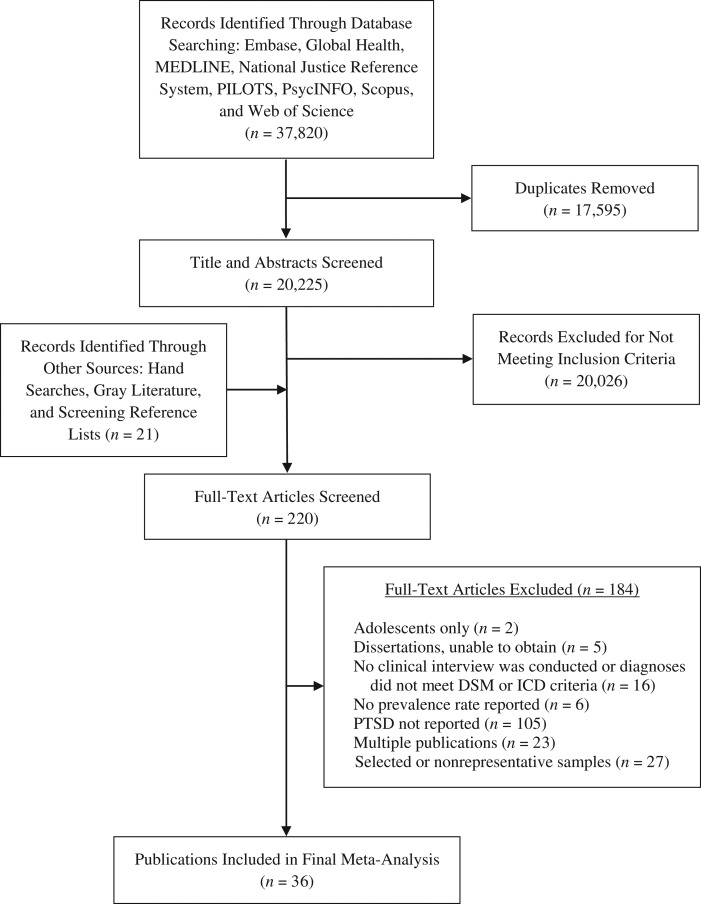
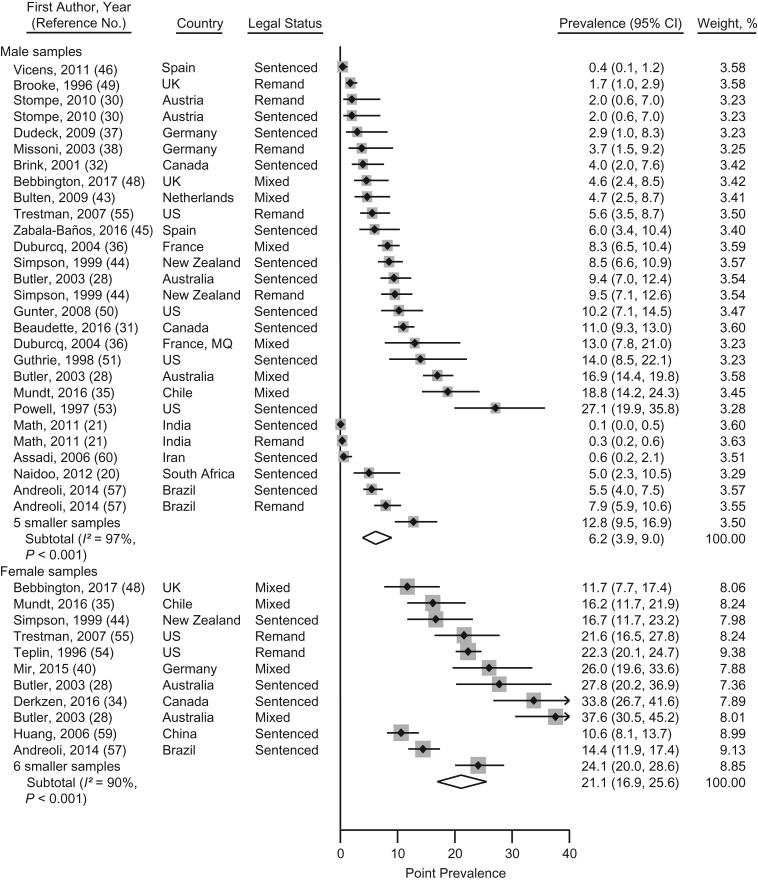
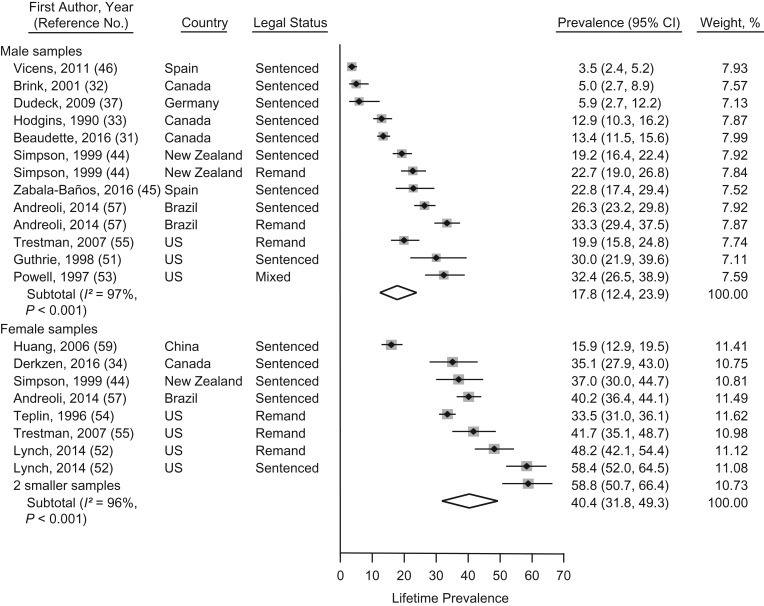
People involved with criminal justice frequently are exposed to violence and traumatic experiences. This may lead to posttraumatic stress disorder (PTSD); however, no review, to our knowledge, has synthetized findings in this setting. We conducted a systematic review and meta-analysis to estimate prevalence rates of PTSD in prison populations. Original studies in which prevalence rates of PTSD in unselected samples of incarcerated people were reported were systematically searched between 1980 and June 2017. Data were pooled using random-effects meta-analysis, and sources of heterogeneity for prespecified characteristics were assessed by meta-regression. We identified 56 samples comprising 21,099 imprisoned men and women from 20 countries. Point prevalence of PTSD ranged from 0.1% to 27% for male, and from 12% to 38% for female prisoner populations. The random-effects pooled point prevalence was 6.2% (95% confidence interval: 3.9, 9.0) in male prisoners and 21.1% (95% confidence interval: 16.9, 25.6) in female prisoners. The heterogeneity between the included studies was very high. Higher prevalence was reported in samples of female prisoners, smaller studies (n ≤ 200), and for investigations based in high-income countries. Existing evidence shows high levels of PTSD among imprisoned people, especially women. Psychosocial interventions to prevent violence, especially against children and women, and to mitigate its consequences in marginalized communities must be improved. Trauma-informed approaches for correctional programs and scalable PTSD treatments in prisons require further consideration.
Overview
The claims and statistics of this paper haven’t been checked yet.
Free: it reads the open-access text and checks the first 5 claims that cite a source we can check. Create a free account to check every claim.
Integrity signals
Registry
Cites
Statistics
Figures
Verification
Claims the paper makes
The claims and statistics of this paper haven’t been checked yet.
Free: it reads the open-access text and checks the first 5 claims that cite a source we can check. Create a free account to check every claim.
Claims other papers make about this one
Each is checked against this paper’s own text: does it say what the citing paper says it does?
The cited source says what the claim attributes to it.
In the citing paper
“The prevalence of PTSD in women prisoners tended to increase compared to males and the general population.”
From A Scoping Review of Correctional-Based Interventions for Women Prisoners with Mental Health Problems (2023) · cites this paper as Baranyi et al. 2018
The cited source says what the claim attributes to it.
In the citing paper
“Male prisoners had a five-time greater point frequency of PTSD than the general population, while female prisoners had an 8-fold higher point prevalence of PTSD (Baranyi et al. 2018).”
From A Scoping Review of Correctional-Based Interventions for Women Prisoners with Mental Health Problems (2023) · cites this paper as Baranyi et al. 2018
Self-check
Percentages, sums and reported differences re-computed from the paper’s own numbers.
The self-check needs the paper’s full text.
Citations
Cites
Preferred Reporting Items for Systematic Reviews and Meta-Analyses: the PRISMA statement
Moher, D., Liberati, A., Tetzlaff, J., Altman, D. G., & for the PRISMA Group (2009) · BMJ · doi:10.1136/bmj.b2535 · Cited by 83,823
Measuring inconsistency in meta-analyses
Higgins, J. P. T., Thompson, S. G., Deeks, J. J., & Altman, D. G. (2003) · BMJ · doi:10.1136/bmj.327.7414.557 · Cited by 63,139
Bias in meta-analysis detected by a simple, graphical test
Egger, M., Smith, G. D., Schneider, M., & Minder, C. (1997) · BMJ · doi:10.1136/bmj.315.7109.629 · Cited by 56,722 · cited 1×
“Differences of the study quality and small study bias were explored as possible reasons for asymmetric funnel plots (27).”
BackgroundMeta-analysis of Observational Studies in Epidemiology<SUBTITLE>A Proposal for Reporting</SUBTITLE>
Stroup, D. F. (2000) · JAMA · doi:10.1001/jama.283.15.2008 · Cited by 20,623
Stang, A. (2010) · European Journal of Epidemiology · doi:10.1007/s10654-010-9491-z · Cited by 17,396 · cited 2×
“) who used a modified checklist, based on the Newcastle-Ottawa Scale (22), from a meta-analysis on the prevalence of depression (23).”
MethodPreferred reporting items for systematic reviews and meta-analyses: The PRISMA statement
Moher, D., Liberati, A., Tetzlaff, J., & Altman, D. G. (2010) · International Journal of Surgery · doi:10.1016/j.ijsu.2010.02.007 · Cited by 12,156
Posttraumatic Stress Disorder in the National Comorbidity Survey
Kessler, R. C. (1995) · Archives of General Psychiatry · doi:10.1001/archpsyc.1995.03950240066012 · Cited by 10,379 · cited 1×
“4% in women in the general population (63).”
BackgroundA basic introduction to fixed-effect and random-effects models for meta-analysis
Borenstein, M., Hedges, L. V., Higgins, J. P. T., & Rothstein, H. R. (2010) · Research Synthesis Methods · doi:10.1002/jrsm.12 · Cited by 6,793 · cited 1×
“samples, we used random-effects models to balance the weighting of studies for data syntheses (24).”
MethodSerious mental disorder in 23 000 prisoners: a systematic review of 62 surveys
Fazel, S., & Danesh, J. (2002) · The Lancet · doi:10.1016/s0140-6736(02)07740-1 · Cited by 2,201 · cited 1×
“Prevalence rates of substance use disorders (3) and personality disorders (4) also have been found to be much higher in the prison population than in the general population.”
BackgroundSelf-citationMetaprop: a Stata command to perform meta-analysis of binomial data
Nyaga, V. N., Arbyn, M., & Aerts, M. (2014) · Archives of Public Health · doi:10.1186/2049-3258-72-39 · Cited by 2,139 · cited 2×
“Freeman-Tukey double arcsine transformation was used to stabilize the variance before pooling (25).”
Method
Research works printed but not linked: 6
- Walmsley R World Prison Population List. 11th ed. London, UK: Institute for Criminal Policy Research; 2016.
- Stompe T, Brandstatter N, Ebner N, et al Psychiatric disorders in prison inmates. J Neurol Neurochir Psychiatr. 2010; 11(2): 20– 23.
- Derkzen D, Barker J, McMillan K, et al Rates of Current Mental Disorders Among Women Offenders in Custody in CSC. Ottawa, Canada: Correctional Service Canada; 2016.
- Duburcq A, Coulomb S, Bonte J, et al Enquête de Prévalence sur les Troubles Psychiatriques en Milieu Carcéral (Phase 1 de l’Étude Épidémiologique) Rapport Final. Paris, France: CEMKA-EVAL; 2004.
- Missoni L, Utting F, Konrad N Psychi(atri)sche Störungen bei Untersuchungsgefangenen. Ergebnisse und Probleme einer epidemiologischen Studie. ZfStrVo. 2003; 52(6): 323– 332.
- Guthrie RK The Prevalence of Posttraumatic Stress Disorder Among Federal Prison Inmates [dissertation]. Morgantown, WV: West Virginia University; 1998.
Cited by
Items 201–247 of 247
Casey, R. C. (2023) · Oxford University Press eBooks · doi:10.1093/oso/9780197694732.003.0031 · Cited by 1
Djllong, A. F., Ridani, A., Sadiq, J., Manoppo, Y., & Mohammad, W. (2023) · Journal Emerging Technologies in Education · doi:10.55849/jete.v1i6.486 · Cited by 2
Product Development of Ayo Belajar Tayamum Application
Khodijah, I. S., Fajriyah, H. N., Sapitri, L., & Tabroni, I. (2023) · Journal Emerging Technologies in Education · doi:10.55849/jete.v1i6.500
Migrant*innen im Maßregelvollzug
Bulla, J., & Roß, T. (2023) · Springer eBooks · doi:10.1007/978-3-662-64465-2_15 · Cited by 1
(2023) · Oxford University Press eBooks · doi:10.1093/med/9780198834533.003.0008
Sease, T. B., Wiese, A. L., & Knight, K. K. (2024) · Journal of Drug Issues · doi:10.1177/00220426241248361 · Cited by 2
“A recent study including more than 20,000 people in prison found that 6.2% of males and 21.1% of females met the diagnostic criteria for Post-Traumatic Stress Disorder (PTSD; Baranyi et al., 2018).”
InfluentialAdversity and Trauma: Realising the Basics
McLachlan, K. J. (2024) · Springer eBooks · doi:10.1007/978-3-031-59290-4_2 · Cited by 1
Pinto‐Cortez, C., Portilla-Saavedra, D., Ferrer‐Urbina, R., Díaz-Faes, D. A., Suárez-Soto, E., Rojas, M., Carvajal, J., & Zamora, Á. (2024) · SAGE Open · doi:10.1177/21582440241245516
“Research that has addressed the mental health of persons deprived of liberty has documented the association between conflicting with the law and experiencing mental health problems (Angelakis et al., 2020; Baranyi et al., 2018; Fazel et al., 2016).”
InfluentialAnimal-Assisted Interventions in Specialized Settings
Binfet, J.-T., Rousseau, C. X., & Green, F. L. L. (2024) · Elsevier eBooks · doi:10.1016/b978-0-443-22346-4.15006-1 · Cited by 1
What Is Wrong with a Criminal Mind? Mental Health Disorders and Offending
Roos, M. S. D. (2024) · Springer eBooks · doi:10.1007/978-3-031-75875-1_6
Sexual boundary violations in correctional services
Gray, R., & Garrett, T. (2025) · Forensic Update · doi:10.53841/bpsfu.2025.1.147.24
Holder, N. D., & Holliday, R. P. (2025) · CBT: science into practice · doi:10.1007/978-3-031-87356-0_11
Moderie, C., Sebag, V., Crocker, A. G., Bertazzo, A., Comai, S., & Gobbi, G. (2026) · Journal of Psychiatric Research · doi:10.2139/ssrn.5273943
Bonsu, N. K., Hasan, F. M., Sreeram, V., Cheesman, A., & Fiagbe, T. (2025) · Springer eBooks · doi:10.1007/978-3-031-86114-7_10
Nuteistųjų trauminės patirtys: traumai jautrios praktikos svarba bausmių vykdymo sistemoje
Bagdonaite, S., & Klimukienė, V. (2025) · Psichologija · doi:10.15388/psichol.2025.73.4
Bright, A., Higgins, A., & Grealish, A. (2025) · PLoS ONE · doi:10.1371/journal.pone.0332373
“Additionally, the prevalence of PTSD was estimated between 12–38% in the female prison population [17].”
“We Were Just Like Rats”: Exploring Experiences of Jail Incarceration Among Persons With PTSD
Carl, A., & Brown, S. C. (2025) · Families in Society The Journal of Contemporary Social Services · doi:10.1177/10443894251352587
Psychiatrischer Beitrag: Aktuelle Prävalenzen schwerer psychischer Störungen in Haft
Korkutan, T., & Ćurić, S. (2025) · Forensische Psychiatrie Psychologie Kriminologie · doi:10.1007/s11757-025-00908-0
“Kriterien einer Persönlichkeitsstörung (PS) erfüllen 65% der Männer und 42% der Frauen, bei Betrachtung der dis-sozialen PS sind es 47% bzw.”
Resozialisierung im Vollzug und die Frage der Traumasensibilität
Deitert, S. (2025) · Trauma und Gewalt · doi:10.21706/tg-19-4-348
Fovet, T., Estoup, M., D’Hondt, F., Jardon, V., Debien, C., Thomas, P., Vaïva, G., & Wathelet, M. (2025) · BMC Public Health · doi:10.1186/s12889-025-25003-1
“Considering the high prevalence of PTSD and stress-related disorders in prisons [17–19], specific strategies could be developed for this sub-group.”
Prost, S. G., Archuleta, A. J., Golder, S., Bullman, D. B., & Williams, B. (2025) · International Journal of Prison Health · doi:10.1108/ijoph-05-2024-0027
Lobbying for Change: One Woman’s Experiences of Incarceration and Male Violence
Williams, J. K. (2025) · Springer eBooks · doi:10.1007/978-3-031-97958-3_13
A scoping review of research to address older women’s health during and after incarceration
Thimmesch, A. R., Aponte, C., Krueger, K. J., Knittel, A. K., & Emerson, A. (2025) · Women s Health · doi:10.1177/17455057251392754 · Cited by 1
Williams, C. (2025) · SpringerBriefs in offending populations & correctional psychotherapy · doi:10.1007/978-3-031-98368-9_1
The Dysregulated Body: Trauma, Protection, and Connection in Yoga for Incarcerated Populations
Williams, C. L. (2025) · SpringerBriefs in offending populations & correctional psychotherapy · doi:10.1007/978-3-031-98368-9_2
Henson, A. R. (2026) · Springer eBooks · doi:10.1007/978-3-032-02242-4_28
Dickins, K. A., Houlihan, M. C., Neely, S. B., Smith, D. L., Nowell, H., Karnik, N. S., & Held, P. (2026) · European Journal of Psychotraumatology · doi:10.1080/20008066.2026.2635314 · Cited by 1
“While women in general are at consistently elevated risk for PTSD development (Olff et al., 2007), the prevalence of PTSD in WI is particularly marked: approximately five to six times higher than that of women in the general population (Baranyi et al., 2018).”
Schlafstörungen unter freiheitsentziehenden Bedingungen
Groß, G., & Stübner, S. (2026) · Forensische Psychiatrie Psychologie Kriminologie · doi:10.1007/s11757-026-00926-6
Co-Occurring Model of Trauma and Substance Use: An Application of a Joint Latent Profile Framework
Llamas, J. D. (2026) · Sci · doi:10.3390/sci8040078 · Cited by 1
“In the United States, this equates to roughly 300,000 of the 2.2 million prisoners in custody [45].”
InfluentialРафаилевич, И. Р. (2026) · Penitentiary Science · doi:10.46741/2686-9764.2026.73.1.012
Torales, J. C., Possuelo, L. G., Barrios, I., Estigarribia, G., Velázquez, G., O’Higgins, M. G., Castaldelli-Maia, J. M., Ventriglio, A., Smith, A. J., Buadze, A., et al. (2026) · Frontiers in Psychiatry · doi:10.3389/fpsyt.2026.1752901 · Cited by 1
“Prison populations present disproportionately high rates of post-traumatic stress disorder (PTSD), substance dependence, and affective instability (35, 36), and adult ADHD itself is characterized by substantial psychiatric comorbidity (37, 38).”
Diminished parasympathetic flexibility in female offenders when experiencing compassion
Moreno, I. R., Bressanutti, S., Comes‐Fayos, J., Blasco‐Ros, C., Romero‐Martínez, Á., & Moya‐Albiol, L. (2026) · Current Psychology · doi:10.1007/s12144-026-09508-5
“For instance, factors such as trauma, emotional dysregulation, PTSD, and mental disorders, which have been shown to be common among female offenders (Ahmed et al., 2016; Baranyi et al., 2018; Bright et al., 2023 ; WHO, 2021 ), were not measured.”
Thomas, K. N., Stenersen, M. R., Hoerner, L., & Kaminsky, C. J. (2026) · Behavioral Sciences & the Law · doi:10.1002/bsl.70069
“Like other incarcerated people, exonerees report experiencing high levels of trauma exposure and related psychopathology while incarcerated (Baranyi et al. 2018; Kukucka et al. 2022; Thomas and Hoyt 2023a, 2023b).”
Rendo-Rodríguez, D., Polanco, M. J., & Falcón, C. M. (2026) · International Journal of Prison Health · doi:10.1108/ijoph-09-2025-0075
Seaward, H., Meyer, A., Hilton, N. Z., Wermuth, P., Liebrenz, M., Egli-Alge, M., Vogel, T., Habermeyer, E., Hiersemenzel, L.-P., Marcot, D., et al. (2026) · BMJ Public Health · doi:10.1136/bmjph-2025-004164 · Cited by 1
Posttraumatic stress disorder in women
Suliman, S., Olff, M., & Seedat, S. (2026) · Elsevier eBooks · doi:10.1016/b978-0-443-45863-7.00092-5
Carl, A., & Brown, S. (2026) · Criminal Justice Review · doi:10.1177/07340168261463546
Evans, E. S., Beail, N., Rawlings, G. H., & Power, N. (2026) · Advances in Mental Health and Intellectual Disabilities · doi:10.1108/amhid-12-2025-0060
Psychiatrische Versorgung im Strafvollzug
Bründl, S., & Fuß, J. (2026) · Edition Forschung und Entwicklung in der Strafrechtspflege · doi:10.1007/978-3-658-50412-0_22
Menéndez, L. Z., Gutiérrez, J. M., & FERNANDEZ, M. A. (2026) · Psychology Crime and Law · doi:10.1080/1068316x.2026.2710387
Latent Profiles of ACEs and Trauma-Related Distress Predict Criminal Legal System Involvement
Atwood, M. R., & Lynch, S. M. (2026) · Journal of Aggression Maltreatment & Trauma · doi:10.1080/10926771.2026.2730189
Dickins, K. A., Houlihan, M. C., LaMonica-Weier, A., Chen, S., Nowell, H., Karnik, N. S., & Held, P. (2026) · The Journal for Nurse Practitioners · doi:10.1016/j.nurpra.2026.106006
HABEEB, F. Y., Pandey, S., & Srivastava, A. (2026) · Journal of Criminological Research Policy and Practice · doi:10.1108/jcrpp-06-2026-0047
Phillips, T. R., Whitman, M. R., Holmes, K., Brown, J. R., & Ben‐Porath, Y. S. (2026) · Journal of Personality Assessment · doi:10.1080/00223891.2026.2732053 · Cited by 1
“In a systematic review comprising 56 samples across 20 countries, Baranyi et al. (2018) found a point prevalence of PTSD of 21% among incarcerated women, compared with 6% among incarcerated men; lifetime prevalence estimates increased to 40% among incarcerated women and 26% among incarcerated men.”
Jalk-Tiravanti, M., Chuquimbalqui, A. F. H., Vargas, M. G., Paco, E. G., Arbildo-Vega, H. I., & Coronel-Zubiate, F. T. (2026) · Frontiers in Oral Health · doi:10.3389/froh.2026.1949416
“Deprivation of liberty generates chronic conditions of psychosocial stress, overcrowding, loss of autonomy, and uncertainty about the future, which considerably increases the burden of mental disorders (8 – 11).”
Gómez, M. (2026) · Research Square · doi:10.21203/rs.3.rs-9879669/v1
Haq, M., & Hughes, M. (2026) · Forensic Update · doi:10.53841/bpsfu.2026.1.153.60
Metadata
- Authors
- Baranyi, G., Cassidy, M., Fazel, S., Priebe, S., & Mundt, A. P.
- Affiliations
- Center for Research on Environment Society and Health, School of GeoSciences, The University of Edinburgh, Edinburgh, United Kingdom
- Queen Mary University of London (GB)
- University of Oxford (GB)
- Universidad San Sebastián (CL)
- Corresponding author
- Mundt, Adrian P
- Venue
- Epidemiologic Reviews
- Publisher
- Oxford University Press (OUP)
- Published
- 2018
- Volume
- 40
- Issue
- 1
- Pages
- 134-145
- ISSN
- 0193-936X (ISSN-L)
- 1478-6729
- PMC
- PMC5982805
- OpenAlex
- W2794707138
- Cited by
- 247
- References
- 67
- Citations by year
- 2026: 23 · 2025: 30 · 2024: 27 · 2023: 42 · 2022: 45 · 2021: 25 · 2020: 28 · 2019: 22 · 2018: 3
- FWCI
- 2.30
- Type
- journal article
- Language
- en
- Open access
- hybrid
- doi.org
- Licence
- Locations
- Epidemiologic Reviews (publishedVersion, cc-by)
- Europe PMC (PubMed Central) (publishedVersion, cc-by)
- PubMed Central (publishedVersion, cc-by)
- PubMed (publishedVersion)
- Edinburgh Research Explorer (University of Edinburgh) (submittedVersion, cc-by)
- Queen Mary Research Online (Queen Mary University of London) (submittedVersion, cc-by)
- Funders
- Wellcome Trust (202836/Z/16/Z)
- Topics
- Social Sciences › Psychology › Clinical Psychology › Posttraumatic Stress Disorder Research
- Social Sciences › Sociology and Political Science › Criminal Justice and Corrections Analysis
- Social Sciences › Psychology › Clinical Psychology › Migration, Health and Trauma
- Keywords
- post-traumatic stress disorder, prisoners, prevalence, women prisoners, incarcerated men, violence exposure, trauma, prison environment, trauma-informed care, psychosocial interventions
- MeSH terms
- Humans, Prisoners, Stress Disorders, Post-Traumatic, Global Health, Models, Statistical, Prevalence
About these checks
Registry, retraction, Cites and statistics results are computed, not judged, with one exception: a printed reference that no index lists is read once by a model before it counts as a citation error. Claims are extracted by a model and kept only when their quote appears verbatim in the text; each cited source is then checked, with a model’s help, for whether it says what the claim relies on. Those verdicts can be wrong — read the claim’s quote and the cited source before relying on one.
Statistics and arithmetic are recomputed, not judged.
Confidence bands are shown only for fields calibrated on our annotated test set. None is calibrated yet, so no band is shown.
What counts as a claim ›How we measure confidence ›How we check this ›
Are you an author, or do you see a problem with this page? Request a review
Data sources
Bibliographic data: Semantic Scholar, OpenAlex, Crossref.
Contains information from the Semantic Scholar Academic Graph Datasets, made available under the ODC Attribution License (ODC-BY 1.0).
Semantic Scholar’s data is described in: Kinney, R., et al. (2023). The Semantic Scholar Open Data Platform. arXiv:2301.10140.
