

Prevalence of Posttraumatic Stress Disorder in Prisoners
Open accessThe DOI matches its Crossref record; 66 of the 67 references it cites were found in a registry or an index.
Abstract
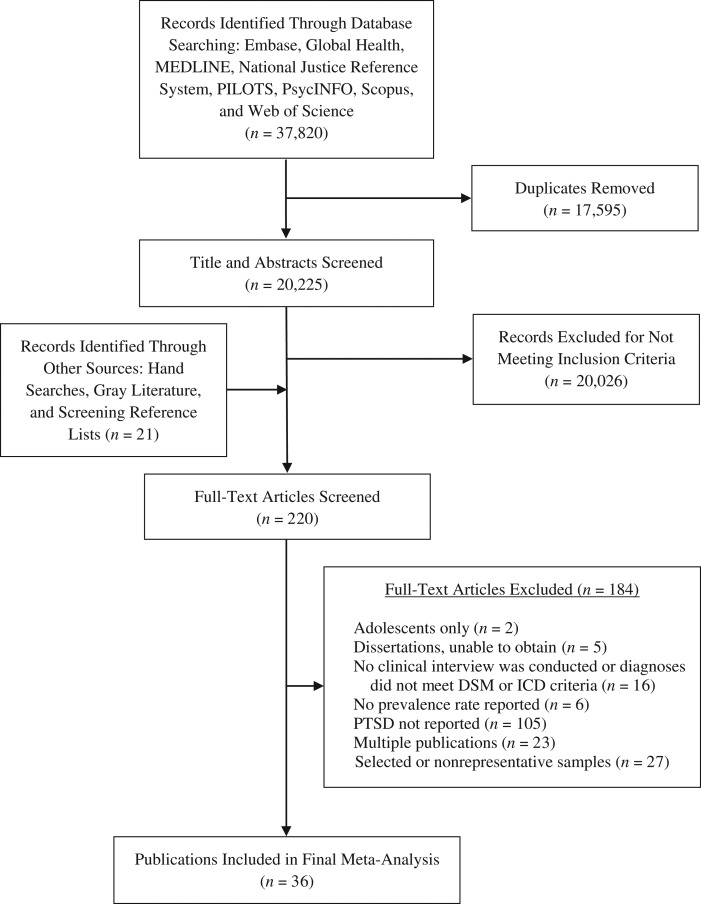
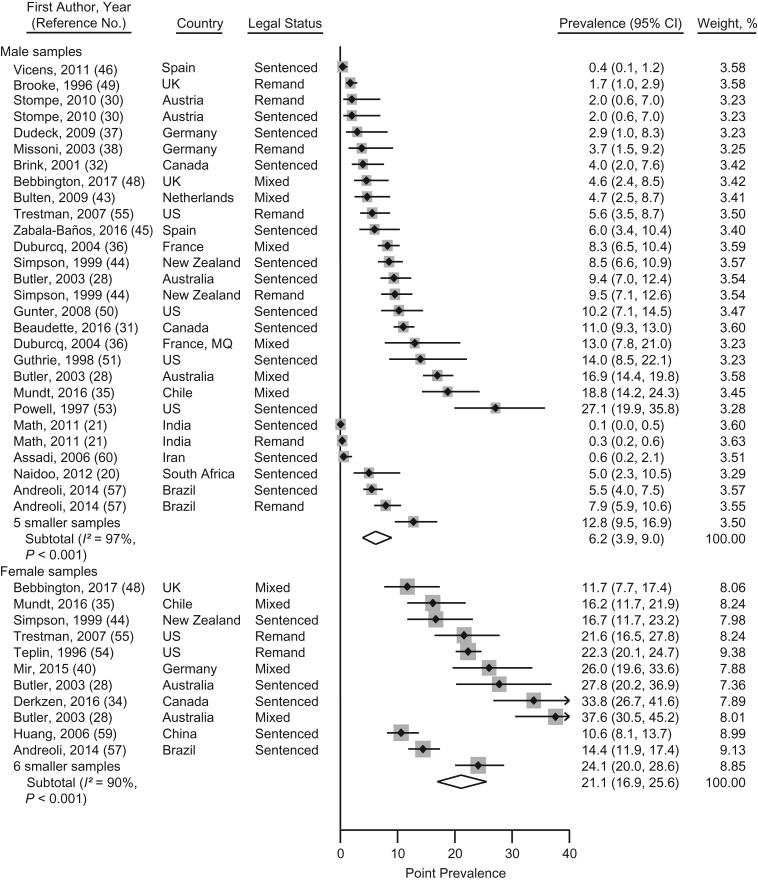
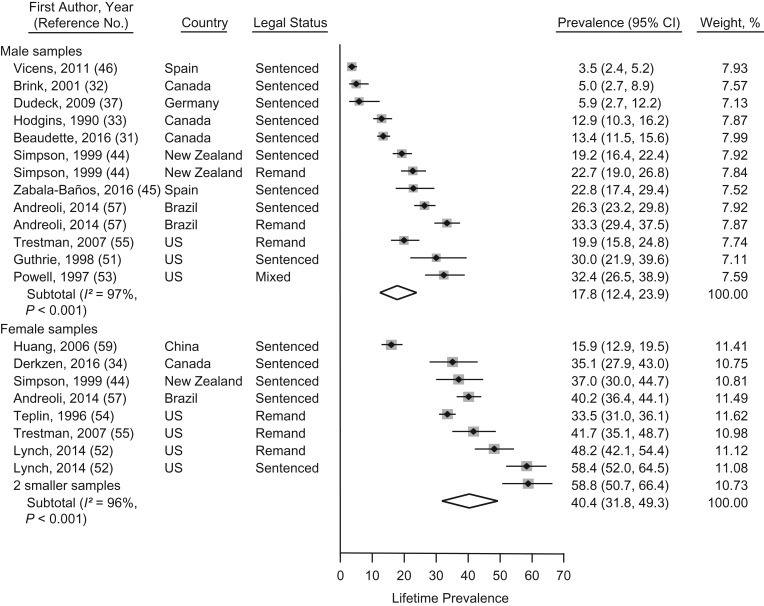
People involved with criminal justice frequently are exposed to violence and traumatic experiences. This may lead to posttraumatic stress disorder (PTSD); however, no review, to our knowledge, has synthetized findings in this setting. We conducted a systematic review and meta-analysis to estimate prevalence rates of PTSD in prison populations. Original studies in which prevalence rates of PTSD in unselected samples of incarcerated people were reported were systematically searched between 1980 and June 2017. Data were pooled using random-effects meta-analysis, and sources of heterogeneity for prespecified characteristics were assessed by meta-regression. We identified 56 samples comprising 21,099 imprisoned men and women from 20 countries. Point prevalence of PTSD ranged from 0.1% to 27% for male, and from 12% to 38% for female prisoner populations. The random-effects pooled point prevalence was 6.2% (95% confidence interval: 3.9, 9.0) in male prisoners and 21.1% (95% confidence interval: 16.9, 25.6) in female prisoners. The heterogeneity between the included studies was very high. Higher prevalence was reported in samples of female prisoners, smaller studies (n ≤ 200), and for investigations based in high-income countries. Existing evidence shows high levels of PTSD among imprisoned people, especially women. Psychosocial interventions to prevent violence, especially against children and women, and to mitigate its consequences in marginalized communities must be improved. Trauma-informed approaches for correctional programs and scalable PTSD treatments in prisons require further consideration.
Overview
The claims and statistics of this paper haven’t been checked yet.
Free: it reads the open-access text and checks the first 5 claims that cite a source we can check. Create a free account to check every claim.
Integrity signals
Registry
Cites
Statistics
Figures
Verification
Claims the paper makes
The claims and statistics of this paper haven’t been checked yet.
Free: it reads the open-access text and checks the first 5 claims that cite a source we can check. Create a free account to check every claim.
Claims other papers make about this one
Each is checked against this paper’s own text: does it say what the citing paper says it does?
The cited source says what the claim attributes to it.
In the citing paper
“The prevalence of PTSD in women prisoners tended to increase compared to males and the general population.”
From A Scoping Review of Correctional-Based Interventions for Women Prisoners with Mental Health Problems (2023) · cites this paper as Baranyi et al. 2018
The cited source says what the claim attributes to it.
In the citing paper
“Male prisoners had a five-time greater point frequency of PTSD than the general population, while female prisoners had an 8-fold higher point prevalence of PTSD (Baranyi et al. 2018).”
From A Scoping Review of Correctional-Based Interventions for Women Prisoners with Mental Health Problems (2023) · cites this paper as Baranyi et al. 2018
Self-check
Percentages, sums and reported differences re-computed from the paper’s own numbers.
The self-check needs the paper’s full text.
Citations
Cites
Preferred Reporting Items for Systematic Reviews and Meta-Analyses: the PRISMA statement
Moher, D., Liberati, A., Tetzlaff, J., Altman, D. G., & for the PRISMA Group (2009) · BMJ · doi:10.1136/bmj.b2535 · Cited by 83,823
Measuring inconsistency in meta-analyses
Higgins, J. P. T., Thompson, S. G., Deeks, J. J., & Altman, D. G. (2003) · BMJ · doi:10.1136/bmj.327.7414.557 · Cited by 63,139
Bias in meta-analysis detected by a simple, graphical test
Egger, M., Smith, G. D., Schneider, M., & Minder, C. (1997) · BMJ · doi:10.1136/bmj.315.7109.629 · Cited by 56,722 · cited 1×
“Differences of the study quality and small study bias were explored as possible reasons for asymmetric funnel plots (27).”
BackgroundMeta-analysis of Observational Studies in Epidemiology<SUBTITLE>A Proposal for Reporting</SUBTITLE>
Stroup, D. F. (2000) · JAMA · doi:10.1001/jama.283.15.2008 · Cited by 20,623
Stang, A. (2010) · European Journal of Epidemiology · doi:10.1007/s10654-010-9491-z · Cited by 17,396 · cited 2×
“) who used a modified checklist, based on the Newcastle-Ottawa Scale (22), from a meta-analysis on the prevalence of depression (23).”
MethodPreferred reporting items for systematic reviews and meta-analyses: The PRISMA statement
Moher, D., Liberati, A., Tetzlaff, J., & Altman, D. G. (2010) · International Journal of Surgery · doi:10.1016/j.ijsu.2010.02.007 · Cited by 12,156
Posttraumatic Stress Disorder in the National Comorbidity Survey
Kessler, R. C. (1995) · Archives of General Psychiatry · doi:10.1001/archpsyc.1995.03950240066012 · Cited by 10,379 · cited 1×
“4% in women in the general population (63).”
BackgroundA basic introduction to fixed-effect and random-effects models for meta-analysis
Borenstein, M., Hedges, L. V., Higgins, J. P. T., & Rothstein, H. R. (2010) · Research Synthesis Methods · doi:10.1002/jrsm.12 · Cited by 6,793 · cited 1×
“samples, we used random-effects models to balance the weighting of studies for data syntheses (24).”
MethodSerious mental disorder in 23 000 prisoners: a systematic review of 62 surveys
Fazel, S., & Danesh, J. (2002) · The Lancet · doi:10.1016/s0140-6736(02)07740-1 · Cited by 2,201 · cited 1×
“Prevalence rates of substance use disorders (3) and personality disorders (4) also have been found to be much higher in the prison population than in the general population.”
BackgroundSelf-citationMetaprop: a Stata command to perform meta-analysis of binomial data
Nyaga, V. N., Arbyn, M., & Aerts, M. (2014) · Archives of Public Health · doi:10.1186/2049-3258-72-39 · Cited by 2,139 · cited 2×
“Freeman-Tukey double arcsine transformation was used to stabilize the variance before pooling (25).”
Method
Research works printed but not linked: 6
- Walmsley R World Prison Population List. 11th ed. London, UK: Institute for Criminal Policy Research; 2016.
- Stompe T, Brandstatter N, Ebner N, et al Psychiatric disorders in prison inmates. J Neurol Neurochir Psychiatr. 2010; 11(2): 20– 23.
- Derkzen D, Barker J, McMillan K, et al Rates of Current Mental Disorders Among Women Offenders in Custody in CSC. Ottawa, Canada: Correctional Service Canada; 2016.
- Duburcq A, Coulomb S, Bonte J, et al Enquête de Prévalence sur les Troubles Psychiatriques en Milieu Carcéral (Phase 1 de l’Étude Épidémiologique) Rapport Final. Paris, France: CEMKA-EVAL; 2004.
- Missoni L, Utting F, Konrad N Psychi(atri)sche Störungen bei Untersuchungsgefangenen. Ergebnisse und Probleme einer epidemiologischen Studie. ZfStrVo. 2003; 52(6): 323– 332.
- Guthrie RK The Prevalence of Posttraumatic Stress Disorder Among Federal Prison Inmates [dissertation]. Morgantown, WV: West Virginia University; 1998.
Cited by
Baranyi, G., Scholl, C., Fazel, S., Patel, V., Priebe, S., & Mundt, A. P. (2019) · The Lancet Global Health · doi:10.1016/s2214-109x(18)30539-4 · Cited by 294
“…was not reported, we imputed a year based on the average mean difference between the year of publication and data collection derived from the other studies (4 years).9 We prespecified categories for sample size (n 500, n≥500) and average time served in prison (time 1 year, time ≥1 year).”
Self-citationBeaudry, G., Yu, R., Långström, N., & Fazel, S. (2021) · Journal of the American Academy of Child & Adolescent Psychiatry · doi:10.1016/j.jaac.2020.01.015 · Cited by 206
“However, the prevalence estimates for PTSD are similar in both groups.(24) These comparisons suggest that the mental health needs of detained adolescents could be different from those of adult prisoners and may require separate and specifically targeted programs to meet these needs.”
MethodSelf-citationKinner, S. A., & Young, J. T. (2018) · Epidemiologic Reviews · doi:10.1093/epirev/mxx018 · Cited by 190
Mental and physical health morbidity among people in prisons: an umbrella review
Favril, L., Rich, J. D., Hard, J., & Fazel, S. (2024) · The Lancet Public Health · doi:10.1016/s2468-2667(24)00023-9 · Cited by 160
“26”
Self-citationFacer-Irwin, E., Blackwood, N., Bird, A., Dickson, H., McGlade, D., Alves-Costa, F., & MacManus, D. (2019) · PLoS ONE · doi:10.1371/journal.pone.0222407 · Cited by 142
Morland, L. A., Wells, S. Y., Glassman, L. H., Greene, C. J., Hoffman, J. E., & Rosen, C. S. (2020) · Current Treatment Options in Psychiatry · doi:10.1007/s40501-020-00215-x · Cited by 98
Fritzon, K., Miller, S., Bargh, D. M., Hollows, K., Osborne, A., & Howlett, A. (2020) · Journal of Aggression Maltreatment & Trauma · doi:10.1080/10926771.2020.1806972 · Cited by 101
Mental disorders and risk of suicide attempt in prisoners
Favril, L., Indig, D., Gear, C., & Wilhelm, K. (2020) · Social Psychiatry and Psychiatric Epidemiology · doi:10.1007/s00127-020-01851-7 · Cited by 69
Bhushan, D., Kotz, K. J., McCall, J., Wirtz, S., Gilgoff, R., Dube, S. R., Powers, C., Olson-Morgan, J., Galeste, M., Patterson, K., et al. (2020) · doi:10.48019/peam8812 · Cited by 121
Facer-Irwin, E., Karatzias, T., Bird, A., Blackwood, N., & MacManus, D. (2021) · Psychological Medicine · doi:10.1017/s0033291720004936 · Cited by 92
“We found the rate of PTSD in our sample to be similar to previous meta-analytic estimates (Baranyi et al., 2018).”
ResultWorldwide incidence of suicides in prison: a systematic review with meta-regression analyses
Mundt, A. P., Cifuentes-Gramajo, P. A., Baranyi, G., & Fazel, S. (2024) · The Lancet Psychiatry · doi:10.1016/s2215-0366(24)00134-2 · Cited by 85
“34,35 This difference is related to the high threshold for female individuals to be imprisoned, which means that those entering prison are more selected than male individuals entering prison.”
Self-citationPosttraumatic stress disorder (PTSD) prevalence: an umbrella review
Schincariol, A., Orrù, G., Otgaar, H., Sartori, G., & Scarpazza, C. (2024) · Psychological Medicine · doi:10.1017/s0033291724002319 · Cited by 95
Malik, N., Facer-Irwin, E., Dickson, H., Bird, A., & MacManus, D. (2021) · Trauma Violence & Abuse · doi:10.1177/15248380211043890 · Cited by 79
“The prevalence of posttraumatic stress disorder (PTSD) is approximately five times greater among the imprisoned population than in community samples (Baranyi et al., 2018).”
BackgroundVirtual reality: a use case for criminal justice practice
Cornet, L. J. M., & van Gelder, J. (2020) · Psychology Crime and Law · doi:10.1080/1068316x.2019.1708357 · Cited by 66
Wildeman, C., Goldman, A. W., & Wang, E. A. (2019) · Public Health Reports® · doi:10.1177/0033354919879732 · Cited by 53
“disorder, self-harm, and suicide among the incarcerated population.(13-17) Other work highlights a potentially protective effect of incarceration, finding lower rates of mortality among persons incarcerated in state prisons than among the adult US population, with important differences by race/ethnicity and age.”
BackgroundTrauma history in a high secure male forensic inpatient population
McKenna, G., Jackson, N., & Browne, C. (2019) · International Journal of Law and Psychiatry · doi:10.1016/j.ijlp.2019.101475 · Cited by 63
Women’s experiences of prison-based mental healthcare: a systematic review of qualitative literature
Bright, A., Higgins, A., & Grealish, A. (2022) · International Journal of Prisoner Health · doi:10.1108/ijph-09-2021-0091 · Cited by 90
Tadros, E., & Ansell, A. (2022) · Journal of Forensic Sciences · doi:10.1111/1556-4029.14976 · Cited by 45
Caravaca-Sánchez, F., Aizpurúa, E., & Wolff, N. (2022) · Trauma Violence & Abuse · doi:10.1177/15248380221130358 · Cited by 54
“This is again concerning because behavioral health problems are densely concentrated among correctional samples worldwide (Baranyi et al., 2018; Facer-Irwin et al., 2019; Mundt et al., 2018; Zhong et al., 2021), elevating public health concerns because of prevalent but preventable prison-based harm.”
BackgroundProst, S. G., Archuleta, A. J., & Golder, S. (2019) · Aging & Mental Health · doi:10.1080/13607863.2019.1693976 · Cited by 47
Kelman, J., Gribble, R., Harvey, J., Palmer, L., & MacManus, D. (2022) · Women & Criminal Justice · doi:10.1080/08974454.2022.2071376 · Cited by 62
“High rates of traumatic experiences have been found in prison populations (Baranyi et al., 2018).”
BackgroundInfluentialSánchez, F. C., Ignatyev, Y., & Mundt, A. P. (2018) · Criminal Behaviour and Mental Health · doi:10.1002/cbm.2099 · Cited by 50
Self-citationFavril, L. (2021) · Psychologica Belgica · doi:10.5334/pb.1072 · Cited by 60
Prison mental healthcare: recent developments and future challenges
Franke, I., Vogel, T., Eher, R., & Dudeck, M. (2019) · Current Opinion in Psychiatry · doi:10.1097/yco.0000000000000504 · Cited by 47
Improving Health Equity for Women Involved in the Criminal Legal System
Golembeski, C., Sufrin, C., Williams, B. A., Bedell, P. S., Glied, S., Binswanger, I. A., Hylton, D., Winkelman, T. N. A., & Meyer, J. P. (2020) · Women s Health Issues · doi:10.1016/j.whi.2020.06.007 · Cited by 37
Wolff, N., & Sánchez, F. C. (2019) · Criminal Justice and Behavior · doi:10.1177/0093854819876008 · Cited by 57
“Hence, it should not be surprising that dozens of studies consistently document the overrepresentation of mental health (Baranyi et al., 2019; Bronson & Berzofsky, 2017; Fazel, Hayes, Bartellas, Clerici, & Trestman, 2016; Fazel & Seewald, 2012; gottfried & Christopher, 2017) and substance abuse disorders (Baranyi et a…”
InfluentialEvery‐Palmer, S., Flewett, T., Dean, S., Hansby, O., Colman, A., Weatherall, M., & Bell, E. M. (2019) · Trials · doi:10.1186/s13063-019-3760-2 · Cited by 35
Carter, A., Butler, A., Willoughby, M., Janca, E. K., Kinner, S. A., Southalan, L., Fazel, S., & Borschmann, R. (2022) · EClinicalMedicine · doi:10.1016/j.eclinm.2021.101266 · Cited by 45
Self-citationAnderson, K., & Willingham, L. (2020) · International Journal of Community Music · doi:10.1386/ijcm_00018_1 · Cited by 27
Morgan‐López, A. A., Hien, D. A., Saraiya, T. C., Saavedra, L. M., Norman, S. B., Killeen, T. K., Simpson, T. L., Fitzpatrick, S., Mills, K. L., Ruglass, L. M., et al. (2022) · Journal of Traumatic Stress · doi:10.1002/jts.22800 · Cited by 31
BURT, C. H. (2020) · Feminist Criminology · doi:10.1177/1557085120918667 · Cited by 31
“…been targeted by male physical and sexual abuse (Belknap, 2007; Siegel & Williams, 2003), and evidence suggests that at least one in five incarcerated women suffer from post-traumatic stress disorder (PTSD), a rate that is eight-fold higher than the general population rate (Baranyi et al., 2018).”
BackgroundMundt, A. P., Rozas-Serri, E., Siebenförcher, M., ALIKAJ, V., Ismayilov, F., Razvodovsky, Y., Hasanovic, M. I., Marinov, P., Frančišković, T., Čermáková, P., et al. (2020) · The Lancet Regional Health - Europe · doi:10.1016/j.lanepe.2021.100137 · Cited by 34
Self-citationTrouble de stress post-traumatique en milieu pénitentiaire
Belet, B., D’Hondt, F., Horn, M., Amad, A., Carton, F., Thomas, P., Vaïva, G., & Fovet, T. (2020) · L Encéphale · doi:10.1016/j.encep.2020.04.017 · Cited by 31
Kukucka, J., Horodyski, A. M., & Dardis, C. M. (2022) · Psychology Public Policy and Law · doi:10.1037/law0000358 · Cited by 28
Prevalence and correlates of sleep problems among Chinese prisoners
Geng, F., Wang, J., Wen, C., Shao, Y., Wu, J., & Fan, F. (2020) · Social Psychiatry and Psychiatric Epidemiology · doi:10.1007/s00127-020-01882-0 · Cited by 25
Linkages between incarceration and health for older adults
Novisky, M. A., Prost, S. G., Fleury‐Steiner, B., & Testa, A. M. (2025) · Health & Justice · doi:10.1186/s40352-025-00331-x · Cited by 25
“Fazel and colleagues (2012) reported depression among 10.2% of male and 14.1% of female adults in prison and roughly 6% of men and 21% of women in prison have clinical levels of PTSD (Baranyi et al., 2018).”
InfluentialBebbington, P., McManus, S., Coid, J. W., Garside, R., & Brugha, T. S. (2021) · Social Psychiatry and Psychiatric Epidemiology · doi:10.1007/s00127-021-02066-0 · Cited by 29
Bianchini, V., Paoletti, G., Ortenzi, R., Lagrotteria, B., Roncone, R., Cofini, V., & Nicolò, G. (2022) · Frontiers in Psychiatry · doi:10.3389/fpsyt.2022.843730 · Cited by 28
“PTSD among forensic patients is common but often unaddressed (17, 40).”
BackgroundDe quels troubles psychiatriques souffrent les personnes détenues en France ?
Fovet, T., Eck, M., & Bouchard, J. (2022) · Annales Médico-psychologiques revue psychiatrique · doi:10.1016/j.amp.2022.08.008 · Cited by 23
The Underlying Structure of Comorbid Mental Health and Substance Use Disorders in Prison Populations
Ignatyev, Y., Baggio, S., & Mundt, A. P. (2019) · Psychopathology · doi:10.1159/000495844 · Cited by 21
Self-citationFitch, K. V., Pence, B. W., Rosen, D. L., Miller, V. E., Gaynes, B. N., Swilley-Martinez, M. E., Kavee, A. L., Carey, T. S., Proescholdbell, S., & Ranapurwala, S. I. (2023) · American Journal of Epidemiology · doi:10.1093/aje/kwad214 · Cited by 19
Macfarlane, C., Masthoff, E., & Hakvoort, L. (2019) · Journal of Forensic Psychology Research and Practice · doi:10.1080/24732850.2019.1670023 · Cited by 20
Trauma exposure and PTSD among men entering jail: A comparative study with the general population
Fovet, T., Wathelet, M., Amad, A., Horn, M., Belet, B., Benradia, I., Roelandt, J.-L., Thomas, P., Vaïva, G., & D’Hondt, F. (2021) · Journal of Psychiatric Research · doi:10.1016/j.jpsychires.2021.12.014 · Cited by 21
Paulino, A., Kuja‐Halkola, R., Fazel, S., Sariaslan, A., Rietz, E. D., Lichtenstein, P., & Brikell, I. (2023) · The Lancet Public Health · doi:10.1016/s2468-2667(23)00075-0 · Cited by 28
“12 The association might also be present in the global population, 10,11 as PTSD has been associated with perpetrating interpersonal violence 13 and increased likelihood of incarceration 14 in civilians.”
Self-citationFacer-Irwin, E., Blackwood, N., Bird, A., & MacManus, D. (2023) · BJPsych Open · doi:10.1192/bjo.2022.639 · Cited by 21
Prevalence of attention‐deficit hyperactivity disorder in adult prisoners: An updated meta‐analysis
Fazel, S., & Favril, L. (2024) · Criminal Behaviour and Mental Health · doi:10.1002/cbm.2337 · Cited by 26
Self-citationVélez‐Pastrana, M. C., González, R. A., Ramos-Fernández, A., Padilla, R. R. R., LEVIN, F. R., & Albizu‐García, C. E. (2020) · European Addiction Research · doi:10.1159/000508829 · Cited by 19
Every‐Palmer, S., Ross, B., Flewett, T., Rutledge, E., Hansby, O., & Bell, E. M. (2023) · European Journal of Psychotraumatology · doi:10.1080/20008066.2023.2282029 · Cited by 15
“…McKenzie et al., 2023) Although the tri-directional relationships between trauma, mental illness and incarceration are increasingly being recognised (Baranyi et al., 2018; Collier & Friedman, 2016; Fritzon et al., 2021; Maguire & Taylor, 2019), forensic mental health services do not usually…”
Background“He Needed Just About Everything”: Caring for Aging Adults Postincarceration
Jimenez, L. B., Cross, S. H., & Boucher, N. A. (2021) · Journal of Applied Gerontology · doi:10.1177/0733464821990511 · Cited by 16
Ning, M., Wen, S., Zhou, P., & Zhang, C. (2022) · Frontiers in Psychology · doi:10.3389/fpsyg.2022.1014202 · Cited by 34
“…such as various other brain circuits [e.g., mPFC-amygdala neurocircuit (Koelsch, 2014; Reybrouck et al., 2021)], neurotransmitters [e.g., oxytocin (Beck et al., 2018a; Harvey, 2020)], and immunological responsiveness [e.g., the reaction of the HPA axis (Reybrouck et al., 2018; Pant et al.,…”
BackgroundSuicidal Ideation Among Female Inmates: A Cross-Sectional Study
Favril, L., & Laenen, F. V. (2019) · International Journal of Forensic Mental Health · doi:10.1080/14999013.2018.1519613 · Cited by 21
Soh, K. C., Tay, Y. H., & Darjee, R. (2023) · Journal of Aggression Maltreatment & Trauma · doi:10.1080/10926771.2023.2186299 · Cited by 19
Kelman, J., Palmer, L., Gribble, R., & MacManus, D. (2024) · International Journal of Forensic Mental Health · doi:10.1080/14999013.2023.2298484 · Cited by 22
“This change in practice is in response to the high prevalence rates of psychological trauma found inter-nationally among imprisoned women (Baranyi et al., 2018; Karatzias et al., 2018), and growing support for using trauma theory to design services for those with trauma histories (Harris & Fallot,…”
Umpunjun, P., Webb, E. L., & Morris, D. J. (2024) · Psychology Crime and Law · doi:10.1080/1068316x.2024.2338488 · Cited by 18
“The high rates of negative health outcomes in prison populations, including mental health disorders, substance use, and their dual presentation (Baranyi et al., 2018), are strongly associated with early adverse experiences (Bomysoad & Francis, 2020).”
InfluentialImpact of oral conditions on the quality of life of incarcerated women in Brazil
Soares, G. H., de Mendonça, I. A., Michel‐Crosato, E., Moysés, S. J., Moysés, S. T., & Werneck, R. I. (2019) · Health Care For Women International · doi:10.1080/07399332.2019.1590362 · Cited by 20
Eck, M., Costa, J. D., Wathelet, M., Beunas, C., D’Ovidio, K., Moncany, A.-H., Thomas, P., & Fovet, T. (2024) · L Encéphale · doi:10.1016/j.encep.2023.11.028 · Cited by 14
PTSD in prison settings: the need for direct comparisons with the general population
Fovet, T., Wathelet, M., Amad, A., Horn, M., Belet, B., Roelandt, J.-L., Thomas, P., Vaïva, G., & D’Hondt, F. (2021) · Psychological Medicine · doi:10.1017/s0033291721000507 · Cited by 12
“A similar observation is made for studies in detention settings since prisoners in high-income countries, particularly in the USA, have a higher PTSD prevalence than imprisoned people in other countries (Baranyi et al., 2018).”
Mental illness and HIV amongst female inmates in Durban, South Africa
Naidoo, S., Subramaney, U., Paruk, S., & Ferreira, L. (2022) · South African Journal of Psychiatry · doi:10.4102/sajpsychiatry.v28i0.1628 · Cited by 21
De psychische gezondheid van gedetineerden in België en Nederland: een systematisch overzicht
Favril, L., & Dirkzwager, A. (2019) · Tijdschrift voor Criminologie · doi:10.5553/tvc/0165182x2019061001001 · Cited by 33
Glorney, E., Ullah, H., & Brooker, C. (2020) · International Journal of Forensic Mental Health · doi:10.1080/14999013.2020.1743389 · Cited by 16
“…but this also co-occurs with a high prevalence of childhood abuse victimization (e.g. Bodkin et al., 2019) and post-traumatic stress disorder (Baranyi et al., 2018), for which there is recognized impact on mental health of male prisoners (Goddard & Pooley, 2019), including the development of…”
BackgroundEquitable Care for Pregnant Incarcerated Women: Infant Contact After Birth—A Human Right
Franco, C. L., Mowers, E. L., & Lewis, D. L. (2020) · Perspectives on Sexual and Reproductive Health · doi:10.1363/psrh.12166 · Cited by 15
Travers, Á., McDonagh, T., Cunningham, T., Dalsklev, M., Armour, C., & Hansen, M. (2020) · Journal of Interpersonal Violence · doi:10.1177/0886260520922355 · Cited by 16
“, 2019; Wolff & Shi, 2012) and PTSD (Baranyi et al., 2018) in offender samples, and prospective research indicates a predictive effect of early trauma on general and violent offending (Maxfield & Widom, 1996; Widom, 1989).”
BackgroundInfluentialTraumatic experiences among individuals with severe mental illnesses on probation
Givens, A., & Cuddeback, G. S. (2021) · Criminal Behaviour and Mental Health · doi:10.1002/cbm.2212 · Cited by 11
PTSD and crime propensity: Stress systems, brain structures, and the nature of the relationship
Svingen, E. (2023) · Heliyon · doi:10.1016/j.heliyon.2023.e18381 · Cited by 8
“remains the most commonly found disorder in the prison population [8], especially among women [9,10].”
BackgroundChanges in rates of psychiatric beds and prison populations in sub-Saharan Africa from 1990 to 2020
Mundt, A. P., Delhey, S., Maphisa, J. M., Sourabié, O., Yongsi, B. N., Rozas-Serri, E., Tshilonda, J.-C. B., Te, J. H., Bitta, M. A., Mathe, L., et al. (2022) · Journal of Global Health · doi:10.7189/jogh.12.04054 · Cited by 11
Self-citationCrole-Rees, C., Tomlin, J., Kalebic, N., Argent, S. E., Berrington, C., Chaplin, E., Davies, J., Hoskins, M., James, L., Jarrett, M., et al. (2024) · Psychology Crime and Law · doi:10.1080/1068316x.2024.2394807 · Cited by 14
“As in the community, female prisoners have a higher prevalence of PTSD than male prisoners, and in one international meta-analysis, this was found to be 21% (Olff, 2017; Karatzias et al. 2018; Baranyi et al., 2018; Shalev et al., 2019).”
High Psychiatric Morbidity and Comorbidity Among Female Prisoners in Hunan, China
Zhong, S., Zhu, X., Chen, Y., Guo, H., Luo, C., Liang, X., Wang, F., Chen, H., Zhou, J., & Wang, X. (2020) · Frontiers in Psychiatry · doi:10.3389/fpsyt.2020.00271 · Cited by 13
“Fazel and colleagues’ systematic review found only nine studies from non-Western countries among 81 publications (6), without any data from China; The Baranyi review (7) identified only one study from China, which merely reported the prevalence of PTSD from a sample of 471 female prisoners (14).”
BackgroundResultMental health in prisons in Latin America: The effects of COVID-19
Forrester, A., Aboaja, A. M., Beigel, L., Mundt, A. P., Arroyo, G. R., & Torales, J. C. (2023) · Medicine Science and the Law · doi:10.1177/00258024221149932 · Cited by 15
“1% of female prisoners, and personality disorder in an estimated 65%.(19,20) Similarly, high levels of drug and alcohol misuse or dependence are described—66.”
BackgroundSelf-citationMorrison, M., Pettus‐Davis, C., Renn, T., Veeh, C. A., & Weatherly, C. (2019) · PubMed · Cited by 15
A Scoping Review of Correctional-Based Interventions for Women Prisoners with Mental Health Problems
Hidayati, N. O., Suryani, S., Rahayuwati, L., Fitrasanti, B. I., & Ahmad, C. A. (2023) · Social Sciences · doi:10.3390/socsci12080452 · Cited by 10
“Male prisoners had a five-time greater point frequency of PTSD than the general population, while female prisoners had an 8-fold higher point prevalence of PTSD (Baranyi et al. 2018).”
BackgroundNot All Traumas Are Equal: Post-Traumatic Stress and Quality of Life among Women in Prison
Prost, S. G., McDonald, A. R., Plassmeyer, M., Middleton, J., & Golder, S. (2021) · Women & Criminal Justice · doi:10.1080/08974454.2020.1871160 · Cited by 16
“Point prevalence rates of PTSD for women incarcerated in prison have been estimated as ranging from 12 to 38% compared to 0.1–27% for their male peers (Baranyi et al., 2018).”
BackgroundInfluentialTreatment of PTSD and SUD for the incarcerated population with EMDR: A pilot study
Bashir, H. A., Wilson, J. F., Ford, J. A., & Hira, N. (2023) · Journal of Addictions & Offender Counseling · doi:10.1002/jaoc.12123 · Cited by 8
Sen, P., Crowley, G., Moro, C., Slade, K., Khan, A. A., Katona, C., & Forrester, A. (2021) · Criminal Behaviour and Mental Health · doi:10.1002/cbm.2207 · Cited by 9
Hodges, T. J., Sharma, S., Nicolas, D. S., & Moore, B. A. (2022) · Aggression and Violent Behavior · doi:10.1016/j.avb.2022.101736 · Cited by 10
The use of benzodiazepines and the mental health of women in prison: a cross-sectional study
Einloft, F. M. S., Kopittke, L., Dias, M. T. G., Schultz, Á. L. V., Dotta, R. M., & Barros, H. M. T. (2023) · Scientific Reports · doi:10.1038/s41598-023-30604-0 · Cited by 13
Holman, L. F., Ellmo, F. I., Wilkerson, S., & Johnson, R. (2020) · Journal of Addictions & Offender Counseling · doi:10.1002/jaoc.12074 · Cited by 11
Psychiatry in Prisons and Corrections
Fovet, T., Mundt, A. P., & Fazel, S. (2023) · Springer eBooks · doi:10.1007/978-3-030-42825-9_103-1 · Cited by 9
Self-citationFelton, J. W., Hailemariam, M., Richie, F. J., Reddy, M. K., Edukere, S., Zlotnick, C., & Johnson, J. E. (2019) · Psychotherapy Research · doi:10.1080/10503307.2019.1587192 · Cited by 12
The revolving prison door: Factors associated with repeat incarcerations in Spain
Sánchez, F. C., Ignatyev, Y., & Mundt, A. P. (2020) · Journal of Forensic and Legal Medicine · doi:10.1016/j.jflm.2020.101947 · Cited by 10
Self-citationEye movement desensitisation and reprocessing (EMDR) within prisons and the criminal justice system
Crole-Rees, C., Lawrence, D., Blundell, L., Saward, K., Jones, L., Anany, S. E., Simon, G., Kalebic, N., & Forrester, A. (2024) · Medicine Science and the Law · doi:10.1177/00258024241293540 · Cited by 7
“1 As in community samples, female prisoners are thought to present with higher rates of PTSD than male prisoners, 13 (Shalev et al. 2019).”
Sousa, M., Gonçalves, T., Caridade, S., Rodrigues, A. D. C., Maia, Â., & Cunha, O. S. (2025) · Trauma Violence & Abuse · doi:10.1177/15248380251397413 · Cited by 7
Injuries Sustained During Incarceration Among Prisoners
McFadden, N. R., Kahn, D. R., & Utter, G. H. (2021) · Journal of Surgical Research · doi:10.1016/j.jss.2021.03.008 · Cited by 7
Assessing a Faith-Based Program for Trauma Healing Among Jail Inmates: A Quasi-Experimental Study
Jang, S. J., Johnson, B. R., Bradshaw, M., & Na, C. (2022) · International Journal of Offender Therapy and Comparative Criminology · doi:10.1177/0306624x221110804 · Cited by 12
“…among incarcerated individuals is their exposure to traumatic events during their lifetime, and more than 75% of the inmates are estimated to have experienced a high degree of trauma (Allely & Allely, 2020; Baranyi et al., 2018; Blaauw et al., 2002; Gibson et al., 1999; Green et al., 2005).”
BackgroundMethodInfluentialForgotten and without Protections: Older Adults in Prison Settings
Arias, J. J., Morgado, L., & Prost, S. G. (2023) · The Hastings Center Report · doi:10.1002/hast.1540 · Cited by 6
Zielinski, M. J., Smith, M. K. S., Kaysen, D. L., Selig, J. P., Zaller, N. D., Curran, G. M., & Kirchner, J. E. (2022) · Health & Justice · doi:10.1186/s40352-022-00192-8 · Cited by 10
“People who are incarcerated also have disproportionate prevalence of trauma sequelae including double the rates of PTSD and over ten times the rates of SUD as same-gender community peers (Baranyi et al., 2018; Fazel et al., 2017; Karlsson & Zielinski, 2020; Trestman et al., 2007).”
BackgroundGiuseppe, T. D., Perasso, G. F., Mazzeo, C., Maculan, A., Vianello, F., & Paoletti, P. (2023) · RICERCHE DI PSICOLOGIA · doi:10.3280/rip2022oa14724 · Cited by 13
Henderson, A., & Kroese, B. S. (2020) · Journal of Forensic Practice · doi:10.1108/jfp-05-2020-0024 · Cited by 9
Lantz, L., Chang, Z., & Virtanen, S. (2024) · Drug and Alcohol Dependence · doi:10.1016/j.drugalcdep.2024.111314 · Cited by 7
Dueweke, A. R., Higuera, D. E., Zielinski, M. J., Karlsson, M. E., & Bridges, A. J. (2022) · International Journal of Group Psychotherapy · doi:10.1080/00207284.2021.2015601 · Cited by 7
“…primarily through examination of time-intensive individual treatments (Cahill et al., 2009), which do not lend themselves well to delivery in underresourced settings with high mental health treatment needs, such as prisons (Adams & Ferrandino, 2008; Appelbaum, 2011; Baranyi et al., 2018).”
BackgroundThe Shadow of Childhood Harm Behind Prison Walls: Theory, Evidence, and Treatment
Wolff, N. (2022) · doi:10.1093/oso/9780197653135.001.0001 · Cited by 10
Geng, F., Tu, L., Zhan, N., Zhang, Y., & Wang, J. (2021) · European Journal of Psychotraumatology · doi:10.1080/20008198.2021.1906022 · Cited by 8
“Another recent review of 21,099 imprisoned men and women from 20 countries reported that the prevalence of PTSD among male prisoners was 6.2%, and that of female prisoners was 21.1% (Baranyi, Cassidy, Fazel, Priebe, & Mundt, 2018).”
BackgroundInfluentialStandardized outcome measures of mental health in research with older adults who are incarcerated
Prost, S. G., Golembeski, C., Periyakoil, V. S., Arias, J. J., Knittel, A. K., Ballin, J., Oliver, H. D., & Tran, N. T. (2022) · International Journal of Prisoner Health · doi:10.1108/ijph-08-2021-0085 · Cited by 7
Zielinski, M. J., Allison, M. K., Smith, M. K. S., Curran, G. M., Kaysen, D. L., & Kirchner, J. E. (2022) · Journal of Traumatic Stress · doi:10.1002/jts.22898 · Cited by 8
Rosenfeld, B. D., Callahan, P. A., Carboni-Jiménez, A., Rice, D. B., Nassar, E., Boruff, J. T., Li, K., & Thombs, B. D. (2024) · International Journal of Forensic Mental Health · doi:10.1080/14999013.2024.2389237 · Cited by 12
“Within this population, the estimated prevalence of mental disorders is substantially higher than in community samples (Baranyi et al., 2018; Fazel & Seewald, 2012; Prins, 2014).”
InfluentialFovet, T., D’Ovidio, K., Eck, M., Benradia, I., Duhem, S., Lancelevée, C., Thomas, P., Wathelet, M., & Amad, A. (2025) · European Psychiatry · doi:10.1192/j.eurpsy.2025.2443 · Cited by 6
“We obtained prevalences that are higher than those reported in international reviews for major depressive disorder (26.3% in our sample vs. 10.2% in Fazel et al. [3]); PTSD (11.1% in our sample vs. 6.2% in Baranyi et al. [16]); and psychosis (10.5% vs. 3.6% in Fazel et al. [3]).”
InfluentialPrevalence of Traumas and PTSD Among Individuals Adjudicated Not Guilty by Reason of Insanity.
Guina, J., Audu, A., Cameron, J., Lemmen, A., Mamidipaka, A., & Kletzka, N. T. (2021) · PubMed · doi:10.29158/jaapl.200062-20 · Cited by 7
“1 to 38 percent (the extremely low end of the range is from a study in India and may represent cultural differences in diagnosis and self-report or methodological problems with accurately assessing PTSD in very large sample sizes).(8,9) Given the severity of mental illness among forensic populations, and since trauma…”
BackgroundMundt, A. P., Marín, P., Gabrysch, C. H., Sepúlveda, C., Roumeau, J., & Heritage, P. (2019) · Frontiers in Psychiatry · doi:10.3389/fpsyt.2019.00716 · Cited by 7
“There has been concern about high rates of mental health problems (3, 4) and substance use disorders (5, 6) in prison populations (7).”
BackgroundSelf-citationIndividuals With Mental Illnesses on Probation: The Intersection of Trauma, Race, and Gender
Givens, A., Murray-Lichtman, A., Deinse, T. B. V., Dallenbach, M. L., Cowell, M. M., Lowder, E. M., & Cuddeback, G. S. (2022) · Feminist Criminology · doi:10.1177/15570851221112926 · Cited by 8
“Rates of diagnosed PTSD are also higher among justice-involved individuals in that rates of PTSD in the general population are approximately 7% compared to 27–38% in the justice-involved population (Baranyi et al., 2018; Harvard Medical School, 2007).”
BackgroundExistential isolation and well-being in justice-involved populations
Sease, T. B., Cox, C. R., & Knight, K. K. (2022) · Frontiers in Psychology · doi:10.3389/fpsyg.2022.1092313 · Cited by 8
“Collectively, justice populations represent an underserved population for behavioral healthcare needs—notably, people involved with the justice system report elevated rates of substance use, mental health difficulties, and trauma histories (Fazel and Seewald, 2012; Fazel et al., 2017; Baranyi et al., 2018).”
BackgroundAsylums and Deinstitutionalization: The Penrose Hypothesis in the Twenty-First Century
Mundt, A. P. (2019) · Springer eBooks · doi:10.1007/978-3-030-12594-3_2 · Cited by 5
Self-citation
Metadata
- Authors
- Baranyi, G., Cassidy, M., Fazel, S., Priebe, S., & Mundt, A. P.
- Affiliations
- Center for Research on Environment Society and Health, School of GeoSciences, The University of Edinburgh, Edinburgh, United Kingdom
- Queen Mary University of London (GB)
- University of Oxford (GB)
- Universidad San Sebastián (CL)
- Corresponding author
- Mundt, Adrian P
- Venue
- Epidemiologic Reviews
- Publisher
- Oxford University Press (OUP)
- Published
- 2018
- Volume
- 40
- Issue
- 1
- Pages
- 134-145
- ISSN
- 0193-936X (ISSN-L)
- 1478-6729
- PMC
- PMC5982805
- OpenAlex
- W2794707138
- Cited by
- 247
- References
- 67
- Citations by year
- 2026: 23 · 2025: 30 · 2024: 27 · 2023: 42 · 2022: 45 · 2021: 25 · 2020: 28 · 2019: 22 · 2018: 3
- FWCI
- 2.30
- Type
- journal article
- Language
- en
- Open access
- hybrid
- doi.org
- Licence
- Locations
- Epidemiologic Reviews (publishedVersion, cc-by)
- Europe PMC (PubMed Central) (publishedVersion, cc-by)
- PubMed Central (publishedVersion, cc-by)
- PubMed (publishedVersion)
- Edinburgh Research Explorer (University of Edinburgh) (submittedVersion, cc-by)
- Queen Mary Research Online (Queen Mary University of London) (submittedVersion, cc-by)
- Funders
- Wellcome Trust (202836/Z/16/Z)
- Topics
- Social Sciences › Psychology › Clinical Psychology › Posttraumatic Stress Disorder Research
- Social Sciences › Sociology and Political Science › Criminal Justice and Corrections Analysis
- Social Sciences › Psychology › Clinical Psychology › Migration, Health and Trauma
- Keywords
- post-traumatic stress disorder, prisoners, prevalence, women prisoners, incarcerated men, violence exposure, trauma, prison environment, trauma-informed care, psychosocial interventions
- MeSH terms
- Humans, Prisoners, Stress Disorders, Post-Traumatic, Global Health, Models, Statistical, Prevalence
About these checks
Registry, retraction, Cites and statistics results are computed, not judged, with one exception: a printed reference that no index lists is read once by a model before it counts as a citation error. Claims are extracted by a model and kept only when their quote appears verbatim in the text; each cited source is then checked, with a model’s help, for whether it says what the claim relies on. Those verdicts can be wrong — read the claim’s quote and the cited source before relying on one.
Statistics and arithmetic are recomputed, not judged.
Confidence bands are shown only for fields calibrated on our annotated test set. None is calibrated yet, so no band is shown.
What counts as a claim ›How we measure confidence ›How we check this ›
Are you an author, or do you see a problem with this page? Request a review
Data sources
Bibliographic data: Semantic Scholar, OpenAlex, Crossref.
Contains information from the Semantic Scholar Academic Graph Datasets, made available under the ODC Attribution License (ODC-BY 1.0).
Semantic Scholar’s data is described in: Kinney, R., et al. (2023). The Semantic Scholar Open Data Platform. arXiv:2301.10140.
