

Effects of aspirin on dementia and cognitive function in diabetic patients: the ASCEND trial
Open accessThe DOI matches its Crossref record; 27 of the 27 references it cites were found in a registry or an index.
Abstract
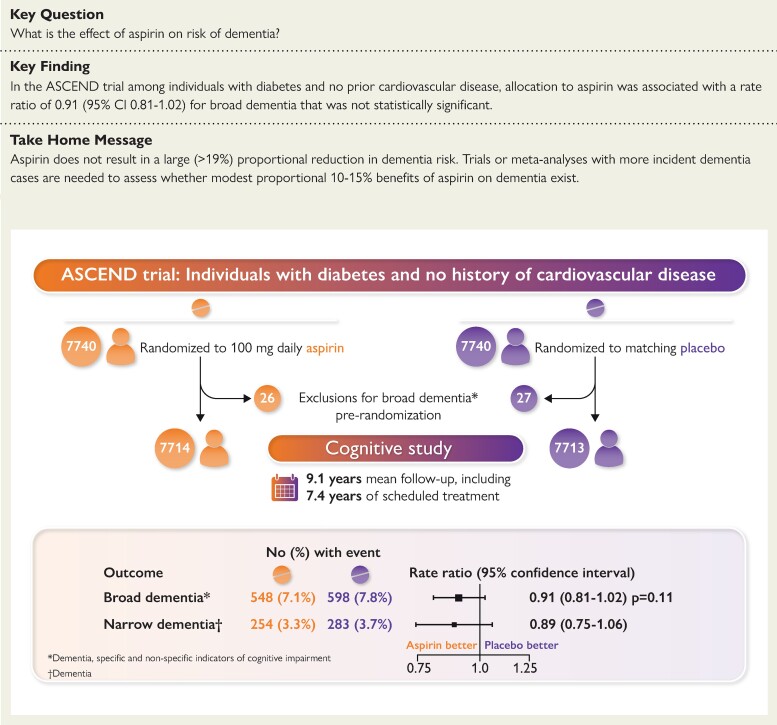
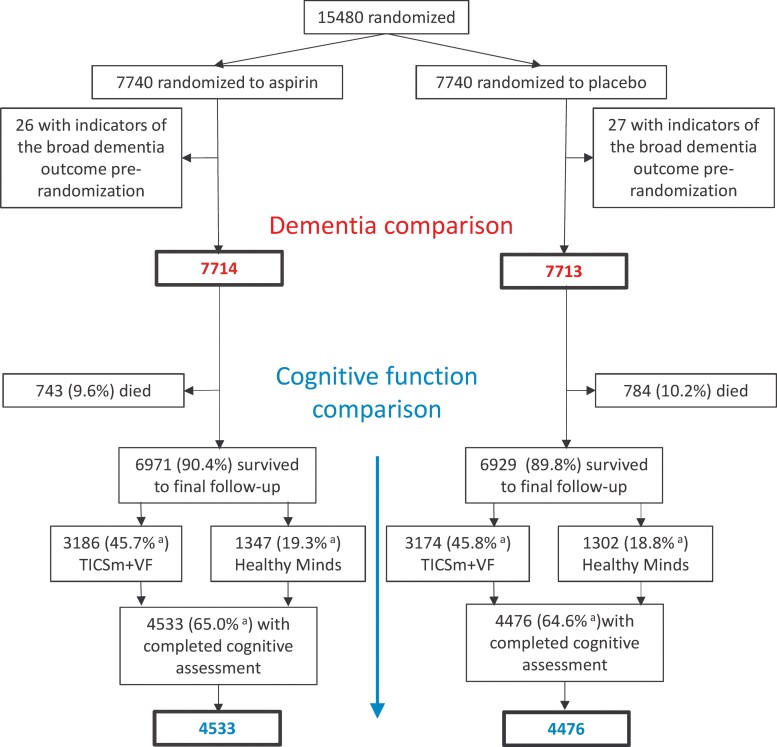
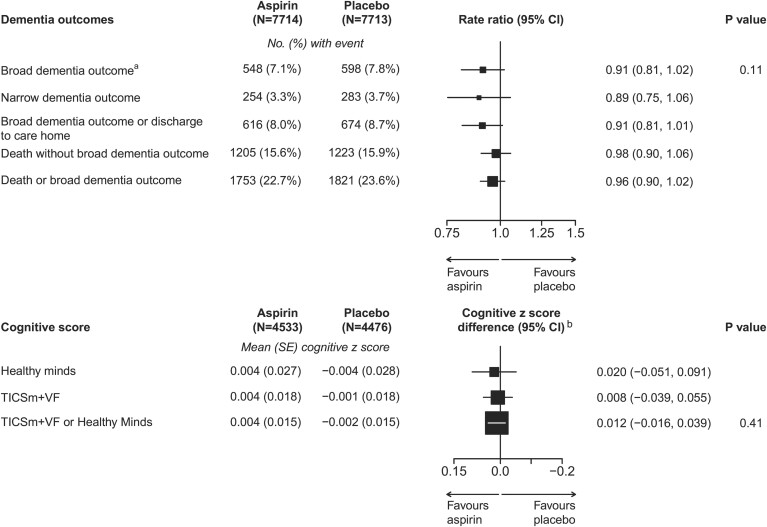
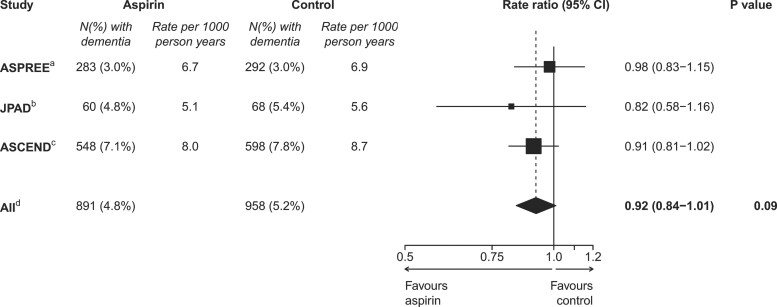
Aims: Aspirin is widely used in cardiovascular disease prevention but is also associated with an increased risk of bleeding. The net effect of aspirin on dementia and cognitive impairment is uncertain. Methods and results: In the ASCEND trial, 15 480 people from the UK with diabetes and no history of cardiovascular disease were randomized to aspirin 100 mg daily or matching placebo for a mean of 7.4 years. The 15 427 ASCEND participants with no recorded dementia prior to baseline were included in this cognitive study with a primary pre-specified outcome of ‘broad dementia’, comprising dementia, cognitive impairment, or confusion. This was ascertained through participant, carer, or general practitioner report or hospital admission diagnosis, by 31 March 2019 (∼2 years beyond the scheduled treatment period). The broad dementia outcome occurred in a similar percentage of participants in the aspirin group and placebo group: 548 participants (7.1%) vs. 598 (7.8%), rate ratio 0.91 [95% confidence interval (CI), 0.81–1.02]. Thus, the CI excluded proportional hazards of >2% and proportional benefits of >19%. Conclusion: Aspirin does not have a large proportional effect on the risk of dementia. Trials or meta-analyses with larger total numbers of incident dementia cases to increase statistical power are needed to assess whether any modest proportional 10–15% benefits of 5–7 years of aspirin use on dementia exist. Clinical Trial Registration: Current Controlled Trials number, ISRCTN60635500; ClinicalTrials.gov number: NCT00135226.
Overview
The claims and statistics of this paper haven’t been checked yet.
Free: it reads the open-access text and checks the first 5 claims that cite a source we can check. Create a free account to check every claim.
Integrity signals
Registry
Cites
Statistics
Figures
Verification
Claims the paper makes
The claims and statistics of this paper haven’t been checked yet.
Free: it reads the open-access text and checks the first 5 claims that cite a source we can check. Create a free account to check every claim.
Claims other papers make about this one
Each is checked against this paper’s own text: does it say what the citing paper says it does?
In the citing paper
“A 9.2-year follow-up analysis of the ASCEND trial excluded harm of ASA on incident dementia, with a trend towards a reduction (HR 0.89; 95% CI, 0.75-1.06)confirmed by a meta-analysis of three large primary prevention RCTs (HR 0.92; 95% CI, 0.84-1.01;P = 0.09).294”
From 2023 ESC guidelines for the management of cardiovascular disease in patients with diabetes. (2023) · cites this paper as [294]
Self-check
Percentages, sums and reported differences re-computed from the paper’s own numbers.
The self-check needs the paper’s full text.
Citations
Cites
Peto, R., Pike, M. C., Armitage, P., Breslow, N. E., Cox, D. R., Howard, S. V., Mantel, N., McPherson, K., Peto, J., & Smith, P. G. (1977) · British Journal of Cancer · doi:10.1038/bjc.1977.1 · Cited by 8,285
Gorelick, P. B., Scuteri, A., Black, S. E., DeCarli, C., Greenberg, S. M., Iadecola, C., Launer, L. J., Laurent, S., Lopez, O. L., Nyenhuis, D., et al. (2011) · Stroke · doi:10.1161/str.0b013e3182299496 · Cited by 3,811
Beta blockade during and after myocardial infarction: An overview of the randomized trials
Yusuf, S., Peto, R., Lewis, J., Collins, R., & Sleight, P. (1985) · Progress in Cardiovascular Diseases · doi:10.1016/s0033-0620(85)80003-7 · Cited by 3,205 · cited 1×
“Randomized comparisons The log-rank method was used to conduct intention-to-treat comparisons in time-to-event analyses of the first occurrence of each dementia outcome among participants in the aspirin and placebo arms.(20,21) The components of the TICSm and VF tests (TICSm+VF) were combined into a cognitive function…”
Self-citationSilent Brain Infarcts and the Risk of Dementia and Cognitive Decline
Vermeer, S. E., Prins, N. D., den Heijer, T., Hofman, A., Koudstaal, P. J., & Breteler, M. M. B. (2003) · New England Journal of Medicine · doi:10.1056/nejmoa022066 · Cited by 2,313 · cited 1×
“However, these observational analyses do not take account of any effects of aspirin mediated via subclinical events such as unreported TIAs, silent brain infarcts, microinfarcts, microbleeds, or cumulative small vessel disease.(5,27,28)”
Risk of dementia in diabetes mellitus: a systematic review
Biessels, G. J., Staekenborg, S., Brunner, E., Brayne, C., & Scheltens, P. (2006) · The Lancet Neurology · doi:10.1016/s1474-4422(05)70284-2 · Cited by 2,187 · cited 1×
“Diabetes increases the rate of cognitive decline and risk of dementia and so any effect of aspirin on dementia may be more marked and important among people with diabetes.(10,11) This report, among the 15 427 participants with diabetes but without prior reported dementia or cognitive impairment who had been randomized…”
Gilbert, T., Neuburger, J., Kraindler, J., Keeble, E., Smith, P., Ariti, C., Arora, S., Street, A., Parker, S., Roberts, H. C., et al. (2018) · The Lancet · doi:10.1016/s0140-6736(18)30668-8 · Cited by 1,504
Effects of aspirin for primary prevention in persons with diabetes mellitus
The ASCEND Study Collaborative Group (2018) · New England Journal of Medicine · doi:10.1056/nejmoa1804988 · Cited by 1,200 · cited 5×
“Participants and procedures CONSORT guidelines for reporting have been followed (see Supplementary material online, Table S1 and Methods S1).(12,13,15) Full details of the study procedures have been reported previously.”
InfluentialEffects of n−3 Fatty Acid Supplements in Diabetes Mellitus
The ASCEND Study Collaborative Group (2018) · New England Journal of Medicine · doi:10.1056/nejmoa1804989 · Cited by 698 · cited 2×
“Participants and procedures CONSORT guidelines for reporting have been followed (see Supplementary material online, Table S1 and Methods S1).(12,13,15) Full details of the study procedures have been reported previously.”
Effect of aspirin on disability-free survival in the healthy elderly
McNeil, J. J., Woods, R. L., Nelson, M. R., Reid, C. M., Kirpach, B., Wolfe, R., Storey, E., Shah, R. C., Lockery, J. E., Tonkin, A. M., et al. (2018) · New England Journal of Medicine · doi:10.1056/nejmoa1800722 · Cited by 590
Zheng, S. L., & Roddick, A. J. (2019) · JAMA · doi:10.1001/jama.2018.20578 · Cited by 577 · cited 1×
“In primary cardiovascular disease prevention, daily low-dose aspirin has been shown, in a recent meta-analysis of randomized trials, to cause an 11% proportional decrease in the risk of major vascular events (including a 19% reduction in ischaemic strokes) but a 43% proportional increase in the risk of serious bleedin…”
Cited by
2023 ESC guidelines for the management of cardiovascular disease in patients with diabetes.
Marx, N., Federici, M., Schütt, K., Müller-Wieland, D., Ajjan, R. A., Antunes, M. J., Christodorescu, R. M., Crawford, C., Di Angelantonio, E., Eliasson, B., et al. (2023) · European Heart Journal · doi:10.1093/eurheartj/ehad192 · Cited by 1,642
Dai, X., Fan, Y., & Zhao, X. (2025) · Signal Transduction and Targeted Therapy · doi:10.1038/s41392-025-02168-0 · Cited by 226
(2022) · European Journal of Cardio-Thoracic Surgery · doi:10.1093/ejcts/ezag193 · Cited by 184
Vascular cognitive impairment and dementia: Mechanisms, treatment, and future directions
Mok, V., Cai, Y., & Markus, H. S. (2024) · International Journal of Stroke · doi:10.1177/17474930241279888 · Cited by 135
“121 A recent meta-analysis on five RCTs (n = 46,804) showed that aspirin was not associated with reduced dementia, MCI, or cognitive decline.”
BackgroundLow-dose aspirin for the prevention of atherosclerotic cardiovascular disease
Patrono, C. (2024) · European Heart Journal · doi:10.1093/eurheartj/ehae324 · Cited by 120
“59 The absolute excess of major bleeds caused by low-dose aspirin in one of the most recent placebo-controlled RCTs for primary prevention, ASCEND, is of the same order of magnitude as the absolute reduction in major vascular events, 60 confirming a substantially uncertain balance of benefits and risks, 61 as previous…”
InfluentialColey, N., Giulioli, C., Aisen, P. S., Vellas, B., & Andrieu, S. (2022) · Ageing Research Reviews · doi:10.1016/j.arr.2022.101777 · Cited by 62
Acute Myocardial Infarction and Risk of Cognitive Impairment and Dementia: A Review
Thong, E. H., Quek, J. W. E., Loo, J. H., Yun, C.-Y., Teo, Y. N., Teo, Y. H., Leow, A. S., Li, T. Y., Sharma, V. K., Tan, B. Y., et al. (2023) · Biology · doi:10.3390/biology12081154 · Cited by 40
“The ASPREE (Aspirin in Reducing Events in the Elderly) and ASCEND (A Study of Cardiovascular Events in Diabetes) randomised controlled trials did not find that aspirin reduced rates of dementia, whilst also increasing risk of bleeding [187,188].”
BackgroundMehta, R. S., Kochar, B. D., Zhou, Z., Broder, J. C., Chung, P. E., Yang, K., Lockery, J. E., Fravel, M. A., Ryan, J. L., Mahady, S. E., et al. (2023) · Gastroenterology · doi:10.1053/j.gastro.2023.05.052 · Cited by 28
Amyloid-beta metabolism in age-related neurocardiovascular diseases
Aivalioti, E., Georgiopoulos, G. A., Tual‐Chalot, S., Bampatsias, D., Delialis, D., Sopova, K., Drakos, S. G., Stellos, K., & Stamatelopoulos, K. S. (2024) · European Heart Journal · doi:10.1093/eurheartj/ehae655 · Cited by 24
“191,192 There was no difference in cognitive outcomes with rivaroxaban treat-ment in patients with recent embolic stroke of undetermined source compared with aspirin.”
Kitt, K., Murphy, R., Clarke, A., Reddin, C., Ferguson, J. P., Bosch, J., Whiteley, W. N., Canavan, M. D., Judge, C. S., & O'Donnell, M. J. (2023) · Age and Ageing · doi:10.1093/ageing/afad197 · Cited by 14
Aspirin Therapy, Cognitive Impairment, and Dementia—A Review
Thong, E. H., Lee, E. C. Y., Yun, C.-Y., Li, T. Y., & Sia, C. (2023) · Future Pharmacology · doi:10.3390/futurepharmacol3010011 · Cited by 14
Residual lipidic risk beyond low-density lipoprotein cholesterol: new challenges and opportunities
Crea, F. (2023) · European Heart Journal · doi:10.1093/eurheartj/ehad671 · Cited by 14
Xie, C. X., Sun, L., Ingram, E., Simoni, A. D., Eldridge, S. M., Pinnock, H., & Relton, C. (2023) · Implementation Science · doi:10.1186/s13012-023-01300-4 · Cited by 13
“For example, a 9-year follow-up of the ASCEND trial evaluating the effect of aspirin on cardiovascular events in patients with diabetes is supported by linking electronic hospital episode data [41].”
BackgroundAn Updated Prioritization of Geroscience- Guided FDA-Approved Drugs Repurposed to Target Aging
Leone, M., & Barzilai, N. (2024) · Medical Research Archives · doi:10.18103/mra.v12i2.5138 · Cited by 12
Embedding routine health care data in clinical trials: with great power comes great responsibility
Handoko, M. L., de Man, F. S., Brugts, J. J., van der Meer, P., Rhodius‐Meester, H. F. M., Schaap, J., van de Kamp, H. J. R., Houterman, S., van Veghel, D., Uijl, A., et al. (2024) · Netherlands Heart Journal · doi:10.1007/s12471-023-01837-5 · Cited by 10
Ding, M., Wennberg, A. M. V., Engström, G., & Modig, K. (2024) · Alzheimer s & Dementia · doi:10.1002/alz.14389 · Cited by 8
“29 It may not be surprising that antiplatelets, especially at higher doses, may be associated with increased dementia risk because they can cause intracranial hemorrhage and cerebral microbleeds, which are associated with cognitive impairment.”
Fi, B., Sumin, A. N., Garganeeva, N. P., Ларева, Н. В., Петрова, М. М., Петрунько, О. В., Попонина, Т. М., Repin, A. N., & Собенников, В. С. (2024) · Complex Issues of Cardiovascular Diseases · doi:10.17802/2306-1278-2024-13-3s-222-253 · Cited by 9
Cardiovascular and dementia prevention: role of scores, diet, and rehabilitation
Crea, F. (2023) · European Heart Journal · doi:10.1093/eurheartj/ehad449 · Cited by 6
Dai, J., Wang, M., Zhang, H., Wang, Z., Xue, M., Sun, Y., Sun, Y., Dong, W., Sun, Z., & Liu, K. (2025) · Frontiers in Psychology · doi:10.3389/fpsyg.2025.1512175 · Cited by 6
“…various approaches to improve cognitive function in diabetic patients: pharmacological interventions (Cukierman-Yaffe et al., 2020; Li et al., 2021; Parish et al., 2022; Ryan et al., 2006), cognitive training (Silverman et al., 2023; Wong et al., 2020), and lifestyle interventions (Chen Y. N. et…”
Drapkina, O. M., Вавилова, Т. В., IuA, K., Kobalava, Z. D., Lomakin, N. V., Ai, M., Ройтман, Е. В., & Sychev, D. A. (2023) · CARDIOVASCULAR THERAPY AND PREVENTION · doi:10.15829/1728-8800-2022-3487 · Cited by 6
Xie, X., Kou, L., Chen, X., Yuan, P., Li, J., & Li, Y. (2023) · Neuroepidemiology · doi:10.1159/000533283 · Cited by 5
“It is even likely to cause dementia and MCI through intracranial haemorrhage and cerebral microbleeds for patients with chronic aspirin treatment.(19,22) Therefore, elucidating the actual effect of aspirin on dementia and MCI is particularly important to prevent or delay the progression of the disease.”
InfluentialAssociation between aspirin use and risk of dementia: a systematic review and meta-analysis
Tao, T., Feng, G., & Fang, Y. (2023) · European Geriatric Medicine · doi:10.1007/s41999-023-00877-9 · Cited by 5
The end of aspirin for dementia prevention in diabetes?
Kristensen, S. D., Olesen, K. K. W., & Mæng, M. (2022) · European Heart Journal · doi:10.1093/eurheartj/ehac211 · Cited by 5
Atrial Fibrillation and Cognitive Disorders
Barkhordarian, M., Montazerin, S. M., Tran, H. H.-V., Amin, T., Frishman, W. H., & Aronow, W. S. (2024) · Cardiology in Review · doi:10.1097/crd.0000000000000733 · Cited by 4
Sołtysik, B. K., Cieślak-Skubel, A., Gutowska, A., Costa, E. M., & Kostka, T. (2025) · BMC Geriatrics · doi:10.1186/s12877-025-06322-9 · Cited by 3
“Other studies present mixed findings, indicating that aspirin might lower AD risk in older patients with ischemic stroke [54], or finding no significant link between aspirin use and dementia risk [55, 56].”
Bronze, L. (2023) · Revista Portuguesa de Cardiologia · doi:10.1016/j.repc.2023.01.007 · Cited by 3
A fresh look to residual risk: triglycerides, apolipoprotein B, and sweeteners
Crea, F. (2024) · European Heart Journal · doi:10.1093/eurheartj/ehae444 · Cited by 2
Fi, B., Veltishchev, D. Y., Volel, B. A., Garganeeva, N. P., Kopylov, F. Y., Lareva, N. V., Medvedev, V. E., Mosolov, S. N., Petrova, M. M., Петрунько, О. В., et al. (2025) · Kardiologiia · doi:10.18087/cardio.2025.6.n2921 · Cited by 3
The year in cardiovascular medicine 2022: the top 10 papers in diabetes and metabolic disorders
Cosentino, F., Marx, N., & Verma, S. (2023) · European Heart Journal · doi:10.1093/eurheartj/ehac780 · Cited by 2
Díez, J. J., Gargallo-Fernández, M., Orna, J. A. G., Arnáiz, E. G., Moreno, I. H., Martínez-Couselo, S., González, M. M., Bretón, M. J. O., López, G. P., Gutiérrez, F. P., et al. (2025) · Endocrinología Diabetes y Nutrición (English ed ) · doi:10.1016/j.endien.2025.501687 · Cited by 1
The challenge of cardiovascular prevention in the elderly: importance of randomized clinical trials
Crea, F. (2022) · European Heart Journal · doi:10.1093/eurheartj/ehac273 · Cited by 1
Crea, F. (2024) · European Heart Journal · doi:10.1093/eurheartj/ehae285 · Cited by 1
Chamberlin, K. W., Li, C., Luo, Z., & Chen, H. (2023) · International Forum of Allergy & Rhinology · doi:10.1002/alr.23271
Patrono, C., & Rocca, B. (2023) · Oxford University Press eBooks · doi:10.1093/med/9780192869227.003.0005
Sun, M., Chen, W., Wu, S., & Zhang, J. (2024) · Journal of the American Medical Directors Association · doi:10.1016/j.jamda.2024.03.110
Cardiovascular disease and dementia: from association to causality?
Olesen, K. K. W., & Mæng, M. (2025) · European Journal of Preventive Cardiology · doi:10.1093/eurjpc/zwaf264
Díez, J. J., Gargallo-Fernández, M., Orna, J. A. G., Arnáiz, E. G., Moreno, I. H., Martínez-Couselo, S., González, M. M., Bretón, M. J. O., López, G. P., Gutiérrez, F. P., et al. (2025) · Endocrinología Diabetes y Nutrición · doi:10.1016/j.endinu.2025.501687
Zheng, H. T., Phyo, A. Z. Z., Wu, Z., Orchard, S. G., Owen, A. J., Espinoza, S. E., Sheets, K. M., Woods, R. L., & Ryan, J. L. (2026) · Age and Ageing · doi:10.1093/ageing/afag218
“However, large population-based randomised controlled trials have produced heterogeneous findings regarding low-dose aspirin’s effect on CVD [ 29– 31], cancer [ 32, 33], dementia [ 34, 35], diabetes [ 2, 36, 37], and mortality [ 38– 40].”
Li, F., Wang, Y., Wang, G., Chen, J., & Huang, S. (2026) · Aging Cell · doi:10.1111/acel.70658
“Aspirin decreased the rate of serious vascular event in diabetic patients, but caused major bleeding events and failed to improve cognitive function in ASCEND clinical trial (Bowman et al. 2018; Parish et al. 2022).”
Grabowska, M. E., Chen, R., Zhou, Y., Vaidya, A. U., Zhong, X., Guardo, C., Dickson, A. L., Babanejad, M., Yan, C., Xin, Y., et al. (2026) · Alzheimer s Research & Therapy · doi:10.1186/s13195-026-02215-0 · Cited by 1
Diabetes‐Associated Cognitive Impairment: Pathophysiology and Emerging Therapies
Corbali, O., Menon, P., Corbali, H. I., Jagannathan, R., & Levey, A. I. (2026) · Annals of Clinical and Translational Neurology · doi:10.1002/acn3.70487
“However, aspirin has not demonstrated a clear cognitive benefit in diabetic patients in the absence of established cardiovascular disease [222].”
Metadata
- Authors
- Parish, S., Mafham, M., Offer, A., Barton, J., Wallendszus, K., Stevens, W., Buck, G., Haynes, R., Collins, R., Bowman, L., & Armitage, J.
- Affiliations
- University of Oxford (GB)
- Corresponding author
- Parish, Sarah
- ORCID
- Venue
- European Heart Journal
- Publisher
- Oxford University Press (OUP)
- Published
- 2022-04-08
- Volume
- 43
- Issue
- 21
- Pages
- 2010-2019
- ISSN
- 0195-668X (ISSN-L)
- 1522-9645
- PMC
- PMC9242621
- OpenAlex
- W4226446021
- Semantic Scholar
- 59162c5f7c8a7f7b27c11447fc1f5b4f8b4757ef
- Cited by
- 40
- References
- 27
- Citations by year
- 2026: 3 · 2025: 7 · 2024: 11 · 2023: 15 · 2022: 4
- FWCI
- 6.44
- Type
- journal article
- Language
- en
- Open access
- hybrid
- doi.org
- Licence
- Locations
- European Heart Journal (publishedVersion, cc-by)
- PubMed Central (publishedVersion, cc-by)
- PubMed (publishedVersion)
- Funders
- British Heart Foundation (SP/03/002, SP/08/010/25939, SP/14/3/31114, PG/05/013/18296)
- Alzheimers Research UK
- UK Medical Research Council (MC-UU_00017/3, MC-UU_00017/5)
- Cancer Research UK
- Topics
- Health Sciences › Medicine › Cardiology and Cardiovascular Medicine › Antiplatelet Therapy and Cardiovascular Diseases
- Health Sciences › Medicine › Psychiatry and Mental health › Dementia and Cognitive Impairment Research
- Health Sciences › Medicine › Cardiology and Cardiovascular Medicine › Atrial Fibrillation Management and Outcomes
- Keywords
- aspirin, dementia, cognitive impairment, diabetes mellitus, ASCEND trial, cardiovascular disease prevention, bleeding risk, dementia risk
- MeSH terms
- Aspirin, Cognition, Dementia, Diabetes Mellitus, Humans, Cognitive Dysfunction
About these checks
Registry, retraction, Cites and statistics results are computed, not judged, with one exception: a printed reference that no index lists is read once by a model before it counts as a citation error. Claims are extracted by a model and kept only when their quote appears verbatim in the text; each cited source is then checked, with a model’s help, for whether it says what the claim relies on. Those verdicts can be wrong — read the claim’s quote and the cited source before relying on one.
Statistics and arithmetic are recomputed, not judged.
Confidence bands are shown only for fields calibrated on our annotated test set. None is calibrated yet, so no band is shown.
What counts as a claim ›How we measure confidence ›How we check this ›
Are you an author, or do you see a problem with this page? Request a review
Data sources
Bibliographic data: Semantic Scholar, OpenAlex, Crossref.
Contains information from the Semantic Scholar Academic Graph Datasets, made available under the ODC Attribution License (ODC-BY 1.0).
Semantic Scholar’s data is described in: Kinney, R., et al. (2023). The Semantic Scholar Open Data Platform. arXiv:2301.10140.
