

Effects of aspirin on dementia and cognitive function in diabetic patients: the ASCEND trial
Open accessThe DOI matches its Crossref record; 27 of the 27 references it cites were found in a registry or an index.
Abstract
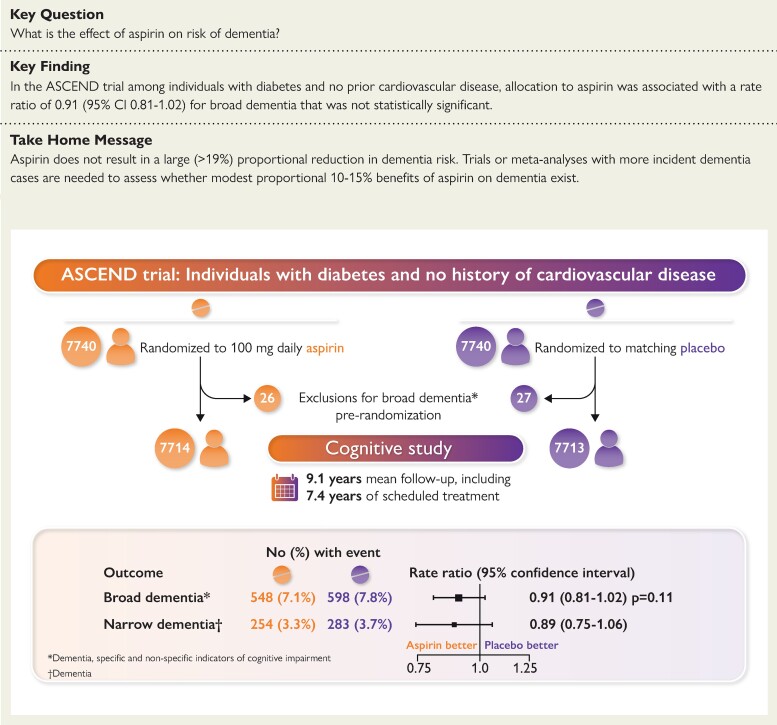
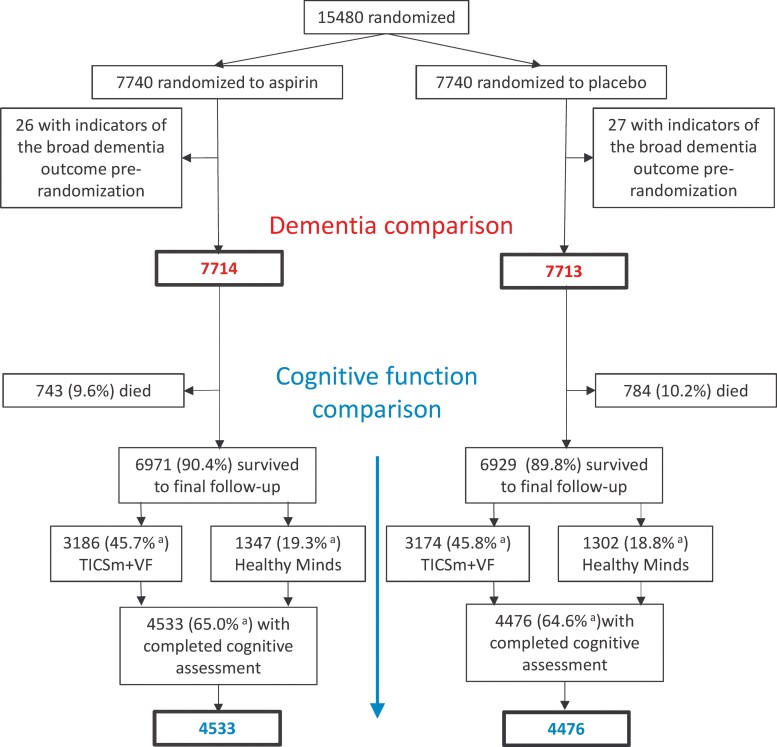
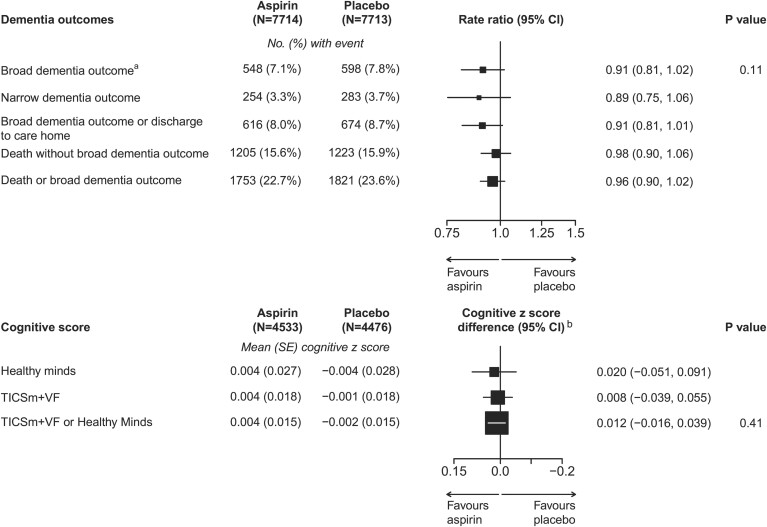
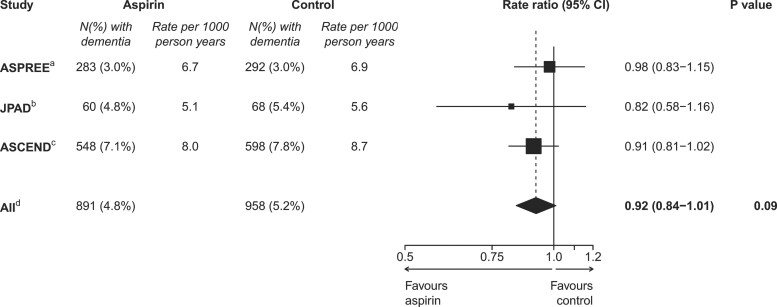
Aims: Aspirin is widely used in cardiovascular disease prevention but is also associated with an increased risk of bleeding. The net effect of aspirin on dementia and cognitive impairment is uncertain. Methods and results: In the ASCEND trial, 15 480 people from the UK with diabetes and no history of cardiovascular disease were randomized to aspirin 100 mg daily or matching placebo for a mean of 7.4 years. The 15 427 ASCEND participants with no recorded dementia prior to baseline were included in this cognitive study with a primary pre-specified outcome of ‘broad dementia’, comprising dementia, cognitive impairment, or confusion. This was ascertained through participant, carer, or general practitioner report or hospital admission diagnosis, by 31 March 2019 (∼2 years beyond the scheduled treatment period). The broad dementia outcome occurred in a similar percentage of participants in the aspirin group and placebo group: 548 participants (7.1%) vs. 598 (7.8%), rate ratio 0.91 [95% confidence interval (CI), 0.81–1.02]. Thus, the CI excluded proportional hazards of >2% and proportional benefits of >19%. Conclusion: Aspirin does not have a large proportional effect on the risk of dementia. Trials or meta-analyses with larger total numbers of incident dementia cases to increase statistical power are needed to assess whether any modest proportional 10–15% benefits of 5–7 years of aspirin use on dementia exist. Clinical Trial Registration: Current Controlled Trials number, ISRCTN60635500; ClinicalTrials.gov number: NCT00135226.
Overview
The claims and statistics of this paper haven’t been checked yet.
Free: it reads the open-access text and checks the first 5 claims that cite a source we can check. Create a free account to check every claim.
Integrity signals
Registry
Cites
Statistics
Figures
Verification
Claims the paper makes
The claims and statistics of this paper haven’t been checked yet.
Free: it reads the open-access text and checks the first 5 claims that cite a source we can check. Create a free account to check every claim.
Claims other papers make about this one
Each is checked against this paper’s own text: does it say what the citing paper says it does?
In the citing paper
“A 9.2-year follow-up analysis of the ASCEND trial excluded harm of ASA on incident dementia, with a trend towards a reduction (HR 0.89; 95% CI, 0.75-1.06)confirmed by a meta-analysis of three large primary prevention RCTs (HR 0.92; 95% CI, 0.84-1.01;P = 0.09).294”
From 2023 ESC guidelines for the management of cardiovascular disease in patients with diabetes. (2023) · cites this paper as [294]
Self-check
Percentages, sums and reported differences re-computed from the paper’s own numbers.
The self-check needs the paper’s full text.
Citations
Cites
Peto, R., Pike, M. C., Armitage, P., Breslow, N. E., Cox, D. R., Howard, S. V., Mantel, N., McPherson, K., Peto, J., & Smith, P. G. (1977) · British Journal of Cancer · doi:10.1038/bjc.1977.1 · Cited by 8,285
Gorelick, P. B., Scuteri, A., Black, S. E., DeCarli, C., Greenberg, S. M., Iadecola, C., Launer, L. J., Laurent, S., Lopez, O. L., Nyenhuis, D., et al. (2011) · Stroke · doi:10.1161/str.0b013e3182299496 · Cited by 3,811
Beta blockade during and after myocardial infarction: An overview of the randomized trials
Yusuf, S., Peto, R., Lewis, J., Collins, R., & Sleight, P. (1985) · Progress in Cardiovascular Diseases · doi:10.1016/s0033-0620(85)80003-7 · Cited by 3,205 · cited 1×
“Randomized comparisons The log-rank method was used to conduct intention-to-treat comparisons in time-to-event analyses of the first occurrence of each dementia outcome among participants in the aspirin and placebo arms.(20,21) The components of the TICSm and VF tests (TICSm+VF) were combined into a cognitive function…”
Self-citationSilent Brain Infarcts and the Risk of Dementia and Cognitive Decline
Vermeer, S. E., Prins, N. D., den Heijer, T., Hofman, A., Koudstaal, P. J., & Breteler, M. M. B. (2003) · New England Journal of Medicine · doi:10.1056/nejmoa022066 · Cited by 2,313 · cited 1×
“However, these observational analyses do not take account of any effects of aspirin mediated via subclinical events such as unreported TIAs, silent brain infarcts, microinfarcts, microbleeds, or cumulative small vessel disease.(5,27,28)”
Risk of dementia in diabetes mellitus: a systematic review
Biessels, G. J., Staekenborg, S., Brunner, E., Brayne, C., & Scheltens, P. (2006) · The Lancet Neurology · doi:10.1016/s1474-4422(05)70284-2 · Cited by 2,187 · cited 1×
“Diabetes increases the rate of cognitive decline and risk of dementia and so any effect of aspirin on dementia may be more marked and important among people with diabetes.(10,11) This report, among the 15 427 participants with diabetes but without prior reported dementia or cognitive impairment who had been randomized…”
Gilbert, T., Neuburger, J., Kraindler, J., Keeble, E., Smith, P., Ariti, C., Arora, S., Street, A., Parker, S., Roberts, H. C., et al. (2018) · The Lancet · doi:10.1016/s0140-6736(18)30668-8 · Cited by 1,504
Effects of aspirin for primary prevention in persons with diabetes mellitus
The ASCEND Study Collaborative Group (2018) · New England Journal of Medicine · doi:10.1056/nejmoa1804988 · Cited by 1,200 · cited 5×
“Participants and procedures CONSORT guidelines for reporting have been followed (see Supplementary material online, Table S1 and Methods S1).(12,13,15) Full details of the study procedures have been reported previously.”
InfluentialEffects of n−3 Fatty Acid Supplements in Diabetes Mellitus
The ASCEND Study Collaborative Group (2018) · New England Journal of Medicine · doi:10.1056/nejmoa1804989 · Cited by 698 · cited 2×
“Participants and procedures CONSORT guidelines for reporting have been followed (see Supplementary material online, Table S1 and Methods S1).(12,13,15) Full details of the study procedures have been reported previously.”
Effect of aspirin on disability-free survival in the healthy elderly
McNeil, J. J., Woods, R. L., Nelson, M. R., Reid, C. M., Kirpach, B., Wolfe, R., Storey, E., Shah, R. C., Lockery, J. E., Tonkin, A. M., et al. (2018) · New England Journal of Medicine · doi:10.1056/nejmoa1800722 · Cited by 590
Zheng, S. L., & Roddick, A. J. (2019) · JAMA · doi:10.1001/jama.2018.20578 · Cited by 577 · cited 1×
“In primary cardiovascular disease prevention, daily low-dose aspirin has been shown, in a recent meta-analysis of randomized trials, to cause an 11% proportional decrease in the risk of major vascular events (including a 19% reduction in ischaemic strokes) but a 43% proportional increase in the risk of serious bleedin…”
Utility of TICS‐M for the assessment of cognitive function in older adults
de Jager, C. A., Budge, M. M., & Clarke, R. (2003) · International Journal of Geriatric Psychiatry · doi:10.1002/gps.830 · Cited by 456 · cited 1×
“The TICSm is a 13-item test covering 4 component domains: orientation, memory (registration, recent memory, and delayed recall), attention/calculation, and language (semantic memory, comprehension, and repetition).(17) In the VF test, participants are asked to name in 1 min as many different animals as they can and th…”
Cerebral microbleeds are associated with worse cognitive function: The Rotterdam Scan Study
Poels, M. M. F., Ikram, M. A., van der Lugt, A., Hofman, A., Niessen, W. J., Krestin, G. P., Breteler, M. M. B., & Vernooij, M. W. (2012) · Neurology · doi:10.1212/wnl.0b013e3182452928 · Cited by 378
Incidence of Cerebral Microbleeds in the General Population: The Rotterdam Scan Study
Poels, M. M. F., Ikram, M. A., van der Lugt, A., Hofman, A., Krestin, G. P., Breteler, M. M. B., & Vernooij, M. W. (2011) · Stroke · doi:10.1161/strokeaha.110.607184 · Cited by 294
Prevalence and knowledge of transient ischemic attack among US adults
Johnston, S. C., Fayad, P. B., Gorelick, P. B., Hanley, D. F., Shwayder, P., van Husen, D., & Weiskopf, T. (2003) · Neurology · doi:10.1212/01.wnl.0000063309.41867.0f · Cited by 255 · cited 1×
“However, these observational analyses do not take account of any effects of aspirin mediated via subclinical events such as unreported TIAs, silent brain infarcts, microinfarcts, microbleeds, or cumulative small vessel disease.(5,27,28)”
Emerging Concepts in Vascular Dementia: A Review
Bir, S. C., Khan, M. W., Javalkar, V., Toledo, E. G., & Kelley, R. E. (2021) · Journal of Stroke and Cerebrovascular Diseases · doi:10.1016/j.jstrokecerebrovasdis.2021.105864 · Cited by 223 · cited 1×
“However, these observational analyses do not take account of any effects of aspirin mediated via subclinical events such as unreported TIAs, silent brain infarcts, microinfarcts, microbleeds, or cumulative small vessel disease.(5,27,28)”
Feinkohl, I., Price, J. F., Strachan, M. W. J., & Frier, B. M. (2015) · Alzheimer's Research & Therapy · doi:10.1186/s13195-015-0130-5 · Cited by 182 · cited 1×
“Diabetes increases the rate of cognitive decline and risk of dementia and so any effect of aspirin on dementia may be more marked and important among people with diabetes.(10,11) This report, among the 15 427 participants with diabetes but without prior reported dementia or cognitive impairment who had been randomized…”
Randomized placebo-controlled trial of the effects of aspirin on dementia and cognitive decline
Ryan, J., Storey, E., Murray, A. M., Woods, R. L., Wolfe, R., Reid, C. M., Nelson, M. R., Chong, T. T. J., Williamson, J. D., Ward, S. A., et al. (2020) · Neurology · doi:10.1212/wnl.0000000000009277 · Cited by 182
Sommerlad, A., Perera, G., Singh‐Manoux, A., Lewis, G., Stewart, R., & Livingston, G. (2018) · Alzheimer's & Dementia · doi:10.1016/j.jalz.2018.02.012 · Cited by 150 · cited 1×
“Furthermore, 20% of dementia cases may be missed when hospital admissions data alone are used to ascertain dementia cases.(29,30) Linkage to primary care would have provided amore complete and timely capture of dementia but was not available with national coverage at the time of this study.”
Bowman, L., Mafham, M., Stevens, W., Haynes, R., Aung, T., Chen, F., Buck, G., Collins, R., & Armitage, J. (2018) · American Heart Journal · doi:10.1016/j.ahj.2017.12.006 · Cited by 106 · cited 2×
“Participants and procedures CONSORT guidelines for reporting have been followed (see Supplementary material online, Table S1 and Methods S1).(12,13,15) Full details of the study procedures have been reported previously.”
Self-citationLow dose aspirin and cognitive function in the women's health study cognitive cohort
Kang, J. H., Cook, N., Manson, J., Buring, J. E., & Grodstein, F. (2007) · BMJ · doi:10.1136/bmj.39166.597836.be · Cited by 103
Price, J. F., Stewart, M. C., Deary, I. J., Murray, G. D., Sandercock, P., Butcher, I., Fowkes, F. G. R., & Trialists, O. B. O. T. A. (2008) · BMJ · doi:10.1136/bmj.a1198 · Cited by 96
Brown, A., Kirichek, O., Balkwill, A., Reeves, G., Beral, V., Sudlow, C., Gallacher, J., & Green, J. (2016) · Emerging Themes in Epidemiology · doi:10.1186/s12982-016-0053-z · Cited by 78 · cited 1×
“Furthermore, 20% of dementia cases may be missed when hospital admissions data alone are used to ascertain dementia cases.(29,30) Linkage to primary care would have provided amore complete and timely capture of dementia but was not available with national coverage at the time of this study.”
Low‐Dose Aspirin Use and Cognitive Function in Older Age: A Systematic Review and Meta‐analysis
Veronese, N., Stubbs, B., Maggi, S., Thompson, T., Schofield, P., Muller, C., Tseng, P., Lin, P., Carvalho, A. F., & Solmi, M. (2017) · Journal of the American Geriatrics Society · doi:10.1111/jgs.14883 · Cited by 52 · cited 1×
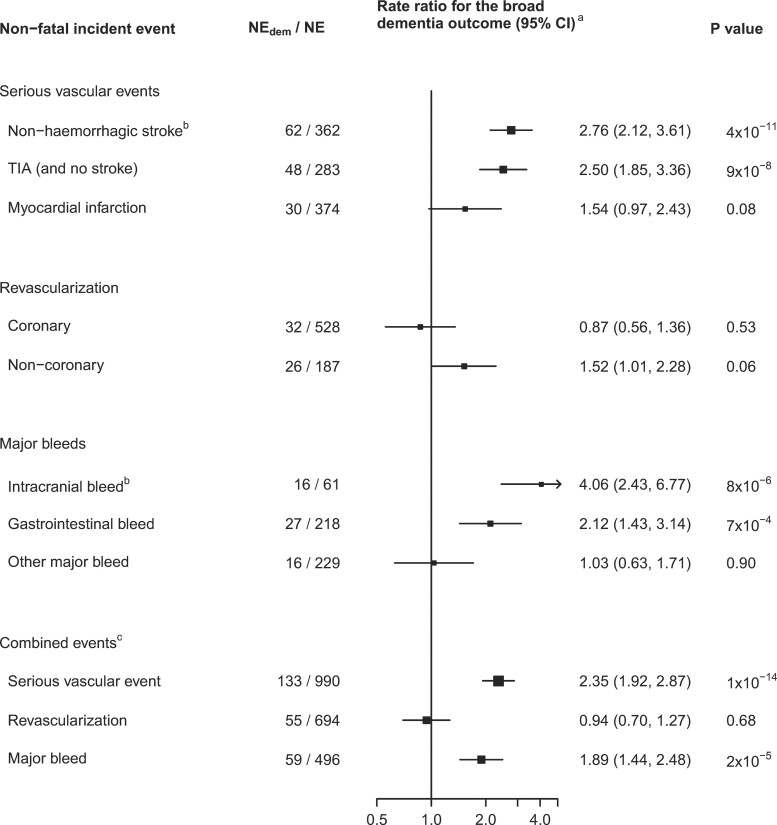
“A meta-analysis in 2017 of the effects of aspirin on cognitive function in a broader range of randomized trials also found no evidence for any effect.(9) In observational analyses within the trial population, having a serious vascular event or a major bleed were each associated with about a two-fold increase in propor…”
A Meta-Analysis of Association between Cerebral Microbleeds and Cognitive Impairment
Liu, X. (2014) · Medical Science Monitor · doi:10.12659/msm.891004 · Cited by 51
The development and initial validation of a telephone‐administered cognitive test battery (TACT)
Prince, M. J., Macdonald, A. M., Sham, P. C., Richards, M., Quraishi, S., & Horn, I. (1999) · International Journal of Methods in Psychiatric Research · doi:10.1002/mpr.56 · Cited by 31
Matsumoto, C., Ogawa, H., Saito, Y., Okada, S., Soejima, H., Sakuma, M., Masuda, I., Nakayama, M., Doi, N., Jinnouchi, H., et al. (2019) · Diabetes Care · doi:10.2337/dc19-1188 · Cited by 21
Offer, A., Arnold, M., Clarke, R., Bennett, D., Bowman, L., Bulbulia, R., Haynes, R., Li, J., Hopewell, J. C., Landray, M., et al. (2019) · JAMA Network Open · doi:10.1001/jamanetworkopen.2019.0223 · Cited by 20
Self-citation
Cited by
2023 ESC guidelines for the management of cardiovascular disease in patients with diabetes.
Marx, N., Federici, M., Schütt, K., Müller-Wieland, D., Ajjan, R. A., Antunes, M. J., Christodorescu, R. M., Crawford, C., Di Angelantonio, E., Eliasson, B., et al. (2023) · European Heart Journal · doi:10.1093/eurheartj/ehad192 · Cited by 1,642
Dai, X., Fan, Y., & Zhao, X. (2025) · Signal Transduction and Targeted Therapy · doi:10.1038/s41392-025-02168-0 · Cited by 226
(2022) · European Journal of Cardio-Thoracic Surgery · doi:10.1093/ejcts/ezag193 · Cited by 184
Vascular cognitive impairment and dementia: Mechanisms, treatment, and future directions
Mok, V., Cai, Y., & Markus, H. S. (2024) · International Journal of Stroke · doi:10.1177/17474930241279888 · Cited by 135
“121 A recent meta-analysis on five RCTs (n = 46,804) showed that aspirin was not associated with reduced dementia, MCI, or cognitive decline.”
BackgroundLow-dose aspirin for the prevention of atherosclerotic cardiovascular disease
Patrono, C. (2024) · European Heart Journal · doi:10.1093/eurheartj/ehae324 · Cited by 120
“59 The absolute excess of major bleeds caused by low-dose aspirin in one of the most recent placebo-controlled RCTs for primary prevention, ASCEND, is of the same order of magnitude as the absolute reduction in major vascular events, 60 confirming a substantially uncertain balance of benefits and risks, 61 as previous…”
Influential
Metadata
- Authors
- Parish, S., Mafham, M., Offer, A., Barton, J., Wallendszus, K., Stevens, W., Buck, G., Haynes, R., Collins, R., Bowman, L., & Armitage, J.
- Affiliations
- University of Oxford (GB)
- Corresponding author
- Parish, Sarah
- ORCID
- Venue
- European Heart Journal
- Publisher
- Oxford University Press (OUP)
- Published
- 2022-04-08
- Volume
- 43
- Issue
- 21
- Pages
- 2010-2019
- ISSN
- 0195-668X (ISSN-L)
- 1522-9645
- PMC
- PMC9242621
- OpenAlex
- W4226446021
- Semantic Scholar
- 59162c5f7c8a7f7b27c11447fc1f5b4f8b4757ef
- Cited by
- 40
- References
- 27
- Citations by year
- 2026: 3 · 2025: 7 · 2024: 11 · 2023: 15 · 2022: 4
- FWCI
- 6.44
- Type
- journal article
- Language
- en
- Open access
- hybrid
- doi.org
- Licence
- Locations
- European Heart Journal (publishedVersion, cc-by)
- PubMed Central (publishedVersion, cc-by)
- PubMed (publishedVersion)
- Funders
- British Heart Foundation (SP/03/002, SP/08/010/25939, SP/14/3/31114, PG/05/013/18296)
- Alzheimers Research UK
- UK Medical Research Council (MC-UU_00017/3, MC-UU_00017/5)
- Cancer Research UK
- Topics
- Health Sciences › Medicine › Cardiology and Cardiovascular Medicine › Antiplatelet Therapy and Cardiovascular Diseases
- Health Sciences › Medicine › Psychiatry and Mental health › Dementia and Cognitive Impairment Research
- Health Sciences › Medicine › Cardiology and Cardiovascular Medicine › Atrial Fibrillation Management and Outcomes
- Keywords
- aspirin, dementia, cognitive impairment, diabetes mellitus, ASCEND trial, cardiovascular disease prevention, bleeding risk, dementia risk
- MeSH terms
- Aspirin, Cognition, Dementia, Diabetes Mellitus, Humans, Cognitive Dysfunction
About these checks
Registry, retraction, Cites and statistics results are computed, not judged, with one exception: a printed reference that no index lists is read once by a model before it counts as a citation error. Claims are extracted by a model and kept only when their quote appears verbatim in the text; each cited source is then checked, with a model’s help, for whether it says what the claim relies on. Those verdicts can be wrong — read the claim’s quote and the cited source before relying on one.
Statistics and arithmetic are recomputed, not judged.
Confidence bands are shown only for fields calibrated on our annotated test set. None is calibrated yet, so no band is shown.
What counts as a claim ›How we measure confidence ›How we check this ›
Are you an author, or do you see a problem with this page? Request a review
Data sources
Bibliographic data: Semantic Scholar, OpenAlex, Crossref.
Contains information from the Semantic Scholar Academic Graph Datasets, made available under the ODC Attribution License (ODC-BY 1.0).
Semantic Scholar’s data is described in: Kinney, R., et al. (2023). The Semantic Scholar Open Data Platform. arXiv:2301.10140.
