

Vigorous physical activity, incident heart disease, and cancer: how little is enough?
Open accessThe DOI matches its Crossref record; 49 of the 50 references it cites were found in a registry or an index.
Abstract
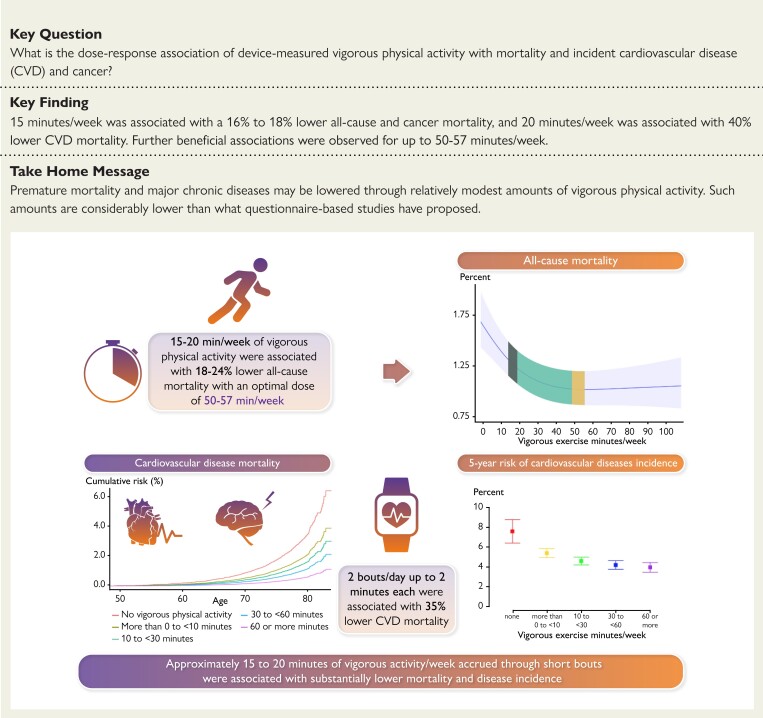
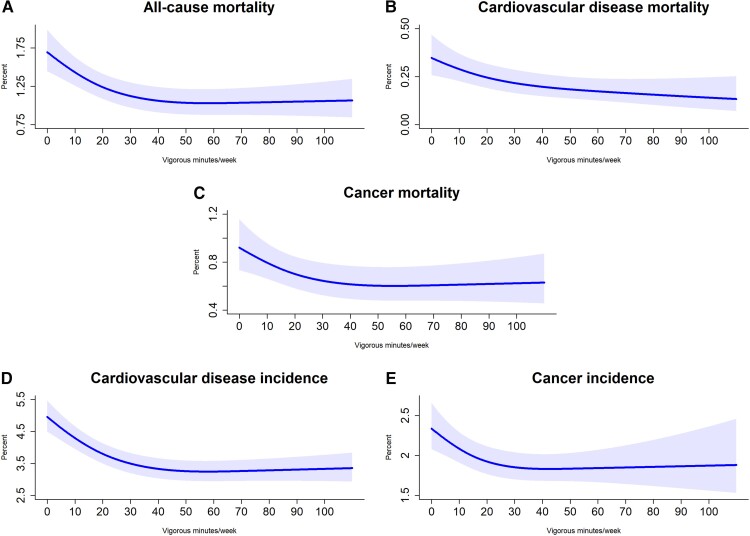
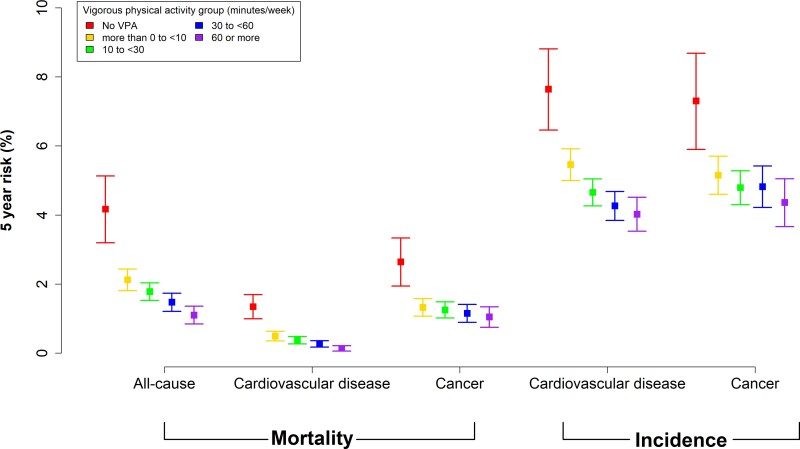
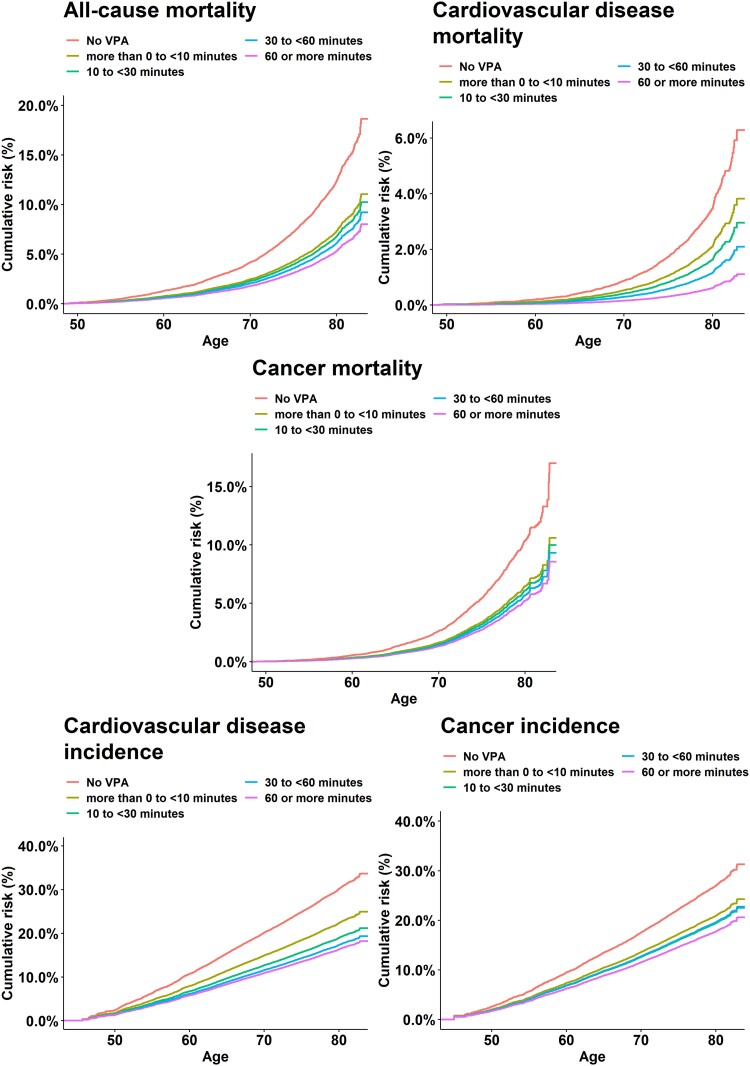
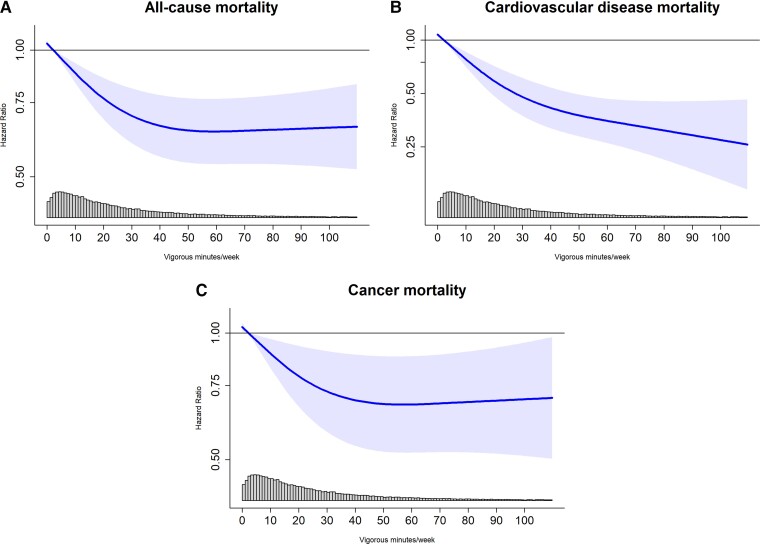
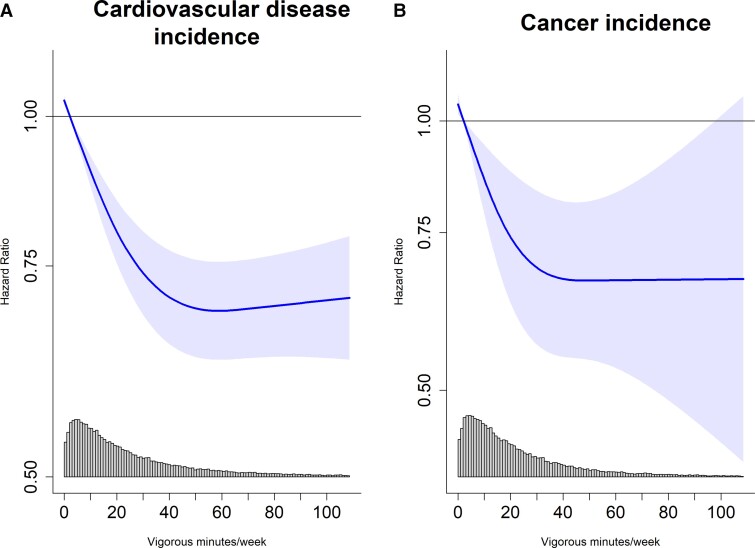
Aims: Vigorous physical activity (VPA) is a time-efficient way to achieve recommended physical activity levels. There is a very limited understanding of the minimal and optimal amounts of vigorous physical activity in relation to mortality and disease incidence. Methods and results: A prospective study in 71 893 adults [median age (IQR): 62.5 years (55.3, 67.7); 55.9% female] from the UK Biobank cohort with wrist-worn accelerometry. VPA volume (min/week) and frequency of short VPA bouts (≤2 min) were measured. The dose–response associations of VPA volume and frequency with mortality [all-cause, cardiovascular disease (CVD) and cancer], and CVD and cancer incidence were examined after excluding events occurring in the first year. During a mean post-landmark point follow-up of 5.9 years (SD ± 0.8), the adjusted 5-year absolute mortality risk was 4.17% (95% confidence interval: 3.19%, 5.13%) for no VPA, 2.12% (1.81%, 2.44%) for >0 to <10 min, 1.78% (1.53%, 2.03%) for 10 to <30 min, 1.47% (1.21%, 1.73%) for 30 to <60 min, and 1.10% (0.84%, 1.36%) for ≥60 min. The ‘optimal dose’ (nadir of the curve) was 53.6 (50.5, 56.7) min/week [hazard ratio (HR): 0.64 (0.54, 0.77)] relative to the 5th percentile reference (2.2 min/week). There was an inverse linear dose-response association of VPA with CVD mortality. The ‘minimal’ volume dose (50% of the optimal dose) was ∼15 (14.3, 16.3) min/week for all-cause [HR: 0.82 (0.75, 0.89)] and cancer [HR: 0.84 (0.74, 0.95)] mortality, and 19.2 (16.5, 21.9) min/week [HR: 0.60 (0.50, 0.72)] for CVD mortality. These associations were consistent for CVD and cancer incidence. There was an inverse linear association between VPA frequency and CVD mortality. 27 (24, 30) bouts/week was associated with the lowest all-cause mortality [HR: 0.73 (0.62, 0.87)]. Conclusion: VPA of 15–20 min/week were associated with a 16–40% lower mortality HR, with further decreases up to 50–57 min/week. These findings suggest reduced health risks may be attainable through relatively modest amounts of VPA accrued in short bouts across the week.
Overview
The claims and statistics of this paper haven’t been checked yet.
Free: it reads the open-access text and checks the first 5 claims that cite a source we can check. Create a free account to check every claim.
Integrity signals
Registry
Cites
Statistics
Figures
Verification
Claims the paper makes
The claims and statistics of this paper haven’t been checked yet.
Free: it reads the open-access text and checks the first 5 claims that cite a source we can check. Create a free account to check every claim.
Claims other papers make about this one
Each is checked against this paper’s own text: does it say what the citing paper says it does?
The source backs part of the claim, not all of it — or backs it for a different population, condition or comparison.
In the citing paper
“Physical activity intensity was classified with a validated accelerometer-based two-level Random Forest machine learning activity scheme that first classifies activity type and then intensity.5,6,17”
From Brief bouts of device-measured intermittent lifestyle physical activity and its association with major adverse cardiovascular events and mortality in people who do not exercise: A prospective cohort study (2023) · cites this paper as [6]
Experimental — accuracy not yet measuredThe source backs part of the claim, not all of it — or backs it for a different population, condition or comparison.
In the citing paper
“These findings may in part explain why moderate and vigorous physical activity beyond a specific amount of time does not offer additional reduction in mortality risk, thereby exhibiting a nadir in the dose–response relationship.32,33”
From Lifelong endurance exercise and its relation with coronary atherosclerosis (2023) · cites this paper as [32]
Experimental — accuracy not yet measuredIn the citing paper
“We calculated E-values to estimate the plausibility of bias from unmeasured confounding30,55.”
From Association of wearable device-measured vigorous intermittent lifestyle physical activity with mortality (2022) · cites this paper as [30]
In the citing paper
“Data obtained from wearable devices show that as few as four short bouts of vigorous physical activity totalling approximately 2-3 min per day are associated with a substantially lower risk of all-cause cardiovascular disease and cancer mortality.5,6”
In the citing paper
“a ∼40% decrease in CVD mortality risk was nevertheless found at only 15-20 min/week. 6”
From Exercise benefits in cardiovascular diseases: From mechanisms to clinical implementation (2023) · cites this paper as [6]
1 more claim about this paper
Create a free account to see every claim other papers make about this one.
Self-check
Percentages, sums and reported differences re-computed from the paper’s own numbers.
The self-check needs the paper’s full text.
Citations
Cites
World Health Organization 2020 guidelines on physical activity and sedentary behaviour
Bull, F. C., Al-Ansari, S. S., Biddle, S., Borodulin, K., Buman, M. P., Cardon, G., Carty, C., Chaput, J.-P., Chastin, S., Chou, R., et al. (2020) · British Journal of Sports Medicine · doi:10.1136/bjsports-2020-102955 · Cited by 11,657
Self-citationThe Physical Activity Guidelines for Americans
Piercy, K. L., Troiano, R. P., Ballard, R. M., Carlson, S. A., Fulton, J. E., Galuska, D. A., George, S. M., & Olson, R. D. (2018) · JAMA · doi:10.1001/jama.2018.14854 · Cited by 9,755
A Modified Poisson Regression Approach to Prospective Studies with Binary Data
Zou, G. (2004) · American Journal of Epidemiology · doi:10.1093/aje/kwh090 · Cited by 9,615
2021 ESC Guidelines on cardiovascular disease prevention in clinical practice
Visseren, F. L. J., Mach, F., Smulders, Y. M., Carballo, D., Koskinas, K. C., Bäck, M., Benetos, A., Biffi, A., Boavida, J.-M., Capodanno, D., et al. (2021) · European Heart Journal · doi:10.1093/eurheartj/ehab484 · Cited by 6,485
Dose-Response Analysis Using R
Ritz, C., Baty, F., Streibig, J. C., & Gerhard, D. (2015) · PLOS ONE · doi:10.1371/journal.pone.0146021 · Cited by 3,658
Correlates of adults??? participation in physical activity: review and update
TROST, S. G., OWEN, N., BAUMAN, A. E., SALLIS, J. F., & BROWN, W. (2002) · Medicine & Science in Sports & Exercise · doi:10.1097/00005768-200212000-00020 · Cited by 3,040
Zamorano, J. L., Lancellotti, P., Rodriguez Muñoz, D., Aboyans, V., Asteggiano, R., Galderisi, M., Habib, G., Lenihan, D. J., Lip, G. Y. H., Lyon, A. R., et al. (2016) · European Heart Journal · doi:10.1093/eurheartj/ehw211 · Cited by 2,544
Conducting accelerometer-based activity assessments in field-based research
TROST, S. G., MCIVER, K. L., & PATE, R. R. (2005) · Medicine & Science in Sports & Exercise · doi:10.1249/01.mss.0000185657.86065.98 · Cited by 2,033 · cited 1×
“This is consistent with a study(43) in overweight postmenopausal women that reported significant interval effects for estimated VPA time over 7 days for 10 s intervals compared with 1 min intervals and a review in children that found VPA volume decreased 4-fold when measurement intervals increased from 5 s to 1 min us…”
Dose‐response analyses using restricted cubic spline functions in public health research
Desquilbet, L., & Mariotti, F. (2010) · Statistics in Medicine · doi:10.1002/sim.3841 · Cited by 1,980
Wen, C. P., Wai, J. P. M., Tsai, M. K., Yang, Y. C., Cheng, T. Y. D., Lee, M.-C., Chan, H. T., Tsao, C. K., Tsai, S. P., & Wu, X. (2011) · The Lancet · doi:10.1016/s0140-6736(11)60749-6 · Cited by 1,908 · cited 2×
“Questionnaire-based studies have suggested 60–70 min/week of VPA behaviour can attenuate mortality risk by 30%.(10,11,32,33) Our device-based findings suggest that a minimal dose of 20 min/week of actual VPA provides similar levels of lower mortality risk.”
Background
Research works printed but not linked: 1
- Harrell Jr FE. RMS: Regression Modeling Strategies. R package version 4.0-0: Vanderbilt University; 2017.
Cited by
Stamatakis, E., Ahmadi, M. N., Gill, J. M. R., Thøgersen-Ntoumani, C., Gibala, M. J., Doherty, A., & Hamer, M. (2022) · Nature Medicine · doi:10.1038/s41591-022-02100-x · Cited by 336
“We calculated E-values to estimate the plausibility of bias from unmeasured confounding 30,55 .”
Self-citationHealthy Lifestyle and Cancer Risk: Modifiable Risk Factors to Prevent Cancer
Marino, P., Mininni, M., Deiana, G., Marino, G., Divella, R., Bochicchio, I., Giuliano, A., Lapadula, S., Lettini, A. R., & Sanseverino, F. (2024) · Nutrients · doi:10.3390/nu16060800 · Cited by 240
“A further study highlighted that intense physical exercise for at least 15-20 min per week was linked to a reduction in mortality risk of 16–40%, with a more marked reduction for physical activity of 50–57 min per week [87].”
BackgroundExercise benefits in cardiovascular diseases: From mechanisms to clinical implementation
Valenzuela, P. L., Ruilope, L. M., Santos-Lozano, A., Wilhelm, M., Kränkel, N., Fiuza-Luces, C., & Lucia, A. (2023) · European Heart Journal · doi:10.1093/eurheartj/ehad170 · Cited by 237
Ahmadi, M. N., Hamer, M., Gill, J. M. R., Murphy, M., Sanders, J. P., Doherty, A., & Stamatakis, E. (2023) · The Lancet Public Health · doi:10.1016/s2468-2667(23)00183-4 · Cited by 172
“5,6 Public health guidelines 7 emphasise the health value of short bouts of intermittent physical activity, including non-exercise activities, to lower mortality and cardiovascular disease risk.”
BackgroundSelf-citationStamatakis, E., Ahmadi, M. N., Friedenreich, C. M., Blodgett, J. M., Koster, A., Holtermann, A., Atkin, A., Rangul, V., Sherar, L. B., Teixeira-Pinto, A., et al. (2023) · JAMA Oncology · doi:10.1001/jamaoncol.2023.1830 · Cited by 163
Self-citationThe effect of physical exercise on anticancer immunity
Fiuza‐Luces, C., Valenzuela, P. L., Gálvez, B. G., Ramírez, M. R., López‐Soto, A., Simpson, R. J., & Lucía, A. (2023) · Nature reviews. Immunology · doi:10.1038/s41577-023-00943-0 · Cited by 181
“In turn, regular physical activity is associated with lower cancer incidence 6–8 , lower cancer recurrence 9 and reduced mortality 8–11 .”
Lifelong endurance exercise and its relation with coronary atherosclerosis
De Bosscher, R., Dausin, C., Claus, P., Bogaert, J., Dymarkowski, S., Goetschalckx, K., Ghekiere, O., Van De Heyning, C. M., Van Herck, P., Paelinck, B., et al. (2023) · European Heart Journal · doi:10.1093/eurheartj/ehad152 · Cited by 162
“These findings may in part explain why moderate and vigorous physical activity beyond a specific amount of time does not offer additional reduction in mortality risk, thereby exhibiting a nadir in the dose–response relationship.(32,33) One of the key strengths of our study was the comprehensive nature of the participa…”
BackgroundBlodgett, J. M., Ahmadi, M. N., Atkin, A. J., CHASTIN, S. F. M., Chan, H., Suorsa, K., Bakker, E. A., Hettiarcachchi, P., Johansson, P. J., Sherar, L. B., et al. (2023) · European Heart Journal · doi:10.1093/eurheartj/ehad717 · Cited by 172
“49,60,64 This was consistent with MVPA-stratified re-sults, where reallocation plots indicated greater theoretical benefits in those with lower levels of MVPA at baseline.”
Self-citationRelationship of Daily Step Counts to All-Cause Mortality and Cardiovascular Events
Stens, N. A., Bakker, E. A., Mañas, A., Buffart, L. M., Ortega, F. B., Lee, D.-C., Thompson, P. D., Thijssen, D. H. J., & Eijsvogels, T. M. H. (2023) · Journal of the American College of Cardiology · doi:10.1016/j.jacc.2023.07.029 · Cited by 345
Dose–response associations, physical activity intensity and mortality risk: A narrative review
Ekelund, U., Sánchez-Lastra, M. A., Dalene, K. E., & Tarp, J. (2023) · Journal of sport and health science/Journal of Sport and Health Science · doi:10.1016/j.jshs.2023.09.006 · Cited by 115
“For example, in analyses using data from the UK Biobank ( n = 71,893), Ahmadi et al. 36 suggested that as little as 15 (cid:1) 20 min of VPA per week was associated with an up to 40% lower risk of death from all-cause mortality, CVD, and cancer.”
MethodYin, M., Li, H., Bai, M., Liu, H., Chen, Z., Deng, J., Deng, S., Chuan, M., Vollaard, N. B. J., Little, J. P., et al. (2023) · Applied Physiology, Nutrition, and Metabolism · doi:10.1139/apnm-2023-0329 · Cited by 93
Ahmadi, M. N., Rezende, L. F. M., Ferrari, G., Cruz, B. D. P., Lee, I.-M. M., & Stamatakis, E. (2024) · British Journal of Sports Medicine · doi:10.1136/bjsports-2023-107221 · Cited by 80
“We examined the dose response for the optimal (nadir of the curve) and minimal (defined as 50% of the optimal dose 5 27 ; ((1−opimal dose HR)/2) number of steps for high and low sedentary time.”
BackgroundSelf-citationSabag, A., Ahmadi, M. N., François, M. E., Postnova, S., Cistulli, P. A., Fontana, L., & Stamatakis, E. (2024) · Diabetes Care · doi:10.2337/dc23-2448 · Cited by 65
Self-citationBiomarkers of aging: from molecules and surrogates to physiology and function
Furrer, R., & Handschin, C. (2025) · Physiological Reviews · doi:10.1152/physrev.00045.2024 · Cited by 74
Thøgersen‐Ntoumani, C., Kritz, M., Grunseit, A. C., Chau, J. Y., Ahmadi, M., Holtermann, A., Koster, A., Tudor-Locke, C. E., Johnson, N. A., Sherrington, C., et al. (2023) · International Journal of Behavioral Nutrition and Physical Activity · doi:10.1186/s12966-023-01480-8 · Cited by 63
“Finally, recent developments in the measurement of habitual physical activity and VILPA via accelerometry and new algorithms [12, 55] open up new possibilities for research on VILPA.”
MethodSelf-citationShreves, A. H., Small, S. R., Walmsley, R., Chan, S., Saint‐Maurice, P. F., Moore, S. C., Papier, K., Gaitskell, K. L., Travis, R. C., Matthews, C. E., et al. (2025) · British Journal of Sports Medicine · doi:10.1136/bjsports-2024-109360 · Cited by 59
“34 35 We observed inverse linear dose–response associations for LIPA and MVPA with cancer after adjusting for other daily behaviours, whereas SB was not uniquely associated with cancer.”
Dose Response of Incidental Physical Activity Against Cardiovascular Events and Mortality
Stamatakis, E., Biswas, R. K., Koemel, N. A., Sabag, A., Pulsford, R. M., Atkin, A. J., Stathi, A., Cheng, S. W. M., Thøgersen‐Ntoumani, C., Blodgett, J. M., et al. (2025) · Circulation · doi:10.1161/circulationaha.124.072253 · Cited by 60
“8,10,18,19 We excluded participants with insufficient valid wear days, those who had missing covariate data, and participants who reported an inability to walk.”
Self-citationSánchez-Lastra, M. A., Ding, D., Cruz, B. D. P., Dalene, K. E., Pérez, C. A., Ekelund, U., & Tarp, J. (2023) · British Journal of Sports Medicine · doi:10.1136/bjsports-2023-107252 · Cited by 47
Ahmadi, M. N., Blodgett, J. M., Atkin, A. J., Chan, H., Cruz, B. D. P., Suorsa, K., Bakker, E. A., Pulsford, R. M., Mielke, G. I., Johansson, P. J., et al. (2024) · Diabetologia · doi:10.1007/s00125-024-06090-y · Cited by 46
“The associations and daily durations that we observed provide evidence that is consistent with large-scale prospective studies examining hard clinical endpoints such as CVD mortality and incidence [9, 10, 58, 59].”
BackgroundResultSelf-citationStamatakis, E., Ahmadi, M. N., Biswas, R. K., Cruz, B. D. P., Thøgersen‐Ntoumani, C., MURPHY, M. H., Sabag, A., Lear, S. A., Gill, J. M., Chow, C. K., et al. (2024) · British Journal of Sports Medicine · doi:10.1136/bjsports-2024-108484 · Cited by 54
Self-citationLi, Z., Cheng, S., Guo, B., Ding, L., Liang, Y., Shen, Y., Li, J., Hu, Y., Long, T., Guo, X., et al. (2024) · European Heart Journal · doi:10.1093/eurheartj/ehae406 · Cited by 41
“28 The reference point was set as 0 min/week, equivalent to the 3rd percentile of the accelerometer-derived MVPA volume distribution and the 14th percentile of the questionnaire-based MVPA volume distribution.”
Baldanzi, G., Sayols-Baixeras, S., Ekblom‐Bak, E., Ekblom, Ö. B., Dekkers, K. F., Hammar, U., Nguyen, D. T., Ahmad, S., Ericson, U., Arvidsson, D., et al. (2024) · EBioMedicine · doi:10.1016/j.ebiom.2024.104989 · Cited by 41
“SED: time in sedentary behaviour; MPA: time in moderate-intensity physical activity; VPA: time in vigorous-intensity physical activity. mortality by 18% 59 ; therefore, effects of VPA could be expected even with little time spent in these activities.”
BackgroundFeng, J., Zhang, Q., Chen, B., Chen, J., Wang, W., Hu, Y., Yu, J., & Huang, H. (2024) · Frontiers in Endocrinology · doi:10.3389/fendo.2024.1360998 · Cited by 48
Blodgett, J. M., Ahmadi, M. N., Atkin, A. J., Pulsford, R. M., Rangul, V., CHASTIN, S. F. M., Chan, H., Suorsa, K., Bakker, E. A., Gupta, N., et al. (2024) · Circulation · doi:10.1161/circulationaha.124.069820 · Cited by 49
“14,15 For example, prospective data from the UK Biobank suggest that 15.0 (95% CI, 14.3, 15.7) and 56.5 (95% CI, 55.4, 55.6) minutes per week of vigorous PA represent minimal and optimal doses to yield a decrease in cardiovascular disease (CVD) risk.”
InfluentialSelf-citationKoemel, N. A., Ahmadi, M. N., Biswas, R. K., Koster, A., Atkin, A. J., Sabag, A., & Stamatakis, E. (2024) · European Journal of Preventive Cardiology · doi:10.1093/eurjpc/zwae316 · Cited by 42
Self-citationXiang, B., Zhou, Y., Wu, X., & Zhou, X. (2023) · Hypertension · doi:10.1161/hypertensionaha.123.21663 · Cited by 34
“22,23 Based on the evidence above, low levels of VPA may be more beneficial, and the optimal VPA amount was probably lower than the guideline’s recommendation.”
Rezende, L. F. M., Ahmadi, M. N., Ferrari, G., Cruz, B. D. P., Lee, I.-M. M., Ekelund, U., & Stamatakis, E. (2024) · International Journal of Behavioral Nutrition and Physical Activity · doi:10.1186/s12966-024-01615-5 · Cited by 44
“[5, 6, 28, 29] The classifier categorized movement in 10 s windows into 1 of 4 movement classes: sedentary, standing utilitarian movements (e.g., ironing a shirt, washing dishes), walking activities (e.g. gardening, active commuting, mopping floors), running/high energetic activities (e.g. active…”
BackgroundResultInfluentialSelf-citationBiswas, R. K., Ahmadi, M. N., Bauman, A. E., Milton, K. E., Koemel, N. A., & Stamatakis, E. (2025) · Nature Communications · doi:10.1038/s41467-025-63475-2 · Cited by 41
“Supplementary Data 1 shows participant characteristics by levels of VPA duration.”
InfluentialSelf-citationNew principles, the benefits, and practices for fostering a physically active lifestyle
Rozanski, A. (2023) · Progress in Cardiovascular Diseases · doi:10.1016/j.pcad.2023.04.002 · Cited by 34
Stamatakis, E., Koemel, N. A., Biswas, R. K., Ahmadi, M. N., Allman-Farinelli, M. A., Trost, S. G., Eroglu, E. I., Cruz, B. D. P., Bin, Y. S., Postnova, S., et al. (2025) · BMC Medicine · doi:10.1186/s12916-024-03833-x · Cited by 31
Self-citationDevice-measured weekend catch-up sleep, mortality, and cardiovascular disease incidence in adults
Chaput, J., Biswas, R. K., Ahmadi, M. N., Cistulli, P. A., Rajaratnam, S. M. W., Hamer, M., & Stamatakis, E. (2024) · SLEEP · doi:10.1093/sleep/zsae135 · Cited by 30
Self-citationAhn, H., Choi, E., Rhee, T., Choi, J., Lee, K., Kwon, S., Lee, S., Oh, S., & Lip, G. Y. H. (2024) · British Journal of Sports Medicine · doi:10.1136/bjsports-2023-106862 · Cited by 28
“23 36 Of note, we suggested a specific amount of MVPA (108 min/week) for the apparent benefit on all-cause mortality and there was no upper threshold limiting the benefit.”
BackgroundGuo, L., Wang, W., Shi, J., Zheng, X., Hua, Y., & Lu, C. (2023) · JMIR Public Health and Surveillance · doi:10.2196/45677 · Cited by 24
“Sixth, our analyses did not consider physical activity as a covariate because it was not assessed using a standardized scale and may be an intermediate variable between social isolation and CVD [57-61].”
BackgroundPhysical Activity for Health—Every Minute Counts
Katzmarzyk, P. T., & Jakicic, J. M. (2023) · JAMA · doi:10.1001/jama.2023.11014 · Cited by 26
Self-citationLiang, Y. Y., He, Y., Huang, P., Feng, H., Li, H., Ai, S., Du, J., Xue, H., Liu, Y., Zhang, J., et al. (2025) · Journal of Sport and Health Science · doi:10.1016/j.jshs.2024.100973 · Cited by 25
“35 We also used an isotemporal substitution model to assess the effect on composite events, macrovascular events, micro-vascular events, and HF of substituting SB with either 10 min/ day or 30 min/day dedicated to MVPA or LPA, and we investigated the effect of substituting LPA with 10 min/day or 30…”
Unhealthy lifestyle factors and the risk of colorectal cancer: a Mendelian randomization study
Li, X., Chang, Z., Wang, J., Ding, K., Pan, S., Hu, H., & Tang, Q. (2024) · Scientific Reports · doi:10.1038/s41598-024-64813-y · Cited by 32
Zaccardi, F., Rowlands, A. V., Dempsey, P. C., Razieh, C., Henson, J. J., Goldney, J., Maylor, B. D., Bhattacharjee, A., Chudasama, Y., Edwardson, C. L., et al. (2024) · Journal of sport and health science/Journal of Sport and Health Science · doi:10.1016/j.jshs.2024.100970 · Cited by 30
Non-invasive vagus nerve stimulation and exercise capacity in healthy volunteers: a randomized trial
Ackland, G. L., Patel, A., Miller, S., del Arroyo, A. G., Thirugnanasambanthar, J., Ravindran, J. I., Schroth, J., Boot, J. R., Caton, L., Mein, C. A., et al. (2025) · European Heart Journal · doi:10.1093/eurheartj/ehaf037 · Cited by 24
“41 Notably, significant time commitment and effort are required to achieve increases in exercise capacity through conventional training regimes.”
Ahmadi, M. N., Coenen, P., Straker, L. M., & Stamatakis, E. (2024) · International Journal of Epidemiology · doi:10.1093/ije/dyae136 · Cited by 27
“…admission and primary care linkage, as well as participants who were underweight (body mass index 18.5 kg/m 2 ), had missing covariate data or had an event within the first 12 months following the accelerome-try measurements (Supplementary Figure S2, available as Supplementary data at IJE…”
MethodInfluentialSelf-citationDaley, A., Griffin, R. A., Sanders, J. P., Gokal, K., Ives, N. J., Skrybant, M., Parretti, H. M., Edwardson, C. L., Biddle, S., Jolly, K. B., et al. (2025) · International Journal of Behavioral Medicine · doi:10.1007/s12529-025-10352-3 · Cited by 23
“Analogous concepts to Snacktivity™ include ‘snackercis-ing’ and vigorous/moderate intermittent lifestyle physical activity (VILPA and MV-ILPA) [23–25], which have also been supported by the public [23].”
Cao, Z., Min, J., Hou, Y., Si, K., Wang, M., & Xu, C. (2024) · European Journal of Preventive Cardiology · doi:10.1093/eurjpc/zwae248 · Cited by 26
Tarp, J., Dalene, K. E., Fagerland, M. W., Steene-Johannesen, J., Hansen, B. H., Anderssen, S. A., Hagströmer, M., Dohrn, I., Dempsey, P. C., Wijndaele, K., et al. (2024) · American Journal of Preventive Medicine · doi:10.1016/j.amepre.2024.07.022 · Cited by 25
Self-citation2023 All-Russian screening for hypertension: results
Rotar, O. P., Ilyanova, I. N., Boyarinova, M. A., Moguchaya, E. V., Tolkunova, K., Dyachkov, V. A., Rubanenko, O. A., Рубаненко, А. О., Евгеньевна, Г. О., Gubareva, E. Y., et al. (2024) · Russian Journal of Cardiology · doi:10.15829/1560-4071-2024-5931 · Cited by 23
Bian, W., Biswas, R. K., Ahmadi, M. N., Bin, Y. S., Postnova, S., Phillips, A. J. K., Koemel, N. A., Chaput, J., Rajaratnam, S. M. W., Cistulli, P. A., et al. (2025) · BMC Public Health · doi:10.1186/s12889-025-21649-z · Cited by 17
“We selected covariates based on previous literature [8, 25, 27, 31].”
Self-citationPhysical exercise, inflammation, and hypertension: how to improve cardiovascular prevention
Crea, F. (2022) · European Heart Journal · doi:10.1093/eurheartj/ehac695 · Cited by 15
From London buses to activity trackers: A reflection of 70 years of physical activity research
Ding, D., & Ekelund, U. (2024) · Journal of sport and health science/Journal of Sport and Health Science · doi:10.1016/j.jshs.2024.06.001 · Cited by 16
“6 Still, most evidence on device-measured physical activity and health outcomes is derived from a single study, the UK Biobank study.”
BackgroundWei, J., Shen, M., Li, S., Xiao, Y., Luo, D., Ferrari, G., Lee, D. H., Rezende, L. F. M., Gill, J. M. R., Ahmadi, M. N., et al. (2026) · European Heart Journal · doi:10.1093/eurheartj/ehag168 · Cited by 16
“While meeting recommended activity volumes remains important, prioritizing intensity—even in very smaller amounts 10,12 —can provide substantial population health benefits and reduce healthcare burden across multiple chronic diseases.”
Self-citationBrown, N. I., Henderson, J., Stern, M., & Carson, T. L. (2024) · American Journal of Lifestyle Medicine · doi:10.1177/15598276241253160 · Cited by 13
“There was variability among the studies with regard to the devices used to measure and assess PA. ,25,26 Heart rate monitors (i.e., Polar and pulse oximeters) were used to assess intensity of activity in two studies.”
Arigo, D., Schumacher, L. M., Baga, K., & Mogle, J. A. (2024) · Annals of Behavioral Medicine · doi:10.1093/abm/kaae058 · Cited by 13
Cruz, B. D. P., Ahmadi, M. N., Sabag, A., Saint‐Maurice, P. F., Lee, I.-M. M., & Stamatakis, E. (2025) · Annals of Internal Medicine · doi:10.7326/annals-25-01547 · Cited by 14
Self-citationYin, M., Li, H., Zhang, B., & Li, Y. (2024) · Sports Medicine · doi:10.1007/s40279-024-02080-7 · Cited by 13
Rey-López, J. P., Lee, D. H., Ferrari, G., Giovannucci, E. L., & Rezende, L. F. M. (2023) · International Journal of Environmental Research and Public Health · doi:10.3390/ijerph20116027 · Cited by 11
“Although new epidemiological studies are incorporating wrist accelerometers (Axivity AX3, Axivity, Newcastle, UK) to classify vigorous, moderate, or light intensity activity using a machine learning scheme [36], the validity (compared with body cameras) of this accelerometer (accuracy, weighted kappa, and intraclass c…”
BackgroundSeino, S., Abe, T., Nofuji, Y., Hata, T., Shinkai, S., Kitamura, A., & Fujiwara, Y. (2024) · Frontiers in Public Health · doi:10.3389/fpubh.2024.1357618 · Cited by 9
“Similar to the results of these studies (5–8, 22, 34, 35), the only dose–response analysis with FD as an outcome showed that a higher MVPA, regardless of about of 10 or ≥ 10 min, significantly reduced the risk of FD (10).”
BackgroundResultKoemel, N. A., Biswas, R. K., Simpson, S. J., Rezende, L. F. M., Wang, T., Bauman, A. E., Raubenheimer, D., Allman-Farinelli, M. A., Cistulli, P. A., Ahmadi, M. N., et al. (2026) · European Journal of Preventive Cardiology · doi:10.1093/eurjpc/zwag141 · Cited by 12
Self-citationGe, C., Long, B., Lu, Q., Jiang, Z., & He, Y. (2024) · Scientific Reports · doi:10.1038/s41598-024-58197-2 · Cited by 10
“Two recent analyses indicate reductions in mortality across the general populace could potentially be attained with VPA quantities less than those presently advised, yet neither study delved into the impact of prolonged VPA exposure 18,19 .”
BackgroundGonzález-Torres, C., Farias, T. Y., de la Rosa, F. J. B., & Lizana, P. A. (2023) · Healthcare · doi:10.3390/healthcare11071020 · Cited by 12
“Together with this point, recent reports state that at least 20 min per day of moderate to intense PA for 5 days per week can lead to a 16 to 40% reduction in the risk of suffering cardiovascular diseases among adults [54].”
BackgroundProdromal Parkinson’s disease and subsequent risk of Parkinson’s disease and mortality
Chen, X., Li, Y., Shen, Y., Schwarzschild, M. A., & Gao, X. (2025) · npj Parkinson s Disease · doi:10.1038/s41531-024-00863-3 · Cited by 9
He, Y., Wang, J., Zhang, W., Chen, X., Wu, Q., Li, Y., Ou, Y., Liu, Y., Feng, H., Zhang, J., et al. (2025) · Journal of Cachexia Sarcopenia and Muscle · doi:10.1002/jcsm.13726 · Cited by 11
Koemel, N. A., Ahmadi, M. N., Biswas, R. K., Thøgersen‐Ntoumani, C., Teixeira-Pinto, A. M., Chow, C. K., Harezlak, J., & Stamatakis, E. (2026) · International Journal of Behavioral Nutrition and Physical Activity · doi:10.1186/s12966-026-01876-2 · Cited by 20
“…an extensive range of additional analyses to test the robustness of our results to the risk of reverse causation, confounding, and other biases, including the exclusion of prevalent diseases, frail or poor health individuals, and adjustments for cardiometabolic health markers [8, 9, 21, 23, 56].”
InfluentialSelf-citationGruber, W., Stehling, F., Blosch, C., Dillenhoefer, S., Olivier, M., Brinkmann, F., Koerner‐Rettberg, C., Sutharsan, S., Mellies, U., Taube, C., et al. (2024) · Frontiers in Sports and Active Living · doi:10.3389/fspor.2024.1284878 · Cited by 13
Eroglu, E. I., Ahmadi, M. N., Biswas, R. K., Ding, D., Rezende, L. F. M., Lee, I.-M. M., Giovannucci, E. L., & Stamatakis, E. (2024) · Cancer Epidemiology Biomarkers & Prevention · doi:10.1158/1055-9965.epi-23-1185 · Cited by 8
Self-citationWearable device-measured physical activity and incident cardiovascular disease in cancer survivors
Jiang, C., Li, Z., Guo, B., Chen, L., Zhu, L., Liang, Y., Shen, Y., Long, T., Zhai, M., Shi, J., et al. (2025) · British Journal of Sports Medicine · doi:10.1136/bjsports-2024-108734 · Cited by 8
“The dose-response analysis of MVPA duration with outcomes was conducted using restricted cubic splines, with knots positioned at the 10th, 50th and 90th percentiles according to the previous literature, 20–22 and the reference group set to zero minutes per week.”
Ahmadi, M. N., Sabag, A., Biswas, R. K., Cruz, B. D. P., Chow, C., O’Sullivan, J., Eijsvogels, T. M. H., & Stamatakis, E. (2026) · British Journal of Sports Medicine · doi:10.1136/bjsports-2025-109894 · Cited by 14
“Our findings, alongside recent device-based studies focused on short bouts of high intensity activities, 23 24 58 59 provide valuable insights for potentially re-evaluating treatment options for patients with hypertension.”
Self-citationWei, J., Fan, L., Fan, X., Zhu, X., Chen, L., & Wang, T. (2024) · Diabetes & Metabolic Syndrome Clinical Research & Reviews · doi:10.1016/j.dsx.2024.102975 · Cited by 10
Sun, J., Qiao, Y., Li, F., Lin, R., Yu, Y., Wang, M., Zhao, M., & Xi, B. (2025) · Journal of sport and health science/Journal of Sport and Health Science · doi:10.1016/j.jshs.2025.101099 · Cited by 8
“14,59,60”
Prospective Study of Lung Function with Prodromal, Clinical Parkinson’s Disease, and Mortality
Chen, X., Zhang, Z., Tong, L., Wang, H., Xu, X., Sun, L., Li, Y., & Gao, X. (2024) · Journal of Parkinson s Disease · doi:10.3233/jpd-240097 · Cited by 7
Device-measured vigorous intermittent lifestyle physical activity and major cardiovascular eventsPreprint
Stamatakis, E. A., Ahmadi, M. N., Biswas, R. K., Cruz, B. D. P., Thøgersen‐Ntoumani, C., MURPHY, M. H., Sabag, A., Lear, S. A., Gill, J. M. R., Chow, C. K., et al. (2023) · medRxiv · doi:10.1101/2023.10.23.23297430 · Cited by 6
Self-citationAhmadi, M. N., Mundell, H. D., Sutherland, G. T., Hamer, M., Sillanpää, E., Blodgett, J. M., Cruz, B. D. P., & Stamatakis, E. (2025) · Journal of sport and health science/Journal of Sport and Health Science · doi:10.1016/j.jshs.2025.101055 · Cited by 8
Self-citationPang, B., Moullin, J. C., Thompson, C., Thøgersen‐Ntoumani, C., Stamatakis, E., Ahmadi, M. N., & McVeigh, J. A. (2025) · Age and Ageing · doi:10.1093/ageing/afaf244 · Cited by 10
Self-citationLiu, J.-C., Yang, R., Feng, Z.-F., Liu, B.-Q., Yu, L., Chen, Y.-H., Li, D.-R., Zheng, W.-R., Liu, N., Gao, S., et al. (2025) · JNCI Journal of the National Cancer Institute · doi:10.1093/jnci/djaf365 · Cited by 6
Device-captured incidental physical activity, sedentary behaviour and all-cause mortality risk
Koemel, N. A., Ahmadi, M. N., Biswas, R. K., Sabag, A., Cheng, S. W. M., Bauman, A. E., & Stamatakis, E. (2025) · Journal of Epidemiology & Community Health · doi:10.1136/jech-2024-222394 · Cited by 6
Self-citationHow Could Sensor-Based Measurement of Physical Activity Be Used in Cardiovascular Healthcare?
Hughes, M. E., & Chico, T. (2023) · Sensors · doi:10.3390/s23198154 · Cited by 5
“Daily physical activity measurement using a smartwatch found that higher levels of activity are associated with a lower risk of CVD [12,31,32], and the ability of wearables to detect very short bursts of vigorous activity (such as going upstairs) reveals that even in people who perform low levels…”
Crea, F. (2023) · European Heart Journal · doi:10.1093/eurheartj/ehad181 · Cited by 5
The Significant Role of Physical Activity and Exercise in Health and Metabolic Diseases
Dimitriadis, G., Chryssanthopοulos, C., Philippou, Α., & Koutsilieris, M. (2025) · Physiologia · doi:10.3390/physiologia5040057 · Cited by 12
“In a prospective study involving 71,893 participants from the UK Biobank, Ahmadi et al. [147] examined the dose–response relationship between short, intermittent bursts of vigorous exercise (measured by accelerometry) and mortality and CVD incidence after a 6-year follow-up.”
Eroglu, E. I., Ahmadi, M. N., Sainsbury, A., Leitzmann, M. F., Khunti, K., Yates, T. E., & Stamatakis, E. (2024) · American Journal of Epidemiology · doi:10.1093/aje/kwae180 · Cited by 6
“40 Because of these differences between self-reported and device-measured MVPA, both methodologies may still be necessary to fully understand the effects of PA on health outcomes.”
Self-citationMatthews, C. E., Saint‐Maurice, P. F., Freeman, J. R., Hayes, H. A., Shreves, A. H., Doherty, A., Hyde, E. T., Ylarregui, K., Jones, R. R., & Keadle, S. K. (2025) · Journal for the Measurement of Physical Behaviour · doi:10.1123/jmpb.2024-0051 · Cited by 7
Socioeconomic status, individual behaviors and risk for Lymphomas: a Mendelian randomization study
Tan, Z., Wang, Y., Xing, X., Shen, Z., & Sang, W. (2024) · Journal of Cancer · doi:10.7150/jca.96413 · Cited by 5
“Ahmadi et al. [35] observed that engaging in vigorous activity for approximately 15-20 minutes weekly correlated with lower mortality, cardio-vascular disease, and cancer incidence.”
BackgroundChen, X., Zhou, M., Wang, J., Liu, M., Zhu, C., Wu, C., Dong, M., Liu, Y., Ai, S., Feng, H., et al. (2024) · General Hospital Psychiatry · doi:10.1016/j.genhosppsych.2024.08.005 · Cited by 4
Sánchez-Lastra, M. A., Strain, T., Ding, D., Dalene, K. E., Cruz, B. D. P., Ekelund, U., & Tarp, J. (2024) · Journal of sport and health science/Journal of Sport and Health Science · doi:10.1016/j.jshs.2024.101018 · Cited by 7
“8,9,32,33 Potential explanations include that higher intensity activity could have more positive effects on the shared mechanisms between adiposity and cancer development (e.g., insulin resistance, chronic inflam-mation, or endogenous sex hormones).”
Wei, L., Ahmadi, M. N., Hamer, M., Blodgett, J. M., Small, S., Trost, S. G., & Stamatakis, E. (2024) · Journal of science and medicine in sport · doi:10.1016/j.jsams.2024.05.002 · Cited by 4
Self-citationIyanda, A., Ade-Oni, A., & Omiyefa, S. (2024) · Journal of Prevention & Intervention in the Community · doi:10.1080/10852352.2024.2415162 · Cited by 4
“Even though vigorous and moderate PA have been extensively studied for their social and health benefits (Ahmadi et al., 2022; Liu et al., 2020; Rennie et al., 2003a, 2003b; Richardson et al., 2013; Thompson, 1996; Valero-Elizondo et al., 2016; Wannamethee & Shaper, 2001), the evidence regarding…”
The hare and the tortoise: physical activity intensity and scientific translation
Matthews, C. E., & Saint‐Maurice, P. F. (2022) · European Heart Journal · doi:10.1093/eurheartj/ehac626 · Cited by 4
Cruz‐Montecinos, C., Calatayud, J., Andersen, L. L., López‐Bueno, R., Peñailillo, L., Torres‐Castro, R., Diefenthaeler, F., & Núñez‐Cortés, R. (2025) · The Gerontologist · doi:10.1093/geront/gnaf228 · Cited by 3
The surprisingly big health benefits of just a little exercise
Lenharo, M. (2026) · Nature · doi:10.1038/d41586-026-00237-0 · Cited by 3
Wang, H., Chang, Y., Wang, H., Diao, K., & Sun, S. (2026) · Nutrition & Metabolism · doi:10.1186/s12986-026-01120-5 · Cited by 6
Zhang, Q., Huang, K., Shi, X., Jin, H., Hou, D., Dong, Z., Chen, Z., Gong, J., Bai, T., Xu, Z., et al. (2024) · Scientia Sinica Vitae · doi:10.1360/ssv-2024-0307 · Cited by 4
Huang, Y., Yang, X., Wang, Q., Abula, A., Dong, Y., & Li, W. (2025) · Frontiers in Aging Neuroscience · doi:10.3389/fnagi.2025.1532884 · Cited by 3
Chen, X., Wang, P., Luo, W., Wang, J., Sun, L., Li, Y., Zhang, F. F., & Gao, X. (2025) · Journal of Neurology Neurosurgery & Psychiatry · doi:10.1136/jnnp-2025-336045 · Cited by 7
Chen, H., Liu, P., Deng, Y., Cai, H., Liang, P., & Jiang, X. (2025) · Life · doi:10.3390/life15081245 · Cited by 4
“Furthermore, vigorous physical activity (VPA) performed in 10 min bouts, two–three times per week, improves glucose and lipid metabolism while enhancing life expectancy [25].”
Ianê-Siva, C., Gonçalves, R., Otoni, C. D. O., Dias, K. C. R., Stein, R., Rezende, B. A., & Rodrigues‐Machado, M. D. G. (2023) · Scientific Reports · doi:10.1038/s41598-023-43303-7 · Cited by 3
Exercise and tumor proteome: insights from a neuroblastoma model
Plaza‐Florido, A., Gálvez, B. G., López, J. A., Santos‐Lozano, A., Zazo, S., Rincón‐Castanedo, C., Martín-Ruiz, A., Lumbreras, J., Terron-Camero, L. C., López‐Soto, A., et al. (2024) · Physiological Genomics · doi:10.1152/physiolgenomics.00064.2024 · Cited by 4
Duque, A. L. M. D. S., Paula, D. P., de Paula, D., Molina, M. D. C. B., Giatii, L., Schmidt, M. I., da Fonseca, M. D. J. M., & Griep, R. H. (2025) · Arquivos Brasileiros de Cardiologia · doi:10.36660/abc.20250091i · Cited by 3
Ahmadi, M. N., Sabag, A., Biswas, R. K., Cruz, B. D. P., Chow, C. K., & Stamatakis, E. (2024) · medRxiv · doi:10.1101/2024.07.31.24311326 · Cited by 4
Self-citationKoemel, N. A., Ahmadi, M. N., Biswas, R. K., Thøgersen‐Ntoumani, C., Teixeira-Pinto, A. M., Chow, C. K., Harezlak, J., & Stamatakis, E. A. (2025) · medRxiv · doi:10.1101/2025.08.05.25333017 · Cited by 3
Self-citationLi, C., Zhang, Z., Zhu, J., Du, C., Jin, H., Jiang, B., Sun, Z., Lou, J., & Liu, X. (2025) · Aging Clinical and Experimental Research · doi:10.1007/s40520-025-03093-6 · Cited by 2
The Use of Wearable Cameras to Capture Physical Activity and Sedentary Behavior: A Scoping Review
Martinez, J., Steinbrink, G. M., Kate, R. J., Cho, C. C., Swartz, A. M., & Strath, S. J. (2025) · Journal for the Measurement of Physical Behaviour · doi:10.1123/jmpb.2024-0045 · Cited by 3
Physiological basis for recommending changes to the physical activity guidelines
Skinner, J. S., & Durstine, J. L. (2025) · Sports Medicine and Health Science · doi:10.1016/j.smhs.2025.09.006 · Cited by 3
WEI, L., Ahmadi, M. N., Blodgett, J. M., Aguiar, E. J., Biswas, R. K., Koemel, N. A., Cruz, B. D. P., & Stamatakis, E. (2025) · Medicine & Science in Sports & Exercise · doi:10.1249/mss.0000000000003887 · Cited by 4
Self-citationHan, M., Qu, Y., Zeng, M., Gu, Z., Zhang, Y., Fan, T., Yang, Q., Wang, Z., Gao, P., Chen, S., et al. (2026) · Geriatric Nursing · doi:10.1016/j.gerinurse.2026.103834 · Cited by 3
Every step counts and intensity matters: scaling physical activity intensity across chronic diseases
Schwendinger, F., Schmidt-Trucksäss, A., & Hanssen, H. (2026) · European Heart Journal · doi:10.1093/eurheartj/ehag288 · Cited by 2
Metadata
- Authors
- Ahmadi, M. N., Clare, P. J., Katzmarzyk, P. T., del Pozo Cruz, B., Lee, I. M., & Stamatakis, E.
- Affiliations
- The University of Sydney (AU)
- Pennington Biomedical Research Center (US)
- Department of Sports Science and Clinical Biomechanics, University of Southern Denmark , Odense , Denmark
- Brigham and Women's Hospital (US)
- Corresponding author
- Ahmadi, Matthew N
- ORCID
- Venue
- European Heart Journal
- Publisher
- Oxford University Press (OUP)
- Published
- 2022-10-27
- Volume
- 43
- Issue
- 46
- Pages
- 4801-4814
- ISSN
- 0195-668X (ISSN-L)
- 1522-9645
- PMC
- PMC9726449
- OpenAlex
- W4307500053
- Cited by
- 175
- References
- 50
- Citations by year
- 2026: 32 · 2025: 49 · 2024: 60 · 2023: 31 · 2022: 3
- FWCI
- 22.14
- Type
- journal article
- Language
- en
- Open access
- hybrid
- doi.org
- Licence
- Locations
- European Heart Journal (publishedVersion, cc-by-nc)
- PubMed Central (publishedVersion, cc-by-nc)
- PubMed (publishedVersion)
- Civil War Book Review (submittedVersion)
- University of Southern Denmark Research Portal (University of Southern Denmark) (submittedVersion, cc-by-nc)
- Funders
- Australian National Health and Medical Research Council (1194510)
- Topics
- Health Sciences › Medicine › Public Health, Environmental and Occupational Health › Physical Activity and Health
- Health Sciences › Medicine › Physiology (medical) › Cardiovascular and exercise physiology
- Health Sciences › Medicine › Cardiology and Cardiovascular Medicine › Cardiovascular Effects of Exercise
- Keywords
- high-intensity exercise, physical activity volume, physical activity frequency, dose-response relationship, optimal dose, all-cause mortality, cardiovascular mortality, cancer incidence, heart disease, cancer
- MeSH terms
- Female, Heart Diseases, Humans, Male, Neoplasms, Prospective Studies, Exercise
About these checks
Registry, retraction, Cites and statistics results are computed, not judged, with one exception: a printed reference that no index lists is read once by a model before it counts as a citation error. Claims are extracted by a model and kept only when their quote appears verbatim in the text; each cited source is then checked, with a model’s help, for whether it says what the claim relies on. Those verdicts can be wrong — read the claim’s quote and the cited source before relying on one.
Statistics and arithmetic are recomputed, not judged.
Confidence bands are shown only for fields calibrated on our annotated test set. None is calibrated yet, so no band is shown.
What counts as a claim ›How we measure confidence ›How we check this ›
Are you an author, or do you see a problem with this page? Request a review
Data sources
Bibliographic data: Semantic Scholar, OpenAlex, Crossref.
Contains information from the Semantic Scholar Academic Graph Datasets, made available under the ODC Attribution License (ODC-BY 1.0).
Semantic Scholar’s data is described in: Kinney, R., et al. (2023). The Semantic Scholar Open Data Platform. arXiv:2301.10140.
