

Vigorous physical activity, incident heart disease, and cancer: how little is enough?
Open accessThe DOI matches its Crossref record; 49 of the 50 references it cites were found in a registry or an index.
Abstract
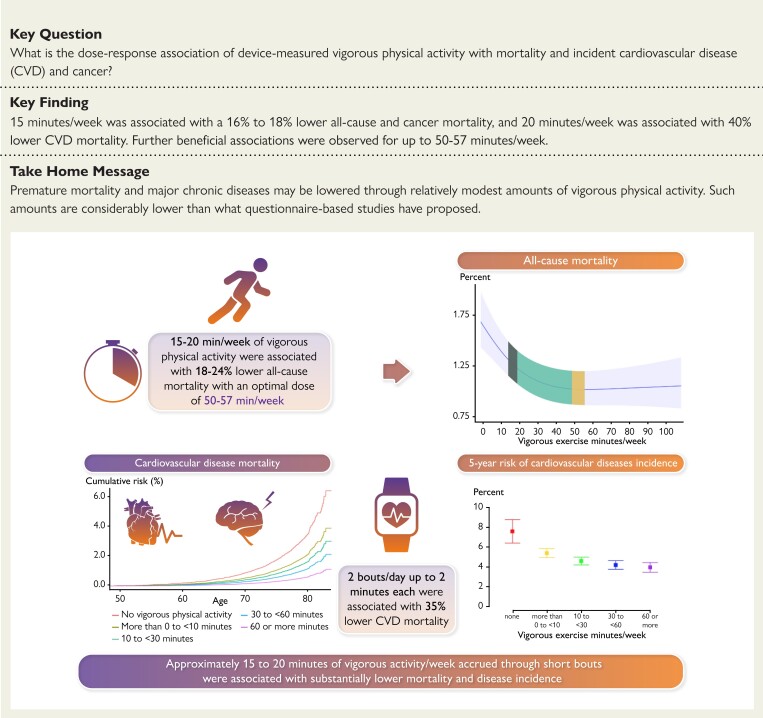
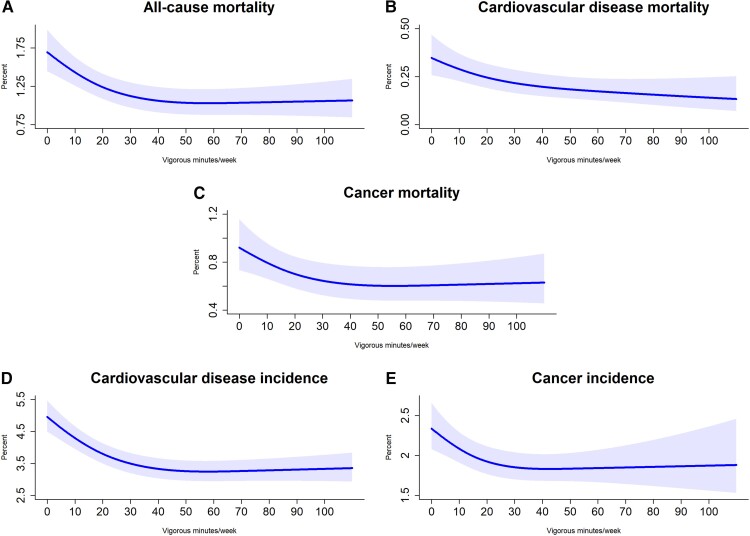
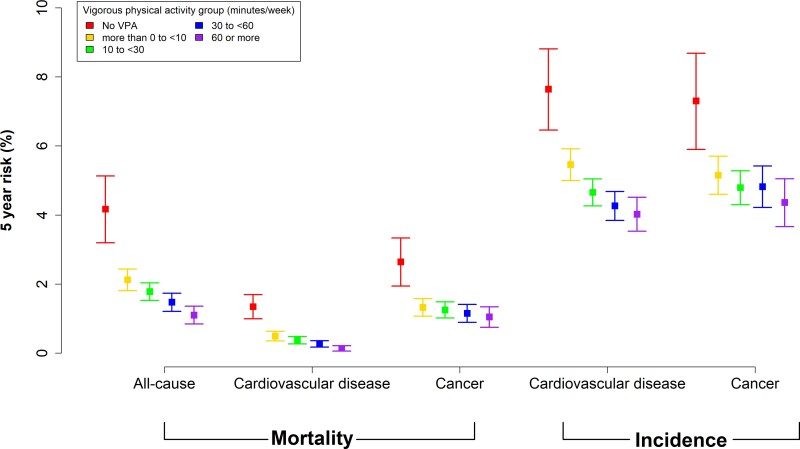
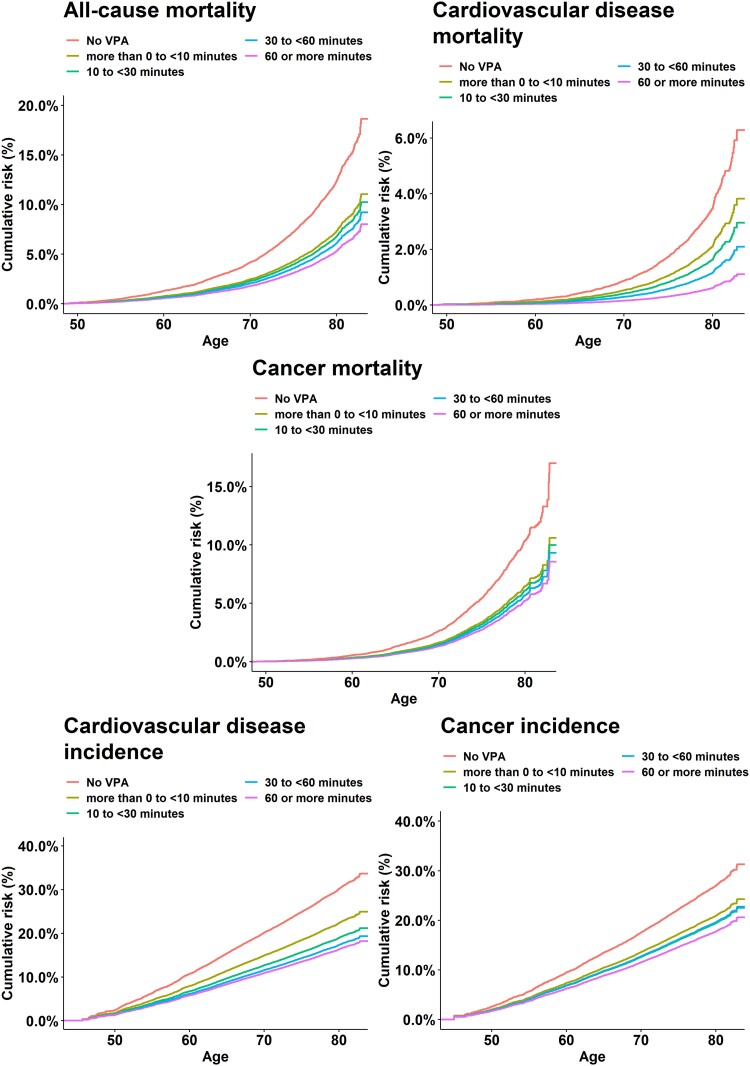
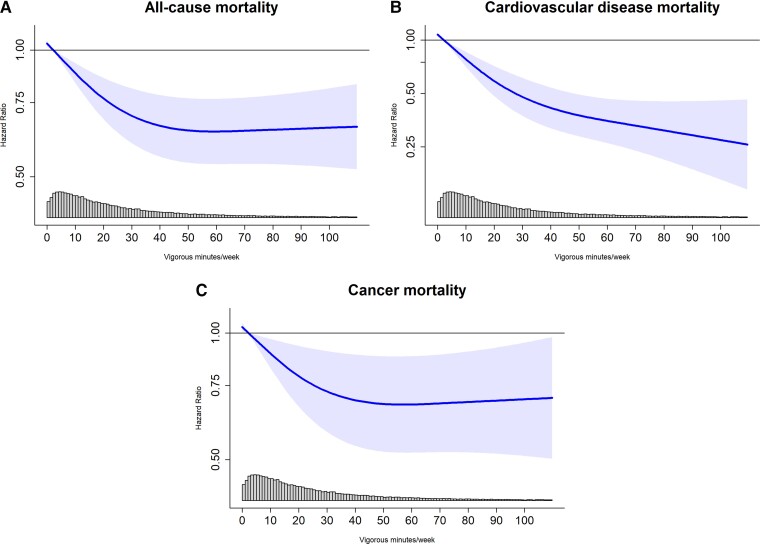
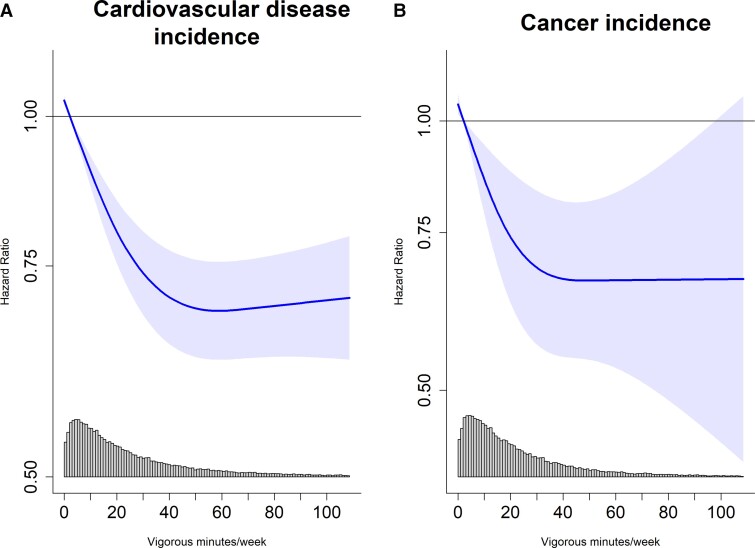
Aims: Vigorous physical activity (VPA) is a time-efficient way to achieve recommended physical activity levels. There is a very limited understanding of the minimal and optimal amounts of vigorous physical activity in relation to mortality and disease incidence. Methods and results: A prospective study in 71 893 adults [median age (IQR): 62.5 years (55.3, 67.7); 55.9% female] from the UK Biobank cohort with wrist-worn accelerometry. VPA volume (min/week) and frequency of short VPA bouts (≤2 min) were measured. The dose–response associations of VPA volume and frequency with mortality [all-cause, cardiovascular disease (CVD) and cancer], and CVD and cancer incidence were examined after excluding events occurring in the first year. During a mean post-landmark point follow-up of 5.9 years (SD ± 0.8), the adjusted 5-year absolute mortality risk was 4.17% (95% confidence interval: 3.19%, 5.13%) for no VPA, 2.12% (1.81%, 2.44%) for >0 to <10 min, 1.78% (1.53%, 2.03%) for 10 to <30 min, 1.47% (1.21%, 1.73%) for 30 to <60 min, and 1.10% (0.84%, 1.36%) for ≥60 min. The ‘optimal dose’ (nadir of the curve) was 53.6 (50.5, 56.7) min/week [hazard ratio (HR): 0.64 (0.54, 0.77)] relative to the 5th percentile reference (2.2 min/week). There was an inverse linear dose-response association of VPA with CVD mortality. The ‘minimal’ volume dose (50% of the optimal dose) was ∼15 (14.3, 16.3) min/week for all-cause [HR: 0.82 (0.75, 0.89)] and cancer [HR: 0.84 (0.74, 0.95)] mortality, and 19.2 (16.5, 21.9) min/week [HR: 0.60 (0.50, 0.72)] for CVD mortality. These associations were consistent for CVD and cancer incidence. There was an inverse linear association between VPA frequency and CVD mortality. 27 (24, 30) bouts/week was associated with the lowest all-cause mortality [HR: 0.73 (0.62, 0.87)]. Conclusion: VPA of 15–20 min/week were associated with a 16–40% lower mortality HR, with further decreases up to 50–57 min/week. These findings suggest reduced health risks may be attainable through relatively modest amounts of VPA accrued in short bouts across the week.
Overview
The claims and statistics of this paper haven’t been checked yet.
Free: it reads the open-access text and checks the first 5 claims that cite a source we can check. Create a free account to check every claim.
Integrity signals
Registry
Cites
Statistics
Figures
Verification
Claims the paper makes
The claims and statistics of this paper haven’t been checked yet.
Free: it reads the open-access text and checks the first 5 claims that cite a source we can check. Create a free account to check every claim.
Claims other papers make about this one
Each is checked against this paper’s own text: does it say what the citing paper says it does?
The source backs part of the claim, not all of it — or backs it for a different population, condition or comparison.
In the citing paper
“Physical activity intensity was classified with a validated accelerometer-based two-level Random Forest machine learning activity scheme that first classifies activity type and then intensity.5,6,17”
From Brief bouts of device-measured intermittent lifestyle physical activity and its association with major adverse cardiovascular events and mortality in people who do not exercise: A prospective cohort study (2023) · cites this paper as [6]
Experimental — accuracy not yet measuredThe source backs part of the claim, not all of it — or backs it for a different population, condition or comparison.
In the citing paper
“These findings may in part explain why moderate and vigorous physical activity beyond a specific amount of time does not offer additional reduction in mortality risk, thereby exhibiting a nadir in the dose–response relationship.32,33”
From Lifelong endurance exercise and its relation with coronary atherosclerosis (2023) · cites this paper as [32]
Experimental — accuracy not yet measuredIn the citing paper
“We calculated E-values to estimate the plausibility of bias from unmeasured confounding30,55.”
From Association of wearable device-measured vigorous intermittent lifestyle physical activity with mortality (2022) · cites this paper as [30]
In the citing paper
“Data obtained from wearable devices show that as few as four short bouts of vigorous physical activity totalling approximately 2-3 min per day are associated with a substantially lower risk of all-cause cardiovascular disease and cancer mortality.5,6”
In the citing paper
“a ∼40% decrease in CVD mortality risk was nevertheless found at only 15-20 min/week. 6”
From Exercise benefits in cardiovascular diseases: From mechanisms to clinical implementation (2023) · cites this paper as [6]
1 more claim about this paper
Create a free account to see every claim other papers make about this one.
Self-check
Percentages, sums and reported differences re-computed from the paper’s own numbers.
The self-check needs the paper’s full text.
Citations
Cites
World Health Organization 2020 guidelines on physical activity and sedentary behaviour
Bull, F. C., Al-Ansari, S. S., Biddle, S., Borodulin, K., Buman, M. P., Cardon, G., Carty, C., Chaput, J.-P., Chastin, S., Chou, R., et al. (2020) · British Journal of Sports Medicine · doi:10.1136/bjsports-2020-102955 · Cited by 11,657
Self-citationThe Physical Activity Guidelines for Americans
Piercy, K. L., Troiano, R. P., Ballard, R. M., Carlson, S. A., Fulton, J. E., Galuska, D. A., George, S. M., & Olson, R. D. (2018) · JAMA · doi:10.1001/jama.2018.14854 · Cited by 9,755
A Modified Poisson Regression Approach to Prospective Studies with Binary Data
Zou, G. (2004) · American Journal of Epidemiology · doi:10.1093/aje/kwh090 · Cited by 9,615
2021 ESC Guidelines on cardiovascular disease prevention in clinical practice
Visseren, F. L. J., Mach, F., Smulders, Y. M., Carballo, D., Koskinas, K. C., Bäck, M., Benetos, A., Biffi, A., Boavida, J.-M., Capodanno, D., et al. (2021) · European Heart Journal · doi:10.1093/eurheartj/ehab484 · Cited by 6,485
Dose-Response Analysis Using R
Ritz, C., Baty, F., Streibig, J. C., & Gerhard, D. (2015) · PLOS ONE · doi:10.1371/journal.pone.0146021 · Cited by 3,658
Correlates of adults??? participation in physical activity: review and update
TROST, S. G., OWEN, N., BAUMAN, A. E., SALLIS, J. F., & BROWN, W. (2002) · Medicine & Science in Sports & Exercise · doi:10.1097/00005768-200212000-00020 · Cited by 3,040
Zamorano, J. L., Lancellotti, P., Rodriguez Muñoz, D., Aboyans, V., Asteggiano, R., Galderisi, M., Habib, G., Lenihan, D. J., Lip, G. Y. H., Lyon, A. R., et al. (2016) · European Heart Journal · doi:10.1093/eurheartj/ehw211 · Cited by 2,544
Conducting accelerometer-based activity assessments in field-based research
TROST, S. G., MCIVER, K. L., & PATE, R. R. (2005) · Medicine & Science in Sports & Exercise · doi:10.1249/01.mss.0000185657.86065.98 · Cited by 2,033 · cited 1×
“This is consistent with a study(43) in overweight postmenopausal women that reported significant interval effects for estimated VPA time over 7 days for 10 s intervals compared with 1 min intervals and a review in children that found VPA volume decreased 4-fold when measurement intervals increased from 5 s to 1 min us…”
Dose‐response analyses using restricted cubic spline functions in public health research
Desquilbet, L., & Mariotti, F. (2010) · Statistics in Medicine · doi:10.1002/sim.3841 · Cited by 1,980
Wen, C. P., Wai, J. P. M., Tsai, M. K., Yang, Y. C., Cheng, T. Y. D., Lee, M.-C., Chan, H. T., Tsao, C. K., Tsai, S. P., & Wu, X. (2011) · The Lancet · doi:10.1016/s0140-6736(11)60749-6 · Cited by 1,908 · cited 2×
“Questionnaire-based studies have suggested 60–70 min/week of VPA behaviour can attenuate mortality risk by 30%.(10,11,32,33) Our device-based findings suggest that a minimal dose of 20 min/week of actual VPA provides similar levels of lower mortality risk.”
BackgroundZamorano, J. L., Lancellotti, P., Rodriguez Muñoz, D., Aboyans, V., Asteggiano, R., Galderisi, M., Habib, G., Lenihan, D. J., Lip, G. Y. H., Lyon, A. R., et al. (2017) · European Journal of Heart Failure · doi:10.1002/ejhf.654 · Cited by 1,795
Ekelund, U., Tarp, J., Steene-Johannessen, J., Hansen, B. H., Jefferis, B., Fagerland, M. W., Whincup, P., Diaz, K. M., Hooker, S. P., Chernofsky, A., et al. (2019) · BMJ · doi:10.1136/bmj.l4570 · Cited by 1,769
Self-citationDoherty, A., Jackson, D., Hammerla, N., Plötz, T., Olivier, P., Granat, M. H., White, T., van Hees, V. T., Trenell, M. I., Owen, C. G., et al. (2017) · PLOS ONE · doi:10.1371/journal.pone.0169649 · Cited by 1,250 · cited 1×
“to prospective outcomes.(49) The large sample size and long follow up allowed us to reduce the risk of reverse causality by removing participants who had an event in the first two years, prevalence of major disease, self-rated poor health, or used CVD medication.”
BackgroundUsing the E-Value to Assess the Potential Effect of Unmeasured Confounding in Observational Studies
Haneuse, S., VanderWeele, T. J., & Arterburn, D. (2019) · JAMA · doi:10.1001/jama.2018.21554 · Cited by 988 · cited 1×
“We calculated E-values to estimate the plausibility of bias from unmeasured confounding.(20) The E-values indicate the required magnitude of the association unmeasured confounders to reduce findings to null.”
Ross, R., Chaput, J.-P., Giangregorio, L. M., Janssen, I., Saunders, T. J., Kho, M. E., Poitras, V. J., Tomasone, J. R., El-Kotob, R., McLaughlin, E. C., et al. (2020) · Applied Physiology, Nutrition, and Metabolism · doi:10.1139/apnm-2020-0467 · Cited by 941
Self-citationSamitz, G., Egger, M., & Zwahlen, M. (2011) · International Journal of Epidemiology · doi:10.1093/ije/dyr112 · Cited by 836
Leisure-time running reduces all-cause and cardiovascular mortality risk.
Lee, D.-C., Pate, R. R., Lavie, C. J., Sui, X., Church, T. S., & Blair, S. N. (2014) · Journal of the American College of Cardiology · doi:10.1016/j.jacc.2014.04.058 · Cited by 819 · cited 2×
“Questionnaire-based studies have suggested 60–70 min/week of VPA behaviour can attenuate mortality risk by 30%.(10,11,32,33) Our device-based findings suggest that a minimal dose of 20 min/week of actual VPA provides similar levels of lower mortality risk.”
BackgroundAssociation of daily step count and step intensity with mortality among US adults
Saint-Maurice, P. F., Troiano, R. P., Bassett, D. R., Graubard, B. I., Carlson, S. A., Shiroma, E. J., Fulton, J. E., & Matthews, C. E. (2020) · JAMA · doi:10.1001/jama.2020.1382 · Cited by 660
Association of Step Volume and Intensity With All-Cause Mortality in Older Women
Lee, I.-M., Shiroma, E. J., Kamada, M., Bassett, D. R., Matthews, C. E., & Buring, J. E. (2019) · JAMA Internal Medicine · doi:10.1001/jamainternmed.2019.0899 · Cited by 604
Self-citationLöllgen, H., Böckenhoff, A., & Knapp, G. (2009) · International Journal of Sports Medicine · doi:10.1055/s-0028-1128150 · Cited by 529
UK Biobank: Current status and what it means for epidemiology
Allen, N., Sudlow, C., Downey, P., Peakman, T., Danesh, J., Elliott, P., Gallacher, J., Green, J., Matthews, P., Pell, J., et al. (2012) · Health Policy and Technology · doi:10.1016/j.hlpt.2012.07.003 · Cited by 521 · cited 1×
“Participants completed physical examinations by trained staff and touchscreen questionnaires.(13) We excluded participants with prevalent CVD or cancer (ascertained through self-report, hospital admission, and cancer registry records), missing covariate data, or an event within the first 12 months after the accelerome…”
MethodO’Donovan, G., Lee, I.-M., Hamer, M., & Stamatakis, E. (2017) · JAMA Internal Medicine · doi:10.1001/jamainternmed.2016.8014 · Cited by 462 · cited 1×
“Only 20% of middle age to older adults report engaging in any VPA for at least 15 continuous minutes.(28) Sustained participation in VPA leisure-time physical activity requires considerable time and often monetary commitment and can be physically challenging for people with poor fitness or established cardiovascular a…”
BackgroundSelf-citationPhysical Activity Recommendations and Decreased Risk of Mortality
Leitzmann, M. F. (2007) · Archives of Internal Medicine · doi:10.1001/archinte.167.22.2453 · Cited by 438 · cited 1×
“Questionnaire-based studies have suggested 60–70 min/week of VPA behaviour can attenuate mortality risk by 30%.(10,11,32,33) Our device-based findings suggest that a minimal dose of 20 min/week of actual VPA provides similar levels of lower mortality risk.”
BackgroundDiPietro, L., Al-Ansari, S. S., Biddle, S. J. H., Borodulin, K., Bull, F. C., Buman, M. P., Cardon, G., Carty, C., Chaput, J.-P., Chastin, S., et al. (2020) · International Journal of Behavioral Nutrition and Physical Activity · doi:10.1186/s12966-020-01042-2 · Cited by 387 · cited 1×
“Indeed, the World Health Organization Guidelines Development Group recently indicated the need for device-based studies to objectively assess the relationship of physical activity with mortality and disease risk as a priority for research.(12) The aim of this study was to examine the dose-response association of devic…”
BackgroundSelf-citationHuang, B.-H., Duncan, M. J., Cistulli, P. A., Nassar, N., Hamer, M., & Stamatakis, E. (2022) · British Journal of Sports Medicine · doi:10.1136/bjsports-2021-104046 · Cited by 345
Self-citationGebel, K., Ding, D., Chey, T., Stamatakis, E., Brown, W. J., & Bauman, A. E. (2015) · JAMA Internal Medicine · doi:10.1001/jamainternmed.2015.0541 · Cited by 344 · cited 6×
“%) were associated with 10% lower mortality relative to no VPA.6,7 These previous %VPA findings may be affected by the susceptibility of over-reporting due to social desirability bias from self-reports.”
ResultInfluentialSelf-citationEijsvogels, T. M. H., Molossi, S., Lee, D.-C., Emery, M. S., & Thompson, P. D. (2016) · Journal of the American College of Cardiology · doi:10.1016/j.jacc.2015.11.034 · Cited by 305
Rampinelli, C., De Marco, P., Origgi, D., Maisonneuve, P., Casiraghi, M., Veronesi, G., Spaggiari, L., & Bellomi, M. (2017) · BMJ · doi:10.1136/bmj.j347 · Cited by 264 · cited 1×
“To provide conservative point estimates for associations, we assessed the minimal dose, defined as the volume of VPA associated with 50% of the lowest HR (‘optimal dose’; nadir of the dose curve).(21,22) We used bootstrapping with replacement (1000 iterations) to calculate CIs for the optimal and minimal dose.”
MethodExploring Motivation and Barriers to Physical Activity among Active and Inactive Australian Adults
Hoare, E., Stavreski, B., Jennings, G., & Kingwell, B. (2017) · Sports · doi:10.3390/sports5030047 · Cited by 262
Estimating Activity and Sedentary Behavior from an Accelerometer on the Hip or Wrist
ROSENBERGER, M. E., HASKELL, W. L., ALBINALI, F., MOTA, S., NAWYN, J., & INTILLE, S. (2013) · Medicine & Science in Sports & Exercise · doi:10.1249/mss.0b013e31827f0d9c · Cited by 237
Wang, Y., Nie, J., Ferrari, G., Rey-Lopez, J. P., & Rezende, L. F. M. (2021) · JAMA Internal Medicine · doi:10.1001/jamainternmed.2020.6331 · Cited by 229
Stamatakis, E., Owen, K. B., Shepherd, L., Drayton, B., Hamer, M., & Bauman, A. E. (2021) · Epidemiology · doi:10.1097/ede.0000000000001316 · Cited by 192
Self-citationPerceived Barriers to Leisure-Time Physical Activity in Adults: An Ecological Perspective
Cerin, E., Leslie, E., Sugiyama, T., & Owen, N. (2010) · Journal of Physical Activity and Health · doi:10.1123/jpah.7.4.451 · Cited by 186
Ramakrishnan, R., Doherty, A., Smith-Byrne, K., Rahimi, K., Bennett, D., Woodward, M., Walmsley, R., & Dwyer, T. (2021) · PLOS Medicine · doi:10.1371/journal.pmed.1003487 · Cited by 183 · cited 1×
“Studies assessing the association between CVD incidence and physical activity intensity volume with wrist-worn devices have reported an inverse linear association.(45,46) We now further focus specifically on VPA and investigate in depth not only the volume dose response but also the associations of weekly frequency an…”
BackgroundField evaluation of a random forest activity classifier for wrist-worn accelerometer data
Pavey, T. G., Gilson, N. D., Gomersall, S. R., Clark, B., & Trost, S. G. (2017) · Journal of Science and Medicine in Sport · doi:10.1016/j.jsams.2016.06.003 · Cited by 174 · cited 1×
“Physical activity intensity was classified with a validated accelerometer-based activity machine learning scheme covering VPA, moderate intensity physical activity, and light intensity physical activity.(16) Briefly, this activity scheme uses features in the raw acceleration signal to identify and quantify time spent…”
MethodAnalyses of Triaxial Accelerometer Calibration Algorithms
Sipos, M., Paces, P., Rohac, J., & Novacek, P. (2012) · IEEE Sensors Journal · doi:10.1109/jsen.2011.2167319 · Cited by 145 · cited 1×
“Participants returned the devices by mail and the data were calibrated and non-wear periods were identified according to standard procedures.(14,15) Monitoring days were considered valid if wear time was greater than 16 h.”
MethodD’Ascenzi, F., Anselmi, F., Fiorentini, C., Mannucci, R., Bonifazi, M., & Mondillo, S. (2019) · European Journal of Preventive Cardiology · doi:10.1177/2047487319874900 · Cited by 130 · cited 1×
“This may provide opportunities for improvement of CVD preventative strategies in cardio-oncology where high-intensity activity has been shown to attenuate the cardiotoxicity of cancer treatments.(34,35) Whilst our results reflect associations that can be expected in the general population, the health benefits from con…”
BackgroundBrief Intense Stair Climbing Improves Cardiorespiratory Fitness
ALLISON, M. K., BAGLOLE, J. H., MARTIN, B. J., MACINNIS, M. J., GURD, B. J., & GIBALA, M. J. (2017) · Medicine & Science in Sports & Exercise · doi:10.1249/mss.0000000000001188 · Cited by 116 · cited 1×
“They are also consistent with proof of concept trials showing demonstrable effects of short VPA bouts on cardiorespiratory fitness in physically inactive adults.(29,30) Findings from these trials suggest short VPA durations can stimulate the cardiorespiratory system and lead to measurable cardiovascular adaptations.”
ResultDo stair climbing exercise "snacks" improve cardiorespiratory fitness?
Jenkins, E. M., Nairn, L. N., Skelly, L. E., Little, J. P., & Gibala, M. J. (2019) · Applied Physiology, Nutrition, and Metabolism · doi:10.1139/apnm-2018-0675 · Cited by 116 · cited 1×
“They are also consistent with proof of concept trials showing demonstrable effects of short VPA bouts on cardiorespiratory fitness in physically inactive adults.(29,30) Findings from these trials suggest short VPA durations can stimulate the cardiorespiratory system and lead to measurable cardiovascular adaptations.”
ResultNon-wear or sleep? Evaluation of five non-wear detection algorithms for raw accelerometer data
Ahmadi, M. N., Nathan, N., Sutherland, R., Wolfenden, L., & Trost, S. G. (2020) · Journal of Sports Sciences · doi:10.1080/02640414.2019.1703301 · Cited by 113 · cited 1×
“Participants returned the devices by mail and the data were calibrated and non-wear periods were identified according to standard procedures.(14,15) Monitoring days were considered valid if wear time was greater than 16 h.”
MethodSelf-citationStamatakis, E., Huang, B.-H., Maher, C., Thøgersen-Ntoumani, C., Stathi, A., Dempsey, P. C., Johnson, N., Holtermann, A., Chau, J. Y., Sherrington, C., et al. (2021) · Sports Medicine · doi:10.1007/s40279-020-01368-8 · Cited by 113 · cited 2×
“VPA, defined as physical activity at an energy expenditure rate of at least six metabolic equivalents (METs) is a time-efficient way to achieve recommended physical activity levels and can lead to rapid cardiorespiratory adaptations.(3) For the first time, current physical activity guidelines(1,2,4,5) emphasize the va…”
BackgroundSelf-citationVigorous-Intensity Leisure-Time Physical Activity and Risk of Major Chronic Disease in Men
CHOMISTEK, A. K., COOK, N. R., FLINT, A. J., & RIMM, E. B. (2012) · Medicine & Science in Sports & Exercise · doi:10.1249/mss.0b013e31825a68f3 · Cited by 103 · cited 1×
“Questionnaire-based studies have suggested 60–70 min/week of VPA behaviour can attenuate mortality risk by 30%.(10,11,32,33) Our device-based findings suggest that a minimal dose of 20 min/week of actual VPA provides similar levels of lower mortality risk.”
BackgroundGabriel, K. P., McClain, J. J., Schmid, K. K., Storti, K. L., High, R., Underwood, D. A., Kuller, L. H., & Kriska, A. M. (2010) · International Journal of Behavioral Nutrition and Physical Activity · doi:10.1186/1479-5868-7-53 · Cited by 83
Iannetta, D., Keir, D. A., Fontana, F. Y., Inglis, E. C., Mattu, A. T., Paterson, D. H., Pogliaghi, S., & Murias, J. M. (2021) · Sports Medicine · doi:10.1007/s40279-021-01476-z · Cited by 72
Trost, S. G. (2020) · International Journal of Behavioral Nutrition and Physical Activity · doi:10.1186/s12966-020-00929-4 · Cited by 65
Rey Lopez, J. P., Sabag, A., Martinez Juan, M., Rezende, L. F. M., & Pastor-Valero, M. (2020) · BMJ Open Sport & Exercise Medicine · doi:10.1136/bmjsem-2020-000775 · Cited by 63 · cited 2×
“Examining the dose-response of short and intermittent VPA bursts requires device-based measurments.(9) Indeed, the World Health Organization Guidelines Development Group recently indicated the need for device-based studies to objectively assess the relationship of physical activity with mortality and disease risk as a…”
BackgroundTarp, J., Hansen, B. H., Fagerland, M. W., Steene-Johannessen, J., Anderssen, S. A., & Ekelund, U. (2020) · International Journal of Behavioral Nutrition and Physical Activity · doi:10.1186/s12966-020-00945-4 · Cited by 58 · cited 1×
“Despite the extensive precautionary measures, the potential for reverse causation may still exist caused by low activity levels due to undiagnosed or prodromal disease.(50) Due to the observational design, we cannot rule out the presence of unmeasured confounding.”
BackgroundCruz, B. D. P., Ahmadi, M., Inan‐Eroglu, E., Huang, B., & Stamatakis, E. (2022) · Journal of the American Heart Association · doi:10.1161/jaha.121.023290 · Cited by 53 · cited 1×
“Studies assessing the association between CVD incidence and physical activity intensity volume with wrist-worn devices have reported an inverse linear association.(45,46) We now further focus specifically on VPA and investigate in depth not only the volume dose response but also the associations of weekly frequency an…”
BackgroundSelf-citationRey Lopez, J. P., Gebel, K., Chia, D., & Stamatakis, E. (2019) · BMJ Open Sport & Exercise Medicine · doi:10.1136/bmjsem-2019-000596 · Cited by 52 · cited 1×
“Findings on cardiovascular disease (CVD) and cancer mortality showed similar results.(8,9) Sixty to 90 min of weekly VPA accumulated through 10 to 15 minlong bouts of exercise has been shown to be associated with a 3-year extension of life expectancy and a 4% lower risk of ACM for every additional 15 min.”
BackgroundSelf-citation
Research works printed but not linked: 1
- Harrell Jr FE. RMS: Regression Modeling Strategies. R package version 4.0-0: Vanderbilt University; 2017.
Cited by
Stamatakis, E., Ahmadi, M. N., Gill, J. M. R., Thøgersen-Ntoumani, C., Gibala, M. J., Doherty, A., & Hamer, M. (2022) · Nature Medicine · doi:10.1038/s41591-022-02100-x · Cited by 336
“We calculated E-values to estimate the plausibility of bias from unmeasured confounding 30,55 .”
Self-citationHealthy Lifestyle and Cancer Risk: Modifiable Risk Factors to Prevent Cancer
Marino, P., Mininni, M., Deiana, G., Marino, G., Divella, R., Bochicchio, I., Giuliano, A., Lapadula, S., Lettini, A. R., & Sanseverino, F. (2024) · Nutrients · doi:10.3390/nu16060800 · Cited by 240
“A further study highlighted that intense physical exercise for at least 15-20 min per week was linked to a reduction in mortality risk of 16–40%, with a more marked reduction for physical activity of 50–57 min per week [87].”
BackgroundExercise benefits in cardiovascular diseases: From mechanisms to clinical implementation
Valenzuela, P. L., Ruilope, L. M., Santos-Lozano, A., Wilhelm, M., Kränkel, N., Fiuza-Luces, C., & Lucia, A. (2023) · European Heart Journal · doi:10.1093/eurheartj/ehad170 · Cited by 237
Ahmadi, M. N., Hamer, M., Gill, J. M. R., Murphy, M., Sanders, J. P., Doherty, A., & Stamatakis, E. (2023) · The Lancet Public Health · doi:10.1016/s2468-2667(23)00183-4 · Cited by 172
“5,6 Public health guidelines 7 emphasise the health value of short bouts of intermittent physical activity, including non-exercise activities, to lower mortality and cardiovascular disease risk.”
BackgroundSelf-citationStamatakis, E., Ahmadi, M. N., Friedenreich, C. M., Blodgett, J. M., Koster, A., Holtermann, A., Atkin, A., Rangul, V., Sherar, L. B., Teixeira-Pinto, A., et al. (2023) · JAMA Oncology · doi:10.1001/jamaoncol.2023.1830 · Cited by 163
Self-citation
Metadata
- Authors
- Ahmadi, M. N., Clare, P. J., Katzmarzyk, P. T., del Pozo Cruz, B., Lee, I. M., & Stamatakis, E.
- Affiliations
- The University of Sydney (AU)
- Pennington Biomedical Research Center (US)
- Department of Sports Science and Clinical Biomechanics, University of Southern Denmark , Odense , Denmark
- Brigham and Women's Hospital (US)
- Corresponding author
- Ahmadi, Matthew N
- ORCID
- Venue
- European Heart Journal
- Publisher
- Oxford University Press (OUP)
- Published
- 2022-10-27
- Volume
- 43
- Issue
- 46
- Pages
- 4801-4814
- ISSN
- 0195-668X (ISSN-L)
- 1522-9645
- PMC
- PMC9726449
- OpenAlex
- W4307500053
- Semantic Scholar
- 10e77344250d19b91cc39cba2a42164d1ee6f500
- Cited by
- 175
- References
- 50
- Citations by year
- 2026: 32 · 2025: 49 · 2024: 60 · 2023: 31 · 2022: 3
- FWCI
- 22.14
- Type
- journal article
- Language
- en
- Open access
- hybrid
- doi.org
- Licence
- Locations
- European Heart Journal (publishedVersion, cc-by-nc)
- PubMed Central (publishedVersion, cc-by-nc)
- PubMed (publishedVersion)
- Civil War Book Review (submittedVersion)
- University of Southern Denmark Research Portal (University of Southern Denmark) (submittedVersion, cc-by-nc)
- Funders
- Australian National Health and Medical Research Council (1194510)
- Topics
- Health Sciences › Medicine › Public Health, Environmental and Occupational Health › Physical Activity and Health
- Health Sciences › Medicine › Physiology (medical) › Cardiovascular and exercise physiology
- Health Sciences › Medicine › Cardiology and Cardiovascular Medicine › Cardiovascular Effects of Exercise
- Keywords
- high-intensity exercise, physical activity volume, physical activity frequency, dose-response relationship, optimal dose, all-cause mortality, cardiovascular mortality, cancer incidence, heart disease, cancer
- MeSH terms
- Female, Heart Diseases, Humans, Male, Neoplasms, Prospective Studies, Exercise
About these checks
Registry, retraction, Cites and statistics results are computed, not judged, with one exception: a printed reference that no index lists is read once by a model before it counts as a citation error. Claims are extracted by a model and kept only when their quote appears verbatim in the text; each cited source is then checked, with a model’s help, for whether it says what the claim relies on. Those verdicts can be wrong — read the claim’s quote and the cited source before relying on one.
Statistics and arithmetic are recomputed, not judged.
Confidence bands are shown only for fields calibrated on our annotated test set. None is calibrated yet, so no band is shown.
What counts as a claim ›How we measure confidence ›How we check this ›
Are you an author, or do you see a problem with this page? Request a review
Data sources
Bibliographic data: Semantic Scholar, OpenAlex, Crossref.
Contains information from the Semantic Scholar Academic Graph Datasets, made available under the ODC Attribution License (ODC-BY 1.0).
Semantic Scholar’s data is described in: Kinney, R., et al. (2023). The Semantic Scholar Open Data Platform. arXiv:2301.10140.
