

Vigorous physical activity, incident heart disease, and cancer: how little is enough?
Open accessThe DOI matches its Crossref record; 49 of the 50 references it cites were found in a registry or an index.
Abstract
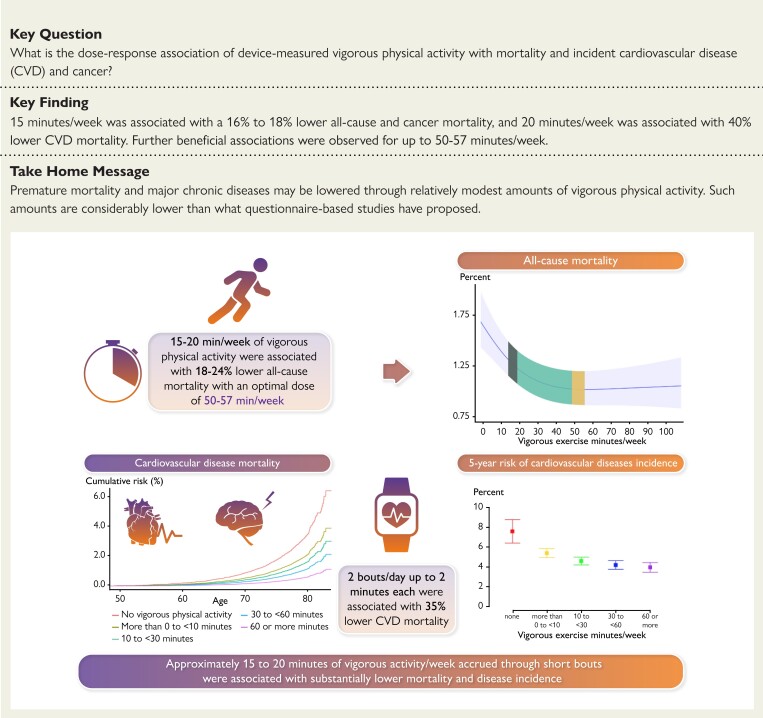
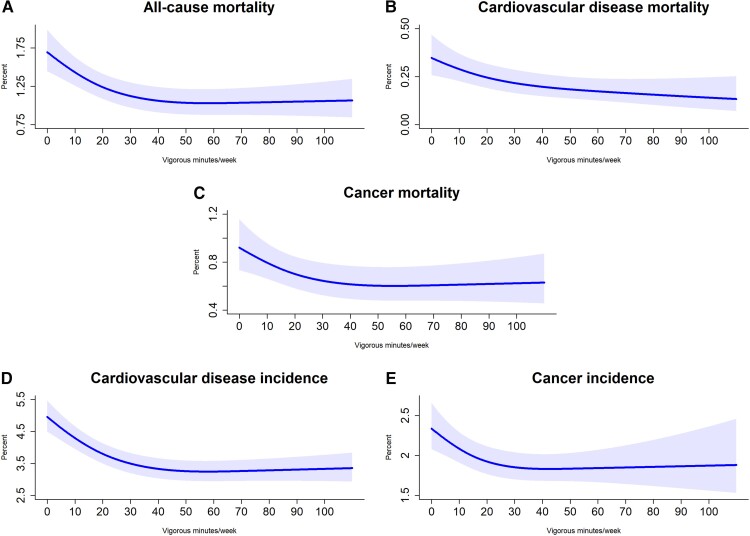
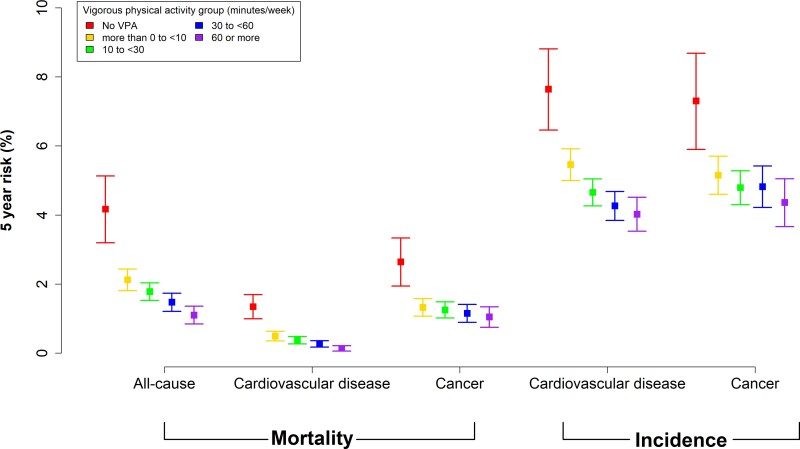
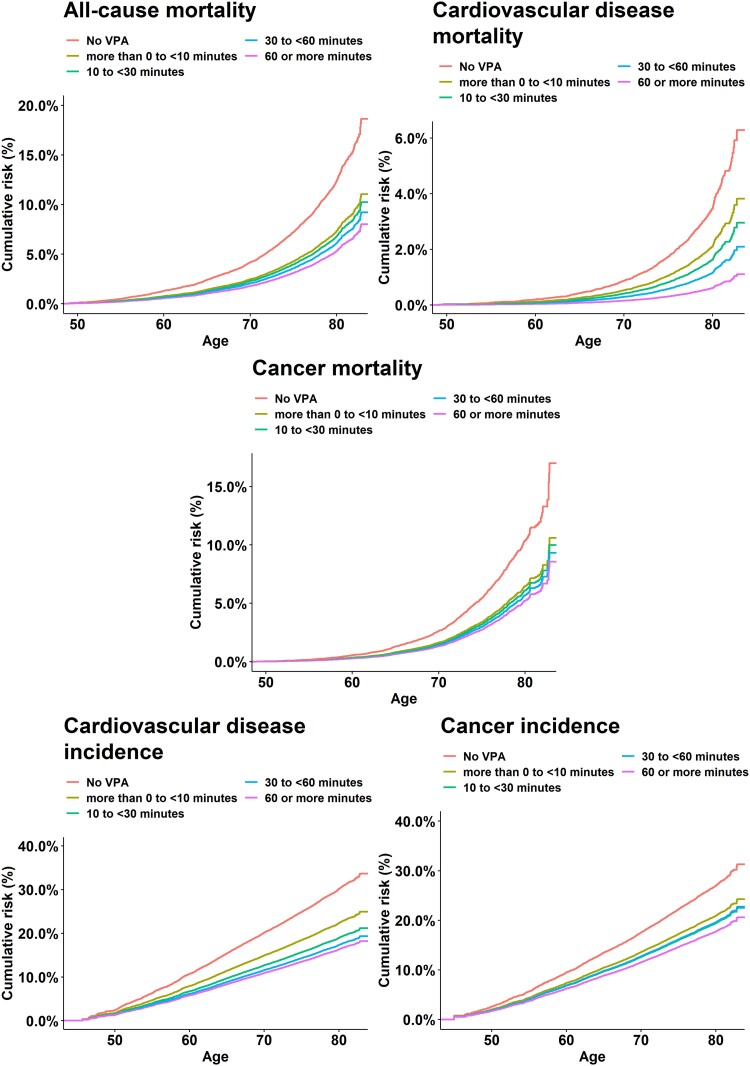
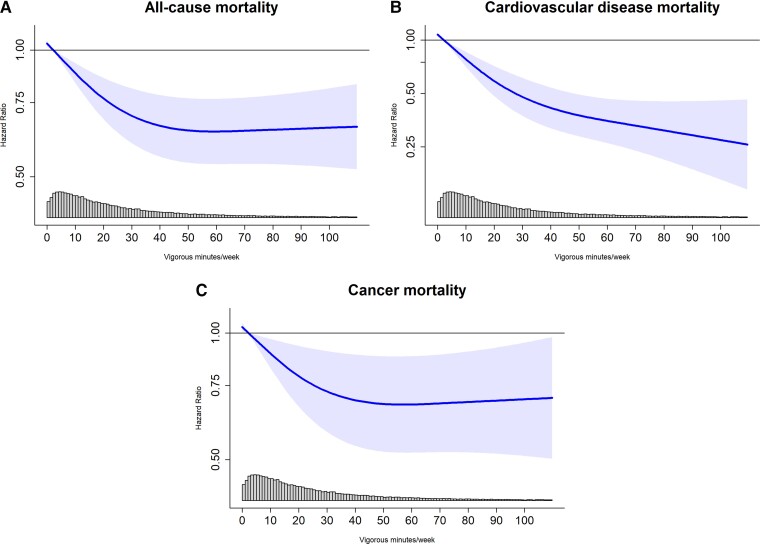
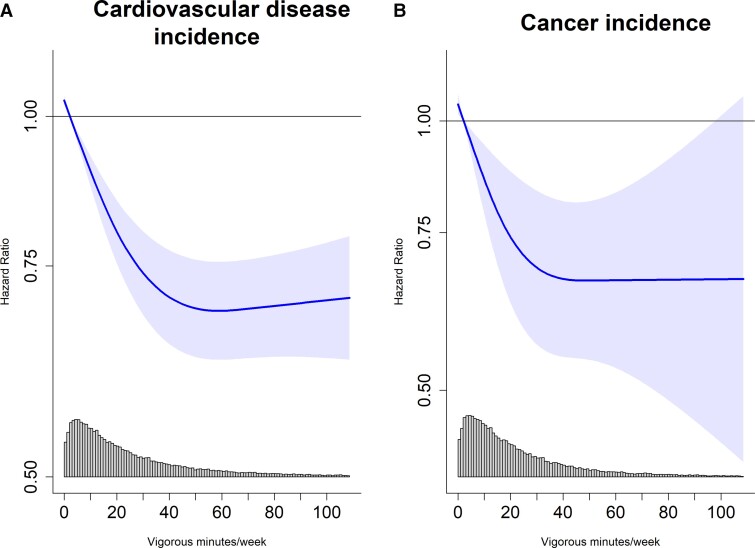
Aims: Vigorous physical activity (VPA) is a time-efficient way to achieve recommended physical activity levels. There is a very limited understanding of the minimal and optimal amounts of vigorous physical activity in relation to mortality and disease incidence. Methods and results: A prospective study in 71 893 adults [median age (IQR): 62.5 years (55.3, 67.7); 55.9% female] from the UK Biobank cohort with wrist-worn accelerometry. VPA volume (min/week) and frequency of short VPA bouts (≤2 min) were measured. The dose–response associations of VPA volume and frequency with mortality [all-cause, cardiovascular disease (CVD) and cancer], and CVD and cancer incidence were examined after excluding events occurring in the first year. During a mean post-landmark point follow-up of 5.9 years (SD ± 0.8), the adjusted 5-year absolute mortality risk was 4.17% (95% confidence interval: 3.19%, 5.13%) for no VPA, 2.12% (1.81%, 2.44%) for >0 to <10 min, 1.78% (1.53%, 2.03%) for 10 to <30 min, 1.47% (1.21%, 1.73%) for 30 to <60 min, and 1.10% (0.84%, 1.36%) for ≥60 min. The ‘optimal dose’ (nadir of the curve) was 53.6 (50.5, 56.7) min/week [hazard ratio (HR): 0.64 (0.54, 0.77)] relative to the 5th percentile reference (2.2 min/week). There was an inverse linear dose-response association of VPA with CVD mortality. The ‘minimal’ volume dose (50% of the optimal dose) was ∼15 (14.3, 16.3) min/week for all-cause [HR: 0.82 (0.75, 0.89)] and cancer [HR: 0.84 (0.74, 0.95)] mortality, and 19.2 (16.5, 21.9) min/week [HR: 0.60 (0.50, 0.72)] for CVD mortality. These associations were consistent for CVD and cancer incidence. There was an inverse linear association between VPA frequency and CVD mortality. 27 (24, 30) bouts/week was associated with the lowest all-cause mortality [HR: 0.73 (0.62, 0.87)]. Conclusion: VPA of 15–20 min/week were associated with a 16–40% lower mortality HR, with further decreases up to 50–57 min/week. These findings suggest reduced health risks may be attainable through relatively modest amounts of VPA accrued in short bouts across the week.
Overview
The claims and statistics of this paper haven’t been checked yet.
Free: it reads the open-access text and checks the first 5 claims that cite a source we can check. Create a free account to check every claim.
Integrity signals
Registry
Cites
Statistics
Figures
Verification
Claims the paper makes
The claims and statistics of this paper haven’t been checked yet.
Free: it reads the open-access text and checks the first 5 claims that cite a source we can check. Create a free account to check every claim.
Claims other papers make about this one
Each is checked against this paper’s own text: does it say what the citing paper says it does?
The source backs part of the claim, not all of it — or backs it for a different population, condition or comparison.
In the citing paper
“Physical activity intensity was classified with a validated accelerometer-based two-level Random Forest machine learning activity scheme that first classifies activity type and then intensity.5,6,17”
From Brief bouts of device-measured intermittent lifestyle physical activity and its association with major adverse cardiovascular events and mortality in people who do not exercise: A prospective cohort study (2023) · cites this paper as [6]
Experimental — accuracy not yet measuredThe source backs part of the claim, not all of it — or backs it for a different population, condition or comparison.
In the citing paper
“These findings may in part explain why moderate and vigorous physical activity beyond a specific amount of time does not offer additional reduction in mortality risk, thereby exhibiting a nadir in the dose–response relationship.32,33”
From Lifelong endurance exercise and its relation with coronary atherosclerosis (2023) · cites this paper as [32]
Experimental — accuracy not yet measuredIn the citing paper
“We calculated E-values to estimate the plausibility of bias from unmeasured confounding30,55.”
From Association of wearable device-measured vigorous intermittent lifestyle physical activity with mortality (2022) · cites this paper as [30]
In the citing paper
“Data obtained from wearable devices show that as few as four short bouts of vigorous physical activity totalling approximately 2-3 min per day are associated with a substantially lower risk of all-cause cardiovascular disease and cancer mortality.5,6”
In the citing paper
“a ∼40% decrease in CVD mortality risk was nevertheless found at only 15-20 min/week. 6”
From Exercise benefits in cardiovascular diseases: From mechanisms to clinical implementation (2023) · cites this paper as [6]
1 more claim about this paper
Create a free account to see every claim other papers make about this one.
Self-check
Percentages, sums and reported differences re-computed from the paper’s own numbers.
The self-check needs the paper’s full text.
Citations
Cites
World Health Organization 2020 guidelines on physical activity and sedentary behaviour
Bull, F. C., Al-Ansari, S. S., Biddle, S., Borodulin, K., Buman, M. P., Cardon, G., Carty, C., Chaput, J.-P., Chastin, S., Chou, R., et al. (2020) · British Journal of Sports Medicine · doi:10.1136/bjsports-2020-102955 · Cited by 11,657
Self-citationThe Physical Activity Guidelines for Americans
Piercy, K. L., Troiano, R. P., Ballard, R. M., Carlson, S. A., Fulton, J. E., Galuska, D. A., George, S. M., & Olson, R. D. (2018) · JAMA · doi:10.1001/jama.2018.14854 · Cited by 9,755
A Modified Poisson Regression Approach to Prospective Studies with Binary Data
Zou, G. (2004) · American Journal of Epidemiology · doi:10.1093/aje/kwh090 · Cited by 9,615
2021 ESC Guidelines on cardiovascular disease prevention in clinical practice
Visseren, F. L. J., Mach, F., Smulders, Y. M., Carballo, D., Koskinas, K. C., Bäck, M., Benetos, A., Biffi, A., Boavida, J.-M., Capodanno, D., et al. (2021) · European Heart Journal · doi:10.1093/eurheartj/ehab484 · Cited by 6,485
Dose-Response Analysis Using R
Ritz, C., Baty, F., Streibig, J. C., & Gerhard, D. (2015) · PLOS ONE · doi:10.1371/journal.pone.0146021 · Cited by 3,658
Correlates of adults??? participation in physical activity: review and update
TROST, S. G., OWEN, N., BAUMAN, A. E., SALLIS, J. F., & BROWN, W. (2002) · Medicine & Science in Sports & Exercise · doi:10.1097/00005768-200212000-00020 · Cited by 3,040
Zamorano, J. L., Lancellotti, P., Rodriguez Muñoz, D., Aboyans, V., Asteggiano, R., Galderisi, M., Habib, G., Lenihan, D. J., Lip, G. Y. H., Lyon, A. R., et al. (2016) · European Heart Journal · doi:10.1093/eurheartj/ehw211 · Cited by 2,544
Conducting accelerometer-based activity assessments in field-based research
TROST, S. G., MCIVER, K. L., & PATE, R. R. (2005) · Medicine & Science in Sports & Exercise · doi:10.1249/01.mss.0000185657.86065.98 · Cited by 2,033 · cited 1×
“This is consistent with a study(43) in overweight postmenopausal women that reported significant interval effects for estimated VPA time over 7 days for 10 s intervals compared with 1 min intervals and a review in children that found VPA volume decreased 4-fold when measurement intervals increased from 5 s to 1 min us…”
Dose‐response analyses using restricted cubic spline functions in public health research
Desquilbet, L., & Mariotti, F. (2010) · Statistics in Medicine · doi:10.1002/sim.3841 · Cited by 1,980
Wen, C. P., Wai, J. P. M., Tsai, M. K., Yang, Y. C., Cheng, T. Y. D., Lee, M.-C., Chan, H. T., Tsao, C. K., Tsai, S. P., & Wu, X. (2011) · The Lancet · doi:10.1016/s0140-6736(11)60749-6 · Cited by 1,908 · cited 2×
“Questionnaire-based studies have suggested 60–70 min/week of VPA behaviour can attenuate mortality risk by 30%.(10,11,32,33) Our device-based findings suggest that a minimal dose of 20 min/week of actual VPA provides similar levels of lower mortality risk.”
Background
Research works printed but not linked: 1
- Harrell Jr FE. RMS: Regression Modeling Strategies. R package version 4.0-0: Vanderbilt University; 2017.
Cited by
Items 101–175 of 175
Chanteau, A., Faity, G. V., Mahé, G., Sabia, S., & Faucheur, A. L. (2026) · Sports Medicine - Open · doi:10.1186/s40798-026-01039-4 · Cited by 2
“Taken together, these studies highlight the value of using wearables to quantify the granular characteristics of PA bouts (e.g., FITT components) that may influence health over and above the total of cumulated amount of MVPA [69, 76, 78, 81, 84].”
Chaput, J., Biswas, R. K., Ahmadi, M., Cistulli, P. A., Bian, W., & Stamatakis, E. (2026) · SLEEP · doi:10.1093/sleep/zsag193 · Cited by 3
Self-citationQiu, P., Wu, J., Li, M., Zhao, Z., & Wang, Q. (2024) · Sports Medicine and Health Science · doi:10.1016/j.smhs.2024.09.002 · Cited by 2
“Firstly, VPA enhances cardiovascular ef fi ciency, 50 strengthening the heart muscle and improving blood circulation.”
Unraveling the role of exercise in cancer suppression: insights from a mathematical model
Taylor, J., Bagarti, T., & Kumar, N. (2024) · Physical Biology · doi:10.1088/1478-3975/ad899d · Cited by 3
Physical activity, sedentary time and health – a narrative review with new insights
Ekelund, U., Tarp, J., Sánchez-Lastra, M. A., & Dalene, K. E. (2024) · Danish Medical Journal · doi:10.61409/a06240433 · Cited by 6
Gaskell, C., Lutimba, S., Bendriss, G., & Aleem, E. A. (2024) · Cancers · doi:10.3390/cancers16244205 · Cited by 2
López‐Bueno, R., Andersen, L. L., López, L., Suso‐Martí, L., Núñez‐Cortés, R., López-Gil, J. F., & Calatayud, J. (2025) · Journal of the American Medical Directors Association · doi:10.1016/j.jamda.2025.105875 · Cited by 3
Sanchis‐Gomar, F., Pérez-Quilis, C., Eijsvogels, T. M. H., de la Guía-Galipienso, F., Christle, J. W., Perez, M. V., & Lavie, C. J. (2023) · Heart and Mind · doi:10.4103/hm.hm-d-23-00005 · Cited by 3
Iyanda, A., Ade-Oni, A., Omiyefa, S., & Krishnan, B. (2023) · Research Square · doi:10.21203/rs.3.rs-2861281/v1 · Cited by 3
Blodgett, J. M., Ahmadi, M., Atkin, A. J., CHASTIN, S. F. M., Chan, H., Suorsa, K., Bakker, E., Hettiarcachchi, P., Johansson, P., Sherar, L. B., et al. (2023) · medRxiv · doi:10.1101/2023.08.01.23293499 · Cited by 2
Self-citationAhmadi, M. N., Coenen, P., Straker, L. M., & Stamatakis, E. A. (2024) · medRxiv · doi:10.1101/2024.01.17.24301458 · Cited by 2
Self-citationAhmadi, M. N., Koemel, N. A., Biswas, R. K., Chen, S., Pulsford, R. M., Hamer, M., & Stamatakis, E. (2024) · medRxiv · doi:10.1101/2024.08.06.24311529 · Cited by 2
Self-citationSiegel, A. J. (2023) · Medical Research Archives · doi:10.18103/mra.v11i4.3741 · Cited by 1
Gan, H., Yan, Y., Jia, S., Guo, Y., & Lu, G. (2025) · Experimental Gerontology · doi:10.1016/j.exger.2025.112805 · Cited by 3
Physical activity, air pollution, and incident long-term conditions: a prospective cohort study
Huang, M., Olsen, J., Trost, S. G., Celis-Morales, C. A., Pell, J. P., & Ho, F. K. W. (2025) · BMC Medicine · doi:10.1186/s12916-025-04338-x · Cited by 1
“A two-step approach based on random forest and raw acceleration was used to categorise time spent in light, moderate, and vigorous PA based on a method described previously [21, 22].”
Dong, X., Kai, J.-Y., Li, D., Lança, C., Grzybowski, A. E., Ke, C., & Pan, C. (2025) · American Journal of Ophthalmology · doi:10.1016/j.ajo.2025.09.053 · Cited by 2
A prospective study of eating disorders and risk of rheumatoid arthritis
Chen, J., Wang, P., Li, H., Yu, Z., Olsen, N. J., Su, J., Zeng, X., & Gao, X. (2025) · Seminars in Arthritis and Rheumatism · doi:10.1016/j.semarthrit.2025.152857 · Cited by 1
Wilhelm, L. O., Knoll, N., Diering, L., Kołodziejczak, K., Maas, J., Schmidt, H., & Fleig, L. (2025) · Health Psychology and Behavioral Medicine · doi:10.1080/21642850.2025.2576610 · Cited by 1
Physical activity as a system: A network perspective on behavioral attributes and self-efficacy
Alves, D. S., Watanabe, W. T., Goroso, D. G., de Araújo, F. R., Pires, F. D. O., & Asano, R. Y. (2026) · Journal of Health Psychology · doi:10.1177/13591053261443208 · Cited by 1
Beyond traditional cardiovascular risk factors: exploring the hidden side of the moon
Crea, F. (2024) · European Heart Journal · doi:10.1093/eurheartj/ehae055 · Cited by 1
Wei, L., Ahmadi, M. N., Biswas, R. K., Trost, S. G., & Stamatakis, E. (2024) · Scandinavian Journal of Medicine and Science in Sports · doi:10.1111/sms.14719 · Cited by 1
Self-citationSingleton, A. C., Partridge, S. R., Hyun, K. K., MITCHELL, C. M., Raeside, R., Hafiz, N., Nickel, B., Mizrahi, D., Todd, A., McIntosh, J., et al. (2024) · BMJ Open · doi:10.1136/bmjopen-2024-090984 · Cited by 2
Harding, S., Richardson, A., Glynn, A., & Hodgson, L. E. (2025) · COPD Journal of Chronic Obstructive Pulmonary Disease · doi:10.1080/15412555.2025.2482710 · Cited by 3
“Future research should also focus on participants with high sedentary behaviour and low physical activity baseline, who have more potential to change and benefit from that change [51].”
Wen, X., & Yang, X. (2025) · Frontiers in Medicine · doi:10.3389/fmed.2025.1582846 · Cited by 2
Ahmadi, M. N., Blodgett, J. M., Atkin, A. J., Chan, H., Cruz, B. D. P., Suorsa, K., Bakker, E. A., Pulsford, R. M., Mielke, G. I., Johansson, P. J., et al. (2023) · medRxiv · doi:10.1101/2023.07.31.23293468 · Cited by 1
Self-citationLi, Z., Cheng, S., Guo, B., Ding, L., Liang, Y., Shen, Y., Li, J.-Y., Hu, Y.-Q., Long, T., Guo, X., et al. (2023) · medRxiv · doi:10.1101/2023.08.21.23294391 · Cited by 1
Wei, L., Ahmadi, M. N., Blodgett, J. M., Aguiar, E. J., Biswas, R. K., Cruz, B. D. P., & Stamatakis, E. A. (2024) · medRxiv · doi:10.1101/2024.09.10.24313453 · Cited by 1
Self-citationKoemel, N. A., Biswas, R. K., Ahmadi, M. N., Teixeira-Pinto, A. M., Hamer, M., Rezende, L. F. M., Mitchell, J. J., Leech, R. M., Sawan, M. J., Allman-Farinelli, M. A., et al. (2025) · medRxiv · doi:10.1101/2025.04.24.25326344 · Cited by 1
Self-citationMamaril, C. B., Luo, Y., Thomas, D. D., Kramer, A. F., McAuley, E., & Mullen, S. P. (2023) · PsyArXiv (OSF Preprints) · doi:10.31234/osf.io/m64ka
Stamatakis, E. A., Koemel, N. A., Biswas, R. K., Ahmadi, M. N., Allman-Farinelli, M. A., Trost, S. G., Eroglu, E. I., Cruz, B. D. P., Bin, Y. S., Postnova, S., et al. (2023) · medRxiv · doi:10.1101/2023.11.19.23298747
“As previously described, participants were only included in the present study if they had wrist-worn accelerometry data collected with sufficient wear time of at least three days (>16 hours/day) with one of the days being a weekend day [25-28].”
BackgroundMethodInfluentialSelf-citationKommentar zu: Auch „Weekend Warriors“ reduzieren ihr kardiovaskuläres Risiko
Halle, M., & Heitkamp, M. (2023) · Diabetologie und Stoffwechsel · doi:10.1055/a-1974-3578
Welcome to a new journal in exercise and cancer
Lucia, A. (2024) · Physical Activity Exercise and Cancer · doi:10.61486/isfq7460
“Regular physical activity is also associated with lower cancer incidence (Ahmadi et al., 2022; Matthews et al., 2020), recurrence (Morishita et al., 2020), and mortality (Morishita et al., 2020; Arem et al., 2015).”
BackgroundMultimodale kardiovaskuläre Prävention
Müller‐Wieland, D., Verket, M., Brandts, J., Jacobsen, M., Marx, N., Kanna, N. D. D., Balfanz, P., & Schütt, K. S. (2023) · Springer Reference Medizin · doi:10.1007/978-3-642-54676-1_571-1
Focus on device innovation in interventional cardiology and on trials in cardiovascular prevention
Crea, F. (2024) · European Heart Journal · doi:10.1093/eurheartj/ehae180
Zhai, Z., Li, X., Zhao, S., Li, X., Sun, X., Chen, K., Hua, W., Dai, Y., & Zhang, S. (2024) · SSRN Electronic Journal · doi:10.2139/ssrn.4784307
Exploring Dynamics of Blood Pressure Variability: Sitting Still, Rising Pressure?
Giacona, J. M. (2024) · American Journal of Hypertension · doi:10.1093/ajh/hpae070
Zeng, Y., Ke, Z., Zhuang, X., Huang, Z., Wang, S., Zhang, X. D., Cai, S., & Liao, L. (2024) · Research Square · doi:10.21203/rs.3.rs-4953032/v1
Cancer Diagnosis, Physical Activity, and Heart Disease Risk
Stamatakis, E., Koemel, N. A., Biswas, R. K., & Ahmadi, M. N. (2024) · JACC CardioOncology · doi:10.1016/j.jaccao.2024.11.002 · Cited by 1
Self-citationMicro-Workout: A Paradigm Shift in Effective Exercise/Physical Activity for Health and Longevity
Ito, S. (2025) · European Journal of Medical and Health Sciences · doi:10.24018/ejmed.2025.7.2.2275 · Cited by 3
Yu, L., Sun, G., Liu, Y., Zhang, D., Li, X., Zhang, Q., Xing, X., Zhang, X., & Yang, X. (2025) · Diabetes Research and Clinical Practice · doi:10.1016/j.diabres.2025.112203
Zeng, S., Luo, W., Yang, H., Lin, S., Sun, L., Kong, C., Li, J., Xie, W., Zhou, Y., & Zheng, J. (2025) · SSRN Electronic Journal · doi:10.2139/ssrn.5246633
Asociaciones entre actividad física e incidencia y mortalidad por cáncer: revisión sistemática
Alonso, L., González-Devesa, D., Varela, S., Blanco-Martínez, N., & Ayán, C. (2025) · Revista Iberoamericana de Ciencias de la Actividad Física y el Deporte · doi:10.24310/riccafd.14.1.2025.20897
Duque, A. L. M. D. S., Paula, D. P., de Paula, D., Molina, M. D. C. B., Giatii, L., Schmidt, M. I., da Fonseca, M. D. J. M., & Griep, R. H. (2025) · Arquivos Brasileiros de Cardiologia · doi:10.36660/abc.20250091 · Cited by 4
Koemel, N. A., Biswas, R. K., Simpson, S. J., Rezende, L. F. M., Wang, T., Bauman, A. E., Raubenheimer, D., Allman-Farinelli, M. A., Cistulli, P. A., Ahmadi, M. N., et al. (2025) · medRxiv · doi:10.1101/2025.09.10.25335537
Self-citationYu, L., Liu, Y., Xing, X., Wang, M., Zhang, B., Tong, Z., Sun, G., Zhang, Q., Zhao, J. V., Zhang, X., et al. (2025) · Journal of Physical Activity and Health · doi:10.1123/jpah.2025-0195
Ainsworth, B. E., & Cai, Z. (2025) · Journal of sport and health science/Journal of Sport and Health Science · doi:10.1016/j.jshs.2025.101106
Ortiz-Hernández, L., & Castro-Ramírez, D. (2025) · Revista Brasileira de Atividade Física & Saúde · doi:10.12820/rbafs.30e0413
Thøgersen‐Ntoumani, C., Kritz, M., Grunseit, A., Chau, J., Ahmadi, M., Holtermann, A., Koster, A., Tudor‐Locke, C., Johnson, N., Sherrington, C., et al. (2024) · Figshare · doi:10.6084/m9.figshare.26602000
Self-citationThøgersen‐Ntoumani, C., Kritz, M., Grunseit, A., Chau, J., Ahmadi, M., Holtermann, A., Koster, A., Tudor‐Locke, C., Johnson, N., Sherrington, C., et al. (2024) · Figshare · doi:10.6084/m9.figshare.26602003
Self-citationRezende, L. F. M., Ahmadi, M., Ferrari, G., del Pozo Cruz, B., Lee, I.-M. M., Ekelund, U., & Stamatakis, E. (2024) · Figshare · doi:10.6084/m9.figshare.26170679
Self-citationRezende, L. F. M., Ahmadi, M., Ferrari, G., del Pozo Cruz, B., Lee, I.-M. M., Ekelund, U., & Stamatakis, E. (2024) · Figshare · doi:10.6084/m9.figshare.26170522
Self-citationThøgersen‐Ntoumani, C., Kritz, M., Grunseit, A., Chau, J., Ahmadi, M., Holtermann, A., Koster, A., Tudor‐Locke, C., Johnson, N., Sherrington, C., et al. (2024) · Figshare · doi:10.6084/m9.figshare.26602006
Self-citationYang, C. (2025) · Journal of sport and health science/Journal of Sport and Health Science · doi:10.1016/j.jshs.2025.101119
“9 Evaluations should report reach and maintenance in the lowest-activity strata, not only average effects.”
Schab, A. R., McCarroll, T. R., Walsh, E., Kahana-Rojkind, A. H., Quesada-Jimenez, R., & Domb, B. G. (2026) · The American Journal of Sports Medicine · doi:10.1177/03635465251407118
Muszkiet, Z., Truchel, D., Bluszcz, M., Rysak, A., Janota, A., Bar, M., Poszwa, D., Dynowska, Z., & Roczniak, P. (2026) · International Journal of Innovative Technologies in Social Science · doi:10.31435/ijitss.1(49).2026.4752
The precision nutrition recommendations based on genomic information
He, J., Feng, J., Yu, K., Dong, Z., Shi, L., Shi, X., Jin, A., Zhang, Q., Gong, J., & Niu, X. (2026) · Precision Nutrition · doi:10.1097/pn9.0000000000000131
Bewegung, Sport und Gesundheit als Schlüsselthema in der Politik
Kläber, M., & Ruhe, I. (2026) · B&G Bewegungstherapie und Gesundheitssport · doi:10.1055/a-2792-4445
“Sie senkt das Risiko für zahlreiche Krankheiten wie Herz-Kreislauf-Erkrankungen, Diabetes, Krebs und Depressionen und kann die allgemeine Sterblichkeit um bis zu 40 Prozent reduzieren [8].”
Martinez, J., Cho, C. C., Kate, R. J., Swartz, A. M., Doherty, A., & Strath, S. J. (2026) · Journal for the Measurement of Physical Behaviour · doi:10.1123/jmpb.2025-0046
Zhang, X., & Ping, Z. (2026) · medRxiv · doi:10.64898/2026.04.06.26350269
Smedberg, K., Bergh, A., Roman, E., Spörndly-Nees, S., Eriksson, J. W., Kallings, L., & Söder, J. (2026) · PLoS ONE · doi:10.1371/journal.pone.0346895
“VPA of merely 15–20 min per week has been associated with a 16–40% lower mortality hazard ratio, with further reductions up to 50–57 min per week [51].”
The effect of vigorous physical activity on the incidence of kidney cancer
Kim, L. H., Bang, A., Galvao, D. A., Smith, D. P., & Patel, M. I. (2026) · Cancer Epidemiology · doi:10.1016/j.canep.2026.103089 · Cited by 1
Wen, C., Nauman, J., Tsai, M. K., Wai, J. P. M., Tsai, S. P., Lee, J. H., Chiou, H. Y., Wen, C., Chu, T.-W. D., Chen, C. H., et al. (2026) · Mayo Clinic Proceedings · doi:10.1016/j.mayocp.2026.04.016 · Cited by 1
You know exercise is good for you – so why is it so hard to put it into practice?
Baehr, L. A. (2026) · The Conversation · doi:10.64628/aai.exymkt5dc
Hariasz, W., Adamczak, B. B., Makles, S., Kuźnik, Z., Kloc, M., & Kosendiak, A. A. (2026) · Rozprawy Społeczne · doi:10.29316/rs/222206
Dai, Y., Liu, Y., Pan, Y., Ma, J., Diao, X., Zhu, M., Yang, X., Gao, D., Zhang, Y., Ji, M., et al. (2026) · Nutrition Metabolism and Cardiovascular Diseases · doi:10.1016/j.numecd.2026.104849
Tu, C., Yang, X., Wang, Y., Hu, J. B., Hou, X., Bai, T., & Liu, L. (2026) · Frontiers in Public Health · doi:10.3389/fpubh.2026.1865206
“The optimal candidate PA dose for health benefits was defined as the inflection point of the two-piecewise linear regression, and the minimal candidate dose corresponded to the MVPA duration achieving 50% of the maximal risk reduction observed at the optimal dose based on prior literature (27, 28).”
Zhou, Z., Trost, S. G., Ryde, G. C., Parra-Soto, S. L., Fang, Z., Xu, C., Lu, Y., Wang, K., Du, M., Li, Z., et al. (2026) · PLoS Medicine · doi:10.1371/journal.pmed.1004767
“A validated two-step classifier based on a random forest model was used to categorize raw acceleration as SB, light, moderate and vigorous PA [17,18].”
Beyond moving more: physical activity intensity, physiological reserve, and cardiovascular aging
Wang, J., Wang, Y., Gong, Z., Zhao, M., & Xi, B. (2026) · The Journal of Cardiovascular Aging · doi:10.20517/jca.2026.78
Wang, W., Czakyrowa, A. J., Rohmann, N., Hartmann, K., Kruse, L., Türk, K., Bang, C., Franke, A., Laudes, M., & Geisler, C. (2026) · Research Square · doi:10.21203/rs.3.rs-10654191/v1
Wang, Y., Chu, H., Liu, Y., Yang, C., Xu, X., Zhao, C., Wang, G., & Song, G. (2026) · American Journal Of Pathology · doi:10.1016/j.ajpath.2026.07.015
Wei, L., Ahmadi, M. N., Koemel, N. A., Biswas, R. K., Cruz, B. D. P., & Stamatakis, E. (2026) · British Journal of Sports Medicine · doi:10.1136/bjsports-2025-111173
Self-citationSabag, A., Biswas, R. K., Koemel, N. A., François, M. E., Keating, S. E., Gibala, M. J., Little, J. P., Johnson, N. A., Stamatakis, E., & Ahmadi, M. N. (2026) · The Journal of Clinical Endocrinology & Metabolism · doi:10.1210/clinem/dgag316
Self-citationPan, W., Yu, T., Shi, K., Ye, M., & Wang, S. (2026) · Sport Sciences for Health · doi:10.1007/s11332-026-01974-5
Metadata
- Authors
- Ahmadi, M. N., Clare, P. J., Katzmarzyk, P. T., del Pozo Cruz, B., Lee, I. M., & Stamatakis, E.
- Affiliations
- The University of Sydney (AU)
- Pennington Biomedical Research Center (US)
- Department of Sports Science and Clinical Biomechanics, University of Southern Denmark , Odense , Denmark
- Brigham and Women's Hospital (US)
- Corresponding author
- Ahmadi, Matthew N
- ORCID
- Venue
- European Heart Journal
- Publisher
- Oxford University Press (OUP)
- Published
- 2022-10-27
- Volume
- 43
- Issue
- 46
- Pages
- 4801-4814
- ISSN
- 0195-668X (ISSN-L)
- 1522-9645
- PMC
- PMC9726449
- OpenAlex
- W4307500053
- Semantic Scholar
- 10e77344250d19b91cc39cba2a42164d1ee6f500
- Cited by
- 175
- References
- 50
- Citations by year
- 2026: 32 · 2025: 49 · 2024: 60 · 2023: 31 · 2022: 3
- FWCI
- 22.14
- Type
- journal article
- Language
- en
- Open access
- hybrid
- doi.org
- Licence
- Locations
- European Heart Journal (publishedVersion, cc-by-nc)
- PubMed Central (publishedVersion, cc-by-nc)
- PubMed (publishedVersion)
- Civil War Book Review (submittedVersion)
- University of Southern Denmark Research Portal (University of Southern Denmark) (submittedVersion, cc-by-nc)
- Funders
- Australian National Health and Medical Research Council (1194510)
- Topics
- Health Sciences › Medicine › Public Health, Environmental and Occupational Health › Physical Activity and Health
- Health Sciences › Medicine › Physiology (medical) › Cardiovascular and exercise physiology
- Health Sciences › Medicine › Cardiology and Cardiovascular Medicine › Cardiovascular Effects of Exercise
- Keywords
- high-intensity exercise, physical activity volume, physical activity frequency, dose-response relationship, optimal dose, all-cause mortality, cardiovascular mortality, cancer incidence, heart disease, cancer
- MeSH terms
- Female, Heart Diseases, Humans, Male, Neoplasms, Prospective Studies, Exercise
About these checks
Registry, retraction, Cites and statistics results are computed, not judged, with one exception: a printed reference that no index lists is read once by a model before it counts as a citation error. Claims are extracted by a model and kept only when their quote appears verbatim in the text; each cited source is then checked, with a model’s help, for whether it says what the claim relies on. Those verdicts can be wrong — read the claim’s quote and the cited source before relying on one.
Statistics and arithmetic are recomputed, not judged.
Confidence bands are shown only for fields calibrated on our annotated test set. None is calibrated yet, so no band is shown.
What counts as a claim ›How we measure confidence ›How we check this ›
Are you an author, or do you see a problem with this page? Request a review
Data sources
Bibliographic data: Semantic Scholar, OpenAlex, Crossref.
Contains information from the Semantic Scholar Academic Graph Datasets, made available under the ODC Attribution License (ODC-BY 1.0).
Semantic Scholar’s data is described in: Kinney, R., et al. (2023). The Semantic Scholar Open Data Platform. arXiv:2301.10140.
