

SCORE2-Diabetes: 10-year cardiovascular risk estimation in type 2 diabetes in Europe
Open accessThe DOI matches its Crossref record; 36 of the 38 references it cites were found in a registry or an index.
Abstract
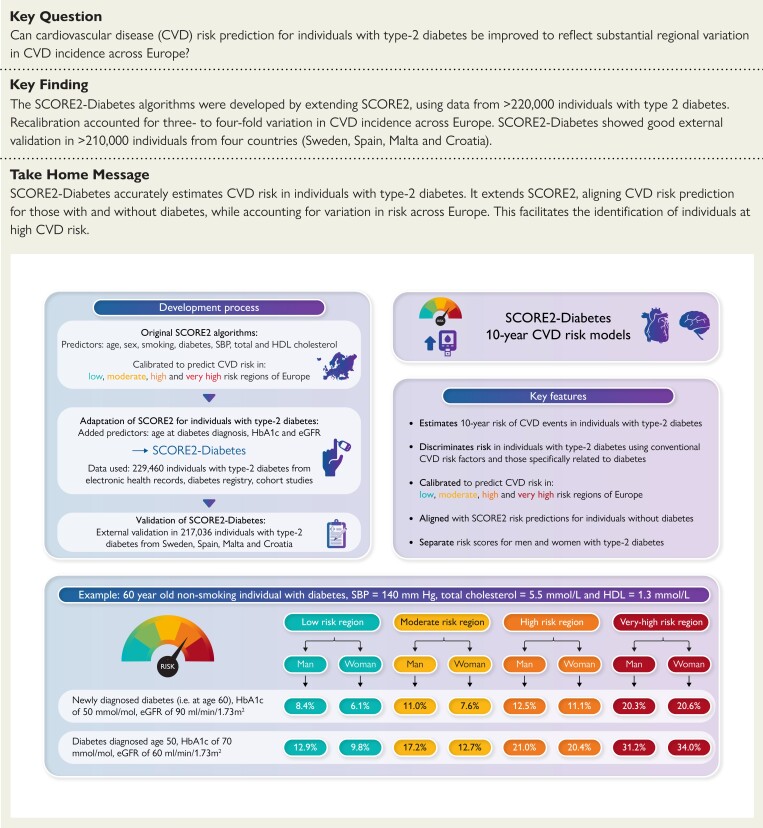
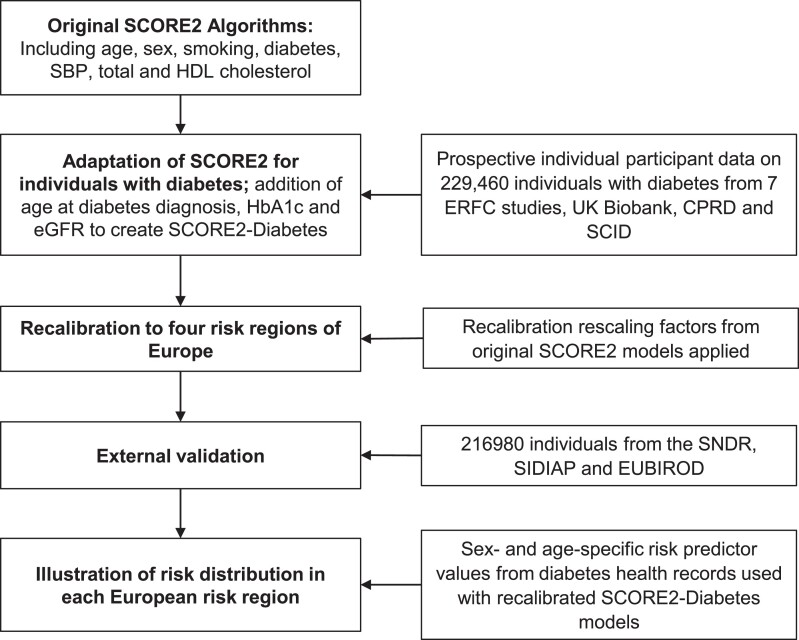
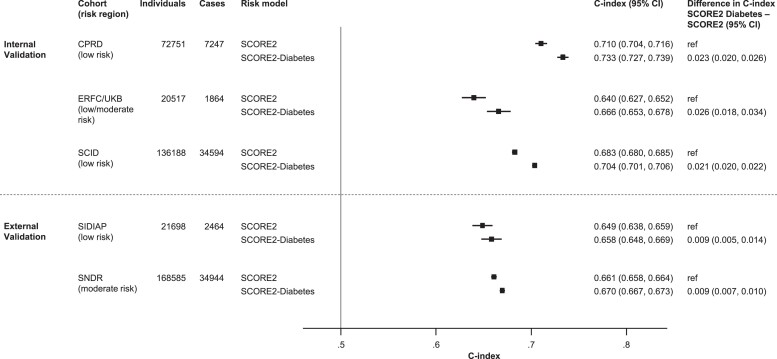
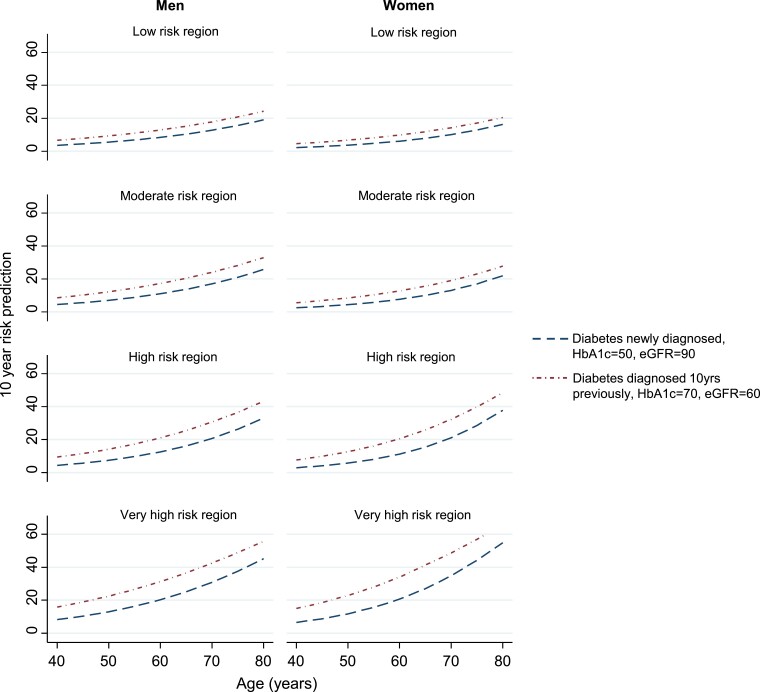
Aims: To develop and validate a recalibrated prediction model (SCORE2-Diabetes) to estimate the 10-year risk of cardiovascular disease (CVD) in individuals with type 2 diabetes in Europe. Methods and results: SCORE2-Diabetes was developed by extending SCORE2 algorithms using individual-participant data from four large-scale datasets comprising 229 460 participants (43 706 CVD events) with type 2 diabetes and without previous CVD. Sex-specific competing risk-adjusted models were used including conventional risk factors (i.e. age, smoking, systolic blood pressure, total, and HDL-cholesterol), as well as diabetes-related variables (i.e. age at diabetes diagnosis, glycated haemoglobin [HbA1c] and creatinine-based estimated glomerular filtration rate [eGFR]). Models were recalibrated to CVD incidence in four European risk regions. External validation included 217 036 further individuals (38 602 CVD events), and showed good discrimination, and improvement over SCORE2 (C-index change from 0.009 to 0.031). Regional calibration was satisfactory. SCORE2-Diabetes risk predictions varied several-fold, depending on individuals’ levels of diabetes-related factors. For example, in the moderate-risk region, the estimated 10-year CVD risk was 11% for a 60-year-old man, non-smoker, with type 2 diabetes, average conventional risk factors, HbA1c of 50 mmol/mol, eGFR of 90 mL/min/1.73 m2, and age at diabetes diagnosis of 60 years. By contrast, the estimated risk was 17% in a similar man, with HbA1c of 70 mmol/mol, eGFR of 60 mL/min/1.73 m2, and age at diabetes diagnosis of 50 years. For a woman with the same characteristics, the risk was 8% and 13%, respectively. Conclusion: SCORE2-Diabetes, a new algorithm developed, calibrated, and validated to predict 10-year risk of CVD in individuals with type 2 diabetes, enhances identification of individuals at higher risk of developing CVD across Europe.
Overview
The claims and statistics of this paper haven’t been checked yet.
Free: it reads the open-access text and checks the first 5 claims that cite a source we can check. Create a free account to check every claim.
Integrity signals
Registry
Cites
Statistics
Figures
Verification
Claims the paper makes
The claims and statistics of this paper haven’t been checked yet.
Free: it reads the open-access text and checks the first 5 claims that cite a source we can check. Create a free account to check every claim.
Claims other papers make about this one
Each is checked against this paper’s own text: does it say what the citing paper says it does?
In the citing paper
“SCORE2-Diabetes integrates information on conventional CVD risk factors (i.e.age, smoking status, systolic blood pressure [SBP], and total and high-density lipoprotein [HDL]-cholesterol) with diabetes-specific information (e.g.age at diabetes diagnosis, HbA1c, and eGFR).50”
From 2023 ESC guidelines for the management of cardiovascular disease in patients with diabetes. (2023) · cites this paper as [50]
Self-check
Percentages, sums and reported differences re-computed from the paper’s own numbers.
The self-check needs the paper’s full text.
Citations
Cites
Sudlow, C., Gallacher, J., Allen, N., Beral, V., Burton, P., Danesh, J., Downey, P., Elliott, P., Green, J., Landray, M., et al. (2015) · PLOS Medicine · doi:10.1371/journal.pmed.1001779 · Cited by 12,728 · cited 1×
“The UKB is a single large prospective cohort study with individual-participant data on approximately 500 000 participants aged over 40 years recruited across 23 UK-based assessment centres during 2006–10, and followed-up for cause-specific morbidity and mortality through linkages to routinely available national datase…”
Self-citation2021 ESC Guidelines on cardiovascular disease prevention in clinical practice
Visseren, F. L. J., Mach, F., Smulders, Y. M., Carballo, D., Koskinas, K. C., Bäck, M., Benetos, A., Biffi, A., Boavida, J.-M., Capodanno, D., et al. (2021) · European Heart Journal · doi:10.1093/eurheartj/ehab484 · Cited by 6,485
Self-citationThe Emerging Risk Factors Collaboration (2010) · The Lancet · doi:10.1016/s0140-6736(10)60484-9 · Cited by 5,125
2013 ACC/AHA Guideline on the Assessment of Cardiovascular Risk
Goff, D. C., Lloyd-Jones, D. M., Bennett, G., Coady, S., D’Agostino, R. B., Gibbons, R., Greenland, P., Lackland, D. T., Levy, D., O’Donnell, C. J., et al. (2014) · Journal of the American College of Cardiology · doi:10.1016/j.jacc.2013.11.005 · Cited by 4,945
New creatinine- and cystatin C-based equations to estimate GFR without race
Inker, L. A., Eneanya, N. D., Coresh, J., Tighiouart, H., Wang, D., Sang, Y., Crews, D. C., Doria, A., Estrella, M. M., Froissart, M., et al. (2021) · New England Journal of Medicine · doi:10.1056/nejmoa2102953 · Cited by 4,695
Self-citationGoff, D. C., Lloyd-Jones, D. M., Bennett, G., Coady, S., D’Agostino, R. B., Gibbons, R., Greenland, P., Lackland, D. T., Levy, D., O’Donnell, C. J., et al. (2014) · Circulation · doi:10.1161/01.cir.0000437741.48606.98 · Cited by 3,697 · cited 1×
“The discrimination ability reported for SCORE2-Diabetes, was somewhat lower than that previously reported for CVD risk scores in the general population.(4,5,37,38) However, higher C-indices are expected to be seen in general population cohorts given the wider age range and heterogeneity in risk factor values.”
ResultCollins, G. S., Reitsma, J. B., Altman, D. G., & Moons, K. G. M. (2015) · Annals of Internal Medicine · doi:10.7326/m14-0697 · Cited by 3,267
Data Resource Profile: Clinical Practice Research Datalink (CPRD)
Herrett, E., Gallagher, A. M., Bhaskaran, K., Forbes, H., Mathur, R., van Staa, T., & Smeeth, L. (2015) · International Journal of Epidemiology · doi:10.1093/ije/dyv098 · Cited by 2,667 · cited 2×
“3 million patients from 674 practices in the UK.(14) With 4.”
BackgroundInfluentialSCORE2 working group and ESC Cardiovascular risk collaboration, Hageman, S., Pennells, L., Ojeda, F., Kaptoge, S., Kuulasmaa, K., de Vries, T., Xu, Z., Kee, F., Chung, R., et al. (2021) · European Heart Journal · doi:10.1093/eurheartj/ehab309 · Cited by 1,810 · cited 1×
“First, SCORE2-Diabetes has been systematically recalibrated to four distinct European regions defined by varying CVD risk levels, using the most contemporary and representative CVD rates available.(12) This improves on previous CVD risk prediction models for individuals with diabetes which either have not incorporated…”
MethodSelf-citationHippisley-Cox, J., Coupland, C., & Brindle, P. (2017) · BMJ · doi:10.1136/bmj.j2099 · Cited by 1,703
Predicting cardiovascular risk in England and Wales: prospective derivation and validation of QRISK2
Hippisley-Cox, J., Coupland, C., Vinogradova, Y., Robson, J., Minhas, R., Sheikh, A., & Brindle, P. (2008) · BMJ · doi:10.1136/bmj.39609.449676.25 · Cited by 1,459 · cited 1×
“The discrimination ability reported for SCORE2-Diabetes, was somewhat lower than that previously reported for CVD risk scores in the general population.(4,5,37,38) However, higher C-indices are expected to be seen in general population cohorts given the wider age range and heterogeneity in risk factor values.”
ResultKaptoge, S., Pennells, L., De Bacquer, D., Cooney, M. T., Kavousi, M., Stevens, G., Riley, L. M., Savin, S., Khan, T., Altay, S., et al. (2019) · The Lancet Global Health · doi:10.1016/s2214-109x(19)30318-3 · Cited by 1,167
Self-citationAssociation of cardiometabolic multimorbidity with mortality
Di Angelantonio, E., Kaptoge, S., Wormser, D., Willeit, P., Butterworth, A. S., Bansal, N., O’Keeffe, L. M., Gao, P., Wood, A. M., Burgess, S., et al. (2015) · JAMA · doi:10.1001/jama.2015.7008 · Cited by 1,155
Self-citationEuropean Society of Cardiology: cardiovascular disease statistics 2021
Timmis, A., Vardas, P., Townsend, N., Torbica, A., Katus, H., De Smedt, D., Gale, C. P., Maggioni, A. P., Petersen, S. E., Huculeci, R., et al. (2022) · European Heart Journal · doi:10.1093/eurheartj/ehab892 · Cited by 1,102 · cited 2×
“Cardiovascular diseases (CVD) remain a major cause of morbidity and mortality in Europe with almost 13 million new cases recorded in 2019 alone.(1) Type 2 diabetes mellitus is a major risk factor for CVD.”
BackgroundSelf-citationThe UKPDS risk engine: a model for the risk of coronary heart disease in Type II diabetes (UKPDS 56)
STEVENS, R. J., KOTHARI, V., ADLER, A. I., & STRATTON, I. M. (2001) · Clinical Science · doi:10.1042/cs20000335 · Cited by 1,084 · cited 1×
“statistically adapted) to reflect the substantial variation in CVD rates across different European countries.(1,10,11) To address these limitations, the ESC has convened an effort to extend the regionally recalibrated European SCORE2 10-year risk models,(12) enabling use in individuals with type 2 diabetes.”
BackgroundMatsushita, K., Coresh, J., Sang, Y., Chalmers, J., Fox, C., Guallar, E., Jafar, T., Jassal, S. K., Landman, G. W. D., Muntner, P., et al. (2015) · The Lancet Diabetes & Endocrinology · doi:10.1016/s2213-8587(15)00040-6 · Cited by 903
Self-citationBatty, G. D., Gale, C. R., Kivimäki, M., Deary, I. J., & Bell, S. (2020) · BMJ · doi:10.1136/bmj.m131 · Cited by 635 · cited 1×
“However, while such biases can lead to misleading levels of absolute risk, relative risks are generally unaffected.(2,33,34) Furthermore, our analyses identified little heterogeneity in model coefficients across studies used in model derivation, suggesting transferability of model coefficients across different populat…”
BackgroundPrognostic Models With Competing Risks: Methods and Application to Coronary Risk Prediction
Wolbers, M., Koller, M. T., Witteman, J. C. M., & Steyerberg, E. W. (2009) · Epidemiology · doi:10.1097/ede.0b013e3181a39056 · Cited by 625 · cited 1×
“For validation, we assessed discrimination using Harrell’s C-index, adjusted for competing risk, 28 and examined improvement when comparing use of SCORE2-Diabetes vs. SCORE2.”
MethodSCORE2-OP working group and ESC Cardiovascular risk collaboration, de Vries, T. I., Cooney, M. T., Selmer, R. M., Hageman, S. H. J., Pennells, L. A., Wood, A., Kaptoge, S., Xu, Z., Westerink, J., et al. (2021) · European Heart Journal · doi:10.1093/eurheartj/ehab312 · Cited by 622 · cited 1×
“those with a family history of premature CVD, or in higher-risk socioeconomic and non-white ethnic groups) as well as in older age groups (those aged over 70 years) where additional consideration of multimorbidities and life expectancy may be needed.(9,36) While the SCORE2-Diabetes models are broadly applicable across…”
BackgroundSelf-citationThe National Diabetes Register in Sweden
Gudbjörnsdottir, S., Cederholm, J., Nilsson, P. M., Eliasson, B., & for the Steering Committee of the Swedish National Diabetes Register (2003) · Diabetes Care · doi:10.2337/diacare.26.4.1270 · Cited by 260
Self-citationBolíbar, B., Fina Avilés, F., Morros, R., del Mar Garcia-Gil, M., Hermosilla, E., Ramos, R., Rosell, M., Rodríguez, J., Medina, M., Calero, S., et al. (2012) · Medicina Clínica · doi:10.1016/j.medcli.2012.01.020 · Cited by 240 · cited 1×
“SIDIAP is a primary care electronic health records database managed by the Catalan Health Institute, covering around 75% of individuals (>5 million) in the Catalonia region of Spain across 328 primary care centres, and is representative of this population in terms of age, sex, and geographic distribution.(19,20) For t…”
MethodThe Emerging Risk Factors Collaboration (2007) · European Journal of Epidemiology · doi:10.1007/s10654-007-9165-7 · Cited by 188
Contemporary model for cardiovascular risk prediction in people with type 2 diabetes
Kengne, A. P., Patel, A., Marre, M., Travert, F., Lievre, M., Zoungas, S., Chalmers, J., Colagiuri, S., Grobbee, D. E., Hamet, P., et al. (2011) · European Journal of Cardiovascular Prevention & Rehabilitation · doi:10.1177/1741826710394270 · Cited by 183 · cited 2×
“Where data were available we compared SCORE2-Diabetes with the ADVANCE risk model for individuals with diabetes.(10) We use ADVANCE as a comparison as it is recommended by the 2021 ESC Guidelines on CVD prevention in clinical practice(3) and it is designed to predict CVD risk.”
BackgroundMethodPennells, L., Kaptoge, S., Wood, A., Sweeting, M., Zhao, X., White, I., Burgess, S., Willeit, P., Bolton, T., Moons, K. G. M., et al. (2019) · European Heart Journal · doi:10.1093/eurheartj/ehy653 · Cited by 164 · cited 2×
“extent of ‘calibration’).(37) We, therefore, ensured SCORE2-Diabetes was well-calibrated to current absolute risk levels for each European region.”
BackgroundResultSelf-citationBerkelmans, G. F. N., Gudbjörnsdottir, S., Visseren, F. L. J., Wild, S. H., Franzen, S., Chalmers, J., Davis, B. R., Poulter, N. R., Spijkerman, A. M., Woodward, M., et al. (2019) · European Heart Journal · doi:10.1093/eurheartj/ehy839 · Cited by 97 · cited 1×
“those with a family history of premature CVD, or in higher-risk socioeconomic and non-white ethnic groups) as well as in older age groups (those aged over 70 years) where additional consideration of multimorbidities and life expectancy may be needed.(9,36) While the SCORE2-Diabetes models are broadly applicable across…”
BackgroundSelf-citationDziopa, K., Asselbergs, F. W., Gratton, J., Chaturvedi, N., & Schmidt, A. F. (2022) · Diabetologia · doi:10.1007/s00125-021-05640-y · Cited by 96
Read, S. H., van Diepen, M., Colhoun, H. M., Halbesma, N., Lindsay, R. S., McKnight, J. A., McAllister, D. A., Pearson, E. R., Petrie, J. R., Philip, S., et al. (2018) · Diabetes Care · doi:10.2337/dc18-0578 · Cited by 67
Self-citationPrediction of Cardiovascular Disease Risk Accounting for Future Initiation of Statin Treatment
Xu, Z., Arnold, M., Stevens, D., Kaptoge, S. K., Pennells, L. A. M., Sweeting, M. J., Barrett, J., Angelantonio, E. D., & Wood, A. (2021) · American Journal of Epidemiology · doi:10.1093/aje/kwab031 · Cited by 51 · cited 1×
“However previous analyses have suggested that inclusion of information on statin initiation during follow-up provides only limited improvement in risk prediction.(35) Furthermore, comprehensive individual-participant data on medication use were unavailable in all data sources used for model development and recalibrati…”
BackgroundSelf-citationMata‐Cases, M., Mauricio, D., Real, J., Bolíbar, B., & Franch‐Nadal, J. (2016) · Endocrinología y Nutrición · doi:10.1016/j.endonu.2016.07.004 · Cited by 43
Self-citationCohort profile: National Diabetes Audit for England and Wales
Holman, N., Knighton, P., Wild, S. H., Sattar, N. A., Dew, C., Gregg, E. W., Khunti, K., Valabhji, J., & Young, B. (2021) · Diabetic Medicine · doi:10.1111/dme.14616 · Cited by 43 · cited 3×
“The NDA is an annually updated registry covering more than 98% of individuals with a recorded diabetes diagnosis from primary healthcare providers in England and Wales and specialist healthcare providers in England.”
BackgroundInfluentialSelf-citationDi Iorio, C. T., Carinci, F., Brillante, M., Azzopardi, J., Beck, P., Bratina, N., Cunningham, S. G., De Beaufort, C., Debacker, N., Jarosz-Chobot, P., et al. (2013) · The European Journal of Public Health · doi:10.1093/eurpub/cks043 · Cited by 38
Self-citationIorio, C. T. D., Carinci, F., Azzopardi, J. G., Baglioni, V., Beck, P., Cunningham, S. G., Evripidou, A., Leese, G., Loevaas, K. F., Olympios, G., et al. (2009) · Journal of Medical Ethics · doi:10.1136/jme.2009.029918 · Cited by 38
Self-citationCarinci, F., Brillante, M., Leese, G. P., McAlpine, R., Azzopardi, J. G., Beck, P., Bratina, N., Bocquet, V., Doggen, K., Jarosz-Chobot, P. A., et al. (2016) · Methods of Information in Medicine · doi:10.3414/me15-01-0016 · Cited by 36 · cited 1×
“In parallel to the analysis presented in this study, we have developed methods and statistical codes that will allow future validation and illustration of SCORE2-Diabetes in diabetes-specific registries as data becomes available.(21,22) Information on incident non-fatal HF and PAD were not uniformly recorded in availa…”
MethodSelf-citationIorio, C. T. D., Carinci, F., Oderkirk, J., Smith, D. L., Siano, M., de Marco, D. A., de Lusignan, S., Hämäläinen, P., & Benedetti, M. M. (2020) · Journal of Medical Ethics · doi:10.1136/medethics-2019-105948 · Cited by 35
Self-citationCarinci, F., Štotl, I., Cunningham, S. G., Poljičanin, T., Pristaš, I., Traynor, V., Olympios, G., Scoutellas, V., Azzopardi, J. G., Doggen, K., et al. (2021) · Frontiers in Clinical Diabetes and Healthcare · doi:10.3389/fcdhc.2021.744516 · Cited by 27 · cited 1×
“In parallel to the analysis presented in this study, we have developed methods and statistical codes that will allow future validation and illustration of SCORE2-Diabetes in diabetes-specific registries as data becomes available.(21,22) Information on incident non-fatal HF and PAD were not uniformly recorded in availa…”
MethodSelf-citationMcKnight, J. A., Morris, A. D., Cline, D., Peden, N. R., Fischbacher, C., Wild, S. H., & on behalf of The Scottish Diabetes Survey Monitoring Group (2008) · Diabetic Medicine · doi:10.1111/j.1464-5491.2008.02453.x · Cited by 25 · cited 1×
“SCID is a dynamic population-based register of people with a diagnosis of diabetes in Scotland that has had almost complete coverage since 2006.(13) CPRD is an ongoing primary care database of anonymised medical records from general practitioners, with coverage of over 11.”
BackgroundSelf-citation
Cited by
2024 ESC Guidelines for the management of elevated blood pressure and hypertension
McEvoy, J. W., McCarthy, C. P., Bruno, R. M., Brouwers, S., Canavan, M. D., Ceconi, C., Christodorescu, R. M., Daskalopoulou, S. S., Ferro, C. J., Gerdts, E., et al. (2024) · European Heart Journal · doi:10.1093/eurheartj/ehae178 · Cited by 2,298
“…while in the minority, some patients with type 2 diabetes aged 60 years may have 10-year CVD risk estimates of 10% by the SCORE2-Diabetes risk equation, 435 and in these cases, initiation of BP medication may be deferred to a BP of 140/90 mmHg in the absence of other high risk CVD conditions.”
Self-citation2023 ESC guidelines for the management of cardiovascular disease in patients with diabetes.
Marx, N., Federici, M., Schütt, K., Müller-Wieland, D., Ajjan, R. A., Antunes, M. J., Christodorescu, R. M., Crawford, C., Di Angelantonio, E., Eliasson, B., et al. (2023) · European Heart Journal · doi:10.1093/eurheartj/ehad192 · Cited by 1,642
Self-citationMartin, S. S., Aday, A. W., Allen, N. B., Almarzooq, Z. I., Anderson, C. A. M., Arora, P., Avery, C. L., Baker-Smith, C. M., Bansal, N., Beaton, A. Z., et al. (2025) · Circulation · doi:10.1161/cir.0000000000001303 · Cited by 1,080
MASLD: a systemic metabolic disorder with cardiovascular and malignant complications
Targher, G., Byrne, C. D., & Tilg, H. (2024) · Gut · doi:10.1136/gutjnl-2023-330595 · Cited by 897
Self-citation2025 Focused Update of the 2019 ESC/EAS Guidelines for the management of dyslipidaemias
Mach, F., Koskinas, K. C., Roeters van Lennep, J. E., Tokgözoğlu, L., Badimon, L., Baigent, C., Benn, M., Binder, C. J., Catapano, A. L., De Backer, G. G., et al. (2025) · European Heart Journal · doi:10.1093/eurheartj/ehaf190 · Cited by 688
Self-citation
Metadata
- Authors
- SCORE2-Diabetes Working Group and the ESC Cardiovascular Risk Collaboration, Pennells, L., Kaptoge, S., Østergaard, H. B., Read, S. H., Carinci, F., Franch-Nadal, J., Petitjean, C., Taylor, O., Hageman, S. H. J., Xu, Z., Shi, F., Spackman, S., Gualdi, S., Holman, N., Da Providencia E Costa, R. B., Bonnet, F., Brenner, H., Gillum, R. F., Kiechl, S., Lawlor, D. A., Potier, L., Schöttker, B., Sofat, R., Völzke, H., Willeit, J., Baltane, Z., Fava, S., Janos, S., Lavens, A., Pildava, S., Poljicanin, T., Pristas, I., Rossing, P., Sascha, R., Scheidt-Nave, C., Stotl, I., Tibor, G., Urbančič-Rovan, V., Vanherwegen, A.-S., Vistisen, D., Du, Y., Walker, M. R., Willeit, P., Ference, B., De Bacquer, D., Halle, M., Huculeci, R., McEvoy, J. W., Timmis, A., Vardas, P., Dorresteijn, J. A. N., Graham, I., Wood, A., Eliasson, B., Herrington, W., Danesh, J., Mauricio, D., Benedetti, M. M., Sattar, N., Visseren, F. L. J., Wild, S., Di Angelantonio, E., Balkau, B., Bonnet, F., Fumeron, F., Stocker, H., Holleczek, B., Schipf, S., Schmidt, C. O., Dörr, M., Tilg, H., Leitner, C., Notdurfter, M., Taylor, J., Dale, C., Prieto-Merino, D., Gillum, R. F., Lavens, A., Vanherwegen, A.-S., Poljicanin, T., Pristas, I., Buble, T., Ivanko, P., Rossing, P., Carstensen, B., Heidemann, C., Du, Y., Scheidt-Nave, C., Gall, T., Sandor, J., Baltane, Z., Pildava, S., Lepiksone, J., Magri, C. J., Azzopardi, J., Stotl, I., Real, J., Vlacho, B., & Mata-Cases, M.
- ORCID
- Pennells, Lisa
- Kaptoge, Stephen
- Read, Stephanie H
- Carinci, Fabrizio
- Petitjean, Carmen
- Hageman, Steven H J
- Xu, Zhe
- Shi, Fanchao
- Spackman, Sarah
- Holman, Naomi
- Brenner, Hermann
- Kiechl, Stefan
- Potier, Louis
- Schöttker, Ben
- Sofat, Reecha
- Völzke, Henry
- Willeit, Johann
- Fava, Stephen
- Vistisen, Dorte
- Walker, Matthew R
- Willeit, Peter
- De Bacquer, Dirk
- Halle, Martin
- Huculeci, Radu
- McEvoy, John William
- Timmis, Adam
- Dorresteijn, Jannick A N
- Graham, Ian
- Wood, Angela
- Eliasson, Björn
- Herrington, William
- Danesh, John
- Sattar, Naveed
- Visseren, Frank L J
- Wild, Sarah
- Di Angelantonio, Emanuele
- Balkau, Beverley
- Stocker, Hannah
- Schipf, Sabine
- Schmidt, Carsten Oliver
- Dörr, Marcus
- Tilg, Herbert
- Taylor, Julie
- Dale, Caroline
- Buble, Tamara
- Ivanko, Pero
- Carstensen, Bendix
- Heidemann, Christin
- Lepiksone, Jana
- Magri, Caroline J
- Azzopardi, Joseph
- Real, Jordi
- Vlacho, Bogdan
- Venue
- European Heart Journal
- Publisher
- Oxford University Press (OUP)
- Published
- 2023-05-29
- Volume
- 44
- Issue
- 28
- Pages
- 2544-2556
- ISSN
- 0195-668X (ISSN-L)
- 1522-9645
- PMC
- PMC10361012
- OpenAlex
- W4378746292
- Cited by
- 329
- References
- 38
- Citations by year
- 2026: 102 · 2025: 120 · 2024: 89 · 2023: 18
- FWCI
- 67.70
- Type
- journal article
- Language
- en
- Open access
- hybrid
- doi.org
- Licence
- Locations
- European Heart Journal (publishedVersion, cc-by-nc)
- PubMed Central (publishedVersion, cc-by-nc)
- PubMed (publishedVersion)
- Ghent University Academic Bibliography (Ghent University) (submittedVersion, cc-by-nc)
- Dipòsit Digital de Documents de la UAB (Universitat Autònoma de Barcelona) (submittedVersion, cc-by-nc)
- UCL Discovery (University College London) (submittedVersion, cc-by-nc)
- Lirias (KU Leuven) (submittedVersion, other-oa)
- Utrecht University Repository (Utrecht University) (submittedVersion, other-oa)
- Edinburgh Research Explorer (University of Edinburgh) (submittedVersion, cc-by-nc)
- Queen Mary Research Online (Queen Mary University of London) (submittedVersion, cc-by-nc)
- Funders
- British Heart Foundation (RG/13/13/30194, RG/18/13/33946)
- BHF Centre of Research Excellence (RE/18/1/34212)
- UK Medical Research Council (MR/L003120/1)
- National Institute for Health and Care Research (NIHR) Cambridge Biomedical Research Centre (BRC-1215–20014)
- NIHR
- British United Provident Association (BUPA) Foundation
- GlaxoSmithKline
- Topics
- Health Sciences › Medicine › Endocrinology, Diabetes and Metabolism › Diabetes, Cardiovascular Risks, and Lipoproteins
- Health Sciences › Medicine › Public Health, Environmental and Occupational Health › Health Promotion and Cardiovascular Prevention
- Health Sciences › Medicine › Endocrinology, Diabetes and Metabolism › Diabetes Treatment and Management
- Keywords
- cardiovascular risk prediction, type 2 diabetes, 10-year cardiovascular risk, SCORE2, HbA1c, estimated glomerular filtration rate, age at diabetes diagnosis, risk recalibration, external validation
- MeSH terms
- Heart Disease Risk Factors, Cardiovascular Diseases, Diabetes Mellitus, Type 2, Europe, Female, Glycated Hemoglobin, Humans, Male, Middle Aged, Risk Factors
About these checks
Registry, retraction, Cites and statistics results are computed, not judged, with one exception: a printed reference that no index lists is read once by a model before it counts as a citation error. Claims are extracted by a model and kept only when their quote appears verbatim in the text; each cited source is then checked, with a model’s help, for whether it says what the claim relies on. Those verdicts can be wrong — read the claim’s quote and the cited source before relying on one.
Statistics and arithmetic are recomputed, not judged.
Confidence bands are shown only for fields calibrated on our annotated test set. None is calibrated yet, so no band is shown.
What counts as a claim ›How we measure confidence ›How we check this ›
Are you an author, or do you see a problem with this page? Request a review
Data sources
Bibliographic data: Semantic Scholar, OpenAlex, Crossref.
Contains information from the Semantic Scholar Academic Graph Datasets, made available under the ODC Attribution License (ODC-BY 1.0).
Semantic Scholar’s data is described in: Kinney, R., et al. (2023). The Semantic Scholar Open Data Platform. arXiv:2301.10140.
