

The DOI matches its Crossref record; 22 of the 23 references it cites were found in a registry or an index.
Risk prediction by genetic risk scores for coronary heart disease is independent of self-reported family history
Open accessAbstract
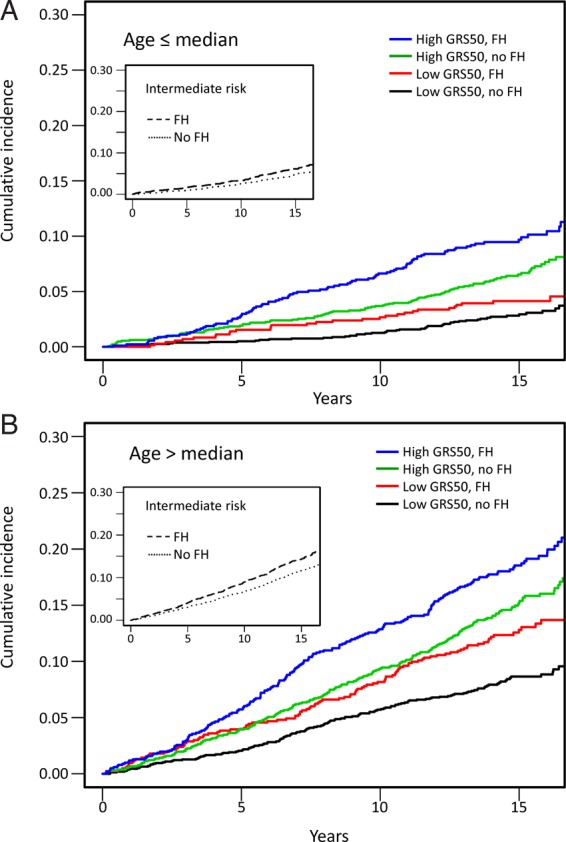
AIMS: Genetic risk scores (GRSs) have been associated with coronary heart disease (CHD) in large studies. We asked whether expanding an established 27-variant GRS (GRS27) to a 50-variant GRS (GRS50) improved CHD prediction and whether GRSs are independent of self-reported family history of CHD. METHODS AND RESULTS: The association between GRSs and incident CHD was assessed in Cox models adjusting for established risk factors in 23 595 participants of the Malmö Diet and Cancer study--a prospective, population-based study. During a median follow-up of 14.4 years, 2213 participants experienced a first CHD event. After adjustment for established risk factors, both GRS27 and GRS50 were associated with incident CHD [hazard ratio (HR) = 1.70 for high (top quintile) vs. low (bottom quintile) of GRS27; 95% confidence interval (CI): 1.48-1.94; Ptrend = 1.6 × 10(-15) and HR = 1.92 for GRS50; 95% CI: 1.67-2.20; Ptrend = 6.2 × 10(-22)]. Adding 23 single nucleotide polymorphisms (SNPs) to GRS27 improved risk prediction (P = 3 × 10(-6)). Further adjustment for self-reported family history did not appreciably change the risk estimates of either GRS27 (HR = 1.65; 95% CI: 1.45-1.89) or GRS50 (HR = 1.87; 95% CI: 1.63-2.14). The addition of GRS50 to established risk factors, including self-reported family history, improved discrimination (P < 0.0001) and reclassification (continuous net reclassification improvement index = 0.17, P < 0.0001). In young participants (below median age), those with high GRS50 had 2.4-fold greater risk (95% CI: 1.85-3.12) than those with low GRS50. CONCLUSION: The addition of 23 SNPs to an existing GRS27 improved CHD risk prediction and was independent of self-reported family history. Coronary heart disease risk assessment by GRS could be particularly useful in young individuals.
Overview
The claims and statistics of this paper haven’t been checked yet.
Run the check — free, no account needed. It reads the open-access text and checks the sources it cites.
Integrity signals
Registry
Cites
Statistics
Figures
Verification
Claims the paper makes
The claims and statistics of this paper haven’t been checked yet.
Run the check — free, no account needed. It reads the open-access text and checks the sources it cites.
Claims other papers make about this one
Each is checked against this paper’s own text: does it say what the citing paper says it does?
The cited source says what the claim attributes to it.
In the citing paper
“Our finding that a polygenic risk score has robust associations with incident coronary events is well aligned with previous studies of both primary and secondary prevention populations.16–24”
From Genetic Risk, Adherence to a Healthy Lifestyle, and Coronary Disease (2016) · cites this paper as [23]
In the citing paper
“GPSCAD performed substantially better than two previously published polygenic scores for coronary artery disease that included 50 and 49,310 variants, respectively (Supplementary Table 7 and Supplementary Fig. 1).17,18”
From Genome-wide polygenic scores for common diseases identify individuals with risk equivalent to monogenic mutations (2018) · cites this paper as [17]
In the citing paper
“These risk alleles, when aggregated into a polygenic risk score, are predictive of incident coronary events and provide a continuous and quantitative measure of genetic susceptibility.16–24”
From Genetic Risk, Adherence to a Healthy Lifestyle, and Coronary Disease (2016) · cites this paper as [23]
Self-check
Percentages, sums and reported differences re-computed from the paper’s own numbers.
The self-check needs the paper’s full text.
Citations
Cites
2013 ACCF/AHA Guideline for the Management of Heart Failure
Yancy, C. W., Jessup, M., Bozkurt, B., Butler, J., Casey, D. E., Drazner, M. H., Fonarow, G. C., Geraci, S. A., Horwich, T., Januzzi, J. L., et al. (2013) · Journal of the American College of Cardiology · doi:10.1016/j.jacc.2013.05.019 · Cited by 12,536
European Guidelines on cardiovascular disease prevention in clinical practice (version 2012)
Authors/Task Force Members:, Perk, J., De Backer, G., Gohlke, H., Graham, I., Reiner, Ž., Verschuren, M., Albus, C., Benlian, P., Boysen, G., et al. (2012) · European Heart Journal · doi:10.1093/eurheartj/ehs092 · Cited by 8,490
Heart Disease and Stroke Statistics—2014 Update
Go, A. S., Mozaffarian, D., Roger, V. L., Benjamin, E. J., Berry, J. D., Blaha, M. J., Dai, S., Ford, E. S., Fox, C. S., Franco, S., et al. (2013) · Circulation · doi:10.1161/01.cir.0000441139.02102.80 · Cited by 5,264
2013 ACC/AHA Guideline on the Assessment of Cardiovascular Risk
Goff, D. C., Lloyd-Jones, D. M., Bennett, G., Coady, S., D’Agostino, R. B., Gibbons, R., Greenland, P., Lackland, D. T., Levy, D., O’Donnell, C. J., et al. (2014) · Journal of the American College of Cardiology · doi:10.1016/j.jacc.2013.11.005 · Cited by 4,945
European guidelines on cardiovascular disease prevention in clinical practice: executive summary
Graham, I., Atar, D., Borch‐Johnsen, K., Boysen, G., Burell, G. K., Cífková, R., Dallongeville, J., Backer, G. D., Ebrahim, S. B. J., Gjelsvik, B., et al. (2007) · European Heart Journal · doi:10.1093/eurheartj/ehm316 · Cited by 3,865
Large-scale association analysis identifies new risk loci for coronary artery disease
The CARDIoGRAMplusC4D Consortium, Deloukas, P., DIAGRAM Consortium, CARDIOGENICS Consortium, MuTHER Consortium, Wellcome Trust Case Control Consortium, Kanoni, S., Willenborg, C., Farrall, M., Assimes, T. L., et al. (2013) · Nature Genetics · doi:10.1038/ng.2480 · Cited by 1,614
Self-citationGenetic Susceptibility to Death from Coronary Heart Disease in a Study of Twins
Marenberg, M. E., RISCH, N. J., Berkman, L. F., Floderus, B., & Fairé, U. D. (1994) · New England Journal of Medicine · doi:10.1056/nejm199404143301503 · Cited by 1,256
Yeboah, J., McClelland, R. L., Polonsky, T. S., Burke, G. L., Sibley, C. T., O’Leary, D., Carr, J. J., Goff, D. C., Greenland, P., & Herrington, D. M. (2012) · JAMA · doi:10.1001/jama.2012.9624 · Cited by 1,122
Parental Cardiovascular Disease as a Risk Factor for Cardiovascular Disease in Middle-aged Adults
Lloyd‐Jones, D. M., Nam, B., D’Agostino, R. B., Levy, D. A., Murabito, J. M., Wang, T. J., Wilson, P. W. F., & O’Donnell, C. J. (2004) · JAMA · doi:10.1001/jama.291.18.2204 · Cited by 833
Mega, J. L., Stitziel, N. O., Smith, J. G., Chasman, D. I., Caulfield, M. J., Devlin, J. J., Nordio, F., Hyde, C. L., Cannon, C. P., Sacks, F. M., et al. (2015) · The Lancet · doi:10.1016/s0140-6736(14)61730-x · Cited by 704
Self-citationPolymorphisms Associated with Cholesterol and Risk of Cardiovascular Events
Kathiresan, S., Melander, O., Anevski, D., Guiducci, C., Burtt, N. P., Roos, C., Hirschhorn, J. N., Berglund, G., Hedblad, B., Groop, L., et al. (2008) · New England Journal of Medicine · doi:10.1056/nejmoa0706728 · Cited by 696
Self-citationBerglund, G., Elmståhl, S., Janzon, L., & LARSSON, S. A. (1993) · Journal of Internal Medicine · doi:10.1111/j.1365-2796.1993.tb00647.x · Cited by 640
Ripatti, S., Tikkanen, E., Orho-Melander, M., Havulinna, A. S., Silander, K., Sharma, A., Guiducci, C., Perola, M., Jula, A., Sinisalo, J., et al. (2010) · The Lancet · doi:10.1016/s0140-6736(10)61267-6 · Cited by 562
Self-citationNew susceptibility locus for coronary artery disease on chromosome 3q22.3
Italian Atherosclerosis, T., Erdmann, J., Myocardial Infarction Genetics Consortium, Wellcome Trust Case Control Consortium, Cardiogenics Consortium, Großhennig, A., Braund, P. S., König, I. R., Hengstenberg, C., Hall, A. S., et al. (2009) · Nature Genetics · doi:10.1038/ng.307 · Cited by 484
Self-citationEuropean Cardiovascular Disease Statistics 2012
Nichols, M. S., Townsend, N. P., Luengo-Fernández, R., Leal, J. L., Gray, A. G., Scarborough, P., & Rayner, M. (2012) · Bristol Research (University of Bristol) · Cited by 380
Smith, J. G., Platonov, P. G., Hedblad, B., Engström, G., & Melander, O. (2010) · European Journal of Epidemiology · doi:10.1007/s10654-009-9404-1 · Cited by 275
Self-citationSibling Cardiovascular Disease as a Risk Factor for Cardiovascular Disease in Middle-aged Adults
Murabito, J. M. (2005) · JAMA · doi:10.1001/jama.294.24.3117 · Cited by 271
Multilocus Genetic Risk Scores for Coronary Heart Disease Prediction
Ganna, A., Magnusson, P. K. E., Pedersen, N. L., de Faire, U., Reilly, M., Ärnlöv, J., Sundström, J., Hamsten, A., & Ingelsson, E. (2013) · Arteriosclerosis, Thrombosis, and Vascular Biology · doi:10.1161/atvbaha.113.301218 · Cited by 156
Shah, S. H., Casas, J. P., Gaunt, T. R., Cooper, J. A., Drenos, F., Zabaneh, D., Swerdlow, D. I., Shah, T., Sofat, R., Palmen, J., et al. (2012) · European Heart Journal · doi:10.1093/eurheartj/ehs243 · Cited by 38
Improving Assessment of Cardiovascular Disease Risk by Using Family History
Kashani, M., Eliasson, A. H., Vernalis, M., Costa, L. M., & Terhaar, M. F. (2013) · The Journal of Cardiovascular Nursing · doi:10.1097/jcn.0b013e318294b206 · Cited by 27
A multilocus genetic risk score predicts coronary heart disease risk in a Chinese Han population
Gui, L., Wu, F., Han, X., Dai, X., Qiu, G., Li, J., Wang, J., Zhang, X., Wu, T., & He, M. (2014) · Atherosclerosis · doi:10.1016/j.atherosclerosis.2014.09.032 · Cited by 24
Yiannakouris, N., Katsoulis, M., Trichopoulou, A., Ordovás, J. M., & Trichopoulos, D. (2014) · BMJ Open · doi:10.1136/bmjopen-2013-004387 · Cited by 20
Cited by
Sorted by citations
Heart Disease and Stroke Statistics—2020 Update: A Report From the American Heart Association
Virani, S. S., Alonso, A., Benjamin, E. J., Bittencourt, M. S., Callaway, C. W., Carson, A. P., Chamberlain, A. M., Chang, A. R., Cheng, S., Delling, F. N., et al. (2020) · Circulation · doi:10.1161/cir.0000000000000757 · Cited by 9,175
Heart Disease and Stroke Statistics—2019 Update: A Report From the American Heart Association
Benjamin, E. J., Muntner, P., Alonso, A., Bittencourt, M. S., Callaway, C. W., Carson, A. P., Chamberlain, A. M., Chang, A. R., Cheng, S., Das, S. R., et al. (2019) · Circulation · doi:10.1161/cir.0000000000000659 · Cited by 9,036
2019 ESC Guidelines for the diagnosis and management of chronic coronary syndromes
Knuuti, J., Wijns, W., Saraste, A., Capodanno, D., Barbato, E., Funck-Brentano, C., Prescott, E., Storey, R. F., Deaton, C., Cuisset, T., et al. (2020) · European Heart Journal · doi:10.1093/eurheartj/ehz425 · Cited by 7,166
Heart disease and stroke statistics-2018 update: a report from the american heart association
Benjamin, E. J., Virani, S. S., Callaway, C. W., Chamberlain, A. M., Chang, A. R., Cheng, S., Chiuve, S. E., Cushman, M., Delling, F. N., Deo, R., et al. (2018) · Circulation · doi:10.1161/cir.0000000000000558 · Cited by 7,146
Heart Disease and Stroke Statistics—2021 Update: A Report From the American Heart Association
Virani, S. S., Alonso, A., Aparicio, H. J., Benjamin, E. J., Bittencourt, M. S., Callaway, C. W., Carson, A. P., Chamberlain, A. M., Cheng, S., Delling, F. N., et al. (2021) · Circulation · doi:10.1161/cir.0000000000000950 · Cited by 5,784
Metadata
- Authors
- Tada, H., Melander, O., Louie, J. Z., Catanese, J. J., Rowland, C. M., Devlin, J. J., Kathiresan, S., & Shiffman, D.
- Affiliations
- Broad Institute (US)
- Lund University (SE)
- Quest Diagnostics (United States) (US)
- Corresponding author
- Melander, Olle
- Kathiresan, Sekar
- Shiffman, Dov
- Venue
- European Heart Journal
- Publisher
- Oxford University Press (OUP)
- Published
- 2015-09-20
- Volume
- 37
- Issue
- 6
- Pages
- 561-567
- ISSN
- 0195-668X (ISSN-L)
- 1522-9645
- PMC
- PMC4744619
- OpenAlex
- W1874197506
- Cited by
- 285
- References
- 23
- Citations by year
- 2026: 7 · 2025: 20 · 2024: 20 · 2023: 31 · 2022: 34 · 2021: 33 · 2020: 30 · 2019: 32 · 2018: 29 · 2017: 29 · 2016: 19 · 2015: 1
- FWCI
- 17.77
- Type
- journal article
- Language
- en
- Open access
- hybrid
- doi.org
- Licence
- cc-by-nc
- Locations
- European Heart Journal (publishedVersion, cc-by-nc)
- PubMed Central (publishedVersion, cc-by-nc)
- PubMed (publishedVersion)
- Digital Access to Scholarship at Harvard (DASH) (Harvard University) (submittedVersion, cc-by)
- Lund University Publications (Lund University) (submittedVersion)
- HighWire Press Open Archive (submittedVersion)
- Funders
- Swedish Cancer Society
- Swedish Medical Research Council
- Swedish Dairy Association
- Albert Påhlsson and Gunnar Nilsson Foundations
- Malmö city council
- Japanese Circulation Society
- Massachusetts General Hospital (MGH)
- MGH
- Donovan Family Foundation
- European Research Council (StG-282255)
- Swedish Heart and Lung Foundation
- Swedish Research Council
- Novo Nordisk Foundation
- Skåne University Hospital
- Medical Faculty, Lund University;
- Albert Påhlsson Research Foundation, Region Skåne
- King Gustav V and Queen Victoria
- Foundation
- Marianne and Marcus Wallenberg Foundation
- Topics
- Life Sciences › Biochemistry, Genetics and Molecular Biology › Genetics › Genetic Associations and Epidemiology
- Life Sciences › Biochemistry, Genetics and Molecular Biology › Genetics › Nutrition, Genetics, and Disease
- Life Sciences › Biochemistry, Genetics and Molecular Biology › Genetics › Genetics and Physical Performance
- Keywords
- coronary artery disease, polygenic risk score, single nucleotide polymorphisms, family history (medicine), risk prediction, risk reclassification, net reclassification improvement, incident cardiovascular events, young adults, Malmö Diet and Cancer Study, cardiovascular risk factors, discrimination (statistics)
- MeSH terms
- Aged, Coronary Artery Disease, Epidemiologic Methods, Female, Humans, Male, Middle Aged, Pedigree, Sweden, Age Distribution, Genetic Predisposition to Disease, Polymorphism, Single Nucleotide
About these checks
Registry, retraction, Cites and statistics results are computed, not judged, with one exception: a printed reference that no index lists is read once by a model before it counts as a citation error. Claims are extracted by a model and kept only when their quote appears verbatim in the text; each cited source is then checked, with a model’s help, for whether it says what the claim relies on. Those verdicts can be wrong — read the claim’s quote and the cited source before relying on one.
Statistics and arithmetic are recomputed, not judged.
Confidence bands are shown only for fields calibrated on our annotated test set. None is calibrated yet, so no band is shown.
What counts as a claim ›How we measure confidence ›How we check this ›
Are you an author, or do you see a problem with this page? Request a review
