

2018 ESC Guidelines for the diagnosis and management of syncope
Open accessThe DOI matches its Crossref record; 482 of the 483 references it cites were found in a registry or an index, and 1 are not checked yet; 231 of the 582 sources its claims cite were checked for support.
Abstract
The Task Force for the diagnosis and management of syncope of the European Society of Cardiology (ESC) Developed with the special contribution of the European Heart Rhythm Association (EHRA) Endorsed by: European Academy of Neurology (EAN), European Federation of Autonomic Societies (EFAS), European Federation of Internal Medicine (EFIM), European Union Geriatric Medicine Society (EUGMS), European Society of Emergency Medicine (EuSEM) The disclosure forms of all experts involved in the development of these Guidelines are available on the ESC website http://www.escardio.org/guidelines. For the Supplementary Data which include background information and detailed discussion of the data that have provided the basis for the Guidelines see https://academic.oup.com/eurheartj/article-lookup/doi/10.1093/eurheartj/ehy037#supplementary-data Click here to access the corresponding chapter in ESC CardioMed - Section 39 Syncope ... ... Guidelines summarize and evaluate available evidence with the aim of assisting health professionals in selecting the best management strategies for an individual patient with a given condition. Guidelines and their recommendations should facilitate decision making of health professionals in their daily practice. However, the final decisions concerning an individual patient must be made by the responsible health professional(s) in consultation with the patient and caregiver as appropriate.
Verified 2026-11-25 · 1 reference not checked yet
Overview
CoChat Summary
TL;DR
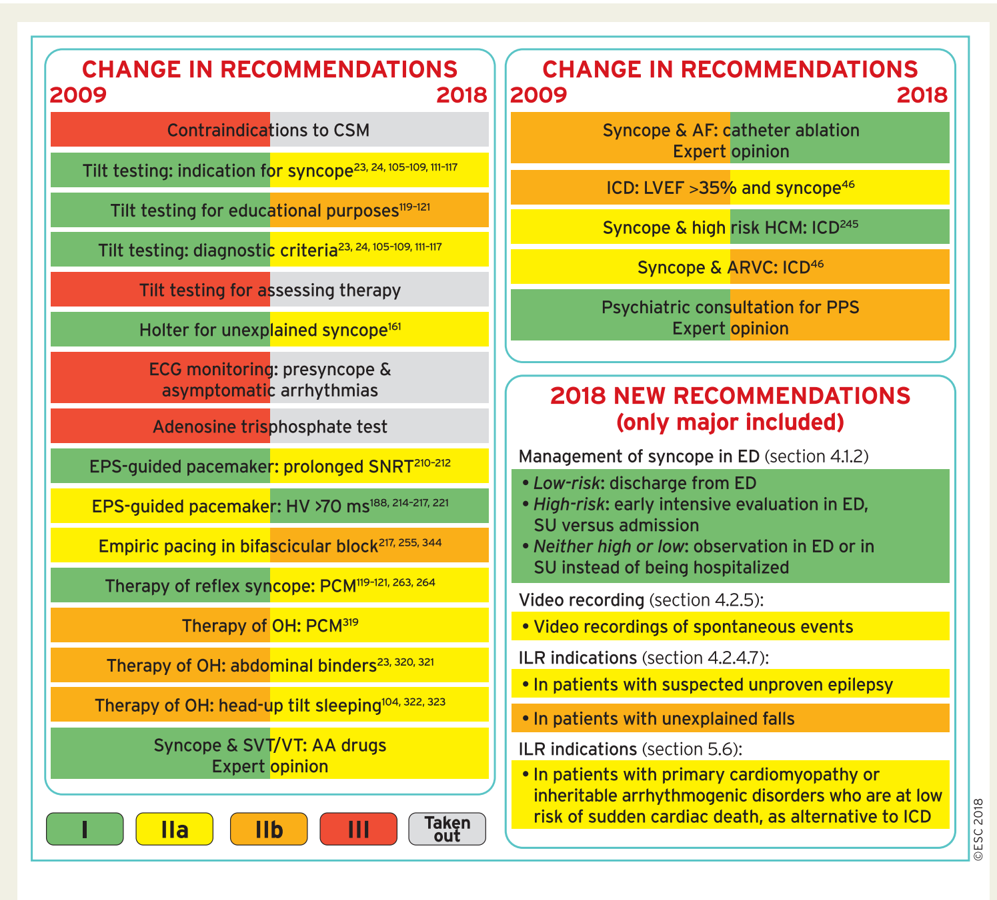
These 2018 ESC Guidelines provide a multidisciplinary, evidence-graded framework for diagnosing and managing syncope and transient loss of consciousness (TLOC), emphasizing initial evaluation, risk stratification, and mechanism-guided therapy. They update prior versions with new/revised concepts including prolonged ECG monitoring, syncope units, tilt-testing as hypotensive susceptibility, and refined pacing/ICD indications.
Key findings
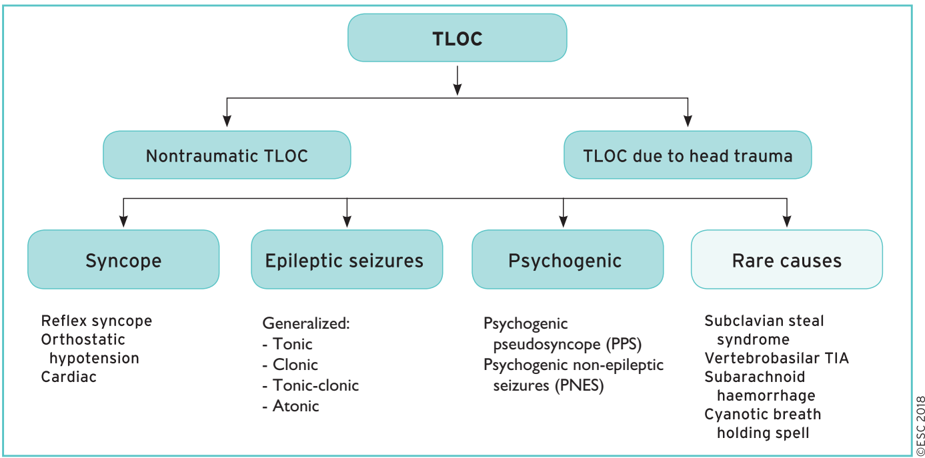
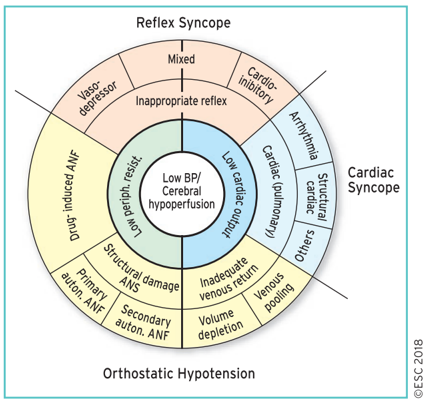
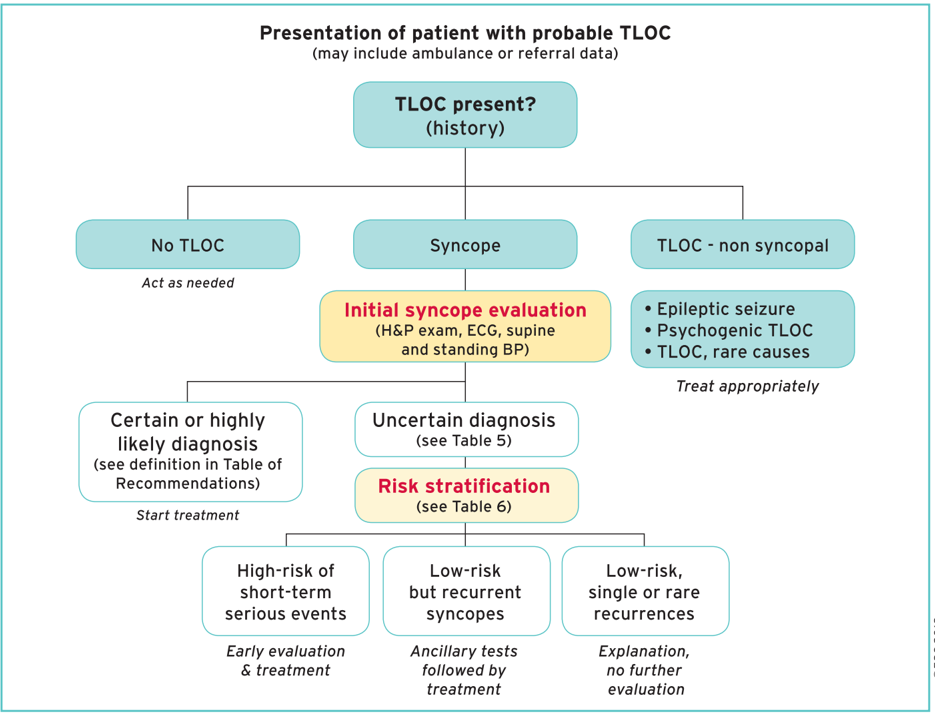
- Syncope is defined as TLOC due to cerebral hypoperfusion with rapid onset, short duration, and spontaneous complete recovery; initial evaluation (history, physical examination including standing blood pressure, and ECG) can differentiate syncope from other forms of TLOC in approximately 60% of cases.
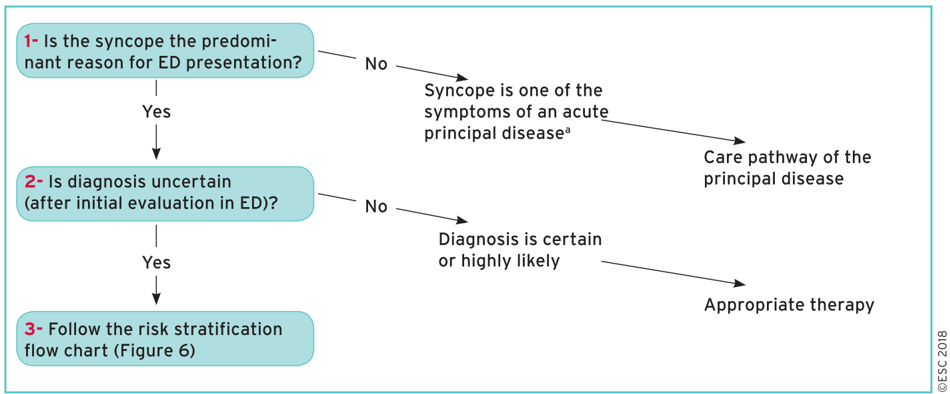
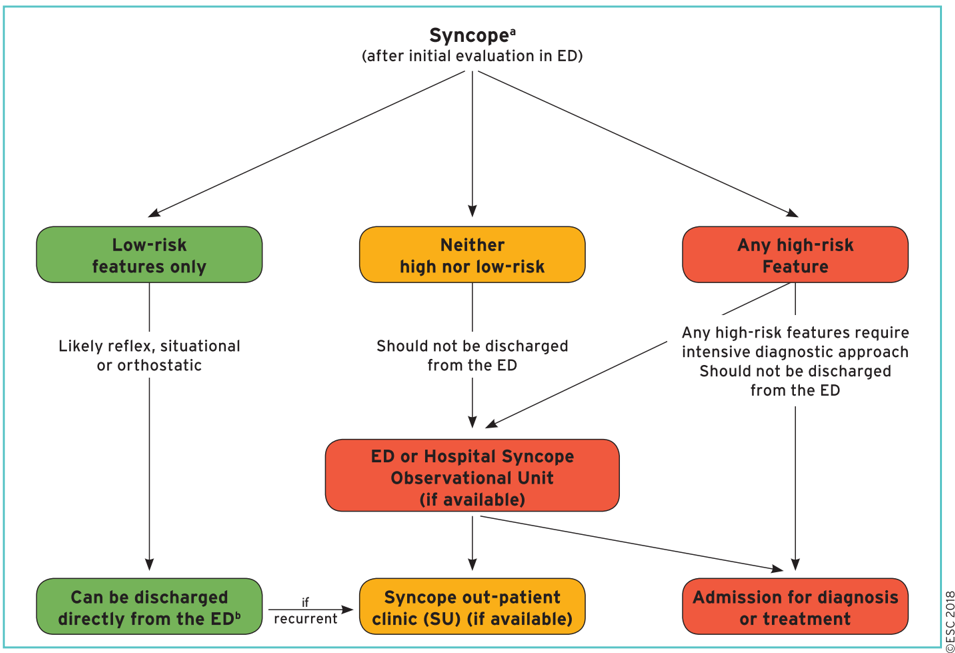
- In the emergency department, approximately 50% of syncope patients are admitted (range 12–86%), but composite outcomes in the next 7–30 days include 0.8% death, 6.9% non-fatal severe outcome while in the ED, and another 3.6% post-ED serious outcome; risk stratification scores perform no better than clinical judgment and should not be used alone.
- Implantable loop recorder (ILR) use in unexplained syncope: a meta-analysis of five RCTs in 660 patients showed a 3.7-fold (95% CI 2.7–5.0) increased relative probability of diagnosis versus conventional strategy; pooled data from nine studies in 506 patients found syncope–ECG correlation in 35%, with asystole/bradycardia in 56%, tachycardia in 11%, and no arrhythmia in 33%.
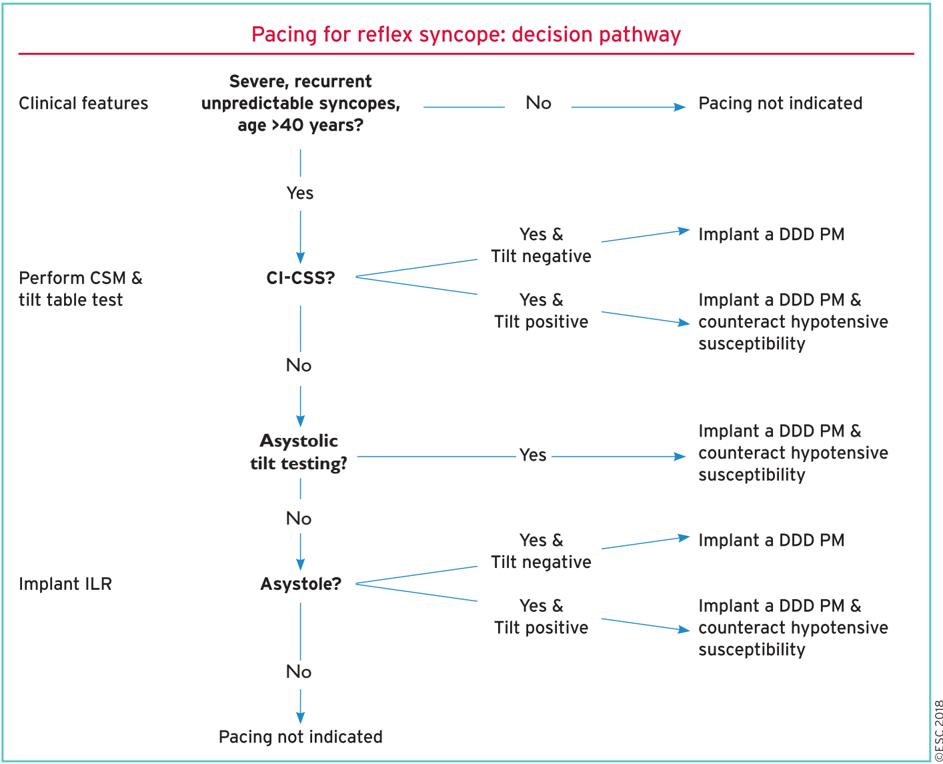
- Treatment recommendations include education/lifestyle modification for reflex syncope; physical counter-pressure manoeuvres reduced recurrence in the PC-Trial (223 patients, relative risk reduction 39%, 95% CI 11–53); beta-blockers are not indicated (Class III, Level A); cardiac pacing for documented asystolic reflex syncope reduced 2-year recurrence from 57% (pacemaker off) to 25% (pacemaker on) in ISSUE-3; fludrocortisone in POST 2 showed a marginal non-significant reduction (hazard ratio 0.69, 95% CI 0.46–1.03; P=0.069; 44% vs 60.5% syncope at 12 months).
Methods
- Design: clinical practice guideline developed by the ESC Task Force for the diagnosis and management of syncope, with special contribution from the European Heart Rhythm Association and endorsement by multiple societies.
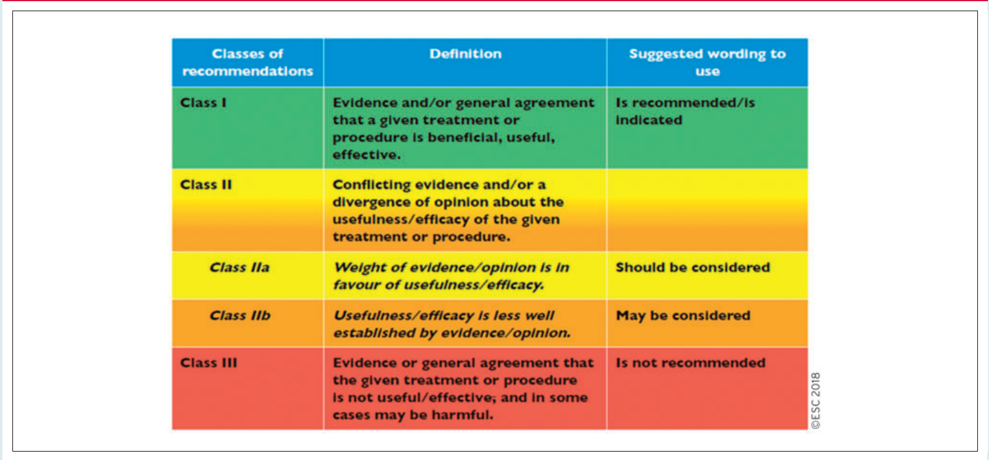
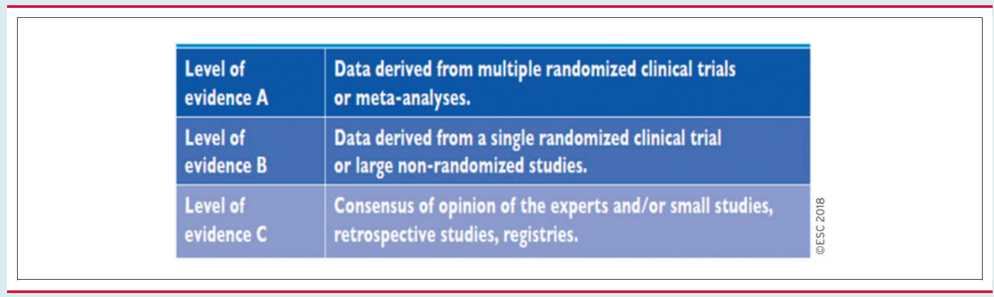
- Data/sample: no primary study sample; the Task Force performed a comprehensive review of published evidence, including randomized trials, observational studies, registries, and consensus documents, and graded recommendations using ESC Classes of recommendations (I–III) and Levels of evidence (A–C).
- Main analysis: evidence synthesis and expert consensus, with practical algorithms and care pathways for initial evaluation, emergency department risk stratification, diagnostic testing, treatment, syncope units, and special populations.
Limitations
- The paper states that many recommendations rely on moderate or weak evidence and consensus rather than large randomized trials; examples include pacing in carotid sinus syndrome, tilt-induced vasovagal syncope, and adenosine-sensitive syncope, where it notes “lack of large RCTs,” “contrasting results,” and “divergence of opinion.”
- The paper explicitly notes diagnostic limitations: tilt testing “offers little diagnostic value in patients for whom it is most needed,” risk stratification scores “perform no better than good clinical judgement,” EPS has a low negative predictive value, and ECG monitoring cannot record blood pressure alongside ECG.
- Evident from the text: this is a guideline document, not a primary empirical study, and it includes a section on “Gaps in evidence and areas for future research”; the provided text is also truncated, so some later sections and supplementary details are not fully available here.
Model-written summary of a shortened version of the paper’s full text (it is longer than we read). Check it against the paper before relying on it.
Integrity signals
Registry
Cites
Statistics
Figures
Verification
Claims the paper makes
151 Valid · 22 Not valid · 111 Not checked · 74 Own results and interpretations
Some cited sources support this claim and some don’t — read each source’s verdict below.
In the paper
“There is strong consensus that the diagnosis of CSS requires both the reproduction of spontaneous symptoms during CSM and clinical features of spontaneous syncope compatible with a reflex mechanism.”
What the sources say
- Not checked — no full text of the sourcecites [89] Kerr SR, Pearce MS, Brayne C, Davis RJ, Kenny RA. Carotid sinus hypersensitivity in asymptomatic older persons: implications for diagnosis of syncope and falls. Arch Intern Med 2006; 166 :515-520. source
- Not checked — no full text of the sourcecites [90] Puggioni E, Guiducci V, Brignole M, Menozzi C, Oddone D, Donateo P, Croci F, Solano A, Lolli G, Tomasi C, Bottoni N. Results and complications of the carotid sinus massage performed according to the 'method of symptoms'. Am J Cardiol 2002; 89 :599-601. source
- Partly supportedcites [92] Solari D, Maggi R, Oddone D, Solano A, Croci F, Donateo P, Brignole M. Clinical context and outcome of carotid sinus syndrome diagnosed by means of the 'method of symptoms'. Europace 2014; 16 :928-934. sourceExperimental — accuracy not yet measured
The Methods state that, under the ‘method of symptoms,’ CSS was diagnosed when carotid sinus massage reproduced spontaneous syncope or pre-syncope in the presence of carotid sinus hypersensitivity; the Discussion likewise says symptom reproduction is required. Our copy does not state that clinical features of spontaneous syncope compatible with a reflex mechanism are an additional requirement. The Results also include 14 diagnosed patients who had pre-syncope only. (LLM, conf=0.86)
- Partly supportedcites [93] Solari D, Maggi R, Oddone D, Solano A, Croci F, Donateo P, Wieling W, Brignole M. Assessment of the vasodepressor reflex in carotid sinus syndrome. Circ Arrhythm Electrophysiol 2014; 7 :505-510. sourceExperimental — accuracy not yet measured
The Methods (page unavailable) state that CSS was diagnosed when carotid sinus massage reproduced spontaneous syncope or presyncope in the presence of carotid sinus hypersensitivity. They do not state that clinical features compatible with a reflex mechanism are an additional diagnostic requirement; the study included patients whose syncope remained unexplained after initial evaluation. (LLM, conf=0.86)
- Not checked — no full text of the sourcecites [98] Brignole M, Menozzi C, Lolli G, Bottoni N, Gaggioli G. Long-term outcome of paced and nonpaced patients with severe carotid sinus syndrome. Am J Cardiol 1992; 69 :1039-1043. source
- Disputedcites [99] Claesson JE, Kristensson BE, Edvardsson N, Wahrborg P. Less syncope and milder symptoms in patients treated with pacing for induced cardioinhibitory carotid sinus syndrome: a randomized study. Europace 2007; 9 :932-936. sourceExperimental — accuracy not yet measured
The Definitions section says cardioinhibitory carotid sinus syndrome may be diagnosed even when a close relationship between carotid-sinus manipulation and syncope has not been demonstrated. That contradicts the claim that reproducing spontaneous symptoms during massage is required. The Introduction also notes continuing controversy rather than strong consensus. Page numbers are unavailable in our copy. (LLM, conf=0.88)
Checked by a reasoning model — may be wrong.
- Not checked — no full text of the sourcecites [100] Menozzi C, Brignole M, Lolli G, Bottoni N, Oddone D, Gianfranchi L, Gaggioli G. Follow-up of asystolic episodes in patients with cardioinhibitory, neurally mediated syncope and VVI pacemaker. Am J Cardiol 1993; 72 :1152-1155. source
- Not checked yetcites [101] Maggi R, Menozzi C, Brignole M, Podoleanu C, Iori M, Sutton R, Moya A, Giada F, Orazi S, Grovale N. Cardioinhibitory carotid sinus hypersensitivity predicts an asystolic mechanism of spontaneous neurally mediated syncope. Europace 2007; 9 :563-567. source
Checked before — its earlier verdict is held back until a new check runs.
- Not checked — no full text of the sourcecites [102] Thomas JE. Hyperactive carotid sinus reflex and carotid sinus syncope. Mayo Clin Proc 1969; 44 :127-139. doi:10.1016/s0025-6196(25)05256-5
boosted- Asserted: passes — The authors put it forward as true.
- Checkable: passes — It can be checked against evidence.
- Load-bearing: passes — The paper’s conclusions depend on it.
- Based: passes — The paper gives a reason why it holds.
At least one cited source doesn’t support this claim or points to a different paper, and none confirmed it — see the verdicts below.
In the paper
“A positive cardioinhibitory response to tilt testing predicts, with high probability, asystolic spontaneous syncope; this finding is relevant for therapeutic implications when cardiac pacing is considered (see section 5.2.6).”
What the sources say
- Disputedcites [122] Deharo JC, Jego C, Lanteaume A, Djiane P. An implantable loop recorder study of highly symptomatic vasovagal patients: the heart rhythm observed during a spontaneous syncope is identical to the recurrent syncope but not correlated with the head-up tilt test or adenosine triphosphate test. J Am Coll Cardiol 2006; 47 :587-593. sourceExperimental — accuracy not yet measured
The Discussion states that the response during head-up tilt testing was not predictive of the mechanism of spontaneous syncope. It reports spontaneous syncope without severe bradycardia in two of four patients with a type 2 tilt response, contrary to the claimed high-probability prediction of asystole. The paper instead discusses documented rhythm during spontaneous syncope as relevant to pacing decisions (Discussion, p. 591). (LLM, conf=0.94)
Checked by a reasoning model — may be wrong.
- Not checked — no full text of the sourcecites [123] Brignole M, Sutton R, Menozzi C, Garcia-Civera R, Moya A, Wieling W, Andresen D, Benditt DG, Grovale N, De Santo T, Vardas P, International Study on Syncope of Uncertain Etiology 2 (ISSUE 2) Group. Lack of correlation between the responses to tilt testing and adenosine triphosphate test and the mechanism of spontaneous neurally mediated syncope. Eur Heart J 2006; 27 :2232-2239. source
boostedstates an association- Asserted: passes — The authors put it forward as true.
- Checkable: passes — It can be checked against evidence.
- Load-bearing: passes — The paper’s conclusions depend on it.
- Based: passes — The paper gives a reason why it holds.
- Disputed
At least one cited source doesn’t support this claim or points to a different paper, and none confirmed it — see the verdicts below.
In the paper
“While a positive cardioinhibitory response to tilt testing predicts, with a high probability, an asystolic spontaneous syncope, the presence of a positive vasodepressor, mixed response, or even a negative response, does not exclude the presence of asystole during spontaneous syncope. 122,123”
What the sources say
- Disputedcites [122] Deharo JC, Jego C, Lanteaume A, Djiane P. An implantable loop recorder study of highly symptomatic vasovagal patients: the heart rhythm observed during a spontaneous syncope is identical to the recurrent syncope but not correlated with the head-up tilt test or adenosine triphosphate test. J Am Coll Cardiol 2006; 47 :587-593. sourceExperimental — accuracy not yet measured
The Discussion says that the tilt-test response was not predictive of the mechanism of spontaneous syncope. It also reports spontaneous syncope without severe bradycardia in two of four patients with a type 2 (cardioinhibitory) tilt response, contrary to the claimed high-probability prediction of asystole. (LLM, conf=0.92)
Checked by a reasoning model — may be wrong.
- Not checked — no full text of the sourcecites [123] Brignole M, Sutton R, Menozzi C, Garcia-Civera R, Moya A, Wieling W, Andresen D, Benditt DG, Grovale N, De Santo T, Vardas P, International Study on Syncope of Uncertain Etiology 2 (ISSUE 2) Group. Lack of correlation between the responses to tilt testing and adenosine triphosphate test and the mechanism of spontaneous neurally mediated syncope. Eur Heart J 2006; 27 :2232-2239. source
boostedstates an association- Asserted: passes — The authors put it forward as true.
- Checkable: passes — It can be checked against evidence.
- Load-bearing: passes — The paper’s conclusions depend on it.
- Based: passes — The paper gives a reason why it holds.
- Disputed
At least one cited source doesn’t support this claim or points to a different paper, and none confirmed it — see the verdicts below.
In the paper
“Because up to now smartphone applications have recorded real-time ECG, their current role in syncope is limited for the same reason as for prospective event recorders. 164,165”
What the sources say
- Disputedcites [164] Bruining N, Caiani E, Chronaki C, Guzik P, van der Velde E, Task Force of the e-Cardiology Working. Acquisition and analysis of cardiovascular signals on smartphones: potential, pitfalls and perspectives: by the Task Force of the eCardiology Working Group of European Society of Cardiology. Eur J Prev Cardiol 2014; 21 :4-13. sourceExperimental — accuracy not yet measured
The ECG monitoring section says smartphone ECG technology can be used for diagnostic or monitoring purposes in patients with recurrent syncope. It also describes eMotion continuously transmitting ECG to a smartphone, with recordings uploaded in real time for up to five days. That contradicts the claim's premise that smartphone ECG recording is limited in the same way as a prospective event recorder; the paper does not make that comparison. (LLM, conf=0.83)
Checked by a reasoning model — may be wrong.
- Not checked — no full text of the sourcecites [165] Waks JW, Fein AS, Das S. Wide complex tachycardia recorded with a smartphone cardiac rhythm monitor. JAMA Intern Med 2015; 175 :437-439. source
plainstates a cause- Asserted: passes — The authors put it forward as true.
- Checkable: passes — It can be checked against evidence.
- Load-bearing: passes — The paper’s conclusions depend on it.
- Based: passes — The paper gives a reason why it holds.
- Disputed
At least one cited source doesn’t support this claim or points to a different paper, and none confirmed it — see the verdicts below.
In the paper
“For patients with suspected heart disease, echocardiography serves to confirm or refute the suspicions in equal proportions”
What the sources say
- Not checked — no full text of the sourcecites [235] Recchia D, Barzilai B. Echocardiography in the evaluation of patients with syncope. J Gen Intern Med 1995; 10 :649-655. source
- Disputedcites [236] Sarasin FP, Junod AF, Carballo D, Slama S, Unger PF, Louis-Simonet M. Role of echocardiography in the evaluation of syncope: a prospective study. Heart 2002; 88 :363-367. sourceExperimental — accuracy not yet measured
The Results report that echocardiography confirmed severe aortic stenosis in 8 of 20 patients in whom it was suspected—40%, not an equal proportion. The study concerns selected patients with syncope and suspected aortic stenosis, rather than patients with suspected heart disease generally. (LLM, conf=0.85)
Checked by a reasoning model — may be wrong.
plain- Asserted: passes — The authors put it forward as true.
- Checkable: passes — It can be checked against evidence.
- Load-bearing: unclear — It is unclear whether the paper’s conclusions depend on it.
- Based: passes — The paper gives a reason why it holds.
222 more claims · 98 with their cited sources checked
Create a free account to see all 358 claims and to verify the 18 references still open.
- Probably not a substantial claim. 35
- It may state two separate claims as one. 103
Claims other papers make about this one
Each is checked against this paper’s own text: does it say what the citing paper says it does?
The source backs part of the claim, not all of it — or backs it for a different population, condition or comparison.
In the citing paper
“While international guidelines recommend ILR implantation in patients with unexplained recurrent syncope after a standard workup [5,22,23,24],”
From Diagnostic Yield and Clinical Implications of Implantable Loop Recorders in Patients with Syncope in Germany: A National Database Analysis (2024) · cites this paper as [5]
Experimental — accuracy not yet measuredThe source backs part of the claim, not all of it — or backs it for a different population, condition or comparison.
In the citing paper
“These criteria were subsequently endorsed by major international neurologic, autonomic and cardiologic societies with slight modifications [1,3,4]”
From Postural orthostatic tachycardia syndrome: clinical presentation, aetiology and management (2019) · cites this paper as [4]
Experimental — accuracy not yet measuredThe source backs part of the claim, not all of it — or backs it for a different population, condition or comparison.
In the citing paper
“Direct a1-adrenoreceptor agonist.”
From Postural orthostatic tachycardia syndrome: clinical presentation, aetiology and management (2019) · cites this paper as [4]
Experimental — accuracy not yet measuredThe source backs part of the claim, not all of it — or backs it for a different population, condition or comparison.
In the citing paper
“It may be effective in 'hypovolaemic' subtype and low-BP phenotype with pronounced orthostatic intolerance.”
From Postural orthostatic tachycardia syndrome: clinical presentation, aetiology and management (2019) · cites this paper as [4]
Experimental — accuracy not yet measuredThe source backs part of the claim, not all of it — or backs it for a different population, condition or comparison.
In the citing paper
“However, the cause of syncope remains unknown in up to one third of patients [5,6].”
From Diagnostic Yield and Clinical Implications of Implantable Loop Recorders in Patients with Syncope in Germany: A National Database Analysis (2024) · cites this paper as [5]
Experimental — accuracy not yet measured
3 more claims about this paper
Create a free account to see every claim other papers make about this one.
Self-check
Percentages, sums and reported differences re-computed from the paper’s own numbers.
Each contradiction between two passages listed here was confirmed by an independent check.
Rated minor: it would not touch a result — a value no result rests on, a p-value that stays on the same side of the significance level, or a conflict that is clerical, resolved elsewhere in the paper, or outside its own findings.
In the paper
§ Additional advice and clinical perspectives · p. 14
“Around 10% of patients with syncope in the ED will suffer from a serious outcome within 7-30 days of their visit, with just under half occurring after their stay in the ED”
§ Question 3: Should the patient be admitted to hospital? · p. 13
“only 0.8% die and 6.9% have a non-fatal severe outcome whilst in the ED, while another 3.6% have a post-ED serious outcome”
Citations
Cites
A Randomized Trial of Intensive versus Standard Blood-Pressure Control
The SPRINT Research Group (2015) · New England Journal of Medicine · doi:10.1056/nejmoa1511939 · Cited by 6,325
2014 ESC Guidelines on diagnosis and management of hypertrophic cardiomyopathy
Authors/Task Force members, Elliott, P. M., Anastasakis, A., Borger, M. A., Borggrefe, M., Cecchi, F., Charron, P., Hagege, A. A., Lafont, A., Limongelli, G., et al. (2014) · European Heart Journal · doi:10.1093/eurheartj/ehu284 · Cited by 4,332
Self-citationPriori, S. G., Blomström-Lundqvist, C., Mazzanti, A., Blom, N., Borggrefe, M., Camm, J., Elliott, P. M., Fitzsimons, D., Hatala, R., Hindricks, G., et al. (2015) · European Heart Journal · doi:10.1093/eurheartj/ehv316 · Cited by 3,893
Self-citation(2013) · European Heart Journal · doi:10.1093/eurheartj/eht150 · Cited by 2,809
Self-citationAHA/ACCF/HRS Recommendations for the Standardization and Interpretation of the Electrocardiogram
Surawicz, B., Childers, R., Deal, B. J., & Gettes, L. S. (2009) · Journal of the American College of Cardiology · doi:10.1016/j.jacc.2008.12.013 · Cited by 2,032
Freeman, R., Wieling, W., Axelrod, F. B., Benditt, D. G., Benarroch, E., Biaggioni, I., Cheshire, W. P., Chelimsky, T., Cortelli, P., Gibbons, C. H., et al. (2011) · Clinical Autonomic Research · doi:10.1007/s10286-011-0119-5 · Cited by 1,697 · cited 24×
“There is no doubt that midodrine increases BP both in the supine and upright posture, and ameliorates the symptoms of OH.”
Influential(2015) · Europace · doi:10.1093/europace/euv319 · Cited by 1,592
Self-citationGoldberger, J. J., Cain, M. E., Hohnloser, S. H., Kadish, A. H., Knight, B. P., Lauer, M. S., Maron, B. J., Page, R. L., Passman, R. S., Siscovick, D., et al. (2008) · Circulation · doi:10.1161/circulationaha.107.189375 · Cited by 1,450
Incidence and Prognosis of Syncope
Soteriades, E. S., Evans, J. C., Larson, M. G., Chen, M. H., Chen, L., Benjamin, E. J., & Levy, D. (2002) · New England Journal of Medicine · doi:10.1056/nejmoa012407 · Cited by 1,364 · cited 1×
“Low-risk patients are more likely to have reflex syncope and have an excellent prognosis.(47) OH is associated with a two-fold higher risk of death owing to the severity of comorbidities compared with the general population.”
O'Mahony, C., Jichi, F., Pavlou, M., Monserrat, L., Anastasakis, A., Rapezzi, C., Biagini, E., Gimeno, J. R., Limongelli, G., McKenna, W. J., et al. (2014) · European Heart Journal · doi:10.1093/eurheartj/eht439 · Cited by 1,251 · cited 1×
“82).(350) A prophylactic ICD is appropriate in individuals with other features indicative of a high risk of SCD that are used to estimate the 5-year risk of SCD using the HCM Risk-SCD model(245); they include: age, family history of SCD, maximum left ventricular wall thickness, left atrial diameter, and non-sustained…”
Research works printed but not linked: 1
- Stephenson, 1990, Fits and faints, 41
Cited by
Items 1,601–1,700 of 1,943
Méndez, C. S., & Martín, A. (2024) · FMC - Formación Médica Continuada en Atención Primaria · doi:10.1016/j.fmc.2023.06.006
Self-citationAvaliação Invasiva de Síncope Recorrente: Relato de Caso
Rabelo, A. C., & Marques, F. D. (2023) · Revista Científica Hospital Santa Izabel · doi:10.35753/rchsi.v7i4.460
Gebelikte Kardiyovasküler Sistem Hastalıkları
Şentürk, M., Aslan, M. S., Akça, B., Çıplak, B., Hidayet, Ş., Bayramoğlu, A., Çakmak, A., PELİT, E., Yağmur, A., Seçici, S., et al. (2022) · Akademisyen Kitabevi eBooks · doi:10.37609/akya.1129
Щербатюк, Н. Ю., Hariyan, T., Чорномидз, І. Б., et al. (2024) · Перспективи та інновації науки · doi:10.52058/2786-4952-2024-2(36)-946-952
Wu, S., Chen, Z., Gao, Y., Shu, S., Chen, F., Wu, Y., Dai, Y., Zhang, S., & Chen, K. (2024) · International Journal of General Medicine · doi:10.2147/ijgm.s454521
Gümbel, D. C., Konrad, M., Krieg, S., Krieg, A. H., & Kostev, K. (2024) · Journal of Clinical Medicine · doi:10.3390/jcm13061566 · Cited by 2
Mobitz II Second-Degree Heart Block During Total Hip Arthroplasty: ACase Report
Owen, R. M., Eppel, C., Platten, M., et al. (2024) · Heliyon · doi:10.1016/j.heliyon.2024.e27486
Heart rate variability indices in children with syncope due to orthostatic hypotension
Kovalchuk, T. (2022) · Bulletin Of Medical And Biological Research · doi:10.11603/bmbr.2706-6290.2022.1.12671
Gałuszka, J., Kaiserová, M., Zapletalová, J., & Táborský, M. (2024) · Medicína pro praxi · doi:10.36290/med.2023.053
Putra, N. A. R. S. N., & Susila, I. K. (2024) · Cardiovascular and Cardiometabolic Journal (CCJ) · doi:10.20473/ccj.v5i1.2024.49-61
Broek-Creemers, L. G. U. H., Ort, B. B. A., Vermeulen, H., Pelgrim, T. C., Vloet, L. C. M., & Berben, S. A. A. (2023) · Figshare · doi:10.6084/m9.figshare.24159247
Broek-Creemers, L. G. U. H., Ort, B. B. A., Vermeulen, H., Pelgrim, T. C., Vloet, L. C. M., & Berben, S. A. A. (2023) · Figshare · doi:10.6084/m9.figshare.24159250
Broek-Creemers, L. G. U. H., Ort, B. B. A., Vermeulen, H., Pelgrim, T. C., Vloet, L. C. M., & Berben, S. A. A. (2023) · Figshare · doi:10.6084/m9.figshare.24159259
Broek-Creemers, L. G. U. H., Ort, B. B. A., Vermeulen, H., Pelgrim, T. C., Vloet, L. C. M., & Berben, S. A. A. (2023) · Figshare · doi:10.6084/m9.figshare.24159256
Fits and funny turns in adults
Siddiqui, Z. A., & Ali, D. A. M. (2024) · InnovAiT Education and inspiration for general practice · doi:10.1177/17557380241245366
Synkopen – Differenzialdiagnosen und Behandlungsmöglichkeiten
Vogel, M., & Fischer, T. H. (2024) · DMW - Deutsche Medizinische Wochenschrift · doi:10.1055/a-2186-1100 · Cited by 1
Incidental and anticipated arrhythmic diagnoses in patients with an implantable cardiac monitor
Maines, M., Rotondi, F., Guarracini, F., Esposito, C., Peruzza, F., Vitillo, P., Kola, N., Quintarelli, S., Franculli, F., Napoli, P., et al. (2024) · Journal of Cardiovascular Medicine · doi:10.2459/jcm.0000000000001624
An analysis of a 4:2 atrioventricular block, a rare occurrence
Mouser, N., Ivanov, A., & Bhave, P. D. (2024) · HeartRhythm Case Reports · doi:10.1016/j.hrcr.2024.05.004
Management of syncope in older adults: still a long way to go
Martín, A., & Martínez, Á. D. V. (2024) · Emergencias · doi:10.55633/s3me/043.2024
Self-citationPapa, A., Fisch, U., Bassetti, S., Badertscher, P., & Krisai, P. (2024) · European Heart Journal - Case Reports · doi:10.1093/ehjcr/ytae256
Pascual, J. F., & Estrada, N. L.-T. (2024) · Medicina Clínica (English Edition) · doi:10.1016/j.medcle.2023.12.016 · Cited by 1
MECANISMOS FISIOPATOLÓGICOS, AVALIAÇÃO CLÍNICA E ABORDAGENS TERAPÊUTICAS DA SÍNCOPE
Okusu, A. R., da Silva, E. R. B., Gama, H. C., Leite, J. F., Pedrosa, M. D. S. B., Sáber, M. R., de Sousa, M. M., Quiroga, P. C. C., & Mariano, U. S. (2024) · EPITAYA eBooks · doi:10.47879/ed.ep.2024479p651
Nunes, N. S. V., & Bomfim, A. D. S. (2024) · International Journal of Cardiovascular Sciences · doi:10.36660/ijcs.20240076
İrdem, A. K., Ergin, S. O., Kaçar, A., & Yüksel, A. (2024) · Research Square · doi:10.21203/rs.3.rs-4561578/v1
Usefulness of last generation insertable cardiac monitors in the diagnosis of unexplained syncope
Arabia, G., Colangelo, M., Borrello, F., Curnis, A., Ciconte, V. A., & Arabia, F. (2024) · International Journal of Cardiology · doi:10.1016/j.ijcard.2024.132301 · Cited by 1
Wada, N., Shoji, K., Nomura, T., et al. (2024) · European Heart Journal - Case Reports · doi:10.1093/ehjcr/ytae309
Bradicich, M., Schuurmans, M. M., Pazhenkottil, A. P., Steinack, C., Hillinger, S., & Hage, R. (2024) · Experimental and Clinical Transplantation · doi:10.6002/ect.2024.0006
The Interplay of HIV and Long COVID in Sub-Saharan Africa: Mechanisms of Endothelial Dysfunction
Chikopela, T., Mwesigwa, N., Masenga, S. K., Kirabo, A., & Shibao, C. A. (2024) · Current Cardiology Reports · doi:10.1007/s11886-024-02087-6 · Cited by 1
Pulseless Electrical Activity from an Overly Distended Bladder
Sandio, A. (2023) · Clinical Cardiology and Cardiovascular Interventions · doi:10.31579/2641-0419/331
Archontakis, S., Oikonomou, E. K., Sideris, K., Dourvas, P., Milaras, N., Kostakis, P. G., Klogkeri, T., Triantafyllou, E., Theofilis, P., Ntalakouras, I., et al. (2024) · Life · doi:10.3390/life14070871
Tang, N., Chen, X., Zhang, D., & Li, H. (2024) · Journal of Cardiothoracic Surgery · doi:10.1186/s13019-024-02962-x
Clinical Presentation and Assessment of the Cardiac Arrhythmia Patient
Blondeel, M., & Vandenberk, B. (2024) · Elsevier eBooks · doi:10.1016/b978-0-443-15734-9.00007-8
Aaftink, D., Reijneveld, J. C., de Lange, F. J., Sander, J. W. A. S., & Thijs, R. D. (2024) · Epilepsia · doi:10.1111/epi.18062
Self-citationAl-Harbi, A., & Al-Ghamdi, S. (2024) · Springer eBooks · doi:10.1007/978-981-19-8357-3_43
Ruiz, A., Makhoul, S., Agustini, M., Re, V. N. G., Maza, S., Zarate, J., Tombesi, P., & Salzberg, S. (2024) · REC CardioClinics · doi:10.1016/j.rccl.2024.07.002
Hernández, B., Dyer, A. H., McCrory, C., Newman, L., Finucane, C., & Kenny, R. A. (2024) · medRxiv · doi:10.1101/2024.07.30.24311251
Self-citationSyncope and Rhythm Disturbances as Common Clinical Manifestations in Amyloidosis
Nunes, N. S. V., do Nascimento, E. A., Gismondi, R. A., & Filho, E. M. D. S. (2024) · International Journal of Cardiovascular Sciences · doi:10.36660/ijcs.20240021 · Cited by 1
“8 In severe cases, discontinuing antihypertensive treatment may be the only solution if the patient remains symptomatic despite treatment modification.”
Diagnostik und Therapie von Synkopen
Kähler, N., Hindricks, G., Dagres, N., & Tscholl, V. (2024) · Herz · doi:10.1007/s00059-024-05260-3
Self-citationPredictive value of isolated very low QRS voltage in tilt-table test for neurally mediated syncope
Chen, H., Cao, Y., Liang, L., Gao, Y., Feng, J., Zhang, L., Shi, L., Chang, F.-J., Cheng, G., & Wu, H.-Y. (2024) · SAGE Open Medicine · doi:10.1177/20503121241272661
Sudden Collapses in Athletes: Etiology and Management
Kaşıkçıoğlu, E., Kadr, H., & Demirel, H. A. (2024) · Springer eBooks · doi:10.1007/978-3-642-36801-1_490-1
Benefits and limitations of implantable loop recorders in the very elderly
Engelke, H., Willy, K., Reinke, F., Rath, B., Könemann, H., Eckardt, L., & Frommeyer, G. (2024) · Pacing and Clinical Electrophysiology · doi:10.1111/pace.15071
Sudden arrhythmic death in patients with syncope and implantable cardiac monitor
Cabanas‐Grandío, P., Pierre, B., Bisignani, G., Cuneo, A., Papp, R., Schrader, J., & Lau, D. H. (2024) · Heart Rhythm O2 · doi:10.1016/j.hroo.2024.09.002 · Cited by 1
From Syncope to Pregnancy: A Case Report of Gestational Transient Thyrotoxicosis
Costa, A. M., Monteiro-Brás, T., Cravo, M., & de Assunção, G. V. (2024) · Cureus · doi:10.7759/cureus.69739
Multiple System Atrophy Masquerading as Drug-Resistant Orthostatic Hypotension
Yamaoka, M., Neshige, S., Sasaki, K., et al. (2024) · Cureus · doi:10.7759/cureus.69774
Vasovagal syncope with asystole
Middleton, H. T., Bachman, M. J., & Strelow, B. (2024) · JAAPA · doi:10.1097/01.jaa.0000000000000038
Benabou, L., Duchâteau, J., Amri, N., & Maille, B. (2024) · Archives des Maladies du Coeur et des Vaisseaux - Pratique · doi:10.1016/j.amcp.2024.09.010
Klingenheben, T. (2024) · Springer Reference Medizin · doi:10.1007/978-3-642-54676-1_203-2
Self-citationBloc auriculo-ventriculaire à l’effort
Mahieddine, H., & Piot, O. (2024) · Archives des Maladies du Coeur et des Vaisseaux - Pratique · doi:10.1016/j.amcp.2024.10.004
Self-citationDalili, M., & Rahimpoor, F. (2024) · Clinical Case Reports · doi:10.1002/ccr3.9527
Long-term clinical outcomes and prognosis
Molinari, L. V., Ricci, F., Gallina, S., Fedorowski, A., & Chahal, C. A. A. (2024) · Elsevier eBooks · doi:10.1016/b978-0-443-14001-3.00012-1
Self-citationThe Backup That Led to a Blackout: Syncope and Severe Constipation
Ghimire, A., & Hicks, S. (2024) · Cureus · doi:10.7759/cureus.72802
Refractory Vasovagal Syncope Despite Tilt Training: Should Paroxetine be Included in the Treatment?
Asarcıklı, L. D., Beton, O., Açar, B., Beton, N., Birtan, H., Zekican, G., Yılmaz, N., Kaya, H., Kurt, R., Akın, Y., et al. (2024) · Cyprus Journal of Medical Sciences · doi:10.4274/cjms.2024.2023-66
Gao, Y., Xu, Y., Sun, Y. K., & Zhang, Q. (2024) · Cardiology in the Young · doi:10.1017/s1047951124026933
Diagnosis and treatment of electric shock
Dodulík, J., Plášek, J., Vrtal, J., et al. (2024) · Vnitřní lékařství · doi:10.36290/vnl.2024.093
Cardiac Geometry and Function in Patients with Reflex Syncope
Coșeriu, G., Șchiop-Țentea, P., Apetrei, C.-A., Mindreanu, I.-G., Sârb, A.-D., Moldovan, M. P., Lazar, R.-D., Avram, T., Chiorescu, R. M., Guşetu, G., et al. (2024) · Journal of Clinical Medicine · doi:10.3390/jcm13226852
Serotonin does not seem to play a major role in eliciting vasovagal syncope
Alboni, P. (2024) · Clinical Autonomic Research · doi:10.1007/s10286-024-01092-7
Dziedzic, A., Furtak, D., Grela, W., Niewiadomska, J., Głogowska, P., Tulej, D., Marciniuk, D., Gniaź, N., Górska, A., & Marko, N. (2024) · Journal of Education Health and Sport · doi:10.12775/jehs.2024.71.56193 · Cited by 1
Reader comment regarding: Evaluation of consequential risk in ED patients with non-cardiac syncope
Yıldırım, Ö. T., Özgeyik, M., & Yıldırım, S. (2024) · The American Journal of Emergency Medicine · doi:10.1016/j.ajem.2024.11.069
Condotta diagnostica davanti a un paziente con sospetta sincope
Mansourati, J. (2024) · EMC - AKOS - Trattato di Medicina · doi:10.1016/s1634-7358(24)49630-7
SYNCOPA IN CHILDREN AND ADOLESCENTS OUR EXPERIENCE
Sulovic, L. S., Filipović, D., Šulović, V., Živković, Z., & Popović, M. (2024) · Praxis medica · doi:10.70949/pramed202301435s
Tilt training as a treatment for reflex syncope: a multimodal approach!?
Hornikx, M., Haemers, P., Stans, L., Robyns, T., Garweg, C., Ector, J., Vandenberk, B., & Willems, R. (2024) · Frontiers in Neuroscience · doi:10.3389/fnins.2024.1473687 · Cited by 1
Hamad, A. K. S. (2024) · Cardiovascular & Haematological Disorders - Drug Targets · doi:10.2174/011871529x335166241203183331 · Cited by 1
Saeda, S., Fujiwara, K., Sumi, Y., et al. (2024) · doi:10.1109/embc53108.2024.10781845
Syncope caused by rupture of a right coronary artery aneurysm
Šyler, J., Plášek, J., Vrtal, J., Václavík, J., & Dodulík, J. (2024) · Vnitřní lékařství · doi:10.36290/vnl.2024.100
Vanhala, V., Surakka, O., Multisilta, V., et al. (2024) · JMIR Cardio · doi:10.2196/67774
(2000) · Time to knit · doi:10.1016/s1166-4568(21)44369-x
(2000) · Time to knit · doi:10.1016/s0246-0378(20)85812-6
(2000) · Time to knit · doi:10.1016/s1166-4568(22)46205-x
Syndrome de tachycardie posturale orthostatique
Seder, E., Deharo, J., & Maillé, B. (2023) · EMC - Cardiologie · doi:10.1016/s1166-4568(22)41769-4
(2000) · Time to knit · doi:10.1016/s1166-4568(19)91318-0
Karkowski, G., Ząbek, A., Boczar, K., et al. (2025) · Kardiologia Polska · doi:10.33963/v.phj.104328
(2000) · Time to knit · doi:10.1016/s1634-6939(24)48214-8
(2000) · Time to knit · doi:10.1016/s1634-6939(22)43652-0
(2000) · Time to knit · doi:10.1016/s1877-7848(22)47166-8
(2000) · Time to knit · doi:10.1016/s1166-4568(19)91304-0
(2000) · Time to knit · doi:10.1016/s1166-4568(21)42556-8
Redzepi, B., Bengueddache, S., Schwitter, J., Antiochos, P., & Pruvot, E. J. (2025) · European Heart Journal - Case Reports · doi:10.1093/ehjcr/ytaf035
Research progress in diagnosis and treatment of psychogenic pseudosyncope in children
Huang, Z., Xu, Y., Wang, S., Wang, Y., Hong, C., Zou, R., & Wang, C. (2025) · Cardiology in the Young · doi:10.1017/s1047951124026945
Cardioinhibitory variant of syncope induced during a long-term passive orthostatic test
Оrakova, F. K., Барасбиевич, Х. А., Tkhabisimova, I. K., Tkhabisimova, М. М., Медалиева, Р. Х., Mizova, D. Z., Azikov, M. M., Afaunova, D. M., Khanieva, A. R., Тоджиддиновна, А. Ф., et al. (2025) · Meditsinskiy sovet = Medical Council · doi:10.21518/ms2024-552 · Cited by 1
Komiyama, T., Ayabe, K., Orita, K., et al. (2025) · PLoS ONE · doi:10.1371/journal.pone.0317817
A scientific document for the remote monitoring of cardiac implantable electronic devices in Greece
Dilaveris, P., Antoniou, C. K., Xydonas, S., Chrysohoou, C. A., Apostolopoulos, T., Stafylas, P. C., KOCHIADAKIS, G. E., & Gatzoulis, K. A. (2025) · Hellenic Journal of Cardiology · doi:10.1016/j.hjc.2025.02.002 · Cited by 2
Clinical Significance and Management of Arrhythmias
Martínez‐Rubio, A., Romiti, G. F., & Dan, G. (2024) · Springer eBooks · doi:10.1007/978-3-031-74046-6_11
Self-citationMultitarget Autonomic Acting Drugs
Dan, A. R., Martínez‐Rubio, A., & Buzea, A. (2024) · Springer eBooks · doi:10.1007/978-3-031-74046-6_7
Romdhoni, A. C., Saputra, P. B. T., Arnindita, J. N., Mustofa, A., Arsyi, D. H., Humardani, F. M., & Pratama, N. R. (2025) · Heliyon · doi:10.1016/j.heliyon.2025.e42939
RetractedHekimsoy, V., & Kaya, E. B. (2025) · Blood Pressure Monitoring · doi:10.1097/mbp.0000000000000747
Primary care assessment of transient loss of consciousness in adults
Thorn, C., Round, T., Rajappan, K., & Jones, N. R. (2025) · British Journal of General Practice · doi:10.3399/bjgp25x741009
Lewis, R., Saunderson, C. E. D., Tayebjee, M. H., Fairclough, S., & Mercer, B. N. (2025) · European Heart Journal - Case Reports · doi:10.1093/ehjcr/ytaf123
Haarmann, H., Hasan, B., Soubh, N., et al. (2025) · Future Cardiology · doi:10.1080/14796678.2025.2476313
Did George Floyd Die of Cardioinhibition From Pressure on His Neck?
Weedn, V. W., Steinberg, A. A., & Speth, P. (2025) · Academic Forensic Pathology · doi:10.1177/19253621251327721
“It is de fi ned as carotid sinus hypersensitivity (CSH) (see below) causing syncope (42, 43, 78).”
InfluentialSwallow Syncope as a Late Complication of Sleeve Gastrectomy
Rudensky, F., Khan, S., & Chalasani, P. V. R. K. (2025) · Cureus · doi:10.7759/cureus.81434
Fits, faints, funny turns, and falls in the differential diagnosis of the dizzy patient
Tarnutzer, A. A., & Newman‐Toker, D. E. (2025) · Oxford University Press eBooks · doi:10.1093/med/9780198834380.003.0027
Application of insertable cardiac monitors in the real world: an observational cohort study in China
Di, B., Liang, L., Yang, W., Zhang, N., Liu, X., Peng, H., & Sun, Z. (2025) · BMC Cardiovascular Disorders · doi:10.1186/s12872-025-04707-7
Conducta diagnóstica ante un paciente con sospecha de síncope
Mansourati, J. (2025) · EMC - Tratado de Medicina · doi:10.1016/s1636-5410(25)50379-3
Lee, J. H., Lee, S., Cho, Y., Oh, I., Kwon, S., Jeon, J., You, S.-J., Oh, S., & Choi, E. (2025) · International Journal of Cardiology · doi:10.1016/j.ijcard.2025.133265
Syncope and All-Cause Mortality in Heart Failure: A Propensity Score–Matched Analysis
Rattanawong, P., Chao, C., Sriramoju, A., Tagle‐Cornell, C., Farina, J., Beirne, E., Girardo, M. E., Koepke, L. M., Fatunde, O. A., Ko, N. L. K., et al. (2025) · Mayo Clinic Proceedings Innovations Quality & Outcomes · doi:10.1016/j.mayocpiqo.2025.100620
Self-citation何, 川. (2025) · Advances in Clinical Medicine · doi:10.12677/acm.2025.1541208
Sailer, C. L., & Allen, L. A. (2025) · doi:10.1093/med/9780197754153.003.0008
Sudden Collapses in Athletes: Etiology and Management
Kaşıkçıoğlu, E., Kadr, H., & Demirel, H. A. (2025) · Springer eBooks · doi:10.1007/978-3-031-58351-3_490
Kharraziha, I., Memarian, E., Ekblom, Ö. B., Gottsäter, A., Engström, G., & Hamrefors, V. (2025) · Journal of Human Hypertension · doi:10.1038/s41371-025-01022-8
A szituációs syncope speciális formája: a pertussis által kiváltott kollapszus
Varga, Z., Simonyi, G., Benczúr, B., Berkes, E., Püspöki, Z., & Finta, E. P. (2025) · Orvosi Hetilap · doi:10.1556/650.2025.33273
Metadata
- Authors
- Brignole, M., Moya, A., de Lange, F. J., Deharo, J.-C., Elliott, P. M., Fanciulli, A., Fedorowski, A., Furlan, R., Kenny, R. A., Martín, A., Probst, V., Reed, M. J., Rice, C. P., Sutton, R., Ungar, A., van Dijk, J. G., ESC Scientific Document Group, Torbicki, A., Moreno, J., Aboyans, V., Agewall, S., Asteggiano, R., Blanc, J.-J., Bornstein, N., Boveda, S., Bueno, H., Burri, H., Coca, A., Collet, J.-P., Costantino, G., Díaz-Infante, E., Delgado, V., Dolmans, F., Gaemperli, O., Gajek, J., Hindricks, G., Kautzner, J., Knuuti, J., Kulakowski, P., Lambrinou, E., Leclercq, C., Mabo, P., Morillo, C. A., Piepoli, M. F., Roffi, M., Shen, W. K., Simpson, I. A., Stockburger, M., Vanbrabant, P., Windecker, S., Zamorano, J. L., Windecker, S., Aboyans, V., Agewall, S., Barbato, E., Bueno, H., Coca, A., Collet, J.-P., Coman, I. M., Dean, V., Delgado, V., Fitzsimons, D., Gaemperli, O., Hindricks, G., Iung, B., Jüni, P., Katus, H. A., Knuuti, J., Lancellotti, P., Leclercq, C., McDonagh, T., Piepoli, M. F., Ponikowski, P., Richter, D. J., Roffi, M., Shlyakhto, E., Sousa-Uva, M., Simpson, I. A., Zamorano, J. L., Roithinger, F. X., Chasnoits, A., Vandekerckhove, Y., Traykov, V. B., Puljevic, D., Papasavvas, E., Kautzner, J., Mølgaard, H., Nawar, M., Parikka, H., Vavlukis, M., Piot, O., Etsadashvili, K., Klingenheben, T., Deftereos, S., Sághy, L., Gudmundsson, K., Beinart, R., Raviele, A., Abdrakhmanov, A., Mirrakhimov, E., Kalejs, O., Benlamin, H. A., Puodziukynas, A., Dimmer, C., Sammut, M. A., Raducan, A., Vukmirović, M., Abdelali, S., Hemels, M. E. W., Haugaa, K. H., Baranowski, R., Cunha, P. S., Dan, G.-A., Tyurina, T., Bertelli, L., Mitro, P., Lozano, I. F., Bergfeldt, L., Osswald, S., Afef, B. H., Özdemír, H. M., & Lim, P. B.
- Affiliations
- Presidio Ospedaliero (IT)
- University of Florence (IT)
- Corresponding author
- Brignole, Michele
- ORCID
- Brignole, Michele
- Deharo, Jean-Claude
- Fanciulli, Alessandra
- Fedorowski, Artur
- Furlan, Raffaello
- Kenny, Rose Anne
- Probst, Vincent
- Reed, Matthew J
- Sutton, Richard
- Ungar, Andrea
- Torbicki, Adam
- Moreno, Javier
- Asteggiano, Riccardo
- Burri, Haran
- Costantino, Giorgio
- Gajek, Jacek
- Lambrinou, Ekaterini
- Mabo, Philippe
- Morillo, Carlos A
- Stockburger, Martin
- Vanbrabant, Peter
- Barbato, Emanuele
- Fitzsimons, Donna
- Iung, Bernard
- Jüni, Peter
- Katus, Hugo Albert
- Lancellotti, Patrizio
- McDonagh, Theresa
- Ponikowski, Piotr
- Richter, Dimitrios J
- Shlyakhto, Evgeny
- Chasnoits, Alexandr
- Vandekerckhove, Yves
- Vavlukis, Marija
- Piot, Olivier
- Etsadashvili, Kakhaber
- Deftereos, Spyridon
- Sághy, László
- Beinart, Roy
- Raviele, Antonio
- Abdrakhmanov, Ayan
- Mirrakhimov, Erkin
- Sammut, Mark A
- Vukmirović, Mihailo
- Hemels, Martin E W
- Haugaa, Kristina H
- Baranowski, Rafał
- Cunha, Pedro Silva
- Dan, Gheorghe-Andrei
- Mitro, Peter
- Lozano, Ignacio Fernández
- Bergfeldt, Lennart
- Osswald, Stefan
- Lim, P Boon
- Venue
- European Heart Journal
- Publisher
- Oxford University Press (OUP)
- Published
- 2018-03-19
- Volume
- 39
- Issue
- 21
- Pages
- 1883-1948
- ISSN
- 0195-668X (ISSN-L)
- 1522-9645
- OpenAlex
- W2790615343
- Semantic Scholar
- de18443817d3e0f9cea42b595dd097ee951bef6f
- Cited by
- 1,951
- References
- 464
- Citations by year
- 2026: 206 · 2025: 218 · 2024: 236 · 2023: 258 · 2022: 241 · 2021: 273 · 2020: 245 · 2019: 186 · 2018: 84
- FWCI
- 204.82
- Type
- journal article
- Language
- en
- Open access
- bronze
- doi.org
- Locations
- European Heart Journal (publishedVersion)
- PubMed (publishedVersion)
- Florence Research (University of Florence) (submittedVersion, other-oa)
- Open Repository and Bibliography (University of Liège) (submittedVersion, other-oa)
- Pure Amsterdam UMC (submittedVersion, cc-by)
- Trinity's Access to Research Output (TARA) (Trinity College Dublin) (submittedVersion)
- Data Archiving and Networked Services (DANS) (submittedVersion, other-oa)
- Arrow@dit (Dublin Institute of Technology) (submittedVersion, cc-by-nc-sa)
- Data Archiving and Networked Services (DANS) (submittedVersion)
- Leiden Repository (Leiden University) (submittedVersion)
- Bern Open Repository and Information System (University of Bern) (submittedVersion, other-oa)
- IRIS Research product catalog (Sapienza University of Rome) (submittedVersion)
- Lund University Publications (Lund University) (submittedVersion)
- Research Portal (Queen's University Belfast) (submittedVersion, other-oa)
- Spiral (Imperial College London) (submittedVersion)
- Topics
- Health Sciences › Medicine › Cardiology and Cardiovascular Medicine › Cardiovascular Syncope and Autonomic Disorders
- Health Sciences › Medicine › Cardiology and Cardiovascular Medicine › Heart Rate Variability and Autonomic Control
- Life Sciences › Neuroscience › Neurology › Vestibular and auditory disorders
- Keywords
- syncope, autonomic dysfunction, syncope risk stratification, syncope triggers
About these checks
Registry, retraction, Cites and statistics results are computed, not judged, with one exception: a printed reference that no index lists is read once by a model before it counts as a citation error. Claims are extracted by a model and kept only when their quote appears verbatim in the text; each cited source is then checked, with a model’s help, for whether it says what the claim relies on. Those verdicts can be wrong — read the claim’s quote and the cited source before relying on one.
The claim verdicts this report counts are experimental: their accuracy is not yet measured.
A language model drew the claims from the paper on 2026-10-12, under version 3 of the claim definition (model deepseek-v4.1-flash, prompt extract-v3).
A second model labelled each claim on 2026-10-12 (model jev-1.13-20260917, definition revision gold-guideline-v0.2).
Cited sources are checked with a language model’s help (gpt-6-sol).
Statistics and arithmetic are recomputed, not judged.
Confidence bands are shown only for fields calibrated on our annotated test set. None is calibrated yet, so no band is shown.
What counts as a claim ›How we measure confidence ›How we check this ›
Are you an author, or do you see a problem with this page? Request a review
Data sources
Bibliographic data: Semantic Scholar, OpenAlex, Crossref.
Contains information from the Semantic Scholar Academic Graph Datasets, made available under the ODC Attribution License (ODC-BY 1.0).
Semantic Scholar’s data is described in: Kinney, R., et al. (2023). The Semantic Scholar Open Data Platform. arXiv:2301.10140.
