

Differential effects of endurance, interval, and resistance training on telomerase activity and telomere length in a randomized, controlled study
Open accessThe DOI matches its Crossref record; 49 of the 54 references it cites were found in a registry or an index.
Abstract
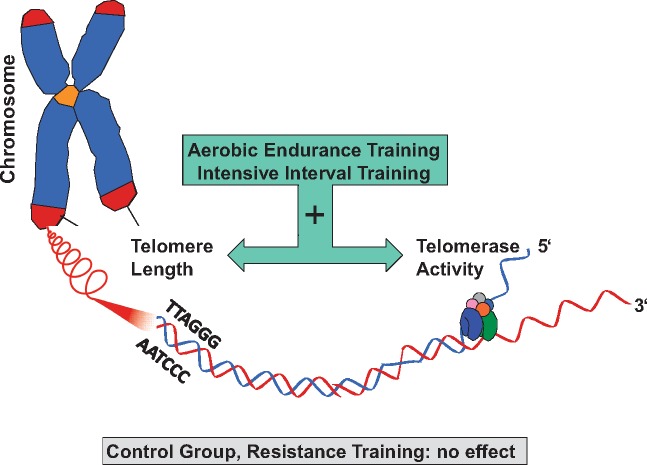
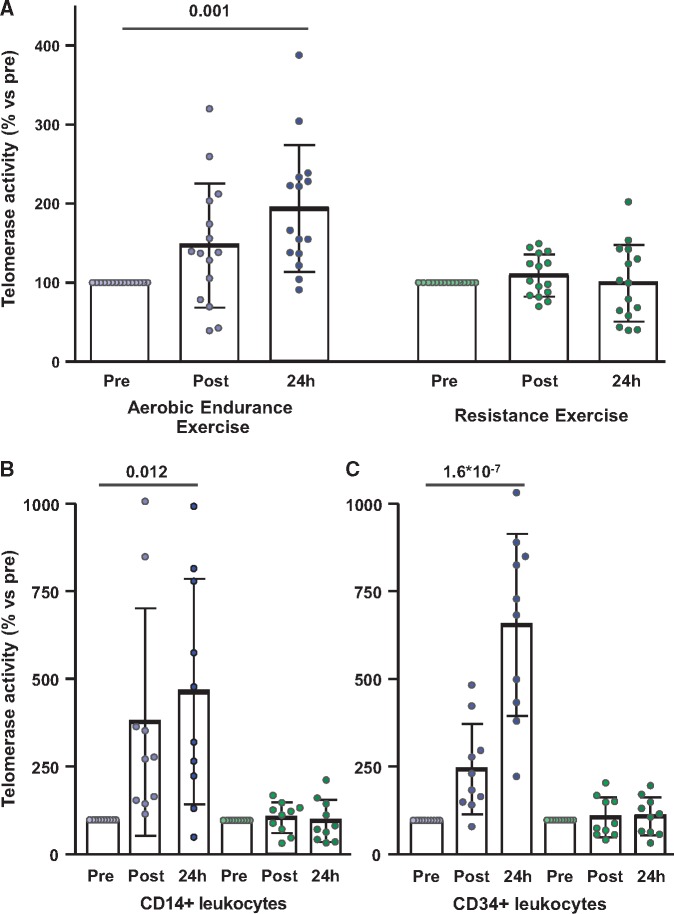
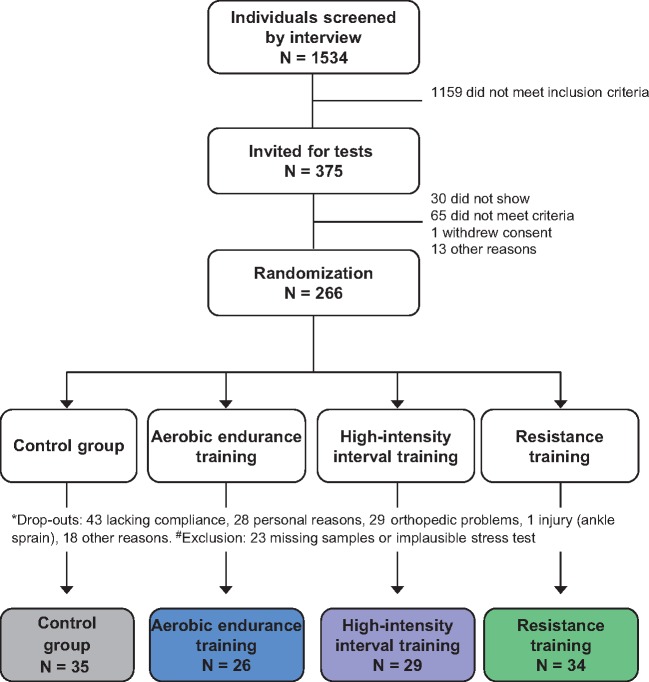
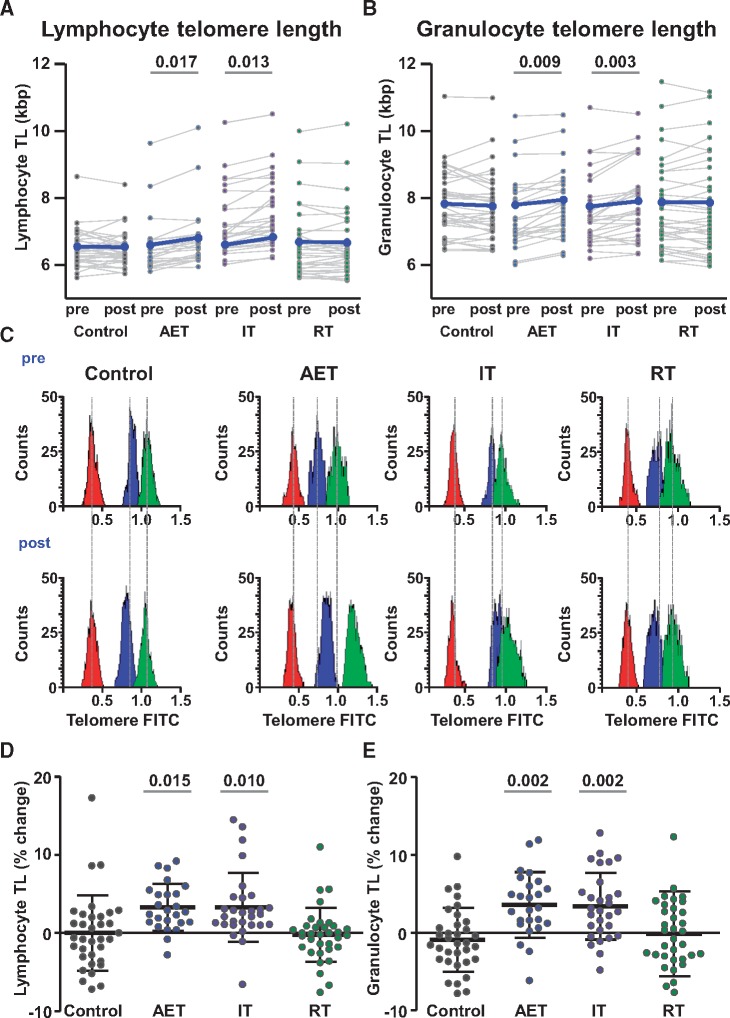
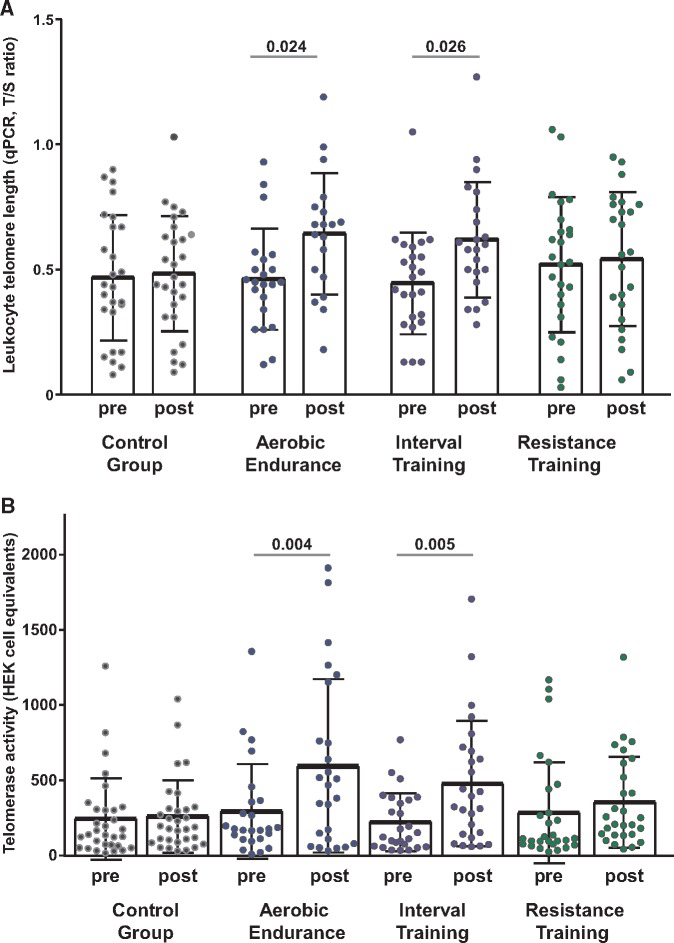
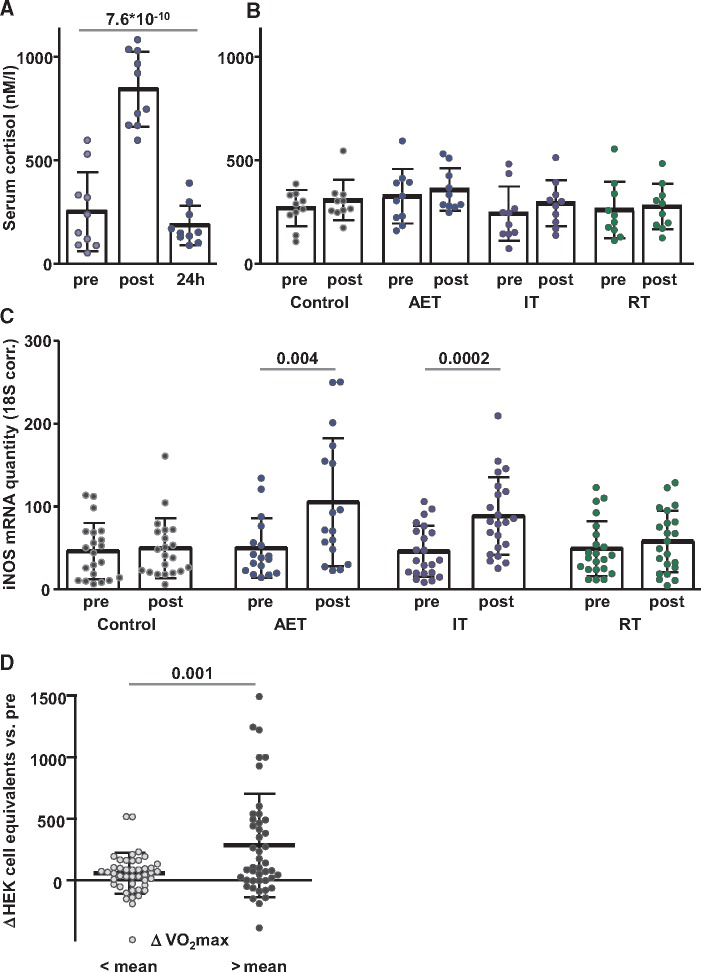
Aims: It is unknown whether different training modalities exert differential cellular effects. Telomeres and telomere-associated proteins play a major role in cellular aging with implications for global health. This prospective training study examines the effects of endurance training, interval training (IT), and resistance training (RT) on telomerase activity and telomere length (TL). Methods and results: One hundred and twenty-four healthy previously inactive individuals completed the 6 months study. Participants were randomized to three different interventions or the control condition (no change in lifestyle): aerobic endurance training (AET, continuous running), high-intensive IT (4 × 4 method), or RT (circle training on 8 devices), each intervention consisting of three 45 min training sessions per week. Maximum oxygen uptake (VO2max) was increased by all three training modalities. Telomerase activity in blood mononuclear cells was up-regulated by two- to three-fold in both endurance exercise groups (AET, IT), but not with RT. In parallel, lymphocyte, granulocyte, and leucocyte TL increased in the endurance-trained groups but not in the RT group. Magnet-activated cell sorting with telomerase repeat-ampliflication protocol (MACS-TRAP) assays revealed that a single bout of endurance training-but not RT-acutely increased telomerase activity in CD14+ and in CD34+ leucocytes. Conclusion: This randomized controlled trial shows that endurance training, IT, and RT protocols induce specific cellular pathways in circulating leucocytes. Endurance training and IT, but not RT, increased telomerase activity and TL which are important for cellular senescence, regenerative capacity, and thus, healthy aging.
Overview
The claims and statistics of this paper haven’t been checked yet.
Free: it reads the open-access text and checks the first 5 claims that cite a source we can check. Create a free account to check every claim.
Integrity signals
Registry
Cites
Statistics
Figures
Verification
Claims the paper makes
The claims and statistics of this paper haven’t been checked yet.
Free: it reads the open-access text and checks the first 5 claims that cite a source we can check. Create a free account to check every claim.
Claims other papers make about this one
Each is checked against this paper’s own text: does it say what the citing paper says it does?
The cited source says what the claim attributes to it.
In the citing paper
“Aerobic exercise (45 min/session, thrice a week for six months) also increased telomerase activity [666].”
From Global consensus on optimal exercise recommendations for enhancing healthy longevity in older adults (ICFSR) (2025) · cites this paper as [666]
Self-check
Percentages, sums and reported differences re-computed from the paper’s own numbers.
The self-check needs the paper’s full text.
Citations
Cites
López-Otín, C., Blasco, M. A., Partridge, L., Serrano, M., & Kroemer, G. (2013) · Cell · doi:10.1016/j.cell.2013.05.039 · Cited by 14,982
European Guidelines on cardiovascular disease prevention in clinical practice (version 2012)
Authors/Task Force Members:, Perk, J., De Backer, G., Gohlke, H., Graham, I., Reiner, Ž., Verschuren, M., Albus, C., Benlian, P., Boysen, G., et al. (2012) · European Heart Journal · doi:10.1093/eurheartj/ehs092 · Cited by 8,490
Specific Association of Human Telomerase Activity with Immortal Cells and Cancer
Kim, N. W., Piatyszek, M. A., Prowse, K. R., Harley, C. B., West, M. D., Ho, P. L. C., Coviello, G. M., Wright, W. E., Weinrich, S. L., & Shay, J. W. (1994) · Science · doi:10.1126/science.7605428 · Cited by 7,091
2016 European Guidelines on cardiovascular disease prevention in clinical practice
Piepoli, M. F., Hoes, A. W., Agewall, S., Albus, C., Brotons, C., Catapano, A. L., Cooney, M.-T., Corrà, U., Cosyns, B., Deaton, C., et al. (2016) · European Heart Journal · doi:10.1093/eurheartj/ehw106 · Cited by 6,457
A PGC1-α-dependent myokine that drives brown-fat-like development of white fat and thermogenesis
Boström, P., Wu, J., Jedrychowski, M. P., Korde, A., Ye, L., Lo, J. C., Rasbach, K. A., Boström, E. A., Choi, J. H., Long, J. Z., et al. (2012) · Nature · doi:10.1038/nature10777 · Cited by 4,810
Telomere measurement by quantitative PCR
Cawthon, R. M. (2002) · Nucleic Acids Research · doi:10.1093/nar/30.10.e47 · Cited by 3,487 · cited 2×
“In order to account for the methodological challenges of TL measurements in humans, especially with regard to PCR,(36) two established independent methods were used.(8,12,13,22,23) Both assays were carefully controlled (details described in Supplementary material online, Methods).”
MethodAuthors/Task Force Members, Piepoli, M. F., Hoes, A. W., Agewall, S., Albus, C., Brotons, C., Catapano, A. L., Cooney, M.-T., Corrà, U., Cosyns, B., et al. (2016) · European Journal of Preventive Cardiology · doi:10.1177/2047487316653709 · Cited by 1,334
Weston, K. S., Wisløff, U., & Coombes, J. S. (2014) · British Journal of Sports Medicine · doi:10.1136/bjsports-2013-092576 · Cited by 1,274 · cited 2×
“Compared with conventional aerobic endurance training (AET), high-intensity interval training (IT) is believed to be a more effective and time-efficient training method for improving cardiorespiratory fitness.(5) However, few randomized comparisons of different training modalities have been reported, and it is unknown…”
BackgroundPollock, M. L., Franklin, B. A., Balady, G. J., Chaitman, B. L., Fleg, J. L., Fletcher, B., Limacher, M., Piña, I. L., Stein, R. A., Williams, M., et al. (2000) · Circulation · doi:10.1161/01.cir.101.7.828 · Cited by 1,058 · cited 1×
“Endurance training and RT induce a number of differential haemodynamic, metabolic, and/or neurohumoral responses, both acute and chronic.(4,39,40) Precise comparisons between endurance and a resistance exercise protocols are scarce.”
BackgroundLaufs, U., Werner, N., Link, A., Endres, M., Wassmann, S., Jürgens, K., Miche, E., Böhm, M., & Nickenig, G. (2004) · Circulation · doi:10.1161/01.cir.0000109141.48980.37 · Cited by 857
Self-citation
Cited by
Izquierdo, M., de Souto Barreto, P., Arai, H., Bischoff-Ferrari, H. A., Cadore, E. L., Cesari, M., Chen, L.-K., Coen, P. M., Courneya, K. S., Duque, G., et al. (2025) · The Journal of nutrition, health and aging · doi:10.1016/j.jnha.2024.100401 · Cited by 273
The association of resistance training with mortality: A systematic review and meta-analysis
Saeidifard, F., Medina-Inojosa, J. R., West, C. P., Olson, T. P., Somers, V. K., Bonikowske, A. R., Prokop, L. J., Vinciguerra, M., & Lopez-Jimenez, F. (2019) · European Journal of Preventive Cardiology · doi:10.1177/2047487319850718 · Cited by 216
“found that, in contrast to endurance training, resistance training was not associated with telomerase activity and length, suggesting that resistance training had no anti-aging effect.(34) This may explain why the potentially beneficial effects of resistance training in survival were modest when compared with enduranc…”
ResultCellular senescence in cardiac diseases
Shimizu, I., & Minamino, T. (2019) · Journal of Cardiology · doi:10.1016/j.jjcc.2019.05.002 · Cited by 167
Wu, Z., Zhu-ying, W., Gao, H.-E., Zhou, X.-F., & Li, F. (2021) · Experimental Gerontology · doi:10.1016/j.exger.2021.111345 · Cited by 153
Physical Exercise and Selective Autophagy: Benefit and Risk on Cardiovascular Health
Wu, N. N., Tian, H., Chen, P., Wang, D., Ren, J., & Zhang, Y. (2019) · Cells · doi:10.3390/cells8111436 · Cited by 129
“Given that physical inactivity is a well-known independent risk factor for all-cause mortality, regular physical exercise may offer profound health benefits in many aspects including cardiac performance, exercise tolerance, endothelial function, inflammatory response, insulin sensitivity, autonomic regulation, and blo…”
BackgroundExercise effects on cardiovascular disease: from basic aspects to clinical evidence
Sanchis‐Gomar, F., Lavie, C. J., Marín-Puyalto, J., Pérez-Quilis, C., Eijsvogels, T. M. H., O’Keefe, J. H., Perez, M. V., & Blair, S. N. (2021) · Cardiovascular Research · doi:10.1093/cvr/cvab272 · Cited by 115
“113 From 17 to 90years of age, we progressively lose (cid:2) 30% of cardiomyocytes.”
BackgroundTelomeres and Age-Related Diseases
Gruber, H.-J., Semeraro, M. D., Renner, W., & Herrmann, M. (2021) · Biomedicines · doi:10.3390/biomedicines9101335 · Cited by 94
Sellami, M., Bragazzi, N. L., Prince, M. S., Denham, J., & Elrayess, M. A. (2021) · Frontiers in Genetics · doi:10.3389/fgene.2021.652497 · Cited by 98
Noureen, N., Wu, S., Lv, Y., Yang, J., Yung, W. K. A., Gelfond, J., Wang, X., Koul, D., Ludlow, A. T., & Zheng, S. (2021) · Nature Communications · doi:10.1038/s41467-020-20474-9 · Cited by 82
Breast Cancer: Lifestyle, the Human Gut Microbiota/Microbiome, and Survivorship
Bodai, B. I., & Nakata, T. E. (2020) · The Permanente Journal · doi:10.7812/tpp/19.129 · Cited by 74
Hachmo, Y., Hadanny, A., Hamed, R. A., Daniel-Kotovsky, M., Catalogna, M., Fishlev, G., Lang, E., Polak, N., Doenyas‐Barak, K., Friedman, M., et al. (2020) · Aging · doi:10.18632/aging.202188 · Cited by 98
“A recent study found that aerobic endurance training or high intensity interval training for six month increased telomere length up to 5% [21].”
BackgroundBarragán, R., Ortega‐Azorín, C., Sorlí, J. V., Asensio, E. M., Coltell, Ó., St‐Onge, M., Portolés, O., & Corella, D. (2021) · Journal of Clinical Medicine · doi:10.3390/jcm11010076 · Cited by 79
“[44] 2019 125 inactive participants PCR FlowFISH FACS Blood Three groups: aerobic endurance training; high intensity exercises; resistance training Endurance training and high intensity, but not strength training, was associated with increased telomerase activity and TL”
BackgroundTelomerase as a Therapeutic Target in Cardiovascular Disease
Hoffmann, J., Richardson, G. D., Haendeler, J., Altschmied, J., Andrés, V., & Spyridopoulos, I. (2021) · Arteriosclerosis Thrombosis and Vascular Biology · doi:10.1161/atvbaha.120.315695 · Cited by 73
Puhlmann, L. M. C., Valk, S. L., Engert, V., Bernhardt, B. C., Lin, J., Epel, E. S., Vrtička, P., & Singer, T. (2019) · JAMA Network Open · doi:10.1001/jamanetworkopen.2019.9687 · Cited by 74
Physical Activity on Telomere Length as a Biomarker for Aging: A Systematic Review
Schellnegger, M., Lin, A. C., Hammer, N., & Kamolz, L. (2022) · Sports Medicine - Open · doi:10.1186/s40798-022-00503-1 · Cited by 71
“Multiple factors such as age [66], BMI [67], sex [68], volume of training, training modality [57], duration of physical activity, and method of TL analysis [69] can all affect telomere dynamic measurements.”
BackgroundMethodMeditation and telomere length: a meta-analysis
Schutte, N. S., Malouff, J. M., & Keng, S.-L. (2020) · Psychology & Health · doi:10.1080/08870446.2019.1707827 · Cited by 54
Erusalimsky, J. D. (2020) · Free Radical Biology and Medicine · doi:10.1016/j.freeradbiomed.2020.02.008 · Cited by 61
“participants compared the effects of three exercise training modalities on telomerase activity and telomere length in PBMCs [89].”
BackgroundDenham, J., & Sellami, M. (2021) · Ageing Research Reviews · doi:10.1016/j.arr.2021.101411 · Cited by 56
Physical activity, a modulator of aging through effects on telomere biology
Semeraro, M. D., Smith, C., Kaiser, M., Levinger, I., Duque, G., Gruber, H.-J., & Herrmann, M. (2020) · Aging · doi:10.18632/aging.103504 · Cited by 49
“To date, only one study directly compared the effects of different exercise modalities on telomere biology [99].”
BackgroundInfluentialRoles of physical exercise in neurodegeneration: reversal of epigenetic clock
Xu, M., Zhu, J., Liu, X.-D., Luo, M.-Y., & Xu, N.-J. (2021) · Translational Neurodegeneration · doi:10.1186/s40035-021-00254-1 · Cited by 46
Telomere Length: A Cardiovascular Biomarker and a Novel Therapeutic Target
Sagris, Μ., Theofilis, P., Antonopoulos, A. S., Tsioufis, K. P., & Tousoulis, D. (2022) · International Journal of Molecular Sciences · doi:10.3390/ijms232416010 · Cited by 49
Song, S., Lee, E., & Kim, H. (2022) · Medicina · doi:10.3390/medicina58020242 · Cited by 53
“In addition, in relation to the duration of the intervention, telomere length increased after six months of physical activity, while there was no effect in the short term [9,10].”
BackgroundAge at Menopause, Leukocyte Telomere Length, and Coronary Artery Disease in Postmenopausal Women
Schuermans, A., Nakao, T., Uddin, M. M., Hornsby, W., Ganesh, S., Shadyab, A. H., Liu, S., Haring, B., SHUFELT, C. L., Taub, M. A., et al. (2023) · Circulation Research · doi:10.1161/circresaha.123.322984 · Cited by 46
Effect of a lifestyle intervention on telomere length: A systematic review and meta-analysis
Buttet, M., Bagheri, R., Ugbolue, U. C., Laporte, C., Trousselard, M., Benson, A. C., Bouillon‐Minois, J., & Dutheil, F. (2022) · Mechanisms of Ageing and Development · doi:10.1016/j.mad.2022.111694 · Cited by 45
Brandão, C., Nonino, C. B., de Carvalho, F. G., Nicoletti, C. F., Noronha, N. Y., Santibáñez, R. P. S. M., de Freitas, E. C., Junqueira‐Franco, M. V. M., & Marchini, J. S. (2020) · Sports Medicine - Open · doi:10.1186/s40798-020-0235-7 · Cited by 45
Age and Sport Intensity-Dependent Changes in Cytokines and Telomere Length in Elite Athletes
Sellami, M., Almuraikhy, S., Al-Jaber, H., Al-Amri, H. S., Al-Mansoori, L., Mazloum, N. A., Donati, F., Botrè, F., & Elrayess, M. A. (2021) · Antioxidants · doi:10.3390/antiox10071035 · Cited by 44
“In contrast, other reports proposed that exposure to acute endurance exercise might be threatening to an individual’s health as it leads to accelerated oxygen radical generation and oxidative stress [53,54].”
BackgroundZhao, Q., Liu, Y., Wang, X., Zhu, Y., Jiao, Y., Bao, Y., & Shi, W. (2023) · Ecotoxicology and Environmental Safety · doi:10.1016/j.ecoenv.2023.114831 · Cited by 39
Gaudl, A., Kratzsch, J., & Ceglarek, U. (2019) · The Journal of Steroid Biochemistry and Molecular Biology · doi:10.1016/j.jsbmb.2019.105389 · Cited by 37
Self-citationExploration of the mechanism and therapy of ovarian aging by targeting cellular senescence
Tang, W., Wang, K., Feng, Y., Tsui, K., Singh, K. K., Stout, M. B., Wang, S., & Wu, M. (2025) · Life Medicine · doi:10.1093/lifemedi/lnaf004 · Cited by 38
“In a groundbreaking 6-month randomized controlled trial involving 124 previously inactive adults, researchers have also suggested that activating telomerase could be a strategy to delay the ovarian cellular senescence [13].”
Potential roles of telomeres and telomerase in neurodegenerative diseases
Wang, J., Liu, Y., Xia, Q., Xia, Q., Wang, B., Yang, C., Liang, J., & Liu, X. (2020) · International Journal of Biological Macromolecules · doi:10.1016/j.ijbiomac.2020.07.046 · Cited by 40
High-intensity interval training modulates inflammatory response in Parkinson’s disease
Malczynska-Sims, P., Chalimoniuk, M., Wroński, Z., Marusiak, J., & Sułek, A. (2022) · Aging Clinical and Experimental Research · doi:10.1007/s40520-022-02153-5 · Cited by 41
“This study is similar to other studies showing no changes in the monocytes count as the result of prolonged training in young adults [30, 31] and the elderly population with rheumatoid arthritis [32].”
BackgroundResultInfluentialFalz, R., Fikenzer, S., Holzer, R., Laufs, U., Fikenzer, K., & Busse, M. W. (2019) · European Journal of Applied Physiology · doi:10.1007/s00421-019-04138-1 · Cited by 39
Self-citationLi, F., Sun, L., Wu, D.-S., Gao, H.-E., & Zhu, M. (2019) · Aging · doi:10.18632/aging.102044 · Cited by 39
“mRNA expression was assayed using reverse transcription-polymerase chain reaction (RT-PCR) as described previously [3].”
BackgroundMethodTelomere length and human hippocampal neurogenesis
Palmos, A., Duarte, R. R. R., Smeeth, D. M., Hedges, E. C., Nixon, D. F., Thuret, S., & Powell, T. R. (2020) · Neuropsychopharmacology · doi:10.1038/s41386-020-00863-w · Cited by 38
“Intriguingly, environmental interventions shown to reduce the rate of cognitive ageing [77], including exercise and energy restriction, have positive effects on both peripheral telomere length in humans [15, 78, 79] and hippocampal neurogenesis in animal models [80, 81].”
BackgroundGharehbagh, S. A., Azar, J. T., & Razi, M. (2021) · Life Sciences · doi:10.1016/j.lfs.2021.119585 · Cited by 39
Souza, D., do Vale, A. F., da Silva, A. S., de Araújo, M. A. S., Júnior, C. A. D. P., de Lira, C. A. B., Ramírez‐Campillo, R., Martins, W. R., & Gentil, P. (2021) · Biology · doi:10.3390/biology10090868 · Cited by 40
“However, lymphocytes might adapt to repeated IT sessions and become more resistant to stress [27,42].”
BackgroundInfluentialEffect of different levels of exercise on telomere length: A systematic review and meta-analysis
Lin, X., Zhou, J., & Dong, B. (2019) · Journal of Rehabilitation Medicine · doi:10.2340/16501977-2560 · Cited by 37
Effect of physical activity and exercise on telomere length: systematic review with meta-analysis
Valente, C., Andrade, R., Alvarez, L., Rebelo‐Marques, A., Stamatakis, E., & Espregueira‐Mendes, J. (2021) · Journal of the American Geriatrics Society · doi:10.1111/jgs.17334 · Cited by 34
Chen, B., Wu, Z., Huang, X., Li, Z., Wu, Q., & Chen, Z. (2023) · Heliyon · doi:10.1016/j.heliyon.2023.e20188 · Cited by 34
Böhm, M., Schumacher, H., Werner, C. M., Teo, K. K., Lonn, E., Mahfoud, F., Speer, T., Mancia, G., Redón, J., Schmieder, R. E., et al. (2022) · Cardiovascular Diabetology · doi:10.1186/s12933-021-01429-w · Cited by 35
“function [26–29], cellular senescence [30] and interstitial fibrosis [31], which all are suggested to facilitate endorgan damage and renal dysfunction in diabetes [4–6].”
BackgroundSelf-citationTelomeres and telomerase in risk assessment of cardiovascular diseases
Boniewska-Bernacka, E., Pańczyszyn, A., & Klinger, M. (2020) · Experimental Cell Research · doi:10.1016/j.yexcr.2020.112361 · Cited by 31
Iskandar, M., Barbero, M. X., Jaber, M. T., Chen, R., Gomez-Guevara, R., Cruz, E., & Westerheide, S. D. (2025) · Cancers · doi:10.3390/cancers17020257 · Cited by 35
Afonso, J. R., Nakamura, F. Y., Canário-Lemos, R., Peixoto, R., Fernandes, C., Mota, T., Ferreira, M. F. S., Silva, R., Teixeira, A., & Clemente, F. M. (2021) · Frontiers in Sports and Active Living · doi:10.3389/fspor.2021.661200 · Cited by 31
“resistance training) tend to produce differential adaptations (Werner et al., 2019; Morville et al., 2020).”
BackgroundDelgado, B., Novo, A., Lopes, I., Rebelo, C., Almeida, C., Pestana, S. M. D. C., Gomes, B. P., Froelicher, E. S., & Klompstra, L. V. (2022) · Clinical Rehabilitation · doi:10.1177/02692155221088684 · Cited by 30
Denham, J. (2023) · Aging Cell · doi:10.1111/acel.13836 · Cited by 28
Trajectories of cardiovascular ageing—from molecular mechanisms to clinical implementation
Ministrini, S., Wenzl, F. A., Lüscher, T. F., & Camici, G. G. (2024) · Cardiovascular Research · doi:10.1093/cvr/cvae178 · Cited by 30
“154,155”
Physical activity types, variety, and mortality: results from two prospective cohort studies
Han, H., Hu, J., Lee, D. H., Zhang, Y., Giovannucci, E. L., Stampfer, M. J., Hu, F. B., Hu, Y., & Sun, Q. (2026) · BMJ Medicine · doi:10.1136/bmjmed-2025-001513 · Cited by 28
“32 A recent study indicated the advantage of aerobic exercises over resistance training in improving the risk profiles for cardiovascular disease in adults with overweight or obesity.”
Martí, A., de la Puente, M. F., Canudas, S., Zalba, G., Razquín, C., Valle‐Hita, C., Fitó, M., Martínez‐González, M. Á., García-Calzón, S., & Salas‐Salvadó, J. (2023) · Clinical Nutrition · doi:10.1016/j.clnu.2023.06.030 · Cited by 29
Controlling for baseline telomere length biases estimates of the rate of telomere attrition
Melissa Bateson, B., Eisenberg, D. T. A., & Nettle, D. (2019) · Royal Society Open Science · doi:10.1098/rsos.190937 · Cited by 26
González, J. L. S., Sánchez-Rodríguez, J. L., Varela-Rodríguez, S., González‐Sarmiento, R., Picón, C. R., Juárez‐Vela, R., Tejada-Garrido, C. I., Martín‐Vallejo, J., & Navarro‐López, V. (2024) · JMIR Public Health and Surveillance · doi:10.2196/46019 · Cited by 30
“Regarding the type of exercise, 4 studies performed resistance training [17,18,21,25], 4 used aerobic exercises [17,19,20,23], 3 used HIIT [17,22,23], and 1 used combined training (aerobic plus resistance training) [24].”
InfluentialNon-invasive vagus nerve stimulation and exercise capacity in healthy volunteers: a randomized trial
Ackland, G. L., Patel, A., Miller, S., del Arroyo, A. G., Thirugnanasambanthar, J., Ravindran, J. I., Schroth, J., Boot, J. R., Caton, L., Mein, C. A., et al. (2025) · European Heart Journal · doi:10.1093/eurheartj/ehaf037 · Cited by 24
“50 tVNS had been shown to trigger systemic release of cardioprotective factor(s) that reduced ischaemia/reperfusion injury when plasma dialysate from the participants receiving tVNS was applied to isolated perfused rat hearts with myocardial infarction.”
Hagman, M., Werner, C. M., Kamp, K., Fristrup, B., Hornstrup, T., Meyer, T., Böhm, M., Laufs, U., & Krustrup, P. (2020) · Progress in Cardiovascular Diseases · doi:10.1016/j.pcad.2020.05.009 · Cited by 25
Self-citationZhu, J., Yang, Y., Zeng, Y., Han, X., Chen, W., Hu, Y., Qu, Y., Yang, H., Valdimarsdóttir, U. A., Fang, F., et al. (2023) · The Journals of Gerontology Series A · doi:10.1093/gerona/glad064 · Cited by 27
“Some revealed that TL did not differ between exercise intervention and control groups (38), whereas 1 randomized controlled trial showed that endurance and interval training protocol could increase telomerase activity and TL (39).”
Hyperbaric oxygen therapy: future prospects in regenerative therapy and anti-aging
Gupta, M., & Rathored, J. (2024) · Frontiers in Aging · doi:10.3389/fragi.2024.1368982 · Cited by 27
Telomere shortening associates with elevated insulin and nuchal fat accumulation
Mangge, H., Herrmann, M., Almer, G., Zelzer, S., Moeller, R., Horejsi, R., & Renner, W. (2020) · Scientific Reports · doi:10.1038/s41598-020-63916-6 · Cited by 23
Reddy, Y. N. V., Obokata, M., Jones, A. D., Lewis, G. D., Shah, S. J., Abou-Ezzedine, O. F., Fudim, M., Alhanti, B., Stevenson, L. W., Redfield, M. M., et al. (2020) · Journal of Cardiac Failure · doi:10.1016/j.cardfail.2020.08.008 · Cited by 24
The complex role of neutrophils in healthy aging, inflammaging, and frailty
Abdullah, G. A., Akpan, A., Phelan, M. M., & Wright, H. L. (2025) · Journal of Leukocyte Biology · doi:10.1093/jleuko/qiaf117 · Cited by 25
Berezina, T. N., Rybtsova, N., & Александрович, Р. С. (2020) · European Journal of Investigation in Health Psychology and Education · doi:10.3390/ejihpe10030055 · Cited by 22
Berezina, T. N., & Александрович, Р. С. (2021) · Biomedicines · doi:10.3390/biomedicines9080913 · Cited by 22
“Incorporating endurance training into the daily routine of adults affects telomerase activity and telomere length [24] and protects against excessive chromosomal damage [57].”
BackgroundTokgözoğlu, L. S., Hekimsoy, V., Costabile, G., Calabrese, I., & Riccardi, G. (2020) · Handbook of experimental pharmacology · doi:10.1007/164_2020_353 · Cited by 26
Zhang, J., Tian, Z., Qin, C., & Momeni, M. R. (2024) · Human Cell · doi:10.1007/s13577-024-01057-y · Cited by 22
“Exercising has been linked to variations in gene expression which may help decrease the hazard of various chronic illnesses due to DNA injury, DNA methylation that does not follow the normal pattern, and telomeres which are not as long as they should be [2–14].”
Maier, R. H., Bawamia, B., Bennaceur, K., Dunn, S., Marsay, L., Amoah, R., Kasim, A., Filby, A. J., Austin, D., Hancock, H. C., et al. (2020) · JMIR Research Protocols · doi:10.2196/19456 · Cited by 22
Effects of Physical Exercise on Cognition and Telomere Length in Healthy Older Women
González, J. L. S., Sánchez-Rodríguez, J. L., Martín‐Vallejo, J., Martel-Martel, A., & González‐Sarmiento, R. (2021) · Brain Sciences · doi:10.3390/brainsci11111417 · Cited by 21
“Some research has shown that endurance training causes adaptive changes in the antioxidant protein systems at the systemic level leading to a maintenance of TL [42], while other studies have concluded there is no effect at all [43,44] or even a shortening of TL [45].”
BackgroundSport and longevity: an observational study of international athletes
Altulea, A., Rutten, M. G. S., Verdijk, L. B., & Demaria, M. (2024) · GeroScience · doi:10.1007/s11357-024-01307-9 · Cited by 22
“However, a study demonstrated that endurance and interval training increase telomerase activity and telomere length, while resistance training does not [43].”
The year in cardiology: cardiovascular prevention
Ray, K. K., Laufs, U., Cosentino, F., Lobo, M. D., & Landmesser, U. (2020) · European Heart Journal · doi:10.1093/eurheartj/ehz929 · Cited by 20
Self-citationSeki, Y., Aczél, D., Torma, F., Jókai, M., Boros, A., Suzuki, K., Higuchi, M., Tanisawa, K., Boldogh, I. R., Horvath, S., et al. (2023) · Biogerontology · doi:10.1007/s10522-022-10011-0 · Cited by 21
“(1234567890) The maximal oxygen uptake (VO2max) which was calculated from the Chester step test, was higher in athletes (masters 44.7 ml/kg/min vs. sedentary: 33.7 ml/kg/min).”
BackgroundInfluentialUnraveling the causal genes and transcriptomic determinants of human telomere length
Chang, Y., Zhou, Y., Zhou, J., Li, W., Cao, J., Jing, Y., Zhang, S., Shen, Y., Lin, Q., Fan, X., et al. (2023) · Nature Communications · doi:10.1038/s41467-023-44355-z · Cited by 21
“Nongenetic factors, such as cigarette smoking 13 , alcohol consumption 14 , and endurance training 15 , could modulate telomere attrition processes.”
Smarż, K., Jaxa-Chamiec, T., Zaborska, B., Tysarowski, M., & Budaj, A. (2021) · Journal of Clinical Medicine · doi:10.3390/jcm10184083 · Cited by 21
“In a study of 124 healthy individuals, only aerobic endurance and high-intensive interval training, but not resistance training, were associated with increased telomerase activity and telomere length in mononuclear cells [13].”
BackgroundCardiorespiratory fitness and telomere length: a systematic review
Marques, A., Gouveia, É. R., Peralta, M., Martins, J., Venturini, J., Henriques‐Neto, D., & Sarmento, H. (2020) · Journal of Sports Sciences · doi:10.1080/02640414.2020.1754739 · Cited by 21
The effect of a 12-week resistance training intervention on leukocyte telomere length
Nickels, M., Mastana, S. S., Hunter, D. J., Denniff, M. J., Codd, V., & Akam, E. C. (2020) · Heliyon · doi:10.1016/j.heliyon.2020.e04151 · Cited by 21
Exercise as a Therapy to Maintain Telomere Function and Prevent Cellular Senescence
Kim, J., Ahn, A., Ying, J. Y., Hickman, E., & Ludlow, A. T. (2023) · Exercise and Sport Sciences Reviews · doi:10.1249/jes.0000000000000324 · Cited by 19
“Implementing an endurance exercise training program has also been observed to increase V̇O2max and maintain telomere length as well in a variety of human tissues ((41) (leukocytes), (42)(skeletal muscle), (43)(leukocytes)).”
BackgroundEngel, T., Raffenberg, M., Schoepf, I. C., Kootstra, N. A., Reiss, P., Thorball, C. W., Hasse, B. K., Hirzel, C., Wissel, K., Roth, J. A., et al. (2020) · Clinical Infectious Diseases · doi:10.1093/cid/ciaa1034 · Cited by 19
Exercise, telomerase activity, and cardiovascular disease prevention
Stellos, K., & Spyridopoulos, I. (2018) · European Heart Journal · doi:10.1093/eurheartj/ehy707 · Cited by 18
Varghese, N., Szabo, L., Cader, M. Z., Lejri, I., Grimm, A., & Eckert, A. (2025) · Communications Biology · doi:10.1038/s42003-025-08152-2 · Cited by 17
“Telomerase Repeat Ampli fi cation Protocol (TRAP) was performed to determine the telomerase activity 115 – 117 .”
Yan, X., Yang, P., Li, Y., Liu, T., Zha, Y., Wang, T., Zhang, J., Feng, Z., & Li, M.-Y. (2024) · Aging · doi:10.18632/aging.205765 · Cited by 23
Telomere length in different metabolic categories: Clinical associations and modification potential
Khalangot, M. D., Krasnienkov, D. S., & Vaiserman, A. M. (2020) · Experimental Biology and Medicine · doi:10.1177/1535370220931509 · Cited by 17
“However, despite the importance of genetic contributions, both telomere length and the risk for T2D may be modified by life-style interventions,(61) including modulations in diet(62,63) and in physical activity.(42,64) These relationships may also be affected by antidiabetic drug administration.”
BackgroundResultFootball and team handball training postpone cellular aging in women
Hagman, M., Fristrup, B., Michelin, R., Krustrup, P., & Asghar, M. (2021) · Scientific Reports · doi:10.1038/s41598-021-91255-7 · Cited by 17
“(12) have recently shown that 6 months of either 82 endurance training or interval training, but not resistance training, can increase telomere length in 83 previously inactive adults.”
BackgroundExercise attenuates the hallmarks of aging: Novel perspectives
Qiu, Y., Fernández‐Garcia, B., Lehmann, H. I., Li, G., Kroemer, G., López-Otín, C., & Xiao, J. (2025) · Journal of sport and health science/Journal of Sport and Health Science · doi:10.1016/j.jshs.2025.101108 · Cited by 24
“77 In contrast, 6 months of resistance training did not produce significant changes in these parameters.”
InfluentialBerezina, T. N., & Александрович, Р. С. (2022) · European Journal of Investigation in Health Psychology and Education · doi:10.3390/ejihpe12120126 · Cited by 17
“Werner showed that the inclusion of endurance training in the regular daily routine affects telomerase activity and telomere length in healthy people [7].”
BackgroundEigendorf, J., Melk, A., Haufe, S., Boethig, D., Berliner, D., Kerling, A., Kück, M., Stenner, H. T., Bara, C., Stiesch, M., et al. (2019) · European Journal of Preventive Cardiology · doi:10.1177/2047487319849505 · Cited by 16
“Recently, Werner and colleagues reported increases in telomere length after six months’ aerobic endurance and high-intensity interval training for a combined group of women and men.(4) Because the authors did not state results separated for gender we do not have data yet proving that women might benefit from a long-te…”
BackgroundPersonal factors of biological aging in working and non-working respondents in late maturity period
Zinatullina, A., Melnik, V. P., & Zimina, A. A. (2021) · International Journal of Health Sciences · doi:10.53730/ijhs.v5n3.2790 · Cited by 15
“Some of the mental and behavioral factors have a beneficial effect, increasing a person's health and well-being, for example, the inclusion of endurance training in the normal daily routine of healthy people affects telomerase activity and telomere length (Werner et al., 2019; Widana et al., 2021).”
BackgroundSports cardiology: towards the sweet spot in competitive and leisure exercise
Lüscher, T. F. (2019) · European Heart Journal · doi:10.1093/eurheartj/ehy883 · Cited by 15
Farinha, C., Ferreira, J., Serrano, J., Santos, H., Oliveiros, B., Silva, F. M., Cascante-Rusenhack, M., & Teixeira, A. (2022) · Frontiers in Physiology · doi:10.3389/fphys.2022.838580 · Cited by 13
Gagnon, D. D., Dorman, S. C., Ritchie, S. D., Mutt, S. J., Stenbäck, V., Walkowiak, J., & Herzig, K. (2019) · Frontiers in Physiology · doi:10.3389/fphys.2019.01123 · Cited by 17
“Six-month endurance or interval training interventions also seem to increase telomerase activity along with TL in lymphocytes, granulocytes, and other leukocytes in previously inactive individuals (Werner et al., 2018).”
BackgroundPanelli, D. M., Leonard, S. A., Wong, R. J., Becker, M., Mayo, J. A., Wu, E., Girsen, A. I., Gotlib, I. H., Aghaeepour, N., Druzin, M. L., et al. (2022) · BMC Pregnancy and Childbirth · doi:10.1186/s12884-022-04693-0 · Cited by 16
Braga, C. E. H. V. P. F., de Brito, J. S., Ribeiro, M. M., Coutinho‐Wolino, K. S., Regis, B., Calixto, B., Rodrigues, R. C. B., Wang, A. Y.-M., Stenvinkel, P., & Mafra, D. (2025) · Biochimie · doi:10.1016/j.biochi.2025.10.008 · Cited by 19
TERT Promoter Revertant Mutation Inhibits Melanoma Growth through Intrinsic Apoptosis
Wang, Y., Chen, Y., Li, C., Xiao, Z., Yuan, H., Zhang, Y., Pang, D., Tang, X., Li, M., & Ouyang, H. (2022) · Biology · doi:10.3390/biology11010141 · Cited by 14
“As previously described [40,41], in short, cells were lysed with precooled NP-40 lysis buffer, the supernatant was collected after centrifugation, and the total protein concentration”
MethodReljic, D., Koller, A., Herrmann, H. J., Ekici, A. B., Neurath, M. F., & Zopf, Y. (2023) · Antioxidants · doi:10.3390/antiox12101847 · Cited by 13
“…from two previous RCTs. Based on data from a previous study comparing the effects of higher-volume exercise protocols on TL in a healthy population [20] and the results of our own research, indicating differential effects of very-low-volume exercise types on specific physiological parameters such…”
BackgroundMethodResultInfluentialGürel, S., Pak, E. N., & Tek, N. A. (2024) · Current Nutrition Reports · doi:10.1007/s13668-024-00529-9 · Cited by 13
Exercise to Mitigate Cerebrovascular Aging: A Geroscience Perspective
Norling, A. M., & Lipsitz, L. A. (2024) · The Journals of Gerontology Series A · doi:10.1093/gerona/glae083 · Cited by 13
Sex-Specific Association of Serum Anti-Oxidative Capacity and Leukocyte Telomere Length
Hassler, E. M., Almer, G., Reishofer, G., Marsche, G., Mangge, H., Deutschmann, H., Herrmann, M., Leber, S. L., Gunzer, F., & Renner, W. (2021) · Antioxidants · doi:10.3390/antiox10121908 · Cited by 12
“cyte and leucocyte TL increased in the endurance-training groups but not in the RT group of that study [40].”
BackgroundEffect of Physical Exercise on Telomere Length: Umbrella Review and Meta-Analysis
González, J. L. S., Sánchez-Rodríguez, J. L., González‐Sarmiento, R., Navarro‐López, V., Juárez‐Vela, R., Pérez, J. M., & Martín‐Vallejo, J. (2025) · JMIR Aging · doi:10.2196/64539 · Cited by 16
Exercise to Reduce Posttraumatic Stress Disorder Symptoms in Veterans
Reis, D. J., Gaddy, M. A., & Chen, G. J. (2022) · Federal Practitioner · doi:10.12788/fp.0248 · Cited by 14
Du, X., Fan, R., & Kong, J. (2024) · Frontiers in Medicine · doi:10.3389/fmed.2024.1395375 · Cited by 15
Berezina, T. N., Rybtsova, N., Александрович, Р. С., & Fatianov, G. V. (2020) · Journal of Modern Foreign Psychology · doi:10.17759/jmfp.2020090101 · Cited by 11
Brauer, L., Krüger, K., Weyh, C., & Alack, K. (2021) · Immuno · doi:10.3390/immuno1030009 · Cited by 12
“Generally, individual training recommendations guided by measurement of these and other potential parameters associated with cellular senescence and training response may lead to improvement of adherence and efficacy of PA and training programs in cardiovascular disease prevention [79].”
BackgroundSkeletal Muscle-Cardiac Muscle Aging
Kalra, K., Berchie, P. O., Singh, S. B., Jamil, Y., Karthikeyan, N., Ancheta, O. G., Hashmi, A. Z., Martyn, T., Kapadia, S., Menon, V., et al. (2025) · JACC Advances · doi:10.1016/j.jacadv.2025.102347 · Cited by 13
SLUSHER, A. L., KIM, J. J., RIBICK, M., & LUDLOW, A. T. (2022) · Medicine & Science in Sports & Exercise · doi:10.1249/mss.0000000000002868 · Cited by 10
“In response to acute submaximal treadmill exercise, mTert mRNA expression significantly decreased in the gastrocnemius (F[5,24] = 4.”
BackgroundPhysical exercise, autophagy and cardiometabolic stress in aging
Tian, H., Chen, P., & Ren, J. T. (2019) · Aging · doi:10.18632/aging.102129 · Cited by 10
Ni, P., JIA, M.-M., He, J., YU, Z., & Li, F. (2025) · Medicine & Science in Sports & Exercise · doi:10.1249/mss.0000000000003722 · Cited by 10
Metadata
- Authors
- Werner, C. M., Hecksteden, A., Morsch, A., Zundler, J., Wegmann, M., Kratzsch, J., Thiery, J., Hohl, M., Bittenbring, J. T., Neumann, F., Böhm, M., Meyer, T., & Laufs, U.
- Affiliations
- Universitätsklinikum des Saarlandes (DE)
- Saarland University (DE)
- Deutsche Hochschule für Prävention und Gesundheitsmanagement (DE)
- University Hospital Leipzig (DE)
- Klinik für Innere Medizin I, Onkologie, Hämatologie, Klinische Immunologie und Rheumatologie, Universitätsklinikum des Saarlandes, Geb. 41.1/IMED, Homburg/Saar, Germany
- Corresponding author
- Werner, Christian M
- ORCID
- Venue
- European Heart Journal
- Publisher
- Oxford University Press (OUP)
- Published
- 2018-11-28
- Volume
- 40
- Issue
- 1
- Pages
- 34-46
- ISSN
- 0195-668X (ISSN-L)
- 1522-9645
- PMC
- PMC6312574
- OpenAlex
- W2903198713
- Semantic Scholar
- 387bd1deacca90f9a01d683b4d3b76063622c9ab
- Cited by
- 194
- References
- 54
- Citations by year
- 2026: 9 · 2025: 24 · 2024: 18 · 2023: 29 · 2022: 27 · 2021: 32 · 2020: 26 · 2019: 26 · 2018: 3
- FWCI
- 14.92
- Type
- journal article
- Language
- en
- Open access
- hybrid
- doi.org
- Licence
- Locations
- European Heart Journal (publishedVersion, cc-by-nc)
- Europe PMC (PubMed Central) (publishedVersion, cc-by-nc)
- PubMed Central (publishedVersion, cc-by-nc)
- PubMed (publishedVersion)
- Funders
- Corona Foundation (S199/10060/2014)
- Deutsche Forschungsgemeinschaft (SFB TRR 219)
- Topics
- Life Sciences › Biochemistry, Genetics and Molecular Biology › Cell Biology › Telomeres, Telomerase, and Senescence
- Health Sciences › Medicine › Physiology (medical) › Exercise and Physiological Responses
- Health Sciences › Medicine › Physiology (medical) › Cardiovascular and exercise physiology
- Keywords
- telomerase activity, telomere length, endurance training, interval training, resistance training, cellular aging, cellular senescence, blood mononuclear cells, CD14+ monocytes, acute exercise effects, healthy aging, VO2max
- MeSH terms
- Adult, Female, Humans, Male, Middle Aged, Physical Endurance, Prospective Studies, Telomere, Telomerase, Resistance Training, Telomere Homeostasis
About these checks
Registry, retraction, Cites and statistics results are computed, not judged, with one exception: a printed reference that no index lists is read once by a model before it counts as a citation error. Claims are extracted by a model and kept only when their quote appears verbatim in the text; each cited source is then checked, with a model’s help, for whether it says what the claim relies on. Those verdicts can be wrong — read the claim’s quote and the cited source before relying on one.
Statistics and arithmetic are recomputed, not judged.
Confidence bands are shown only for fields calibrated on our annotated test set. None is calibrated yet, so no band is shown.
What counts as a claim ›How we measure confidence ›How we check this ›
Are you an author, or do you see a problem with this page? Request a review
Data sources
Bibliographic data: Semantic Scholar, OpenAlex, Crossref.
Contains information from the Semantic Scholar Academic Graph Datasets, made available under the ODC Attribution License (ODC-BY 1.0).
Semantic Scholar’s data is described in: Kinney, R., et al. (2023). The Semantic Scholar Open Data Platform. arXiv:2301.10140.
