

Elevated high-density lipoprotein in adolescents with Type 1 diabetes is associated with endothelial dysfunction in the presence of systemic inflammation
Open accessThe DOI matches its Crossref record; 42 of the 42 references it cites were found in a registry or an index.
Abstract
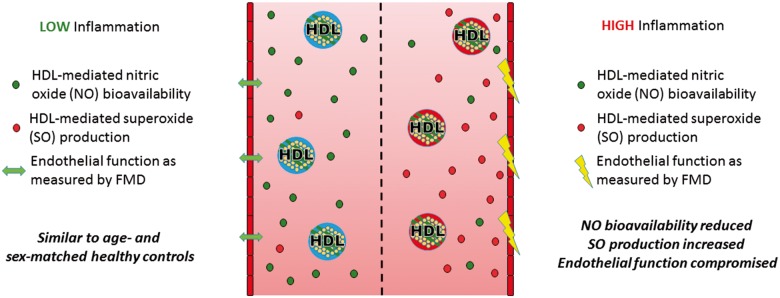
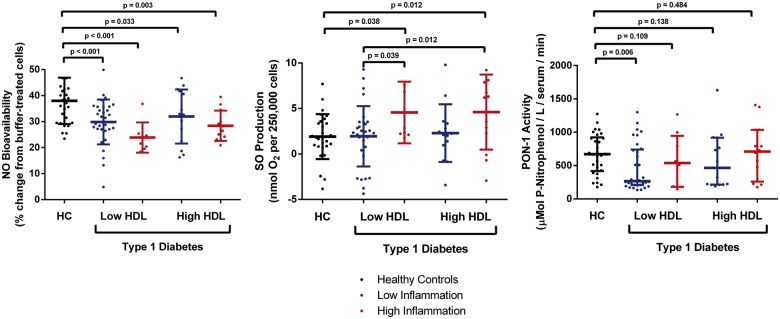
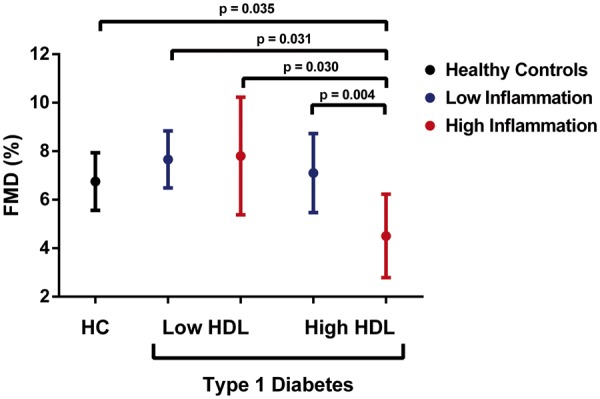
Aims: High-density lipoprotein (HDL) function may be altered in patients with chronic disease, transforming the particle from a beneficial vasoprotective molecule to a noxious pro-inflammatory equivalent. Adolescents with Type 1 diabetes often have elevated HDL, but its vasoprotective properties and relationship to endothelial function have not been assessed. Methods and results: Seventy adolescents with Type 1 diabetes (age 10–17 years) and 30 age-matched healthy controls supplied urine samples for the measurement of early renal dysfunction (albumin:creatinine ratio; ACR), blood samples for the assessment of cardiovascular risk factors (lipid profiles, HDL functionality, glycaemic control, and inflammatory risk score), and had their conduit artery endothelial function tested using flow-mediated dilation (FMD). HDL-c levels (1.69 ± 0.41 vs. 1.44 ± 0.29mmol/L; P < 0.001), and glycated haemoglobin (HbA1c) (8.4 ± 1.2 vs. 5.4 ± 0.2%; P < 0.001) were increased in all patients compared with controls. However, increased inflammation and HDL dysfunction were evident only in patients who also had evidence of early renal dysfunction (mean ± standard deviation for high-ACR vs. low-ACR and healthy controls: inflammatory risk score 11.3 ± 2.5 vs. 9.5 ± 2.4 and 9.2 ± 2.4, P < 0.01; HDL-mediated nitric-oxide bioavailability 38.0 ± 8.9 vs. 33.3 ± 7.3 and 25.0 ± 7.7%, P < 0.001; HDL-mediated superoxide production 3.71 ± 3.57 vs. 2.11 ± 3.49 and 1.91 ± 2.47nmol O2 per 250 000 cells, P < 0.05). Endothelial function (FMD) was impaired only in those who had both a high inflammatory risk score and high levels of HDL-c (P < 0.05). Conclusion: Increased levels of HDL-c commonly observed in individuals with Type 1 diabetes may be detrimental to endothelial function when accompanied by renal dysfunction and chronic inflammation.
Overview
The claims and statistics of this paper haven’t been checked yet.
Free: it reads the open-access text and checks the first 5 claims that cite a source we can check. Create a free account to check every claim.
Integrity signals
Registry
Cites
Statistics
Figures
Verification
Claims the paper makes
The claims and statistics of this paper haven’t been checked yet.
Free: it reads the open-access text and checks the first 5 claims that cite a source we can check. Create a free account to check every claim.
Claims other papers make about this one
Each is checked against this paper’s own text: does it say what the citing paper says it does?
In the citing paper
“In T1DM, high LDL-C values are seen in patients with uncontrolled glycaemia, while high levels of HDL-C might be pro-inflammatory and therefore atherogenic instead of protective.244”
From 2023 ESC guidelines for the management of cardiovascular disease in patients with diabetes. (2023) · cites this paper as [244]
Self-check
Percentages, sums and reported differences re-computed from the paper’s own numbers.
The self-check needs the paper’s full text.
Citations
Cites
European Guidelines on cardiovascular disease prevention in clinical practice (version 2012)
Authors/Task Force Members:, Perk, J., De Backer, G., Gohlke, H., Graham, I., Reiner, Ž., Verschuren, M., Albus, C., Benlian, P., Boysen, G., et al. (2012) · European Heart Journal · doi:10.1093/eurheartj/ehs092 · Cited by 8,490
2016 European Guidelines on cardiovascular disease prevention in clinical practice
Piepoli, M. F., Hoes, A. W., Agewall, S., Albus, C., Brotons, C., Catapano, A. L., Cooney, M.-T., Corrà, U., Cosyns, B., Deaton, C., et al. (2016) · European Heart Journal · doi:10.1093/eurheartj/ehw106 · Cited by 6,457
High density lipoprotein as a protective factor against coronary heart disease
Gordon, T., Castelli, W. P., Hjortland, M. C., Kannel, W. B., & Dawber, T. R. (1977) · The American Journal of Medicine · doi:10.1016/0002-9343(77)90874-9 · Cited by 5,059 · cited 1×
“High-density lipoprotein (HDL) is widely-considered to be a vasoprotective particle due to its many anti-atherogenic and antiinflammatory properties and is associated with improved CVD outcomes in epidemiological studies.(12) HDL levels in Type 1 diabetes are commonly reported to be approximately 0.”
BackgroundRawshani, A., Sattar, N., Franzén, S., Rawshani, A., Hattersley, A. T., Svensson, A.-M., Eliasson, B., & Gudbjörnsdottir, S. (2018) · The Lancet · doi:10.1016/s0140-6736(18)31506-x · Cited by 802
Flow-mediated dilation and cardiovascular risk prediction: A systematic review with meta-analysis
Ras, R. T., Streppel, M. T., Draijer, R., & Zock, P. L. (2013) · International Journal of Cardiology · doi:10.1016/j.ijcard.2012.09.047 · Cited by 622 · cited 1×
“This subclinical marker—which can be measured non-invasively using flow-mediated dilation (FMD)—is an established predictor of future adverse CVD outcomes.(5) In agreement with previous studies,(6,7) recent work from our group, as part of the Adolescent Type 1 Diabetes cardio-renal Intervention Trial (AdDIT), has repo…”
ResultMatsuzawa, Y., Kwon, T., Lennon, R. J., Lerman, L. O., & Lerman, A. (2015) · Journal of the American Heart Association · doi:10.1161/jaha.115.002270 · Cited by 558 · cited 1×
“Due to a lack of hard clinical endpoints in the young, we chose FMD as our surrogate marker of subclinical disease due to its widespread prevalence in this patient population,(4,6,7) as well as its established ability to predict future adverse CVD events.(41)”
BackgroundSorrentino, S. A., Besler, C., Rohrer, L., Meyer, M., Heinrich, K., Bahlmann, F. H., Mueller, M., Horváth, T., Doerries, C., Heinemann, M., et al. (2010) · Circulation · doi:10.1161/circulationaha.108.836346 · Cited by 402 · cited 1×
“Firstly, these changes have previously been shown to be related to endothelial dysfunction in patients with Type 2 diabetes.(16) Secondly, endothelial dysfunction is one of the earliest signs of subclinical vascular damage detectable in the young and has repeatedly been shown to be present in children and adolescents…”
BackgroundSecrest, A. M., Becker, D. J., Kelsey, S. F., LaPorte, R. E., & Orchard, T. J. (2010) · Diabetes · doi:10.2337/db10-0862 · Cited by 358
Reverse cholesterol transport and cholesterol efflux in atherosclerosis
Ohashi, R., Mu, H., Wang, X., Yao, Q., & Chen, C. (2005) · QJM: An International Journal of Medicine · doi:10.1093/qjmed/hci136 · Cited by 336
Type 1 diabetes and coronary artery disease
Orchard, T. J., Costacou, T., Kretowski, A., & Nesto, R. W. (2006) · Diabetes Care · doi:10.2337/dc06-1161 · Cited by 305
Cited by
2023 ESC guidelines for the management of cardiovascular disease in patients with diabetes.
Marx, N., Federici, M., Schütt, K., Müller-Wieland, D., Ajjan, R. A., Antunes, M. J., Christodorescu, R. M., Crawford, C., Di Angelantonio, E., Eliasson, B., et al. (2023) · European Heart Journal · doi:10.1093/eurheartj/ehad192 · Cited by 1,642
High Density Lipoproteins: Metabolism, Function, and Therapeutic Potential
Jomard, A., & Osto, E. (2020) · Frontiers in Cardiovascular Medicine · doi:10.3389/fcvm.2020.00039 · Cited by 175
“Further, T1DM patients with extremely high HDL levels and inflammation have a substantially decreased FMD (94), suggesting that high levels of HDL associated to systemic inflammation, as found in several cardiovascular and metabolic disease, may be a driver of vascular dysfunction and not merely a reflection of an ove…”
BackgroundInfluentialHDL in Immune-Inflammatory Responses: Implications beyond Cardiovascular Diseases
Bonacina, F., Pirillo, A., Catapano, A. L., & Norata, G. D. (2021) · Cells · doi:10.3390/cells10051061 · Cited by 131
Liu, Z., Fan, Q., Wu, S., Wan, Y., & Lei, Y. (2021) · Lipids in Health and Disease · doi:10.1186/s12944-021-01462-4 · Cited by 112
“The antioxidant effects as well as anti-inflammatory of high-density lipoprotein cholesterol (HDL-C) are well known, and reduced risks of HDL-C are relevant to systemic inflammation and endothelial cell dysfunction, thus participating in the progression of PD [4, 10].”
BackgroundPetek, T. H., Petek, T., Močnik, M., & Varda, N. M. (2022) · Antioxidants · doi:10.3390/antiox11050894 · Cited by 114
Metadata
- Authors
- Chiesa, S. T., Charakida, M., McLoughlin, E., Nguyen, H. C., Georgiopoulos, G., Motran, L., Elia, Y., Marcovecchio, M. L., Dunger, D. B., Dalton, R. N., Daneman, D., Sochett, E., Mahmud, F. H., & Deanfield, J. E.
- Affiliations
- University College London (GB)
- National and Kapodistrian University of Athens (GR)
- University of Toronto (CA)
- University of Cambridge (GB)
- St Thomas' Hospital (GB)
- Corresponding author
- Deanfield, John E
- ORCID
- Venue
- European Heart Journal
- Publisher
- Oxford University Press (OUP)
- Published
- 2019-03-12
- Volume
- 40
- Issue
- 43
- Pages
- 3559-3566
- ISSN
- 0195-668X (ISSN-L)
- 1522-9645
- PMC
- PMC6855140
- OpenAlex
- W2922106601
- Semantic Scholar
- 0f856f063a8fecf4d383e0e460d7a9a550c2d6e5
- Cited by
- 54
- References
- 42
- Citations by year
- 2026: 3 · 2025: 7 · 2024: 7 · 2023: 10 · 2022: 5 · 2021: 7 · 2020: 12 · 2019: 3
- FWCI
- 5.48
- Type
- journal article
- Language
- en
- Open access
- hybrid
- doi.org
- Licence
- Locations
- European Heart Journal (publishedVersion, cc-by)
- Europe PMC (PubMed Central) (publishedVersion, cc-by)
- PubMed Central (publishedVersion, cc-by)
- PubMed (publishedVersion)
- UCL Discovery (University College London) (submittedVersion)
- Research Portal (King's College London) (submittedVersion, other-oa)
- Apollo (University of Cambridge) (submittedVersion)
- Apollo
- Funders
- Juvenile Diabetes Research Foundation
- JDRF
- Diabetes UK
- DUK
- British Heart Foundation
- JDRF-CCTN
- Juvenile Diabetes Research Fund—Canadian Clinical Trials Network
- Heart and Stroke Foundation
- Canadian Diabetes Association
- Fondation Leducq Trans-Atlantic Network of Excellence
- Topics
- Health Sciences › Medicine › Endocrinology, Diabetes and Metabolism › Diabetes, Cardiovascular Risks, and Lipoproteins
- Health Sciences › Medicine › Physiology (medical) › Nitric Oxide and Endothelin Effects
- Life Sciences › Biochemistry, Genetics and Molecular Biology › Clinical Biochemistry › Paraoxonase enzyme and polymorphisms
- Keywords
- type 1 diabetes, adolescents, high-density lipoprotein, HDL dysfunction, endothelial dysfunction, systemic inflammation, early renal dysfunction, albumin-creatinine ratio, flow-mediated dilation, nitric oxide bioavailability, superoxide production, HbA1c, cardiovascular risk, glycemic control, dyslipidemia
- MeSH terms
- Adolescent, Child, Chronic Disease, Diabetes Mellitus, Type 1, Endothelium, Vascular, Female, Humans, Hyperlipidemias, Inflammation, Lipoproteins, HDL, Male, Biomarkers, Case-Control Studies, Renal Insufficiency
About these checks
Registry, retraction, Cites and statistics results are computed, not judged, with one exception: a printed reference that no index lists is read once by a model before it counts as a citation error. Claims are extracted by a model and kept only when their quote appears verbatim in the text; each cited source is then checked, with a model’s help, for whether it says what the claim relies on. Those verdicts can be wrong — read the claim’s quote and the cited source before relying on one.
Statistics and arithmetic are recomputed, not judged.
Confidence bands are shown only for fields calibrated on our annotated test set. None is calibrated yet, so no band is shown.
What counts as a claim ›How we measure confidence ›How we check this ›
Are you an author, or do you see a problem with this page? Request a review
Data sources
Bibliographic data: Semantic Scholar, OpenAlex, Crossref.
Contains information from the Semantic Scholar Academic Graph Datasets, made available under the ODC Attribution License (ODC-BY 1.0).
Semantic Scholar’s data is described in: Kinney, R., et al. (2023). The Semantic Scholar Open Data Platform. arXiv:2301.10140.
