

The DOI matches its Crossref record; 35 of the 35 references it cites were found in a registry or an index.
By how much would limiting TV food advertising reduce childhood obesity?
Open accessAbstract
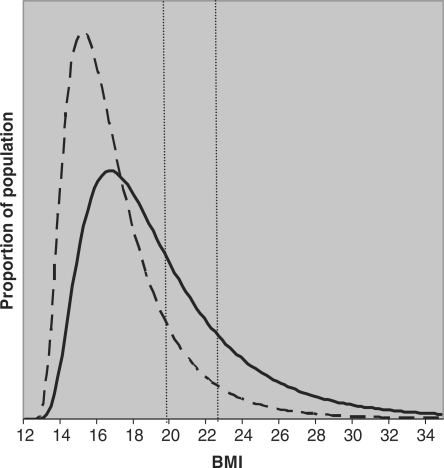
BACKGROUND: There is evidence suggesting that food advertising causes childhood obesity. The strength of this effect is unclear. To inform decisions on whether to restrict advertising opportunities, we estimate how much of the childhood obesity prevalence is attributable to food advertising on television (TV). METHODS: We constructed a mathematical simulation model to estimate the potential effects of reducing the exposure of 6- to 12-year-old US children to TV advertising for food on the prevalence of overweight and obesity. Model input was based on body measurements from NHANES 2003-04, the CDC-2000 cut-offs for weight categories, and literature that relates advertising to consumption levels and consumption to body mass. In an additional analysis we use a Delphi study to obtain experts' estimates of the effect of advertising on consumption. RESULTS: Based on literature findings, the model predicts that reducing the exposure to zero would decrease the average BMI by 0.38 kg/m(-2) and lower the prevalence of obesity from 17.8 to 15.2% (95% uncertainty interval 14.8-15.6) for boys and from 15.9% to 13.5% (13.1-13.8) for girls. When estimates are based on expert opinion, these values are 11.0% (7.7-14.0) and 9.9% (7.2-12.4), respectively. CONCLUSION: This study suggests that from one in seven up to one in three obese children in the USA might not have been obese in the absence of advertising for unhealthy food on TV. Limiting the exposure of children to marketing of energy-dense food could be part of a broader effort to make children's diets healthier.
Overview
The claims and statistics of this paper haven’t been checked yet.
Run the check — free, no account needed. It reads the open-access text and checks the sources it cites.
Integrity signals
Registry
Cites
Statistics
Figures
Verification
Claims the paper makes
The claims and statistics of this paper haven’t been checked yet.
Run the check — free, no account needed. It reads the open-access text and checks the sources it cites.
Claims other papers make about this one
Each is checked against this paper’s own text: does it say what the citing paper says it does?
In the citing paper
“Similarly, in an analysis using 2003–2004 National Health and Nutrition Examination Survey (NHANES) data and evidence for relation of television advertising to dietary consumption, it was estimated that eliminating television food advertisements to children 6 to 12 years of age would reduce the prevalence of obesity by 14.6%.”
From Population Approaches to Improve Diet, Physical Activity, and Smoking Habits: A Scientific Statement From the American Heart Association (2012) · cites this paper as [393]
Self-check
Percentages, sums and reported differences re-computed from the paper’s own numbers.
The self-check needs the paper’s full text.
Citations
Cites
An Introduction to the Bootstrap
Efron, B., & Tibshirani, R. J. (1994) · doi:10.1201/9780429246593 · Cited by 40,500
Prevalence of Overweight and Obesity in the United States, 1999-2004
Ogden, C. L., Carroll, M. D., Curtin, L. R., McDowell, M. A., Tabak, C. J., & Flegal, K. M. (2006) · JAMA · doi:10.1001/jama.295.13.1549 · Cited by 8,720
CDC GROWTH CHARTS FOR THE UNITED STATES: METHODS AND DEVELOPMENT 2000
Kuczmarski, R. J., Ogden, C. L., Guo, S. S., Strawn, L. G., Flegal, K. M., & Mei, Z. (2002) · Cited by 6,426
Prevalence of Overweight and Obesity in the United States
Crespo, C. J., & Smit, E. (2003) · Human Kinetics eBooks · doi:10.5040/9781718206601.ch-001 · Cited by 4,382
2000 CDC Growth Charts for the United States: methods and development.
Kuczmarski, R. J., Ogden, C. L., Guo, S. S., Grummer‐Strawn, L. M., Flegal, K. M., Mei, Z., Wei, R. X., Curtin, L. R., Roche, A. F., & Johnson, C. L. (2002) · PubMed · Cited by 3,716
Qualitative Research: Consensus methods for medical and health services research
Jones, J., & Hunter, D. (1995) · BMJ · doi:10.1136/bmj.311.7001.376 · Cited by 3,471
An Introduction to the Bootstrap.
Buckland, S. T., Efron, B., & Tibshirani, R. J. (1994) · Biometrics · doi:10.2307/2532810 · Cited by 3,236
National Center for Health Statistics (NCHS)
Feinleib, M. (2005) · Encyclopedia of Biostatistics · doi:10.1002/0470011815.b2a16042 · Cited by 3,134
Reducing Children's Television Viewing to Prevent Obesity: A Randomized Controlled Trial
Robinson, T. N. (1999) · JAMA · doi:10.1001/jama.282.16.1561 · Cited by 1,838
Obesity in Adulthood and Its Consequences for Life Expectancy: A Life-Table Analysis
Peeters, A., Barendregt, J. J., Willekens, F., Mackenbach, J. P., Mamun, A. A., & Bonneux, L. (2003) · Annals of Internal Medicine · doi:10.7326/0003-4819-138-1-200301070-00008 · Cited by 1,494
Self-citation
Research works printed but not linked: 2
- 1983, CURR ISSUES RES ADVERTISING, 6, 173
- 2004, Advance data, 27, 1
Cited by
Sorted by citations
European Guidelines on cardiovascular disease prevention in clinical practice (version 2012)
Authors/Task Force Members:, Perk, J., De Backer, G., Gohlke, H., Graham, I., Reiner, Ž., Verschuren, M., Albus, C., Benlian, P., Boysen, G., et al. (2012) · European Heart Journal · doi:10.1093/eurheartj/ehs092 · Cited by 8,490
2016 European Guidelines on cardiovascular disease prevention in clinical practice
Piepoli, M. F., Hoes, A. W., Agewall, S., Albus, C., Brotons, C., Catapano, A. L., Cooney, M.-T., Corrà, U., Cosyns, B., Deaton, C., et al. (2016) · European Heart Journal · doi:10.1093/eurheartj/ehw106 · Cited by 6,457
2016 European Guidelines on cardiovascular disease prevention in clinical practice
Authors/Task Force Members, Piepoli, M. F., Hoes, A. W., Agewall, S., Albus, C., Brotons, C., Catapano, A. L., Cooney, M. T., Corrà, U., Cosyns, B., et al. (2016) · European Journal of Preventive Cardiology · doi:10.1177/2047487316653709 · Cited by 1,435
Food cue reactivity and craving predict eating and weight gain: A meta-analytic review
Boswell, R. G., & Kober, H. (2016) · Obesity Reviews · doi:10.1111/obr.12354 · Cited by 703
Mozaffarian, D., Afshin, A., Benowitz, N. L., Bittner, V., Daniels, S. R., Franch, H. A., Jacobs, D. R., Kraus, W. E., Kris-Etherton, P. M., Krummel, D. A., et al. (2012) · Circulation · doi:10.1161/cir.0b013e318260a20b · Cited by 601
Metadata
- Authors
- Veerman, J. L., Van Beeck, E. F., Barendregt, J. J., & Mackenbach, J. P.
- Affiliations
- The University of Queensland (AU)
- Erasmus University Rotterdam (NL)
- ORCID
- Mackenbach, J. P.
- Venue
- The European Journal of Public Health
- Publisher
- Oxford University Press (OUP)
- Published
- 2009-03-26
- Volume
- 19
- Issue
- 4
- Pages
- 365-369
- ISSN
- 1101-1262 (ISSN-L)
- 1464-360X
- PMC
- PMC2712920
- OpenAlex
- W2148677460
- Cited by
- 179
- References
- 35
- Citations by year
- 2026: 2 · 2025: 1 · 2024: 5 · 2023: 3 · 2022: 7 · 2021: 7 · 2020: 8 · 2019: 8 · 2018: 12 · 2017: 11 · 2016: 19 · 2015: 14 · 2014: 19 · 2013: 14 · 2012: 17
- FWCI
- 16.39
- Type
- journal article
- Language
- en
- Open access
- hybrid
- doi.org
- Licence
- cc-by-nc
- Locations
- European Journal of Public Health (publishedVersion, cc-by-nc)
- PubMed Central (publishedVersion, cc-by-nc)
- PubMed (publishedVersion)
- EUR Research Repository (Erasmus University Rotterdam) (publishedVersion)
- EUR Research Repository (Erasmus University Rotterdam) (submittedVersion)
- Funders
- National Health and Medical Research Council
- Topics
- Health Sciences › Medicine › Public Health, Environmental and Occupational Health › Obesity, Physical Activity, Diet
- Health Sciences › Nursing › Nutrition and Dietetics › Nutrition, Health and Food Behavior
- Social Sciences › Communication › Media Influence and Health
- Keywords
- childhood obesity, television food advertising, advertising restrictions, overweight prevalence, body mass index, energy-dense foods, food marketing exposure, children's diet, obesity prevention, mathematical simulation model
- MeSH terms
- Advertising, Child, Child, Preschool, Female, Humans, Male, Nutrition Surveys, Obesity, Models, Statistical, Body Mass Index, Food Industry
About these checks
Registry, retraction, Cites and statistics results are computed, not judged, with one exception: a printed reference that no index lists is read once by a model before it counts as a citation error. Claims are extracted by a model and kept only when their quote appears verbatim in the text; each cited source is then checked, with a model’s help, for whether it says what the claim relies on. Those verdicts can be wrong — read the claim’s quote and the cited source before relying on one.
Statistics and arithmetic are recomputed, not judged.
Confidence bands are shown only for fields calibrated on our annotated test set. None is calibrated yet, so no band is shown.
What counts as a claim ›How we measure confidence ›How we check this ›
Are you an author, or do you see a problem with this page? Request a review
