

The DOI matches its Crossref record; 206 of the 207 references it cites were found in a registry or an index.
Ruminococcus gnavus : friend or foe for human health
Open accessAbstract
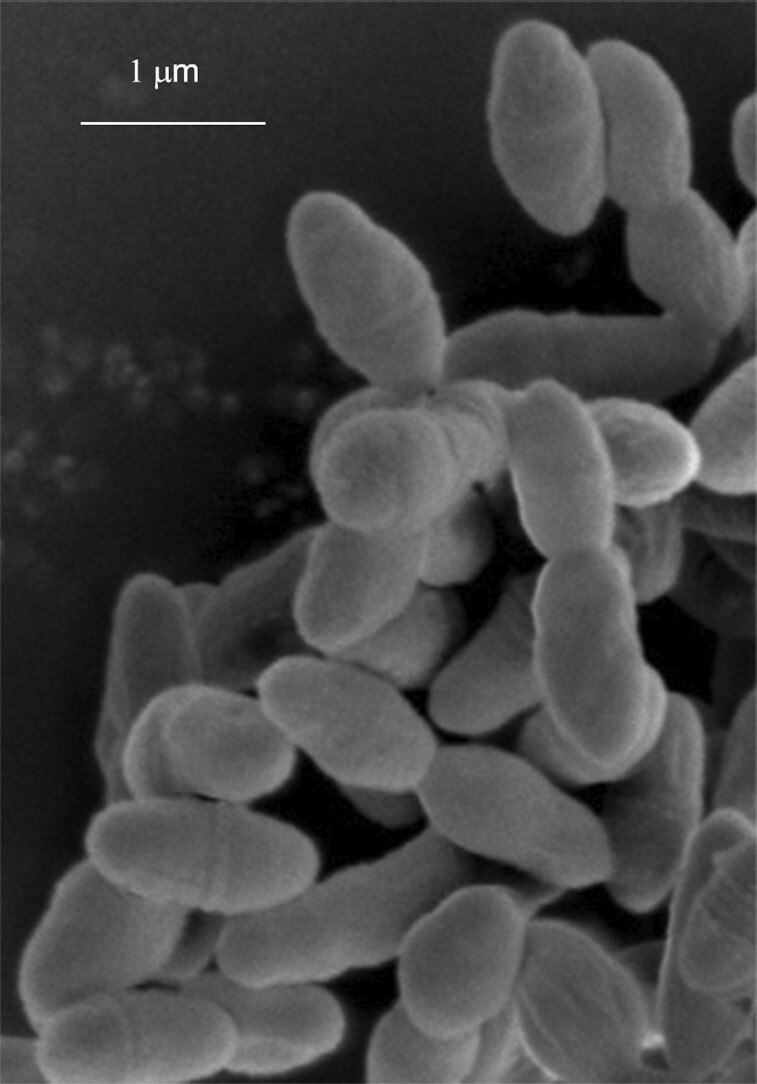
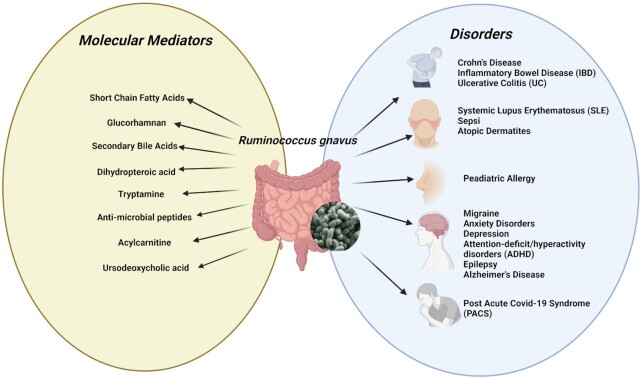
Ruminococcus gnavus was first identified in 1974 as a strict anaerobe in the gut of healthy individuals, and for several decades, its study has been limited to specific enzymes or bacteriocins. With the advent of metagenomics, R. gnavus has been associated both positively and negatively with an increasing number of intestinal and extraintestinal diseases from inflammatory bowel diseases to neurological disorders. This prompted renewed interest in understanding the adaptation mechanisms of R. gnavus to the gut, and the molecular mediators affecting its association with health and disease. From ca. 250 publications citing R. gnavus since 1990, 94% were published in the last 10 years. In this review, we describe the biological characterization of R. gnavus, its occurrence in the infant and adult gut microbiota and the factors influencing its colonization of the gastrointestinal tract; we also discuss the current state of our knowledge on its role in host health and disease. We highlight gaps in knowledge and discuss the hypothesis that differential health outcomes associated with R. gnavus in the gut are strain and niche specific.
Overview
The claims and statistics of this paper haven’t been checked yet.
Run the check — free, no account needed. It reads the open-access text and checks the sources it cites.
Integrity signals
Registry
Cites
Statistics
Figures
Verification
Claims the paper makes
The claims and statistics of this paper haven’t been checked yet.
Run the check — free, no account needed. It reads the open-access text and checks the sources it cites.
Claims other papers make about this one
Each is checked against this paper’s own text: does it say what the citing paper says it does?
In the citing paper
“R. gnavus has previously been related to inflammation, 42 but it was also associated with longevity in a Chinese study. 43”
From Global genetic diversity of human gut microbiome species is related to geographic location and host health (2025) · cites this paper as [42]
Self-check
Percentages, sums and reported differences re-computed from the paper’s own numbers.
The self-check needs the paper’s full text.
Citations
Cites
1 retracted
Huang, R., He, K., Duan, X., Xiao, J., Wang, H., & Xiang, G. (2022) · Computational and Mathematical Methods in Medicine · doi:10.1155/2022/1940846 · Cited by 16
RetractedA human gut microbial gene catalogue established by metagenomic sequencing
MetaHIT Consortium, Qin, J., Li, R., Raes, J., Arumugam, M., Burgdorf, K. S., Manichanh, C., Nielsen, T., Pons, N., Levenez, F., et al. (2010) · Nature · doi:10.1038/nature08821 · Cited by 11,624
Human gut microbiome viewed across age and geography
Yatsunenko, T., Rey, F. E., Manary, M. J., Trehan, I., Dominguez-Bello, M. G., Contreras, M., Magris, M., Hidalgo, G., Baldassano, R. N., Anokhin, A. P., et al. (2012) · Nature · doi:10.1038/nature11053 · Cited by 7,815
Gut microbiota in human metabolic health and disease
Fan, Y., & Pedersen, O. (2021) · Nature Reviews Microbiology · doi:10.1038/s41579-020-0433-9 · Cited by 4,724
Gut microbiota, metabolites and host immunity
Rooks, M. G., & Garrett, W. S. (2016) · Nature reviews. Immunology · doi:10.1038/nri.2016.42 · Cited by 3,409
Microbial tryptophan catabolites in health and disease
Roager, H. M., & Licht, T. R. (2018) · Nature Communications · doi:10.1038/s41467-018-05470-4 · Cited by 2,236
Gut microbiota-derived metabolites as key actors in inflammatory bowel disease
Lavelle, A., & Sokol, H. (2020) · Nature Reviews Gastroenterology & Hepatology · doi:10.1038/s41575-019-0258-z · Cited by 2,015
Gut microbiome structure and metabolic activity in inflammatory bowel disease
Franzosa, E. A., Sirota-Madi, A., Avila-Pacheco, J., Fornelos, N., Haiser, H. J., Reinker, S., Vatanen, T., Hall, A. B., Mallick, H., McIver, L. J., et al. (2018) · Nature Microbiology · doi:10.1038/s41564-018-0306-4 · Cited by 1,995
The abundance and variety of carbohydrate-active enzymes in the human gut microbiota
Kaoutari, A. E., Armougom, F., Gordon, J. I., Raoult, D., & Henrissat, B. (2013) · Nature Reviews Microbiology · doi:10.1038/nrmicro3050 · Cited by 1,683
The composition of the gut microbiota throughout life, with an emphasis on early life
Rodríguez, J. M., Murphy, K., Stanton, C., Ross, R. P., Kober, O. I., Juge, N., Avershina, E., Rudi, K., Narbad, A., Jenmalm, M. C., et al. (2015) · Microbial Ecology in Health and Disease · doi:10.3402/mehd.v26.26050 · Cited by 1,414
Self-citation
Cited by
Sorted by citations
Gilliland, A., Chan, J. J., Wolfe, T. J. D., Yang, H., & Vallance, B. A. (2023) · Gastroenterology · doi:10.1053/j.gastro.2023.09.019 · Cited by 237
Varghese, S., Rao, S., Khattak, A., Zamir, F., & Chaari, A. (2024) · Nutrients · doi:10.3390/nu16213663 · Cited by 152
Nishijima, S., Stankevič, E., Aasmets, O., Schmidt, T., Nagata, N., Keller, M. I., Ferretti, P., Juel, H. B., Fullam, A., Robbani, S. M., et al. (2024) · Cell · doi:10.1016/j.cell.2024.10.022 · Cited by 140
Andreu-Sánchez, S., Blanco-Míguez, A., Wang, D., Golzato, D., Manghi, P., Heidrich, V., Fackelmann, G., Zhernakova, D. V., Kurilshikov, A., Valles-Colomer, M., et al. (2025) · Cell · doi:10.1016/j.cell.2025.04.014 · Cited by 81
Effects of four food hydrocolloids on colitis and their regulatory effect on gut microbiota
Zhang, S., Sun, Y., Nie, Q., Hu, J., Li, Y., Shi, Z., Ji, H., Zhang, H., Zhao, M., Chen, C., et al. (2023) · Carbohydrate Polymers · doi:10.1016/j.carbpol.2023.121368 · Cited by 81
Metadata
- Authors
- Crost, E. H., Coletto, E., Bell, A., & Juge, N.
- Affiliations
- Quadram Institute (GB)
- Corresponding author
- Juge, Nathalie
- Venue
- FEMS Microbiology Reviews
- Publisher
- Oxford University Press (OUP)
- Published
- 2023-03
- Volume
- 47
- Issue
- 2
- ISSN
- 0168-6445 (ISSN-L)
- 1574-6976
- PMC
- PMC10112845
- OpenAlex
- W4362525665
- Cited by
- 335
- References
- 207
- Citations by year
- 2026: 90 · 2025: 128 · 2024: 98 · 2023: 19
- FWCI
- 8.99
- Type
- journal article
- Language
- en
- Open access
- hybrid
- doi.org
- Licence
- Locations
- FEMS Microbiology Reviews (publishedVersion, cc-by)
- PubMed Central (publishedVersion, cc-by)
- PubMed (publishedVersion)
- Funders
- Biotechnology and Biological Sciences Research Council (BB/R012490/1)
- Topics
- Life Sciences › Biochemistry, Genetics and Molecular Biology › Molecular Biology › Gut microbiota and health
- Health Sciences › Medicine › Infectious Diseases › Clostridium difficile and Clostridium perfringens research
- Life Sciences › Agricultural and Biological Sciences › Food Science › Probiotics and Fermented Foods
- Keywords
- Ruminococcus gnavus, gut microbiota, intestinal colonization, inflammatory bowel disease, neurological disorders, strain-specific effects, niche specificity, host-microbe interactions, anaerobic bacteria, metagenomics
- MeSH terms
- Eubacteriales, Gastrointestinal Microbiome, Adult, Humans, Gastrointestinal Tract, Ruminococcus
About these checks
Registry, retraction, Cites and statistics results are computed, not judged, with one exception: a printed reference that no index lists is read once by a model before it counts as a citation error. Claims are extracted by a model and kept only when their quote appears verbatim in the text; each cited source is then checked, with a model’s help, for whether it says what the claim relies on. Those verdicts can be wrong — read the claim’s quote and the cited source before relying on one.
Statistics and arithmetic are recomputed, not judged.
Confidence bands are shown only for fields calibrated on our annotated test set. None is calibrated yet, so no band is shown.
What counts as a claim ›How we measure confidence ›How we check this ›
Are you an author, or do you see a problem with this page? Request a review
