

Effects of Controlled Supramaximal High-Intensity Interval Training on Cardiorespiratory Fitness and Global Cognitive Function in Older Adults: The Umeå HIT Study-A Randomized Controlled Trial
Open accessThe DOI matches its Crossref record; 54 of the 55 references it cites were found in a registry or an index.
Abstract
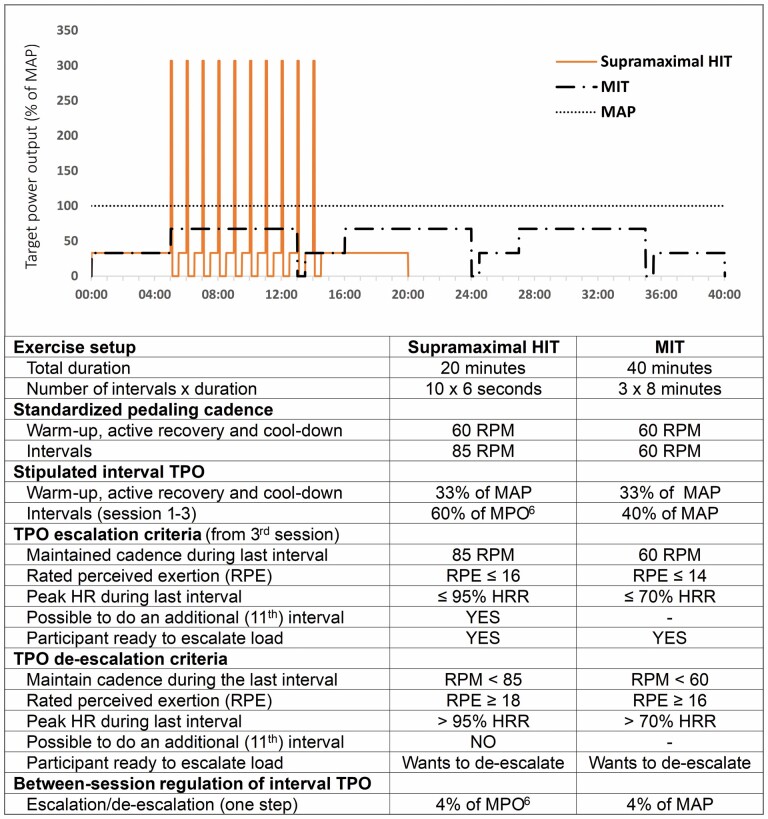
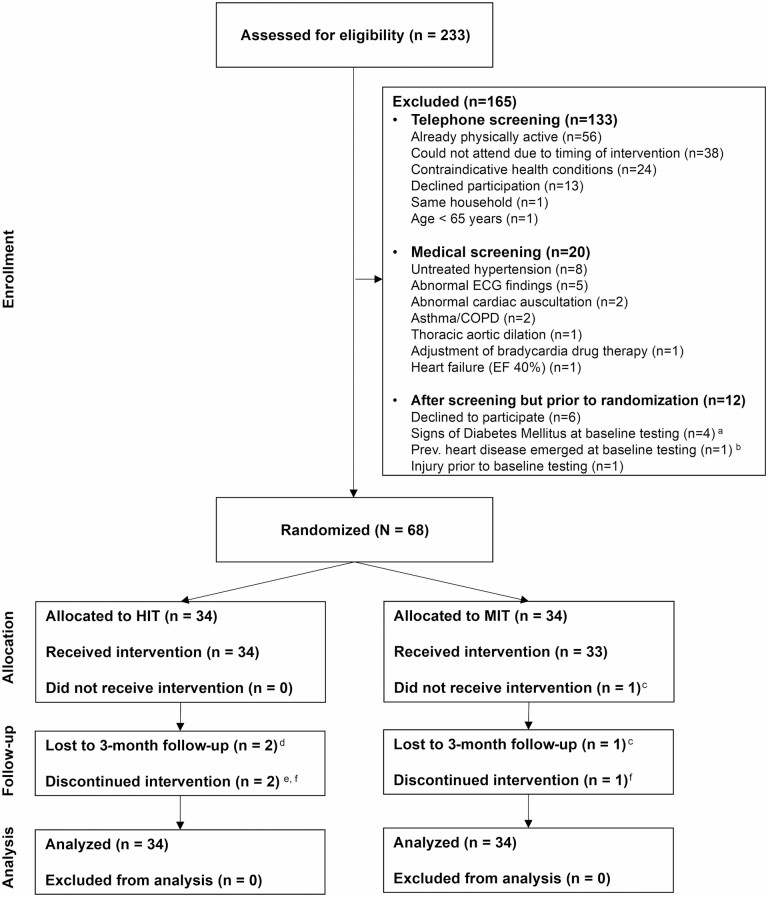
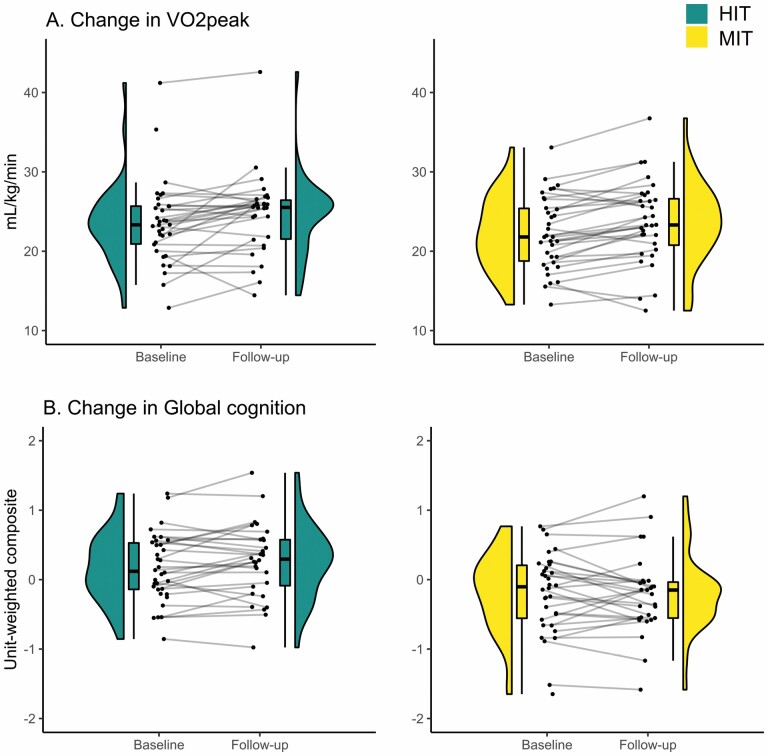
Background: This study examined the effects of regulated and controlled supramaximal high-intensity interval training (HIT) adapted for older adults, compared to moderate-intensity training (MIT), on cardiorespiratory fitness; cognitive, cardiovascular, and muscular function; and quality of life. Methods: Sixty-eight nonexercising older adults (66–79 years, 44% males) were randomized to 3 months of twice-weekly HIT (20-minute session including 10 × 6-second intervals) or MIT (40-minute session including 3 × 8-minute intervals) on stationary bicycles in an ordinary gym setting. Individualized target intensity was watt controlled with a standardized pedaling cadence and individual adjustment of the resistance load. Primary outcomes were cardiorespiratory fitness (V̇o2peak) and global cognitive function (unit-weighted composite). Results: V̇o2peak increased significantly (mean 1.38 mL/kg/min, 95% CI [0.77, 1.98]), with no between-group difference (mean difference 0.05 [−1.17, 1.25]). Global cognition did not improve (0.02 [−0.05, 0.09]), nor differed between groups (0.11 [−0.03, 0.24]). Significant between-group differences in change were observed for working memory (0.32 [0.01, 0.64]), and maximal isometric knee extensor muscle strength (0.07 N·m/kg [0.003, 0.137]), both in favor of HIT. Irrespective of the group, there was a negative change in episodic memory (−0.15 [−0.28, −0.02]), a positive change in visuospatial ability (0.26 [0.08, 0.44]), and a decrease in systolic (−2.09 mmHg [−3.54, −0.64]) and diastolic (−1.27 mmHg [−2.31, −0.25]) blood pressure. Conclusions: In nonexercising older adults, 3 months of watt-controlled supramaximal HIT improved cardiorespiratory fitness and cardiovascular function to a similar extent as MIT, despite half the training time. In favor of HIT, there was an improvement in muscular function and a potential domain-specific effect on working memory. Clinical Trial Registration: NCT03765385
Overview
The claims and statistics of this paper haven’t been checked yet.
Free: it reads the open-access text and checks the first 5 claims that cite a source we can check. Create a free account to check every claim.
Integrity signals
Registry
Cites
Statistics
Figures
Verification
Claims the paper makes
The claims and statistics of this paper haven’t been checked yet.
Free: it reads the open-access text and checks the first 5 claims that cite a source we can check. Create a free account to check every claim.
Claims other papers make about this one
Each is checked against this paper’s own text: does it say what the citing paper says it does?
The source backs part of the claim, not all of it — or backs it for a different population, condition or comparison.
In the citing paper
“Recently, HIIT has gained recognition as an effective exercise method for older adults due to its numerous health benefits, including improvements in cardiovascular health [120] and muscle mass [157] and cognitive function [158,159].”
From Global consensus on optimal exercise recommendations for enhancing healthy longevity in older adults (ICFSR) (2025) · cites this paper as [159]
Experimental — accuracy not yet measured
Self-check
Percentages, sums and reported differences re-computed from the paper’s own numbers.
The self-check needs the paper’s full text.
Citations
Cites
R: A Language and Environment for Statistical Computing
R Core Team (2025) · doi:10.32614/r.manuals · Cited by 352,181
Fitting Linear Mixed-Effects Models Using lme4
Bates, D., Mächler, M., Bolker, B., & Walker, S. (2015) · Journal of Statistical Software · doi:10.18637/jss.v067.i01 · Cited by 86,835 · cited 2×
“463 (RStudio Team, 2016), using the lme4 (37) and lmerTest (38) packages with 2-tailed testing and α = 0.”
MethodlmerTest Package: Tests in Linear Mixed Effects Models
Kuznetsova, A., Brockhoff, P. B., & Christensen, R. H. B. (2017) · Journal of Statistical Software · doi:10.18637/jss.v082.i13 · Cited by 24,346 · cited 1×
“463 (RStudio Team, 2016), using the lme4 (37) and lmerTest (38) packages with 2-tailed testing and α = 0.”
MethodMiyake, A., Friedman, N. P., Emerson, M. J., Witzki, A. H., Howerter, A., & Wager, T. D. (2000) · Cognitive Psychology · doi:10.1006/cogp.1999.0734 · Cited by 15,798 · cited 1×
“The tests selected for the global and domainspecific composites were based on previous research (29,30).”
MethodGlobal physical activity levels: surveillance progress, pitfalls, and prospects
Hallal, P. C., Andersen, L. B., Bull, F. C., Guthold, R., Haskell, W., & Ekelund, U. (2012) · The Lancet · doi:10.1016/s0140-6736(12)60646-1 · Cited by 5,711
Borg's Perceived Exertion and Pain Scales
Heath, E. M. (1998) · Medicine& Science in Sports & Exercise · doi:10.1097/00005768-199809000-00018 · Cited by 3,037 · cited 1×
“Self-rated perceived exertion was assessed with the 15-point (6–20) Rating of Perceived Exertion (RPE) scale (34).”
MethodPhysiological adaptations to low-volume, high-intensity interval training in health and disease
Gibala, M. J., Little, J. P., MacDonald, M. J., & Hawley, J. A. (2012) · The Journal of Physiology · doi:10.1113/jphysiol.2011.224725 · Cited by 1,744 · cited 5×
“Domain-specific composites were calculated for 5 different domains: (1) Processing speed (Digit symbol, 1-back, TMT 2 and 3), (2) Episodic memory (Free recall, Word recognition, Paired associates), (3) Working memory (Automated Operation Span, Backward digit span), (4) Executive function (Stroop, 2-back, TMT 4), and (…”
BackgroundMethodInfluentialBuchheit, M., & Laursen, P. B. (2013) · Sports Medicine · doi:10.1007/s40279-013-0029-x · Cited by 1,490
Northey, J. M., Cherbuin, N., Pumpa, K. L., Smee, D. J., & Rattray, B. (2018) · British Journal of Sports Medicine · doi:10.1136/bjsports-2016-096587 · Cited by 1,380 · cited 2×
“Aerobic and resistance training have overlapping as well as specific physiological effects, and a metaanalysis has shown positive effects from both aerobic and combined exercise, as well as a domain-specific interaction effect of resistance training on working memory (46).”
BackgroundCunningham, C., O' Sullivan, R., Caserotti, P., & Tully, M. A. (2020) · Scandinavian Journal of Medicine & Science in Sports · doi:10.1111/sms.13616 · Cited by 1,154 · cited 2×
“Domain-specific composites were calculated for 5 different domains: (1) Processing speed (Digit symbol, 1-back, TMT 2 and 3), (2) Episodic memory (Free recall, Word recognition, Paired associates), (3) Working memory (Automated Operation Span, Backward digit span), (4) Executive function (Stroop, 2-back, TMT 4), and (…”
Method
Research works printed but not linked: 1
- Sullivan M, Karlsson J, Taft C, Ware JE. SF-36 Hälsoenkät: Svensk Manual Och Tolkningsguide = (Swedish Manual and Interpretation Guide) (2nd ed.). Sahlgrenska Sjukhuset, Sektionen för Vårdforskning; 2002.
Cited by
Izquierdo, M., de Souto Barreto, P., Arai, H., Bischoff-Ferrari, H. A., Cadore, E. L., Cesari, M., Chen, L.-K., Coen, P. M., Courneya, K. S., Duque, G., et al. (2025) · The Journal of nutrition, health and aging · doi:10.1016/j.jnha.2024.100401 · Cited by 273
Physical exercise, cognition, and brain health in aging
Boa Sorte Silva, N. C., Barha, C. K., Erickson, K. I., Kramer, A. F., & Liu-Ambrose, T. (2024) · Trends in Neurosciences · doi:10.1016/j.tins.2024.04.004 · Cited by 119
Dhahbi, W., Briki, W., Heißel, A., Schega, L., Dergaa, I., Guelmami, N., Omri, A. E., & Chaabène, H. (2025) · Sports Medicine - Open · doi:10.1186/s40798-025-00857-2 · Cited by 121
“Interestingly, combining high-intensity exercise with motor-cognitive dual-task training has been shown to enhance processing speed, visuospatial skills, and inhibitory control, likely mediated by increased cerebral blood flow and the release of neurotrophic factors [10, 72, 84].”
Liang, W., Xiang, W., Cheng, S., Jiao, J., Zhu, X., & Duan, Y. (2024) · Sports Medicine - Open · doi:10.1186/s40798-024-00767-9 · Cited by 40
Wang, H., Pei, Z., & Liu, Y. (2024) · BMC Geriatrics · doi:10.1186/s12877-024-04714-x · Cited by 28
“In particular, older adults with lower levels of cardiorespiratory fitness have been found to exhibit poorer executive function [44], and older adults’ muscle strength has a domain-specific effect on their working memory [45].”
BackgroundSert, H., Eren, M. G., Gürçay, B., & Koç, F. (2025) · BMC Sports Science Medicine and Rehabilitation · doi:10.1186/s13102-025-01176-5 · Cited by 25
Fosstveit, S. H., Lohne‐Seiler, H., Feron, J., Lucas, S. J. E., Ivarsson, A., & Berntsen, S. (2024) · Scandinavian Journal of Medicine and Science in Sports · doi:10.1111/sms.14573 · Cited by 27
“Six studies 40,43,44,54,59,62 reported blinding of the outcome assessors.”
BackgroundResultInfluentialHistory and perspectives on interval training in sport, health, and disease
Foster, C., Casado, A., Bok, D., Hofmann, P., Bakken, M., Tjelta, A. R., Manso, J. G., Boullosa, D. A., & de Koning, J. J. (2025) · Applied Physiology, Nutrition, and Metabolism · doi:10.1139/apnm-2023-0611 · Cited by 19
Jakobsson, J., Burtin, C., Hedlund, M., Boraxbekk, C., Westman, J., Karalija, N., Stål, P., Sandström, T., Ruttens, D., Gosker, H. R., et al. (2024) · Trials · doi:10.1186/s13063-024-08481-3 · Cited by 11
“A novel concept of controlled supramaximal HIIT involves 10 × 6 s cycling intervals [15, 16] at intensities above maximal aerobic capacity, that is, higher than the external intensity that results in maximal oxygen uptake during a cardiopulmonary exercise test (CPET).”
Self-citationFang, W., Fan, S., Zheng, H., Fang, Z., You, Y., Yin, B., Li, B., & Ye, X. (2025) · Humanities and Social Sciences Communications · doi:10.1057/s41599-025-05155-6 · Cited by 12
“Recent research shows that AI-guided high-intensity exercise greatly improves cardiorespiratory fi tness by precisely adjusting breathing rhythms and optimizing workout intensity in real time (Simonsson et al. 2023).”
Fridberg, H., Wiklund, M., Snellman, F., Rosendahl, E., Hedlund, M., Boraxbekk, C., & Lindelöf, N. (2025) · BMC Geriatrics · doi:10.1186/s12877-024-05635-5 · Cited by 10
Self-citationFrykholm, E., Simonsson, E., Sandström, S. L., Hedlund, M., Holmberg, H., Johansson, B. H., Lindelöf, N., Boraxbekk, C., & Rosendahl, E. (2024) · Psychology of sport and exercise · doi:10.1016/j.psychsport.2024.102647 · Cited by 7
Self-citationFrykholm, E., Hedlund, M., Becker, C., Holmberg, H., Johansson, B. H., Klenk, J., Lindelöf, N., Lindemann, U., Simonsson, E., Boraxbekk, C., et al. (2024) · Age and Ageing · doi:10.1093/ageing/afae226 · Cited by 7
Self-citationMen, J., Zhao, C., Xiang, C., Zhu, G., Yu, Z., Wang, P., Wu, S., Zhang, Y., Li, Y., Wang, L., et al. (2025) · Frontiers in Endocrinology · doi:10.3389/fendo.2025.1526991 · Cited by 12
Jakobsson, J., Brandt, J. D., Hedlund, M., Rullander, A., Sandström, T., & Nyberg, A. (2025) · ERJ Open Research · doi:10.1183/23120541.01321-2024 · Cited by 11
“Thus, this provides novel data on individuals with COPD and further supports the feasibility of SupraHIIT in HC [26, 27].”
InfluentialSelf-citationBrandt, J. D., Jakobsson, J., Hedlund, M., Sandström, T., & Nyberg, A. (2025) · Experimental Physiology · doi:10.1113/ep092151 · Cited by 4
“The mBCST has mostly been used as an exercise test that enables supra-maximal intensities, and therefore can be used to prescribe SupraHIIT (Frykholm et al., 2024; Hedlund et al., 2019; Simonsson et al., 2023).”
InfluentialSelf-citationWahlström, V., Abtahi, F., Forsman, M., Yang, L., Öhrner, P., Tornevi, A., Stjernbrandt, A., Lewis, C., & Järvholm, L. S. (2025) · International Archives of Occupational and Environmental Health · doi:10.1007/s00420-025-02161-8 · Cited by 5
“On the other hand, studies on high-intensity interval exercise with short intervals have shown to be effective in increasing aer - obic capacity (Simonsson et al. 2023).”
Sandström, S. L., Simonsson, E., Hedlund, M., Rosendahl, E., & Boraxbekk, C. (2025) · Cerebral Cortex · doi:10.1093/cercor/bhaf277 · Cited by 5
Self-citationChu, R., Li, M., Zhu, C., Du, Y., & Wu, S. (2026) · Medicine · doi:10.1097/md.0000000000047101 · Cited by 6
“[34,37,38,40,42,46,47] The meta-analysis results (as shown in Fig.”
InfluentialFrykholm, E., Pettersson, B., Hedlund, M., Wiklund, M., Johansson, B. H., Boraxbekk, C., Rosendahl, E., & Lindelöf, N. (2025) · European Review of Aging and Physical Activity · doi:10.1186/s11556-025-00379-6 · Cited by 3
“The benefits, acceptability, and appropriateness of supramaximal HIT are promising for older adults [15– 18].”
InfluentialSelf-citationGiannì, J., Crepaldi, M., Fusi, G., Colombi, F., Brugnera, A., Greco, A., Compare, A., & Rusconi, M. L. (2024) · Geriatrics · doi:10.3390/geriatrics9030059 · Cited by 2
“…activity’s beneficial effects derive from it being carried out regularly over time [60]; without consistency and frequency, it would not be possible to build a strong reserve, and it would correspond only to a sporadic physical exercise, thus leading to insufficient physiological changes [62].”
BackgroundMen, J., Zhao, C., Xiang, C., Zhu, G., Yu, Z., Wang, P., Wu, S., Zhang, Y., Li, Y., Wang, L., et al. (2024) · Research Square · doi:10.21203/rs.3.rs-4253175/v1
Effectiveness of Interval Training in Increasing Cardiorespiratory Endurance: A Systematic Review
Ridwan, M., Zhuka, E. M., Haqiyah, A., & Zakaria, J. (2024) · Physical Education Theory and Methodology · doi:10.17309/tmfv.2024.6.19 · Cited by 1
Sandström, S. L., Frankel, J., Lindelöf, N., Hedlund, M., Frykholm, E., Fridberg, H., Rosendahl, E., Boraxbekk, C., & Sandlund, M. (2025) · Research Square · doi:10.21203/rs.3.rs-6707321/v1
Self-citationButts, B., Herring, C., Park, C., Swatson, E., Watson, J., & Wharton, W. (2025) · Current Geriatrics Reports · doi:10.1007/s13670-025-00435-0
Sandström, S. L., Frankel, J., Lindelöf, N., Hedlund, M., Frykholm, E., Fridberg, H., Rosendahl, E., Boraxbekk, C., & Sandlund, M. (2026) · European Review of Aging and Physical Activity · doi:10.1186/s11556-026-00401-5
Self-citationNascimento-da-Silva, F., Lopes, A. M. M., Araújo, R. A. D. A. M., Werneck‐de‐Castro, J. P., & Valentim‐Silva, J. R. (2026) · Frontiers in Sports and Active Living · doi:10.3389/fspor.2026.1655441
Jiuchen, Y., I, F. L., Shi, S., & Wu, Z. (2026) · The Journals of Gerontology Series A · doi:10.1093/gerona/glag030
Frykholm, E., Boman‐Häggbom, J., Holmberg, H., Johansson, B. H., Sandström, S. L., Simonsson, E., Wiklund, U., Rosendahl, E., & Hedlund, M. (2026) · Physiological Reports · doi:10.14814/phy2.70910
“The test was terminated at volitional exhaustion, most commonly corresponding to a rating of perceived exertion ≥ 18 on the Borg scale, or according to predefined safety criteria; detailed procedures and termination criteria have been described previously (Simonsson et al., 2023).”
InfluentialSelf-citationStefanovic, J., Werndle, V. V., & Reljic, D. (2026) · Sports · doi:10.3390/sports14070311
Entrenamiento interválico y sus beneficios en la cognición
Romero, M. A. C., Sotelo, J. J. G., Reyes, R. A., Blanco-Salazar, A., Rentería, I., Chávez-Guevara, I. A., & Jiménez‐Maldonado, A. (2026) · Revista Mexicana de Ciencias de la Cultura Física · doi:10.54167/rmccf.v6i12.2222
Faisal, F., & Boileau, A. J. (2026) · Cureus · doi:10.7759/cureus.114670
Moreira, P., Ferreira, S., Garrido, N. D., Monteiro, A. M., Afonso, P., Malheiro, A., Ribeiro, J., & Forte, P. M. (2026) · Journal of Clinical Medicine · doi:10.3390/jcm15176701
“Importantly, HIIT protocols can be adapted to different functional capacities and clinical contexts, ranging from supramaximal cycle ergometer protocols to low-volume and home-based interventions [7,15].”
Li, W., An, X., Zhang, Y., Liu, W., & Zhao, H. (2026) · Maturitas · doi:10.1016/j.maturitas.2026.109109
Simonsson, E., Andersson, M., Hedlund, M., Rosendahl, E., Nyberg, L. H., & Boraxbekk, C. (2026) · Aging Brain · doi:10.1016/j.nbas.2026.100172
“In the Umeå HIT Study, a randomized controlled trial, we have previously demonstrated that three months of controlled supra-maximal high-intensity interval training (HIT) or aerobic moderate-intensity training (MIT) similarly improved CRF among older adults [39].”
InfluentialSelf-citation
Metadata
- Authors
- Simonsson, E., Levik Sandström, S., Hedlund, M., Holmberg, H., Johansson, B., Lindelöf, N., Boraxbekk, C.-J., & Rosendahl, E.
- Affiliations
- Umeå University (SE)
- Department of Radiation Sciences, Diagnostic Radiology, Umeå University , Umeå , Sweden
- University of Copenhagen (DK)
- Corresponding author
- Simonsson, Emma
- ORCID
- Venue
- The Journals of Gerontology: Series A
- Publisher
- Oxford University Press (OUP)
- Published
- 2023-03-28
- Volume
- 78
- Issue
- 9
- Pages
- 1581-1590
- ISSN
- 1079-5006 (ISSN-L)
- 1758-535X
- PMC
- PMC10460559
- OpenAlex
- W4361190695
- Cited by
- 35
- References
- 55
- Citations by year
- 2026: 11 · 2025: 13 · 2024: 11
- FWCI
- 10.65
- Type
- journal article
- Language
- en
- Open access
- hybrid
- doi.org
- Licence
- Locations
- The Journals of Gerontology Series A (publishedVersion, cc-by-nc)
- PubMed Central (publishedVersion, cc-by-nc)
- PubMed (publishedVersion)
- Research at the University of Copenhagen (University of Copenhagen) (publishedVersion, cc-by-nc)
- DiVA at Umeå University (Umeå University) (submittedVersion, other-oa)
- Funders
- Swedish Research Council (2017-00912)
- Forte—Swedish Research Council for Health, Working Life and Welfare (2020-00159)
- Kamprad Family Foundation
- Seniorhusen Foundation
- Swedish Dementia Association
- Strategic Research Area Health Care Science
- Erik and Anne Marie Detlof’s Foundation
- Kempe Foundation
- Umeå University Foundation for Medical Research
- Faculty of Medicine at Umeå University
- Topics
- Health Sciences › Medicine › Physiology (medical) › Cardiovascular and exercise physiology
- Health Sciences › Medicine › Public Health, Environmental and Occupational Health › Physical Activity and Health
- Health Sciences › Medicine › Orthopedics and Sports Medicine › Sports Performance and Training
- Keywords
- high-intensity interval training, supramaximal exercise, older adults, cardiorespiratory fitness, cognitive function, working memory, episodic memory, visuospatial ability, muscle strength, blood pressure, quality of life, stationary cycling, moderate-intensity training
- MeSH terms
- Cardiorespiratory Fitness, High-Intensity Interval Training, Aged, Cognition, Female, Humans, Male, Quality of Life
About these checks
Registry, retraction, Cites and statistics results are computed, not judged, with one exception: a printed reference that no index lists is read once by a model before it counts as a citation error. Claims are extracted by a model and kept only when their quote appears verbatim in the text; each cited source is then checked, with a model’s help, for whether it says what the claim relies on. Those verdicts can be wrong — read the claim’s quote and the cited source before relying on one.
Statistics and arithmetic are recomputed, not judged.
Confidence bands are shown only for fields calibrated on our annotated test set. None is calibrated yet, so no band is shown.
What counts as a claim ›How we measure confidence ›How we check this ›
Are you an author, or do you see a problem with this page? Request a review
Data sources
Bibliographic data: Semantic Scholar, OpenAlex, Crossref.
Contains information from the Semantic Scholar Academic Graph Datasets, made available under the ODC Attribution License (ODC-BY 1.0).
Semantic Scholar’s data is described in: Kinney, R., et al. (2023). The Semantic Scholar Open Data Platform. arXiv:2301.10140.
