

The DOI matches its Crossref record; 53 of the 54 references it cites were found in a registry or an index; 2 of the 23 sources its claims cite were checked for support.
Common variants near FRK/COL10A1 and VEGFA are associated with advanced age-related macular degeneration
Open accessAbstract
Despite significant progress in the identification of genetic loci for age-related macular degeneration (AMD), not all of the heritability has been explained. To identify variants which contribute to the remaining genetic susceptibility, we performed the largest meta-analysis of genome-wide association studies to date for advanced AMD. We imputed 6 036 699 single-nucleotide polymorphisms with the 1000 Genomes Project reference genotypes on 2594 cases and 4134 controls with follow-up replication of top signals in 5640 cases and 52 174 controls. We identified two new common susceptibility alleles, rs1999930 on 6q21-q22.3 near FRK/COL10A1 [odds ratio (OR) 0.87; P = 1.1 × 10(-8)] and rs4711751 on 6p12 near VEGFA (OR 1.15; P = 8.7 × 10(-9)). In addition to the two novel loci, 10 previously reported loci in ARMS2/HTRA1 (rs10490924), CFH (rs1061170, and rs1410996), CFB (rs641153), C3 (rs2230199), C2 (rs9332739), CFI (rs10033900), LIPC (rs10468017), TIMP3 (rs9621532) and CETP (rs3764261) were confirmed with genome-wide significant signals in this large study. Loci in the recently reported genes ABCA1 and COL8A1 were also detected with suggestive evidence of association with advanced AMD. The novel variants identified in this study suggest that angiogenesis (VEGFA) and extracellular collagen matrix (FRK/COL10A1) pathways contribute to the development of advanced AMD.
Overview
AI snapshot
Written from the paper’s full text.
TL;DR
This large meta-analysis of genome-wide association studies for advanced age-related macular degeneration (AMD) identified two novel common susceptibility loci, near FRK/COL10A1 and VEGFA, and confirmed 10 previously reported loci. The findings implicate angiogenesis and extracellular collagen matrix pathways in advanced AMD.
Key findings
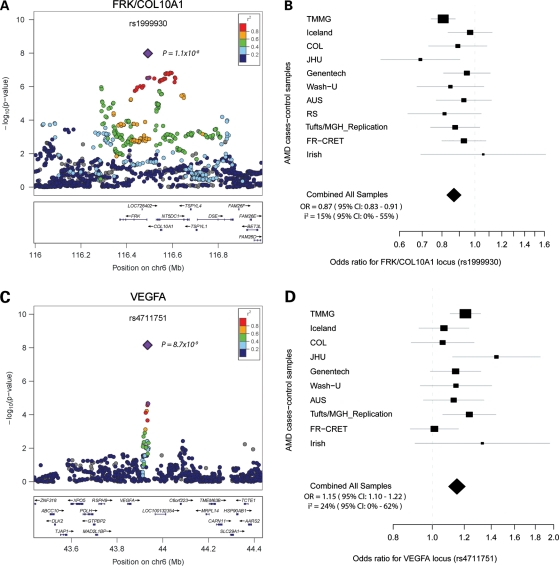
- rs1999930 near FRK/COL10A1 was associated with reduced risk of advanced AMD (combined OR 0.87, 95% CI 0.83–0.91, P = 1.1 × 10⁻⁸); rs4711751 near VEGFA was associated with increased risk (combined OR 1.15, 95% CI 1.10–1.21, P = 8.7 × 10⁻⁹).
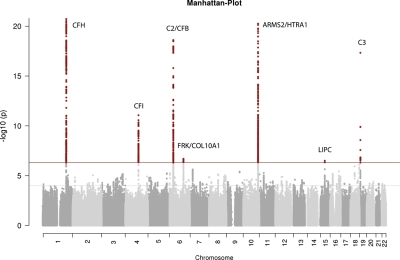
- Ten previously reported loci were confirmed with genome-wide significant signals in the combined analysis, including ARMS2/HTRA1 (rs10490924, P = 3.6 × 10−322), CFH (rs1061170, P = 1.3 × 10−261; rs1410996, P = 7.4 × 10−235), CFB (rs641153, P = 5.5 × 10⁻³¹), C3 (rs2230199, P = 4.6 × 10⁻²⁹), C2 (rs9332739, P = 2.4 × 10⁻²³), CFI (rs10033900, P = 4.1 × 10⁻¹⁰), LIPC (rs10468017, P = 2.7 × 10⁻¹²), TIMP3 (rs9621532, P = 2.2 × 10⁻¹⁵), and CETP (rs3764261, P = 6.9 × 10⁻⁹).
- Both novel variants had similar effect sizes for geographic atrophy and neovascular AMD subtypes in the TMMG samples.
- A risk score using 14 validated or suggested variants estimated a >50-fold difference in advanced AMD risk between high-risk (score >2) and low-risk (score <−2) individuals; the associated loci explained ∼39% of total variance, or 55% of the heritability, of advanced AMD.
Methods
- Meta-analysis of GWAS in the TMMG data set: 2594 advanced AMD cases and 4134 controls of European ancestry, with 6,036,699 high-quality SNPs imputed using 1000 Genomes Project reference genotypes.
- Replication in 5640 cases and 52,174 controls from 10 independent cohorts; top signals were tested with fixed-effects meta-analysis, and heterogeneity was assessed by Cochran’s Q-test.
- Cases had advanced AMD (geographic atrophy or neovascular disease); controls were without macular degeneration. Analyses adjusted for genotyping platform and genetic ancestry principal components.
Limitations
- The paper states that discovery effect sizes for both novel SNPs were larger than replication effect sizes, possibly due to a “winner’s curse” phenomenon.
- The paper notes that the genome-wide significance threshold assumes ∼1,000,000 independent SNPs, but 1000 Genomes imputation tested many more correlated SNPs, and no empirical studies address genome-wide significance for 1000 Genomes-derived data.
- The paper states that the genetic risk score’s clinical utility needs further evaluation in independent samples, and that associations may exist for other endophenotypes such as macular drusen; evident from the text, all cohorts were of European ancestry, limiting generalizability, and not all replication cohorts contributed to every SNP analysis (e.g., Rotterdam Study was not genotyped for rs4711751).
Model-written summary. Check it against the paper before relying on it.
Integrity signals
Registry
Cites
Statistics
Figures
Verification
Claims the paper makes
25 Own result · 15 Own method · 14 Not checked yet · 6 Own interpretation · 3 No basis given · 1 Supported
A result the paper reports from its own data — it cites no other source for it, so there is none to check. The quote shows it is in the paper.
In the paper
“The risk allele (T) of rs4711751 also had a similar magnitude of effect on GA [OR = 1.23 (1.08–1.40), P = 2.0 × 10⁻³] and NV [OR = 1.20 (1.09–1.32), P = 2.5 × 10⁻⁴].”
§ Common variants near FRK/COL10A1 and VEGFA are associated with advanced age-related macular degeneration > RESULTS
plaincorrelational- Asserted: passes — The authors put it forward as true.
- Checkable: passes — It can be checked against evidence.
- Load-bearing: unclear — It is unclear whether the paper’s conclusions depend on it.
- Based: passes — The paper gives a reason why it holds.
In the paper
“Using a standard liability threshold model (25), the previously reported loci combined with the new loci discovered in this study explain ∼39% of the total variance (or 55% of the heritability) of advanced AMD.”
§ Common variants near FRK/COL10A1 and VEGFA are associated with advanced age-related macular degeneration > DISCUSSION
What the sources say
- Not checked yetcites [25] Barrett, 2008, Genome-wide association defines more than 30 distinct susceptibility loci for Crohn's disease, Nat. Genet. source
plaincorrelational- Asserted: passes — The authors put it forward as true.
- Checkable: passes — It can be checked against evidence.
- Load-bearing: passes — The paper’s conclusions depend on it.
- Based: passes — The paper gives a reason why it holds.
In the paper
“ARMS2/HTRA1 was more strongly related to NV compared with GA as previously reported (23).”
§ Common variants near FRK/COL10A1 and VEGFA are associated with advanced age-related macular degeneration > RESULTS
What the sources say
- Not checked yetcites [23] Sobrin, 2011, ARMS2/HTRA1 locus can confer differential susceptibility to the advanced subtypes of age-related macular degeneration, Am. J. Ophthalmol. source
plaincorrelational- Asserted: passes — The authors put it forward as true.
- Checkable: passes — It can be checked against evidence.
- Load-bearing: unclear — It is unclear whether the paper’s conclusions depend on it.
- Based: passes — The paper gives a reason why it holds.
A result the paper reports from its own data — it cites no other source for it, so there is none to check. The quote shows it is in the paper.
In the paper
“As expected, we observed highly statistically significant association signals at SNPs in six previously published loci, including ARMS2/HTRA1 (rs10490924, P = 1.2 × 10−144), CFH (rs1061170, P = 5.6 × 10−138, and rs1410996, P = 2.1 × 10−134), CFB (rs641153, P = 2.9 × 10⁻²²), C3 (rs2230199, P = 1.4 × 10⁻¹⁸), C2 (rs9332739, P = 4.3 × 10⁻¹²), CFI (rs10033900, P = 2.4 × 10⁻¹¹) and LIPC (rs1532085, P =”
§ Common variants near FRK/COL10A1 and VEGFA are associated with advanced age-related macular degeneration > RESULTS
plaincorrelationaln = 2,594 ·- Asserted: passes — The authors put it forward as true.
- Checkable: passes — It can be checked against evidence.
- Load-bearing: unclear — It is unclear whether the paper’s conclusions depend on it.
- Based: passes — The paper gives a reason why it holds.
A result the paper reports from its own data — it cites no other source for it, so there is none to check. The quote shows it is in the paper.
In the paper
“Loci in the recently reported genes ABCA1 and COL8A1 were also detected with suggestive evidence of association with advanced AMD.”
- Also stated in: § RESULTS · plain
“Two other variants in ABCA1 (rs1883025, P = 1.2 × 10⁻⁷) and COL8A1 (rs13095226, P = 9.7 × 10⁻⁷) which were reported in our previous GWAS (15) are also still noteworthy candidates”
§ Common variants near FRK/COL10A1 and VEGFA are associated with advanced age-related macular degeneration > Abstract
plaincorrelational- Asserted: passes — The authors put it forward as true.
- Checkable: passes — It can be checked against evidence.
- Load-bearing: unclear — It is unclear whether the paper’s conclusions depend on it.
- Based: passes — The paper gives a reason why it holds.
- Also stated in: § RESULTS · plain
A result the paper reports from its own data — it cites no other source for it, so there is none to check. The quote shows it is in the paper.
In the paper
“The risk locus rs1999930 associated with advanced AMD in our study is in strong LD (R2 = 0.81 in 1000 Genomes CEU data) with a functional variant rs9488843.”
§ Common variants near FRK/COL10A1 and VEGFA are associated with advanced age-related macular degeneration > DISCUSSION
boostedcorrelational- Asserted: passes — The authors put it forward as true.
- Checkable: passes — It can be checked against evidence.
- Load-bearing: passes — The paper’s conclusions depend on it.
- Based: passes — The paper gives a reason why it holds.
A result the paper reports from its own data — it cites no other source for it, so there is none to check. The quote shows it is in the paper.
In the paper
“Association signals at CFH, C2, CFB, C3, CFI and ARMS2/HTRA1 were also significant for both GA and NV compared with controls.”
§ Common variants near FRK/COL10A1 and VEGFA are associated with advanced age-related macular degeneration > RESULTS
plaincorrelational- Asserted: passes — The authors put it forward as true.
- Checkable: passes — It can be checked against evidence.
- Load-bearing: unclear — It is unclear whether the paper’s conclusions depend on it.
- Based: passes — The paper gives a reason why it holds.
A result the paper reports from its own data — it cites no other source for it, so there is none to check. The quote shows it is in the paper.
In the paper
“In addition to the two novel loci, 10 previously reported loci in ARMS2/HTRA1 (rs10490924), CFH (rs1061170, and rs1410996), CFB (rs641153), C3 (rs2230199), C2 (rs9332739), CFI (rs10033900), LIPC (rs10468017), TIMP3 (rs9621532) and CETP (rs3764261) were confirmed with genome-wide significant signals in this large study.”
- Also stated in: § DISCUSSION · boosted
“In addition, we confirmed strong association with the previously reported genetic variations at 10 loci including ARMS2/HTRA1 (rs10490924, P = 3.6 × 10−322), CFH (rs1061170, P = 1.3 × 10−261, and rs1410996, P = 7.4 × 10−235), CFB (rs641153, P = 5.5 × 10⁻³¹), C3 (rs2230199, P = 4.6 × 10⁻²⁹), C2 (rs9332739, P = 2.4 × 10⁻²³), CFI (rs10033900, P = 4.1 × 10⁻¹⁰), LIPC (rs10468017, P = 2.7 × 10⁻¹²), TIMP”
§ Common variants near FRK/COL10A1 and VEGFA are associated with advanced age-related macular degeneration > Abstract
boostedcorrelationaln = 2,594- Asserted: passes — The authors put it forward as true.
- Checkable: passes — It can be checked against evidence.
- Load-bearing: unclear — It is unclear whether the paper’s conclusions depend on it.
- Based: passes — The paper gives a reason why it holds.
- Also stated in: § DISCUSSION · boosted
The paper states this without a source or data behind it here, so there is nothing to check it against. The quote shows it is in the paper.
In the paper
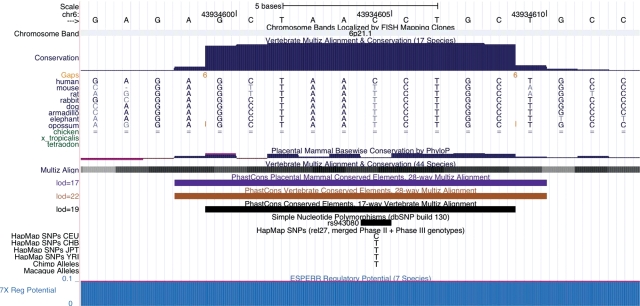
“The risk allele (T) at rs4711751 is on the same haplotype as the evolutionarily conserved allele (T) at rs943080.”
§ Common variants near FRK/COL10A1 and VEGFA are associated with advanced age-related macular degeneration > DISCUSSION
plaincorrelational- Asserted: passes — The authors put it forward as true.
- Checkable: passes — It can be checked against evidence.
- Load-bearing: passes — The paper’s conclusions depend on it.
- Based: passes — The paper gives a reason why it holds.
A result the paper reports from its own data — it cites no other source for it, so there is none to check. The quote shows it is in the paper.
In the paper
“Combining the effect sizes of all independent replication cohorts using a fixed effects model confirmed the association (OR = 0.90, P = 8.3 × 10⁻⁴).”
§ Common variants near FRK/COL10A1 and VEGFA are associated with advanced age-related macular degeneration > RESULTS
plaincorrelationaln = 5,640 ·- Asserted: passes — The authors put it forward as true.
- Checkable: passes — It can be checked against evidence.
- Load-bearing: passes — The paper’s conclusions depend on it.
- Based: passes — The paper gives a reason why it holds.
- Probably not a substantial claim. 21
- It may state two separate claims as one. 14
- The quote only partly states this claim. 1
Every source the paper cites for this claim was checked and supports it.
In the paper
“All samples included in this study met quality control measures as described previously (15,16).”
§ Common variants near FRK/COL10A1 and VEGFA are associated with advanced age-related macular degeneration > MATERIALS AND METHODS
What the sources say
- Supportedcites [15] Neale, 2010, Genome-wide association study of advanced age-related macular degeneration identifies a role of the hepatic lipase gene (LIPC), Proc. Natl Acad. Sci. USA source
The citation points to previously described quality-control measures, not to independent verification of the citing study’s samples. In Methods (Genotyping, Analysis, and Replication; page unavailable), the source describes its QC filters and the exclusion of individuals with low call rates; Results (Case and Control Sample Development; page unavailable) also reports stringent sample quality control. (LLM, conf=0.88)
- Supportedcites [16] Chen, 2010, Genetic variants near TIMP3 and high-density lipoprotein-associated loci influence susceptibility to age-related macular degeneration, Proc. Natl Acad. Sci. USA source
The Results and Discussion section describes quality-control exclusions for individuals and genetic markers and reports a 99.94% average call rate for analyzed markers and samples. The Genotyping and Imputation section also states that standard quality filters were applied. These passages support the citation to previously described quality-control measures; whether every sample in the citing study passed them is the citing authors’ own assertion. (LLM, conf=0.88)
plainn = 6,728- Asserted: passes — The authors put it forward as true.
- Checkable: passes — It can be checked against evidence.
- Load-bearing: passes — The paper’s conclusions depend on it.
- Based: passes — The paper gives a reason why it holds.
Probably not a substantial claim.
- Supported
A result the paper reports from its own data — it cites no other source for it, so there is none to check. The quote shows it is in the paper.
In the paper
“The T allele of rs4711751, with an allele frequency of 0.54 in cases and 0.50 in controls, was associated with increased risk of advanced AMD [OR = 1.21 (95% CI:1.11–1.32)].”
§ Common variants near FRK/COL10A1 and VEGFA are associated with advanced age-related macular degeneration > RESULTS
plaincorrelational- Asserted: passes — The authors put it forward as true.
- Checkable: passes — It can be checked against evidence.
- Load-bearing: passes — The paper’s conclusions depend on it.
- Based: passes — The paper gives a reason why it holds.
It may state two separate claims as one.
A result the paper reports from its own data — it cites no other source for it, so there is none to check. The quote shows it is in the paper.
In the paper
“rs4711751 on 6p12 near VEGFA (OR 1.15; P = 8.7 × 10⁻⁹)”
- Also stated in: § RESULTS · plain
“This SNP reached genome-wide significance [OR = 1.15 (95% CI: 1.10–1.21), P = 8.7 × 10⁻⁹] in the combined analysis”
- Also stated in: § DISCUSSION · plain
“We also identified a novel locus (rs4711751, P = 8.7 × 10⁻⁹) for advanced AMD near VEFGA.”
§ Common variants near FRK/COL10A1 and VEGFA are associated with advanced age-related macular degeneration > Abstract
plaincorrelational- Asserted: passes — The authors put it forward as true.
- Checkable: passes — It can be checked against evidence.
- Load-bearing: passes — The paper’s conclusions depend on it.
- Based: passes — The paper gives a reason why it holds.
The quote only partly states this claim.
- Also stated in: § RESULTS · plain
A result the paper reports from its own data — it cites no other source for it, so there is none to check. The quote shows it is in the paper.
In the paper
“The allele (G) at rs9488843, which creates a possible transcription factor-binding site for paired box 3 (PAX3) near the promoter region of COL10A1, is on the same haplotype as the allele (T) at rs1999930.”
§ Common variants near FRK/COL10A1 and VEGFA are associated with advanced age-related macular degeneration > DISCUSSION
hedgedcorrelational- Asserted: passes — The authors put it forward as true.
- Checkable: passes — It can be checked against evidence.
- Load-bearing: passes — The paper’s conclusions depend on it.
- Based: passes — The paper gives a reason why it holds.
It may state two separate claims as one.
A result the paper reports from its own data — it cites no other source for it, so there is none to check. The quote shows it is in the paper.
In the paper
“Finally, we note that the newly identified SNP rs4711751 is in strong LD with rs943080 (R2 = 1.0 in 1000 Genomes CEU data), a variant that resides in a highly evolutionarily conserved region (Fig. 3).”
§ Common variants near FRK/COL10A1 and VEGFA are associated with advanced age-related macular degeneration > DISCUSSION
plaincorrelational- Asserted: passes — The authors put it forward as true.
- Checkable: passes — It can be checked against evidence.
- Load-bearing: passes — The paper’s conclusions depend on it.
- Based: passes — The paper gives a reason why it holds.
It may state two separate claims as one.
A result the paper reports from its own data — it cites no other source for it, so there is none to check. The quote shows it is in the paper.
In the paper
“In addition, rs4711751 is in moderate LD with nearby genome-wide significant variants reported in type 2 diabetes, waist–hip ratio and chronic kidney disease (R2= 0.31, D′ = 0.91 to rs881858).”
§ Common variants near FRK/COL10A1 and VEGFA are associated with advanced age-related macular degeneration > DISCUSSION
plaincorrelational- Asserted: passes — The authors put it forward as true.
- Checkable: passes — It can be checked against evidence.
- Load-bearing: fails — The paper’s conclusions may not depend on it.
- Based: passes — The paper gives a reason why it holds.
Probably not a substantial claim. The paper’s conclusions may not depend on it.
A result the paper reports from its own data — it cites no other source for it, so there is none to check. The quote shows it is in the paper.
In the paper
“However, rs881858 was not significantly associated with advanced AMD in the TMMG meta-analysis (P = 0.11) and cannot explain the association we observe in rs4711751.”
§ Common variants near FRK/COL10A1 and VEGFA are associated with advanced age-related macular degeneration > DISCUSSION
plain- Asserted: passes — The authors put it forward as true.
- Checkable: passes — It can be checked against evidence.
- Load-bearing: passes — The paper’s conclusions depend on it.
- Based: passes — The paper gives a reason why it holds.
It may state two separate claims as one.
A result the paper reports from its own data — it cites no other source for it, so there is none to check. The quote shows it is in the paper.
In the paper
“the merged data set of TMMG contained 6728 samples, of which 4300 were genotyped by AFFY 6.0 and 2428 were genotyped by ILMN 370.”
§ Common variants near FRK/COL10A1 and VEGFA are associated with advanced age-related macular degeneration > MATERIALS AND METHODS
plainn = 6,728- Asserted: passes — The authors put it forward as true.
- Checkable: passes — It can be checked against evidence.
- Load-bearing: fails — The paper’s conclusions may not depend on it.
- Based: passes — The paper gives a reason why it holds.
Probably not a substantial claim. The paper’s conclusions may not depend on it. It may state two separate claims as one.
A result the paper reports from its own data — it cites no other source for it, so there is none to check. The quote shows it is in the paper.
In the paper
“The replication data sets consisted of 5640 cases and 52 174 controls from 10 independent cohorts from JHU, COL, Genentech, Iceland, Wash-U, AUS, RS, FR-CRET, Irish and an independent replication sample from Tufts/MGH.”
§ Common variants near FRK/COL10A1 and VEGFA are associated with advanced age-related macular degeneration > MATERIALS AND METHODS
plainn = 5,640- Asserted: passes — The authors put it forward as true.
- Checkable: passes — It can be checked against evidence.
- Load-bearing: passes — The paper’s conclusions depend on it.
- Based: passes — The paper gives a reason why it holds.
Probably not a substantial claim.
None of the sources cited for this claim have been checked yet.
In the paper
“The TMMG meta-analysis data set consisted of: (i) 1242 cases and 492 controls from the Tufts/MGH GWAS Cohort Study (15), which were derived from ongoing AMD study protocols as described previously (8,15,24,35–37); (ii) 1355 cases and 1076 controls from the MMAP Cohort Study (16); (iii) 1188 controls from the (MIGen) Consortium Study (21) and (iv) 1378 controls from the GAIN Schizophrenia Study (22”
§ Common variants near FRK/COL10A1 and VEGFA are associated with advanced age-related macular degeneration > MATERIALS AND METHODS
What the sources say
- Not checked yetcites [15] Neale, 2010, Genome-wide association study of advanced age-related macular degeneration identifies a role of the hepatic lipase gene (LIPC), Proc. Natl Acad. Sci. USA source
- Not checked yetcites [16] Chen, 2010, Genetic variants near TIMP3 and high-density lipoprotein-associated loci influence susceptibility to age-related macular degeneration, Proc. Natl Acad. Sci. USA source
- Not checked yetcites [21] Kathiresan, 2009, Genome-wide association of early-onset myocardial infarction with single nucleotide polymorphisms and copy number variants, Nat. Genet. source
plainn = 1,242- Asserted: passes — The authors put it forward as true.
- Checkable: passes — It can be checked against evidence.
- Load-bearing: passes — The paper’s conclusions depend on it.
- Based: passes — The paper gives a reason why it holds.
Probably not a substantial claim. It may state two separate claims as one.
The paper states this without a source or data behind it here, so there is nothing to check it against. The quote shows it is in the paper.
In the paper
“The effect sizes of both rs1999930 and rs4711751 in the replication cohorts are smaller than the effect sizes estimated in the TMMG analysis.”
§ Common variants near FRK/COL10A1 and VEGFA are associated with advanced age-related macular degeneration > DISCUSSION
plain- Asserted: passes — The authors put it forward as true.
- Checkable: passes — It can be checked against evidence.
- Load-bearing: unclear — It is unclear whether the paper’s conclusions depend on it.
- Based: passes — The paper gives a reason why it holds.
It may state two separate claims as one.
A conclusion the paper draws from its own results — it cites no other source for it, so there is none to check. The quote shows it is in the paper.
In the paper
“However, SNP rs4711751 appears to be independent of the rs2010963 variant (R2 = 0.015, D′ = 0.14 in samples of European ancestry); therefore, the association we identified near VEGFA was in a novel region and is not likely due to LD with SNPs in the VEGFA promoter region.”
§ Common variants near FRK/COL10A1 and VEGFA are associated with advanced age-related macular degeneration > DISCUSSION
hedged- Asserted: passes — The authors put it forward as true.
- Checkable: passes — It can be checked against evidence.
- Load-bearing: passes — The paper’s conclusions depend on it.
- Based: passes — The paper gives a reason why it holds.
It may state two separate claims as one.
A conclusion the paper draws from its own results — it cites no other source for it, so there is none to check. The quote shows it is in the paper.
In the paper
“The novel variants identified in this study suggest that angiogenesis (VEGFA) and extracellular collagen matrix (FRK/COL10A1) pathways contribute to the development of advanced AMD.”
§ Common variants near FRK/COL10A1 and VEGFA are associated with advanced age-related macular degeneration > Abstract
hedgedconditionaln = 2,594- Asserted: passes — The authors put it forward as true.
- Checkable: passes — It can be checked against evidence.
- Load-bearing: passes — The paper’s conclusions depend on it.
- Based: passes — The paper gives a reason why it holds.
It may state two separate claims as one.
What the paper did — it cites no source for this, so there is none to check. The quote shows it is in the paper.
In the paper
“A consensus set of 6 036 699 high-quality SNPs from each imputed data set was analyzed by PLINK, using a generalized linear model controlling for the genotyping platform and genetic ancestry based on principal component analysis.”
§ Common variants near FRK/COL10A1 and VEGFA are associated with advanced age-related macular degeneration > MATERIALS AND METHODS
plain- Asserted: passes — The authors put it forward as true.
- Checkable: passes — It can be checked against evidence.
- Load-bearing: passes — The paper’s conclusions depend on it.
- Based: passes — The paper gives a reason why it holds.
Probably not a substantial claim.
What the paper did — it cites no source for this, so there is none to check. The quote shows it is in the paper.
In the paper
“Our novel findings are not likely caused by population admixture or population substructure, because subjects in all cohorts are of European ancestry, and we adjusted for the genetic ancestry components in our study.”
§ Common variants near FRK/COL10A1 and VEGFA are associated with advanced age-related macular degeneration > DISCUSSION
hedged- Asserted: passes — The authors put it forward as true.
- Checkable: passes — It can be checked against evidence.
- Load-bearing: passes — The paper’s conclusions depend on it.
- Based: passes — The paper gives a reason why it holds.
It may state two separate claims as one.
What the paper did — it cites no source for this, so there is none to check. The quote shows it is in the paper.
In the paper
“The top 40 SNPs were validated using Sequenom genotyping on 1600 samples that were also part of the Tufts/MGH GWAS.”
§ Common variants near FRK/COL10A1 and VEGFA are associated with advanced age-related macular degeneration > MATERIALS AND METHODS
plainn = 1,600- Asserted: passes — The authors put it forward as true.
- Checkable: passes — It can be checked against evidence.
- Load-bearing: passes — The paper’s conclusions depend on it.
- Based: passes — The paper gives a reason why it holds.
Probably not a substantial claim.
In the paper
“In patients with osteoarthritis, expression of COL10A1 was significantly downregulated (28).”
§ Common variants near FRK/COL10A1 and VEGFA are associated with advanced age-related macular degeneration > DISCUSSION
What the sources say
- Not checked yetcites [28] Lamas, 2010, Large-scale gene expression in bone marrow mesenchymal stem cells: a putative role for COL10A1 in osteoarthritis, Ann. Rheum. Dis. source
plaindirect- Asserted: passes — The authors put it forward as true.
- Checkable: passes — It can be checked against evidence.
- Load-bearing: fails — The paper’s conclusions may not depend on it.
- Based: passes — The paper gives a reason why it holds.
Probably not a substantial claim. The paper’s conclusions may not depend on it.
In the paper
“cone–rod homeobox (CRX), which is an essential transcription factor highly expressed in RPE and retinal ganglion cells (27).”
§ Common variants near FRK/COL10A1 and VEGFA are associated with advanced age-related macular degeneration > DISCUSSION
What the sources say
- Not checked yetcites [27] Corbo, 2010, CRX ChIP-seq reveals the cis-regulatory architecture of mouse photoreceptors, Genome Res. source
plain- Asserted: passes — The authors put it forward as true.
- Checkable: passes — It can be checked against evidence.
- Load-bearing: passes — The paper’s conclusions depend on it.
- Based: passes — The paper gives a reason why it holds.
Probably not a substantial claim. It may state two separate claims as one.
What the paper did — it cites no source for this, so there is none to check. The quote shows it is in the paper.
In the paper
“All replication studies applied the same criteria for the diagnosis of cases.”
§ Common variants near FRK/COL10A1 and VEGFA are associated with advanced age-related macular degeneration > MATERIALS AND METHODS
plainn = 5,640- Asserted: passes — The authors put it forward as true.
- Checkable: passes — It can be checked against evidence.
- Load-bearing: fails — The paper’s conclusions may not depend on it.
- Based: passes — The paper gives a reason why it holds.
Probably not a substantial claim. The paper’s conclusions may not depend on it.
What the paper did — it cites no source for this, so there is none to check. The quote shows it is in the paper.
In the paper
“A major advantage of the study design is the careful diagnosis of cases across all cohorts.”
§ Common variants near FRK/COL10A1 and VEGFA are associated with advanced age-related macular degeneration > DISCUSSION
plain- Asserted: passes — The authors put it forward as true.
- Checkable: passes — It can be checked against evidence.
- Load-bearing: passes — The paper’s conclusions depend on it.
- Based: passes — The paper gives a reason why it holds.
Probably not a substantial claim.
What the paper did — it cites no source for this, so there is none to check. The quote shows it is in the paper.
In the paper
“we only included imputed genotypes of common variants (MAF >0.01) in the analysis”
§ Common variants near FRK/COL10A1 and VEGFA are associated with advanced age-related macular degeneration > MATERIALS AND METHODS
plain- Asserted: passes — The authors put it forward as true.
- Checkable: passes — It can be checked against evidence.
- Load-bearing: passes — The paper’s conclusions depend on it.
- Based: passes — The paper gives a reason why it holds.
Probably not a substantial claim.
None of the sources cited for this claim have been checked yet.
In the paper
“As this prediction model only included genetic risk factors, we expect an improvement of the performance of advanced AMD risk assessment with additional environmental and demographic factors in prospective studies as in our previous calculations (18,19).”
§ Common variants near FRK/COL10A1 and VEGFA are associated with advanced age-related macular degeneration > DISCUSSION
What the sources say
- Not checked yetcites [18] Seddon, 2011, Risk models for progression to advanced age-related macular degeneration using demographic, environmental, genetic, and ocular factors, Ophthalmology source
- Not checked yetcites [19] Seddon, 2009, Prediction model for prevalence and incidence of advanced age-related macular degeneration based on genetic, demographic, and environmental variables, Invest. Ophthalmol. Vis. Sci. source
hedgedconditional- Asserted: passes — The authors put it forward as true.
- Checkable: passes — It can be checked against evidence.
- Load-bearing: fails — The paper’s conclusions may not depend on it.
- Based: passes — The paper gives a reason why it holds.
Probably not a substantial claim. The paper’s conclusions may not depend on it.
What the paper did — it cites no source for this, so there is none to check. The quote shows it is in the paper.
In the paper
“For the meta-analysis of GWAS, we included only imputed genotypes with imputation quality scores >0.6, where the score is defined as the ratio-of-variances (empirical/asymptotic) of each genotype.”
§ Common variants near FRK/COL10A1 and VEGFA are associated with advanced age-related macular degeneration > MATERIALS AND METHODS
plain- Asserted: passes — The authors put it forward as true.
- Checkable: passes — It can be checked against evidence.
- Load-bearing: passes — The paper’s conclusions depend on it.
- Based: passes — The paper gives a reason why it holds.
Probably not a substantial claim.
In the paper
“The larger effect size observed in the discovery cohort (TMMG) could be due to a ‘winner's curse’ phenomenon where association is often exaggerated relative to the estimated effect in follow-up studies (34).”
§ Common variants near FRK/COL10A1 and VEGFA are associated with advanced age-related macular degeneration > DISCUSSION
What the sources say
- Not checked yetcites [34] Lohmueller, 2003, Meta-analysis of genetic association studies supports a contribution of common variants to susceptibility to common disease, Nat. Genet. source
hedgedconditional- Asserted: passes — The authors put it forward as true.
- Checkable: passes — It can be checked against evidence.
- Load-bearing: fails — The paper’s conclusions may not depend on it.
- Based: passes — The paper gives a reason why it holds.
Probably not a substantial claim. The paper’s conclusions may not depend on it.
What the paper did — it cites no source for this, so there is none to check. The quote shows it is in the paper.
In the paper
“The sample size of this study is the largest of all published association studies for advanced AMD to date.”
§ Common variants near FRK/COL10A1 and VEGFA are associated with advanced age-related macular degeneration > DISCUSSION
plain- Asserted: passes — The authors put it forward as true.
- Checkable: passes — It can be checked against evidence.
- Load-bearing: fails — The paper’s conclusions may not depend on it.
- Based: fails — The paper may give no reason why it holds.
Probably not a substantial claim. The paper’s conclusions may not depend on it. The paper may give no reason why it holds.
What the paper did — it cites no source for this, so there is none to check. The quote shows it is in the paper.
In the paper
“Of the two SNPs we selected for replication in FRK/COL10A1 locus, rs12204816 failed the genotyping quality criteria in the replication phase, but rs1999930 was successfully genotyped in all 10 replication cohorts.”
§ Common variants near FRK/COL10A1 and VEGFA are associated with advanced age-related macular degeneration > RESULTS
plain- Asserted: passes — The authors put it forward as true.
- Checkable: passes — It can be checked against evidence.
- Load-bearing: fails — The paper’s conclusions may not depend on it.
- Based: passes — The paper gives a reason why it holds.
Probably not a substantial claim. The paper’s conclusions may not depend on it. It may state two separate claims as one.
In the paper
“This score is commonly applied as a quality filter for imputed genotypes and is equivalent to the RSQR_HAT value by MACH and the information content (INFO) measure by PLINK (44).”
§ Common variants near FRK/COL10A1 and VEGFA are associated with advanced age-related macular degeneration > MATERIALS AND METHODS
What the sources say
- Not checked yetcites [44] de Bakker, 2008, Practical aspects of imputation-driven meta-analysis of genome-wide association studies, Hum. Mol. Genet. source
plain- Asserted: passes — The authors put it forward as true.
- Checkable: passes — It can be checked against evidence.
- Load-bearing: fails — The paper’s conclusions may not depend on it.
- Based: passes — The paper gives a reason why it holds.
Probably not a substantial claim. The paper’s conclusions may not depend on it. It may state two separate claims as one.
A conclusion the paper draws from its own results — it cites no other source for it, so there is none to check. The quote shows it is in the paper.
In the paper
“The genetic loci associated with AMD suggest that the disease process may be explained in part by dysregulation of the alternative complement pathway (CFH, C2, CFB, C3, CFI), HDL cholesterol metabolism (LIPC, CETP, ABCA1), angiogenesis (VEGFA) and degradation of extracellular matrix (COL10A1, COL8A1, FRK, TIMP3, and possibly ARMS2).”
§ Common variants near FRK/COL10A1 and VEGFA are associated with advanced age-related macular degeneration > DISCUSSION
hedgedconditional- Asserted: passes — The authors put it forward as true.
- Checkable: passes — It can be checked against evidence.
- Load-bearing: passes — The paper’s conclusions depend on it.
- Based: passes — The paper gives a reason why it holds.
It may state two separate claims as one.
A conclusion the paper draws from its own results — it cites no other source for it, so there is none to check. The quote shows it is in the paper.
In the paper
“Owing to the larger size of the Icelanders data set, the imputation is more reliable based on the Icelanders data set than the imputation based on the HapMap or 1000 Genomes Project.”
§ Common variants near FRK/COL10A1 and VEGFA are associated with advanced age-related macular degeneration > MATERIALS AND METHODS
plaindirect- Asserted: passes — The authors put it forward as true.
- Checkable: passes — It can be checked against evidence.
- Load-bearing: fails — The paper’s conclusions may not depend on it.
- Based: passes — The paper gives a reason why it holds.
Probably not a substantial claim. The paper’s conclusions may not depend on it.
A conclusion the paper draws from its own results — it cites no other source for it, so there is none to check. The quote shows it is in the paper.
In the paper
“Compared with other complex diseases, the associated risk variants for advanced AMD are more informative in terms of predicting risk of disease.”
§ Common variants near FRK/COL10A1 and VEGFA are associated with advanced age-related macular degeneration > DISCUSSION
plaincorrelational- Asserted: passes — The authors put it forward as true.
- Checkable: passes — It can be checked against evidence.
- Load-bearing: fails — The paper’s conclusions may not depend on it.
- Based: fails — The paper may give no reason why it holds.
Probably not a substantial claim. The paper’s conclusions may not depend on it. The paper may give no reason why it holds.
In the paper
“The newly identified SNP (rs4711751) is 60 kb downstream of VEGFA and >90 kb away from a SNP (rs2010963) in the VEGFA promoter region which has been reported to be associated with AMD (26).”
§ Common variants near FRK/COL10A1 and VEGFA are associated with advanced age-related macular degeneration > DISCUSSION
What the sources say
- Not checked yetcites [26] Haines, 2006, Functional candidate genes in age-related macular degeneration: significant association with VEGF, VLDLR, and LRP6, Invest. Ophthalmol. Vis. Sci. source
plaincorrelational- Asserted: passes — The authors put it forward as true.
- Checkable: passes — It can be checked against evidence.
- Load-bearing: fails — The paper’s conclusions may not depend on it.
- Based: passes — The paper gives a reason why it holds.
Probably not a substantial claim. The paper’s conclusions may not depend on it.
The authors state this as an assumption.
There are no empirical studies that address levels of genome-wide significance for 1000 Genomes Project-derived data.
“To our knowledge, there are no empirical studies that address levels of genome-wide significance for the 1000 Genomes Project-derived data.”
The paper relies on this without support.
The generally accepted genome-wide significance threshold of P < 5 × 10⁻⁸ is appropriate for this study despite the larger number of SNPs tested.
“For this study, we utilized the generally accepted genome-wide level of significance (P < 5 × 10⁻⁸) as our threshold for association.”
Claims other papers make about this one
Each is checked against this paper’s own text: does it say what the citing paper says it does?
In the citing paper
“Association has also been demonstrated with several additional loci14–20, each providing an entry-point into AMD biology and potential therapeutic targets.”
From Seven new loci associated with age-related macular degeneration (2013) · cites this paper as [19]
Self-check
Percentages, sums and reported differences re-computed from the paper’s own numbers.
Each contradiction between two passages listed here was confirmed by an independent check.
Rated minor: it would not touch a result — a value no result rests on, a p-value that stays on the same side of the significance level, or a conflict that is clerical, resolved elsewhere in the paper, or outside its own findings.
In the paper
§ Common variants near FRK/COL10A1 and VEGFA are associated with advanced age-related macular degeneration > DISCUSSION
“rs4711751 is in strong LD with rs943080 (R2 = 1.0 in 1000 Genomes CEU data)”
§ Common variants near FRK/COL10A1 and VEGFA are associated with advanced age-related macular degeneration > DISCUSSION
“Figure 3. rs934080 in a putative CRX transcription factor-binding site. rs4711751 is in strong LD with rs934080”
Citations
Cites
1 retracted
Sudhakar, A. (2005) · Journal of Clinical Investigation · doi:10.1172/jci24813 · Cited by 162
RetractedPLINK: a tool set for whole-genome association and population-based linkage analyses.
Purcell, S., Neale, B., Todd-Brown, K., Thomas, L., Ferreira, M. A. R., Bender, D., Maller, J., Sklar, P., de Bakker, P. I. W., Daly, M. J., et al. (2007) · The American Journal of Human Genetics · doi:10.1086/519795 · Cited by 34,089 · cited 4×
“SNPs which met genotype quality control criteria in other replication cohorts were tested for association with advanced AMD, using a generalized linear model in PLINK.”
MethodInfluentialSelf-citationPrincipal components analysis corrects for stratification in genome-wide association studies
Price, A. L., Patterson, N. J., Plenge, R. M., Weinblatt, M. E., Shadick, N. A., & Reich, D. (2006) · Nature Genetics · doi:10.1038/ng1847 · Cited by 10,248
METAL: fast and efficient meta-analysis of genomewide association scans
Willer, C. J., Li, Y., & Abecasis, G. R. (2010) · Bioinformatics · doi:10.1093/bioinformatics/btq340 · Cited by 5,205 · cited 1×
“The P-value for the combined analysis was derived from the effect size estimates and standard errors, using a fixed effects model by METAL (51).”
MethodComplement factor H polymorphism in age-related macular degeneration
Klein, R. J., Zeiss, C., Chew, E. Y., Tsai, J.-Y., Sackler, R. S., Haynes, C., Henning, A. K., SanGiovanni, J. P., Mane, S. M., Mayne, S. T., et al. (2005) · Science · doi:10.1126/science.1109557 · Cited by 4,492
Endostatin: an endogenous inhibitor of angiogenesis and tumor growth
O'Reilly, M. S., Boehm, T., Shing, Y., Fukai, N., Vasios, G., Lane, W. S., Flynn, E., Birkhead, J. R., Olsen, B. R., & Folkman, J. (1997) · Cell · doi:10.1016/s0092-8674(00)81848-6 · Cited by 4,486
Howie, B. N., Donnelly, P., & Marchini, J. (2009) · PLoS Genetics · doi:10.1371/journal.pgen.1000529 · Cited by 3,928 · cited 1×
“For candidate SNPs not directly genotyped in the Genentech samples, genotype information was imputed using IMPUTE version 2 (48) with combined reference data of CEU and TSI population from the 1000 Genomes Project (June 2010 release) and HapMap3 Project.”
MethodBrowning, S. R., & Browning, B. L. (2007) · The American Journal of Human Genetics · doi:10.1086/521987 · Cited by 3,217
Genome-wide association defines more than 30 distinct susceptibility loci for Crohn's disease
the NIDDK IBD Genetics Consortium, Barrett, J. C., the Belgian-French IBD Consortium, the Wellcome Trust Case Control Consortium, Hansoul, S., Nicolae, D. L., Cho, J. H., Duerr, R. H., Rioux, J. D., Brant, S. R., et al. (2008) · Nature Genetics · doi:10.1038/ng.175 · Cited by 2,593 · cited 1×
“Using a standard liability threshold model (25), the previously reported loci combined with the new loci discovered in this study explain 39% of the total variance (or 55% of the heritability) of advanced AMD.”
MethodSelf-citation
Cited by
Sorted by citations
Age-related macular degeneration
Lim, L. S., Mitchell, P., Seddon, J. M., Holz, F. G., & Wong, T. Y. (2012) · The Lancet · doi:10.1016/s0140-6736(12)60282-7 · Cited by 1,806
Self-citationSeven new loci associated with age-related macular degeneration
The AMD Gene Consortium (2013) · Nature Genetics · doi:10.1038/ng.2578 · Cited by 788
Self-citationAdvancing human genetics research and drug discovery through exome sequencing of the UK Biobank
Szustakowski, J. D., Balasubramanian, S., Kvikstad, E., Khalid, S., Bronson, P. G., Sasson, A., Wong, E., Liu, D., Wade Davis, J., Haefliger, C., et al. (2021) · Nature Genetics · doi:10.1038/s41588-021-00885-0 · Cited by 401
Mechanisms of age‐related macular degeneration and therapeutic opportunities
van Lookeren Campagne, M., LeCouter, J., Yaspan, B. L., & Ye, W. (2014) · The Journal of Pathology · doi:10.1002/path.4266 · Cited by 382
“It is interesting to note, given the success of anti-VEGFA therapies in AMD, that a common variant in VEGFA was one of the more recent polymorphisms to be identified and confirmed [129,130].”
BackgroundRisk factors and biomarkers of age-related macular degeneration
Lambert, N. G., Elshelmani, H., Singh, M. K., Mansergh, F. C., Wride, M. A., Padilla, M., Keegan, D., Hogg, R. E., & Ambati, B. K. (2016) · Progress in Retinal and Eye Research · doi:10.1016/j.preteyeres.2016.04.003 · Cited by 367
Self-citationSeddon, J. M., Yu, Y., Miller, E. C., Reynolds, R. C., Tan, P. L., Gowrisankar, S., Goldstein, J. I., Triebwasser, M. P., Anderson, H. E., Zerbib, J., et al. (2013) · Nature Genetics · doi:10.1038/ng.2741 · Cited by 352
Self-citationHanda, J. T., Rickman, C. B., Dick, A. D., Gorin, M. B., Miller, J. W., Toth, C. A., Ueffing, M., Zarbin, M. A., & Farrer, L. A. (2019) · Nature Communications · doi:10.1038/s41467-019-11262-1 · Cited by 285
Miller, J. W. (2012) · American Journal of Ophthalmology · doi:10.1016/j.ajo.2012.10.018 · Cited by 254
A new perspective on lipid research in age-related macular degeneration
van Leeuwen, E. M., Emri, E., Merle, B. M. J., Colijn, J. M., Kersten, E., Cougnard-Gregoire, A., Dammeier, S., Meester-Smoor, M., Pool, F. M., de Jong, E. K., et al. (2018) · Progress in Retinal and Eye Research · doi:10.1016/j.preteyeres.2018.04.006 · Cited by 247
Self-citationAging is not a disease: Distinguishing age-related macular degeneration from aging
Ardeljan, D., & Chan, C. (2013) · Progress in Retinal and Eye Research · doi:10.1016/j.preteyeres.2013.07.003 · Cited by 250
“Several studies have found an association with the TIMP3 single-nucleotide polymorphism (SNP) rs9621532 and development of AMD (Chen et al., 2010b; Yu et al., 2011) and our own study of TIMP3 suggests that the moderate protection from CNV offered by rs9625132 could be due to lower TIMP3…”
ResultA Unified Framework for Association Analysis with Multiple Related Phenotypes
Stephens, M. (2013) · PLoS ONE · doi:10.1371/journal.pone.0065245 · Cited by 240
“N VEGFA codes for the protein ‘‘Vascular endothelial growth factor A’’, and variants near VEGFA have been implicated in a range of clinical conditions, including diabetic retinopathy [41–43] and age-related macular degeneration [44].”
BackgroundGut microbiota influences pathological angiogenesis in obesity‐driven choroidal neovascularization
Andriessen, E. M., Wilson, A. M., Mawambo, G., Dejda, A., Miloudi, K., Sennlaub, F., & Sapieha, P. (2016) · EMBO Molecular Medicine · doi:10.15252/emmm.201606531 · Cited by 201
A functional variant in the CFI gene confers a high risk of age-related macular degeneration
van de Ven, J. P. H., Nilsson, S. C., Tan, P. L., Buitendijk, G. H. S., Ristau, T., Mohlin, F. C., Nabuurs, S. B., Schoenmaker-Koller, F. E., Smailhodzic, D., Campochiaro, P. A., et al. (2013) · Nature Genetics · doi:10.1038/ng.2640 · Cited by 198
Self-citationNew loci and coding variants confer risk for age-related macular degeneration in East Asians
Cheng, C., Yamashiro, K., Chen, L. J., Ahn, J., Huang, L., Huang, L., Cheung, C. M. G., Miyake, M., Cackett, P., Yeo, I. Y. S., et al. (2015) · Nature Communications · doi:10.1038/ncomms7063 · Cited by 186
Nature and nurture- genes and environment- predict onset and progression of macular degeneration
Sobrin, L., & Seddon, J. M. (2014) · Progress in Retinal and Eye Research · doi:10.1016/j.preteyeres.2013.12.004 · Cited by 183
Self-citationAge‐related macular degeneration—clinical review and genetics update
Ratnapriya, R., & Chew, E. Y. (2013) · Clinical Genetics · doi:10.1111/cge.12206 · Cited by 180
“These variations have often been attributed to genetic variation, leading to few small-scale pharmacogenetic testing studies in AMD patients using single or few gene markers (CFH , ARMS2 , and VEGFA) (53–55).”
BackgroundAge-related macular degeneration: genome-wide association studies to translation
Black, J. R., & Clark, S. J. (2015) · Genetics in Medicine · doi:10.1038/gim.2015.70 · Cited by 139
Molecular genetics in glaucoma
Liu, Y., & Allingham, R. R. (2011) · Experimental Eye Research · doi:10.1016/j.exer.2011.08.007 · Cited by 136
Holliday, E. G., Smith, A. V., Cornes, B. K., Buitendijk, G. H. S., Jensen, R. A., Sim, X., Aspelund, T., Aung, T., Baird, P. N., Boerwinkle, E., et al. (2013) · PLoS ONE · doi:10.1371/journal.pone.0053830 · Cited by 128
“Together with biological evidence, these findings highlight the importance of immune, inflammatory and lipid metabolic pathways in late AMD pathogenesis, while also implicating angiogenic, apoptotic, extracellular-matrix remodelling and melanosome trafficking processes [10,11,12,13,14,15].”
BackgroundResultSelf-citationYu, Y., Reynolds, R. C., ROSNER, B. A., Daly, M. J., & Seddon, J. M. (2012) · Investigative Ophthalmology & Visual Science · doi:10.1167/iovs.11-8657 · Cited by 122
Self-citationAdaptive Optics Technology for High-Resolution Retinal Imaging
Lombardo, M., Serrao, S., Devaney, N. M., Parravano, M., & Lombardo, G. (2012) · Sensors · doi:10.3390/s130100334 · Cited by 120
“All these factors have been associated with the onset, progression and bilateral involvement of early, intermediate, and advanced states of AMD [140–146].”
BackgroundChoroidal Neovascularization: Mechanisms of Endothelial Dysfunction
Yeo, N. J. Y., Chan, E. J. J., & Cheung, C. (2019) · Frontiers in Pharmacology · doi:10.3389/fphar.2019.01363 · Cited by 120
Cell-based therapeutic strategies for replacement and preservation in retinal degenerative diseases
Jones, M. K., Lü, B., Girman, S., & Wang, S. (2017) · Progress in Retinal and Eye Research · doi:10.1016/j.preteyeres.2017.01.004 · Cited by 114
Radeke, M. J., Radeke, C. M., Shih, Y.-H., Hu, J. G., Bok, D., Johnson, L. V., & Coffey, P. J. (2015) · Genome Medicine · doi:10.1186/s13073-015-0183-x · Cited by 114
“In large part, the analysis focused on genes whose association has been corroborated in multiple studies or large cohort genome-wide association studies [58–97].”
ResultYu, Y., Triebwasser, M. P., Wong, E. K. S., Schramm, E. C., Thomas, B., Reynolds, R. C., Mardis, E. R., Atkinson, J. P., Daly, M. J., Raychaudhuri, S., et al. (2014) · Human Molecular Genetics · doi:10.1093/hmg/ddu226 · Cited by 111
“0) derived from a general linear model of the genotype dosages of known common alleles (37).”
BackgroundSelf-citationGorin, M. B. (2012) · Molecular Aspects of Medicine · doi:10.1016/j.mam.2012.04.004 · Cited by 105
NLRP3 Inflammasome Blockade Inhibits VEGF-A-Induced Age-Related Macular Degeneration
Marneros, A. G. (2013) · Cell Reports · doi:10.1016/j.celrep.2013.08.002 · Cited by 110
“, 2013) (Yu et al., 2011), suggesting that increased VEGF-A levels may promote not only neovascular AMD, but also nonexudative AMD.”
BackgroundSeddon, J. M., Silver, R. E., Kwong, M., & ROSNER, B. A. (2015) · Investigative Ophthalmology & Visual Science · doi:10.1167/iovs.14-15841 · Cited by 103
“003 AG 392 (47) 971 (46) GG 80 (10) 304 (14)”
Self-citationGenetics of Diabetic Retinopathy
Cho, H., & Sobrin, L. (2014) · Current Diabetes Reports · doi:10.1007/s11892-014-0515-z · Cited by 98
Self-citationGenetic variants in five novel loci including CFB and CD40 predispose to chronic hepatitis B
Jiang, D., Ma, X., Yu, H., Cao, G., Ding, D., Chen, H., Huang, H., Gao, Y., Wu, X., Long, X., et al. (2015) · Hepatology · doi:10.1002/hep.27794 · Cited by 92
“degeneration (AMD; Supporting Table 9).(18-23) Most studies reported that another SNP in the gene, rs641153, was associated with AMD risk.”
BackgroundGenetic Studies of Age-related Macular Degeneration
Ratnapriya, R., Chew, E. Y., & Swaroop, A. (2012) · Ophthalmology · doi:10.1016/j.ophtha.2012.06.042 · Cited by 91
Cipriani, V., Leung, H.-T., Plagnol, V., Bunce, C., Khan, J. C., Shahid, H., Moore, A. T., Harding, S. P., Bishop, P. N., Hayward, C., et al. (2012) · Human Molecular Genetics · doi:10.1093/hmg/dds225 · Cited by 90
Self-citationWang, S. K., Nair, S., Li, R., Kraft, K., Pampari, A., Patel, A., Kang, J. B., Luong, C., Kundaje, A., & Chang, H. Y. (2022) · bioRxiv · doi:10.1016/j.xgen.2022.100164 · Cited by 101
“Integration of eQTL data similarly improved our interpretation of rs66475830 on chromosome 6 in the FRK-NT5DC1-COL10A1 risk locus for AMD.”
MethodModelling the Genetic Risk in Age-Related Macular Degeneration
Graßmann, F., Fritsche, L. G., Keilhauer, C. N., Heid, I. M., & Weber, B. H. F. (2012) · PLoS ONE · doi:10.1371/journal.pone.0037979 · Cited by 85
Increased retinal mtDNA damage in the CFH variant associated with age-related macular degeneration
Ferrington, D. A., Kapphahn, R. J., Leary, M. M., Atilano, S. R., Terluk, M. R., Karunadharma, P., Chen, G. K.-J., Ratnapriya, R., Swaroop, A., Montezuma, S. R., et al. (2016) · Experimental Eye Research · doi:10.1016/j.exer.2016.01.018 · Cited by 85
Seddon, J. M. (2017) · Investigative Ophthalmology & Visual Science · doi:10.1167/iovs.17-23544 · Cited by 86
“In a large meta-analysis, we discovered additional new loci in the genes FRK/COL10A1 and COL8A1 in the collagen matrix pathway and VEGFA, the first genome-wide significant AMD gene in the angiogenesis or new blood vessel growth pathway.(52) More recently, using an exome array design that included 4332 cases and 25,268…”
Self-citationGallois, A., Mefford, J., Ko, A., Vaysse, A., Julienne, H., Ala‐Korpela, M., Laakso, M., Zaitlen, N., Pajukanta, P., & Aschard, H. (2019) · Nature Communications · doi:10.1038/s41467-019-12703-7 · Cited by 78
Loyet, K. M., DeForge, L. E., Katschke, K. J., Diehl, L. J., Graham, R., Pao, L. I., Sturgeon, L., Lewin-Koh, S.-C., Hollyfield, J. G., & Campagne, M. V. L. (2012) · Investigative Ophthalmology & Visual Science · doi:10.1167/iovs.12-9587 · Cited by 84
Self-citationSobrin, L., Ripke, S., Yu, Y., Fagerness, J. A., Bhangale, T., Tan, P. L., Souied, E. H., Buitendijk, G. H. S., Merriam, J. E., Richardson, A. J., et al. (2012) · Ophthalmology · doi:10.1016/j.ophtha.2012.03.014 · Cited by 81
Self-citationAMD and the alternative complement pathway: genetics and functional implications
Tan, P. L., Rickman, C. B., & Katsanis, N. (2016) · Human Genomics · doi:10.1186/s40246-016-0079-x · Cited by 79
Self-citationTowards the application of precision medicine in Age-Related Macular Degeneration
Cascella, R., Strafella, C., Caputo, V., Errichiello, V., Zampatti, S., Milano, F., Potenza, S., Mauriello, S., Novelli, G., Ricci, F., et al. (2018) · Progress in Retinal and Eye Research · doi:10.1016/j.preteyeres.2017.11.004 · Cited by 76
Housset, M., Samuel, A., Ettaiche, M., Bemelmans, A., Béby, F., Billon, N., & Lamonerie, T. (2013) · Journal of Neuroscience · doi:10.1523/jneurosci.1099-13.2013 · Cited by 76
Cuticular drusen: Stars in the sky
Boon, C. J. F., van de Ven, J. P. H., Hoyng, C. B., den Hollander, A. I., & Klevering, B. J. (2013) · Progress in Retinal and Eye Research · doi:10.1016/j.preteyeres.2013.08.003 · Cited by 71
Marangoni, D., Falsini, B., Piccardi, M., Ambrosio, L., Minnella, A. M., Savastano, M. C., Bisti, S., Maccarone, R., Fadda, A., Mello, E., et al. (2013) · Journal of Translational Medicine · doi:10.1186/1479-5876-11-228 · Cited by 71
Graßmann, F., Schoenberger, P. G. A., Brandl, C., Schick, T., Hasler, D., Meister, G., Fleckenstein, M., Lindner, M., Helbig, H., Fauser, S., et al. (2014) · PLoS ONE · doi:10.1371/journal.pone.0107461 · Cited by 70
“mTOR signaling (hsa04150) 16/52 33/60 VEGFA [17]”
BackgroundInfluentialGenetics and genetic testing for age-related macular degeneration
Warwick, A., & Lotery, A. (2018) · Eye · doi:10.1038/eye.2017.245 · Cited by 67
Liu, M. M., Chan, C., & Tuo, J. (2012) · Human Genomics · doi:10.1186/1479-7364-6-13 · Cited by 70
“regulator of neovascularization [31], have been associated with AMD as well [6], reiterating the role of”
BackgroundSanGiovanni, J. P., & Neuringer, M. D. (2012) · American Journal of Clinical Nutrition · doi:10.3945/ajcn.112.038240 · Cited by 69
Genetic Determinants of Age-Related Macular Degeneration in Diverse Populations From the PAGE Study
Restrepo, N. A., Spencer, K. L., Goodloe, R., Garrett, T. A., HEISS, G. M., kova, P. B., Jorgensen, N. W., Jensen, R. A., Matise, T. C., Hindorff, L. A., et al. (2014) · Investigative Ophthalmology & Visual Science · doi:10.1167/iovs.14-14246 · Cited by 66
“While most associations did not generalize in the non-European populations, variants within lipid-related genes were found to be associated with AMD.”
BackgroundResultInfluentialLiu, K., Chen, L. J., Lai, T. Y. Y., Tam, P. O. S., Ho, M., Chiang, S. W. Y., Liu, D. T. L., Young, A. L., Yang, Z., & Pang, C. P. (2014) · Ophthalmology · doi:10.1016/j.ophtha.2013.10.042 · Cited by 66
Seo, H.-R., Jeong, H. E., Joo, H. J., Choi, S., Park, C., Kim, J.-H., Choi, J.-H., Cui, L.-H., Hong, S. J., Chung, S. H., et al. (2016) · Scientific Reports · doi:10.1038/srep28832 · Cited by 69
Kawa, M. P., Machalińska, A., Rogińska, D., & Machaliński, B. (2014) · Journal of Immunology Research · doi:10.1155/2014/483960 · Cited by 65
Thakkinstian, A., McEvoy, M., Chakravarthy, U., Chakrabarti, S., McKay, G. J., Ryu, E., Silvestri, G., Kaur, I., Francis, P. J., Iwata, T., et al. (2012) · American Journal of Epidemiology · doi:10.1093/aje/kws031 · Cited by 63
“Some groups of researchers have combined the PAR of the 14 variants identified to obtain much larger and clinically useful estimates (61) in Table 5.”
BackgroundResultSelf-citationMechanism of Inflammation in Age-Related Macular Degeneration: An Up-to-Date on Genetic Landmarks
Parmeggiani, F., Sorrentino, F. S., Romano, M. R., Costagliola, C., Semeraro, F., Incorvaia, C., D’Angelo, S., Perri, P., Nadai, K. D., Roversi, E. B., et al. (2013) · Mediators of Inflammation · doi:10.1155/2013/435607 · Cited by 64
“Although further investigation is needed to better elucidate these clinicogenetic relationships, recent GWAS identified four HDL-related genes as remarkable risk factors for AMD: LIPC (hepatic lipase), CETP (cholesteryl ester transfer protein), ABCA1, and LPL (lipoprotein lipase) [25, 31, 32].”
BackgroundWhitmore, S. S., Braun, T. A., Skeie, J. M., Haas, C. M., Sohn, E. H., Stone, E. M., Scheetz, T. E., & Mullins, R. F. (2013) · Europe PMC (PubMed Central) · Cited by 61
Ophthalmology 1 Age-related macular degeneration
Lim, L. S., Mitchell, P., Seddon, J. M., Holz, F. G., & Wong, T. Y. (2012) · Cited by 60
Self-citationRastogi, N., & Smith, R. T. (2015) · Survey of Ophthalmology · doi:10.1016/j.survophthal.2015.10.003 · Cited by 60
Self-citationA search for age-related macular degeneration risk variants in Alzheimer disease genes and pathways
Logue, M. W., Schu, M. C., Vardarajan, B. N., Farrell, J. J., Lunetta, K. L., Jun, G., Baldwin, C. T., DeAngelis, M. M., & Farrer, L. A. (2013) · Neurobiology of Aging · doi:10.1016/j.neurobiolaging.2013.12.007 · Cited by 62
Genetic Factors for Choroidal Neovascularization Associated with High Myopia
Leveziel, N., Yu, Y., Reynolds, R. C., Tai, A., Meng, W., Caillaux, V., Calvas, P., ROSNER, B. A., Malecaze, F., Souied, E. H., et al. (2012) · Investigative Ophthalmology & Visual Science · doi:10.1167/iovs.12-9538 · Cited by 58
Self-citationSeddon, J. M., Silver, R. E., & ROSNER, B. A. (2016) · British Journal of Ophthalmology · doi:10.1136/bjophthalmol-2016-308624 · Cited by 56
Self-citationSeabury, C. M., Dowd, S. E., Seabury, P. M., Raudsepp, T., Brightsmith, D. J., Liboriussen, P., Halley, Y., Fisher, C. A., Owens, E. K., Viswanathan, G. G., et al. (2013) · PLoS ONE · doi:10.1371/journal.pone.0062415 · Cited by 56
“Comparison of the scarlet macaw and chicken genomes revealed outlier macaw contigs (Figure 4, Table S14) possessing coding and noncoding loci which were subsequently characterized based on either known function and/or the results of independent human genome wide association studies (GWAS; Table 4) [57,64–110].”
BackgroundGenomic aspects of age-related macular degeneration
Horie‐Inoue, K., & Inoue, S. (2014) · Biochemical and Biophysical Research Communications · doi:10.1016/j.bbrc.2014.08.013 · Cited by 54
Seddon, J. M., Reynolds, R. C., Yu, Y., & ROSNER, B. A. (2014) · PLoS ONE · doi:10.1371/journal.pone.0087047 · Cited by 56
“Since 2011, associations with AMD have been shown for a novel rare variant (R1210C) in CFH [3] common variants in COL10A1[4–6], COL8A1[4–6], VEGFA [5], and TNFRSF10A [6,7] Additional common variants were also identified in our international consortium effort based on meta-analyses of several genome-wide case-control a…”
BackgroundInfluentialSelf-citationValidation of a Prediction Algorithm for Progression to Advanced Macular Degeneration Subtypes
Seddon, J. M., Reynolds, R. C., Yu, Y., & ROSNER, B. A. (2013) · JAMA Ophthalmology · doi:10.1001/jamaophthalmol.2013.2578 · Cited by 54
“91 25 243 (30) 714 (34) 99 (34) 239 (35) 25-29 331 (41) 894 (42) 129 (44) 288 (42) 30 235 (29) 497 (24) 66 (22) 158 (23) Genotype CFH rs1061170 (Y402H) .”
Self-citationMatrix Metalloproteinases in Age-Related Macular Degeneration (AMD)
García‐Onrubia, L., Valentín-Bravo, F. J., Coco, R. M., González‐Sarmiento, R., Jimeno, J. C. P., Usategui‐Martín, R., & Pastor‐Idoate, S. (2020) · International Journal of Molecular Sciences · doi:10.3390/ijms21165934 · Cited by 54
A systems biology approach uncovers novel disease mechanisms in age-related macular degeneration
Orozco, L. D., Owen, L. A., Hofmann, J. W., Stockwell, A., Tao, J., Haller, S., Mukundan, V. T., Clarke, C., Lund, J. M., Sridhar, A., et al. (2023) · Cell Genomics · doi:10.1016/j.xgen.2023.100302 · Cited by 51
Wagner, E. K., Raychaudhuri, S., Villalonga, M. B., Java, A., Triebwasser, M. P., Daly, M. J., Atkinson, J. P., & Seddon, J. M. (2016) · Scientific Reports · doi:10.1038/srep31531 · Cited by 54
Self-citationProgressive dysfunction of the retinal pigment epithelium and retina due to increased VEGF-A levels
Ablonczy, Z., Dahrouj, M., & Marneros, A. G. (2014) · The FASEB Journal · doi:10.1096/fj.13-248021 · Cited by 52
“Genetic association studies have established genetic loci associated with advanced AMD (13, 14).”
BackgroundEmerging roles for nuclear receptors in the pathogenesis of age-related macular degeneration
Malek, G., & Lad, E. M. (2014) · Cellular and Molecular Life Sciences · doi:10.1007/s00018-014-1709-x · Cited by 52
“Additionally, extracellular matrix molecules including TIMP3 [120], collagen type X, alpha 1/fynrelated Src family tyrosine kinase (COL10A1/FRK), and COL8A1 [104, 120], and angiogenesis-related genes such as VEGF-A [121] and TGFB receptor 1 (TGFBR1) [104] have been identified.”
BackgroundIncreased VEGF‐A promotes multiple distinct aging diseases of the eye through shared pathomechanisms
Marneros, A. G. (2016) · EMBO Molecular Medicine · doi:10.15252/emmm.201505613 · Cited by 51
“The VEGF-A gene locus has been associated with both neovascular (“wet”) and non-exudative (“dry”) age-related macular degeneration (AMD) (Yu et al, 2011; Fritsche et al, 2013).”
BackgroundSorsby fundus dystrophy:Insights from the past and looking to the future
Anand‐Apte, B., Chao, J. R., Singh, R., & Stöhr, H. (2019) · Journal of Neuroscience Research · doi:10.1002/jnr.24317 · Cited by 45
Yamashiro, K., Hosoda, Y., Miyake, M., Ooto, S., & Tsujikawa, A. (2020) · Journal of Clinical Medicine · doi:10.3390/jcm9072034 · Cited by 48
Ferrara, D., & Seddon, J. M. (2015) · JAMA Ophthalmology · doi:10.1001/jamaophthalmol.2015.0814 · Cited by 46
Self-citationHallak, J., de Sisternes, L., Osborne, A. R., Yaspan, B. L., Rubin, D. L., & Leng, T. (2019) · JAMA Ophthalmology · doi:10.1001/jamaophthalmol.2019.0868 · Cited by 46
Seddon, J. M., & ROSNER, B. A. (2018) · American Journal of Ophthalmology · doi:10.1016/j.ajo.2018.10.022 · Cited by 48
Self-citationExperimental Models in Neovascular Age Related Macular Degeneration
Rastoin, O., Pagès, G., & Dufies, M. (2020) · International Journal of Molecular Sciences · doi:10.3390/ijms21134627 · Cited by 52
“Most ge etic vari nts known to cause heritable AMD re genes in the complement cascade or genes encoding for VEGF and components of the collagen matrix pathway [6].”
BackgroundBruch’s membrane pathology: A mechanistic perspective
Murali, A., Krishnakumar, S., Subramanian, A., & Parameswaran, S. (2020) · European Journal of Ophthalmology · doi:10.1177/1120672120919337 · Cited by 41
“COL10A1, which in turn might reduce the possibility of angiogenesis.(72) The anti-angiogenic properties of ECM components are not just limited to collagens as fibulins also play a role.”
BackgroundMerle, B. M. J., Maubaret, C. G., Korobelnik, J., Delyfer, M., Rougier, M., Lambert, J., Amouyel, P., Malet, F., Goff, M. L., Dartigues, J., et al. (2013) · PLoS ONE · doi:10.1371/journal.pone.0079848 · Cited by 41
“Yu, 2011 [22] Meta-analysis of case-control studies Caucasian Late AMD, n=2594.”
Genetic and Environmental Underpinnings to Age-Related Ocular Diseases
Seddon, J. M. (2013) · Investigative Ophthalmology & Visual Science · doi:10.1167/iovs.13-13234 · Cited by 41
Self-citationKeenan, T. D. L., Toso, M., Pappas, C. M., Nichols, L., Bishop, P. N., & Hageman, G. S. (2015) · Investigative Ophthalmology & Visual Science · doi:10.1167/iovs.15-17009 · Cited by 41
Zhao, L., Grob, S., Avery, R. L., KIMURA, A. E., Pieramici, D. J., Lee, J., Rabena, M., Ortiz, S. O., Quach, J., Cao, G., et al. (2013) · Current Molecular Medicine · doi:10.2174/15665240113139990048 · Cited by 39
“hypothesized that an allelic change from the evolutionary conserved allele T to C at rs943080 may disrupt an important binding site for cone-rod homeobox (CRX), a transcription factor highly expressed within the retina [13, 17].”
BackgroundResultInfluentialAge-Related Macular Degeneration and Mortality: A Systematic Review and Meta-Analysis
McGuinness, M. B., Karahalios, A., Finger, R. P., Guymer, R. H., & Simpson, J. A. (2017) · Ophthalmic Epidemiology · doi:10.1080/09286586.2016.1259422 · Cited by 39
Self-citationCascella, R., Strafella, C., Longo, G., Ragazzo, M., Manzo, L., Felici, C. D., Errichiello, V., Caputo, V., Viola, F., Eandi, C. M., et al. (2017) · Oncotarget · doi:10.18632/oncotarget.23241 · Cited by 38
Molecular Genetic Mechanisms in Age-Related Macular Degeneration
Shughoury, A., Sevgi, D. D., & Ciulla, T. A. (2022) · Genes · doi:10.3390/genes13071233 · Cited by 42
“Similarly, the rs1999930 gene variant near the collagen matrix protein-coding genes COL10A1 (coding for α chain of type X collagen) and FRK (coding for fyn-related kinase) have also been associated with increased AMD risk [48], as they have copy number variants in the EFEMP1 gene coding for fibulin 3, a matrix glycopr…”
BackgroundAsian Age-Related Macular Degeneration
Lim, L. S., Cheung, C. M. G., & Wong, T. Y. (2013) · Asia-Pacific Journal of Ophthalmology · doi:10.1097/apo.0b013e31827ff5bc · Cited by 37
“In most series published from the Western literature, PCV is estimated to only make up 8% to 13% of neovascular AMD.5,12Y19 The frequency of PCV lesions among patients with exudative AMD in the Shihpai Eye Study was 11%.20 Estimates from Korean19,21 and Japanese15,22 populations have been even higher, ranging from 22%…”
BackgroundInfluentialGraßmann, F., Fauser, S., & Weber, B. H. F. (2015) · European Journal of Pharmaceutics and Biopharmaceutics · doi:10.1016/j.ejpb.2015.04.039 · Cited by 38
Systems genomics in age-related macular degeneration
den Hollander, A. I., Mullins, R. F., Orozco, L. D., Voigt, A. P., Chen, H.-H., Strunz, T., Graßmann, F., Haines, J. L., Kuiper, J. J. W., Tumminia, S. J., et al. (2022) · Experimental Eye Research · doi:10.1016/j.exer.2022.109248 · Cited by 38
Self-citationPark, U. C., Shin, J. Y., Kim, S. J., Shin, E., Lee, J. E., McCarthy, L. C., Newcombe, P. J., Xu, C., Chung, H., & Yu, H. G. (2013) · Retina · doi:10.1097/iae.0b013e3182979e1e · Cited by 35
Yamashiro, K., Mori, K., Honda, S., Kano, M., Yanagi, Y., Obana, A., Sakurada, Y., Sato, T., Nagai, Y., Hikichi, T., et al. (2017) · Scientific Reports · doi:10.1038/s41598-017-09632-0 · Cited by 35
Genetic Factors Associated with Age-Related Macular Degeneration
Leveziel, N., Tilleul, J., Puche, N., Zerbib, J., Lalloum, F., Querques, G., & Souied, E. H. (2011) · Ophthalmologica · doi:10.1159/000328981 · Cited by 33
Self-citationAge-related macular degeneration
de Jong, E. K., Geerlings, M. J., & den Hollander, A. I. (2019) · Elsevier eBooks · doi:10.1016/b978-0-12-816222-4.00010-1 · Cited by 32
Butler, J. M., Sharif, U., Ali, M., McKibbin, M., Thompson, J. P., Gale, R., Yang, Y. C., Inglehearn, C., & Paraoan, L. (2015) · Human Genetics · doi:10.1007/s00439-015-1552-7 · Cited by 28
Park, U. C., Shin, J. Y., McCarthy, L. C., Kim, S. J., Park, J., Chung, H., & Yu, H. G. (2014) · PubMed Central · Cited by 30
Liu, K., Lai, T. Y. Y., Ma, L., Lai, F. H. P., Young, A. L., Brelen, M. E., Tam, P. O. S., Pang, C. P., & Chen, L. J. (2015) · Scientific Reports · doi:10.1038/srep09424 · Cited by 29
Genetic Susceptibility, Diet Quality, and Two-Step Progression in Drusen Size
Merle, B. M. J., ROSNER, B. A., & Seddon, J. M. (2020) · Investigative Ophthalmology & Visual Science · doi:10.1167/iovs.61.5.17 · Cited by 31
“43 However, the mode of action of VEGFA on drusen progression has not yet been explored.”
Self-citationCandidate gene study of macular response to supplemental lutein and zeaxanthin
Yonova‐Doing, E., Hysi, P. G., Venturini, C., Williams, K. M., Nag, A., Beatty, S., Liew, S. H. M., Gilbert, C. E., & Hammond, C. J. (2013) · Experimental Eye Research · doi:10.1016/j.exer.2013.07.020 · Cited by 30
Genetic factors associated with the development of age-related macular degeneration
Sergejeva, O., Botov, R., Liutkevičienė, R., & Kriaučiūnienė, L. (2016) · Medicina · doi:10.1016/j.medici.2016.02.004 · Cited by 31
Cheng, Y., Huang, L., Li, X., Zhou, P., Zeng, W., & Zhang, C. (2013) · PLoS ONE · doi:10.1371/journal.pone.0053665 · Cited by 31
“The association between AMD,PCV and three SNPs in these gene regions, namely rs1061170 (CFH), rs10490924 (ARMS2), and rs11200638 (HTRA1), were verified by a number of research groups in Caucasians and Japanese [33,36,37,38,39,40,41,42,43].”
BackgroundInfluentialMacular xanthophylls, lipoprotein-related genes, and age-related macular degeneration
Koo, E. B., Neuringer, M., & SanGiovanni, J. P. (2014) · American Journal of Clinical Nutrition · doi:10.3945/ajcn.113.071563 · Cited by 30
Fields, M. A., Bowrey, H. E., Gong, J., Moreira, E. F., Cai, H., & Priore, L. V. D. (2017) · PLoS ONE · doi:10.1371/journal.pone.0177763 · Cited by 29
Metadata
- Authors
- Yu, Y., Bhangale, T. R., Fagerness, J., Ripke, S., Thorleifsson, G., Tan, P. L., Souied, E. H., Richardson, A. J., Merriam, J. E., Buitendijk, G. H. S., Reynolds, R., Raychaudhuri, S., Chin, K. A., Sobrin, L., Evangelou, E., Lee, P. H., Lee, A. Y., Leveziel, N., Zack, D. J., Campochiaro, B., Campochiaro, P., Smith, R. T., Barile, G. R., Guymer, R. H., Hogg, R., Chakravarthy, U., Robman, L. D., Gustafsson, O., Sigurdsson, H., Ortmann, W., Behrens, T. W., Stefansson, K., Uitterlinden, A. G., van Duijn, C. M., Vingerling, J. R., Klaver, C. C. W., Allikmets, R., Brantley, M. A., Baird, P. N., Katsanis, N., Thorsteinsdottir, U., Ioannidis, J. P. A., Daly, M. J., Graham, R. R., & Seddon, J. M.
- Affiliations
- Tufts University (US)
- Broad Institute (US)
- Duke University (US)
- Université Paris-Est Créteil (FR)
- The University of Melbourne (AU)
- Columbia University (US)
- Tufts Medical Center (US)
- Massachusetts Eye and Ear Infirmary (US)
- Washington University in St. Louis (US)
- Institut de la Vision (FR)
- Johns Hopkins University (US)
- Queen's University Belfast (GB)
- Genentech (US)
- Erasmus MC (NL)
- Corresponding author
- Seddon, Johanna M.
- ORCID
- Yu, Yi
- Bhangale, Tushar R.
- Ripke, Stephan
- Tan, Perciliz L.
- Souied, Eric H.
- Buitendijk, Gabriëlle H.S.
- Raychaudhuri, Soumya
- Sobrin, Lucia
- Lee, Phil H.
- Lee, Aaron Y.
- Leveziel, Nicolas
- Zack, Donald J.
- Campochiaro, Peter
- Smith, R. Theodore
- Guymer, Robyn H.
- Hogg, Ruth
- Chakravarthy, Usha
- Ortmann, Ward
- Behrens, Timothy W.
- Uitterlinden, André G.
- Vingerling, Johannes R.
- Klaver, Caroline C.W.
- Allikmets, Rando
- Brantley, Milam A.
- Baird, Paul N.
- Katsanis, Nicholas
- Ioannidis, John P.A.
- Daly, Mark J.
- Graham, Robert R.
- Seddon, Johanna M.
- Venue
- Human Molecular Genetics
- Publisher
- Oxford University Press (OUP)
- Published
- 2011-06-10
- Volume
- 20
- Issue
- 18
- Pages
- 3699-3709
- ISSN
- 0964-6906 (ISSN-L)
- 1460-2083
- PMC
- PMC3159552
- OpenAlex
- W2099989980
- Semantic Scholar
- 97301598fe7bc85d8c49c0c3a586fa1ead9afa0e
- Cited by
- 254
- References
- 54
- Citations by year
- 2026: 3 · 2025: 5 · 2024: 7 · 2023: 5 · 2022: 12 · 2021: 14 · 2020: 10 · 2019: 18 · 2018: 7 · 2017: 15 · 2016: 23 · 2015: 27 · 2014: 32 · 2013: 41 · 2012: 27
- FWCI
- 5.92
- Type
- journal article
- Language
- en
- Open access
- hybrid
- doi.org
- Licence
- cc-by-nc
- Locations
- Human Molecular Genetics (publishedVersion, cc-by-nc)
- Europe PMC (PubMed Central) (publishedVersion, cc-by-nc)
- PubMed Central (publishedVersion, cc-by-nc)
- PubMed (publishedVersion)
- Research Explorer (The University of Manchester) (publishedVersion)
- Minerva Access (University of Melbourne) (submittedVersion, cc-by-nc)
- EUR Research Repository (Erasmus University Rotterdam) (submittedVersion, other-oa)
- RePub (Erasmus University Rotterdam) (submittedVersion, other-oa)
- Research Portal (Queen's University Belfast) (submittedVersion)
- Hirsla (Landspítali University Hospital) (submittedVersion)
- Funders
- Research to Prevent Blindness
- Brigham and Women's Hospital
- Tufts Medical Center
- Macula Vision Research Foundation
- Northwestern University
- Massachusetts Lions Eye Research Fund
- State Government of Victoria
- National Institutes of Health (5k12ey016335-17, K12EY16335, RO1-EY11309)
- Tufts University School of Medicine
- Medical Research Council
- National Health and Medical Research Council (529923)
- National Institute of Mental Health (MH59566, R01 MH61675, U01-MH79470, MH-60870, R01 MH-59571, R01MH59588, U01MH46276, R01-MH59566, R01-MH60879, U01MH046276, R01-MH60870, MH-59586, R01-MH59586, R01MH059566, MH79470, MH60879, R01 MH81800, R01MH59587, U01MH046318, R01-MH59565, MH81800, R01MH059571, MH 61675, R01MH060879, R01MH059565, U01MH46289, MH67257, MH46289, R01MH081800, R01 MH-67257, MH46318, R01MH060870, U01MH079469, R01MH061675, R01MH059586, MH59571, R01MH059588, R01MH067257, U01MH079470, MH59588, MH79469, U01MH46318, MH-59587, MH59565, R01MH059587, MH-46276, U01MH-79469)
- National Eye Institute (K12 EY16335, EY-017404, R01EY013435, R01 EY13435, EY16335, EY-13435, K12-EY016335, R01 EY 11309, EY11309, P30EY001765, R01EY011309, R24EY017404)
- National Institute of Arthritis and Musculoskeletal and Skin Diseases (K08AR055688)
- Alcon Research Institute
- Topics
- Health Sciences › Medicine › Ophthalmology › Retinal Diseases and Treatments
- Life Sciences › Biochemistry, Genetics and Molecular Biology › Genetics › Genetic Associations and Epidemiology
- Health Sciences › Medicine › Ophthalmology › Retinal Development and Disorders
- Keywords
- advanced age-related macular degeneration, genetic susceptibility, common genetic variants, VEGF-A, angiogenesis, collagen matrix, complement factor H, complement system, hepatic lipase, TIMP-3, cholesteryl ester transfer protein, ABCA1, COL8A1, genetic loci
- MeSH terms
- Female, Genotype, Humans, Macular Degeneration, Male, Neoplasm Proteins, Protein-Tyrosine Kinases, Genetic Variation, Cohort Studies, Case-Control Studies, Polymorphism, Single Nucleotide, Collagen Type X, Vascular Endothelial Growth Factor A, White People, Genome-Wide Association Study
About these checks
Registry, retraction, Cites and statistics results are computed, not judged, with one exception: a printed reference that no index lists is read once by a model before it counts as a citation error. Claims are extracted by a model and kept only when their quote appears verbatim in the text; each cited source is then checked, with a model’s help, for whether it says what the claim relies on. Those verdicts can be wrong — read the claim’s quote and the cited source before relying on one.
A language model drew the claims from the paper on 2026-10-09, under version 3 of the claim definition (model deepseek-v4.1-flash, prompt extract-v3).
A second model labelled each claim on 2026-10-09 (model jev-1.13-20260917, definition revision gold-guideline-v0.2).
Cited sources are checked with a language model’s help (gpt-6-sol).
Statistics and arithmetic are recomputed, not judged.
Confidence bands are shown only for fields calibrated on our annotated test set. None is calibrated yet, so no band is shown.
What counts as a claim ›How we measure confidence ›How we check this ›
Are you an author, or do you see a problem with this page? Request a review
