

The DOI matches its Crossref record; 29 of the 29 references it cites were found in a registry or an index.
Population mobility reductions associated with travel restrictions during the Ebola epidemic in Sierra Leone: use of mobile phone data
Open accessAbstract
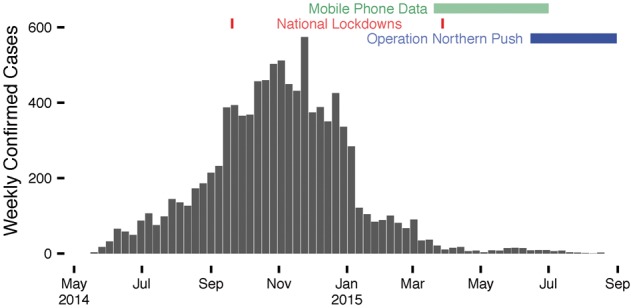
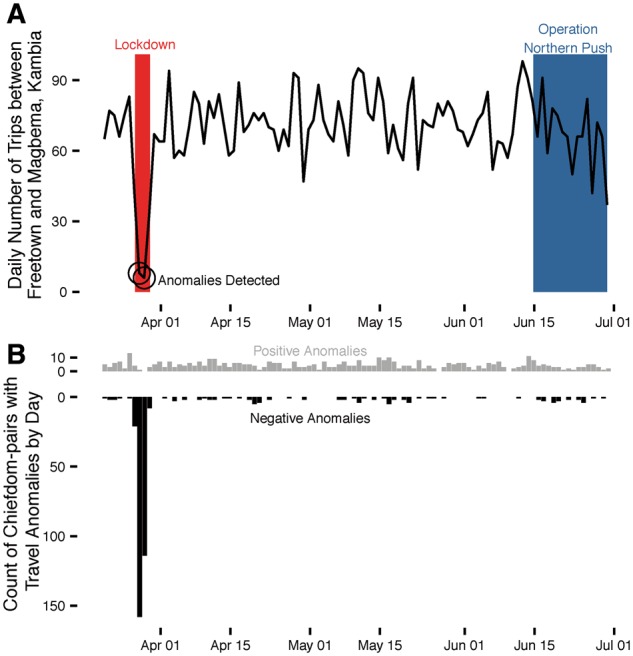
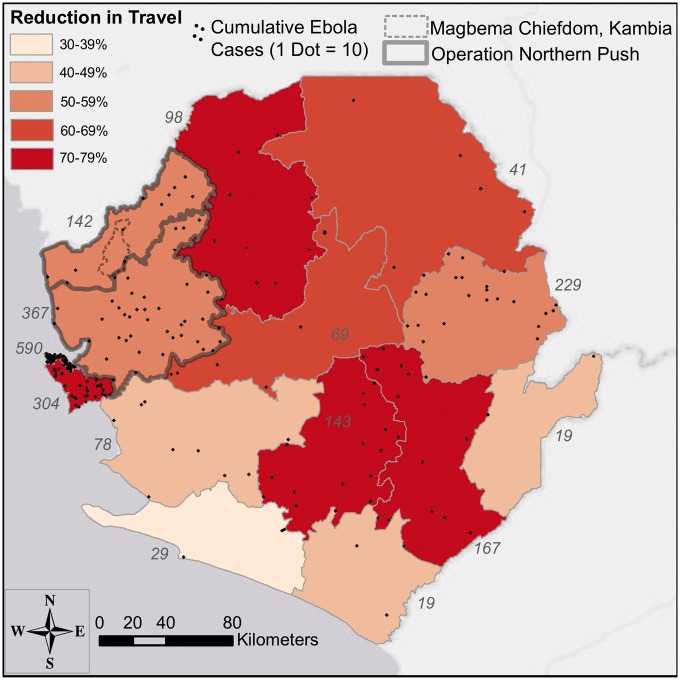
Background: Travel restrictions were implemented on an unprecedented scale in 2015 in Sierra Leone to contain and eliminate Ebola virus disease. However, the impact of epidemic travel restrictions on mobility itself remains difficult to measure with traditional methods. New 'big data' approaches using mobile phone data can provide, in near real-time, the type of information needed to guide and evaluate control measures. Methods: We analysed anonymous mobile phone call detail records (CDRs) from a leading operator in Sierra Leone between 20 March and 1 July in 2015. We used an anomaly detection algorithm to assess changes in travel during a national 'stay at home' lockdown from 27 to 29 March. To measure the magnitude of these changes and to assess effect modification by region and historical Ebola burden, we performed a time series analysis and a crossover analysis. Results: Routinely collected mobile phone data revealed a dramatic reduction in human mobility during a 3-day lockdown in Sierra Leone. The number of individuals relocating between chiefdoms decreased by 31% within 15 km, by 46% for 15-30 km and by 76% for distances greater than 30 km. This effect was highly heterogeneous in space, with higher impact in regions with higher Ebola incidence. Travel quickly returned to normal patterns after the restrictions were lifted. Conclusions: The effects of travel restrictions on mobility can be large, targeted and measurable in near real-time. With appropriate anonymization protocols, mobile phone data should play a central role in guiding and monitoring interventions for epidemic containment.
Overview
The claims and statistics of this paper haven’t been checked yet.
Run the check — free, no account needed. It reads the open-access text and checks the sources it cites.
Integrity signals
Registry
Cites
Statistics
Figures
Verification
Claims the paper makes
The claims and statistics of this paper haven’t been checked yet.
Run the check — free, no account needed. It reads the open-access text and checks the sources it cites.
Claims other papers make about this one
Each is checked against this paper’s own text: does it say what the citing paper says it does?
In the citing paper
“While in the above we reviewed COVID-19 related studies for their timely relevance, mobility restrictions had been used and studied in the past, for example to stop the spread of Ebola in Sierra Leone [108], H1N1 influenza [109], etc.”
From Human-centred artificial intelligence for mobile health sensing: challenges and opportunities (2023) · cites this paper as [108]
Self-check
Percentages, sums and reported differences re-computed from the paper’s own numbers.
The self-check needs the paper’s full text.
Citations
Cites
Automatic Time Series Forecasting: The forecast Package for R
Hyndman, R. J., & Khandakar, Y. (2008) · Journal of Statistical Software · doi:10.18637/jss.v027.i03 · Cited by 3,548 · cited 1×
“We used the auto.arima function in the forecast package in R (Hyndman and Khandakar 30 ) to identify the best-fitting parameters for the periodicity of the time series, and the linear mixed effects lme function in the nlme package in R (Pinheeiro et al. 31 ) to fit the time series model in the…”
MethodIntervention Analysis with Applications to Economic and Environmental Problems
Box, G. E. P., & Tiao, G. C. (1975) · Journal of the American Statistical Association · doi:10.1080/01621459.1975.10480264 · Cited by 2,399
Applied Spatial Data Analysis with R - Second Edition
Bivand, R., Pebesma, E., & Gómez-Rubio, V. (2008) · Use R! · doi:10.1007/978-1-4614-7618-4 · Cited by 2,065
Multiscale mobility networks and the spatial spreading of infectious diseases
Balcan, D., Vittoria Colizza, A., Gonçalves, B., Hu, H., Ramasco, J. J., & Vespignani, A. (2009) · Proceedings of the National Academy of Sciences · doi:10.1073/pnas.0906910106 · Cited by 1,347 · cited 1×
“8 Specifically for travel bans and border closures during the 2014–15 Ebola epidemic, simulations assuming travel reductions exceeding 80% predicted limited impact on international disease diffusion; 9 joining the call for quantification of previously unmeasured changes in mobility during the…”
BackgroundPercentage Points for a Generalized ESD Many-Outlier Procedure
ROSNER, B. A. (1983) · Technometrics · doi:10.1080/00401706.1983.10487848 · Cited by 1,287 · cited 1×
“The method uses a generalized extreme studentized deviate many-outlier procedure 27 to detect positive and negative deviants of statistically significant magnitude in the presence of periodic (in this application, weekly) and long-term trends.”
MethodTime Series Analysis: With Applications in R
Cryer, J. D., & Chan, K. (2010) · Springer texts in statistics · doi:10.1007/978-0-387-75959-3 · Cited by 682
Bengtsson, L., Lu, X., Thorson, A., Garfield, R., & von Schreeb, J. (2011) · PLoS Medicine · doi:10.1371/journal.pmed.1001083 · Cited by 634
Self-citationPredictability of population displacement after the 2010 Haiti earthquake
Lu, X. B., Bengtsson, L., & Holme, P. (2012) · Proceedings of the National Academy of Sciences · doi:10.1073/pnas.1203882109 · Cited by 607
Self-citationHuman Mobility Networks, Travel Restrictions, and the Global Spread of 2009 H1N1 Pandemic
Bajardi, P., Poletto, C., Ramasco, J. J., Tizzoni, M., Colizza, V., & Vespignani, A. (2011) · PLoS ONE · doi:10.1371/journal.pone.0016591 · Cited by 495 · cited 1×
“3 The ultimate goals of travel restrictions (e.g. geographical containment and transmission interruption) depend first and fundamentally on the impact of travel restrictions on changes to human travel behaviour.”
BackgroundLessons from the History of Quarantine, from Plague to Influenza A
Tognotti, E. (2013) · Emerging infectious diseases · doi:10.3201/eid1902.120312 · Cited by 460 · cited 1×
“This class of intervention ranges from ancient restrictions of the free association of people with leprosy 1 to maritime quaran-tines in 13th century Venice 2 and international air travel restrictions in the highly interconnected world of the 21st century.”
Background
Research works printed but not linked: 4
- Médecins Sans Frontières (MSF), 2014, Ebola: Quarantine Can Undermine Efforts to Curb Epidemic
- National Ebola Reponse Centre (NERC), 2015, Zero Ebola Campaign 3 Days Stay At Home—Operational Overview
- National Ebola Reponse Centre (NERC), 2015, FAQs—National Zero Ebola Campaign
- National Ebola Response Centre (NERC), 2015, Surge Operation Order
Cited by
Sorted by citations
The positive impact of lockdown in Wuhan on containing the COVID-19 outbreak in China
Lau, H., Khosrawipour, V., Kocbach, P., Mikolajczyk, A., Schubert, J., Bania, J., & Khosrawipour, T. (2020) · Journal of Travel Medicine · doi:10.1093/jtm/taaa037 · Cited by 1,294
“(6) Green line: approximated growth curve for COVID-19 cases under new diagnostic criteria”
BackgroundExploring the impacts of COVID-19 on travel behavior and mode preferences
Abdullah, M., Dias, C., Muley, D., & Shahin, M. (2020) · Transportation Research Interdisciplinary Perspectives · doi:10.1016/j.trip.2020.100255 · Cited by 736
“Thus, in general, travel is restricted during pandemics (Zhang et al., 2011; Cooley et al., 2011; Peak et al., 2018; Muley et al., 2020).”
BackgroundThe use of mobile phone data to inform analysis of COVID-19 pandemic epidemiology
Grantz, K. H., Meredith, H. R., Cummings, D. A. T., Metcalf, C. J. E., Grenfell, B. T., Giles, J. R., Mehta, S. H., Solomon, S. S., Labrique, A. B., Kishore, N., et al. (2020) · Nature Communications · doi:10.1038/s41467-020-18190-5 · Cited by 425
Self-citationPullano, G., Valdano, E., Scarpa, N., Rubrichi, S., & Vittoria Colizza, A. (2020) · The Lancet Digital Health · doi:10.1016/s2589-7500(20)30243-0 · Cited by 358
A new twenty-first century science for effective epidemic response
Bedford, J., Farrar, J., Ihekweazu, C. A., Kang, G., Koopmans, M., & Nkengasong, J. N. (2019) · Nature · doi:10.1038/s41586-019-1717-y · Cited by 333
“A retrospective analysis of mobile phone call data in Sierra Leone from 2015 showed how it might have been used to assess the impact of travel restrictions on mobility during the Ebola epidemic 46 .”
MethodNundy, S., Ghosh, A., Mesloub, A., Albaqawy, G. A., & Alnaim, M. M. (2021) · Journal of Cleaner Production · doi:10.1016/j.jclepro.2021.127705 · Cited by 319
On the predictability of infectious disease outbreaks
Scarpino, S. V., & Petri, G. (2019) · Nature Communications · doi:10.1038/s41467-019-08616-0 · Cited by 224
Peak, C. M., Kahn, R. J., Grad, Y. H., Childs, L. M., Li, R., Lipsitch, M., & Buckee, C. O. (2020) · The Lancet Infectious Diseases · doi:10.1016/s1473-3099(20)30361-3 · Cited by 211
Self-citationImpacts of social distancing policies on mobility and COVID-19 case growth in the US
Wellenius, G. A., Vispute, S., Espinosa, V., Fabrikant, A., Tsai, T. C., Hennessy, J., Dai, A., Williams, B., Gadepalli, K., Boulanger, A., et al. (2021) · Nature Communications · doi:10.1038/s41467-021-23404-5 · Cited by 205
Decline in Mobility: Public Transport in Poland in the time of the COVID-19 Pandemic
Wielechowski, M., Czech, K., & Grzęda, Ł. (2020) · Economies · doi:10.3390/economies8040078 · Cited by 182
“Peak et al. (2018), based on routinely collected mobile phone data during the Ebola epidemic in Sierra Leone revealed a dramatic reduction in human mobility only during a 3-day lockdown, while mobility quickly returned to normal patterns after the restrictions were lifted.”
BackgroundResultMobile phone location data for disasters: A review from natural hazards and epidemics
Yabe, T., Jones, N. K. W., Rao, P. S. C., González, M. C., & Ukkusuri, S. V. (2022) · Computers Environment and Urban Systems · doi:10.1016/j.compenvurbsys.2022.101777 · Cited by 164
Is Lockdown Bad for Social Anxiety in COVID-19 Regions?: A National Study in The SOR Perspective
Zheng, L., Miao, M., Lim, J., Li, M., Nie, S., & Zhang, X. (2020) · International Journal of Environmental Research and Public Health · doi:10.3390/ijerph17124561 · Cited by 145
Anwari, N., Ahmed, M. T., Islam, M. R., Hadiuzzaman, M., & Amin, S. R. (2021) · Transportation Research Interdisciplinary Perspectives · doi:10.1016/j.trip.2021.100334 · Cited by 152
Poverty and COVID-19 in Africa and Latin America
Bargain, O., & Aminjonov, U. (2021) · World Development · doi:10.1016/j.worlddev.2021.105422 · Cited by 117
“These reports record percent 4 Note that mobile phone tracking has already been used for gauging the mobility impact of travel restrictions, for instance during the unprecedented measures put in place to eliminate Ebola in 2015 (Peak et al., 2018, for Sierra Leone).”
COVID-19, cytokines, inflammation, and spices: How are they related?
Kunnumakkara, A. B., Rana, V., Parama, D., Banik, K., Girisa, S., Henamayee, S., Thakur, K. K., Dutta, U., Garodia, P., Gupta, S. C., et al. (2021) · Life Sciences · doi:10.1016/j.lfs.2021.119201 · Cited by 107
Lai, S., Farnham, A., Ruktanonchai, N. W., & Tatem, A. J. (2019) · Journal of Travel Medicine · doi:10.1093/jtm/taz019 · Cited by 93
Self-citationRole of Transport during Outbreak of Infectious Diseases: Evidence from the Past
Muley, D., Shahin, M., Dias, C., & Abdullah, M. (2020) · Sustainability · doi:10.3390/su12187367 · Cited by 107
“However, the travel patterns became normal quickly after the lifting of restrictions [50].”
BackgroundImpacts of social distancing policies on mobility and COVID-19 case growth in the US
Wellenius, G. A., Vispute, S., Espinosa, V., Fabrikant, A., Tsai, T. C., Hennessy, J., Dai, A. M., Williams, B., Gadepalli, K., Boulanger, A., et al. (2021) · RePEc: Research Papers in Economics · doi:10.3929/ethz-b-000488459 · Cited by 95
Failure in initial stage containment of global COVID‐19 epicenters
Khosrawipour, V., Lau, H., Khosrawipour, T., Kocbach, P., Ichii, H., Bania, J., & Mikołajczyk, A. (2020) · Journal of Medical Virology · doi:10.1002/jmv.25883 · Cited by 84
Bohman, H., Ryan, J., Stjernborg, V., & Nilsson, D. (2021) · Transport Policy · doi:10.1016/j.tranpol.2021.03.013 · Cited by 77
“In a study on the Ebola outbreak in Sierra Leone using cell phone data, Peak et al. (2018) found a drastic decline in mobility during a three-day lockdown.”
BackgroundUsing digital surveillance tools for near real-time mapping of the risk of infectious disease spread
Bhatia, S., Lassmann, B., Cohn, E. L., Desai, A. N., Carrion, M. N., Kraemer, M. U. G., Herringer, M., Brownstein, J. S., Madoff, L., Cori, A., et al. (2021) · npj Digital Medicine · doi:10.1038/s41746-021-00442-3 · Cited by 78
Human mobility and the infectious disease transmission: a systematic review
Lessani, M. N., Li, Z., Jing, F., Qiao, S., Zhang, J., Olatosi, B., & Li, X. (2023) · Geo-spatial Information Science · doi:10.1080/10095020.2023.2275619 · Cited by 88
“In response to the 2014 Ebola outbreak, several countries implemented travel bans in areas with an Ebola out-break in 2014, aiming to limit the spread of the virus to new regions (Peak et al. 2018; Poletto et al. 2014).”
COVID-19 is linked to changes in the time–space dimension of human mobility
Santana, C., Botta, F., Barbosa, H., Privitera, F., de Menezes, R. P., & Clemente, R. D. (2023) · Nature Human Behaviour · doi:10.1038/s41562-023-01660-3 · Cited by 72
Impact of lockdown and change in mobility patterns on road fatalities during COVID-19 pandemic
Gupta, M., Pawar, N. M., & Velaga, N. R. (2021) · Transportation Letters · doi:10.1080/19427867.2021.1892937 · Cited by 65
“Further, the domestic travel restrictions during a 3-day lockdown in Sierra Leone during Ebola outbreak reduced mobility by 31% to 76% (Peak et al. 2018).”
BackgroundQuantifying human mobility resilience to the COVID-19 pandemic: A case study of Beijing, China
Liu, Y., Wang, X., Song, C., Chen, J., Shu, H., Wu, M., Guo, S., Huang, Q., & Pei, T. (2022) · Sustainable Cities and Society · doi:10.1016/j.scs.2022.104314 · Cited by 64
Impact of COVID-19 on daily travel behaviour: a literature review
Paul, T., Chakraborty, R., & Anwari, N. (2022) · Transportation Safety and Environment · doi:10.1093/tse/tdac013 · Cited by 66
Using Mobile Phone Data for Emergency Management: a Systematic Literature Review
Wang, Y., Li, J., Zhao, X., Feng, G., & Luo, X. R. (2020) · Information Systems Frontiers · doi:10.1007/s10796-020-10057-w · Cited by 54
The role of high-speed rail and air travel in the spread of COVID-19 in China
Zhu, P., & Guo, Y. (2021) · Travel Medicine and Infectious Disease · doi:10.1016/j.tmaid.2021.102097 · Cited by 48
“Our findings in general resonate with similar studies on earlier outbreaks, such as H1N1 [2,15], Ebola [16], and SARS [17].”
Endogenous social distancing and its underappreciated impact on the epidemic curve
Gosak, M., Kraemer, M. U. G., Nax, H. H., Perc, M., & Pradelski, B. (2021) · Scientific Reports · doi:10.1038/s41598-021-82770-8 · Cited by 40
“† Some related empirical work has been done to capture the change in human movements in response to environmental disaster (41), and travel restrictions (42), but not in response to disease outbreaks except for some recent work we shall discuss separately in the concluding remarks.”
High-Performance Modelling and Simulation for Big Data Applications
Kołodziej, J., & González–Vélez, H. (2019) · Lecture notes in computer science · doi:10.1007/978-3-030-16272-6 · Cited by 37
Incubation periods impact the spatial predictability of cholera and Ebola outbreaks in Sierra Leone
Kahn, R. J., Peak, C. M., Fernández-Gracia, J., Hill, A., Jambai, A., Ganda, L., Castro, M. C., & Buckee, C. O. (2020) · Proceedings of the National Academy of Sciences · doi:10.1073/pnas.1913052117 · Cited by 35
Self-citationEnhancing Situational Awareness to Prevent Infectious Disease Outbreaks from Becoming Catastrophic
Lipsitch, M., & Santillana, M. (2019) · Current Topics in Microbiology and Immunology · doi:10.1007/82_2019_172 · Cited by 34
Mayo, F. L., Maglasang, R. S., Moridpour, S., & Buque‐Taboada, E. M. (2021) · Transportation Research Interdisciplinary Perspectives · doi:10.1016/j.trip.2021.100461 · Cited by 38
Haddawy, P., Lawpoolsri, S., Sa-ngamuang, C., Yin, M. S., Barkowsky, T., Wiratsudakul, A., Kaewkungwal, J., Khamsiriwatchara, A., Sa-angchai, P., Sattabongkot, J., et al. (2021) · PLoS ONE · doi:10.1371/journal.pone.0245842 · Cited by 32
Kishore, K., Jaswal, V., Verma, M., & Koushal, V. (2021) · JMIR Public Health and Surveillance · doi:10.2196/29957 · Cited by 31
“Research has demonstrated the association between mobility and disease transmission for various infectious diseases, such as cholera, dengue, influenza, Ebola, malaria, measles, and COVID-19 [10-17].”
BackgroundLiu, X., Wen, J., Kozak, M., Jiang, Y., & Li, Z. (2021) · Tourism Review · doi:10.1108/tr-01-2021-0034 · Cited by 31
Human-centred artificial intelligence for mobile health sensing: challenges and opportunities
Dang, T., Spathis, D., Ghosh, A., & Mascolo, C. (2023) · Royal Society Open Science · doi:10.1098/rsos.230806 · Cited by 30
“While in the above we reviewed COVID-19 related studies for their timely relevance, mobility restrictions had been used and studied in the past, for example to stop the spread of Ebola in Sierra Leone [108], H1N1 influenza [109], etc.”
BackgroundCOVID-19 policy analysis: labour structure dictates lockdown mobility behaviour
Heroy, S., Loaiza, I., Pentland, A., & O’Clery, N. (2021) · Journal of The Royal Society Interface · doi:10.1098/rsif.2020.1035 · Cited by 39
“Urban mobility metrics from mobile phones have frequently been used to quantify mobility reductions in the wake of COVID-19 as well as other infectious diseases, both to characterize lockdown measures [2,18] and to predict epidemic spread [19–22].”
BackgroundWardle, J., Bhatia, S., Kraemer, M. U. G., Nouvellet, P., & Cori, A. (2023) · Epidemics · doi:10.1016/j.epidem.2023.100666 · Cited by 29
COVID-19 policy analysis: labour structure dictates lockdown mobility behaviour
Heroy, S., Loaiza, I., Pentland, A., & O’Clery, N. (2020) · DSpace@MIT (Massachusetts Institute of Technology) · Cited by 28
Can tracking people through phone-call data improve lives?
Maxmen, A. (2019) · Nature · doi:10.1038/d41586-019-01679-5 · Cited by 29
Padmakumar, A., & Patil, G. R. (2022) · Cities · doi:10.1016/j.cities.2022.103697 · Cited by 27
Milusheva, S., Lewin, A., Gomez, T. P. B., Matekenya, D., & Reid, K. (2021) · Data & Policy · doi:10.1017/dap.2021.10 · Cited by 26
Managing the spread of disease with mobile phone data
Milusheva, S. (2020) · Journal of Development Economics · doi:10.1016/j.jdeveco.2020.102559 · Cited by 25
Using mobile phone data to reveal risk flow networks underlying the HIV epidemic in Namibia
Valdano, E., Okano, J. T., Vittoria Colizza, A., Mitonga, K. H., & Blower, S. M. (2021) · Nature Communications · doi:10.1038/s41467-021-23051-w · Cited by 22
Keating, P., Murray, J., Schenkel, K., Merson, L., & Seale, A. C. (2021) · BMC Public Health · doi:10.1186/s12889-021-11790-w · Cited by 22
Ethical Considerations for Movement Mapping to Identify Disease Transmission Hotspots
de Jong, B. C., Gaye, B., Luyten, J., van Buitenen, B., André, E., Meehan, C. J., O’Siochain, C., Tomsu, K., Urbain, J., Grietens, K. P., et al. (2019) · Emerging infectious diseases · doi:10.3201/eid2507.181421 · Cited by 22
“This type of mapping could reduce transmission of diseases that are difficult to eliminate, such as tuberculosis (TB), leprosy, schistosomiasis, malaria (6), and sleeping sickness, and assist in controlling outbreaks of acute disease, such as Ebola virus (7,8), cholera, or Shiga toxin–producing Escherichia coli O157:H…”
BackgroundPopulation mobility induced phase separation in SIS epidemic and social dynamics
Harding, N., Spinney, R. E., & Prokopenko, M. (2020) · Scientific Reports · doi:10.1038/s41598-020-64183-1 · Cited by 19
Monitoring Social Distancing and SARS-CoV-2 Transmission in Brazil Using Cell Phone Mobility DataPreprint
de Oliveira, S. B., Pôrto, V. B. G., Ganem, F., Mendes, F. M., Almirón, M., de Oliveira, W. K., Fantinato, F. F. S. T., de Almeida, W. A. F., Borges, A. P. D. M., Pinheiro, H. N. B., et al. (2020) · SSRN Electronic Journal · doi:10.1101/2020.04.30.20082172 · Cited by 20
Pathak, A. A., Chandrasekaran, S., & Annamalai, B. (2022) · Transportation Research Record Journal of the Transportation Research Board · doi:10.1177/03611981221089936 · Cited by 19
“People accept and support government-imposed travel restrictions to control the spread of epidemics (11).”
BackgroundThe limits of human mobility traces to predict the spread of COVID-19: A transfer entropy approach
Delussu, F., Tizzoni, M., & Gauvin, L. (2023) · PNAS Nexus · doi:10.1093/pnasnexus/pgad302 · Cited by 19
“In the past 15 years, the increasing availability of mobility data derived from mobile phones has fueled a large body of work aimed at identifying opportunities to use them for infectious disease modeling and surveillance ( 4 – 10).”
BackgroundLetta, M., Montalbano, P., & Paolantonio, A. (2023) · Journal of Economic Surveys · doi:10.1111/joes.12584 · Cited by 20
Zhang, Y., & Xu, B. (2021) · Journal of theoretical and applied electronic commerce research · doi:10.3390/jtaer16050095 · Cited by 18
Human mobility in epidemic modeling
Lu, X. B., Feng, J., Lai, S., Holme, P., Liu, S., Du, Z., Yuan, X., Wang, S., Li, Y.-X., Zhang, X., et al. (2025) · Physics Reports · doi:10.1016/j.physrep.2025.10.010 · Cited by 25
Self-citationPoverty and COVID-19 in Developing CountriesPreprint
Bargain, O., & Aminjonov, U. (2020) · RePEc: Research Papers in Economics · Cited by 16
Yin, L., Lin, N., Song, X., Mei, S., Shaw, S., Fang, Z., Li, Q., Li, Y., & Mao, L. (2019) · Applied Geography · doi:10.1016/j.apgeog.2019.102103 · Cited by 15
Vanhove, M. P. M., Thys, S., Decaestecker, E., Antoine‐Moussiaux, N., Man, J. D., Hugé, J., Keune, H., Sterckx, A., & de Bisthoven, L. J. (2020) · Cities & Health · doi:10.1080/23748834.2020.1805282 · Cited by 16
“Although the practice and logic of confinement are ancient and partly similar actions were applied during EVD outbreaks (Peak et al. 2018), today’s GUCMs render their effects tangible to everyone because they are per definition ubiquitous.”
BackgroundCorporate Liquidity and Solvency in Europe During COVID-19: The Role of Policies
Ebeke, C. (2021) · IMF Working Paper · doi:10.5089/9781513570914.001.a001 · Cited by 14
Comparing sources of mobility for modelling the epidemic spread of Zika virus in Colombia
Perrotta, D., Frı́as-Martı́nez, E., y Piontti, A. P., Zhang, Q., Luengo-Oroz, M. A., Paolotti, D., Tizzoni, M., & Vespignani, A. (2022) · PLoS neglected tropical diseases · doi:10.1371/journal.pntd.0010565 · Cited by 14
Using big data for evaluating development outcomes: A systematic map
Rathinam, F., Khatua, S., Siddiqui, Z., Malik, M., Duggal, P., Watson, S., & Vollenweider, X. (2021) · Campbell Systematic Reviews · doi:10.1002/cl2.1149 · Cited by 12
Liu, Y., Osorio, J., & Ouyang, Y. (2023) · Journal of Public Transportation · doi:10.1016/j.jpubtr.2023.100051 · Cited by 12
Alderman, J., & Harjoto, M. A. (2020) · Transforming Government People Process and Policy · doi:10.1108/tg-06-2020-0130 · Cited by 12
Big Data Processing, Analysis and Applications in Mobile Cellular Networks
Brdar, S., Novović, O., Grujić, N., González–Vélez, H., Truică, C., Siegfried Benkner, A., Bajrović, E., & Papadopoulos, A. N. (2019) · Lecture notes in computer science · doi:10.1007/978-3-030-16272-6_6 · Cited by 12
Strömblad, E., Hiselius, L. W., Rosqvist, L. S., & Svensson, H. (2021) · Sustainability · doi:10.3390/su132312979 · Cited by 12
“Follow-ups of previous epidemics have shown that travel behavior returned to normal levels about three months after the peak of the SARS epidemic in Taiwan [23] and within days after restrictions were lifted from a three-day national lockdown during the Ebola outbreak in Sierra Leone [34].”
BackgroundInfluentialAderibigbe, O.-O. B., & Gumbo, T. (2022) · Sustainability · doi:10.3390/su142416959 · Cited by 14
Ha, T. V., ASADA, T., & Arimura, M. (2022) · Transportation Research Interdisciplinary Perspectives · doi:10.1016/j.trip.2022.100744 · Cited by 11
Ensoy, C., Nguyen, M. H., Hens, N., Molenberghs, G., & Faes, C. (2023) · Spatial and Spatio-temporal Epidemiology · doi:10.1016/j.sste.2023.100568 · Cited by 14
“, 2011) and the West Africa Ebola epidemic (Peak et al., 2018).”
Kuo, F., & Wen, T. (2020) · Applied Geography · doi:10.1016/j.apgeog.2020.102375 · Cited by 10
“…restrictions against global epidemics, including influenza A/H1N1 (Cooper, Pitman, Edmunds, & Gay, 2006; Epstein et al., 2007), SARS (T. Day, Park, Madras, Gumel, & Wu, 2006; Fraser, Riley, Anderson, & Ferguson, 2004), and Ebola virus (Peak et al., 2018), has also been proven in previous studies.”
Townend, I. H., Baden, D. A., Baker, J., Buermann, J., Dawson, I., Dbouk, W., Dearing, J. A., Doncaster, C. P., Eigenbrod, F., Hellmann, T., et al. (2025) · Futures · doi:10.1016/j.futures.2025.103649 · Cited by 11
Measuring Sensitivity to Social Distancing Behavior during the COVID-19 Pandemic
Kontokosta, C. E., Hong, B., & Bonczak, B. J. (2022) · Scientific Reports · doi:10.1038/s41598-022-20198-4 · Cited by 10
Using big data for evaluating development outcomes: a systematic map
Infonomics, A., Rathinam, F., Khatua, S., 3ie, Siddiqui, Z., 3ie, Malik, M., 3ie, Duggal, P., 3ie, et al. (2020) · doi:10.51744/cmwp2 · Cited by 10
Mobile positioning-based population statistics in crisis management: An Estonian case study
Tominga, A., Silm, S., Orru, K., Vent, K., Klaos, M., Võik, E.-J., & Saluveer, E. (2023) · International Journal of Disaster Risk Reduction · doi:10.1016/j.ijdrr.2023.103887 · Cited by 9
Human Mobility Modeling during the COVID-19 Pandemic via Deep Graph Diffusion Infomax
Liu, Y., Rong, Y., Guo, Z., Chen, N., Xu, T., Tsung, F., & Li, J. (2023) · Proceedings of the AAAI Conference on Artificial Intelligence · doi:10.1609/aaai.v37i12.26678 · Cited by 9
Assessing the impact of human mobility to predict regional excess death in Ecuador
Cuéllar, L., Torres, I., Romero-Severson, E. O., Mahesh, R., Ortega, N., Pungitore, S. A., Ke, R., & Hengartner, N. (2022) · Scientific Reports · doi:10.1038/s41598-021-03926-0 · Cited by 9
“Such data has emerged as a useful tool to measure human mobility and its relationship to the spread of diseases8,9,10 including SARS-COV-28,11,12, malaria13,14 cholera15, measles16, dengue17,18, and Ebola19,20.”
BackgroundAI-Assisted Diplomatic Decision-Making During Crises: Challenges and Opportunities
Pokhriyal, N., & Koebe, T. (2023) · Springer eBooks · doi:10.1007/978-3-032-12201-8_36 · Cited by 15
Key opportunities and challenges for the use of big data in migration research and policy
Franklinos, L. H. V., Parrish, R., Burns, R., Caflisch, A. C., Mallick, B., Rahman, T., Routsis, V., López, A. S., Tatem, A. J., & Trigwell, R. (2021) · UCL Open Environment · doi:10.14324/111.444/ucloe.000027 · Cited by 11
“Previous studies have used big data to predict patterns of human movement during natural disasters [8] and track movement in near real-time [9], quantify migration at national scales [10–14], guide and evaluate humanitarian interventions [15] and examine the effects of human movement on disease transmission [16].”
BackgroundSelf-citationExploring the role of information technology in tourism informatics: state of the art
Wei, W., Ding, S., Chai, Y., Sun, J., & Wang, F. (2024) · Asia Pacific Journal of Tourism Research · doi:10.1080/10941665.2024.2358311 · Cited by 7
“In addition to social media, cell phone data can be used to control the fl ow of tourists (Peak et al., 2018), and climate data and the RayMan model can be used to quantify the potential of climate tourism in tourist destinations (Brosy et al., 2014).”
Kajiita, R. M., & Kang’ethe, S. M. (2021) · Perspectives on Global Development and Technology · doi:10.1163/15691497-12341596 · Cited by 7
“Like other previous epidemics, such as HIV and AIDS in Africa and Ebola in West and central Africa (Peak et al. 2018; Mo Ibrahim Foundation 2020; WHO 2020b), the outbreak of COVID-19 exposed the incapacity and unpreparedness of many countries to respond to health disasters (Gilbert et al. 2020;…”
BackgroundArjona, J. O., & Sampériz, J. D. L. O.-L. (2023) · Scientific Reports · doi:10.1038/s41598-023-36108-1 · Cited by 7
“In contrast to previous research that has dealt with other infectious diseases in developing countries, a significant number of COVID-19-related studies have focused on the United States or European countries as study areas, with the main result being the decrease in population movements after the…”
ResultHigh-resolution home location prediction from tweets using deep learning with dynamic structure
Ghaffari, M., Srinivasan, A., & Liu, X. (2019) · IEEE/ACM International Conference on Advances in Social Networks Analysis and Mining (ASONAM) · doi:10.1145/3341161.3342956 · Cited by 7
“information, have been considered as alternative sources [1], [2].”
BackgroundYang, L., Wei, C.-Y., Jiang, X., Ye, Q., & Tatano, H. (2022) · International Journal of Disaster Risk Science · doi:10.1007/s13753-022-00393-7 · Cited by 7
“Mobile phone data are usually used to capture population flow (Peak et al. 2018; Yabe et al. 2020).”
MethodEbola and slum dwellers: Community engagement and epidemic response strategies in urban Sierra Leone
Hrdličková, Z., Macarthy, J. M., Conteh, A., Ali, S. H., Blango, V. N., & Sesay, A. B. (2023) · Heliyon · doi:10.1016/j.heliyon.2023.e17425 · Cited by 6
Čaušević, A. (2023) · Sustainability · doi:10.3390/su151310701 · Cited by 6
Chen, Q., Li, M., Wang, Y., Zhang, L., & Tan, X. (2021) · Disaster Medicine and Public Health Preparedness · doi:10.1017/dmp.2021.20 · Cited by 6
Lockdown and psychological stress in Wuhan, China
Li, M., Wang, W., Zhu, B., Chen, Q., Zhang, Y., Peng, S., Zhang, L., & Tan, X. (2023) · PLoS ONE · doi:10.1371/journal.pone.0274696 · Cited by 5
Ebola incidence and mortality before and during a lockdown: The 2022 epidemic in Uganda
Izudi, J., Komakech, A., Morukileng, J., & Bajunirwe, F. (2023) · PLOS Global Public Health · doi:10.1371/journal.pgph.0002702 · Cited by 4
Papageorgiou, G., Skamnia, E., & Εconomou, P. (2025) · Wiley Interdisciplinary Reviews Data Mining and Knowledge Discovery · doi:10.1002/widm.70016 · Cited by 5
Innovations in Disease Surveillance and Monitoring
Espey, J., & Dahmm, H. (2020) · Springer eBooks · doi:10.1007/978-3-030-05325-3_16-1 · Cited by 4
Construction of Tourism Management Engineering Based on Data Mining Technology
Ma, Z. (2022) · Journal of Electrical and Computer Engineering · doi:10.1155/2022/1982462 · Cited by 4
“Literature [13] believes that the developing tourism e-commerce website will become the real core of the tourism supply chain.”
BackgroundRetractedThe Prospects of Domestic Tourism in Post-Covid Nepal: Connecting the Missing Dots
Silwal, A., Garcia, G. N. G., & Silwal, A. (2022) · Shanti Journal · doi:10.3126/shantij.v1i1.47794 · Cited by 4
“The study further amplifies that travel restrictions are implemented during pandemics (Peak et al., 2018; Muley et al., 2020; Abdullah et al., 2020).”
BackgroundYuan, B., Lee, H., & Nishiura, H. (2021) · Theoretical Biology and Medical Modelling · doi:10.1186/s12976-021-00149-8 · Cited by 4
“Published applications include modeling of malaria [3], rubella [12], dengue [13], and Ebola transmission [14].”
Angelis, M. D., Durastanti, C., Giovannoni, M., & Moretti, L. (2022) · Transportation Research Interdisciplinary Perspectives · doi:10.1016/j.trip.2022.100646 · Cited by 4
Socio-Life Science and the COVID-19 Outbreak
Yano, M., Matsuda, F., Sakuntabhai, A., & Hirota, S. (2021) · Economics, law, and institutions in Asia Pacific · doi:10.1007/978-981-16-5727-6 · Cited by 4
On the predictability of infectious disease outbreaksPreprint
Scarpino, S. V., & Petri, G. (2017) · arXiv (Cornell University) · doi:10.48550/arxiv.1703.07317 · Cited by 4
Literature Review and Data Analysis on the Impacts of Prolonged Events on Transit System Ridership
Liu, Y., Osorio, J., & Ouyang, Y. (2021) · doi:10.36501/0197-9191/21-026 · Cited by 4
Kamis, A. A., Ding, Y., Qu, Z., & Zhang, C. (2021) · Applied Sciences · doi:10.3390/app112311227 · Cited by 3
Intelligent Planning of Tourist Routes Based on Cloud Computing and Marching Algorithm
Lu, J. (2022) · Security and Communication Networks · doi:10.1155/2022/8793392 · Cited by 3
“Literature [15] uses a multisource social media fusion method to integrate fragmented tourism information from multiple aspects to recommend routes to users.”
BackgroundRetractedAnalysis of the Covid-19 pandemic on preferences of transport modes
Murat, Y. Ş., & Çakıcı, Z. (2024) · Proceedings of the Institution of Civil Engineers - Transport · doi:10.1680/jtran.23.00105 · Cited by 3
Positive Impacts of Covid-19 Pandemic on Various Aspects
Sharma, A. (2021) · Psychology and Education Journal · doi:10.17762/pae.v58i2.1868 · Cited by 3
“We know from past examinations that movement limitations have exhibited a beneficial outcome in past SARS, Ebola and bubonic plague episodes [13,14,15].”
ResultCovid-19 Outbreak: Current Scenario of Pakistan
Fatima, I. (2023) · Annals of Human and Social Sciences · doi:10.35484/ahss.2023(4-ii)16 · Cited by 3
Metadata
- Authors
- Peak, C. M., Wesolowski, A., zu Erbach-Schoenberg, E., Tatem, A. J., Wetter, E., Lu, X., Power, D., Weidman-Grunewald, E., Ramos, S., Moritz, S., Buckee, C. O., & Bengtsson, L.
- Affiliations
- Harvard University (US)
- Johns Hopkins University (US)
- Flowminder Foundation, Stockholm, Sweden
- Flowminder Foundation (SE)
- Asian Institute of Management (PH)
- Central South University (CN)
- Ericsson (Sweden) (SE)
- Karolinska Institutet (SE)
- Corresponding author
- Buckee, Caroline O
- ORCID
- Venue
- International Journal of Epidemiology
- Publisher
- Oxford University Press (OUP)
- Published
- 2018-06-26
- Volume
- 47
- Issue
- 5
- Pages
- 1562-1570
- ISSN
- 0300-5771 (ISSN-L)
- 1464-3685
- PMC
- PMC6208277
- OpenAlex
- W2811210701
- Cited by
- 141
- References
- 29
- Citations by year
- 2026: 4 · 2025: 7 · 2024: 5 · 2023: 21 · 2022: 22 · 2021: 47 · 2020: 24 · 2019: 10
- FWCI
- 25.06
- Type
- journal article
- Language
- en
- Open access
- hybrid
- doi.org
- Licence
- Locations
- International Journal of Epidemiology (publishedVersion, cc-by-nc)
- Europe PMC (PubMed Central) (publishedVersion, cc-by-nc)
- PubMed Central (publishedVersion, cc-by-nc)
- PubMed (publishedVersion)
- ePrints Soton (University of Southampton) (acceptedVersion)
- Funders
- National Institute of General Medical Sciences (U54GM088558)
- National Research Service Award (T32AI007535–16A)
- Wellcome Trust Sustaining Health (106866/Z/15/Z)
- Swedish Research Council (D0313701)
- Burroughs Wellcome Fund
- Natural Science Foundation of China (71522014)
- National Institutes of Health
- Topics
- Social Sciences › Transportation › Human Mobility and Location-Based Analysis
- Health Sciences › Medicine › Infectious Diseases › Viral Infections and Outbreaks Research
- Health Sciences › Medicine › Epidemiology › Data-Driven Disease Surveillance
- Keywords
- Ebola virus disease, travel restrictions, human mobility, mobile phone data, call detail records, epidemic containment, anomaly detection, chiefdoms, spatial heterogeneity, disease surveillance, Sierra Leone
- MeSH terms
- Humans, Population Dynamics, Retrospective Studies, Sierra Leone, Travel, Incidence, Infection Control, Hemorrhagic Fever, Ebola, Cell Phone, Epidemics
About these checks
Registry, retraction, Cites and statistics results are computed, not judged, with one exception: a printed reference that no index lists is read once by a model before it counts as a citation error. Claims are extracted by a model and kept only when their quote appears verbatim in the text; each cited source is then checked, with a model’s help, for whether it says what the claim relies on. Those verdicts can be wrong — read the claim’s quote and the cited source before relying on one.
Statistics and arithmetic are recomputed, not judged.
Confidence bands are shown only for fields calibrated on our annotated test set. None is calibrated yet, so no band is shown.
What counts as a claim ›How we measure confidence ›How we check this ›
Are you an author, or do you see a problem with this page? Request a review
