

The DOI matches its Crossref record; 27 of the 27 references it cites were found in a registry or an index; 4 of the 9 sources its claims cite were checked for support.
Federated learning improves site performance in multicenter deep learning without data sharing
Open accessAbstract
Objective: To demonstrate enabling multi-institutional training without centralizing or sharing the underlying physical data via federated learning (FL). Materials and Methods: Deep learning models were trained at each participating institution using local clinical data, and an additional model was trained using FL across all of the institutions. Results: We found that the FL model exhibited superior performance and generalizability to the models trained at single institutions, with an overall performance level that was significantly better than that of any of the institutional models alone when evaluated on held-out test sets from each institution and an outside challenge dataset. Discussion: The power of FL was successfully demonstrated across 3 academic institutions while avoiding the privacy risk associated with the transfer and pooling of patient data. Conclusion: Federated learning is an effective methodology that merits further study to enable accelerated development of models across institutions, enabling greater generalizability in clinical use.
Overview
AI snapshot
Written from the paper’s full text.
TL;DR
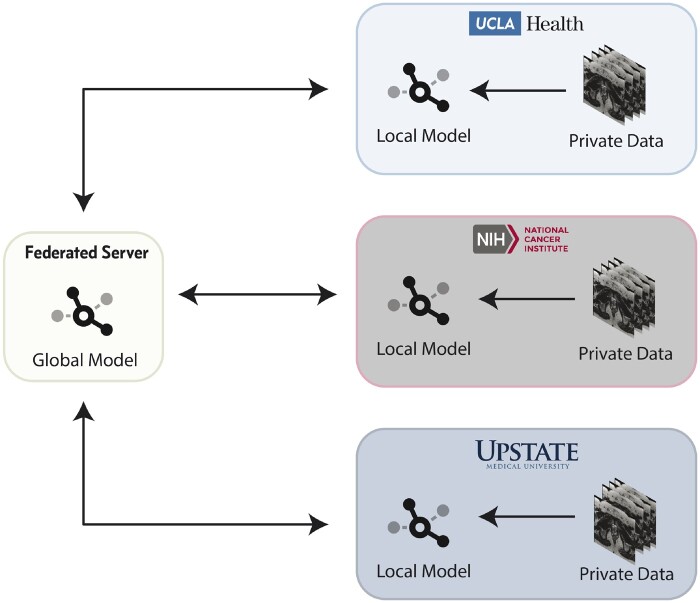
In a 3-institution study using real prostate MRI, federated learning produced a single model without sharing patient data. The FL model outperformed each institution’s private model on held-out institutional test sets and an external challenge dataset.
Key findings
- The FL model achieved an overall private-test-set mean Dice of 0.895 ± 0.036, significantly better than each private model (P < .001); private model overall Dice values were 0.833 ± 0.131 (NCI), 0.854 ± 0.074 (SUNY), and 0.745 ± 0.178 (UCLA).
- On the external PROSTATEx challenge dataset (n = 343), the FL model achieved 0.889 ± 0.036, significantly better than the private models: NCI 0.872 ± 0.062, SUNY 0.838 ± 0.043, UCLA 0.812 ± 0.136 (P < .001 for all comparisons).
- Private models performed well on their own institutional test sets (Dice range 0.883–0.925) but had diminished performance on other institutions’ test sets (Dice range 0.575–0.887).
Methods
- Retrospective multicenter study at UCLA, SUNY Upstate, and NCI: each institution collected 1 prostate MRI from 100 patients, with axial T2W images at 3T and expert whole-prostate segmentations; each private dataset was split into 80 training and 20 held-out test images. An external challenge dataset of 343 axial T2W prostate images from SPIE-AAPM-NCI PROSTATEx was also used.
- The model was a 3D Anisotropic Hybrid Network trained with soft Dice loss and Adam; each private training set was split into 5 sets of 16 images to train 5 submodels combined into an ensemble. All models were trained for 300 epochs.
- Federated learning used a cloud-based aggregation server; after each epoch, model weights and validation metrics were sent from each institution, combined by a weighted average based on validation mean Dice, and redistributed. Evaluation used Dice coefficient and 2-sided paired t-tests comparing private models to the FL model on the combined private test set and the challenge dataset.
Limitations
- Stated: the authors did not address the potential for an inside actor to recover underlying patient data through a model inversion attack on shared weights; they suggest calibrated distortion to shared weights as a possible future enhancement.
- Stated: the task (prostate segmentation on T2-weighted MRI) is relatively simple, and all private models achieved high performance on their own institutional datasets, so the study could not demonstrate that an FL-trained model would significantly outperform a single-site-trained model on that single site’s data.
- Stated: because private datasets were similarly sized, the authors did not explore varying the federated aggregation methodology; adding more institutions may introduce challenges in imaging data quality heterogeneity, governance, intellectual property, and model generalizability, possibly requiring private fine-tuning. Evident from the text: only 3 academic institutions and one segmentation task were tested, and no formal privacy attack evaluation was performed.
Model-written summary. Check it against the paper before relying on it.
Integrity signals
Registry
Cites
Statistics
Figures
Verification
Claims the paper makes
8 Own interpretation · 4 Own method · 4 Own result · 3 Partly supported · 2 No basis given · 1 Sources not found · 1 No full text of the sources · accuracy not yet measured
The cited sources support only part of this claim — read each source’s verdict below.
In the paper
“However, works that examine the practical application of FL in radiological applications are still limited.20,21”
§ Federated learning improves site performance in multicenter deep learning without data sharing > INTRODUCTION
What the sources say
- Not matchedcites [20] Roth
Couldn’t be matched to a paper in Crossref, so it can’t be checked.
- Partly supportedcites [21] Sheller, 2020, Federated learning in medicine: facilitating multi-institutional collaborations without sharing patient data, Sci Rep sourceExperimental — accuracy not yet measured
The Methods > Data and Discussion passages describe this paper’s evaluation of federated learning on radiographic brain imaging, so it is an example of the kind of work the citing sentence identifies. They do not establish that such works are limited in number. No page numbers are available in our copy. (LLM, conf=0.81)
plain- Asserted: passes — The authors put it forward as true.
- Checkable: passes — It can be checked against evidence.
- Load-bearing: passes — The paper’s conclusions depend on it.
- Based: passes — The paper gives a reason why it holds.
- Not matched
A result the paper reports from its own data — it cites no other source for it, so there is none to check. The quote shows it is in the paper.
In the paper
“The private models exhibited varied performance on the challenge dataset (Dice coefficient range: 0.812–0.872).”
§ Federated learning improves site performance in multicenter deep learning without data sharing > RESULTS
plain- Asserted: passes — The authors put it forward as true.
- Checkable: passes — It can be checked against evidence.
- Load-bearing: unclear — It is unclear whether the paper’s conclusions depend on it.
- Based: passes — The paper gives a reason why it holds.
The paper states this without a source or data behind it here, so there is nothing to check it against. The quote shows it is in the paper.
In the paper
“we were unable to demonstrate the expected benefit that an FL-trained model would significantly outperform a single-site-trained model on that single site’s data.”
§ Federated learning improves site performance in multicenter deep learning without data sharing > DISCUSSION
plain- Asserted: passes — The authors put it forward as true.
- Checkable: passes — It can be checked against evidence.
- Load-bearing: passes — The paper’s conclusions depend on it.
- Based: passes — The paper gives a reason why it holds.
What the paper did — it cites no source for this, so there is none to check. The quote shows it is in the paper.
In the paper
“At no point during this study were private data transferred or shared across institutions.”
- Also stated in: § DISCUSSION · plain
“Since no transfer of protected health information (or even deidentified health information) was required, we were able to address the privacy and data governance limitations inherent to multicenter studies through the use of simplified 2-way collaboration agreements, rather than requiring the negotiation of a complex 4-way collaboration and material transfer agreement that would have been required”
§ Federated learning improves site performance in multicenter deep learning without data sharing > MATERIALS AND METHODS > Study overview
plain- Asserted: passes — The authors put it forward as true.
- Checkable: passes — It can be checked against evidence.
- Load-bearing: passes — The paper’s conclusions depend on it.
- Based: passes — The paper gives a reason why it holds.
- Also stated in: § DISCUSSION · plain
A conclusion the paper draws from its own results — it cites no other source for it, so there is none to check. The quote shows it is in the paper.
In the paper
“The power of federated learning was successfully demonstrated across 3 academic institutions using real clinical prostate imaging data.”
§ Federated learning improves site performance in multicenter deep learning without data sharing > CONCLUSION
boosteddirect- Asserted: passes — The authors put it forward as true.
- Checkable: passes — It can be checked against evidence.
- Load-bearing: passes — The paper’s conclusions depend on it.
- Based: passes — The paper gives a reason why it holds.
In the paper
“A major limitation of the DL approach is the need for a large volume of training data that captures the full breadth of inputs on which the model is likely to be subsequently used.”
§ Federated learning improves site performance in multicenter deep learning without data sharing > INTRODUCTION
What the sources say
- Not checked — no full text of the sourcecites [13] Russakovsky, 2015, ImageNet large scale visual recognition challenge, Int J Comput Vis source
plaindirect- Asserted: passes — The authors put it forward as true.
- Checkable: passes — It can be checked against evidence.
- Load-bearing: passes — The paper’s conclusions depend on it.
- Based: passes — The paper gives a reason why it holds.
A conclusion the paper draws from its own results — it cites no other source for it, so there is none to check. The quote shows it is in the paper.
In the paper
“we believe the method we demonstrate in this paper significantly better protects the privacy of patients than the current standard of direct sharing of data.”
§ Federated learning improves site performance in multicenter deep learning without data sharing > DISCUSSION
hedgeddirect- Asserted: passes — The authors put it forward as true.
- Checkable: passes — It can be checked against evidence.
- Load-bearing: passes — The paper’s conclusions depend on it.
- Based: passes — The paper gives a reason why it holds.
- Rests on an assumption: The practical risk of model inversion by an inside actor outside crafted malintent is low due to the weight averaging scheme.
A conclusion the paper draws from its own results — it cites no other source for it, so there is none to check. The quote shows it is in the paper.
In the paper
“This suggests that the FL model was able to benefit from the advantage of learning important institution-specific knowledge through the FL aggregation paradigm, without requiring any individual training site to “see” the full breadth of inputs.”
§ Federated learning improves site performance in multicenter deep learning without data sharing > DISCUSSION
hedgeddirect- Asserted: passes — The authors put it forward as true.
- Checkable: passes — It can be checked against evidence.
- Load-bearing: passes — The paper’s conclusions depend on it.
- Based: passes — The paper gives a reason why it holds.
What the paper did — it cites no source for this, so there is none to check. The quote shows it is in the paper.
In the paper
“participating institutions intentionally made no effort to harmonize either the T2W acquisition protocol or segmentation methodologies.”
§ Federated learning improves site performance in multicenter deep learning without data sharing > MATERIALS AND METHODS > Datasets and preprocessing
plain- Asserted: passes — The authors put it forward as true.
- Checkable: passes — It can be checked against evidence.
- Load-bearing: passes — The paper’s conclusions depend on it.
- Based: passes — The paper gives a reason why it holds.
A conclusion the paper draws from its own results — it cites no other source for it, so there is none to check. The quote shows it is in the paper.
In the paper
“suggesting that the model also attained the expected advantages inherent in training with more data through the FL aggregation method, even though the full dataset was not seen at any single training site.”
§ Federated learning improves site performance in multicenter deep learning without data sharing > DISCUSSION
hedgeddirect- Asserted: passes — The authors put it forward as true.
- Checkable: passes — It can be checked against evidence.
- Load-bearing: passes — The paper’s conclusions depend on it.
- Based: passes — The paper gives a reason why it holds.
- Probably not a substantial claim. 6
- It may state two separate claims as one. 8
The cited sources support only part of this claim — read each source’s verdict below.
In the paper
“Previous work has demonstrated the potential utility of FL for model training, generally using publicly available data to simulate multi-institutional training.”
§ Federated learning improves site performance in multicenter deep learning without data sharing > INTRODUCTION
What the sources say
- Not matchedcites [20] Roth
Couldn’t be matched to a paper in Crossref, so it can’t be checked.
- Supportedcites [21] Sheller, 2020, Federated learning in medicine: facilitating multi-institutional collaborations without sharing patient data, Sci Rep source
The Discussion reports that FL trained models across multiple institutional datasets performed comparably to centralized training. The Methods (Data; page unavailable) say the authors used the publicly available BraTS training dataset and divided it to match the ten institutions that contributed the scans, supporting the description of simulated multi-institutional training. The division reflected actual institutional origins rather than arbitrary hypothetical institutions. (LLM, conf=0.88)
boosted- Asserted: passes — The authors put it forward as true.
- Checkable: passes — It can be checked against evidence.
- Load-bearing: fails — The paper’s conclusions may not depend on it.
- Based: passes — The paper gives a reason why it holds.
Probably not a substantial claim. The paper’s conclusions may not depend on it.
- Not matched
The cited sources support only part of this claim — read each source’s verdict below.
In the paper
“Such models often suffer from poor performance when transferred to other institutions with differing protocols, equipment, or patient populations.14,15”
§ Federated learning improves site performance in multicenter deep learning without data sharing > INTRODUCTION
What the sources say
- Supportedcites [14] Yasaka, 2018, Deep learning and artificial intelligence in radiology: current applications and future directions, PLOS Med source
The paper’s discussion of model transportability says deep learning models do not necessarily perform consistently across hospitals and identifies differences in imaging vendors, scan conditions, and patient populations as relevant. It also reports poorer performance on external hospital data than on data from the training sites. (LLM, conf=0.91)
- Partly supportedcites [15] De Fauw, 2018, Clinically applicable deep learning for diagnosis and referral in retinal disease, Nat Med sourceExperimental — accuracy not yet measured
The Introduction (p. 1) identifies generalization to new populations and devices as a challenge. In “Generalization to a New Scanning Device Type” (p. 7), the authors report a 46.6% referral-error rate when their model was applied to scans from a different device without retraining. That supports the equipment-transfer point, but the study does not establish that models often perform poorly across institutions or that differing protocols or patient populations caused such declines. (LLM, conf=0.88)
plaindirect- Asserted: passes — The authors put it forward as true.
- Checkable: passes — It can be checked against evidence.
- Load-bearing: passes — The paper’s conclusions depend on it.
- Based: passes — The paper gives a reason why it holds.
It may state two separate claims as one.
- Supported
A result the paper reports from its own data — it cites no other source for it, so there is none to check. The quote shows it is in the paper.
In the paper
“The private models performed well on their own private test sets (Dice coefficient range: 0.883–0.925) but had diminished performance on the other private test sets (Dice coefficient range: 0.575–0.887). This led to overall mean Dice coefficients between 0.745 and 0.833 for the private models.”
§ Federated learning improves site performance in multicenter deep learning without data sharing > RESULTS
plaindirect- Asserted: passes — The authors put it forward as true.
- Checkable: passes — It can be checked against evidence.
- Load-bearing: passes — The paper’s conclusions depend on it.
- Based: passes — The paper gives a reason why it holds.
It may state two separate claims as one.
A result the paper reports from its own data — it cites no other source for it, so there is none to check. The quote shows it is in the paper.
In the paper
“The generic FL model outperformed each of the private models, with an overall mean Dice coefficient of 0.889. The statistical analysis again demonstrated that the FL model was significantly superior to any of the private models (P < .001).”
§ Federated learning improves site performance in multicenter deep learning without data sharing > RESULTS
boosteddirectn = 343 ·- Asserted: passes — The authors put it forward as true.
- Checkable: passes — It can be checked against evidence.
- Load-bearing: passes — The paper’s conclusions depend on it.
- Based: passes — The paper gives a reason why it holds.
It may state two separate claims as one.
A result the paper reports from its own data — it cites no other source for it, so there is none to check. The quote shows it is in the paper.
In the paper
“The FL model exhibited private test set mean Dice coefficients between 0.880 and 0.920, yielding an overall result of 0.895. The statistical analysis using 2-sided paired t-tests demonstrated that the FL model was significantly superior to any of the private models (P < .001 for all comparisons).”
- Also stated in: § DISCUSSION · plain
“The FL model that we trained performed well across all of the private datasets, yielding an overall performance level that was significantly better than that of any of the private models alone.”
§ Federated learning improves site performance in multicenter deep learning without data sharing > RESULTS
boosteddirectn = 60 ·- Asserted: passes — The authors put it forward as true.
- Checkable: passes — It can be checked against evidence.
- Load-bearing: passes — The paper’s conclusions depend on it.
- Based: passes — The paper gives a reason why it holds.
It may state two separate claims as one.
- Also stated in: § DISCUSSION · plain
A conclusion the paper draws from its own results — it cites no other source for it, so there is none to check. The quote shows it is in the paper.
In the paper
“The federated model demonstrated improved performance across both held-out test sets from each institution and an external test set, validating the FL paradigm.”
§ Federated learning improves site performance in multicenter deep learning without data sharing > CONCLUSION
boosteddirect- Asserted: passes — The authors put it forward as true.
- Checkable: passes — It can be checked against evidence.
- Load-bearing: passes — The paper’s conclusions depend on it.
- Based: passes — The paper gives a reason why it holds.
It may state two separate claims as one.
A conclusion the paper draws from its own results — it cites no other source for it, so there is none to check. The quote shows it is in the paper.
In the paper
“in the worst case, our method is no less secure as only model weights are ever transmitted.”
§ Federated learning improves site performance in multicenter deep learning without data sharing > DISCUSSION
plain- Asserted: passes — The authors put it forward as true.
- Checkable: passes — It can be checked against evidence.
- Load-bearing: passes — The paper’s conclusions depend on it.
- Based: passes — The paper gives a reason why it holds.
It may state two separate claims as one.
What the paper did — it cites no source for this, so there is none to check. The quote shows it is in the paper.
In the paper
“All 3 academic institutions had IRB approval for review and image analysis, with written informed patient consent or waiver of patient consent.”
§ Federated learning improves site performance in multicenter deep learning without data sharing > MATERIALS AND METHODS > Data governance
plain- Asserted: passes — The authors put it forward as true.
- Checkable: passes — It can be checked against evidence.
- Load-bearing: fails — The paper’s conclusions may not depend on it.
- Based: passes — The paper gives a reason why it holds.
Probably not a substantial claim. The paper’s conclusions may not depend on it. It may state two separate claims as one.
What the paper did — it cites no source for this, so there is none to check. The quote shows it is in the paper.
In the paper
“we did not attempt to address the potential for an inside actor (ie, 1 of the participating institutions) to attempt to recover the underlying patient data through a model inversion attack on the trained weights shared during federated learning.”
§ Federated learning improves site performance in multicenter deep learning without data sharing > DISCUSSION
plain- Asserted: passes — The authors put it forward as true.
- Checkable: passes — It can be checked against evidence.
- Load-bearing: fails — The paper’s conclusions may not depend on it.
- Based: passes — The paper gives a reason why it holds.
Probably not a substantial claim. The paper’s conclusions may not depend on it.
None of the sources cited for this claim could be matched to a paper in Crossref, so there is nothing to check it against.
In the paper
“the sharing of trained model weights is an accepted practice within healthcare,28,29”
§ Federated learning improves site performance in multicenter deep learning without data sharing > DISCUSSION
What the sources say
- Not matchedcites [28] Soni
Couldn’t be matched to a paper in Crossref, so it can’t be checked.
- Not matchedcites [29] Liu, 2020
Couldn’t be matched to a paper in Crossref, so it can’t be checked.
plain- Asserted: passes — The authors put it forward as true.
- Checkable: passes — It can be checked against evidence.
- Load-bearing: fails — The paper’s conclusions may not depend on it.
- Based: passes — The paper gives a reason why it holds.
Probably not a substantial claim. The paper’s conclusions may not depend on it.
- Not matched
A conclusion the paper draws from its own results — it cites no other source for it, so there is none to check. The quote shows it is in the paper.
In the paper
“Our work shows that FL can be reduced to practice using real-world private clinical data across multiple institutions, and that this approach creates a model that demonstrates improved generalizability both within the participating institutions and with outside data.”
- Also stated in: § Results · plain
“We found that the FL model exhibited superior performance and generalizability to the models trained at single institutions, with an overall performance level that was significantly better than that of any of the institutional models alone when evaluated on held-out test sets from each institution and an outside challenge dataset.”
- Also stated in: § CONCLUSION · boosted
“The federated model demonstrated improved performance across both held-out test sets from each institution and an external test set, validating the FL paradigm.”
§ Federated learning improves site performance in multicenter deep learning without data sharing > INTRODUCTION
boosteddirect- Asserted: passes — The authors put it forward as true.
- Checkable: passes — It can be checked against evidence.
- Load-bearing: passes — The paper’s conclusions depend on it.
- Based: passes — The paper gives a reason why it holds.
It may state two separate claims as one.
- Also stated in: § Results · plain
A conclusion the paper draws from its own results — it cites no other source for it, so there is none to check. The quote shows it is in the paper.
In the paper
“though model inversion is a technical risk that cannot be ruled out”
§ Federated learning improves site performance in multicenter deep learning without data sharing > DISCUSSION
plain- Asserted: passes — The authors put it forward as true.
- Checkable: passes — It can be checked against evidence.
- Load-bearing: fails — The paper’s conclusions may not depend on it.
- Based: passes — The paper gives a reason why it holds.
Probably not a substantial claim. The paper’s conclusions may not depend on it.
The paper states this without a source or data behind it here, so there is nothing to check it against. The quote shows it is in the paper.
In the paper
“However, a limitation of this approach is that no single model ever “sees” a complete picture of the universe of potential inputs during the training phase, thus placing pressure on the federated aggregation function to adequately distribute knowledge from each site into the model.”
§ Federated learning improves site performance in multicenter deep learning without data sharing > INTRODUCTION
plaindirect- Asserted: passes — The authors put it forward as true.
- Checkable: passes — It can be checked against evidence.
- Load-bearing: fails — The paper’s conclusions may not depend on it.
- Based: passes — The paper gives a reason why it holds.
Probably not a substantial claim. The paper’s conclusions may not depend on it.
The paper relies on this without support.
The practical risk of model inversion by an inside actor outside crafted malintent is low due to the weight averaging scheme.
“we empirically believe that the practical risk of inversion outside of crafted malintent on the part of study designers to be low due to the weight averaging scheme in place.”
The paper relies on this without support.
Medical imaging data in most cases is siloed within provider institutions, and assembling large-scale datasets traditionally requires transfer of data between silos.
“However, medical imaging data in most cases is siloed within provider institutions, and, as a result, assembling large-scale datasets traditionally requires the transfer of data between these silos.”
The paper relies on this without support.
Very few public large-scale pooled medical image datasets exist.
“As a result, very few public large-scale pooled medical image datasets exist.”
The paper relies on this without support.
Deep learning models are primarily interpolators, not extrapolators—they perform best when presented with inputs similar to training data.
“This large volume is required because deep learning models are primarily interpolators, not extrapolators—that is, they perform best when presented with inputs that are similar to the data that those models were trained on.”
The paper relies on this without support.
The task of prostate segmentation on T2-weighted MRI is relatively simple.
“the task we used (prostate segmentation on T2-weighted MRI) is relatively simple”
Claims other papers make about this one
Each is checked against this paper’s own text: does it say what the citing paper says it does?
In the citing paper
“Federated ML (FL) provides an alternative paradigm for accurate and generalizable ML, by only sharing numerical model updates.”
From Federated learning enables big data for rare cancer boundary detection (2022) · cites this paper as [19]
Self-check
Percentages, sums and reported differences re-computed from the paper’s own numbers.
Each contradiction between two passages listed here was confirmed by an independent check.
Rated minor: it would not touch a result — a value no result rests on, a p-value that stays on the same side of the significance level, or a conflict that is clerical, resolved elsewhere in the paper, or outside its own findings.
In the paper
§ Federated learning improves site performance in multicenter deep learning without data sharing > RESULTS
“This led to overall mean Dice coefficients between 0.745 and 0.833 for the private models.”
§ Federated learning improves site performance in multicenter deep learning without data sharing > RESULTS
“| Private models | SUNY | 0.887 ± 0.027 | 0.906 ± 0.018 | 0.768 ± 0.064 | 0.854 ± 0.074* |”
Citations
Cites
ImageNet Large Scale Visual Recognition Challenge
Russakovsky, O., Deng, J., Su, H., Krause, J., Satheesh, S., Ma, S., Huang, Z., Karpathy, A., Khosla, A., Bernstein, M., et al. (2015) · International Journal of Computer Vision · doi:10.1007/s11263-015-0816-y · Cited by 39,380 · cited 1×
“13 This large volume is required because deep learning models are primarily interpolators , not extrapolators— that is, they perform best when presented with inputs that are similar to the data that those models were trained on.”
Dermatologist-level classification of skin cancer with deep neural networks
Esteva, A., Kuprel, B., Novoa, R. A., Ko, J., Swetter, S. M., Blau, H. M., & Thrun, S. (2017) · Nature · doi:10.1038/nature21056 · Cited by 14,362
Gulshan, V., Peng, L., Coram, M., Stumpe, M. C., Wu, D., Narayanaswamy, A., Venugopalan, S., Widner, K., Madams, T., Cuadros, J., et al. (2016) · JAMA · doi:10.1001/jama.2016.17216 · Cited by 7,697 · cited 1×
“DL has enabled a wave of innovation in imaging decision support, with recent major results in the fields of ophthalmology, 2–4 dermatology, 5–7 pathology, 8–10 and radiology.”
Li, Z., & Hoiem, D. (2018) · IEEE Transactions on Pattern Analysis and Machine Intelligence · doi:10.1109/tpami.2017.2773081 · Cited by 4,202
The Future of Digital Health with Federated Learning
Rieke, N., Hancox, J., Li, W., Milletari, F., Roth, H., Albarqouni, S., Bakas, S., Galtier, M. N., Landman, B., Maier-Hein, K., et al. (2020) · arXiv · doi:10.48550/arxiv.2003.08119 · Cited by 3,495
Self-citationEhteshami Bejnordi, B., Veta, M., Johannes van Diest, P., van Ginneken, B., Karssemeijer, N., Litjens, G., van der Laak, J. A. W. M., and the CAMELYON16 Consortium, Hermsen, M., Manson, Q. F., et al. (2017) · JAMA · doi:10.1001/jama.2017.14585 · Cited by 3,293
International evaluation of an AI system for breast cancer screening
McKinney, S. M., Sieniek, M., Godbole, V., Godwin, J., Antropova, N., Ashrafian, H., Back, T., Chesus, M., Corrado, G. S., Darzi, A., et al. (2020) · Nature · doi:10.1038/s41586-019-1799-6 · Cited by 3,287 · cited 1×
“DL has enabled a wave of innovation in imaging decision support, with recent major results in the fields of ophthalmology, dermatology, pathology, and radiology.(11,12) A major limitation of the DL approach is the need for a large volume of training data that captures the full breadth of inputs on which the model is l…”
BackgroundCoudray, N., Ocampo, P. S., Sakellaropoulos, T., Narula, N., Snuderl, M., Fenyö, D., Moreira, A. L., Razavian, N., & Tsirigos, A. (2018) · Nature Medicine · doi:10.1038/s41591-018-0177-5 · Cited by 2,930
Clinically applicable deep learning for diagnosis and referral in retinal disease
De Fauw, J., Ledsam, J. R., Romera-Paredes, B., Nikolov, S., Tomasev, N., Blackwell, S., Askham, H., Glorot, X., O’Donoghue, B., Visentin, D., et al. (2018) · Nature Medicine · doi:10.1038/s41591-018-0107-6 · Cited by 2,639 · cited 1×
“14,15 As a result, there is a need for methods to enable the development of general models for clinical use, without requiring the creation of pooled datasets.”
BackgroundSecure, privacy-preserving and federated machine learning in medical imaging
Kaissis, G. A., Makowski, M. R., Rückert, D., & Braren, R. F. (2020) · Nature Machine Intelligence · doi:10.1038/s42256-020-0186-1 · Cited by 1,676
Sheller, M. J., Edwards, B., Reina, G. A., Martin, J., Pati, S., Kotrotsou, A., Milchenko, M., Xu, W., Marcus, D., Colen, R. R., et al. (2020) · Scientific Reports · doi:10.1038/s41598-020-69250-1 · Cited by 1,646 · cited 2×
“21 In FL, models are trained simultaneously at each site and then periodically aggregated and redistrib-uted.”
BackgroundMethodDeep learning algorithms for detection of critical findings in head CT scans: a retrospective study
Chilamkurthy, S., Ghosh, R., Tanamala, S., Biviji, M., Campeau, N. G., Venugopal, V. K., Mahajan, V., Rao, P., & Warier, P. (2018) · The Lancet · doi:10.1016/s0140-6736(18)31645-3 · Cited by 1,020 · cited 1×
“11,12 A major limitation of the DL approach is the need for a large volume of training data that captures the full breadth of inputs on which the model is likely to be subsequently used.”
BackgroundBulten, W., Pinckaers, H., van Boven, H., Vink, R., de Bel, T., van Ginneken, B., van der Laak, J., Hulsbergen-van de Kaa, C., & Litjens, G. (2020) · The Lancet Oncology · doi:10.1016/s1470-2045(19)30739-9 · Cited by 705 · cited 1×
“DL has enabled a wave of innovation in imaging decision support, with recent major results in the fields of ophthalmology, 2–4 dermatology, 5–7 pathology, 8–10 and radiology.”
Automatic skin lesion segmentation using deep fully convolutional networks with jaccard distance.
Yuan, Y., Chao, M., & Lo, Y.-C. (2017) · IEEE Transactions on Medical Imaging · doi:10.1109/tmi.2017.2695227 · Cited by 687
Privacy-Preserving Federated Brain Tumour Segmentation
Li, W., Milletarì, F., Xu, D., Rieke, N., Hancox, J., Zhu, W., Baust, M., Cheng, Y., Ourselin, S., Cardoso, M. J., et al. (2019) · Lecture Notes in Computer Science · doi:10.1007/978-3-030-32692-0_16 · Cited by 578
Self-citationImageNet Large Scale Visual Recognition Challenge
Russakovsky, O., Deng, J., Su, H., Krause, J., Satheesh, S., Ma, S., Huang, Z., Karpathy, A., Khosla, A., Bernstein, M., et al. (2014) · arXiv · doi:10.48550/arxiv.1409.0575 · Cited by 567
Zhang, L., Wang, X., Yang, D., Sanford, T., Harmon, S. A., Türkbey, B., Wood, B. J., Roth, H. R., Myronenko, A., Xu, D., et al. (2020) · IEEE Transactions on Medical Imaging · doi:10.1109/tmi.2020.2973595 · Cited by 556
Self-citationDeep image mining for diabetic retinopathy screening
Quellec, G., Charrière, K., Boudi, Y., Cochener, B., & Lamard, M. (2017) · Medical Image Analysis · doi:10.1016/j.media.2017.04.012 · Cited by 537
Skin lesion classification with ensembles of deep convolutional neural networks
Harangi, B. (2018) · Journal of Biomedical Informatics · doi:10.1016/j.jbi.2018.08.006 · Cited by 460
Distributed deep learning networks among institutions for medical imaging
Chang, K., Balachandar, N., Lam, C., Yi, D., Brown, J., Beers, A., Rosen, B., Rubin, D. L., & Kalpathy-Cramer, J. (2018) · Journal of the American Medical Informatics Association · doi:10.1093/jamia/ocy017 · Cited by 340 · cited 1×
“16 In this paradigm, data are not combined into a single, pooled dataset.”
Larobina, M., & Murino, L. (2013) · Journal of Imaging Informatics in Medicine · doi:10.1007/s10278-013-9657-9 · Cited by 244 · cited 1×
“The images were then converted to the NIFTI format 23 for training, and the intensity values within each image were normalized to zero mean and unit variance.”
MethodDeep learning and artificial intelligence in radiology: current applications and future directions
Yasaka, K., & Abe, O. (2018) · PLoS Medicine · doi:10.1371/journal.pmed.1002707 · Cited by 238 · cited 1×
“Such models often suffer from poor performance when transferred to other institutions with differing protocols, equipment, or patient populations.(14,15) As a result, there is a need for methods to enable the development of general models for clinical use, without requiring the creation of pooled datasets.”
BackgroundCode of Medical Ethics of the American Medical Association
Riddick, F. A. (2011) · Medicine & Science in Sports & Exercise · doi:10.1249/mss.0b013e318215e9ba · Cited by 229
Armato, S. G., Huisman, H. J., Drukker, K., Hadjiiski, L. M., Kirby, J., Petrick, N., Redmond, G., Giger, M. L., Cha, K., Mamonov, A. B., et al. (2018) · Journal of medical imaging · doi:10.1117/1.jmi.5.4.044501 · Cited by 196 · cited 1×
“In addition, 343 axial T2W images of the prostate were obtained from the public SPIE-AAPM-NCI PROSTATEx data-set 22 (the “challenge dataset”).”
MethodLiu, S., Xu, D., Zhou, S. K., Pauly, O., Grbić, S., Mertelmeier, T., Wicklein, J., Jerebko, A. K., Cai, W., & Comaniciu, D. (2018) · Lecture notes in computer science · doi:10.1007/978-3-030-00934-2_94 · Cited by 129 · cited 1×
“The 3D Anisotropic Hybrid Network 24”
Self-citationBulten, W., Pinckaers, H., van Boven, H., Vink, R., de Bel, T., van Ginneken, B., van der Laak, J. A. W. M., van de Kaa, C. A. H. ‐., & Litjens, G. J. S. (2020) · arXiv (Cornell University) · Cited by 112
Accounting for data variability in multi-institutional distributed deep learning for medical imaging
Balachandar, N., Chang, K., Kalpathy–Cramer, J., & Rubin, D. L. (2020) · Journal of the American Medical Informatics Association · doi:10.1093/jamia/ocaa017 · Cited by 61
Cited by
Sorted by citations
Algorithmic fairness in artificial intelligence for medicine and healthcare
Chen, R. J., Wang, J. J., Williamson, D. F. K., Chen, T. Y., Lipkova, J., Lu, M. Y., Sahai, S., & Mahmood, F. (2023) · Nature Biomedical Engineering · doi:10.1038/s41551-023-01056-8 · Cited by 750
“…multi-institutional collaboration to aid the validation of AI algorithms for prostate segmentation, brain-cancer detection, the monitoring of the progression of Alzheimer’s disease using magnetic resonance imaging (MRI) and the classification of paediatric chest X-ray images 211,214,222–224 .”
BackgroundShifting machine learning for healthcare from development to deployment and from models to data
Zhang, A., Xing, L., Zou, J., & Wu, J. C. (2022) · Nature Biomedical Engineering · doi:10.1038/s41551-022-00898-y · Cited by 420
“…learning were found to achieve 99% of the performance of traditional centralized training even with imbalanced datasets or with relatively few samples per institution, thus showing that federated learning can be realistically implemented without sacrificing performance or generalization 77,78 .”
BackgroundFederated learning enables big data for rare cancer boundary detection
Pati, S., Baid, U., Edwards, B., Sheller, M., Wang, S.-H., Reina, G. A., Foley, P., Gruzdev, A., Karkada, D., Davatzikos, C., et al. (2022) · Nature Communications · doi:10.1038/s41467-022-33407-5 · Cited by 394
“The exact 49 site IDs are: 1, 2, 3, 4, 5, 6, 7, 9, 10, 12, 13, 14, 15, 16, 17, 18, 22, 23, 24, 25, 26, 27, 28, 29, 30, 31, 32, 33, 34, 35, 36, 37, 38, 39, 40, 41, 42, 44, 45, 46, 48, 49, 50, 52, 53, 54, 56, 59, 60.”
Rauniyar, A., Hagos, D. H., Jha, D., Håkegård, J. E., Bagci, U., Rawat, D. B., & Vlassov, V. (2024) · IEEE Internet of Things Journal · doi:10.1109/jiot.2023.3329061 · Cited by 315
“In [153], the efficacy of FL has been exemplified through a multi-institutional collaboration involving three esteemed academic establishments: 1) the University of California at Los Angeles (UCLA), USA; 2) the State University of New York (SUNY) Upstate Medical University, USA; and 3) the National…”
BackgroundFederated learning for secure IoMT-applications in smart healthcare systems: A comprehensive review
Rani, S., Kataria, A., Kumar, S., & Tiwari, P. (2023) · Knowledge-Based Systems · doi:10.1016/j.knosys.2023.110658 · Cited by 228
Metadata
- Authors
- Sarma, K. V., Harmon, S., Sanford, T., Roth, H. R., Xu, Z., Tetreault, J., Xu, D., Flores, M. G., Raman, A. G., Kulkarni, R., Wood, B. J., Choyke, P. L., Priester, A. M., Marks, L. S., Raman, S. S., Enzmann, D., Turkbey, B., Speier, W., & Arnold, C. W.
- Affiliations
- University of California, Los Angeles (US)
- National Institutes of Health (US)
- SUNY Upstate Medical University (US)
- Nvidia (United States) (US)
- National Cancer Institute, National Institutes of Health, Bethesda, Maryland, USA
- Corresponding author
- Arnold, Corey W
- ORCID
- Venue
- Journal of the American Medical Informatics Association
- Publisher
- Oxford University Press (OUP)
- Published
- 2021-02-04
- Volume
- 28
- Issue
- 6
- Pages
- 1259-1264
- ISSN
- 1067-5027 (ISSN-L)
- 1527-974X
- PMC
- PMC8200268
- OpenAlex
- W3128304793
- Semantic Scholar
- ef5abdbf50baa6f719338ffa8a4fe1e41fed0352
- Cited by
- 242
- References
- 25
- Citations by year
- 2026: 36 · 2025: 54 · 2024: 55 · 2023: 49 · 2022: 34 · 2021: 13
- FWCI
- 8.11
- Type
- journal article
- Language
- en
- Open access
- hybrid
- doi.org
- Licence
- Locations
- Journal of the American Medical Informatics Association (publishedVersion, cc-by)
- PubMed Central (publishedVersion, cc-by)
- PubMed (publishedVersion)
- eScholarship (California Digital Library) (submittedVersion, cc-by)
- eScholarship (California Digital Library) (submittedVersion)
- Funders
- NIH NCI (F30CA210329, R21CA220352, P50CA092131, ZIDBC011242, Z1ACL040015, HHSN261200800001E)
- NIH NIGMS (GM08042)
- NIH
- AMA Foundation
- NVIDIA Corporation Academic Hardware Grant
- NIH Center for Interventional Oncology
- Intramural Research Program of the NIH, and a cooperative research and development agreement (CRADA) between NIH and nVIDIA
- Topics
- Physical Sciences › Computer Science › Artificial Intelligence › Privacy-Preserving Technologies in Data
- Health Sciences › Medicine › Health Informatics › Artificial Intelligence in Healthcare and Education
- Physical Sciences › Computer Science › Artificial Intelligence › Domain Adaptation and Few-Shot Learning
- Keywords
- federated learning, data privacy, data sharing, model generalization, clinical data
- MeSH terms
- Deep Learning, Humans, Privacy, Information Dissemination
About these checks
Registry, retraction, Cites and statistics results are computed, not judged, with one exception: a printed reference that no index lists is read once by a model before it counts as a citation error. Claims are extracted by a model and kept only when their quote appears verbatim in the text; each cited source is then checked, with a model’s help, for whether it says what the claim relies on. Those verdicts can be wrong — read the claim’s quote and the cited source before relying on one.
A language model drew the claims from the paper on 2026-10-07, under version 3 of the claim definition (model deepseek-v4.1-flash, prompt extract-v3).
A second model labelled each claim on 2026-10-07 (model jev-1.13-20260917, definition revision gold-guideline-v0.2).
Cited sources are checked with a language model’s help (gpt-6-sol).
Statistics and arithmetic are recomputed, not judged.
Confidence bands are shown only for fields calibrated on our annotated test set. None is calibrated yet, so no band is shown.
What counts as a claim ›How we measure confidence ›How we check this ›
Are you an author, or do you see a problem with this page? Request a review
