

The DOI matches its Crossref record; 11 of the 11 references it cites were found in a registry or an index.
Publish and perish: mental health among communication and media scholars
Abstract
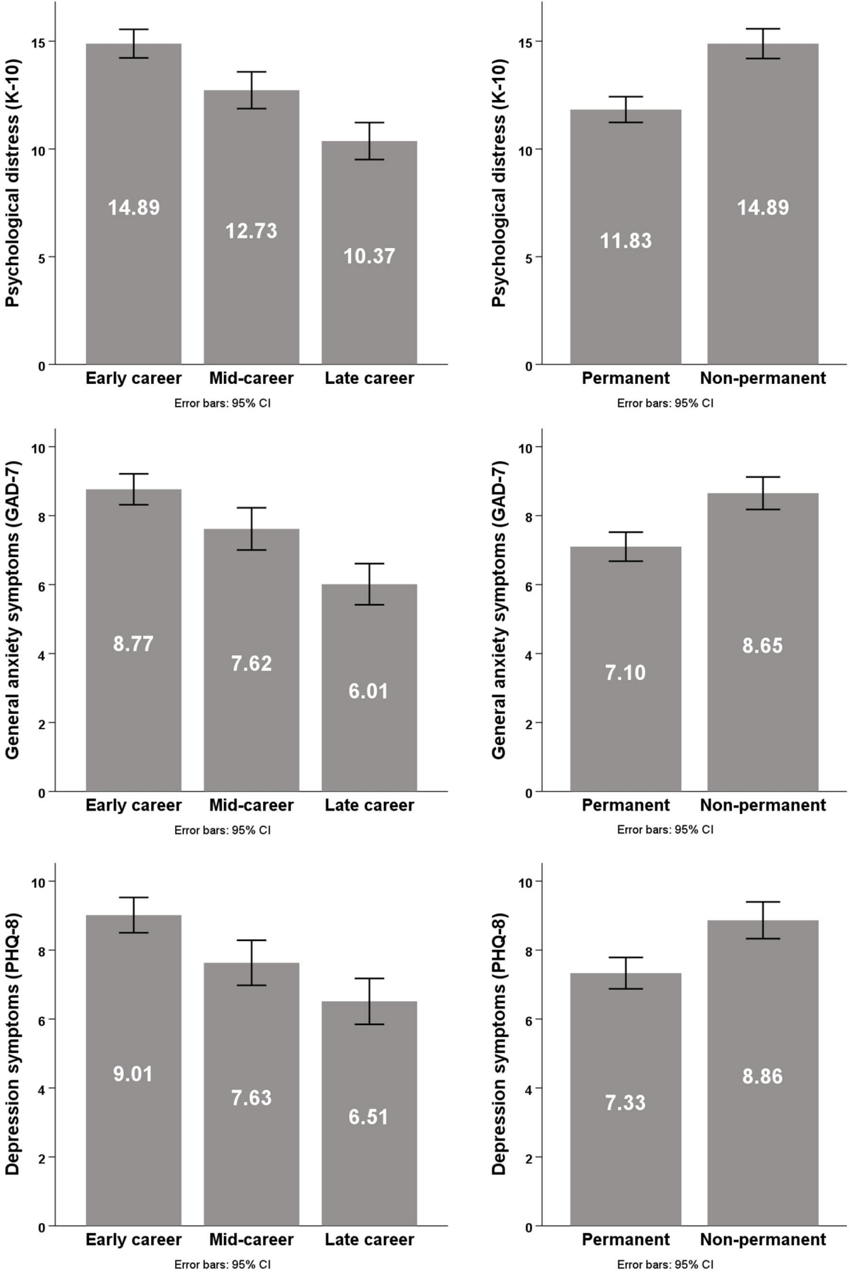
Studies point to a significantly higher prevalence of mental health issues among academics compared to most other working populations. However, we know relatively little about the situation within the field of media and communication studies. Based on an international survey of 1028 researchers within this field, we found mental health issues to be widespread. Early career researchers, women, and those in nonpermanent positions were significantly more strongly affected by these issues than scholars in later career stages, men, and those in permanent employment. Academics in our field worry most about structural aspects of their work, most notably about publication pressure and future career prospects. We argue that while our findings are somewhat aligned with results from or across other fields, they are still worrisome. We thus argue for the need to start a conversation about how to reduce the mental burden, especially for young and early career researchers.
Overview
The claims and statistics of this paper haven’t been checked yet.
Run the check — free, no account needed. It reads the open-access text and checks the sources it cites.
Integrity signals
Registry
Cites
Statistics
Figures
Verification
Claims the paper makes
The claims and statistics of this paper haven’t been checked yet.
Run the check — free, no account needed. It reads the open-access text and checks the sources it cites.
Claims other papers make about this one
Each is checked against this paper’s own text: does it say what the citing paper says it does?
In the citing paper
“The most frequently cited systemic factor is the mismatch between the growing number of PhD graduates and the comparatively limited number of permanent positions in academia4,40,66–68.”
From Prevalence and severity of mental health problems in early-career researchers: a systematic review and meta-analysis (2026) · cites this paper as [68]
In the citing paper
“These shifts incentivize research that is safe, short-term and likely to generate high citation counts, while discouraging riskier, long-term or niche projects4,68,73,74.”
From Prevalence and severity of mental health problems in early-career researchers: a systematic review and meta-analysis (2026) · cites this paper as [68]
In the citing paper
“Second, postdoctoral ECRs made up less than 3% of the overall sample5,52,57,66,68,87–93, yet they face slightly different challenges than doctoral students, and thus, more research should be dedicated to this group.”
From Prevalence and severity of mental health problems in early-career researchers: a systematic review and meta-analysis (2026) · cites this paper as [68]
Self-check
Percentages, sums and reported differences re-computed from the paper’s own numbers.
The self-check needs the paper’s full text.
Citations
Cites
Job Demands, Job Decision Latitude, and Mental Strain: Implications for Job Redesign
Karasek, R. A. (1979) · Administrative Science Quarterly · doi:10.2307/2392498 · Cited by 12,597
Job demands–resources theory: Taking stock and looking forward.
Bakker, A. B., & Demerouti, E. (2017) · Journal of Occupational Health Psychology · doi:10.1037/ocp0000056 · Cited by 6,979
The global prevalence of common mental disorders: a systematic review and meta-analysis 1980–2013
Steel, Z., Marnane, C., Iranpour, C., Chey, T., Jackson, J. W., Patel, V., & Silove, D. (2014) · International Journal of Epidemiology · doi:10.1093/ije/dyu038 · Cited by 2,846
An empirical examination of self-reported work stress among U.S. managers.
Cavanaugh, M. A., Boswell, W. R., Roehling, M. V., & Boudreau, J. W. (2000) · Journal of Applied Psychology · doi:10.1037/0021-9010.85.1.65 · Cited by 2,154
Interpreting scores on the Kessler Psychological Distress Scale (K10)
Andrews, G., & Slade, T. (2001) · Australian and New Zealand Journal of Public Health · doi:10.1111/j.1467-842x.2001.tb00310.x · Cited by 2,021
The World Mental Health Report: Transforming mental health for all
Freeman, M. (2022) · World Psychiatry · doi:10.1002/wps.21018 · Cited by 1,472
Evidence for a mental health crisis in graduate education
Evans, T. M., Bira, L., Gastelum, J. B., Weiss, L. T., & Vanderford, N. L. (2018) · Nature Biotechnology · doi:10.1038/nbt.4089 · Cited by 1,441
Meier, A., & Reinecke, L. (2021) · Communication Research · doi:10.1177/0093650220958224 · Cited by 534
Intended and unintended consequences of a publish‐or‐perish culture: A worldwide survey
van Dalen, H. P., & Henkens, K. (2012) · Journal of the American Society for Information Science and Technology · doi:10.1002/asi.22636 · Cited by 355
Understanding persons with psychological distress in primary health care
Arvidsdotter, T., Marklund, B., Kylén, S., Taft, C., & Ekman, I. (2016) · Scandinavian Journal of Caring Sciences · doi:10.1111/scs.12289 · Cited by 268
Research works printed but not linked: 54
- Anderson, 2007, The perverse effects of competition on scientists’ work and relationships, Science and Engineering Ethics, 13, 437, 10.1007/s11948-007-9042-5 · DOI · Paper page
- Bakker, 2004, Using the job demands-resources model to predict burnout and performance, Human Resource Management, 43, 83, 10.1002/hrm.20004 · DOI · Paper page
- Bira, 2019, Mental health in academia: An invisible crisis, Physiology News, 115(Summer 2019), 32, 10.36866/pn.115.32 · DOI
- Bourgeault, 2021, Mental health in academia: The challenges faculty face predate the pandemic and require systemic solutions, Academic Matters, Fall, 2021
- Bradbury, 2020, Mental health stigma: The impact of age and gender on attitudes, Community Mental Health Journal, 56, 933, 10.1007/s10597-020-00559-x · DOI
- Cox, 2010, Occupational health psychology, 31
- Daly, 2022, Prevalence of psychological distress among working-age adults in the United States, 1999–2018, American Journal of Public Health, 112, 1045, 10.2105/AJPH.2022.306828 · DOI
- Dawson, 2016, The role of hindrance stressors in the job demand-control-support model of occupational stress: A proposed theory revision, Journal of Organizational Behavior, 37, 397, 10.1002/job.2049 · DOI
- Demerouti, 2001, The job demands resources model of burnout, Journal of Applied Psychology, 86, 499, 10.1037/0021-9010.86.3.499 · DOI · Paper page
- Eriksson, 2017, The false academy: Predatory publishing in science and bioethics, Medicine, Health Care, and Philosophy, 20, 163, 10.1007/s11019-016-9740-3 · DOI
- Flatt, 2017, Improving the Measurement of Scientific Success by Reporting a Self-Citation Index, Publications, 5, 20, 10.3390/publications5030020 · DOI
- Ford, 2011, Relationships between psychological, physical, and behavioural health and work performance: A review and meta-analysis, Work & Stress, 25, 185, 10.1080/02678373.2011.609035 · DOI
- Gao, 2021, Potentially long-lasting effects of the pandemic on scientists, Nature Communications, 12, 6188, 10.1038/s41467-021-26428-z · DOI
- Gewin, 2021, Pandemic burnout is rampant in academia, Nature, 591, 489, 10.1038/d41586-021-00663-2 · DOI · Paper page
- Guthrie, 2018, Understanding mental health in the research environment: A rapid evidence assessment, Rand Health Quarterly, 7, 2
- Hall, 2023, A mental-health crisis is gripping science–toxic research culture is to blame, Nature, 617, 666, 10.1038/d41586-023-01708-4 · DOI
- Hazell, 2021, Nationwide assessment of the mental health of UK Doctoral Researchers, Humanities and Social Sciences Communications, 8, a305 1, 10.1057/s41599-021-00983-8 · DOI · Paper page
- Hayton, 2012, With a little help from my colleagues: A social embeddedness approach to perceived organizational support, Journal of Organizational Behavior, 33, 235, 10.1002/job.755 · DOI
- Horton, 2014, Disabilities in academic workplaces: Experiences of human and physical geographers, Transactions of the Institute of British Geographers, 39, 76, 10.1111/tran.12009 · DOI
- Johnson, 1988, Job strain, workplace social support and cardiovascular disease: A cross sectional study of a random sample of the Swedish working population, American Journal of Public Health, 78, 1336, 10.2105/AJPH.78.10.1336 · DOI
- Jolly, 2021, Social support at work: An integrative review, Journal of Organizational Behavior, 42, 229, 10.1002/job.2485 · DOI · Paper page
- Karasek, 1998, The Job Content Questionnaire (JCQ): An instrument for internationally comparative assessments of psychosocial job characteristics, Journal of Occupational Health Psychology, 3, 322, 10.1037/1076-8998.3.4.322 · DOI
- Kessler, 2002, Short screening scales to monitor population prevalences and trends in non-specific psychological distress, Psychological Medicine, 32, 959, 10.1017/S0033291702006074 · DOI · Paper page
- Kinman, 2001, Pressure points: A review of research on stressors and strains in UK academics, Educational Psychology, 21, 473, 10.1080/01443410120090849 · DOI · Paper page
- Kinman, 2008, A life beyond work? Job demands, work-life balance, and well-being in UK academics, Journal of Human Behavior in the Social Environment, 17, 41, 10.1080/10911350802165478 · DOI
- Kinman, 2020, Handbook of research on stress and well-being in the public sector, 152
- Kroenke, 2009, The PHQ-8 as a measure of current depression in the general population, Journal of Affective Disorders, 114, 163, 10.1016/j.jad.2008.06.026 · DOI · Paper page
- Lavin, 2020, Normalizing deviants: Notes on the de-stigma trend, Deviant Behavior, 41, 828, 10.1080/01639625.2020.1763108 · DOI
- Lazarus, 1984, Stress, appraisal, and coping
- LePine, 2004, Challenge and hindrance stress: Relationships with exhaustion, motivation to learn, and learning performance, The Journal of Applied Psychology, 89, 883, 10.1037/0021-9010.89.5.883 · DOI
- Loissel, 2020, Mental health in academia: Shedding light on those who provide support, eLife, 9, e64739, 10.7554/eLife.64739 · DOI
- Meeks, 2021, Depression, anxiety, and stress among students, faculty, and staff, Journal of American College Health, 71, 348, 10.1080/07448481.2021.1891913 · DOI
- de Meis, 2003, The growing competition in Brazilian science: Rites of passage, stress and burnout, Brazilian Journal of Medical and Biological Research, 36, 1135, 10.1590/S0100-879X2003000900001 · DOI
- Mudrak, 2018, Occupational well-being among university faculty: A job demands-resources model, Research in Higher Education, 59, 325, 10.1007/s11162-017-9467-x · DOI
- Ogbonna, 2004, Work intensification and emotional labour among UK university lecturers: An exploratory study, Organization Studies, 25, 1185, 10.1177/0170840604046315 · DOI
- Padilla, 2016, Burning out faculty at doctoral research universities, Stress and Health, 32, 551, 10.1002/smi.2661 · DOI
- Pujol-Cols, 2018, Psychosocial risks and job satisfaction in Argentinian scholars: Exploring the moderating role of work engagement, Revista de Psicología del Trabajo y de las Organizaciones, 34, 145
- Ryan, 2017, Self-determination theory: Basic psychological needs in motivation, development, and wellness, 10.1521/978.14625/28806 · DOI · Paper page
- Satinsky, 2021, Systematic review and meta-analysis of depression, anxiety, and suicidal ideation among Ph.D. students, Scientific Reports, 11, 14370, 10.1038/s41598-021-93687-7 · DOI · Paper page
- Smith, 2020, Who cares for academics? We need to talk about emotional well-being including what we avoid and intellectualise through macro-discourses, Organization, 27, 840, 10.1177/1350508419867201 · DOI
- Spitzer, 2006, A brief measure for assessing generalized anxiety disorder: The GAD-7, Archives of Internal Medicine, 166, 1092, 10.1001/archinte.166.10.1092 · DOI · Paper page
- Syrek, 2011, Entwicklung und Validierung der Trierer Kurzskala zur Messung von Work-Life Balance (TKS-WLB), Diagnostica, 57, 134, 10.1026/0012-1924/a000044 · DOI
- Tijdink, 2013, Publication pressure and burn out among dutch medical professors: A nationwide survey, PLoS One, 8, e73381, 10.1371/journal.pone.0073381 · DOI
- Torpy, 2011, Generalized anxiety disorder, JAMA, 305, 522, 10.1001/jama.305.5.522 · DOI
- Urbina-Garcia, 2020, What do we know about university academics' mental health? A system-atic literature review, Stress and Health, 36, 563, 10.1002/smi.2956 · DOI
- Viertiö, 2021, Factors contributing to psychological distress in the working population, with a special reference to gender difference, BMC Public Health, 21, 611, 10.1186/s12889-021-10560-y · DOI
- Voorspoels, 2021, Positive screens for mental disorders among healthcare professionals during the first covid19 wave in Belgium, Journal of Psychiatric Research, 140, 329, 10.1016/j.jpsychires.2021.05.024 · DOI
- Watts, 2011, Burnout in university teaching staff: a systematic literature review, Educational Research, 53, 33, 10.1080/00131881.2011.552235 · DOI
- Winefield, 2003, Occupational stress in Australian university staff: Results from a national survey, International Journal of Stress Management, 10, 51, 10.1037/1072-5245.10.1.51 · DOI · Paper page
- Winefield, 2008, Update on national university stress study, Australian Universities’ Review, 50, 20
- Woolston, 2019, PhDs: The tortuous truth, Nature, 575, 403, 10.1038/d41586-019-03459-7 · DOI · Paper page
- Woolston, 2021, Stagnating salaries present hurdles to career satisfaction, Nature, 599, 519, 10.1038/d41586-021-03041-0 · DOI
- Wong, 2018, Effects of contact-based mental illness stigma reduction programs: Age, gender, and Asian, Latino, and White American differences, Social Psychiatry and Psychiatric Epidemiology, 53, 299, 10.1007/s00127-017-1459-9 · DOI
- Wray, 2022, The psychosocial hazards of academic work: an analysis of trends, Studies in Higher Education, 47, 771, 10.1080/03075079.2020.1793934 · DOI
Cited by
Sorted by citations
Dreisoerner, A., Goetz, V., Frohnmayer, D., Tran, U. S., Voracek, M., & Nater, U. M. (2026) · Nature Human Behaviour · doi:10.1038/s41562-026-02505-5 · Cited by 2
Metadata
- Authors
- Hanitzsch, T., Markiewitz, A., & Bødker, H.
- Venue
- Journal of Communication
- Publisher
- Oxford University Press (OUP)
- Published
- 2024-03-05
- Volume
- 74
- Issue
- 6
- Pages
- 429-442
- ISSN
- 0021-9916
- 1460-2466
- Cited by
- 20
- References
- 11
- Language
- en
About these checks
Registry, retraction, Cites and statistics results are computed, not judged, with one exception: a printed reference that no index lists is read once by a model before it counts as a citation error. Claims are extracted by a model and kept only when their quote appears verbatim in the text; each cited source is then checked, with a model’s help, for whether it says what the claim relies on. Those verdicts can be wrong — read the claim’s quote and the cited source before relying on one.
Statistics and arithmetic are recomputed, not judged.
Confidence bands are shown only for fields calibrated on our annotated test set. None is calibrated yet, so no band is shown.
What counts as a claim ›How we measure confidence ›How we check this ›
Are you an author, or do you see a problem with this page? Request a review
