

CMB power spectra and cosmological parameters from Planck PR4 with CamSpec
Open accessThe DOI matches its Crossref record; 46 of the 46 references it cites were found in a registry or an index.
Abstract
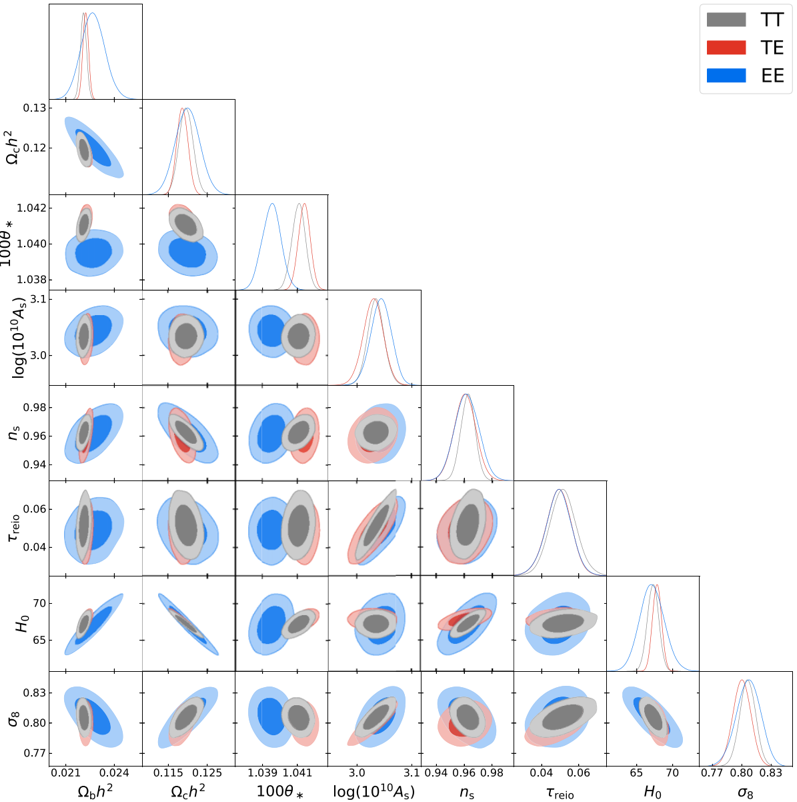
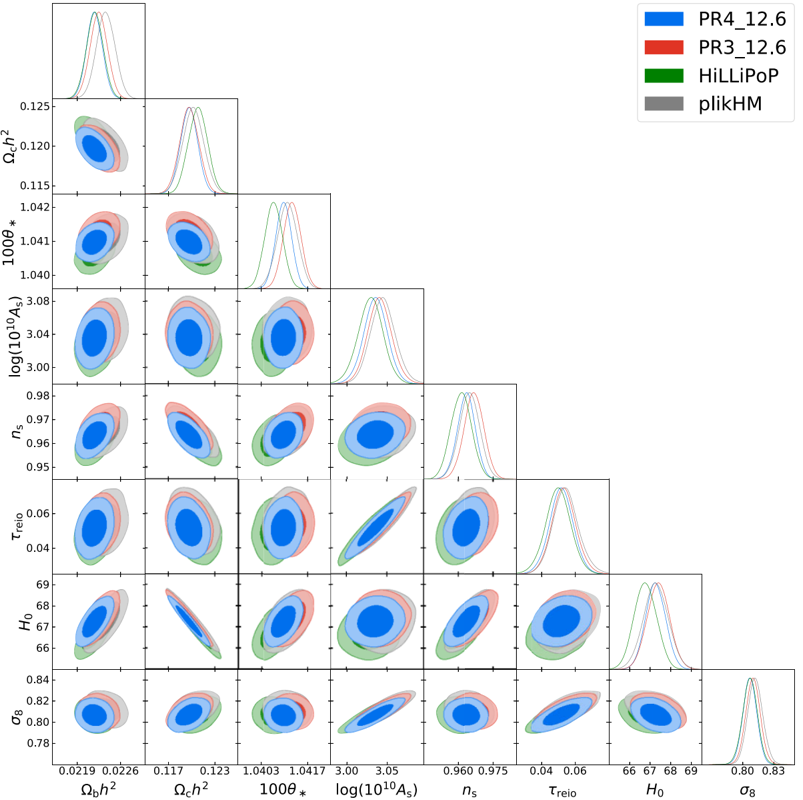
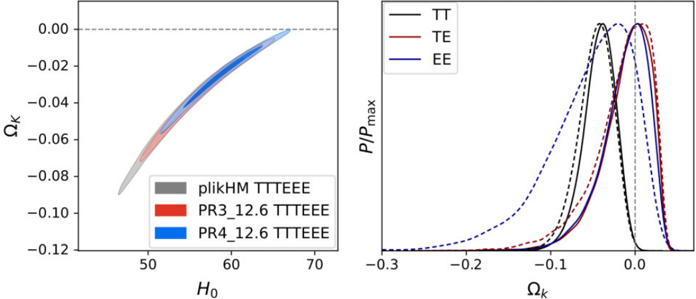
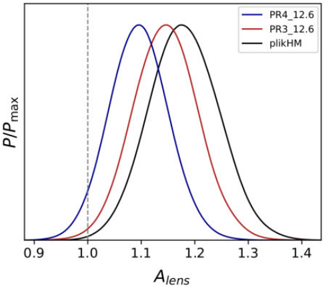
We present angular power spectra and cosmological parameter constraints derived from the Planck PR4 (NPIPE) maps of the cosmic microwave background. NPIPE, released by the Planck Collaboration in 2020, is a new processing pipeline for producing calibrated frequency maps from Planck data. We have created new versions of the CamSpec likelihood using these maps and applied them to constrain the lambda cold dark matter (ΛCDM) model and single-parameter extensions. We find excellent consistency between NPIPE and the Planck 2018 maps at the parameter level, showing that the Planck cosmology is robust to substantial changes in the mapmaking. The lower noise of NPIPE leads to ~10 per cent tighter constraints, and we see both smaller error bars and a shift towards the ΛCDM values for beyond-ΛCDM parameters including ΩK and AL.
Overview
The claims and statistics of this paper haven’t been checked yet.
Free: it reads the open-access text and checks the first 5 claims that cite a source we can check. Create a free account to check every claim.
Integrity signals
Registry
Cites
Statistics
Figures
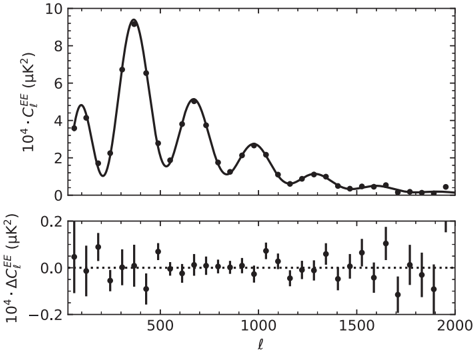
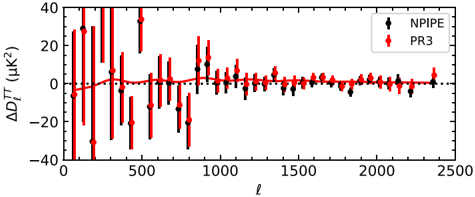
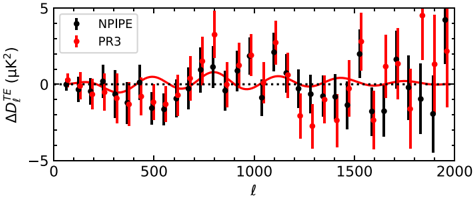
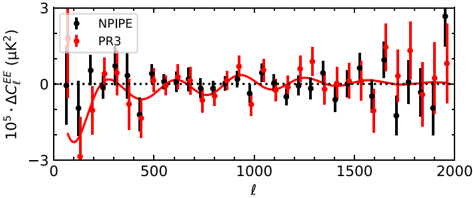
Verification
Claims the paper makes
The claims and statistics of this paper haven’t been checked yet.
Free: it reads the open-access text and checks the first 5 claims that cite a source we can check. Create a free account to check every claim.
Claims other papers make about this one
Each is checked against this paper’s own text: does it say what the citing paper says it does?
The source backs part of the claim, not all of it — or backs it for a different population, condition or comparison.
In the citing paper
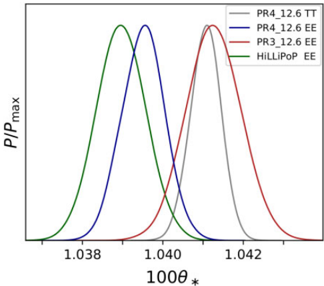
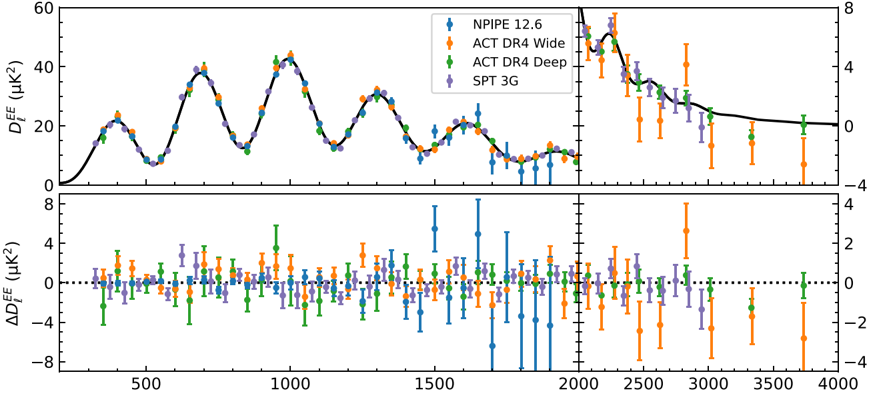
“the reduction of its significance is due to the modification of the EE power spectrum, which is shifting all the parameters towards ΛCDM.”
From Challenges of the Standard Cosmological Model (2022) · cites this paper as [81]
Experimental — accuracy not yet measuredThe source backs part of the claim, not all of it — or backs it for a different population, condition or comparison.
In the citing paper
“a tension at more than 3σ between TT and EE”
From Challenges of the Standard Cosmological Model (2022) · cites this paper as [81]
Experimental — accuracy not yet measuredThe source backs part of the claim, not all of it — or backs it for a different population, condition or comparison.
In the citing paper
“this change in EE is also producing a significant shift in the acoustic scale parameter θ (see Figure 15 of Ref. [81])”
From Challenges of the Standard Cosmological Model (2022) · cites this paper as [81]
Experimental — accuracy not yet measuredThe cited source says what the claim attributes to it.
In the citing paper
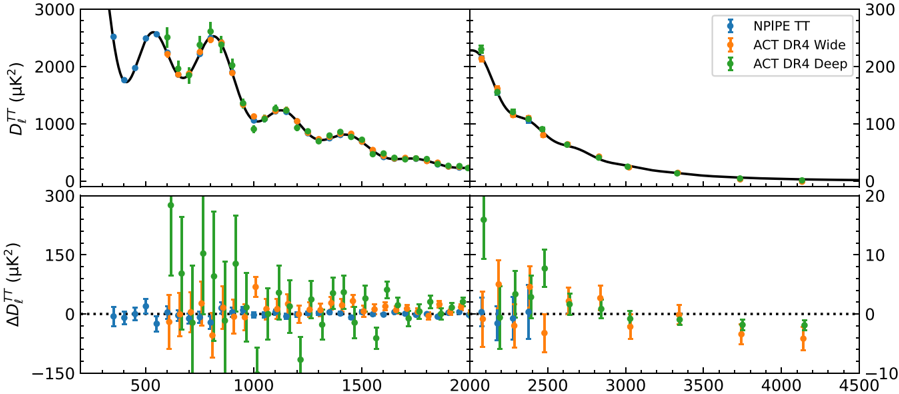
“looking at Table 6 of Ref. [81], it is clear that the significance of Ω k < 0 from the temperature power spectrum is mostly unchanged for the new PR4 release with CamSpec.”
From Challenges of the Standard Cosmological Model (2022) · cites this paper as [81]
The cited source says what the claim attributes to it.
In the citing paper
“looking at Table 6 of Ref. [81], it is clear that the problem in the temperature power spectrum is not solved and the significance of A lens > 1 is unchanged for this probe”
From Challenges of the Standard Cosmological Model (2022) · cites this paper as [81]
2 more claims about this paper
Create a free account to see every claim other papers make about this one.
Self-check
Percentages, sums and reported differences re-computed from the paper’s own numbers.
The self-check needs the paper’s full text.
Citations
Cites
Matplotlib: a 2D graphics environment
Hunter, J. D. (2007) · Computing in Science & Engineering · doi:10.1109/mcse.2007.55 · Cited by 39,249
SciPy 1.0: fundamental algorithms for scientific computing in Python
Virtanen, P., Gommers, R., Oliphant, T. E., Haberland, M., Reddy, T., Cournapeau, D., Burovski, E., Peterson, P., Weckesser, W., Bright, J., et al. (2020) · Nature Methods · doi:10.1038/s41592-019-0686-2 · Cited by 38,430
Harris, C. R., Millman, K. J., van der Walt, S. J., Gommers, R., Virtanen, P., Cournapeau, D., Wieser, E., Taylor, J., Berg, S., Smith, N. J., et al. (2020) · Nature · doi:10.1038/s41586-020-2649-2 · Cited by 23,826
Harris, C., Millman, K., van der Walt, S., Gommers, R., Virtanen, P., Cournapeau, D., Wieser, E., Taylor, J., Berg, S., Smith, N., et al. (2020) · RePEc: Research Papers in Economics · Cited by 17,844
Astropy: A community Python package for astronomy
The Astropy Collaboration, Robitaille, T. P., Tollerud, E. J., Greenfield, P., Droettboom, M., Bray, E., Aldcroft, T., Davis, M., Ginsburg, A., Price-Whelan, A. M., et al. (2013) · Astronomy & Astrophysics · doi:10.1051/0004-6361/201322068 · Cited by 14,620
Planck 2018 results: VI. Cosmological parameters
Planck Collaboration, Aghanim, N., Akrami, Y., Ashdown, M., Aumont, J., Baccigalupi, C., Ballardini, M., Banday, A. J., Barreiro, R. B., Bartolo, N., et al. (2020) · Astronomy & Astrophysics · doi:10.1051/0004-6361/201833910 · Cited by 14,258
Self-citationSciPy 1.0: fundamental algorithms for scientific computing in Python
Virtanen, P., Gommers, R., Oliphant, T. E., Haberland, M., Reddy, T., Cournapeau, D., Burovski, E., Peterson, P., Weckesser, W., Bright, J., et al. (2019) · Apollo - University of Cambridge Repository · doi:10.17863/cam.64134 · Cited by 10,460
The Astropy Project: Building an Open-science Project and Status of the v2.0 Core Package*
The Astropy Collaboration, Price-Whelan, A. M., Sipőcz, B. M., Günther, H. M., Lim, P. L., Crawford, S. M., Conseil, S., Shupe, D. L., Craig, M. W., Dencheva, N., et al. (2018) · The Astronomical Journal · doi:10.3847/1538-3881/aabc4f · Cited by 7,687
Gorski, K. M., Hivon, E., Banday, A. J., Wandelt, B. D., Hansen, F. K., Reinecke, M., & Bartelmann, M. (2005) · The Astrophysical Journal · doi:10.1086/427976 · Cited by 5,958
Lewis, A., Challinor, A., & Lasenby, A. (2000) · The Astrophysical Journal · doi:10.1086/309179 · Cited by 4,920
Research works printed but not linked: 4
- Cartis C., Fiala J., Marteau B., Roberts L., 2018a, preprint ( arXiv:1804.00154 ) · arXiv
- Dutcher D. et al., 2021, Phys. Rev. D, 104, 022003
- Handley W., Lemos P., 2021, Phys. Rev. D, 103, 063529
- Tristram, 2022, Phys. Rev. D, 083524
Cited by
DESI 2024 VI: cosmological constraints from the measurements of baryon acoustic oscillations
Adame, A. G., Aguilar, J., Ahlen, S., Alam, S., Alexander, D. M., Alvarez, M., Alves, O., Anand, A., Andrade, U., Armengaud, E., et al. (2025) · Journal of Cosmology and Astroparticle Physics · doi:10.1088/1475-7516/2025/02/021 · Cited by 1,136
DESI DR2 results. II. Measurements of baryon acoustic oscillations and cosmological constraints
Abdul Karim, M., Aguilar, J., Ahlen, S., Alam, S., Allen, L., Prieto, C. A., Alves, O., Anand, A., Andrade, U., Armengaud, E., et al. (2025) · Physical Review D · doi:10.1103/tr6y-kpc6 · Cited by 856
The Atacama Cosmology Telescope: DR6 Gravitational Lensing Map and Cosmological Parameters
Madhavacheril, M. S., Qu, F. J., Sherwin, B. D., MacCrann, N., Li, Y., Abril-Cabezas, I., Ade, P. A. R., Aiola, S., Alford, T., Amiri, M., et al. (2024) · The Astrophysical Journal · doi:10.3847/1538-4357/acff5f · Cited by 354
“It should be noted that this preference for negative curvature weakens in the recent Planck NPIPE re-analysis of CMB anisotropies (Rosenberg et al. 2022).”
BackgroundMethodDi Valentino, E., Said, J. L., Riess, A., Pollo, A., Poulin, V., Gómez-Valent, A., Weltman, A., Palmese, A., Huang, C. D., Bruck, C. V. D., et al. (2025) · Physics of the Dark Universe · doi:10.1016/j.dark.2025.101965 · Cited by 319
CMB lensing from Planck PR4 maps
Carron, J., Mirmelstein, M., & Lewis, A. (2022) · Journal of Cosmology and Astroparticle Physics · doi:10.1088/1475-7516/2022/09/039 · Cited by 288
Metadata
- Authors
- Rosenberg, E., Gratton, S., & Efstathiou, G.
- Affiliations
- University of Cambridge (GB)
- Corresponding author
- Rosenberg, Erik
- Venue
- Monthly Notices of the Royal Astronomical Society
- Publisher
- Oxford University Press (OUP)
- Published
- 2022-09-26
- Volume
- 517
- Issue
- 3
- Pages
- 4620-4636
- ISSN
- 0035-8711 (ISSN-L)
- 1365-2966
- OpenAlex
- W4297302508
- Cited by
- 225
- References
- 43
- Citations by year
- 2026: 70 · 2025: 101 · 2024: 36 · 2023: 14 · 2022: 4
- FWCI
- 15.60
- Type
- journal article
- Language
- en
- Open access
- hybrid
- doi.org
- Licence
- Locations
- Monthly Notices of the Royal Astronomical Society (publishedVersion, cc-by)
- arXiv (Cornell University) (acceptedVersion)
- Apollo (University of Cambridge) (submittedVersion, cc-by)
- OSTI OAI (U.S. Department of Energy Office of Scientific and Technical Information) (submittedVersion)
- arXiv (Cornell University)
- Apollo (cc-by)
- Funders
- University of Cambridge
- Engineering and Physical Sciences Research Council (EP/T022159/1)
- Science and Technology Facilities Council
- National Energy Research Scientific Computing Center
- U.S. Department of Energy
- Office of Science
- Lawrence Berkeley National Laboratory (DE-AC02-05CH11231)
- Topics
- Physical Sciences › Physics and Astronomy › Astronomy and Astrophysics › Cosmology and Gravitation Theories
- Physical Sciences › Physics and Astronomy › Nuclear and High Energy Physics › Dark Matter and Cosmic Phenomena
- Physical Sciences › Physics and Astronomy › Astronomy and Astrophysics › Galaxies: Formation, Evolution, Phenomena
- Keywords
- cosmic microwave background, angular power spectrum, cosmological parameter constraints, Planck PR4, LambdaCDM model, dark energy equation of state
About these checks
Registry, retraction, Cites and statistics results are computed, not judged, with one exception: a printed reference that no index lists is read once by a model before it counts as a citation error. Claims are extracted by a model and kept only when their quote appears verbatim in the text; each cited source is then checked, with a model’s help, for whether it says what the claim relies on. Those verdicts can be wrong — read the claim’s quote and the cited source before relying on one.
Statistics and arithmetic are recomputed, not judged.
Confidence bands are shown only for fields calibrated on our annotated test set. None is calibrated yet, so no band is shown.
What counts as a claim ›How we measure confidence ›How we check this ›
Are you an author, or do you see a problem with this page? Request a review
How to cite
Cite CoChat for the checks on this page, and the paper for its own findings.
- This page
- CoChat. (2026). Citation check: CMB power spectra and cosmological parameters from Planck PR4 with CamSpec. https://app.cochat.ai/papers/10.1093/mnras/stac2744
- The paper
- Rosenberg, E., Gratton, S., & Efstathiou, G. (2022). CMB power spectra and cosmological parameters from Planck PR4 with CamSpec. Monthly Notices of the Royal Astronomical Society. https://doi.org/10.1093/mnras/stac2744
Data sources
Bibliographic data: Semantic Scholar, OpenAlex, Crossref.
Contains information from the Semantic Scholar Academic Graph Datasets, made available under the ODC Attribution License (ODC-BY 1.0).
Semantic Scholar’s data is described in: Kinney, R., et al. (2023). The Semantic Scholar Open Data Platform. arXiv:2301.10140.
