

New Phylogenomic Analysis of the Enigmatic Phylum Telonemia Further Resolves the Eukaryote Tree of Life
Open accessPublished version of a preprint
The DOI matches its Crossref record; 62 of the 62 references it cites were found in a registry or an index.
Abstract
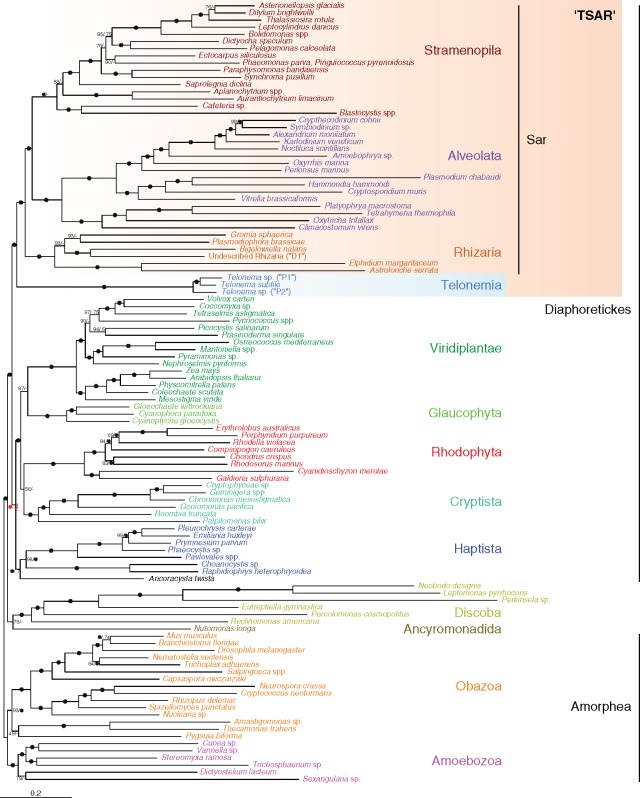
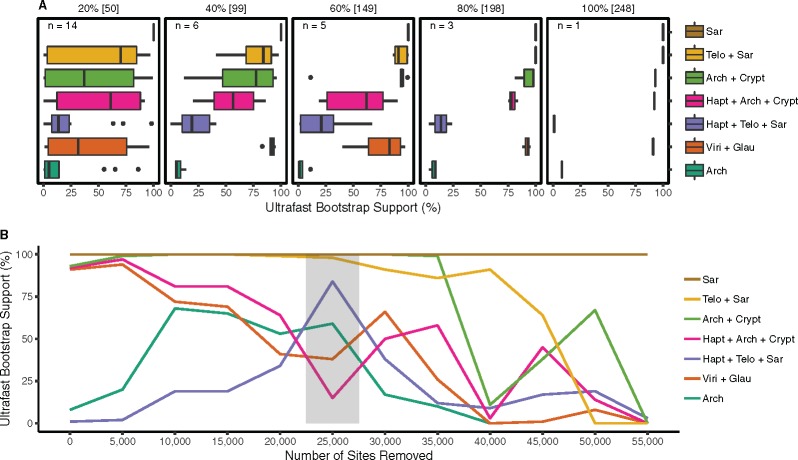
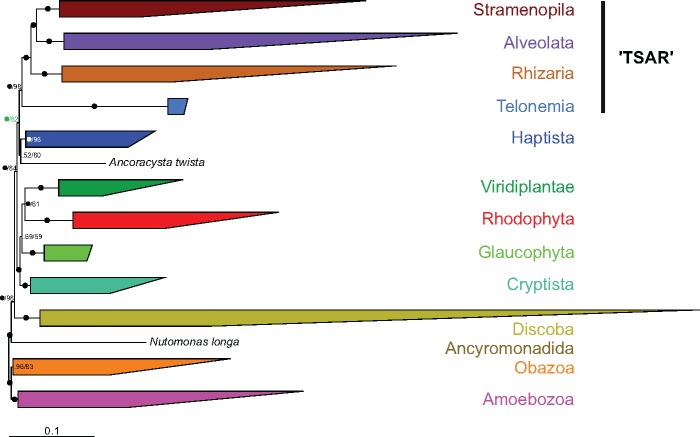
The resolution of the broad-scale tree of eukaryotes is constantly improving, but the evolutionary origin of several major groups remains unknown. Resolving the phylogenetic position of these “orphan” groups is important, especially those that originated early in evolution, because they represent missing evolutionary links between established groups. Telonemia is one such orphan taxon for which little is known. The group is composed of molecularly diverse biflagellated protists, often prevalent although not abundant in aquatic environments. Telonemia has been hypothesized to represent a deeply diverging eukaryotic phylum but no consensus exists as to where it is placed in the tree. Here, we established cultures and report the phylogenomic analyses of three new transcriptome data sets for divergent telonemid lineages. All our phylogenetic reconstructions, based on 248 genes and using site-heterogeneous mixture models, robustly resolve the evolutionary origin of Telonemia as sister to the Sar supergroup. This grouping remains well supported when as few as 60% of the genes are randomly subsampled, thus is not sensitive to the sets of genes used but requires a minimal alignment length to recover enough phylogenetic signal. Telonemia occupies a crucial position in the tree to examine the origin of Sar, one of the most lineage-rich eukaryote supergroups. We propose the moniker “TSAR” to accommodate this new mega-assemblage in the phylogeny of eukaryotes.
Overview
The claims and statistics of this paper haven’t been checked yet.
Free: it reads the open-access text and checks the first 5 claims that cite a source we can check. Create a free account to check every claim.
Integrity signals
Registry
Cites
Statistics
Figures
Verification
Claims the paper makes
The claims and statistics of this paper haven’t been checked yet.
Free: it reads the open-access text and checks the first 5 claims that cite a source we can check. Create a free account to check every claim.
Claims other papers make about this one
Each is checked against this paper’s own text: does it say what the citing paper says it does?
The source backs part of the claim, not all of it — or backs it for a different population, condition or comparison.
In the citing paper
“Recent large-scale phylogenomic studies of nuclear genes place haptophytes and the heterotrophic centrohelids together (Haptista) as sister to the SAR assemblage (stramenopiles, alveolates, and rhizarians), whereas Cryptista (to which cryptophytes belong) branches completely separate in a highly supported relationship with Archaeplastida (e.g., Burki et al. 2016; Strassert et al. 2019).”
From Genomic Insights into Plastid Evolution (2020) · cites this paper as Strassert et al. 2019
Experimental — accuracy not yet measuredThe cited source says what the claim attributes to it.
In the citing paper
“However, given our current understanding of the structure of the eukaryotic tree of life (e.g., Burki et al. 2016; Strassert et al. 2019), the chromalveolate hypothesis is unparsimonious in the sense that it requires extensive plastid loss in numerous, phylogenetically intervening, heterotrophic lineages (fig. 1; see below).”
From Genomic Insights into Plastid Evolution (2020) · cites this paper as Strassert et al. 2019
The cited source says what the claim attributes to it.
In the citing paper
“With phylogenomics, the deep structure of the eukaryotic tree of life has become ever more resolved (e.g., Strassert et al. 2019; Burki et al. 2020; fig. 1), thereby providing a framework for mapping plastid gains and losses across the tree.”
From Genomic Insights into Plastid Evolution (2020) · cites this paper as Strassert et al. 2019
Self-check
Percentages, sums and reported differences re-computed from the paper’s own numbers.
The self-check needs the paper’s full text.
Citations
Cites
Trimmomatic: a flexible trimmer for Illumina sequence data
Bolger, A. M., Lohse, M., & Usadel, B. (2014) · Bioinformatics · doi:10.1093/bioinformatics/btu170 · Cited by 65,548 · cited 2×
“Reads were trimmed with Trimmomatic v. 0.36 (Bolger et al. 2014) using the following parameters: LEADING:5, TRAILING:5, SLIDINGWINDOW:5:16, MINLEN:80.”
MethodInfluentialMAFFT Multiple Sequence Alignment Software Version 7: Improvements in Performance and Usability
Katoh, K., & Standley, D. M. (2013) · Molecular Biology and Evolution · doi:10.1093/molbev/mst010 · Cited by 46,209
RAxML version 8: a tool for phylogenetic analysis and post-analysis of large phylogenies
Stamatakis, A. (2014) · Bioinformatics · doi:10.1093/bioinformatics/btu033 · Cited by 32,291 · cited 2×
“FastTree v. 2.1.10 (Price et al. 2010) employing -lg -gamma plus options for more accurate performances (first round) and RAxML v. 8.2.10 (Stamatakis 2014) employing PROTGAMMALGF and 100 rapid bootstrap searches (second and third round) were used to infer single gene Maximum Likelihood (ML) trees.”
MethodInfluentialIQ-TREE: A Fast and Effective Stochastic Algorithm for Estimating Maximum-Likelihood Phylogenies
Nguyen, L.-T., Schmidt, H. A., von Haeseler, A., & Minh, B. Q. (2015) · Molecular Biology and Evolution · doi:10.1093/molbev/msu300 · Cited by 26,046
FastTree 2 – Approximately Maximum-Likelihood Trees for Large Alignments
Price, M. N., Dehal, P. S., & Arkin, A. P. (2010) · PLoS ONE · doi:10.1371/journal.pone.0009490 · Cited by 14,894 · cited 1×
“10 (Price et al. 2010) employing -lg -gamma plus options for more accurate performances (first round) and RAxML v.”
MethodtrimAl: a tool for automated alignment trimming in large-scale phylogenetic analyses
Capella-Gutiérrez, S., Silla-Martínez, J. M., & Gabaldón, T. (2009) · Bioinformatics · doi:10.1093/bioinformatics/btp348 · Cited by 12,751
Cd-hit: Accelerated for clustering the next-generation sequencing data
Fu, L., Niu, B., Zhu, Z., Wu, S., & Li, W. (2012) · Bioinformatics · doi:10.1093/bioinformatics/bts565 · Cited by 11,175 · cited 1×
“com): 1) Protein sequences for each taxon were clustered with CDHIT (Fu et al. 2012) using an identity threshold of 85%; 2) Homologous copies were retrieved by BLASTP searches using the 263 genes as queries (e-value: 1e-20; coverage cutoff: 0.”
MethodUFBoot2: Improving the Ultrafast Bootstrap Approximation
Hoang, D. T., Chernomor, O., von Haeseler, A., Minh, B. Q., & Vinh, L. S. (2018) · Molecular Biology and Evolution · doi:10.1093/molbev/msx281 · Cited by 10,881 · cited 1×
“Each sub-data set was again used in ML tree reconstruction (LGþC60þFþC4 model) with UFBoot approximation (Hoang et al. 2018).”
MethodHaas, B. J., Papanicolaou, A., Yassour, M., Grabherr, M., Blood, P. D., Bowden, J., Couger, M. B., Eccles, D., Li, B., Lieber, M., et al. (2013) · Nature Protocols · doi:10.1038/nprot.2013.084 · Cited by 8,464
Ultrafast Approximation for Phylogenetic Bootstrap
Minh, B. Q., Nguyen, M. A. T., & von Haeseler, A. (2013) · Molecular Biology and Evolution · doi:10.1093/molbev/mst024 · Cited by 4,844 · cited 1×
“Following the Akaike information criterion and the Bayesian information criterion, the best fitting model was the LGþC60 mixture model (Quang et al. 2008; Minh et al. 2013) with stationary amino acid frequencies optimized from the data set (F) and four discrete gamma (C) categories for rate heterogeneity (LGþC60þFþC4).”
MethodEukaryotic plankton diversity in the sunlit ocean
de Vargas, C., Audic, S., Henry, N., Decelle, J., Mahé, F., Logares, R., Lara, E., Berney, C., Le Bescot, N., Probert, I., et al. (2015) · Science · doi:10.1126/science.1261605 · Cited by 2,003
The Revised Classification of Eukaryotes
Adl, S. M., Simpson, A. G. B., Lane, C. E., Lukeš, J., Bass, D., Bowser, S. S., Brown, M. W., Burki, F., Dunthorn, M., Hampl, V., et al. (2012) · Journal of Eukaryotic Microbiology · doi:10.1111/j.1550-7408.2012.00644.x · Cited by 1,680
Self-citationCriscuolo, A., & Gribaldo, S. (2010) · BMC Evolutionary Biology · doi:10.1186/1471-2148-10-210 · Cited by 1,633
A Bayesian Mixture Model for Across-Site Heterogeneities in the Amino-Acid Replacement Process
Lartillot, N., & Philippe, H. (2004) · Molecular Biology and Evolution · doi:10.1093/molbev/msh112 · Cited by 1,516
Revisions to the Classification, Nomenclature, and Diversity of Eukaryotes
Adl, S. M., Bass, D., Lane, C. E., Lukeš, J., Schoch, C. L., Smirnov, A., Agatha, S., Berney, C., Brown, M. W., Burki, F., et al. (2019) · Journal of Eukaryotic Microbiology · doi:10.1111/jeu.12691 · Cited by 1,396
Self-citationLartillot, N., Rodrigue, N., Stubbs, D., & Richer, J. (2013) · Systematic Biology · doi:10.1093/sysbio/syt022 · Cited by 871 · cited 2×
“In order to further assess the strength of the Telonemia þ Sar þ Haptista relationship, we ran a Bayesian analysis with the CATþF81 model (Lartillot et al. 2013) using the 25,000 sites-removed data set.”
MethodLartillot, N., Brinkmann, H., & Philippe, H. (2007) · BMC Evolutionary Biology · doi:10.1186/1471-2148-7-s1-s4 · Cited by 705 · cited 1×
“…genomic data for an ever-increasing diversity of protists (i.e., microbial eukaryotes), and the development of more realistic models of evolution (Lartillot et al. 2007; Quang et al. 2008; Yabuki et al. 2014; Katz 2015; Burki et al. 2016; Brown et al. 2018; Cavalier-Smith et al. 2018; Wang et…”
Keeling, P. J., Burger, G., Durnford, D. G., Lang, B. F., Lee, R. W., Pearlman, R. E., Roger, A. J., & Gray, M. W. (2005) · Trends in Ecology & Evolution · doi:10.1016/j.tree.2005.09.005 · Cited by 579 · cited 1×
“The current tree places most lineages into a few redefined “supergroups”—a taxonomic rank-less concept that was devised as inclusive clades reasonably supported by molecular and/or morphological evidence (Simpson and Roger 2002, 2004; Keeling et al. 2005).”
BackgroundWang, H.-C., Minh, B. Q., Susko, E., & Roger, A. J. (2018) · Systematic Biology · doi:10.1093/sysbio/syx068 · Cited by 466
Phylogenomics Reshuffles the Eukaryotic Supergroups
Burki, F., Shalchian-Tabrizi, K., Minge, M., Skjæveland, Å., Nikolaev, S. I., Jakobsen, K. S., & Pawlowski, J. (2007) · PLoS ONE · doi:10.1371/journal.pone.0000790 · Cited by 409 · cited 3×
“Consequently, it is possible that Telonemia reflects the ancestral state of the Sar group before the cytoskeleton was reduced and homologous ultrastructural features differentially lost in derived lineages (namely the loss of tripartite tubular flagellar hairs in Alveolata, alveoli in Stramenopila, and both structures…”
BackgroundSelf-citationThe Eukaryotic Tree of Life from a Global Phylogenomic Perspective
Burki, F. (2014) · Cold Spring Harbor Perspectives in Biology · doi:10.1101/cshperspect.a016147 · Cited by 366 · cited 4×
“As few as eight supergroups are currently recognized, sometimes arranged in even higher-order divisions assuming the root of the tree falls outside of these mega-clades: Diaphoretickes, including Sar, Haptista, Cryptista, Archaeplastida; Amorphea, including Amoebozoa and Obazoa; Excavata, including Discoba and Metamon…”
BackgroundInfluentialSelf-citationEmpirical profile mixture models for phylogenetic reconstruction
Si Quang, L., Gascuel, O., & Lartillot, N. (2008) · Bioinformatics · doi:10.1093/bioinformatics/btn445 · Cited by 358 · cited 2×
“Following the Akaike information criterion and the Bayesian information criterion, the best fitting model was the LGþC60 mixture model (Quang et al. 2008; Minh et al. 2013) with stationary amino acid frequencies optimized from the data set (F) and four discrete gamma (C) categories for rate heterogeneity (LGþC60þFþC4).”
BackgroundMethodThe real ‘kingdoms’ of eukaryotes
Simpson, A. G. B., & Roger, A. J. (2004) · Current Biology · doi:10.1016/j.cub.2004.08.038 · Cited by 334
Detecting and Overcoming Systematic Errors in Genome-Scale Phylogenies
Rodríguez-Ezpeleta, N., Brinkmann, H., Roure, B., Lartillot, N., Lang, B. F., & Philippe, H. (2007) · Systematic Biology · doi:10.1080/10635150701397643 · Cited by 323
Burki, F., Kaplan, M., Tikhonenkov, D. V., Zlatogursky, V., Minh, B. Q., Radaykina, L. V., Smirnov, A., Mylnikov, A. P., & Keeling, P. J. (2016) · Proceedings of the Royal Society B: Biological Sciences · doi:10.1098/rspb.2015.2802 · Cited by 301 · cited 7×
“Unfortunately, global convergence was never achieved in any combination of two chains; this is a known issue of PHYLOBAYES, which is especially acute with taxon-rich data sets and has been reported on many occasions (e.g., Katz and Grant 2015; Burki et al. 2016; Kang et al. 2017).”
BackgroundMethodResultInfluentialSelf-citationThe evolutionary history of haptophytes and cryptophytes: phylogenomic evidence for separate origins
Burki, F., Okamoto, N., Pombert, J.-F., & Keeling, P. J. (2012) · Proceedings of the Royal Society B: Biological Sciences · doi:10.1098/rspb.2011.2301 · Cited by 240
Self-citationHackett, J. D., Yoon, H. S., Li, S., Reyes-Prieto, A., Rummele, S. E., & Bhattacharya, D. (2007) · Molecular Biology and Evolution · doi:10.1093/molbev/msm089 · Cited by 232 · cited 3×
“Consequently, it is possible that Telonemia reflects the ancestral state of the Sar group before the cytoskeleton was reduced and homologous ultrastructural features differentially lost in derived lineages (namely the loss of tripartite tubular flagellar hairs in Alveolata, alveoli in Stramenopila, and both structures…”
BackgroundBetween a Pod and a Hard Test: The Deep Evolution of Amoebae
Kang, S., Tice, A. K., Spiegel, F. W., Silberman, J. D., Pánek, T., Čepička, I., Kostka, M., Kosakyan, A., Alcântara, D. M. C., Roger, A. J., et al. (2017) · Molecular Biology and Evolution · doi:10.1093/molbev/msx162 · Cited by 216
Vørs, N. (1992) · Ophelia · doi:10.1080/00785326.1992.10429930 · Cited by 211
The others: our biased perspective of eukaryotic genomes
del Campo, J., Sieracki, M. E., Molestina, R., Keeling, P., Massana, R., & Ruiz-Trillo, I. (2014) · Trends in Ecology & Evolution · doi:10.1016/j.tree.2014.03.006 · Cited by 192
SCaFoS: a tool for Selection, Concatenation and Fusion of Sequences for phylogenomics
Roure, B., Rodriguez-Ezpeleta, N., & Philippe, H. (2007) · BMC Evolutionary Biology · doi:10.1186/1471-2148-7-s1-s2 · Cited by 190
Toward Resolving the Eukaryotic Tree: The Phylogenetic Positions of Jakobids and Cercozoans
Rodríguez-Ezpeleta, N., Brinkmann, H., Burger, G., Roger, A. J., Gray, M. W., Philippe, H., & Lang, B. F. (2007) · Current Biology · doi:10.1016/j.cub.2007.07.036 · Cited by 182
Improvement of molecular phylogenetic inference and the phylogeny of Bilateria
Lartillot, N., & Philippe, H. (2008) · Philosophical Transactions of the Royal Society B: Biological Sciences · doi:10.1098/rstb.2007.2236 · Cited by 177 · cited 1×
“These models have been shown to be more robust against heterogeneity in the amino acid substitution process across sites, which are important to take into consideration especially along the most ancient branches of the eukaryotic tree (Lartillot and Philippe 2008; Quang et al. 2008; Wang et al. 2018).”
BackgroundBurki, F., Inagaki, Y., Bråte, J., Archibald, J. M., Keeling, P. J., Cavalier-Smith, T., Sakaguchi, M., Hashimoto, T., Horak, A., Kumar, S., et al. (2009) · Genome Biology and Evolution · doi:10.1093/gbe/evp022 · Cited by 159
Self-citationPhylogenomics Places Orphan Protistan Lineages in a Novel Eukaryotic Super-Group
Brown, M. W., Heiss, A. A., Kamikawa, R., Inagaki, Y., Yabuki, A., Tice, A. K., Shiratori, T., Ishida, K.-I., Hashimoto, T., Simpson, A. G. B., et al. (2018) · Genome Biology and Evolution · doi:10.1093/gbe/evy014 · Cited by 153 · cited 2×
“Random subsamples of the total 248 genes were generated without replacement in 20% decrements (80% to 20%), with a replication scheme that ensured a 95% probability of sampling every gene in each subset (Brown et al. 2018).”
BackgroundMethodPREQUAL: detecting non-homologous characters in sets of unaligned homologous sequences
Whelan, S., Irisarri, I., & Burki, F. (2018) · Bioinformatics · doi:10.1093/bioinformatics/bty448 · Cited by 152 · cited 1×
“01 (Whelan et al. 2018), a new software to remove or mask stretches of nonhomologous characters in individual sequences.”
Self-citationPhylogenomics demonstrates that breviate flagellates are related to opisthokonts and apusomonads
Brown, M. W., Sharpe, S. C., Silberman, J. D., Heiss, A. A., Lang, B. F., Simpson, A. G. B., & Roger, A. J. (2013) · Proceedings of the Royal Society B: Biological Sciences · doi:10.1098/rspb.2013.1755 · Cited by 147 · cited 1×
“Interestingly, phylogenomics suggested that many of these “orphan” taxa are themselves supergroup-level lineages, likely representing early diverging evolutionary intermediates between the established supergroups (Zhao et al. 2012; Brown et al. 2013; Cavalier-Smith et al. 2015; Janou skovec et al. 2017; Heiss et al. 2…”
BackgroundHemimastigophora is a novel supra-kingdom-level lineage of eukaryotes
Lax, G., Eglit, Y., Eme, L., Bertrand, E. M., Roger, A. J., & Simpson, A. G. B. (2018) · Nature · doi:10.1038/s41586-018-0708-8 · Cited by 145 · cited 3×
“Earlier phylogenomic studies often placed Telonemia in the vicinity of Sar or close to cryptist or haptist lineages but never convincingly (Burki et al. 2009, 2012, 2016; Katz and Grant 2015; Lax et al. 2018).”
BackgroundA New Lineage of Eukaryotes Illuminates Early Mitochondrial Genome Reduction
Janouškovec, J., Tikhonenkov, D. V., Burki, F., Howe, A. T., Rohwer, F. L., Mylnikov, A. P., & Keeling, P. J. (2017) · Current Biology · doi:10.1016/j.cub.2017.10.051 · Cited by 141
Self-citationThe changing view of eukaryogenesis – fossils, cells, lineages and how they all come together
Dacks, J. B., Field, M. C., Buick, R., Eme, L., Gribaldo, S., Roger, A. J., Brochier-Armanet, C., & Devos, D. P. (2016) · Journal of Cell Science · doi:10.1242/jcs.178566 · Cited by 123 · cited 1×
“More generally, our study identifies Telonemia as crucial to infer the evolution of other important characteristics of eukaryotes, for example their cytoskeleton that underlies cell morphology and motility (Dacks et al. 2016).”
BackgroundCavalier‐Smith, T., Chao, E. E. Y., & Lewis, R. (2018) · PROTOPLASMA · doi:10.1007/s00709-018-1241-1 · Cited by 111
Telonemia, a new protist phylum with affinity to chromist lineages
Shalchian-Tabrizi, K., Eikrem, W., Klaveness, D., Vaulot, D., Minge, M. A., Le Gall, F., Romari, K., Throndsen, J., Botnen, A., Massana, R., et al. (2006) · Proceedings of the Royal Society B: Biological Sciences · doi:10.1098/rspb.2006.3515 · Cited by 94 · cited 7×
“This combination of unique and shared ultrastructural features makes Telonema highly distinctive from other eukaryotic groups and has supported the notion that it forms a phylum-level lineage—Telonemia—without close relatives (Shalchian-Tabrizi et al. 2006).”
BackgroundInfluentialCavalier-Smith, T., Chao, E. E., & Lewis, R. (2015) · Molecular Phylogenetics and Evolution · doi:10.1016/j.ympev.2015.07.004 · Cited by 92 · cited 1×
“Interestingly, phylogenomics suggested that many of these “orphan” taxa are themselves supergroup-level lineages, likely representing early diverging evolutionary intermediates between the established supergroups (Zhao et al. 2012; Brown et al. 2013; Cavalier-Smith et al. 2015; Janou skovec et al. 2017; Heiss et al. 2…”
BackgroundEukaryotic Evolution: Getting to the Root of the Problem
Simpson, A. G. B., & Roger, A. J. (2002) · Current Biology · doi:10.1016/s0960-9822(02)01207-1 · Cited by 89
Collodictyon--An Ancient Lineage in the Tree of Eukaryotes
Zhao, S., Burki, F., Brate, J., Keeling, P. J., Klaveness, D., & Shalchian-Tabrizi, K. (2012) · Molecular Biology and Evolution · doi:10.1093/molbev/mss001 · Cited by 89 · cited 1×
“Interestingly, phylogenomics suggested that many of these “orphan” taxa are themselves supergroup-level lineages, likely representing early diverging evolutionary intermediates between the established supergroups (Zhao et al. 2012; Brown et al. 2013; Cavalier-Smith et al. 2015; Janou skovec et al. 2017; Heiss et al. 2…”
BackgroundSelf-citationGrattepanche, J., Walker, L. M., Ott, B. M., Pinto, D. L. P., Delwiche, C. F., Lane, C. E., & Katz, L. A. (2018) · BioEssays · doi:10.1002/bies.201700198 · Cited by 81
Yabuki, A., Kamikawa, R., Ishikawa, S. A., Kolisko, M., Kim, E., Tanabe, A. S., Kume, K., Ishida, K.-I., & Inagki, Y. (2014) · Scientific Reports · doi:10.1038/srep04641 · Cited by 76 · cited 6×
“…lineages that have long been known from early morphological description but remain without clear evolutionary affinities, as well as a few newly discovered deeply diverging lineages (Burki et al. 2009; Yabuki et al. 2014; Cavalier-Smith et al. 2015; Janouškovec et al. 2017; Heiss et al. 2018).”
BackgroundResultInfluentialKatz, L. A., & Grant, J. R. (2015) · Systematic Biology · doi:10.1093/sysbio/syu126 · Cited by 67 · cited 1×
“…data for an ever-increasing diversity of protists (i.e., microbial eukaryotes), and the development of more realistic models of evolution (Lartillot et al. 2007; Quang et al. 2008; Yabuki et al. 2014; Katz 2015; Burki et al. 2016; Brown et al. 2018; Cavalier-Smith et al. 2018; Wang et al. 2018).”
BackgroundWALKER, G., DACKS, J. B., & MARTIN EMBLEY, T. (2006) · Journal of Eukaryotic Microbiology · doi:10.1111/j.1550-7408.2005.00087.x · Cited by 65
Protist Diversity and Eukaryote Phylogeny
Simpson, A. G. B., Slamovits, C. H., & Archibald, J. M. (2017) · Springer eBooks · doi:10.1007/978-3-319-32669-6_45-1 · Cited by 62 · cited 3×
“As few as eight supergroups are currently recognized, sometimes arranged in even higher-order divisions assuming the root of the tree falls outside of these mega-clades: Diaphoretickes, including Sar, Haptista, Cryptista, Archaeplastida; Amorphea, including Amoebozoa and Obazoa; Excavata, including Discoba and Metamon…”
BackgroundBråte, J., Klaveness, D., Rygh, T., Jakobsen, K. S., & Shalchian‐Tabrizi, K. (2010) · BMC Microbiology · doi:10.1186/1471-2180-10-168 · Cited by 61
Tikhonenkov, D. V., Janouškovec, J., Mylnikov, A. P., Mikhailov, K. V., Simdyanov, T. G., Aleoshin, V. V., & Keeling, P. J. (2014) · PLoS ONE · doi:10.1371/journal.pone.0095467 · Cited by 60
Self-citationHeiss, A. A., Kolisko, M., Ekelund, F., Brown, M. W., Roger, A. J., & Simpson, A. G. B. (2018) · Royal Society Open Science · doi:10.1098/rsos.171707 · Cited by 60 · cited 4×
“Importantly, this view of the tree remains a working hypothesis, and whilst most groups have been robustly and consistently supported, others have not and await consensual evidence (this is mainly the case for Archaeplastida and Excavata) (Burki et al. 2016; Heiss et al. 2018).”
BackgroundResultInfluentialBrugerolle, G., Bricheux, G., Philippe, H., & Coffe, G. (2002) · Protist · doi:10.1078/1434-4610-00083 · Cited by 54
Cenci, U., Sibbald, S. J., Curtis, B. A., Kamikawa, R., Eme, L., Moog, D., Henrissat, B., Maréchal, E., Chabi, M., Djemiel, C., et al. (2018) · BMC Biology · doi:10.1186/s12915-018-0593-5 · Cited by 53
Telonema antarcticum sp. nov., a common marine phagotrophic flagellate
Klaveness, D., Shalchian‐Tabrizi, K., Thomsen, H. A., Eikrem, W., & Jakobsen, K. S. (2005) · INTERNATIONAL JOURNAL OF SYSTEMATIC AND EVOLUTIONARY MICROBIOLOGY · doi:10.1099/ijs.0.63652-0 · Cited by 52
Yabuki, A., Chao, E. E. Y., Ishida, K., & Cavalier‐Smith, T. (2011) · Protist · doi:10.1016/j.protis.2011.10.001 · Cited by 48
Shalchian‐Tabrizi, K., Kauserud, H., Massana, R., Klaveness, D., & Jakobsen, K. (2006) · Protist · doi:10.1016/j.protis.2006.10.003 · Cited by 38
Katz, L. A. (2015) · Philosophical Transactions of the Royal Society B Biological Sciences · doi:10.1098/rstb.2014.0324 · Cited by 38 · cited 1×
“…data for an ever-increasing diversity of protists (i.e., microbial eukaryotes), and the development of more realistic models of evolution (Lartillot et al. 2007; Quang et al. 2008; Yabuki et al. 2014; Katz 2015; Burki et al. 2016; Brown et al. 2018; Cavalier-Smith et al. 2018; Wang et al. 2018).”
BackgroundThe Ultrastructure of Ancyromonas, a Eukaryote without Supergroup Affinities
Heiss, A. A., Walker, G., & Simpson, A. G. B. (2011) · Protist · doi:10.1016/j.protis.2010.08.004 · Cited by 34
Phylogenomics places orphan protistan lineages in a novel eukaryotic super-groupPreprint
Brown, M. W., Heiss, A. A., Kamikawa, R., Inagaki, Y., Yabuki, A., Tice, A. K., Shiratori, T., Ishida, K., Hashimoto, T., Simpson, A. G. B., et al. (2017) · bioRxiv (Cold Spring Harbor Laboratory) · doi:10.1101/227884 · Cited by 32
Yabuki, A., Eikrem, W., Takishita, K., & Patterson, D. J. (2013) · Protist · doi:10.1016/j.protis.2013.04.004 · Cited by 22 · cited 6×
“With its unique, highly complex multilayered cytoskeleton (Yabuki et al. 2013), it is possible that Telonemia has retained characteristics of an ancestral complex organization before the cytoskeleton was differentially reduced in other eukaryotic groups.”
BackgroundInfluential
Cited by
Burki, F., Roger, A. J., Brown, M. W., & Simpson, A. G. B. (2020) · Trends in Ecology & Evolution · doi:10.1016/j.tree.2019.08.008 · Cited by 913
“Some or all of thesemay branch with an established group; for example,Ancoracystamay be sister to Haptista [60,62] andmalawimonadsmay be sisters toMetamonada (see above; [68]).”
BackgroundResultInfluentialSelf-citationStrassert, J. F. H., Irisarri, I., Williams, T. A., & Burki, F. (2021) · Nature Communications · doi:10.1038/s41467-021-22044-z · Cited by 298
Self-citationA molecular timescale for the origin of red algal-derived plastids
(2020) · doi:10.1101/2020.08.20.259127 · Cited by 298
Horizontal Gene Transfer in Eukaryotes: Not if, but How Much?
Van Etten, J., & Bhattacharya, D. (2020) · Trends in Genetics · doi:10.1016/j.tig.2020.08.006 · Cited by 231
“Thus, genome-based studies targeting novel or poorly studied lineages (e.g., Rhodelphis, Hemimastigophora [74,75]), or so-called orphan lineages (e.g., Telonemia, ‘CRuMs’ [76,77]) are valuable.”
EukProt: A database of genome-scale predicted proteins across the diversity of eukaryotes
Richter, D. J., Berney, C., Strassert, J. F. H., Poh, Y.-P., Herman, E. K., Muñoz-Gómez, S. A., Wideman, J. G., Burki, F., & de Vargas, C. (2022) · Peer Community Journal · doi:10.24072/pcjournal.173 · Cited by 230
“…the proposal of new supergroups and the placement of enigmatic lineages in known supergroups (Burki et al., 2012, 2020; Kamikawa et al., 2014; Yabuki et al., 2015; Janou š kovec et al., 2017; Brown et al., 2018; Lax et al., 2018; Strassert et al., 2019; Gawryluk et al., 2019; Tice et al., 2021).”
BackgroundSelf-citation
Metadata
- Authors
- Strassert, J. F. H., Jamy, M., Mylnikov, A. P., Tikhonenkov, D. V., & Burki, F.
- Affiliations
- Uppsala University (SE)
- Russian Academy of Sciences (RU)
- Corresponding author
- Burki, Fabien
- Venue
- Molecular Biology and Evolution
- Publisher
- Oxford University Press (OUP)
- Published
- 2019-01-22
- Volume
- 36
- Issue
- 4
- Pages
- 757-765
- ISSN
- 0737-4038 (ISSN-L)
- 1537-1719
- PMC
- PMC6844682
- OpenAlex
- W2951426837
- Semantic Scholar
- 9a5be135723e98dd4ad6455169bdb860eccaed61
- Cited by
- 123
- References
- 62
- Citations by year
- 2026: 5 · 2025: 16 · 2024: 21 · 2023: 12 · 2022: 19 · 2021: 18 · 2020: 21 · 2019: 11
- FWCI
- 5.71
- Type
- journal article
- Language
- en
- Open access
- hybrid
- doi.org
- Licence
- Locations
- Molecular Biology and Evolution (publishedVersion, cc-by-nc)
- bioRxiv (Cold Spring Harbor Laboratory) (acceptedVersion, cc-by-nc-nd)
- Europe PMC (PubMed Central) (publishedVersion, cc-by-nc)
- PubMed Central (publishedVersion, cc-by-nc)
- PubMed (publishedVersion)
- Funders
- Science for Life Laboratory
- Russian Science Foundation (18-14-00239)
- Swedish National Infrastructure (SNIC 2018/8-192)
- Topics
- Life Sciences › Agricultural and Biological Sciences › Ecology, Evolution, Behavior and Systematics › Protist diversity and phylogeny
- Life Sciences › Biochemistry, Genetics and Molecular Biology › Molecular Biology › Genomics and Phylogenetic Studies
- Life Sciences › Biochemistry, Genetics and Molecular Biology › Genetics › Chromosomal and Genetic Variations
- Keywords
- phylogenomics, SAR supergroup, transcriptome, phylogenetic signal, tsar, eukaryotic evolution
- MeSH terms
- Phylogeny, Eukaryota, Transcriptome
About these checks
Registry, retraction, Cites and statistics results are computed, not judged, with one exception: a printed reference that no index lists is read once by a model before it counts as a citation error. Claims are extracted by a model and kept only when their quote appears verbatim in the text; each cited source is then checked, with a model’s help, for whether it says what the claim relies on. Those verdicts can be wrong — read the claim’s quote and the cited source before relying on one.
Statistics and arithmetic are recomputed, not judged.
Confidence bands are shown only for fields calibrated on our annotated test set. None is calibrated yet, so no band is shown.
What counts as a claim ›How we measure confidence ›How we check this ›
Are you an author, or do you see a problem with this page? Request a review
Data sources
Bibliographic data: Semantic Scholar, OpenAlex, Crossref.
Contains information from the Semantic Scholar Academic Graph Datasets, made available under the ODC Attribution License (ODC-BY 1.0).
Semantic Scholar’s data is described in: Kinney, R., et al. (2023). The Semantic Scholar Open Data Platform. arXiv:2301.10140.
