

BRENDA, the ELIXIR core data resource in 2021: new developments and updates
Open accessThe DOI matches its Crossref record; 38 of the 40 references it cites were found in a registry or an index.
Abstract
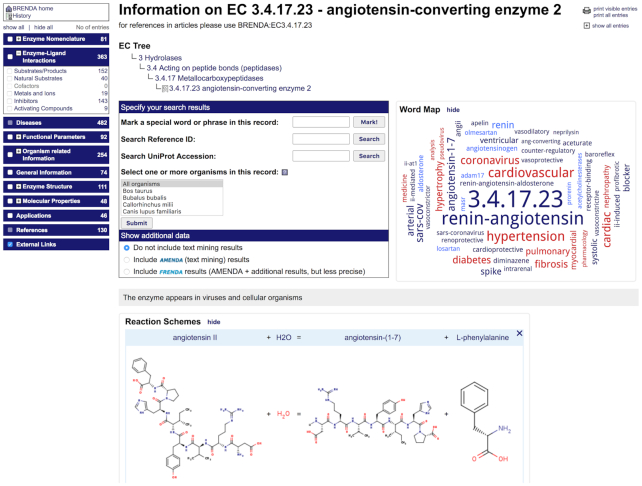
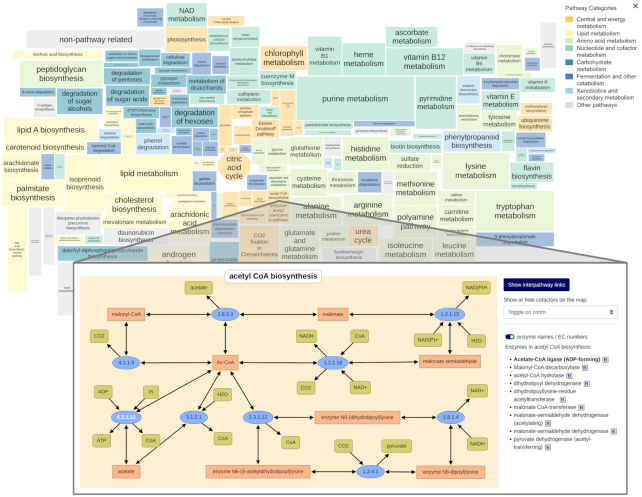
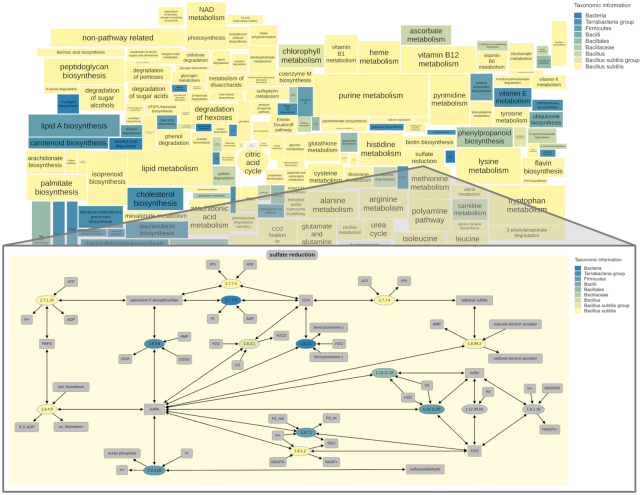
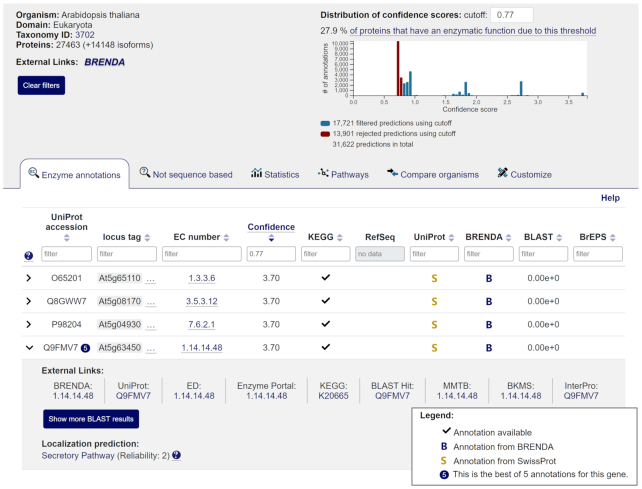
The BRENDA enzyme database (https://www.brenda-enzymes.org), established in 1987, has evolved into the main collection of functional enzyme and metabolism data. In 2018, BRENDA was selected as an ELIXIR Core Data Resource. BRENDA provides reliable data, continuous curation and updates of classified enzymes, and the integration of newly discovered enzymes. The main part contains >5 million data for ∼90 000 enzymes from ∼13 000 organisms, manually extracted from ∼157 000 primary literature references, combined with information of text and data mining, data integration, and prediction algorithms. Supplements comprise disease-related data, protein sequences, 3D structures, genome annotations, ligand information, taxonomic, bibliographic, and kinetic data. BRENDA offers an easy access to enzyme information from quick to advanced searches, text- and structured-based queries for enzyme-ligand interactions, word maps, and visualization of enzyme data. The BRENDA Pathway Maps are completely revised and updated for an enhanced interactive and intuitive usability. The new design of the Enzyme Summary Page provides an improved access to each individual enzyme. A new protein structure 3D viewer was integrated. The prediction of the intracellular localization of eukaryotic enzymes has been implemented. The new EnzymeDetector combines BRENDA enzyme annotations with protein and genome databases for the detection of eukaryotic and prokaryotic enzymes.
Overview
The claims and statistics of this paper haven’t been checked yet.
Free: it reads the open-access text and checks the first 5 claims that cite a source we can check. Create a free account to check every claim.
Integrity signals
Registry
Cites
Statistics
Figures


Verification
Claims the paper makes
The claims and statistics of this paper haven’t been checked yet.
Free: it reads the open-access text and checks the first 5 claims that cite a source we can check. Create a free account to check every claim.
Claims other papers make about this one
Each is checked against this paper’s own text: does it say what the citing paper says it does?
The source backs part of the claim, not all of it — or backs it for a different population, condition or comparison.
In the citing paper
“The amidotransferase had a lower affinity for the ASN according to parameters found in BRENDA (Chang et al., 2021).”
From Fundamental behaviors emerge from simulations of a living minimal cell (2022) · cites this paper as Chang et al., 2021
Experimental — accuracy not yet measuredThe cited source says what the claim attributes to it.
In the citing paper
“Kinetic parameters for the majority of the cellular reactions have been measured in related organisms through decades of biochemical, single-molecule (sm) FRET, and spectroscopic studies reported in the literature and kinetic databases like Bremer and Dennis (2008), BRENDA (Chang et al., 2021), and equilibrium constants reported in NIST’s TECRdb (Goldberg et al., 2004) and Equilibrator (Flamholz”
From Fundamental behaviors emerge from simulations of a living minimal cell (2022) · cites this paper as Chang et al., 2021
Self-check
Percentages, sums and reported differences re-computed from the paper’s own numbers.
The self-check needs the paper’s full text.
Citations
Cites
Basic local alignment search tool
Altschul, S. F., Gish, W., Miller, W., Myers, E. W., & Lipman, D. J. (1990) · Journal of Molecular Biology · doi:10.1006/jmbi.1990.9999 · Cited by 98,669
Cytoscape: A software Environment for integrated models of biomolecular interaction networks
Shannon, P., Markiel, A., Ozier, O., Baliga, N. S., Wang, J. T., Ramage, D., Amin, N., Schwikowski, B., & Ideker, T. (2003) · Genome Research · doi:10.1101/gr.1239303 · Cited by 51,888
Database resources of the National Center for Biotechnology Information: update
Wheeler, D. L. (2004) · Nucleic Acids Research · doi:10.1093/nar/gkh073 · Cited by 10,641
KEGG: new perspectives on genomes, pathways, diseases and drugs
Kanehisa, M., Furumichi, M., Tanabe, M., Sato, Y., & Morishima, K. (2017) · Nucleic Acids Research · doi:10.1093/nar/gkw1092 · Cited by 8,865
UniProt: a worldwide hub of protein knowledge
The UniProt Consortium (2019) · Nucleic Acids Research · doi:10.1093/nar/gky1049 · Cited by 7,698
O'Leary, N. A., Wright, M. W., Brister, J. R., Ciufo, S., Haddad, D., McVeigh, R., Rajput, B., Robbertse, B., Smith-White, B., Ako-Adjei, D., et al. (2016) · Nucleic Acids Research · doi:10.1093/nar/gkv1189 · Cited by 6,357
Predicting Subcellular Localization of Proteins Based on their N-terminal Amino Acid Sequence
Emanuelsson, O., Nielsen, H., Brunak, S., & von Heijne, G. (2000) · Journal of Molecular Biology · doi:10.1006/jmbi.2000.3903 · Cited by 4,263
A hidden Markov model for predicting transmembrane helices in protein sequences.
Sonnhammer, E. L. L., von HEIJNE, G., & Krogh, A. (1998) · PubMed · Cited by 2,505
Improvements to PATRIC, the all-bacterial Bioinformatics Database and Analysis Resource Center
Wattam, A. R., Davis, J. J., Assaf, R., Boisvert, S., Brettin, T., Bun, C., Conrad, N., Dietrich, E. M., Disz, T., Gabbard, J. L., et al. (2017) · Nucleic Acids Research · doi:10.1093/nar/gkw1017 · Cited by 1,657
Database resources of the National Center for Biotechnology Information
Coordinators, N. R., Agarwala, R., Barrett, T., Beck, J., Benson, D. A., Bollin, C., Bolton, E., Bourexis, D., Brister, J. R., Bryant, S. H., et al. (2018) · Nucleic Acids Research · doi:10.1093/nar/gkx1095 · Cited by 1,502
Cited by
Items 801–801 of 801
Benchmarking and Experimental Validation of Machine Learning Strategies for Enzyme Engineering
Zeng, Z., Jin, J., Xu, R., 武玉真, & Luo, X. (2026) · Journal of Chemical Information and Modeling · doi:10.1021/acs.jcim.6c01200 · Cited by 4
Metadata
- Authors
- Chang, A., Jeske, L., Ulbrich, S., Hofmann, J., Koblitz, J., Schomburg, I., Neumann-Schaal, M., Jahn, D., & Schomburg, D.
- Affiliations
- Technische Universität Braunschweig (DE)
- Leibniz Institute DSMZ – German Collection of Microorganisms and Cell Cultures (DE)
- Leibniz Institute DSMZ-German Collection of Microorganisms and Cell Cultures, Inhoffenstrasse 7 B, 38124 Braunschweig, Germany
- Corresponding author
- Schomburg, Dietmar
- Venue
- Nucleic Acids Research
- Publisher
- Oxford University Press (OUP)
- Published
- 2020-11-19
- Volume
- 49
- Issue
- D1
- Pages
- D498-D508
- ISSN
- 0305-1048 (ISSN-L)
- 1362-4962
- PMC
- PMC7779020
- OpenAlex
- W3105895642
- Cited by
- 789
- References
- 40
- Citations by year
- 2026: 126 · 2025: 182 · 2024: 171 · 2023: 145 · 2022: 117 · 2021: 48
- FWCI
- 25.35
- Type
- journal article
- Language
- en
- Open access
- gold
- doi.org
- Licence
- Locations
- Nucleic Acids Research (publishedVersion, cc-by)
- Europe PMC (PubMed Central) (publishedVersion, cc-by)
- PubMed Central (publishedVersion, cc-by)
- PubMed (publishedVersion)
- Digitale Bibliothek Braunschweig (Verbundzentrale Göttingen (VZG)) (submittedVersion, cc-by)
- Funders
- German Federal Ministry of Education and Research (031A539D, 031L0078E, 031L0078G, 01KX1235)
- Topics
- Life Sciences › Biochemistry, Genetics and Molecular Biology › Molecular Biology › Bioinformatics and Genomic Networks
- Life Sciences › Biochemistry, Genetics and Molecular Biology › Structural Biology › Enzyme Structure and Function
- Life Sciences › Biochemistry, Genetics and Molecular Biology › Molecular Biology › Genomics and Phylogenetic Studies
- Keywords
- enzyme kinetics, enzyme-ligand interactions, enzyme annotation, metabolic pathways
- MeSH terms
- Acetyl Coenzyme A, Bacillus subtilis, Enzymes, Arabidopsis, Imaging, Three-Dimensional, Databases, Protein, Metabolic Networks and Pathways, Search Engine, Molecular Sequence Annotation
About these checks
Registry, retraction, Cites and statistics results are computed, not judged, with one exception: a printed reference that no index lists is read once by a model before it counts as a citation error. Claims are extracted by a model and kept only when their quote appears verbatim in the text; each cited source is then checked, with a model’s help, for whether it says what the claim relies on. Those verdicts can be wrong — read the claim’s quote and the cited source before relying on one.
Statistics and arithmetic are recomputed, not judged.
Confidence bands are shown only for fields calibrated on our annotated test set. None is calibrated yet, so no band is shown.
What counts as a claim ›How we measure confidence ›How we check this ›
Are you an author, or do you see a problem with this page? Request a review
Data sources
Bibliographic data: Semantic Scholar, OpenAlex, Crossref.
Contains information from the Semantic Scholar Academic Graph Datasets, made available under the ODC Attribution License (ODC-BY 1.0).
Semantic Scholar’s data is described in: Kinney, R., et al. (2023). The Semantic Scholar Open Data Platform. arXiv:2301.10140.
