

TCRdb: a comprehensive database for T-cell receptor sequences with powerful search function
Open accessThe DOI matches its Crossref record; 38 of the 38 references it cites were found in a registry or an index.
Abstract
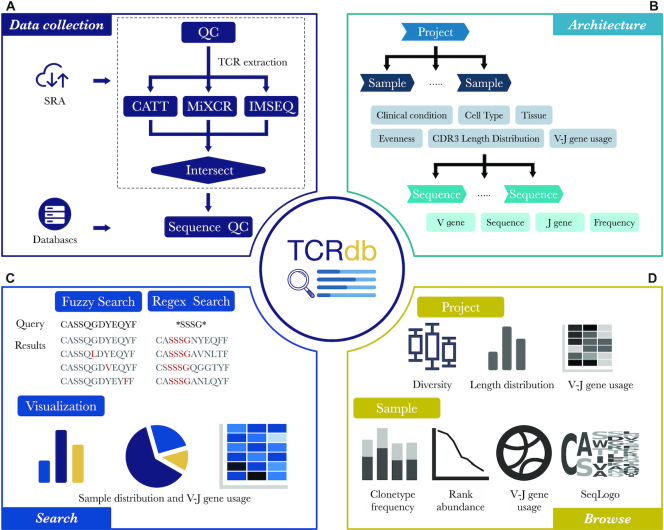
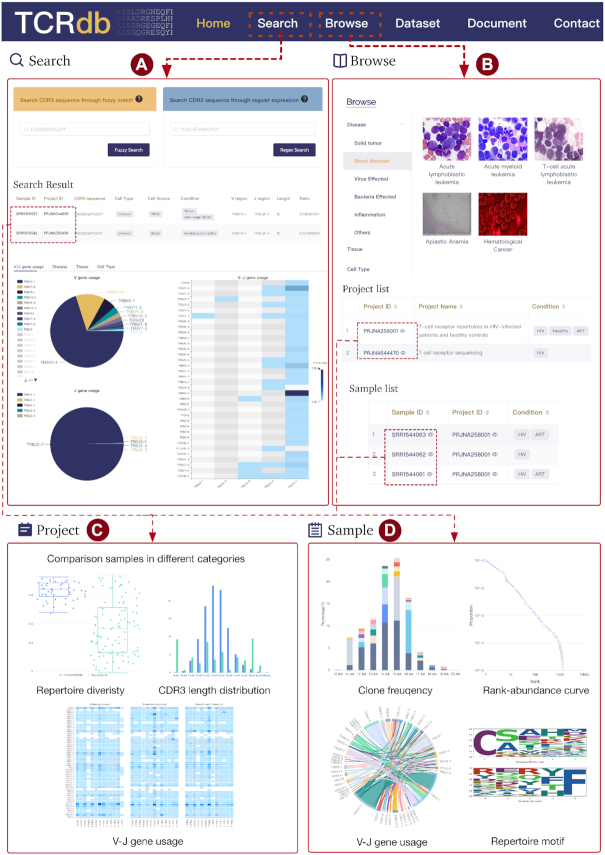
T cells and the T-cell receptor (TCR) repertoire play pivotal roles in immune response and immunotherapy. TCR sequencing (TCR-Seq) technology has enabled accurate profiling TCR repertoire and currently a large number of TCR-Seq data are available in public. Based on the urgent need to effectively re-use these data, we developed TCRdb, a comprehensive human TCR sequences database, by a uniform pipeline to characterize TCR sequences on TCR-Seq data. TCRdb contains more than 277 million highly reliable TCR sequences from over 8265 TCR-Seq samples across hundreds of tissues/clinical conditions/cell types. The unique features of TCRdb include: (i) comprehensive and reliable sequences for TCR repertoire in different samples generated by a strict and uniform pipeline of TCRdb; (ii) powerful search function, allowing users to identify their interested TCR sequences in different conditions; (iii) categorized sample metadata, enabling comparison of TCRs in different sample types; (iv) interactive data visualization charts, describing the TCR repertoire in TCR diversity, length distribution and V-J gene utilization. The TCRdb database is freely available at http://bioinfo.life.hust.edu.cn/TCRdb/ and will be a useful resource in the research and application community of T cell immunology.
Overview
The claims and statistics of this paper haven’t been checked yet.
Free: it reads the open-access text and checks the first 5 claims that cite a source we can check. Create a free account to check every claim.
Integrity signals
Registry
Cites
Statistics
Figures
Verification
Claims the paper makes
The claims and statistics of this paper haven’t been checked yet.
Free: it reads the open-access text and checks the first 5 claims that cite a source we can check. Create a free account to check every claim.
Claims other papers make about this one
Each is checked against this paper’s own text: does it say what the citing paper says it does?
The source backs part of the claim, not all of it — or backs it for a different population, condition or comparison.
In the citing paper
“Chen et al. developed TCRdb, a comprehensive TCR database, that aids in identifying the states and functions of specific sequences [138].”
From Single-cell sequencing to multi-omics: technologies and applications (2024) · cites this paper as [138]
Experimental — accuracy not yet measured
Self-check
Percentages, sums and reported differences re-computed from the paper’s own numbers.
The self-check needs the paper’s full text.
Citations
Cites
fastp: an ultra-fast all-in-one FASTQ preprocessor
Chen, S., Zhou, Y., Chen, Y., & Gu, J. (2018) · Bioinformatics · doi:10.1093/bioinformatics/bty560 · Cited by 29,721
Self-citationPEAR: a fast and accurate Illumina Paired-End reAd mergeR
Zhang, J., Kobert, K., Flouri, T., & Stamatakis, A. (2014) · Bioinformatics · doi:10.1093/bioinformatics/btt593 · Cited by 4,497
T-cell antigen receptor genes and T-cell recognition
Davis, M. M., & Bjorkman, P. J. (1988) · Nature · doi:10.1038/334395a0 · Cited by 3,202 · cited 1×
“The high diversity of TCRs is mainly due to the complementarity determining regions 3 (CDR3) on the beta chain (3).”
BackgroundThe Immune Epitope Database (IEDB): 2018 update
Vita, R., Mahajan, S., Overton, J. A., Dhanda, S. K., Martini, S., Cantrell, J. R., Wheeler, D. K., Sette, A., & Peters, B. (2019) · Nucleic Acids Research · doi:10.1093/nar/gky1006 · Cited by 2,186 · cited 1×
“VDJdb (12), IEDB (13) and McPAS-TCR (14) provide manually curated TCR sequences associated with pathogen or antigen, and just consist of ∼100 000 TCR sequences.”
BackgroundSmith, T., Heger, A., & Sudbery, I. (2017) · Genome Research · doi:10.1101/gr.209601.116 · Cited by 2,143
MiXCR: software for comprehensive adaptive immunity profiling
Bolotin, D. A., Poslavsky, S., Mitrophanov, I., Shugay, M., Mamedov, I. Z., Putintseva, E. V., & Chudakov, D. M. (2015) · Nature Methods · doi:10.1038/nmeth.3364 · Cited by 1,722 · cited 3×
“To increase the reliability of processed TCR sequences, multiple TCR extraction methods were used: CATT (22), MiXCR (23) and IMSEQ (24).”
MethodGlobal characterization of T cells in non-small-cell lung cancer by single-cell sequencing
Guo, X., Zhang, Y., Zheng, L., Zheng, C., Song, J., Zhang, Q., Kang, B., Liu, Z., Jin, L., Xing, R., et al. (2018) · Nature Medicine · doi:10.1038/s41591-018-0045-3 · Cited by 1,651
Innate immunity: impact on the adaptive immune response
Medzhitov, R., & Janeway, C. A. (1997) · Current Opinion in Immunology · doi:10.1016/s0952-7915(97)80152-5 · Cited by 1,558 · cited 2×
“The T-cell receptor (TCR), which is located on the surface of T cells and responsible for antigen recognition, is a core component in the adaptive immune system (1).”
BackgroundIdentification of unique neoantigen qualities in long-term survivors of pancreatic cancer
Initiative, A. P. C. G., Balachandran, V. P., Łuksza, M., Zhao, J. N., Makarov, V., Moral, J. A., Remark, R., Herbst, B., Askan, G., Bhanot, U., et al. (2017) · Nature · doi:10.1038/nature24462 · Cited by 1,191 · cited 1×
“The highly active of TCR-Seq technology in the past 10 years have enabled high-throughput and accurate identification of TCR repertoire, which is important with the advent of precision medicine (32) and immunotherapies (33).”
BackgroundIdentifying specificity groups in the T cell receptor repertoire
Glanville, J., Huang, H., Nau, A., Hatton, O., Wagar, L. E., Rubelt, F., Ji, X., Han, A., Krams, S. M., Pettus, C., et al. (2017) · Nature · doi:10.1038/nature22976 · Cited by 1,026
Cited by
Phenotype, specificity and avidity of antitumour CD8+ T cells in melanoma
Oliveira, G., Stromhaug, K., Klaeger, S., Kula, T., Frederick, D. T., Le, P. M., Forman, J., Huang, T., Li, S., Zhang, W., et al. (2021) · Nature · doi:10.1038/s41586-021-03704-y · Cited by 558
Kwon, M., An, M., Klempner, S. J., Lee, H., Kim, K.-M., Sa, J. K., Cho, H. J., Hong, J. Y., Lee, T., Min, Y. W., et al. (2021) · Cancer Discovery · doi:10.1158/2159-8290.cd-21-0219 · Cited by 237
Can we predict T cell specificity with digital biology and machine learning?
Hudson, D., Fernandes, R. A., Basham, M., Ogg, G., & Koohy, H. (2023) · Nature Reviews Immunology · doi:10.1038/s41577-023-00835-3 · Cited by 206
Single-cell sequencing to multi-omics: technologies and applications
Wu, X., Yang, X., Dai, Y., Zhao, Z., Zhu, J., Guo, H., & Yang, R. (2024) · Biomarker Research · doi:10.1186/s40364-024-00643-4 · Cited by 222
“Chen et al. developed TCRdb, a comprehensive TCR database, that aids in identifying the states and functions of specific sequences [138].”
BackgroundHarnessing big data to characterize immune-related adverse events
Jing, Y., Yang, J., Johnson, D. B., Moslehi, J. J., & Han, L. (2022) · Nature Reviews Clinical Oncology · doi:10.1038/s41571-021-00597-8 · Cited by 125
Xu, Z., Luo, M., Lin, W., Xue, G., Wang, P., Jin, X., Xu, C., Zhou, W., Cai, Y., Yang, W., et al. (2021) · Briefings in Bioinformatics · doi:10.1093/bib/bbab335 · Cited by 103
Greiff, V., Yaari, G., & Cowell, L. G. (2020) · Current Opinion in Systems Biology · doi:10.1016/j.coisb.2020.10.010 · Cited by 89
T-Cell Receptor Repertoire Sequencing in the Era of Cancer Immunotherapy
Frank, M. L., Lu, K. J., Erdogan, C., Han, Y., HU, J. L., Wang, T., Heymach, J. V., Zhang, J. J., & Reuben, A. (2022) · Clinical Cancer Research · doi:10.1158/1078-0432.ccr-22-2469 · Cited by 85
TCR-BERT: learning the grammar of T-cell receptors for flexible antigen-xbinding analysesPreprint
Wu, K., Yost, K. E., Dániel, B., Belk, J. A., Xia, Y., Egawa, T., Satpathy, A. T., Chang, H. Y., & Zou, J. (2021) · bioRxiv (Cold Spring Harbor Laboratory) · doi:10.1101/2021.11.18.469186 · Cited by 85
Sivakumar, S., Jainarayanan, A., Arbe-Barnes, E. H., Sharma, P. K., Leathlobhair, M. N., Amin, S., Reiss, D. J., Heij, L. R., Hegde, S., Magen, A., et al. (2025) · Nature Communications · doi:10.1038/s41467-024-55424-2 · Cited by 76
“Viral TCR detection was performed using VDJdb 85 , McPAS 86 and TCRdb 87 as reference datasets.”
Stitchr: stitching coding TCR nucleotide sequences from V/J/CDR3 information
Heather, J., Spindler, M. J., Alonso, M. H., Shui, Y., Millar, D. G., Johnson, D. S., Cobbold, M., & Hata, A. N. (2022) · Nucleic Acids Research · doi:10.1093/nar/gkac190 · Cited by 57
(2023) · doi:10.1126/sciadv.abo5128 · Cited by 53
Artificial intelligence and neoantigens: paving the path for precision cancer immunotherapy
Bulashevska, A., Nacsa, Z., Lang, F., Braun, M., Machyna, M., Diken, M., Childs, L. H., & König, R. (2024) · Frontiers in Immunology · doi:10.3389/fimmu.2024.1394003 · Cited by 56
TEPCAM : Prediction of T ‐cell receptor–epitope binding specificity via interpretable deep learning
Chen, J., Zhao, B., Lin, S., Sun, H., Mao, X., Wang, M., Chu, Y., Hong, L., Wei, D., Li, M., et al. (2023) · Protein Science · doi:10.1002/pro.4841 · Cited by 53
PD-1 blockade and CDK4/6 inhibition augment nonoverlapping features of T cell activation in cancer
Ali, L. R., Garrido-Castro, A. C., Lenehan, P. J., Böllenrücher, N., Stump, C. T., Dougan, M. L., Goel, S., Shapiro, G. I., Tolaney, S. M., & Dougan, S. K. (2023) · The Journal of Experimental Medicine · doi:10.1084/jem.20220729 · Cited by 44
“Cluster Eff-CD320, in particular, consisted of a terminally differentiated effector CD4 population marked by high expression of cytotoxic genes and was almost entirely composed of an impressively expanded clonotype isolated from patient P1, putatively reactive to the tumor neoantigen NY-ESO-1 by sequence homology (Che…”
BackgroundBioinformatics tools and resources for cancer and application
Huang, J., Mao, L., Lei, Q., & Guo, A. (2024) · Chinese Medical Journal · doi:10.1097/cm9.0000000000003254 · Cited by 41
Self-citationLin, V., Cheung, M., Gowthaman, R., Eisenberg, M., Baker, B. M., & Pierce, B. G. (2024) · Nucleic Acids Research · doi:10.1093/nar/gkae840 · Cited by 50
“TCR3d complements other databases devoted to TCR sequences ( 13 ,14 ) and affinities ( 15 ), and is distinguished from another database on TCR structures ( 16 ) by its content, annotations, and tools.”
BackgroundMachine Learning Approaches to TCR Repertoire Analysis
Katayama, Y., Yokota, R., Akiyama, T., & Kobayashi, T. (2022) · Frontiers in Immunology · doi:10.3389/fimmu.2022.858057 · Cited by 37
“TCRdb (54), one of the major databases of TCR repertoire, contains 131 projects with a total of 8,341 samples of public datasets aggregated from various repositories as of November 2021.”
BackgroundSpike-specific T cells are enriched in breastmilk following SARS-CoV-2 mRNA vaccination
Armistead, B., Jiang, Y., Carlson, M., Ford, E. S., Jani, S., Houck, J., Wu, X., Jing, L., Pecor, T., Kachikis, A. B., et al. (2023) · Mucosal Immunology · doi:10.1016/j.mucimm.2023.01.003 · Cited by 34
“Time since delivery, weeks, median (range) 26 (2-56) Time since 2 SARS2 mRNA dose, weeks, median (range) 11 (0.”
Raybould, M. I. J., Greenshields‐Watson, A., Agarwal, P., Aguilar-Sanjuan, B., Olsen, T. H., Turnbull, O. M., Quast, N. P., & Deane, C. M. (2024) · Cell Reports · doi:10.1016/j.celrep.2024.114704 · Cited by 39
Song, L., Ouyang, Z., Cohen, D., Cao, Y., Altreuter, J., Bai, G., Hu, X. S., Livak, K. J., Li, H., Tang, M., et al. (2022) · Cancer Immunology Research · doi:10.1158/2326-6066.cir-21-0965 · Cited by 30
Accurate TCR-pMHC interaction prediction using a BERT-based transfer learning method
Zhang, J., Ma, W., & Yao, H. J. (2023) · Briefings in Bioinformatics · doi:10.1093/bib/bbad436 · Cited by 38
“In contrast, vast amounts of unlabeled TCR sequences (over 100 million) and pMHC binding data (over 4 million) are available in databases such as TCRdb [20] and IEDB [30].”
BackgroundMethodAdvances of computational methods enhance the development of multi-epitope vaccines
Wei, Y., Qiu, T., Ai, Y., Zhang, Y., Xie, J., Zhang, D., Luo, X., Sun, X., Wang, X., & Qiu, J. (2024) · Briefings in Bioinformatics · doi:10.1093/bib/bbaf055 · Cited by 40
Katayama, Y., & Kobayashi, T. (2022) · Frontiers in Immunology · doi:10.3389/fimmu.2022.797640 · Cited by 27
“These datasets are taken from the TCRdb (28) to satisfy the following conditions: the dataset has less than 100 samples; the dataset contains healthy samples (to avoid shortcut learning); the dataset is prepossessed by the authors (to validate the performance on various protocols).”
BackgroundMethodInfluentialZhang, M., Cheng, Q., Wei, Z., Xu, J., Wu, S., Xu, N., Zhao, C., Yu, L., & Feng, W. (2024) · Briefings in Bioinformatics · doi:10.1093/bib/bbae420 · Cited by 33
“Initially, we employed the MiXCR tool to assemble TCRs, generating TCR sequence data that meets the research requirements [42].”
MethodGRATCR: Epitope-Specific T Cell Receptor Sequence Generation With Data-Efficient Pre-Trained Models
Zhou, Z., Chen, J., Lin, S. L., Hong, L., Wei, D., & Xiong, Y. (2025) · IEEE Journal of Biomedical and Health Informatics · doi:10.1109/jbhi.2024.3514089 · Cited by 31
“To pre-train Epitope-BERT and TCR-GPT, we selected two datasets from Immune Epitope Database (IEDB) [36] and TCRdb [37].”
TIL Therapy in Lung Cancer: Current Progress and Perspectives
Hu, W., Bian, Y., & Ji, H. (2024) · Advanced Science · doi:10.1002/advs.202409356 · Cited by 31
Cai, Y., Luo, M., Yang, W., Xu, C., Wang, P., Xue, G., Jin, X., Cheng, R., Que, J., Zhou, W., et al. (2024) · Cancer Research · doi:10.1158/0008-5472.can-23-0860 · Cited by 25
Fast and accurate modeling of TCR-peptide-MHC complexes using tFold-TCRPreprint
Wu, F., Zhao, Y. S., Xiao, Y., Qin, C., Wang, F., Wu, Z., Huang, L.-K., Liu, X., Song, J., He, B., et al. (2025) · bioRxiv (Cold Spring Harbor Laboratory) · doi:10.1101/2025.01.12.632367 · Cited by 27
Attention-aware contrastive learning for predicting T cell receptor–antigen binding specificity
Fang, Y., Liu, X., & Liu, H. (2022) · Briefings in Bioinformatics · doi:10.1093/bib/bbac378 · Cited by 20
Zhou, W., Xiang, W., Yu, J., Ruan, Z., Pan, Y., Wang, K., & Liu, J. (2024) · Genomics Proteomics & Bioinformatics · doi:10.1093/gpbjnl/qzae010 · Cited by 23
“Several databases of TCR sequences, including VDJdb [17,18], McPAS-TCR [19], and TCRdb [20], are currently available.”
Wang, Z., Gu, Y., Sun, X., & Huang, H. (2025) · Biomarker Research · doi:10.1186/s40364-025-00808-9 · Cited by 26
Dong, C., Miao, Y., Zhao, R. Z., Yang, M., Guo, A., Xue, Z., Li, T., Zhang, Q., Bao, Y., Shen, C., et al. (2022) · Advanced Science · doi:10.1002/advs.202204849 · Cited by 25
Self-citationiTCep: a deep learning framework for identification of T cell epitopes by harnessing fusion features
Zhang, Y., Jian, X., Xu, L., Zhao, J., Lu, M., Lin, Y., & Xie, L. (2023) · Frontiers in Genetics · doi:10.3389/fgene.2023.1141535 · Cited by 18
“To create negative dataset, we collected the TCR beta chain sequences originating from healthy individuals in TCRdb, the public comprehensive database for T cell receptor sequences (Si-Yi et al., 2021).”
Conditional generation of real antigen-specific T cell receptor sequences
Karthikeyan, D., Bennett, S., Reynolds, A. G., Vincent, B. G., & Rubinsteyn, A. (2025) · Nature Machine Intelligence · doi:10.1038/s42256-025-01096-6 · Cited by 20
“For this dataset, we chose to retain duplicate CDR3β sequences as the TCRdb was amassed over multiple studies and populations; therefore, we felt that the inclusion of duplicate CDR3β sequences was reflective of convergent evolution in the true unconditional TCR distribution.”
Jiao, W., Martínez, M., Constanza Bay, M., Zuber, J., Parks, C. A., Obradović, A., Tian, G., Wang, Z., Long, K. D., Waffarn, E., et al. (2024) · EBioMedicine · doi:10.1016/j.ebiom.2024.105028 · Cited by 13
TCRdb 2.0: an updated T-cell receptor sequence database
Yue, T., Chen, S., Shen, W., Liao, Y., Lei, Q., & Guo, A. (2025) · Nucleic Acids Research · doi:10.1093/nar/gkaf876 · Cited by 18
“0), a comprehensive resource that contains ∼ 277 million TCR sequences from over 8000 samples [ 12 ].”
Self-citationKalinová, M., Mrhalová, M., Kabíčková, E., Svatoň, M., Skotnicová, A., Prouzová, Z., Křenová, Z., Kolenová, A., Divoká, M., Froňková, E., et al. (2024) · Modern Pathology · doi:10.1016/j.modpat.2024.100428 · Cited by 11
Predictive and therapeutic applications of protein language models.
Furui, K., Sakano, K., & Ohue, M. (2025) · Allergology International · doi:10.1016/j.alit.2025.08.004 · Cited by 10
MicroEpitope: an atlas of immune epitopes derived from cancer microbiomes
Li, D., Cai, Y., Liu, K., Lv, D., Zeng, M., Wen, L., Lv, C., Guo, J., Xu, K., Ding, N., et al. (2024) · Nucleic Acids Research · doi:10.1093/nar/gkae877 · Cited by 13
“In addition, studies have demonstrated that the T cells with the CDR3 β sequence ‘CASSLGRASNQPQHF’ from a cancer patient could induce tumor lesion regression ( 44 ) and the CDR3 β sequence was also found in the TCRdb database in patients who responded to anti-PD-1 therapy ( 45 ).”
BackgroundShen, W., Zhang, C., Gu, Y.-M., Luo, T., Chen, S., Yue, T., Xie, G., Liao, Y. C., Yuan, Y., Lei, Q., et al. (2025) · 中国科学通报:英文版 · doi:10.1016/j.scib.2025.02.043 · Cited by 14
Self-citationTRAIT: A Comprehensive Database for T-cell Receptor–antigen Interactions
Wei, M., Wu, J., Bai, S., Zhou, Y., Chen, Y., Zhang, X., Zhao, W., G, Y., Pan, G., Zhu, F., et al. (2025) · Genomics Proteomics & Bioinformatics · doi:10.1093/gpbjnl/qzaf033 · Cited by 18
“Others are specialized in describing sequences of TCR repertoires, including the uncon-ventional T cell receptor sequence database (UcTCRdb) [19], the pan immune repertoire database (PIRD) [20], and the human TCR sequence database (TCRdb) [21].”
Self-citationde Jong, M. J. M., Schaftenaar, F. H., Depuydt, M. A. C., Vigario, F. L., Janssen, G. M. C., Peeters, J. A. H. M., Goncalves, L. N., Wezel, A., Smeets, H. J., Kuiper, J., et al. (2024) · Arteriosclerosis Thrombosis and Vascular Biology · doi:10.1161/atvbaha.123.320539 · Cited by 10
A pan-disease and population-level single-cell TCRαβ repertoire reference
Xue, Z., Wu, L., Gao, B. X., Tian, R., Chen, Y., Qi, Y., Dong, T., Bai, Y., Zhao, Y. S., He, B., et al. (2025) · Cell Discovery · doi:10.1038/s41421-025-00836-7 · Cited by 15
“Interestingly, cell subtype composition of public TCR αβ clonotypes in different individuals is more consistent compared to public TCR α or TCR β clonotypes, suggesting that the T cell phenotype is likely to be determined by both α and β chains rather than by either chain alone (Fig.”
TCR sequencing in cancer immunology and immunotherapy: what, when, where, why, and how
Nose, Y., Figueiredo, I., Tuballes, K., Valle, D. M. D., Gonsalves, T. R., Guo, R., Ioannou, G., Cabal, R., Gonzalez‐Kozlova, E., & Gnjatic, S. (2026) · Journal for ImmunoTherapy of Cancer · doi:10.1136/jitc-2025-013499 · Cited by 12
Data Sharing and Reuse: A Method by the AIRR Community
Corrie, B., Christley, S., Busse, C. E., Cowell, L. G., Neller, K. C. M., Rubelt, F., Schwab, N., & Community, O. B. O. T. A. (2022) · Methods in molecular biology · doi:10.1007/978-1-0716-2115-8_23 · Cited by 8
Desai, A. P., Kosari, F., Disselhorst, M., Yin, J., Agahi, A., Peikert, T., Udell, J. B. M., Johnson, S. H., Smadbeck, J. B., Murphy, S. J., et al. (2023) · Journal for ImmunoTherapy of Cancer · doi:10.1136/jitc-2022-006035 · Cited by 9
Chen, Z., Min, M. R., Guo, H., Cheng, C., Clancy, T., & Ning, X. (2023) · Lecture notes in computer science · doi:10.1007/978-3-031-29119-7_11 · Cited by 8
VitTCR: A deep learning method for peptide recognition prediction
Jiang, M., Yu, Z., & Lan, X. (2024) · iScience · doi:10.1016/j.isci.2024.109770 · Cited by 8
Yang, J., He, B., Zhao, Y., Jiang, F., Wang, Z., Guo, Y., Xu, Z., Yuan, B., Song, J., Zhang, Q., et al. (2023) · bioRxiv (Cold Spring Harbor Laboratory) · doi:10.1101/2023.10.18.562845 · Cited by 10
UcTCRdb: An unconventional T cell receptor sequence database with online analysis functions
Dou, Y., Shan, S., & Zhang, J. (2023) · Frontiers in Immunology · doi:10.3389/fimmu.2023.1158295 · Cited by 7
Single‐cell sequencing: Current applications in various tuberculosis specimen types
Zeng, Y., Ma, Q., Chen, J., Kong, X., Chen, Z., Liu, H., Liu, L., Yan, Q., Wang, X., & Lu, S. (2024) · Cell Proliferation · doi:10.1111/cpr.13698 · Cited by 7
“51 However, the diverse nature of each individual's TCR repertoire poses challenges for traditional identification methods.”
BackgroundTertiary lymphoid structures harbour stem-like tumour-specific T cells
Afeyan, A. B., Nagler, A., Tu, C. R., Oliveira, G. R. D., Şímșek, B., Seager, M. D., Ahmar, N. E., Sax, H. E., Lin, E. S., Sud, A., et al. (2026) · Nature · doi:10.1038/s41586-026-10808-w · Cited by 13
“TCRs were annotated as virus-specific if: (1) the TCRα/β clonotype fully matched entries in VDJdb (v2022-03-30) 39 and TCRdb 40 , filtered for HLA class I and class II alleles expressed by at least one patient; (2) CD137 was upregulated in all EBV-LCL conditions but absent in tumour, PBMC or B cell…”
Gielis, S., Flumens, D., van der Heijden, S., Versteven, M., Reu, H. D., Bartholomeus, E., Schippers, J., Campillo-Davó, D., Berneman, Z. N., Anguille, S., et al. (2024) · Annals of Hematology · doi:10.1007/s00277-024-05919-1 · Cited by 9
Luo, H., Guo, W., Luan, X., Yue, T., Yu, S., Yin, X., Zu, R., Rao, L., Hu, B., Liu, X., et al. (2025) · Cancer Research · doi:10.1158/0008-5472.can-25-1407 · Cited by 5
Self-citationCD4 CTLs in supercentenarians: Signs of adaptive expansion in healthy aging
Hashimoto, K., Kojima-Ishiyama, M., Inokuchi, H., Tagami, M., Sasaki, T., Mizuguchi, K., Okazaki, Y., Taniuchi, I., Ishigaki, K., Hirose, N., et al. (2026) · Cell Reports · doi:10.1016/j.celrep.2026.117728 · Cited by 7
PseAAC2Vec protein encoding for TCR protein sequence classification
Tayebi, Z., Ali, S., Murad, T., Khan, I., & Patterson, M. (2024) · Computers in Biology and Medicine · doi:10.1016/j.compbiomed.2024.107956 · Cited by 7
scMoresDB: A comprehensive database of single-cell multi-omics data for human respiratory system
Chen, K., Han, Y., Wang, Y., Zhou, D., Wu, F., Cai, W., Zheng, S., Xiao, Q., Zhang, H., & Li, W. (2024) · iScience · doi:10.1016/j.isci.2024.109567 · Cited by 8
The characteristics of TCR CDR3 repertoire in COVID-19 patients and SARS-CoV-2 vaccine recipients
Zhou, D., Luo, Y. Q., Ma, Q., Xu, Y., & Yao, X. (2024) · Virulence · doi:10.1080/21505594.2024.2421987 · Cited by 6
Shuai, Y., Shen, P., & Zhang, X. (2025) · Computer Methods and Programs in Biomedicine · doi:10.1016/j.cmpb.2025.108797 · Cited by 6
Jeon, J., Yu, S., Lee, S., Kim, S. C., Jo, H.-Y., Jung, I., & Kim, K. (2025) · Bioinformatics · doi:10.1093/bioinformatics/btaf080 · Cited by 4
“We collected seven public datasets for pretraining (TCRdb, Chen et al. 2021), finetuning the epitope prediction models [IEDB (Vita et al. 2019), McPAS-TCR (Tickotsky et al. 2017), PIRD (Zhang et al. 2020), VDJdb (Shugay et al. 2018), 10 × (Link to 10 × ), and neoTCR (Zhou et al. 2023)].”
HIV-1 adapts to HLA class II–associated selection pressure exerted by CD4 + and CD8 + T cells
Alves, E., Currenti, J., Crawford, K., Chopra, A., Ram, R., Barnett, L. D., Read, J. F., Al-kaabi, M., James, I., Carlson, J. M., et al. (2025) · Science Advances · doi:10.1126/sciadv.adr4238 · Cited by 5
“…are due to the recognition of embedded HLA-I–restricted epitopes, none of the CDR3 sequences detected in this assay match previously identified HLA-I–restricted epitope-specific TCRs in these same subjects ( 38 , 52 – 54 ), nor do they match any TCRs deposited in the TCRdb database ( 55 ).”
Sivakumar, S., Jainarayanan, A., Arbe-Barnes, E. H., Sharma, P. K., Leathlobhair, M. N., Amin, S., Heij, L. R., Hegde, S., Magen, A., Tucci, F. A., et al. (2023) · bioRxiv (Cold Spring Harbor Laboratory) · doi:10.1101/2023.08.31.555730 · Cited by 4
TCRfinder: Improved TCR virtual screening for novel antigenic peptides with tailored language modelsPreprint
Li, Y., Zhang, C., Zhang, X., & Zhang, Y. (2024) · bioRxiv (Cold Spring Harbor Laboratory) · doi:10.1101/2024.06.27.601008 · Cited by 6
Bozkurt, C., Cildir, G., Aba, Ü., Erdogan, R. K., Warnock, N. I., Kok, C. H., Sefer, A. P., Haskoloğlu, Ş., Tekeoglu, S. D., Kılınç, G. M., et al. (2025) · Allergy · doi:10.1111/all.16580 · Cited by 3
Jiang, Y., Zhang, P., Huo, M., & Li, S. C. (2025) · Nature Machine Intelligence · doi:10.1038/s42256-025-01085-9 · Cited by 4
Pospiech, M., Tamizharasan, M., Wei, Y., Kumar, A. M. S., Lou, M., Milstein, J., & Alachkar, H. (2023) · Frontiers in Immunology · doi:10.3389/fimmu.2023.1236514 · Cited by 5
Majety, N., Ahmed, R., Al-Hallaf, R., Paul, P., Giwa, A., Heinemann, J., Agha, Z., Choong, C., Donner, T. W., Jie, C., et al. (2024) · Immunological Investigations · doi:10.1080/08820139.2024.2383736 · Cited by 3
“TCRdb (Chen et al., 2021) is a comprehensive T-cell receptor (TCR) database, the TCR on the surface of T cells recognizes antigen and participates in the activation of T cells in immune response.”
Cracking the code of adaptive immunity: The role of computational tools
Vegesana, K., & Thomas, P. G. (2024) · Cell Systems · doi:10.1016/j.cels.2024.11.009 · Cited by 3
Ham, B., Kim, S. Y., Kim, Y., Han, D., Park, T.-H., Cha, S., Jung, S., Kim, J. H., Park, G., Gong, G., et al. (2024) · British Journal of Cancer · doi:10.1038/s41416-024-02707-6 · Cited by 3
“We used TCRdb [13] and VDJdb [10] databases to fi nd viral-speci fi c TCR repertoire (downloaded in 2024).”
Bioinformatics mining for gene expression data
Guo, A. (2020) · Scientia Sinica Vitae · doi:10.1360/ssv-2020-0260 · Cited by 3
Self-citationWan, Y.-T. R., & Nielsen, M. (2025) · NAR Genomics and Bioinformatics · doi:10.1093/nargab/lqaf065 · Cited by 5
“Others such as OTS [ 13 ] and TCRdb [ 14 ] are centred around unlabelled TCR repertoire data.”
TCR representation learning with protein language models: a comprehensive review
Kinoshita, K., & Kobayashi, T. J. (2025) · International Immunology · doi:10.1093/intimm/dxaf048 · Cited by 4
“Similarly, ongoing efforts focus on aggregating diverse TCR sequence data from research groups worldwide, annotating these sequences with relevant information and standardized metadata, and making it publicly available through repositories such as TCRdb and PIRD (100, 101).”
Yang, B., Liu, S., Liu, B., Ye, T., Ma, X., & Song, T. (2026) · Cell Communication and Signaling · doi:10.1186/s12964-026-02883-3 · Cited by 4
“High-throughput sequencing of the circulating T-cell receptor (TCR) repertoire can dynamically assess the breadth and clonality of the systemic immune response [175–178].”
Bakhshian, A., Ghorghanlu, S., Atanaki, F. F., Erfani, E., Ashkiyan, A., Etemadi, A., Negahdari, B., Kavousi, K., Kardar, G., & Mazlomi, M. A. (2026) · Journal of Translational Medicine · doi:10.1186/s12967-026-08535-x · Cited by 3
Nagler, A., Sud, A., Ghannam, J. Y., Pomerance, L., Robles-Oteíza, C., Afeyan, A. B., Weir, J. A., Russell, A. J. C., Lu, W. S., Orden, M. V., et al. (2026) · Nature Biotechnology · doi:10.1038/s41587-026-03194-1 · Cited by 3
Evaluation of T Cell Receptor Construction Methods from scRNA-Seq Data
Tian, R., Yu, Z., Xue, Z., Wu, J., Wu, L., Cai, S., Gao, B. Z., He, B., Zhao, Y. S., Yao, J., et al. (2024) · Genomics Proteomics & Bioinformatics · doi:10.1093/gpbjnl/qzae086 · Cited by 3
“…RNA-seq data with varying cell numbers In light of the substantial amount of available bulk RNA-seq data and the crucial role of bulk T-cell repertoire analysis in diverse diseases [38–40], it is therefore essential to evaluate the performance of these TCR construction methods on bulk RNA-seq data.”
Hist2Vec: A histogram and kernel-based embedding method for molecular sequence analysis
Ali, S., Ali, T. E., Mansoor, H., Chourasia, P., & Patterson, M. (2025) · Expert Systems with Applications · doi:10.1016/j.eswa.2025.126859 · Cited by 3
Hoffstedt, M., Wätzig, H., & Baumann, K. (2025) · ImmunoInformatics · doi:10.1016/j.immuno.2025.100051 · Cited by 2
Jiao, W., Long, K. D., Young, T., Muntnich, C. B., Rey, A. P., Khwajazadah, M., Wang, J. H., Mohan, V., Rogers, K., Valena, A., et al. (2025) · medRxiv · doi:10.1101/2025.06.03.25328904 · Cited by 2
Wright, S. J., Kang, S., An, M., Heo, Y. J., Parikh, M., Bi, L., Lee, H., Moorhead, G., Haradhvala, N. J., Lim, S. H., et al. (2026) · Cell Reports Medicine · doi:10.1016/j.xcrm.2026.102910 · Cited by 1
“32 The database was queried for all CDR3 beta sequences in the dataset that matched those in our dataset using the search function.”
AI-driven computational methods and benchmarking for T-cell antigen identification
Deng, Y., Que, J., Xue, G., Cai, Y., Yang, W., Wang, Y., Yi, H., Wang, Z., Lin, Y., Zhou, W., et al. (2026) · Briefings in Bioinformatics · doi:10.1093/bib/bbag123 · Cited by 4
“Currently, there are a large number of unlabeled TCR datasets such as TCRdb [148] and TCR [149–151] or MHC LMs [152–154].”
TcrDesign: de novo design of epitope-specific full-length T cell receptors
Diao, K., Chen, J., Zhao, X., Wu, T., Qiu, D., Wang, W., Wang, H., & Liu, X.-S. (2026) · Science China Life Sciences · doi:10.1007/s11427-025-3232-5 · Cited by 3
“We gathered β CDR3 data from TCRdb (Chen et al., 2021), ImmuneCODE (Dines et al., 2020; Nolan et al., 2025), and other relevant literature (Carter et al., 2019; Tanno et al., 2020), yielding 40,339,559 unique entries.”
Jiao, W., Shen, Y., Long, K. D., Young, T., Muntnich, C. B., Rey, A. P., Khwajazadah, M., Wang, J. H., Mohan, V., Rogers, K., et al. (2026) · American Journal of Transplantation · doi:10.1016/j.ajt.2026.06.009 · Cited by 3
Immune repertoire and responses to neoadjuvant TCHP therapy in HER2-positive breast cancer
Shin, J., Ham, B., Seo, J.-H., Lee, S. B., Park, I. A., Gong, G., Kim, S., & Lee, H. J. (2023) · Therapeutic Advances in Medical Oncology · doi:10.1177/17588359231157654 · Cited by 1
Wang, L., Xu, Z., Zhang, W., Li, L., Liu, X., & Zhang, J. (2023) · iScience · doi:10.1016/j.isci.2023.108661 · Cited by 2
Song, K., Xu, H., Shi, Y. Y., Zou, X., Da, L., & Hao, J. (2024) · International Journal of Biological Macromolecules · doi:10.1016/j.ijbiomac.2024.136502 · Cited by 2
Luo, H., Zu, R., Li, Y., Liao, Y., Wu, L., Huang, Z., Leng, P., Wen, X., Liu, S., Li, Y., et al. (2021) · SSRN Electronic Journal · doi:10.2139/ssrn.3978572 · Cited by 1
Self-citationTCRosetta: a powerful server for analyzing and annotating T-cell receptor repertoirePreprint
Yue, T., Chen, S., Shen, W., Cheng, L., & Guo, A. (2022) · Research Square · doi:10.21203/rs.3.rs-1621224/v1 · Cited by 1
Self-citationPATCRdb: Database of TCRs from data mining patent documentsPreprint
Lee, Y., Freitag, R., Ganesan, R., Schwämmle, V., Kumar, S., & Krawczyk, K. (2023) · medRxiv · doi:10.1101/2023.01.05.23284150 · Cited by 1
“In certain areas such resources already exist, for instance collating structures (9) or large-scale next-generation sequencing data (10).”
BackgroundMethodIntegrated analysis and annotation for T-cell receptor sequences using TCRosettaPreprint
Yue, T., Chen, S., Shen, W., Cheng, L., & Guo, A. (2023) · bioRxiv (Cold Spring Harbor Laboratory) · doi:10.1101/2023.02.20.529199
“In 185 addition, we constructed a background by computing the public score distribution for 186 5,000,000 CDR3 sequences randomly selected from collected healthy samples [26].”
MethodSelf-citationAhmed, R., Majety, N., Chan, C., Giwa, A., Heinemann, J., Zhang, H., Margolick, J. B., Al-Hallaf, R., Paul, P., Bell, D. R., et al. (2023) · bioRxiv (Cold Spring Harbor Laboratory) · doi:10.1101/2023.05.06.539704
T Cell Receptor Protein Sequences and Sparse Coding: A Novel Approach to Cancer Classification
Tayebi, Z., Ali, S., Chourasia, P., Murad, T., & Patterson, M. (2023) · Communications in computer and information science · doi:10.1007/978-981-99-8141-0_17 · Cited by 4
Zhang, M., Ho, K.-L., & Zhao, S. (2024) · bioRxiv (Cold Spring Harbor Laboratory) · doi:10.1101/2024.02.14.580390 · Cited by 1
“While >300 million human TCRs are defined 14 , 100 canine TCRs are published 15 .”
BackgroundMethodTCellR2Vec: efficient feature selection for TCR sequences for cancer classification
Tayebi, Z., Ali, S., & Patterson, M. (2024) · PeerJ Computer Science · doi:10.7717/peerj-cs.2239 · Cited by 2
Learning Human T Cell Behaviors Through Generative AI Embeddings of T Cell ReceptorsPreprint
Chen, D. G., Su, Y., & Heath, J. R. (2025) · bioRxiv (Cold Spring Harbor Laboratory) · doi:10.1101/2025.06.16.660016 · Cited by 1
BiCNN: A Highly Efficient and Lightweight Model for TCR Affinity Prediction
Yang, R., Cao, J., Yu, Z., Wang, Z., & Zhao, W. (2025) · International Conference on Computer Vision, Image and Deep Learning (CVIDL) · doi:10.1109/cvidl65390.2025.11085611
“This dataset, sourced from GenePlus-COVID-19 and TCRdb [18] , covers a vast array of TCR beta chain sequences, including collections specific to certain diseases (such as COVID-19) as well as extensive immunological research data.”
Tang, Y., Liao, X., Liao, B., Peng, D., & Li, Q. (2025) · Frontiers in Oncology · doi:10.3389/fonc.2025.1625369 · Cited by 1
Kaeuferle, T., Eiz‐Vesper, B., Moosmann, A., Behrends, U., Decker, M. W., Gutjahr, L., Mautner, J., Klein, F., Kreer, C., Reger, M., et al. (2025) · Transfusion Medicine and Hemotherapy · doi:10.1159/000548312
“For example, TCRdb contains a large number of TCR sequences from a variety of clinical samples and offers flexible search and comparison options, but clinically relevant information on function and specificity of individual TCRs is limited [22].”
Progress of Deep Learning Prediction of CD8+ T‐Cell Epitopes
Cheng, X., Wu, H., Chen, P., Liu, R., Lei, Y., Mei, H., & Wang, P. (2025) · PROTEOMICS · doi:10.1002/pmic.70101 · Cited by 2
“Other databases, such as MHCPEP [ 151 ], AntiJen [ 152 ], JenPep [ 153 ], Epitome [ 154 ], SYFPEITHI [ 155 ], and MHCBN [ 156 ] mainly focus on MHC–peptide binding data, while McPAS-TCR [ 157 ], STCRDab [ 158 ], and TCRdb [ 159 ] focus on TCR sequence and reactivity data.”
Metadata
- Authors
- Chen, S.-Y., Yue, T., Lei, Q., & Guo, A.-Y.
- Affiliations
- Huazhong University of Science and Technology (CN)
- Corresponding author
- Lei, Qian
- Guo, An-Yuan
- Venue
- Nucleic Acids Research
- Publisher
- Oxford University Press (OUP)
- Published
- 2020-09-29
- Volume
- 49
- Issue
- D1
- Pages
- D468-D474
- ISSN
- 0305-1048 (ISSN-L)
- 1362-4962
- PMC
- PMC7778924
- OpenAlex
- W3090903754
- Cited by
- 106
- References
- 38
- Citations by year
- 2026: 15 · 2025: 26 · 2024: 28 · 2023: 19 · 2022: 10 · 2021: 6 · 2020: 2
- FWCI
- 3.24
- Type
- journal article
- Language
- en
- Open access
- gold
- doi.org
- Licence
- Locations
- Nucleic Acids Research (publishedVersion, cc-by-nc)
- PubMed Central (publishedVersion, cc-by-nc)
- PubMed (publishedVersion)
- Funders
- National Key Research and Development Program of China (2017YFA0700403)
- National Natural Science Foundation of China (31822030, 31801154, 31771458)
- China Postdoctoral Science Foundation (2017M622455, 2019T120664)
- Topics
- Life Sciences › Immunology and Microbiology › Immunology › T-cell and B-cell Immunology
- Life Sciences › Biochemistry, Genetics and Molecular Biology › Molecular Biology › vaccines and immunoinformatics approaches
- Life Sciences › Biochemistry, Genetics and Molecular Biology › Molecular Biology › Single-cell and spatial transcriptomics
- Keywords
- T cell receptor sequences, T cell receptor repertoire, TCR diversity, sample metadata, T cell immunology
- MeSH terms
- Amino Acid Sequence, Receptors, Antigen, T-Cell, Internet, Databases, Protein, Search Engine
About these checks
Registry, retraction, Cites and statistics results are computed, not judged, with one exception: a printed reference that no index lists is read once by a model before it counts as a citation error. Claims are extracted by a model and kept only when their quote appears verbatim in the text; each cited source is then checked, with a model’s help, for whether it says what the claim relies on. Those verdicts can be wrong — read the claim’s quote and the cited source before relying on one.
Statistics and arithmetic are recomputed, not judged.
Confidence bands are shown only for fields calibrated on our annotated test set. None is calibrated yet, so no band is shown.
What counts as a claim ›How we measure confidence ›How we check this ›
Are you an author, or do you see a problem with this page? Request a review
Data sources
Bibliographic data: Semantic Scholar, OpenAlex, Crossref.
Contains information from the Semantic Scholar Academic Graph Datasets, made available under the ODC Attribution License (ODC-BY 1.0).
Semantic Scholar’s data is described in: Kinney, R., et al. (2023). The Semantic Scholar Open Data Platform. arXiv:2301.10140.
