

TCRdb: a comprehensive database for T-cell receptor sequences with powerful search function
Open accessThe DOI matches its Crossref record; 38 of the 38 references it cites were found in a registry or an index.
Abstract
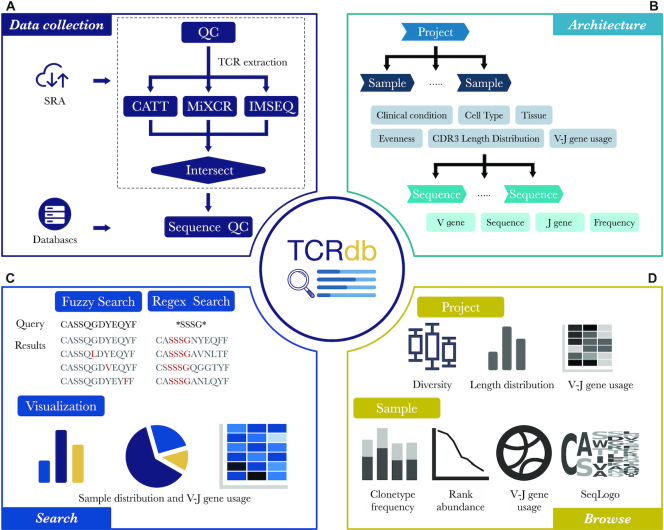
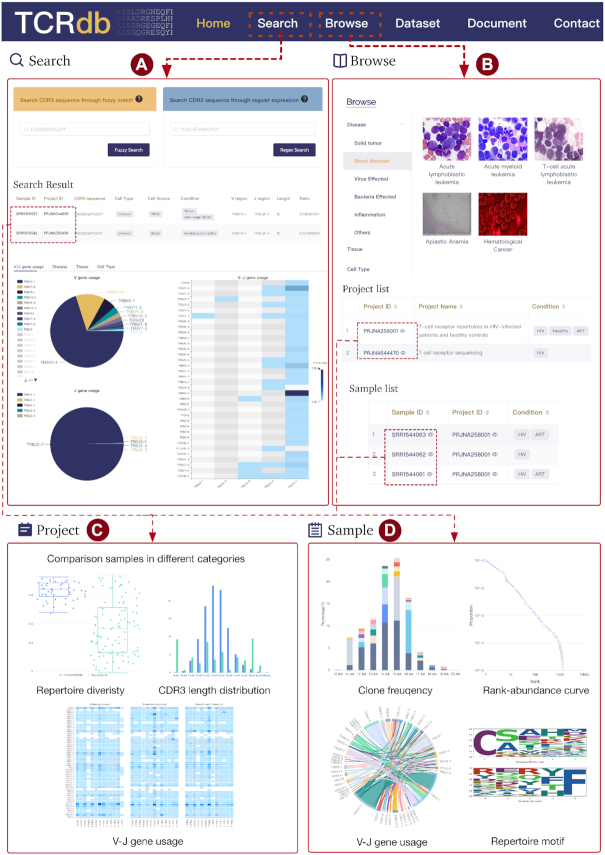
T cells and the T-cell receptor (TCR) repertoire play pivotal roles in immune response and immunotherapy. TCR sequencing (TCR-Seq) technology has enabled accurate profiling TCR repertoire and currently a large number of TCR-Seq data are available in public. Based on the urgent need to effectively re-use these data, we developed TCRdb, a comprehensive human TCR sequences database, by a uniform pipeline to characterize TCR sequences on TCR-Seq data. TCRdb contains more than 277 million highly reliable TCR sequences from over 8265 TCR-Seq samples across hundreds of tissues/clinical conditions/cell types. The unique features of TCRdb include: (i) comprehensive and reliable sequences for TCR repertoire in different samples generated by a strict and uniform pipeline of TCRdb; (ii) powerful search function, allowing users to identify their interested TCR sequences in different conditions; (iii) categorized sample metadata, enabling comparison of TCRs in different sample types; (iv) interactive data visualization charts, describing the TCR repertoire in TCR diversity, length distribution and V-J gene utilization. The TCRdb database is freely available at http://bioinfo.life.hust.edu.cn/TCRdb/ and will be a useful resource in the research and application community of T cell immunology.
Overview
The claims and statistics of this paper haven’t been checked yet.
Free: it reads the open-access text and checks the first 5 claims that cite a source we can check. Create a free account to check every claim.
Integrity signals
Registry
Cites
Statistics
Figures
Verification
Claims the paper makes
The claims and statistics of this paper haven’t been checked yet.
Free: it reads the open-access text and checks the first 5 claims that cite a source we can check. Create a free account to check every claim.
Claims other papers make about this one
Each is checked against this paper’s own text: does it say what the citing paper says it does?
The source backs part of the claim, not all of it — or backs it for a different population, condition or comparison.
In the citing paper
“Chen et al. developed TCRdb, a comprehensive TCR database, that aids in identifying the states and functions of specific sequences [138].”
From Single-cell sequencing to multi-omics: technologies and applications (2024) · cites this paper as [138]
Experimental — accuracy not yet measured
Self-check
Percentages, sums and reported differences re-computed from the paper’s own numbers.
The self-check needs the paper’s full text.
Citations
Cites
fastp: an ultra-fast all-in-one FASTQ preprocessor
Chen, S., Zhou, Y., Chen, Y., & Gu, J. (2018) · Bioinformatics · doi:10.1093/bioinformatics/bty560 · Cited by 29,721
Self-citationPEAR: a fast and accurate Illumina Paired-End reAd mergeR
Zhang, J., Kobert, K., Flouri, T., & Stamatakis, A. (2014) · Bioinformatics · doi:10.1093/bioinformatics/btt593 · Cited by 4,497
T-cell antigen receptor genes and T-cell recognition
Davis, M. M., & Bjorkman, P. J. (1988) · Nature · doi:10.1038/334395a0 · Cited by 3,202 · cited 1×
“The high diversity of TCRs is mainly due to the complementarity determining regions 3 (CDR3) on the beta chain (3).”
BackgroundThe Immune Epitope Database (IEDB): 2018 update
Vita, R., Mahajan, S., Overton, J. A., Dhanda, S. K., Martini, S., Cantrell, J. R., Wheeler, D. K., Sette, A., & Peters, B. (2019) · Nucleic Acids Research · doi:10.1093/nar/gky1006 · Cited by 2,186 · cited 1×
“VDJdb (12), IEDB (13) and McPAS-TCR (14) provide manually curated TCR sequences associated with pathogen or antigen, and just consist of ∼100 000 TCR sequences.”
BackgroundSmith, T., Heger, A., & Sudbery, I. (2017) · Genome Research · doi:10.1101/gr.209601.116 · Cited by 2,143
MiXCR: software for comprehensive adaptive immunity profiling
Bolotin, D. A., Poslavsky, S., Mitrophanov, I., Shugay, M., Mamedov, I. Z., Putintseva, E. V., & Chudakov, D. M. (2015) · Nature Methods · doi:10.1038/nmeth.3364 · Cited by 1,722 · cited 3×
“To increase the reliability of processed TCR sequences, multiple TCR extraction methods were used: CATT (22), MiXCR (23) and IMSEQ (24).”
MethodGlobal characterization of T cells in non-small-cell lung cancer by single-cell sequencing
Guo, X., Zhang, Y., Zheng, L., Zheng, C., Song, J., Zhang, Q., Kang, B., Liu, Z., Jin, L., Xing, R., et al. (2018) · Nature Medicine · doi:10.1038/s41591-018-0045-3 · Cited by 1,651
Innate immunity: impact on the adaptive immune response
Medzhitov, R., & Janeway, C. A. (1997) · Current Opinion in Immunology · doi:10.1016/s0952-7915(97)80152-5 · Cited by 1,558 · cited 2×
“The T-cell receptor (TCR), which is located on the surface of T cells and responsible for antigen recognition, is a core component in the adaptive immune system (1).”
BackgroundIdentification of unique neoantigen qualities in long-term survivors of pancreatic cancer
Initiative, A. P. C. G., Balachandran, V. P., Łuksza, M., Zhao, J. N., Makarov, V., Moral, J. A., Remark, R., Herbst, B., Askan, G., Bhanot, U., et al. (2017) · Nature · doi:10.1038/nature24462 · Cited by 1,191 · cited 1×
“The highly active of TCR-Seq technology in the past 10 years have enabled high-throughput and accurate identification of TCR repertoire, which is important with the advent of precision medicine (32) and immunotherapies (33).”
BackgroundIdentifying specificity groups in the T cell receptor repertoire
Glanville, J., Huang, H., Nau, A., Hatton, O., Wagar, L. E., Rubelt, F., Ji, X., Han, A., Krams, S. M., Pettus, C., et al. (2017) · Nature · doi:10.1038/nature22976 · Cited by 1,026
Miao, Y., Zhang, Q., Lei, Q., Luo, M., Xie, G., Wang, H., & Guo, A. (2020) · Advanced Science · doi:10.1002/advs.201902880 · Cited by 973 · cited 1×
“The discovery and understanding of T cell biology have led to new insights in their application, such as predicting prognosis by the T cell subtypes (30) and selecting appropriate treatment according to the T cell status (31).”
BackgroundSelf-citationQuantifiable predictive features define epitope-specific T cell receptor repertoires
Dash, P., Fiore-Gartland, A. J., Hertz, T., Wang, G. C., Sharma, S., Souquette, A., Crawford, J. C., Clemens, E. B., Nguyen, T. H. O., Kedzierska, K., et al. (2017) · Nature · doi:10.1038/nature22383 · Cited by 897 · cited 1×
“Due to the high diversity of TCR sequences and similar sequences are likely to have similar properties (28), the search function in TCRdb allows users to search their interested TCR sequence through the database and obtain”
BackgroundReprogramming human T cell function and specificity with non-viral genome targeting
Roth, T. L., Puig-Saus, C., Yu, R., Shifrut, E., Carnevale, J., Li, P. J., Hiatt, J., Saco, J., Krystofinski, P., Li, H., et al. (2018) · Nature · doi:10.1038/s41586-018-0326-5 · Cited by 839
Zacharakis, N., Chinnasamy, H., Black, M., Xu, H., Lu, Y.-C., Zheng, Z., Pasetto, A., Langhan, M., Shelton, T., Prickett, T., et al. (2018) · Nature Medicine · doi:10.1038/s41591-018-0040-8 · Cited by 773 · cited 1×
“For example, profiling TCR repertoire is valuable for quantitatively evaluating immune diversity and further to assist cancer early-stage diagnosis (4), treatment selection (5) and prognosis prediction (6).”
BackgroundA neoantigen fitness model predicts tumour response to checkpoint blockade immunotherapy
Łuksza, M., Riaz, N., Makarov, V., Balachandran, V. P., Hellmann, M. D., Solovyov, A., Rizvi, N. A., Merghoub, T., Levine, A. J., Chan, T. A., et al. (2017) · Nature · doi:10.1038/nature24473 · Cited by 646 · cited 1×
“The highly active of TCR-Seq technology in the past 10 years have enabled high-throughput and accurate identification of TCR repertoire, which is important with the advent of precision medicine (32) and immunotherapies (33).”
BackgroundIMGT®, the international ImMunoGeneTics information system® 25 years on
Lefranc, M.-P., Giudicelli, V., Duroux, P., Jabado-Michaloud, J., Folch, G., Aouinti, S., Carillon, E., Duvergey, H., Houles, A., Paysan-Lafosse, T., et al. (2015) · Nucleic Acids Research · doi:10.1093/nar/gku1056 · Cited by 582
McPAS-TCR: a manually curated catalogue of pathology-associated T cell receptor sequences
Tickotsky, N., Sagiv, T., Prilusky, J., Shifrut, E., & Friedman, N. (2017) · Bioinformatics · doi:10.1093/bioinformatics/btx286 · Cited by 555
Bagaev, D. V., Vroomans, R. M. A., Samir, J., Stervbo, U., Rius, C., Dolton, G., Greenshields-Watson, A., Attaf, M., Egorov, E. S., Zvyagin, I. V., et al. (2020) · Nucleic Acids Research · doi:10.1093/nar/gkz874 · Cited by 394 · cited 1×
“VDJdb (12), IEDB (13) and McPAS-TCR (14) provide manually curated TCR sequences associated with pathogen or antigen, and just consist of ∼100 000 TCR sequences.”
BackgroundUnraveling V(D)J Recombination
Jung, D., & Alt, F. W. (2004) · Cell · doi:10.1016/s0092-8674(04)00039-x · Cited by 378 · cited 1×
“The TCR is formed by V(D)J recombination, a mechanism of somatic recombination during the T cell maturation and resulting in a high diversity of TCR repertoire (2).”
BackgroundAnalysis of the B cell receptor repertoire in six immune-mediated diseases
Bashford-Rogers, R. J. M., Bergamaschi, L., McKinney, E. F., Pombal, D. C., Mescia, F., Lee, J. C., Thomas, D. C., Flint, S. M., Kellam, P., Jayne, D. R. W., et al. (2019) · Nature · doi:10.1038/s41586-019-1595-3 · Cited by 284 · cited 1×
“There is also a rising demand for integrated analysis of immune repertoire data (18).”
Adoptive T Cell Therapies: A Comparison of T Cell Receptors and Chimeric Antigen Receptors
Harris, D. T., & Kranz, D. M. (2016) · Trends in Pharmacological Sciences · doi:10.1016/j.tips.2015.11.004 · Cited by 257 · cited 1×
“Furthermore, TCR repertoire analysis could benefit to the immunotherapy, while detecting tumor-specific or neoantigen-specific TCR is a critical step that directly impacts the curative effect (9).”
BackgroundMadi, A., Shifrut, E., Reich-Zeliger, S., Gal, H., Best, K., Ndifon, W., Chain, B., Cohen, I. R., & Friedman, N. (2014) · Genome Research · doi:10.1101/gr.170753.113 · Cited by 171 · cited 1×
“Besides, public TCR sequences that are common in people have shown being related to autoimmunity (35).”
BackgroundPage, D. B., Yuan, J., Redmond, D., Wen, Y. H., Durack, J. C., Emerson, R., Solomon, S., Dong, Z., Wong, P., Comstock, C., et al. (2016) · Cancer Immunology Research · doi:10.1158/2326-6066.cir-16-0013 · Cited by 170 · cited 1×
“For example, profiling TCR repertoire is valuable for quantitatively evaluating immune diversity and further to assist cancer early-stage diagnosis (4), treatment selection (5) and prognosis prediction (6).”
BackgroundPIRD: pan immune repertoire database
Zhang, W., Wang, L., Liu, K., Wei, X., Yang, K., Du, W., Wang, S., Guo, N., Ma, C., Luo, L., et al. (2020) · Bioinformatics · doi:10.1093/bioinformatics/btz614 · Cited by 166
Corrie, B. D., Marthandan, N., Zimonja, B., Jaglale, J., Zhou, Y., Barr, E., Knoetze, N., Breden, F. M. W., Christley, S., Scott, J. K., et al. (2018) · Immunological Reviews · doi:10.1111/imr.12666 · Cited by 164 · cited 1×
“Another three databases VDJServer (15), iRecetpor (16) and PIRD (17) provide TCR sequences extracted from TCR-Seq datasets with limitations on containing only 10–20 TCR-Seq datasets, lack of characteristic information of TCR repertoires, and unfriendly web interfaces.”
Backgroundde Masson, A., O’Malley, J. T., Elco, C. P., Garcia, S. S., Divito, S. J., Lowry, E. L., Tawa, M., Fisher, D. C., Devlin, P. M., Teague, J. E., et al. (2018) · Science Translational Medicine · doi:10.1126/scitranslmed.aar5894 · Cited by 141
STCRDab: the structural T-cell receptor database
Leem, J., de Oliveira, S. H. P., Krawczyk, K., & Deane, C. M. (2018) · Nucleic Acids Research · doi:10.1093/nar/gkx971 · Cited by 129 · cited 1×
“For example, STCRDab (10) and TCR3d (11) provide TCR structural information from PDB database and each database contains only ∼1000 records.”
BackgroundReverse TCR repertoire evolution toward dominant low-affinity clones during chronic CMV infection
Schober, K., Voit, F., Grassmann, S. A., Müller, T. R., Eggert, J., Jarosch, S., Weißbrich, B., Hoffmann, P., Borkner, L., Nio, E., et al. (2020) · Nature Immunology · doi:10.1038/s41590-020-0628-2 · Cited by 119 · cited 1×
“It is also helpful for understanding the dynamics of immune response, such as to monitor the repertoire change during/after virus infection (8).”
BackgroundTCR3d: The T cell receptor structural repertoire database
Gowthaman, R., & Pierce, B. G. (2019) · Bioinformatics · doi:10.1093/bioinformatics/btz517 · Cited by 115
IMSEQ—a fast and error aware approach to immunogenetic sequence analysis
Kuchenbecker, L., Nienen, M., Hecht, J., Neumann, A. U., Babel, N., Reinert, K., & Robinson, P. N. (2015) · Bioinformatics · doi:10.1093/bioinformatics/btv309 · Cited by 96 · cited 2×
“To increase the reliability of processed TCR sequences, multiple TCR extraction methods were used: CATT (22), MiXCR (23) and IMSEQ (24).”
MethodGiudice, V., Feng, X., Lin, Z., Hu, W., Zhang, F., Qiao, W., Ibanez, M. D. P. F., Rios, O., & Young, N. S. (2018) · Haematologica · doi:10.3324/haematol.2017.176701 · Cited by 92
Christley, S., Scarborough, W., Salinas, E., Rounds, W. H., Toby, I. T., Fonner, J. M., Levin, M. K., Kim, M., Mock, S. A., Jordan, C., et al. (2018) · Frontiers in Immunology · doi:10.3389/fimmu.2018.00976 · Cited by 70 · cited 2×
“Another three databases VDJServer (15), iRecetpor (16) and PIRD (17) provide TCR sequences extracted from TCR-Seq datasets with limitations on containing only 10–20 TCR-Seq datasets, lack of characteristic information of TCR repertoires, and unfriendly web interfaces.”
BackgroundSuppression of lethal autoimmunity by regulatory T cells with a single TCR specificity
Levine, A. G., Hemmers, S., Baptista, A. P., Schizas, M., Faire, M. B., Moltedo, B., Konopacki, C., Schmidt‐Supprian, M., Germain, R. N., Treuting, P. M., et al. (2017) · The Journal of Experimental Medicine · doi:10.1084/jem.20161318 · Cited by 47 · cited 1×
“Quantifying the public sequences in the TCR repertoire by TCRdb may assist in predicting the autoimmune disease prognosis (36) and help treatment selection (37).”
BackgroundPreferential Use of Public TCR during Autoimmune Encephalomyelitis
Zhao, Y., Nguyen, P., Ma, J., Wu, T., Jones, L. L., Pei, D., Cheng, C., & Geiger, T. L. (2016) · The Journal of Immunology · doi:10.4049/jimmunol.1501029 · Cited by 37 · cited 1×
“Quantifying the public sequences in the TCR repertoire by TCRdb may assist in predicting the autoimmune disease prognosis (36) and help treatment selection (37).”
BackgroundTools for fundamental analysis functions of TCR repertoires: a systematic comparison
Zhang, Y., Yang, X., Zhang, Y., Zhang, Y., Wang, M., Ou, J. X., Zhu, Y., Zeng, H., Wu, J., Lan, C., et al. (2019) · Briefings in Bioinformatics · doi:10.1093/bib/bbz092 · Cited by 33 · cited 1×
“These methods had demonstrated precise and sensitive performance on previous benchmarks (22,25).”
MethodAn ultra-sensitive T-cell receptor detection method for TCR-Seq and RNA-Seq data
Chen, S., Liu, C., Zhang, Q., & Guo, A. (2020) · Bioinformatics · doi:10.1093/bioinformatics/btaa432 · Cited by 27
Self-citationSystematic comparative study of computational methods for T-cell receptor sequencing data analysis
Afzal, S., Gil-Fariña, I., Gabriel, R., Ahmad, S., Kalle, C. V., Schmidt, M., & Fronza, R. (2017) · Briefings in Bioinformatics · doi:10.1093/bib/bbx111 · Cited by 20 · cited 1×
“Because CATT showed better repertoire precision and MiXCR showed better V and J gene identification capability (22,26), each TCR sequence record adopted the ratio from CATT output and V/D/J gene from MiXCR output.”
MethodNazarov, V. I., Minervina, A. A., Komkov, A. Y., Pogorelyy, M. V., Maschan, M. A., Olshanskaya, Y. V., Zvyagin, I. V., Chudakov, D. M., Lebedev, Y. B., & Mamedov, I. Z. (2016) · Bone Marrow Transplantation · doi:10.1038/bmt.2016.148 · Cited by 12 · cited 1×
“As TCR repertoire could determine the immunological status and abnormality, TCR repertoire analysis has been used to detect the malignant clone in some blood disorders and demonstrated better sensitivity and accuracy than conventional methods (7).”
Method
Cited by
Phenotype, specificity and avidity of antitumour CD8+ T cells in melanoma
Oliveira, G., Stromhaug, K., Klaeger, S., Kula, T., Frederick, D. T., Le, P. M., Forman, J., Huang, T., Li, S., Zhang, W., et al. (2021) · Nature · doi:10.1038/s41586-021-03704-y · Cited by 558
Kwon, M., An, M., Klempner, S. J., Lee, H., Kim, K.-M., Sa, J. K., Cho, H. J., Hong, J. Y., Lee, T., Min, Y. W., et al. (2021) · Cancer Discovery · doi:10.1158/2159-8290.cd-21-0219 · Cited by 237
Can we predict T cell specificity with digital biology and machine learning?
Hudson, D., Fernandes, R. A., Basham, M., Ogg, G., & Koohy, H. (2023) · Nature Reviews Immunology · doi:10.1038/s41577-023-00835-3 · Cited by 206
Single-cell sequencing to multi-omics: technologies and applications
Wu, X., Yang, X., Dai, Y., Zhao, Z., Zhu, J., Guo, H., & Yang, R. (2024) · Biomarker Research · doi:10.1186/s40364-024-00643-4 · Cited by 222
“Chen et al. developed TCRdb, a comprehensive TCR database, that aids in identifying the states and functions of specific sequences [138].”
BackgroundHarnessing big data to characterize immune-related adverse events
Jing, Y., Yang, J., Johnson, D. B., Moslehi, J. J., & Han, L. (2022) · Nature Reviews Clinical Oncology · doi:10.1038/s41571-021-00597-8 · Cited by 125
Metadata
- Authors
- Chen, S.-Y., Yue, T., Lei, Q., & Guo, A.-Y.
- Affiliations
- Huazhong University of Science and Technology (CN)
- Corresponding author
- Lei, Qian
- Guo, An-Yuan
- Venue
- Nucleic Acids Research
- Publisher
- Oxford University Press (OUP)
- Published
- 2020-09-29
- Volume
- 49
- Issue
- D1
- Pages
- D468-D474
- ISSN
- 0305-1048 (ISSN-L)
- 1362-4962
- PMC
- PMC7778924
- OpenAlex
- W3090903754
- Cited by
- 106
- References
- 38
- Citations by year
- 2026: 15 · 2025: 26 · 2024: 28 · 2023: 19 · 2022: 10 · 2021: 6 · 2020: 2
- FWCI
- 3.24
- Type
- journal article
- Language
- en
- Open access
- gold
- doi.org
- Licence
- Locations
- Nucleic Acids Research (publishedVersion, cc-by-nc)
- PubMed Central (publishedVersion, cc-by-nc)
- PubMed (publishedVersion)
- Funders
- National Key Research and Development Program of China (2017YFA0700403)
- National Natural Science Foundation of China (31822030, 31801154, 31771458)
- China Postdoctoral Science Foundation (2017M622455, 2019T120664)
- Topics
- Life Sciences › Immunology and Microbiology › Immunology › T-cell and B-cell Immunology
- Life Sciences › Biochemistry, Genetics and Molecular Biology › Molecular Biology › vaccines and immunoinformatics approaches
- Life Sciences › Biochemistry, Genetics and Molecular Biology › Molecular Biology › Single-cell and spatial transcriptomics
- Keywords
- T cell receptor sequences, T cell receptor repertoire, TCR diversity, sample metadata, T cell immunology
- MeSH terms
- Amino Acid Sequence, Receptors, Antigen, T-Cell, Internet, Databases, Protein, Search Engine
About these checks
Registry, retraction, Cites and statistics results are computed, not judged, with one exception: a printed reference that no index lists is read once by a model before it counts as a citation error. Claims are extracted by a model and kept only when their quote appears verbatim in the text; each cited source is then checked, with a model’s help, for whether it says what the claim relies on. Those verdicts can be wrong — read the claim’s quote and the cited source before relying on one.
Statistics and arithmetic are recomputed, not judged.
Confidence bands are shown only for fields calibrated on our annotated test set. None is calibrated yet, so no band is shown.
What counts as a claim ›How we measure confidence ›How we check this ›
Are you an author, or do you see a problem with this page? Request a review
Data sources
Bibliographic data: Semantic Scholar, OpenAlex, Crossref.
Contains information from the Semantic Scholar Academic Graph Datasets, made available under the ODC Attribution License (ODC-BY 1.0).
Semantic Scholar’s data is described in: Kinney, R., et al. (2023). The Semantic Scholar Open Data Platform. arXiv:2301.10140.
