

scDeepSort: a pre-trained cell-type annotation method for single-cell transcriptomics using deep learning with a weighted graph neural network
Open accessPublished version of a preprint
The DOI matches its Crossref record; 68 of the 68 references it cites were found in a registry or an index.
Abstract
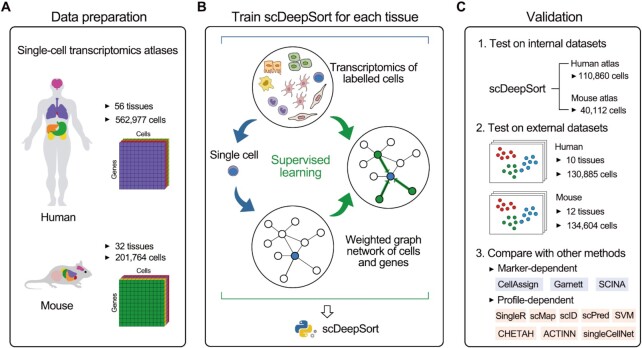
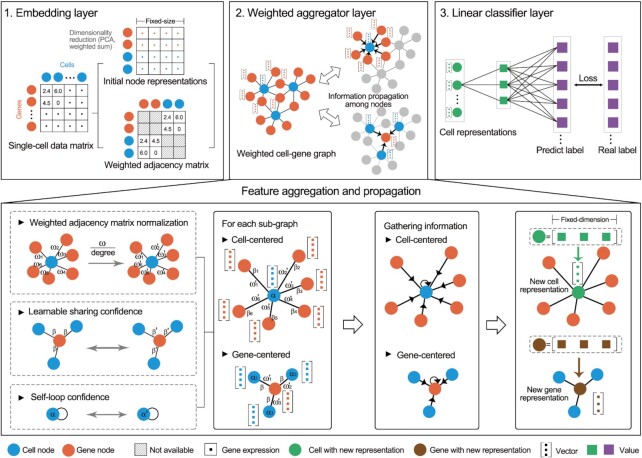
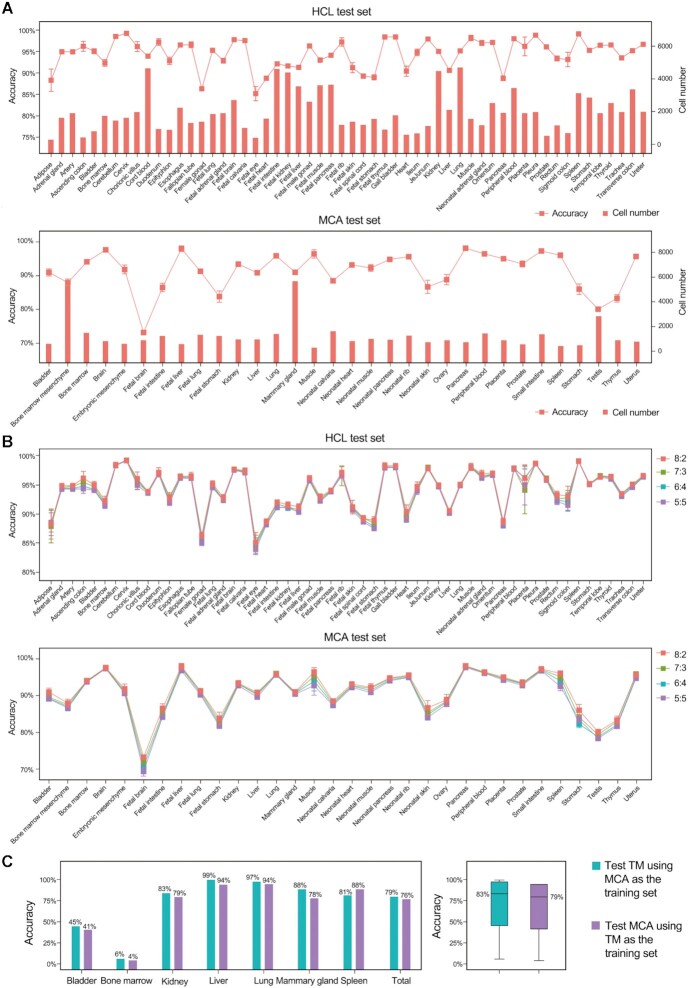
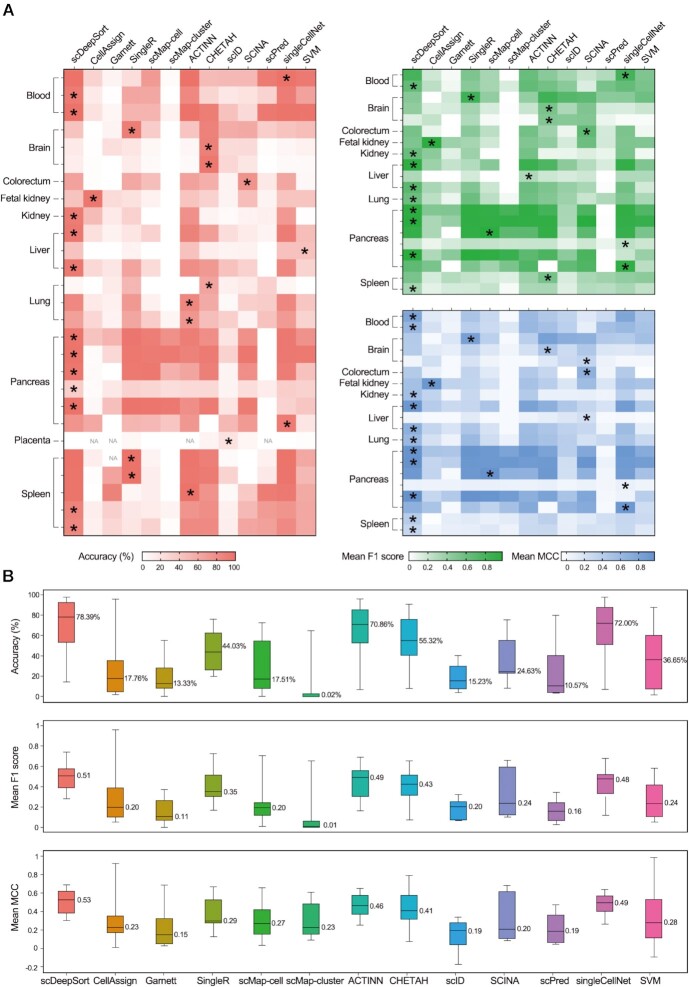
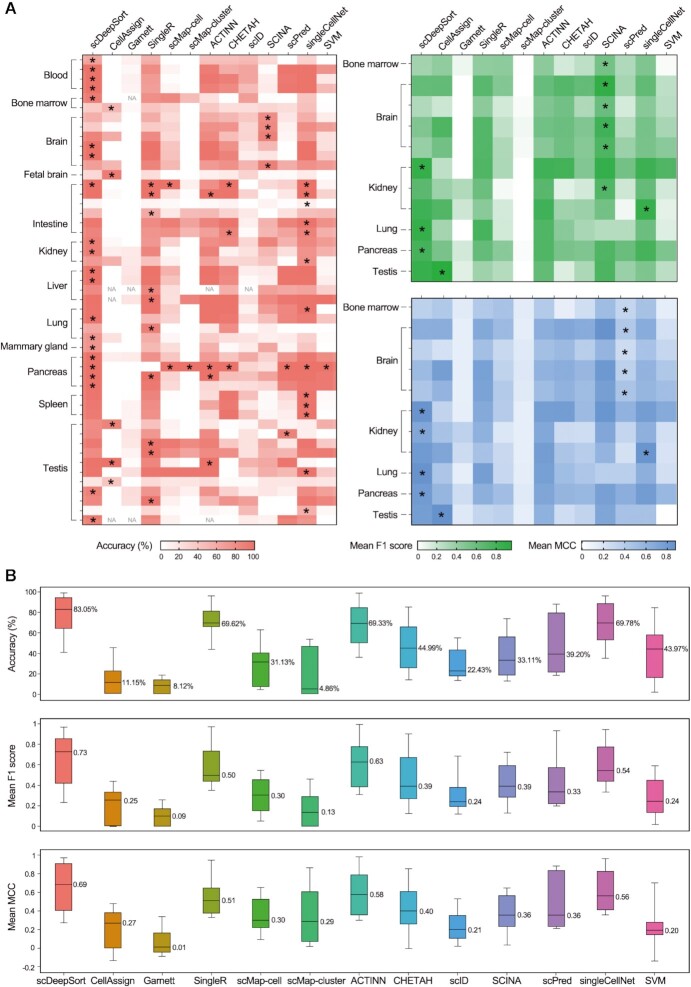
Advances in single-cell RNA sequencing (scRNA-seq) have furthered the simultaneous classification of thousands of cells in a single assay based on transcriptome profiling. In most analysis protocols, single-cell type annotation relies on marker genes or RNA-seq profiles, resulting in poor extrapolation. Still, the accurate cell-type annotation for single-cell transcriptomic data remains a great challenge. Here, we introduce scDeepSort (https://github.com/ZJUFanLab/scDeepSort), a pre-trained cell-type annotation tool for single-cell transcriptomics that uses a deep learning model with a weighted graph neural network (GNN). Using human and mouse scRNA-seq data resources, we demonstrate the high performance and robustness of scDeepSort in labeling 764 741 cells involving 56 human and 32 mouse tissues. Significantly, scDeepSort outperformed other known methods in annotating 76 external test datasets, reaching an 83.79% accuracy across 265 489 cells in humans and mice. Moreover, we demonstrate the universality of scDeepSort using more challenging datasets and using references from different scRNA-seq technology. Above all, scDeepSort is the first attempt to annotate cell types of scRNA-seq data with a pre-trained GNN model, which can realize the accurate cell-type annotation without additional references, i.e. markers or RNA-seq profiles.
Overview
The claims and statistics of this paper haven’t been checked yet.
Free: it reads the open-access text and checks the first 5 claims that cite a source we can check. Create a free account to check every claim.
Integrity signals
Registry
Cites
Statistics
Figures
Verification
Claims the paper makes
The claims and statistics of this paper haven’t been checked yet.
Free: it reads the open-access text and checks the first 5 claims that cite a source we can check. Create a free account to check every claim.
Claims other papers make about this one
Each is checked against this paper’s own text: does it say what the citing paper says it does?
The source backs part of the claim, not all of it — or backs it for a different population, condition or comparison.
In the citing paper
“Compared to tasks such as cell annotation and batch correction, perturbation prediction offers experimentally generated model input/output with well-defined objectives, making it a more robust benchmark for assessing foundation models (15, 20, 21).”
From A systematic comparison of single-cell perturbation response prediction models (2026) · cites this paper as [20]
Experimental — accuracy not yet measured
Self-check
Percentages, sums and reported differences re-computed from the paper’s own numbers.
The self-check needs the paper’s full text.
Citations
Cites
An integrated encyclopedia of DNA elements in the human genome
The ENCODE Project Consortium (2012) · Nature · doi:10.1038/nature11247 · Cited by 18,072
Mastering the game of Go with deep neural networks and tree search
Silver, D., Huang, A., Maddison, C. J., Guez, A., Sifre, L., van den Driessche, G., Schrittwieser, J., Antonoglou, I., Panneershelvam, V., Lanctot, M., et al. (2016) · Nature · doi:10.1038/nature16961 · Cited by 15,612
A Comprehensive Survey on Graph Neural Networks
Wu, Z., Pan, S., Chen, F., Long, G., Zhang, C., & Yu, P. S. (2021) · IEEE Transactions on Neural Networks and Learning Systems · doi:10.1109/tnnls.2020.2978386 · Cited by 11,000
Inductive Representation Learning on Large Graphs
Hamilton, W. L., Ying, R., & Leskovec, J. (2017) · arXiv · doi:10.48550/arxiv.1706.02216 · Cited by 10,639
Highly parallel genome-wide expression profiling of individual cells using nanoliter droplets.
Macosko, E. Z., Basu, A., Satija, R., Nemesh, J., Shekhar, K., Goldman, M., Tirosh, I., Bialas, A. R., Kamitaki, N., Martersteck, E. M., et al. (2015) · Cell · doi:10.1016/j.cell.2015.05.002 · Cited by 7,110
Graph neural networks: A review of methods and applications
Zhou, J., Cui, G., Hu, S., Zhang, Z., Yang, C., Liu, Z., Wang, L., Li, C., & Sun, M. (2020) · AI Open · doi:10.1016/j.aiopen.2021.01.001 · Cited by 6,880
Graph Neural Networks: A Review of Methods and Applications
Zhou, J., Cui, G., Hu, S., Zhang, Z., Yang, C., Liu, Z., Wang, L., Li, C., & Sun, M. (2018) · arXiv · doi:10.48550/arxiv.1812.08434 · Cited by 6,880
Targeted Branching for the Maximum Independent Set Problem Using Graph Neural Networks
Silva, G., Rodrigues, M., Teixeira, A., & Amorim, M. (2024) · DROPS (Schloss Dagstuhl – Leibniz Center for Informatics) · doi:10.4230/lipics.sea.2024.20 · Cited by 5,183
Aran, D., Looney, A. P., Liu, L., Wu, E., Fong, V., Hsu, A., Chak, S., Naikawadi, R. P., Wolters, P. J., Abate, A. R., et al. (2019) · Nature Immunology · doi:10.1038/s41590-018-0276-y · Cited by 4,984 · cited 9×
“Several methods including SingleR (8), CHETAH (9), scMap (10), scID (11), scPred (12), ACTINN (13), CellAssign (14), Garnett (15), SCINA (16), singleCellNet (17) and support vector machine (SVM) belong to this category as described in the recent review (18).”
MethodInfluentialIdentifying Medical Diagnoses and Treatable Diseases by Image-Based Deep Learning
Kermany, D. S., Goldbaum, M., Cai, W., Valentim, C. C. S., Liang, H., Baxter, S. L., McKeown, A., Yang, G., Wu, X., Yan, F., et al. (2018) · Cell · doi:10.1016/j.cell.2018.02.010 · Cited by 4,842
Cited by
Items 101–173 of 173
Single-Cell Transcriptomics in Spinal Cord Studies: Progress and Perspectives
Maihemuti, M., Mimi, M. A., Sohag, S. M., & Hasan, M. M. (2025) · BioChem · doi:10.3390/biochem5020016 · Cited by 4
Liu, Q., Liang, Y., Wang, D., & Li, J. (2022) · Frontiers in Genetics · doi:10.3389/fgene.2022.1068075 · Cited by 4
CSLAN: Cross-Species Latent Alignment Network for Trauma-Related Cell-Type ClassificationPreprint
Wu, R., Shi, A., Liu, Y., Duprey, A., Chen, T., Li, R., & Cao, S. (2025) · bioRxiv (Cold Spring Harbor Laboratory) · doi:10.1101/2025.06.09.655966 · Cited by 4
Wang, Y., & Du, P.-F. (2025) · Frontiers in Genetics · doi:10.3389/fgene.2025.1553352 · Cited by 3
Prompting Meta-Learned Hierarchical Graph Network for Molecular Property Prediction
Zhuang, X., Ding, K., Fang, Y., Chen, H., & Zhang, Q. (2023) · IEEE International Conference on Medical Artificial Intelligence (MedAI) · doi:10.1109/medai59581.2023.00025 · Cited by 3
Self-citationYu, Z., Ye, Y., & Pan, J. (2025) · Journal of Advanced Research · doi:10.1016/j.jare.2025.10.056 · Cited by 3
CellDiffusion: Enhancing scRNA-seq data integration with accurate inference of cell-cell association
Liu, Y., Huang, Z., Lu, S. L., Jiang, L., Lin, Z., Lee, J.-H., Kolachalama, V. B., Li, R., Xu, D. H., Wang, J., et al. (2026) · Science Advances · doi:10.1126/sciadv.aed4155 · Cited by 3
Sensitivity based model agnostic scalable explanations of deep learningPreprint
Aggarwal, M., Cogan, N., & Periwal, V. (2025) · bioRxiv (Cold Spring Harbor Laboratory) · doi:10.1101/2025.02.21.639516 · Cited by 2
scPlantAnnotate: an accurate and robust transformer-based model for plant cell type annotation
Lu, C., Immadi, M. S., Chan, Y. O., Dhakal, S., Xu, D., Libault, M., & Joshi, T. (2026) · Journal of Advanced Research · doi:10.1016/j.jare.2026.01.035 · Cited by 2
Qian, J., Bao, H., Yang, H., Zhang, J., Shao, X., & Fan, X. (2026) · Targetome · doi:10.48130/targetome-0026-0009 · Cited by 2
Self-citationscCCCT: Single-cell RNA-seq data contrastive clustering network with hierarchical cell transformer
Zhao, S., Zhou, Z., Tang, B., Yu, N., Liu, F., & Chen, F. (2026) · Applied Soft Computing · doi:10.1016/j.asoc.2026.115680 · Cited by 2
Dommalapati, L., Guenter, R. E., Golivi, Y., Ganji, S. P., Sandhya, T., Nagaraju, G. P., & Saddala, M. S. (2025) · Biochimica et Biophysica Acta (BBA) - Reviews on Cancer · doi:10.1016/j.bbcan.2025.189456 · Cited by 2
Yuan, L., Sun, S., Li, Z., Zhang, S., Wang, X., & Geng, Y. (2024) · Lecture notes in computer science · doi:10.1007/978-981-97-5692-6_2 · Cited by 2
Application of bioinformatic tools in cell type classification for single-cell RNA-seq data
Sujana, S. T. A., Shahjaman, M., & Singha, A. C. (2025) · Computational Biology and Chemistry · doi:10.1016/j.compbiolchem.2024.108332 · Cited by 2
DANCE 2.0: Transforming single-cell analysis from black box to transparent workflowPreprint
Ding, J., Zhijin, X. I. N. G., Wang, Y., Liu, R., Liu, S., Huang, Z., Tang, W., Xie, Y., Zou, J., Qiu, X., et al. (2025) · bioRxiv (Cold Spring Harbor Laboratory) · doi:10.1101/2025.07.17.665427 · Cited by 2
scKEPLM: Knowledge enhanced large-scale pre-trained language model for single-cell transcriptomicsPreprint
Li, Y., Qiao, G., & Wang, G. (2024) · bioRxiv (Cold Spring Harbor Laboratory) · doi:10.1101/2024.07.09.602633 · Cited by 2
Coppola, G., Fiannaca, A., Rosa, M. L., Paglia, L. L., Urso, A. M., & Gaglio, S. (2022) · Communications in computer and information science · doi:10.1007/978-3-031-08223-8_27 · Cited by 2
Qi, Q., Su, Y., Fan, Y., Yu, Z., Huang, Y., Wong, K., & Li, X. (2026) · Nucleic Acids Research · doi:10.1093/nar/gkaf1470 · Cited by 2
Deng, C., Ka, L., Ma, Y., Li, J., Li, Y. Z., Su, M., Zhou, Y., Zhang, Y., Su, J., & Zhang, Y. (2026) · Communications Biology · doi:10.1038/s42003-026-10158-3 · Cited by 2
Dong, J., Li, M., & Wang, F. (2023) · IEEE International Conference on Medical Artificial Intelligence (MedAI) · doi:10.1109/medai59581.2023.00022 · Cited by 2
RNA analysis as a promising area of diagnostics in nephrology
Morozov, S. L., Pakhomova, V. P., Voinova, V. Y., & Dlin, V. V. (2023) · Rossiyskiy Vestnik Perinatologii i Pediatrii (Russian Bulletin of Perinatology and Pediatrics) · doi:10.21508/1027-4065-2023-68-4-24-xx · Cited by 2
Qin, H., Shi, X., & Zhou, H. (2024) · Journal of Chemical Information and Modeling · doi:10.1021/acs.jcim.4c00616 · Cited by 2
Elnahas, O., Ead, W. M., Qiu, Y., & Lu, J. G. (2025) · BMC Bioinformatics · doi:10.1186/s12859-025-06151-y · Cited by 2
Cava, C., D’Antona, S., Maselli, F., Castiglioni, I., & Porro, D. (2023) · Functional & Integrative Genomics · doi:10.1007/s10142-023-01228-4 · Cited by 2
A systematic comparison of single-cell perturbation response prediction models
Li, L., You, Y., Fu, Y., Liao, W., Fan, X., Lu, S., Cao, Y., Li, B., Ren, W., Kong, J., et al. (2026) · Science Advances · doi:10.1126/sciadv.aed3414 · Cited by 1
Self-citationscDiagnostics: systematic assessment of cell type annotation in single-cell transcriptomics dataPreprint
Christidis, A.-A., Ghazi, A. R., Chawla, S., Turaga, N., Gentleman, R., & Geistlinger, L. (2026) · bioRxiv (Cold Spring Harbor Laboratory) · doi:10.64898/2026.01.29.701618 · Cited by 1
scDiagnostics: systematic assessment of cell type annotation in single-cell transcriptomics data
Christidis, A.-A., Ghazi, A. R., Chawla, S., Turaga, N., Gentleman, R., & Geistlinger, L. (2026) · Briefings in Bioinformatics · doi:10.1093/bib/bbag496 · Cited by 1
Artificial intelligence and deep learning in single-cell omics data analysis: A case study
Anjum, Z., Khalid, W., Takkar, G., Chhetri, P., & Raza, K. (2024) · Elsevier eBooks · doi:10.1016/b978-0-443-27523-4.00007-x · Cited by 1
A Novel GCN-Based Cell Annotation Method for Single-Cell RNA Sequencing Data
Tang, B., & Cheng, G. (2024) · International Congress on Image and Signal Processing (CISP) · doi:10.1109/cisp-bmei64163.2024.10906231 · Cited by 1
scGO: interpretable deep neural network for cell status annotation and disease diagnosis
Wu, Y., Xu, P., Wang, L., Liu, S., Hou, Y., Lu, H. J., Hu, P., Li, X., & Yu, X. (2024) · Briefings in Bioinformatics · doi:10.1093/bib/bbaf018 · Cited by 1
VICTOR: Validation and inspection of cell type annotation through optimal regression
Chang, C.-J., Hsu, C., Liu, Q., & Shyr, Y. (2024) · Computational and Structural Biotechnology Journal · doi:10.1016/j.csbj.2024.08.028 · Cited by 1
Ye, P., Kong, W., & Wang, S. (2025) · Current Bioinformatics · doi:10.2174/0115748936367139250801163310 · Cited by 1
Tang, B., Cheng, G., & Gao, X. (2025) · Interdisciplinary Sciences Computational Life Sciences · doi:10.1007/s12539-025-00738-y · Cited by 1
Liu, Y., Zhang, Z., Qui, M., Wang, S., Salim, F. D., Shen, J., Chen, T., Razzak, I., Li, F., & Bian, J. (2026) · Briefings in Bioinformatics · doi:10.1093/bib/bbag330 · Cited by 1
Dai, H., Meng, X., Pan, Z., Yang, Q., Song, H., Gao, Y., & Wang, X. (2024) · IEEE Journal of Biomedical and Health Informatics · doi:10.1109/jbhi.2024.3487174 · Cited by 1
Hyperbolic Feature Fusion for Single-cell RNA-seq Classification
Li, J., Liu, C., Wang, J., & Chen, J. (2023) · International Conference on Intelligent Computing and Signal Processing (ICSP) · doi:10.1109/icsp58490.2023.10248703 · Cited by 1
scHilda: Hierarchical Integration of LLM with KG database for single cell type annotation
Li, Y., Sun, Y., Geng, A., Xu, J., Meng, Y., Cui, F., Wei, L., Zou, Q., Li, X., & Zhang, Z. (2026) · PLoS Computational Biology · doi:10.1371/journal.pcbi.1014291 · Cited by 1
SAFAARI: Contrastive Adversarial Open-set Domain Adaptation for Single-cell Integration & Annotation
Aminzadeh, F., Wu, J., He, J., Saberi, M., & Vafaee, F. (2026) · Genomics Proteomics & Bioinformatics · doi:10.1093/gpbjnl/qzag008 · Cited by 1
scADGH: scRNA-seq clustering utilizing on attention-based DAE and hybrid similarity GAE
Yan, X. (2024) · IEEE International Conference on Electronic Technology, Communication and Information (ICETCI) · doi:10.1109/icetci61221.2024.10594005 · Cited by 1
RAGCell: retrieval-augmented generation as supervision for versatile single-cell analysis
Liu, T., Zhang, F., Chen, J., Wang, K., Li, H., Qian, S., Zhu, Z., Zhou, D., Wu, H., Zhang, Z., et al. (2026) · Bioinformatics · doi:10.1093/bioinformatics/btag732
Jiang, S., Qi, C., Chen, Y., Song, X., & Wei, Z. (2026) · bioRxiv (Cold Spring Harbor Laboratory) · doi:10.64898/2026.07.06.736807
Dang, Y., Liu, W., Li, H., & Liu, B. (2026) · Computational Biology and Chemistry · doi:10.1016/j.compbiolchem.2026.109239
Supervised Learning: Classification
Castelli, M., Pietropolli, G., & Manzoni, L. (2024) · Elsevier eBooks · doi:10.1016/b978-0-323-95502-7.00116-0
Fuchs, T., Menzel, M., Mößinger, K., Kazdal, D. N., Kahles, A., Budczies, J., & Stenzinger, A. (2026) · Seminars in Cancer Biology · doi:10.1016/j.semcancer.2026.06.005
Data-driven identification of cell subtypes for single-cell transcriptomic data with Subtypist
Yao, Y., Shao, X., Chen, R., Qian, J., Gao, H., Peng, Y., Gao, J., & Fan, X. (2026) · Briefings in Bioinformatics · doi:10.1093/bib/bbag529
Self-citationYasmeen, E., Riaz, M., Saleem, B., Alameri, G., & Gururani, M. A. (2026) · Frontiers in Plant Science · doi:10.3389/fpls.2026.1881910
MOSAIC: A Structured Multi-level Framework for Probabilistic and Interpretable Cell-type AnnotationPreprint
Yang, M., Qi, J., Lan, M., Huang, J., & Jin, S. (2026) · bioRxiv (Cold Spring Harbor Laboratory) · doi:10.64898/2026.01.31.702798
MiCAS: Mixture-based Cell Annotation with Open-Set Recognition for scRNA-seq DataPreprint
İzci, E., & Doğan, B. (2026) · Research Square · doi:10.21203/rs.3.rs-10438566/v1
Integrated inference of cellular compositions and gene expression programs by deconvolution
Zhang, Z., Wang, X., Hong, F., Yu, P., Suo, S., & Chen, Y. (2026) · Cell Regeneration · doi:10.1186/s13619-026-00299-5
scGFormer: A Multi-Scale Graph-Transformer for Cell Type Annotation in Single-Cell RNA Sequencing
Yuan, Z., Zhang, H., Liu, C., Zhang, S., Liu, Y., & Tu, L. (2026) · IEEE Transactions on Computational Biology and Bioinformatics · doi:10.1109/tcbbio.2026.3730687
A gene signature-guided bidirectional retrieval framework for single-cell RNA-seq analysis
Zhang, Y., Huang, Z., Li, T., Wu, C., Zhang, A., Luo, X., Zou, Q., & Wang, Z. (2026) · Neurocomputing · doi:10.1016/j.neucom.2026.135033
Additional file 1 of DANCE: a deep learning library and benchmark platform for single-cell analysis
Ding, J., Liu, R., Wen, H., Tang, W., Li, Z., Venegas, J., Su, R., Molho, D., Jin, W., Wang, Y., et al. (2024) · Figshare · doi:10.6084/m9.figshare.26695245
Additional file 4 of DANCE: a deep learning library and benchmark platform for single-cell analysis
Ding, J., Liu, R., Wen, H., Tang, W., Li, Z., Venegas, J., Su, R., Molho, D., Jin, W., Wang, Y., et al. (2024) · Figshare · doi:10.6084/m9.figshare.26695254
Additional file 2 of DANCE: a deep learning library and benchmark platform for single-cell analysis
Ding, J., Liu, R., Wen, H., Tang, W., Li, Z., Venegas, J., Su, R., Molho, D., Jin, W., Wang, Y., et al. (2024) · Figshare · doi:10.6084/m9.figshare.26695248
Additional file 3 of DANCE: a deep learning library and benchmark platform for single-cell analysis
Ding, J., Liu, R., Wen, H., Tang, W., Li, Z., Venegas, J., Su, R., Molho, D., Jin, W., Wang, Y., et al. (2024) · Figshare · doi:10.6084/m9.figshare.26695251
Additional file 5 of DANCE: a deep learning library and benchmark platform for single-cell analysis
Ding, J., Liu, R., Wen, H., Tang, W., Li, Z., Venegas, J., Su, R., Molho, D., Jin, W., Wang, Y., et al. (2024) · Figshare · doi:10.6084/m9.figshare.26695257
Additional file 6 of DANCE: a deep learning library and benchmark platform for single-cell analysis
Ding, J., Liu, R., Wen, H., Tang, W., Li, Z., Venegas, J., Su, R., Molho, D., Jin, W., Wang, Y., et al. (2024) · Figshare · doi:10.6084/m9.figshare.26695260
Drug Repositioning Using Single-Cell RNA Sequencing in Cancer Research
Abdullah‐Zawawi, M., Chan, S. N., Tieng, F. Y. F., Mohamed‐Hussein, Z., & Mutalib, N. A. (2024) · Interdisciplinary cancer research · doi:10.1007/16833_2024_441
Two-Stage Alignment Framework for Batch Effect Removal and Cell Type Classification in ScRNA-seq
Li, A., Zhou, Y., Zhang, W., Shao, W., & Zhu, Q. (2023) · Asian Conference on Artificial Intelligence Technology (ACAIT) · doi:10.1109/acait60137.2023.10528562
Gene print-based cell subtypes annotation of human disease across heterogeneous datasets with gPRINT
Yan, R., Fan, C., Gu, S., Wang, T., Yin, Z., & Chen, X. (2025) · Protein & Cell · doi:10.1093/procel/pwaf001
Clemente‐Larramendi, I., Hillion, S., Cornec, D., Jamin, C., & Foulquier, N. (2026) · bioRxiv (Cold Spring Harbor Laboratory) · doi:10.64898/2026.07.12.738088
Machine Learning and Deep Learning Techniques on OMICS Data
Guha, A., & Goswami, S. (2025) · Lecture notes in networks and systems · doi:10.1007/978-981-96-6534-1_11
scFTAT: a novel cell annotation method integrating FFT and transformer
Tang, B., & Chen, Y. (2025) · BMC Bioinformatics · doi:10.1186/s12859-025-06061-z
CEAgent-GSL: Code-level Evolutionary Agent for Interpretable Graph Structure Learning on Omics
Xing, Z., Luo, H., Guo, M., Zhang, Z., Yao, Q., Du, W., Wang, J., & Yu, G. (2026) · ACM SIGKDD Conference on Knowledge Discovery and Data Mining (KDD) · doi:10.1145/3770855.3819043
Annotation cellulaire automatique pour la construction d'un atlas cellulaire
Collin, A. (2024) · theses.fr (ABES) · doi:10.70675/f93fa9eezee4bz4a80zb895ze3545824fb5b
Chapter 7 Best Practices in Single-Cell RNA-seq Data Analysis
Galati, M., Wang, X., Shoaib, M., Rawal, R., Balaur, I., Narayanasamy, S., & Satagopam, V. (2025) · OAPEN (The OAPEN Foundation)
Zhang, W., Yu, R., Xu, Z., Li, J., Gao, W., Jiang, M., & Dai, Q. (2024) · Figshare · doi:10.6084/m9.figshare.25720210
Harnessing single-cell omics for farmed animal improvement and human health
Li, H., & Fang, L. (2026) · Journal of Animal Science and Biotechnology/Journal of animal science and biotechnology · doi:10.1186/s40104-026-01516-6
Explainable Graph Neural Networks for Omics-Based Cancer Classification
Hiruelo-Pérez, J., Herrero-Míguez, P., Gutiérrez‐Avilés, D., Jiménez-Navarro, M. J., & Martínez-Ballesteros, M. (2026) · Communications in computer and information science · doi:10.1007/978-3-032-19763-4_21
Cytoneighbor: a scalable neighbor evidence framework for single-cell state analysis
Hu, H., Yu, Y.-Q., Shi, G.-M., Wang, J., Lin, H., & Hou, X. (2026) · Results in Engineering · doi:10.1016/j.rineng.2026.114181
Liu, Q., Liang, Y., Wang, D., & Li, J. (2022) · doi:10.3389/fgene.2022.1068075.s001
Kuźnicki, A. (. (2024) · Research Repository (Delft University of Technology)
Application of artificial intelligence in cancer genomics
Wu, X., & Bhattacharya, S. (2025) · Oxford University Press eBooks · doi:10.1093/med/9780192867636.003.0023
Metadata
- Authors
- Shao, X., Yang, H., Zhuang, X., Liao, J., Yang, P., Cheng, J., Lu, X., Chen, H., & Fan, X.
- Affiliations
- Zhejiang University (CN)
- Pharmaceutical Informatics Institute, College of Pharmaceutical Sciences, Zhejiang University, Hangzhou 310058, China
- First Affiliated Hospital Zhejiang University (CN)
- Westlake University (CN)
- The University of Sydney (AU)
- Corresponding author
- Chen, Huajun
- Fan, Xiaohui
- Venue
- Nucleic Acids Research
- Publisher
- Oxford University Press (OUP)
- Published
- 2021-09-09
- Volume
- 49
- Issue
- 21
- Pages
- e122-e122
- ISSN
- 0305-1048 (ISSN-L)
- 1362-4962
- PMC
- PMC8643674
- OpenAlex
- W3198628780
- Cited by
- 158
- References
- 66
- Citations by year
- 2026: 23 · 2025: 35 · 2024: 47 · 2023: 31 · 2022: 20 · 2021: 2
- FWCI
- 7.88
- Type
- journal article
- Language
- en
- Open access
- gold
- doi.org
- Licence
- Locations
- Nucleic Acids Research (publishedVersion, cc-by-nc)
- bioRxiv (Cold Spring Harbor Laboratory) (acceptedVersion, cc-by-nc-nd)
- PubMed Central (publishedVersion, cc-by-nc)
- PubMed (publishedVersion)
- Funders
- National Natural Science Foundation of China (81973701, 91846204/U19B2027)
- Natural Science Foundation of Zhejiang Province (LZ20H290002)
- National Youth Top-notch Talent Support Program (W02070098)
- Topics
- Life Sciences › Biochemistry, Genetics and Molecular Biology › Molecular Biology › Single-cell and spatial transcriptomics
- Life Sciences › Biochemistry, Genetics and Molecular Biology › Molecular Biology › Gene expression and cancer classification
- Life Sciences › Biochemistry, Genetics and Molecular Biology › Molecular Biology › Genomics and Phylogenetic Studies
- Keywords
- cell type annotation, single-cell transcriptomics, pre-trained deep learning models, human and mouse tissues, cross-dataset generalization, single-cell RNA sequencing
- MeSH terms
- Deep Learning, Animals, Humans, RNA, Neural Networks, Computer, Databases, Genetic, Mice, Single-Cell Analysis, Transcriptome
About these checks
Registry, retraction, Cites and statistics results are computed, not judged, with one exception: a printed reference that no index lists is read once by a model before it counts as a citation error. Claims are extracted by a model and kept only when their quote appears verbatim in the text; each cited source is then checked, with a model’s help, for whether it says what the claim relies on. Those verdicts can be wrong — read the claim’s quote and the cited source before relying on one.
Statistics and arithmetic are recomputed, not judged.
Confidence bands are shown only for fields calibrated on our annotated test set. None is calibrated yet, so no band is shown.
What counts as a claim ›How we measure confidence ›How we check this ›
Are you an author, or do you see a problem with this page? Request a review
Data sources
Bibliographic data: Semantic Scholar, OpenAlex, Crossref.
Contains information from the Semantic Scholar Academic Graph Datasets, made available under the ODC Attribution License (ODC-BY 1.0).
Semantic Scholar’s data is described in: Kinney, R., et al. (2023). The Semantic Scholar Open Data Platform. arXiv:2301.10140.
