

scDeepSort: a pre-trained cell-type annotation method for single-cell transcriptomics using deep learning with a weighted graph neural network
Open accessPublished version of a preprint
The DOI matches its Crossref record; 67 of the 67 references it cites were found in a registry or an index.
Abstract
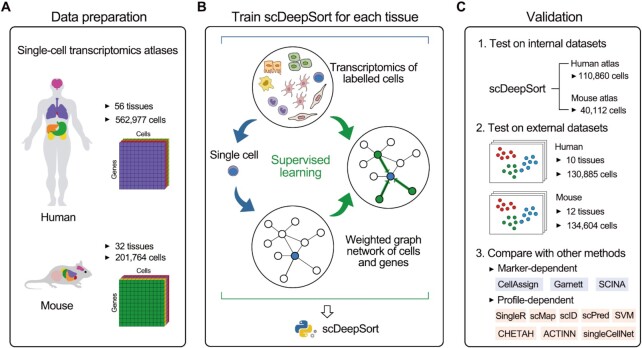
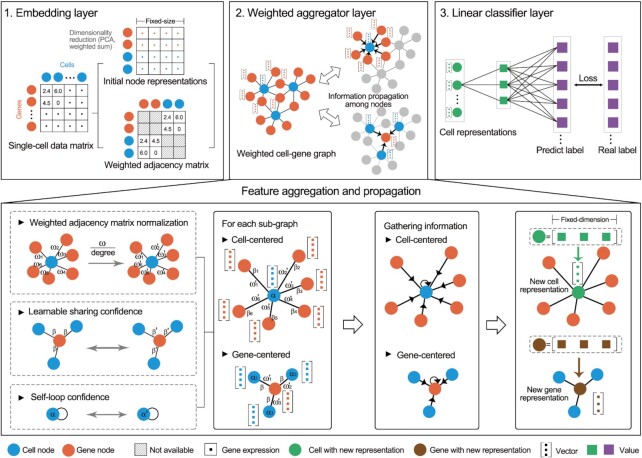
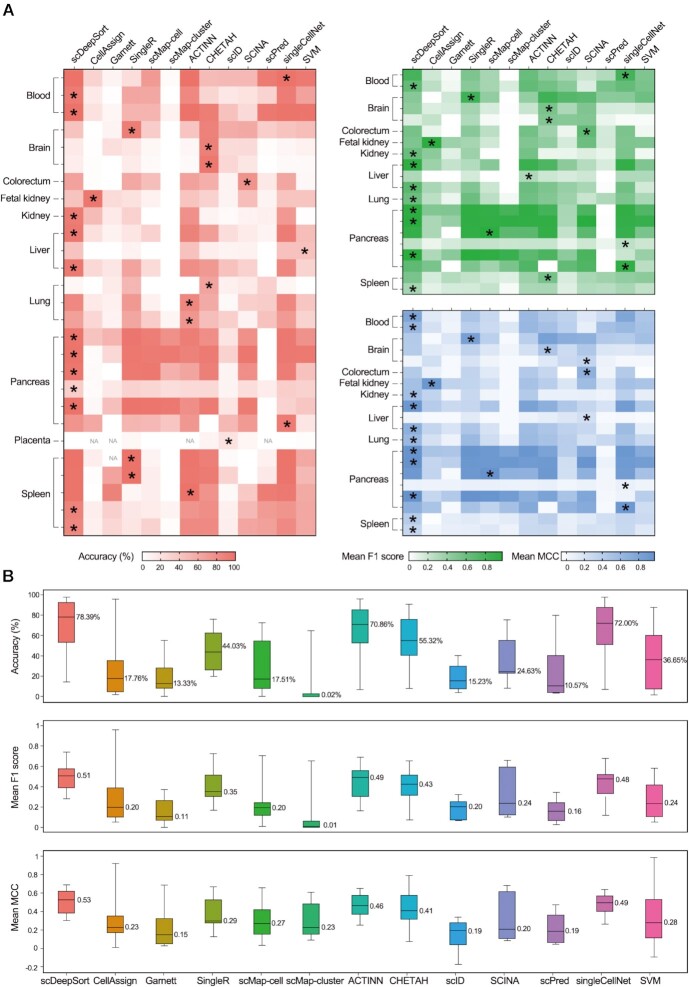
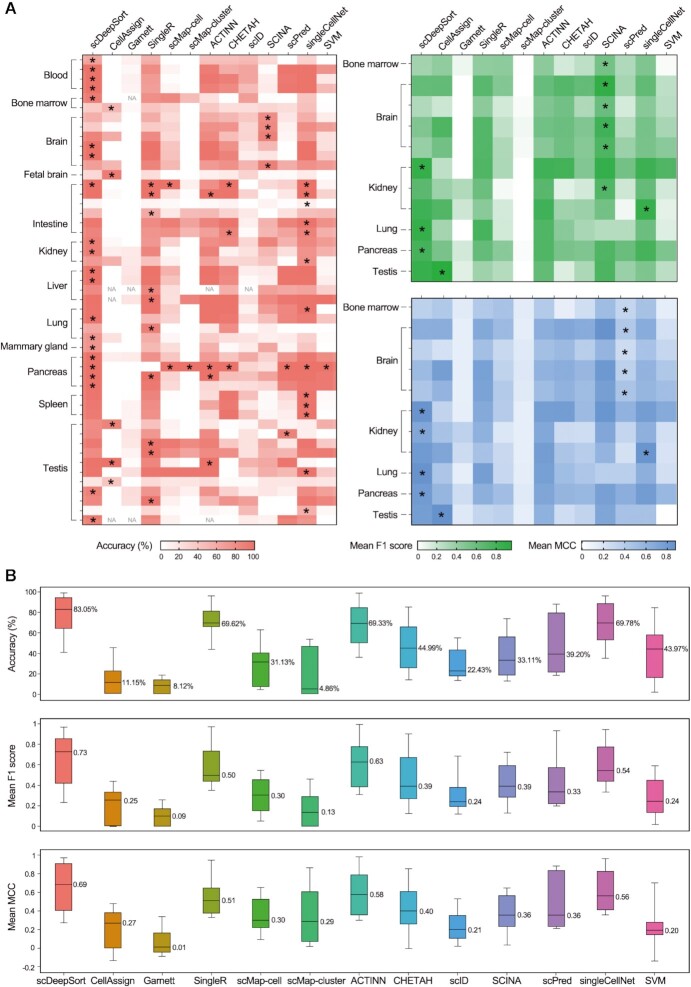
Advances in single-cell RNA sequencing (scRNA-seq) have furthered the simultaneous classification of thousands of cells in a single assay based on transcriptome profiling. In most analysis protocols, single-cell type annotation relies on marker genes or RNA-seq profiles, resulting in poor extrapolation. Still, the accurate cell-type annotation for single-cell transcriptomic data remains a great challenge. Here, we introduce scDeepSort (https://github.com/ZJUFanLab/scDeepSort), a pre-trained cell-type annotation tool for single-cell transcriptomics that uses a deep learning model with a weighted graph neural network (GNN). Using human and mouse scRNA-seq data resources, we demonstrate the high performance and robustness of scDeepSort in labeling 764 741 cells involving 56 human and 32 mouse tissues. Significantly, scDeepSort outperformed other known methods in annotating 76 external test datasets, reaching an 83.79% accuracy across 265 489 cells in humans and mice. Moreover, we demonstrate the universality of scDeepSort using more challenging datasets and using references from different scRNA-seq technology. Above all, scDeepSort is the first attempt to annotate cell types of scRNA-seq data with a pre-trained GNN model, which can realize the accurate cell-type annotation without additional references, i.e. markers or RNA-seq profiles.
Overview
The claims and statistics of this paper haven’t been checked yet.
Free: it reads the open-access text and checks the first 5 claims that cite a source we can check. Create a free account to check every claim.
Integrity signals
Registry
Cites
Statistics
Figures
Verification
Claims the paper makes
The claims and statistics of this paper haven’t been checked yet.
Free: it reads the open-access text and checks the first 5 claims that cite a source we can check. Create a free account to check every claim.
Claims other papers make about this one
Each is checked against this paper’s own text: does it say what the citing paper says it does?
The source backs part of the claim, not all of it — or backs it for a different population, condition or comparison.
In the citing paper
“Compared to tasks such as cell annotation and batch correction, perturbation prediction offers experimentally generated model input/output with well-defined objectives, making it a more robust benchmark for assessing foundation models (15, 20, 21).”
From A systematic comparison of single-cell perturbation response prediction models (2026) · cites this paper as [20]
Experimental — accuracy not yet measured
Self-check
Percentages, sums and reported differences re-computed from the paper’s own numbers.
The self-check needs the paper’s full text.
Citations
Cites
An integrated encyclopedia of DNA elements in the human genome
The ENCODE Project Consortium (2012) · Nature · doi:10.1038/nature11247 · Cited by 18,072
Mastering the game of Go with deep neural networks and tree search
Silver, D., Huang, A., Maddison, C. J., Guez, A., Sifre, L., van den Driessche, G., Schrittwieser, J., Antonoglou, I., Panneershelvam, V., Lanctot, M., et al. (2016) · Nature · doi:10.1038/nature16961 · Cited by 15,612
A Comprehensive Survey on Graph Neural Networks
Wu, Z., Pan, S., Chen, F., Long, G., Zhang, C., & Yu, P. S. (2021) · IEEE Transactions on Neural Networks and Learning Systems · doi:10.1109/tnnls.2020.2978386 · Cited by 11,000
Inductive Representation Learning on Large Graphs
Hamilton, W. L., Ying, R., & Leskovec, J. (2017) · arXiv · doi:10.48550/arxiv.1706.02216 · Cited by 10,639
Highly parallel genome-wide expression profiling of individual cells using nanoliter droplets.
Macosko, E. Z., Basu, A., Satija, R., Nemesh, J., Shekhar, K., Goldman, M., Tirosh, I., Bialas, A. R., Kamitaki, N., Martersteck, E. M., et al. (2015) · Cell · doi:10.1016/j.cell.2015.05.002 · Cited by 7,110
Graph neural networks: A review of methods and applications
Zhou, J., Cui, G., Hu, S., Zhang, Z., Yang, C., Liu, Z., Wang, L., Li, C., & Sun, M. (2020) · AI Open · doi:10.1016/j.aiopen.2021.01.001 · Cited by 6,880
Graph Neural Networks: A Review of Methods and Applications
Zhou, J., Cui, G., Hu, S., Zhang, Z., Yang, C., Liu, Z., Wang, L., Li, C., & Sun, M. (2018) · arXiv · doi:10.48550/arxiv.1812.08434 · Cited by 6,880
Targeted Branching for the Maximum Independent Set Problem Using Graph Neural Networks
Silva, G., Rodrigues, M., Teixeira, A., & Amorim, M. (2024) · DROPS (Schloss Dagstuhl – Leibniz Center for Informatics) · doi:10.4230/lipics.sea.2024.20 · Cited by 5,183
Aran, D., Looney, A. P., Liu, L., Wu, E., Fong, V., Hsu, A., Chak, S., Naikawadi, R. P., Wolters, P. J., Abate, A. R., et al. (2019) · Nature Immunology · doi:10.1038/s41590-018-0276-y · Cited by 4,984 · cited 9×
“Several methods including SingleR (8), CHETAH (9), scMap (10), scID (11), scPred (12), ACTINN (13), CellAssign (14), Garnett (15), SCINA (16), singleCellNet (17) and support vector machine (SVM) belong to this category as described in the recent review (18).”
MethodInfluentialIdentifying Medical Diagnoses and Treatable Diseases by Image-Based Deep Learning
Kermany, D. S., Goldbaum, M., Cai, W., Valentim, C. C. S., Liang, H., Baxter, S. L., McKeown, A., Yang, G., Wu, X., Yan, F., et al. (2018) · Cell · doi:10.1016/j.cell.2018.02.010 · Cited by 4,842
The single-cell transcriptional landscape of mammalian organogenesis
Cao, J., Spielmann, M., Qiu, X., Huang, X., Ibrahim, D. M., Hill, A. J., Zhang, F., Mundlos, S., Christiansen, L., Steemers, F. J., et al. (2019) · Nature · doi:10.1038/s41586-019-0969-x · Cited by 4,490
Droplet barcoding for single-cell transcriptomics applied to embryonic stem cells
Klein, A. M., Mazutis, L., Akartuna, I., Tallapragada, N., Veres, A., Li, V., Peshkin, L., Weitz, D. A., & Kirschner, M. W. (2015) · Cell · doi:10.1016/j.cell.2015.04.044 · Cited by 3,356 · cited 1×
“Recent advancements in single-cell RNA sequencing (scRNA-seq) that permit the identification of various cell types based on transcriptomics at single-cell resolution have facilitated our understanding of the heterogeneity of cellular phenotypes and their composition within complex tissues (1,2).”
BackgroundA Comprehensive Survey on Graph Neural Networks
Wu, Z., Pan, S., Chen, F., Long, G., Zhang, C., & Yu, P. (2020) · UTS ePRESS (University of Technology Sydney) · Cited by 3,174
Deep learning for healthcare: review, opportunities and challenges
Miotto, R., Wang, F., Wang, S., Jiang, X., & Dudley, J. T. (2018) · Briefings in Bioinformatics · doi:10.1093/bib/bbx044 · Cited by 3,076 · cited 1×
“However, the interpretability is the common failing and difficulty for the majority of deep learning models, which is also a great challenge in the field of computer science (27,49).”
BackgroundSingle-cell transcriptomics of 20 mouse organs creates a Tabula Muris
The Tabula Muris Consortium, coordination, O., coordination, L., processing, O. C. A., sequencing, L. P. A., analysis, C. D., annotation, C. T., Writing group, Supplemental text writing group, & Principal investigators (2018) · Nature · doi:10.1038/s41586-018-0590-4 · Cited by 2,842
Clinically applicable deep learning for diagnosis and referral in retinal disease
De Fauw, J., Ledsam, J. R., Romera-Paredes, B., Nikolov, S., Tomasev, N., Blackwell, S., Askham, H., Glorot, X., O’Donoghue, B., Visentin, D., et al. (2018) · Nature Medicine · doi:10.1038/s41591-018-0107-6 · Cited by 2,639
A Deep Learning Approach to Antibiotic Discovery
Stokes, J. M., Yang, K., Swanson, K., Jin, W., Cubillos-Ruiz, A., Donghia, N. M., MacNair, C. R., French, S., Carfrae, L. A., Bloom-Ackermann, Z., et al. (2020) · Cell · doi:10.1016/j.cell.2020.01.021 · Cited by 2,463
The Immunological Genome Project: networks of gene expression in immune cells
The Immunological Genome Project Consortium, Heng, T. S. P., Painter, M. W., Elpek, K., Lukacs-Kornek, V., Mauermann, N., Turley, S. J., Koller, D., Kim, F. S., Wagers, A. J., et al. (2008) · Nature Immunology · doi:10.1038/ni1008-1091 · Cited by 1,864
Massively parallel single-cell RNA-seq for marker-free decomposition of tissues into cell types
Jaitin, D. A., Kenigsberg, E., Keren-Shaul, H., Elefant, N., Paul, F., Zaretsky, I., Mildner, A., Cohen, N., Jung, S., Tanay, A., et al. (2014) · Science · doi:10.1126/science.1247651 · Cited by 1,795
A single-cell survey of the small intestinal epithelium
Haber, A. L., Biton, M., Rogel, N., Herbst, R. H., Shekhar, K., Smillie, C., Burgin, G., Delorey, T. M., Howitt, M. R., Katz, Y., et al. (2017) · Nature · doi:10.1038/nature24489 · Cited by 1,750
Mapping the Mouse Cell Atlas by Microwell-Seq
Han, X., Wang, R., Zhou, Y., Fei, L., Sun, H., Lai, S., Saadatpour, A., Zhou, Z., Chen, H., Ye, F., et al. (2018) · Cell · doi:10.1016/j.cell.2018.02.001 · Cited by 1,597
Self-citationSingle-Cell Transcriptome Profiling of Human Pancreatic Islets in Health and Type 2 Diabetes
Segerstolpe, Å., Palasantza, A., Eliasson, P., Andersson, E.-M., Andréasson, A.-C., Sun, X., Picelli, S., Sabirsh, A., Clausen, M., Bjursell, M. K., et al. (2016) · Cell Metabolism · doi:10.1016/j.cmet.2016.08.020 · Cited by 1,550
Molecular diversity and specializations among the cells of the adult mouse brain
Saunders, A., Macosko, E. Z., Wysoker, A., Goldman, M., Krienen, F. M., de Rivera, H., Bien, E., Baum, M., Bortolin, L., Wang, S., et al. (2018) · Cell · doi:10.1016/j.cell.2018.07.028 · Cited by 1,531 · cited 2×
“Moreover, on three more challenging single-cell atlases (33–35), scDeepSort also accurately predicts the main cell type (Supplementary Figure S3) for most cells except the partial neurons in the Loom dataset (35).”
BackgroundMethodCellMarker: a manually curated resource of cell markers in human and mouse
Zhang, X., Lan, Y., Xu, J., Quan, F., Zhao, E., Deng, C., Luo, T., Xu, L., Liao, G., Yan, M., et al. (2019) · Nucleic Acids Research · doi:10.1093/nar/gky900 · Cited by 1,524
Baron, M., Veres, A., Wolock, S. L., Faust, A. L., Gaujoux, R., Vetere, A., Ryu, J. H., Wagner, B. K., Shen-Orr, S. S., Klein, A. M., et al. (2016) · Cell Systems · doi:10.1016/j.cels.2016.08.011 · Cited by 1,508
GNNExplainer: Generating Explanations for Graph Neural Networks.
Ying, R., Bourgeois, D., You, J., Žitnik, M., & Leskovec, J. (2019) · PubMed · Cited by 1,446
Eleven grand challenges in single-cell data science
Lähnemann, D., Köster, J., Szczurek, E., McCarthy, D. J., Hicks, S. C., Robinson, M. D., Vallejos, C. A., Campbell, K. R., Beerenwinkel, N., Mahfouz, A., et al. (2020) · Genome Biology · doi:10.1186/s13059-020-1926-6 · Cited by 1,327
Self-citationA Single-Cell Transcriptome Atlas of the Human Pancreas
Muraro, M. J., Dharmadhikari, G., Grün, D., Groen, N., Dielen, T., Jansen, E., van Gurp, L., Engelse, M. A., Carlotti, F., de Koning, E. J. P., et al. (2016) · Cell Systems · doi:10.1016/j.cels.2016.09.002 · Cited by 1,321
Deep learning-based multi-omics integration robustly predicts survival in liver cancer
Chaudhary, K., Poirion, O. B., Lu, L., & Garmire, L. X. (2018) · Clinical Cancer Research · doi:10.1158/1078-0432.ccr-17-0853 · Cited by 1,091
Construction of a human cell landscape at single-cell level
Han, X., Zhou, Z., Fei, L., Sun, H., Wang, R., Chen, Y., Chen, H., Wang, J., Tang, H., Ge, W., et al. (2020) · Nature · doi:10.1038/s41586-020-2157-4 · Cited by 1,087
Self-citationA primer on deep learning in genomics
Zou, J., Huss, M., Abid, A., Mohammadi, P., Torkamani, A., & Telenti, A. (2019) · Nature Genetics · doi:10.1038/s41588-018-0295-5 · Cited by 891
GNNExplainer: Generating Explanations for Graph Neural Networks
Ying, R., Bourgeois, D., You, J., Zitnik, M., & Leskovec, J. (2019) · arXiv · doi:10.48550/arxiv.1903.03894 · Cited by 850
scmap: projection of single-cell RNA-seq data across data sets
(2018) · doi:10.1038/nmeth.4644 · Cited by 735
RNA Sequencing of Single Human Islet Cells Reveals Type 2 Diabetes Genes
Xin, Y., Kim, J., Okamoto, H., Ni, M., Wei, Y., Adler, C., Murphy, A. J., Yancopoulos, G. D., Lin, C., & Gromada, J. (2016) · Cell Metabolism · doi:10.1016/j.cmet.2016.08.018 · Cited by 692
A single-cell RNA-seq survey of the developmental landscape of the human prefrontal cortex
Zhong, S., Zhang, S., Fan, X., Wu, Q., Yan, L., Dong, J., Zhang, H., Li, L., Sun, L., Pan, N., et al. (2018) · Nature · doi:10.1038/nature25980 · Cited by 689
Self-citationBini, S. A. (2018) · The Journal of Arthroplasty · doi:10.1016/j.arth.2018.02.067 · Cited by 670
A comparison of automatic cell identification methods for single-cell RNA sequencing data
Abdelaal, T., Michielsen, L., Cats, D., Hoogduin, D., Mei, H., Reinders, M. J. T., & Mahfouz, A. (2019) · Genome Biology · doi:10.1186/s13059-019-1795-z · Cited by 628 · cited 2×
“Interestingly, it seems easy to map cells across the human pancreas as reported in the recent benchmark analysis (18), wherein the widely-used human pancreas datasets (37,42– 44) were tested.”
BackgroundMethodWainberg, M., Merico, D., Delong, A., & Frey, B. J. (2018) · Nature Biotechnology · doi:10.1038/nbt.4233 · Cited by 585
Molecular architecture of the developing mouse brain
La Manno, G., Siletti, K., Furlan, A., Gyllborg, D., Vinsland, E., Mossi Albiach, A., Mattsson Langseth, C., Khven, I., Lederer, A. R., Dratva, L. M., et al. (2021) · Nature · doi:10.1038/s41586-021-03775-x · Cited by 563 · cited 1×
“Moreover, on three more challenging singlecell atlases (33–35), scDeepSort also accurately predicts the main cell type (Supplementary Figure S3) for most cells except the partial neurons in the Loom dataset (35).”
BackgroundMolecular architecture of the developing mouse brain
La Manno, G., Siletti, K., Furlan, A., Gyllborg, D., Vinsland, E., Langseth, C. M., Khven, I., Johnsson, A., Nilsson, M., Lönnerberg, P., et al. (2020) · doi:10.1101/2020.07.02.184051 · Cited by 563
Supervised classification enables rapid annotation of cell atlases
Pliner, H. A., Shendure, J., & Trapnell, C. (2019) · doi:10.1101/538652 · Cited by 498
scPred: accurate supervised method for cell-type classification from single-cell RNA-seq data
Alquicira-Hernandez, J., Sathe, A., Ji, H. P., Nguyen, Q., & Powell, J. E. (2019) · Genome Biology · doi:10.1186/s13059-019-1862-5 · Cited by 482
scGNN is a novel graph neural network framework for single-cell RNA-Seq analyses
Wang, J., Ma, A., Chang, Y., Gong, J., Jiang, Y., Qi, R., Wang, C., Fu, H., Ma, Q., & Xu, D. (2021) · Nature Communications · doi:10.1038/s41467-021-22197-x · Cited by 457
A latent neurogenic program in astrocytes regulated by Notch signaling in the mouse
Magnusson, J. P., Göritz, C., Tatarishvili, J., Dias, D. O., Smith, E. M. K., Lindvall, O., Kokaia, Z., & Frisén, J. (2014) · Science · doi:10.1126/science.346.6206.237 · Cited by 431
Mapping the Mouse Cell Atlas by Microwell-Seq
Han, X., Wang, R., Zhou, Y., Fei, L., Sun, H., Lai, S., Saadatpour, A., Zhou, Z., Chen, H., Ye, F., et al. (2018) · Cell · doi:10.1016/j.cell.2018.05.012 · Cited by 384
Self-citationProbabilistic cell-type assignment of single-cell RNA-seq for tumor microenvironment profiling
Zhang, A. W., O’Flanagan, C., Chavez, E. A., Lim, J. L. P., Ceglia, N., McPherson, A., Wiens, M., Walters, P., Chan, T., Hewitson, B., et al. (2019) · Nature Methods · doi:10.1038/s41592-019-0529-1 · Cited by 375
Tan, Y., & Cahan, P. (2019) · Cell Systems · doi:10.1016/j.cels.2019.06.004 · Cited by 368
SCINA: A Semi-Supervised Subtyping Algorithm of Single Cells and Bulk Samples
Zhang, Z., Luo, D., Zhong, X., Choi, J. H., Ma, Y., Wang, S., Mahrt, E., Guo, W., Stawiski, E. W., Modrusan, Z., et al. (2019) · Genes · doi:10.3390/genes10070531 · Cited by 287
scCATCH: Automatic Annotation on Cell Types of Clusters from Single-Cell RNA Sequencing Data
Shao, X., Liao, J., Lu, X., Xue, R., Ai, N., & Fan, X. (2020) · iScience · doi:10.1016/j.isci.2020.100882 · Cited by 286
Self-citationCHETAH: a selective, hierarchical cell type identification method for single-cell RNA sequencing
de Kanter, J. K., Lijnzaad, P., Candelli, T., Margaritis, T., & Holstege, F. C. P. (2019) · Nucleic Acids Research · doi:10.1093/nar/gkz543 · Cited by 285
Paneth Cell Multipotency Induced by Notch Activation following Injury
Yu, S., Tong, K., Zhao, Y., Balasubramanian, I., Yap, G. S., Ferraris, R. P., Bonder, E. M., Verzi, M. P., & Gao, N. (2018) · Cell Stem Cell · doi:10.1016/j.stem.2018.05.002 · Cited by 282
Liao, J., Lu, X., Shao, X., Zhu, L., & Fan, X. (2021) · Trends in Biotechnology · doi:10.1016/j.tibtech.2020.05.006 · Cited by 278
Self-citationACTINN: automated identification of cell types in single cell RNA sequencing
Ma, F., & Pellegrini, M. (2020) · Bioinformatics · doi:10.1093/bioinformatics/btz592 · Cited by 252
Automated methods for cell type annotation on scRNA-seq data
Pasquini, G., Rojo Arias, J. E., Schäfer, P., & Busskamp, V. (2021) · Computational and Structural Biotechnology Journal · doi:10.1016/j.csbj.2021.01.015 · Cited by 249 · cited 1×
“The key point of our work is that the top-ranked performance for the accurate cell-type annotation, which is the most important part in the application scenario of scRNA-seq (45).”
BackgroundSpatial reconstruction of immune niches by combining photoactivatable reporters and scRNA-seq
Medaglia, C., Giladi, A., Stoler-Barak, L., De Giovanni, M., Salame, T. M., Biram, A., David, E., Li, H., Iannacone, M., Shulman, Z., et al. (2017) · Science · doi:10.1126/science.aao4277 · Cited by 241
Spatial transcriptomic survey of human embryonic cerebral cortex by single-cell RNA-seq analysis
Fan, X., Dong, J., Zhong, S., Wei, Y., Wu, Q., Yan, L., Yong, J., Sun, L., Wang, X., Zhao, Y., et al. (2018) · Cell Research · doi:10.1038/s41422-018-0053-3 · Cited by 227
Self-citationSCSA: A Cell Type Annotation Tool for Single-Cell RNA-seq Data
Cao, Y., Wang, X., & Peng, G. (2020) · Frontiers in Genetics · doi:10.3389/fgene.2020.00490 · Cited by 167
Shao, X., Lu, X., Liao, J., Chen, H., & Fan, X. (2020) · Protein & Cell · doi:10.1007/s13238-020-00727-5 · Cited by 159
Self-citationThe International Human Epigenome Consortium: A Blueprint for Scientific Collaboration and Discovery
Stunnenberg, H. G., & Hirst, M. (2016) · Cell · doi:10.1016/j.cell.2016.12.002 · Cited by 158
iDNA-MS: An Integrated Computational Tool for Detecting DNA Modification Sites in Multiple Genomes
Lv, H., Dao, F., Zhang, D., Guan, Z.-X., Yang, H. Q., Su, W., Liu, M., Ding, H., Chen, W., & Lin, H. (2020) · iScience · doi:10.1016/j.isci.2020.100991 · Cited by 137
Self-citationA multicenter study benchmarking single-cell RNA sequencing technologies using reference samples
Chen, W., Zhao, Y., Chen, X., Yang, Z., Xu, X., Bi, Y., Chen, V., Li, J., Choi, H., Ernest, B., et al. (2021) · Nature Biotechnology · doi:10.1038/s41587-020-00748-9 · Cited by 114
scAlign: a tool for alignment, integration, and rare cell identification from scRNA-seq data
Johansen, N., & Quon, G. (2019) · Genome Biology · doi:10.1186/s13059-019-1766-4 · Cited by 100
Boufea, K., Seth, S., & Batada, N. N. (2020) · iScience · doi:10.1016/j.isci.2020.100914 · Cited by 79
A web server for comparative analysis of single-cell RNA-seq data
Alavi, A., Ruffalo, M., Parvangada, A., Huang, Z., & Bar-Joseph, Z. (2018) · Nature Communications · doi:10.1038/s41467-018-07165-2 · Cited by 60
Game-playing software holds lessons for neuroscience
Gibney, E. (2015) · Nature · doi:10.1038/518465a · Cited by 20
Zhang, X., Peng, X., Han, C., Zhu, W., Wei, L., Zhang, Y., Wang, Y., Zhang, X., Tang, H., Zhang, J., et al. (2018) · Protein & Cell · doi:10.1007/s13238-018-0575-y · Cited by 13
Identify differential genes and cell subclusters from time-series scRNA-seq data using scTITANS
Shao, L., Xue, R., Lu, X.-Y., Liao, J., Shao, X., & Fan, X.-H. (2021) · Computational and Structural Biotechnology Journal · doi:10.1016/j.csbj.2021.07.016 · Cited by 8
Self-citation
Cited by
Transfer learning enables predictions in network biology
Theodoris, C. V., Xiao, L., Chopra, A., Chaffin, M. D., Al Sayed, Z. R., Hill, M. C., Mantineo, H., Brydon, E. M., Zeng, Z., Liu, X. S., et al. (2023) · Nature · doi:10.1038/s41586-023-06139-9 · Cited by 1,193
High-resolution de novo structure prediction from primary sequence
Wu, R., Ding, F., Wang, R., Shen, R., Zhang, X., Luo, S., Su, C., Wu, Z., Xie, Q., Berger, B., et al. (2022) · doi:10.1101/2022.07.21.500999 · Cited by 392
Graph Neural Networks for Multimodal Single-Cell Data Integration
Wen, H., Ding, J., Jin, W., Wang, Y., Xie, Y., & Tang, J. (2022) · Proceedings of the 28th ACM SIGKDD Conference on Knowledge Discovery and Data Mining · doi:10.1145/3534678.3539213 · Cited by 77
“While several existing works attempted to introduce graph neural networks to single cell analysis [27, 31, 7, 24], none of them tackle the challenging problem of multimodal data integration which requires handling different modalities simultaneously.”
BackgroundMethodDeep learning in spatial transcriptomics: Learning from the next next-generation sequencing
Heydari, A. A., & Sindi, S. S. (2023) · Biophysics Reviews · doi:10.1063/5.0091135 · Cited by 44
Graph neural networks for single-cell omics data: a review of approaches and applications
Li, S., Hua, H., & Chen, S. (2025) · Briefings in Bioinformatics · doi:10.1093/bib/bbaf109 · Cited by 43
Metadata
- Authors
- Shao, X., Yang, H., Zhuang, X., Liao, J., Yang, P., Cheng, J., Lu, X., Chen, H., & Fan, X.
- Affiliations
- Zhejiang University (CN)
- Pharmaceutical Informatics Institute, College of Pharmaceutical Sciences, Zhejiang University, Hangzhou 310058, China
- First Affiliated Hospital Zhejiang University (CN)
- Westlake University (CN)
- The University of Sydney (AU)
- Corresponding author
- Chen, Huajun
- Fan, Xiaohui
- Venue
- Nucleic Acids Research
- Publisher
- Oxford University Press (OUP)
- Published
- 2021-09-09
- Volume
- 49
- Issue
- 21
- Pages
- e122-e122
- ISSN
- 0305-1048 (ISSN-L)
- 1362-4962
- PMC
- PMC8643674
- OpenAlex
- W3198628780
- Cited by
- 158
- References
- 67
- Citations by year
- 2026: 23 · 2025: 35 · 2024: 47 · 2023: 31 · 2022: 20 · 2021: 2
- FWCI
- 7.88
- Type
- journal article
- Language
- en
- Open access
- gold
- doi.org
- Licence
- Locations
- Nucleic Acids Research (publishedVersion, cc-by-nc)
- bioRxiv (Cold Spring Harbor Laboratory) (acceptedVersion, cc-by-nc-nd)
- PubMed Central (publishedVersion, cc-by-nc)
- PubMed (publishedVersion)
- Funders
- National Natural Science Foundation of China (81973701, 91846204/U19B2027)
- Natural Science Foundation of Zhejiang Province (LZ20H290002)
- National Youth Top-notch Talent Support Program (W02070098)
- Topics
- Life Sciences › Biochemistry, Genetics and Molecular Biology › Molecular Biology › Single-cell and spatial transcriptomics
- Life Sciences › Biochemistry, Genetics and Molecular Biology › Molecular Biology › Gene expression and cancer classification
- Life Sciences › Biochemistry, Genetics and Molecular Biology › Molecular Biology › Genomics and Phylogenetic Studies
- Keywords
- cell type annotation, single-cell transcriptomics, pre-trained deep learning models, human and mouse tissues, cross-dataset generalization, single-cell RNA sequencing
- MeSH terms
- Deep Learning, Animals, Humans, RNA, Neural Networks, Computer, Databases, Genetic, Mice, Single-Cell Analysis, Transcriptome
About these checks
Registry, retraction, Cites and statistics results are computed, not judged, with one exception: a printed reference that no index lists is read once by a model before it counts as a citation error. Claims are extracted by a model and kept only when their quote appears verbatim in the text; each cited source is then checked, with a model’s help, for whether it says what the claim relies on. Those verdicts can be wrong — read the claim’s quote and the cited source before relying on one.
Statistics and arithmetic are recomputed, not judged.
Confidence bands are shown only for fields calibrated on our annotated test set. None is calibrated yet, so no band is shown.
What counts as a claim ›How we measure confidence ›How we check this ›
Are you an author, or do you see a problem with this page? Request a review
Data sources
Bibliographic data: Semantic Scholar, OpenAlex, Crossref.
Contains information from the Semantic Scholar Academic Graph Datasets, made available under the ODC Attribution License (ODC-BY 1.0).
Semantic Scholar’s data is described in: Kinney, R., et al. (2023). The Semantic Scholar Open Data Platform. arXiv:2301.10140.
