

scDeepSort: a pre-trained cell-type annotation method for single-cell transcriptomics using deep learning with a weighted graph neural network
Open accessPublished version of a preprint
The DOI matches its Crossref record; 68 of the 68 references it cites were found in a registry or an index.
Abstract
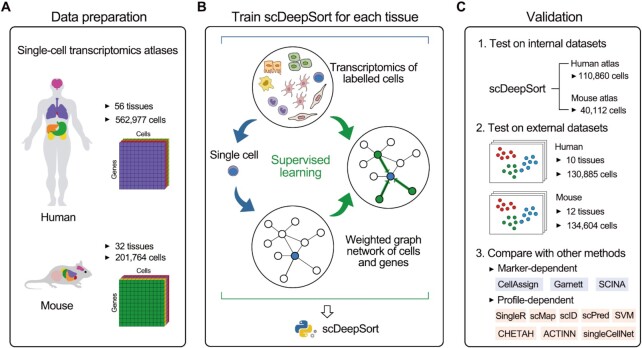
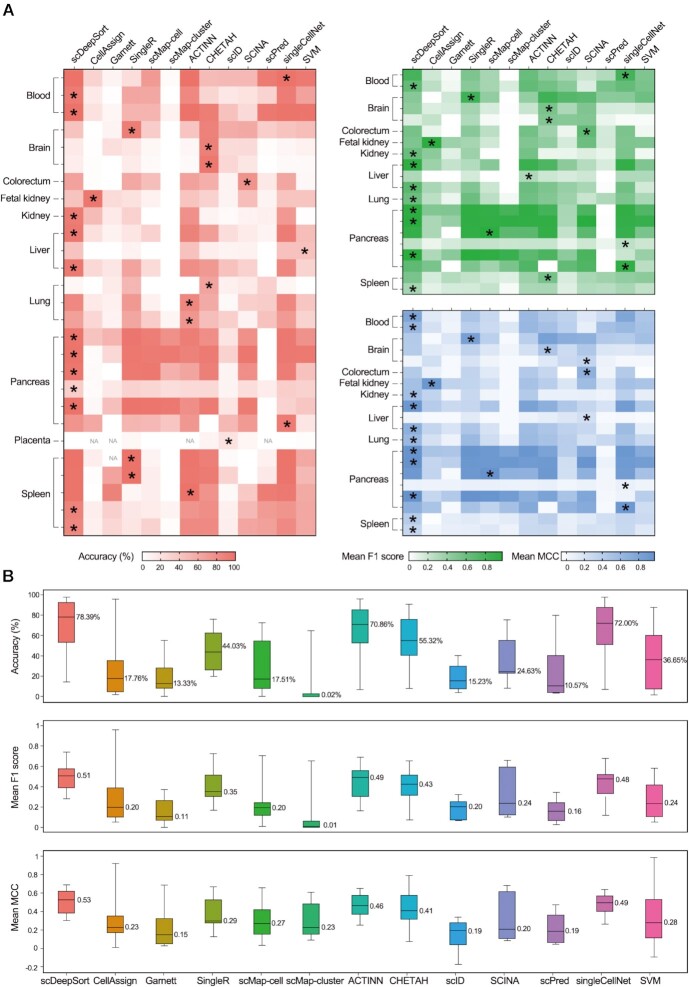
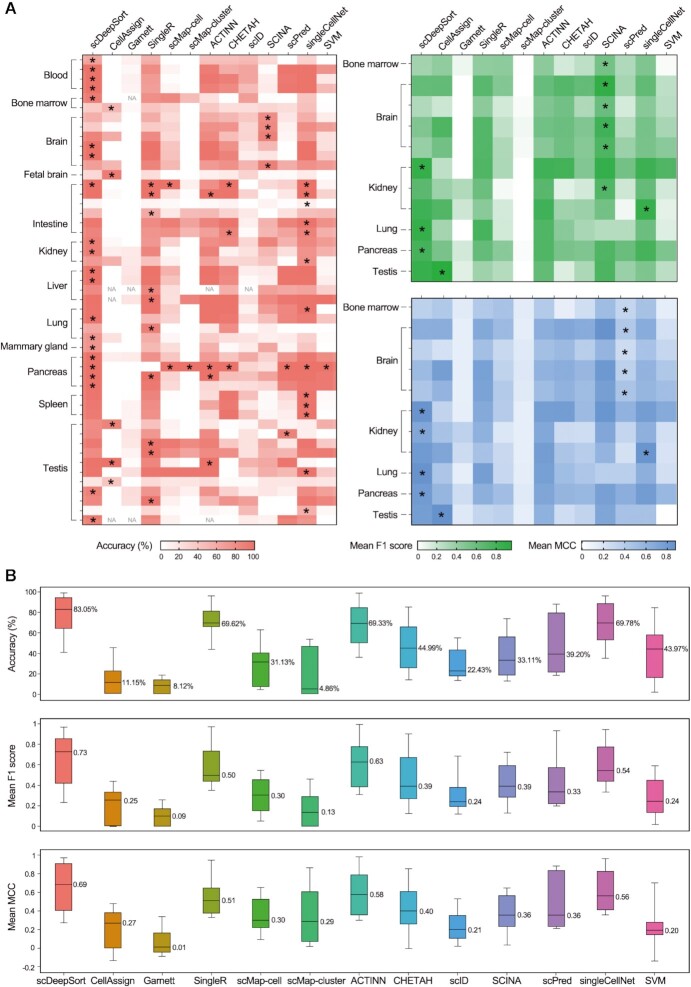
Advances in single-cell RNA sequencing (scRNA-seq) have furthered the simultaneous classification of thousands of cells in a single assay based on transcriptome profiling. In most analysis protocols, single-cell type annotation relies on marker genes or RNA-seq profiles, resulting in poor extrapolation. Still, the accurate cell-type annotation for single-cell transcriptomic data remains a great challenge. Here, we introduce scDeepSort (https://github.com/ZJUFanLab/scDeepSort), a pre-trained cell-type annotation tool for single-cell transcriptomics that uses a deep learning model with a weighted graph neural network (GNN). Using human and mouse scRNA-seq data resources, we demonstrate the high performance and robustness of scDeepSort in labeling 764 741 cells involving 56 human and 32 mouse tissues. Significantly, scDeepSort outperformed other known methods in annotating 76 external test datasets, reaching an 83.79% accuracy across 265 489 cells in humans and mice. Moreover, we demonstrate the universality of scDeepSort using more challenging datasets and using references from different scRNA-seq technology. Above all, scDeepSort is the first attempt to annotate cell types of scRNA-seq data with a pre-trained GNN model, which can realize the accurate cell-type annotation without additional references, i.e. markers or RNA-seq profiles.
Overview
The claims and statistics of this paper haven’t been checked yet.
Free: it reads the open-access text and checks the first 5 claims that cite a source we can check. Create a free account to check every claim.
Integrity signals
Registry
Cites
Statistics
Figures
Verification
Claims the paper makes
The claims and statistics of this paper haven’t been checked yet.
Free: it reads the open-access text and checks the first 5 claims that cite a source we can check. Create a free account to check every claim.
Claims other papers make about this one
Each is checked against this paper’s own text: does it say what the citing paper says it does?
The source backs part of the claim, not all of it — or backs it for a different population, condition or comparison.
In the citing paper
“Compared to tasks such as cell annotation and batch correction, perturbation prediction offers experimentally generated model input/output with well-defined objectives, making it a more robust benchmark for assessing foundation models (15, 20, 21).”
From A systematic comparison of single-cell perturbation response prediction models (2026) · cites this paper as [20]
Experimental — accuracy not yet measured
Self-check
Percentages, sums and reported differences re-computed from the paper’s own numbers.
The self-check needs the paper’s full text.
Citations
Cites
An integrated encyclopedia of DNA elements in the human genome
The ENCODE Project Consortium (2012) · Nature · doi:10.1038/nature11247 · Cited by 18,072
Mastering the game of Go with deep neural networks and tree search
Silver, D., Huang, A., Maddison, C. J., Guez, A., Sifre, L., van den Driessche, G., Schrittwieser, J., Antonoglou, I., Panneershelvam, V., Lanctot, M., et al. (2016) · Nature · doi:10.1038/nature16961 · Cited by 15,612
A Comprehensive Survey on Graph Neural Networks
Wu, Z., Pan, S., Chen, F., Long, G., Zhang, C., & Yu, P. S. (2021) · IEEE Transactions on Neural Networks and Learning Systems · doi:10.1109/tnnls.2020.2978386 · Cited by 11,000
Inductive Representation Learning on Large Graphs
Hamilton, W. L., Ying, R., & Leskovec, J. (2017) · arXiv · doi:10.48550/arxiv.1706.02216 · Cited by 10,639
Highly parallel genome-wide expression profiling of individual cells using nanoliter droplets.
Macosko, E. Z., Basu, A., Satija, R., Nemesh, J., Shekhar, K., Goldman, M., Tirosh, I., Bialas, A. R., Kamitaki, N., Martersteck, E. M., et al. (2015) · Cell · doi:10.1016/j.cell.2015.05.002 · Cited by 7,110
Graph neural networks: A review of methods and applications
Zhou, J., Cui, G., Hu, S., Zhang, Z., Yang, C., Liu, Z., Wang, L., Li, C., & Sun, M. (2020) · AI Open · doi:10.1016/j.aiopen.2021.01.001 · Cited by 6,880
Graph Neural Networks: A Review of Methods and Applications
Zhou, J., Cui, G., Hu, S., Zhang, Z., Yang, C., Liu, Z., Wang, L., Li, C., & Sun, M. (2018) · arXiv · doi:10.48550/arxiv.1812.08434 · Cited by 6,880
Targeted Branching for the Maximum Independent Set Problem Using Graph Neural Networks
Silva, G., Rodrigues, M., Teixeira, A., & Amorim, M. (2024) · DROPS (Schloss Dagstuhl – Leibniz Center for Informatics) · doi:10.4230/lipics.sea.2024.20 · Cited by 5,183
Aran, D., Looney, A. P., Liu, L., Wu, E., Fong, V., Hsu, A., Chak, S., Naikawadi, R. P., Wolters, P. J., Abate, A. R., et al. (2019) · Nature Immunology · doi:10.1038/s41590-018-0276-y · Cited by 4,984 · cited 9×
“Several methods including SingleR (8), CHETAH (9), scMap (10), scID (11), scPred (12), ACTINN (13), CellAssign (14), Garnett (15), SCINA (16), singleCellNet (17) and support vector machine (SVM) belong to this category as described in the recent review (18).”
MethodInfluentialIdentifying Medical Diagnoses and Treatable Diseases by Image-Based Deep Learning
Kermany, D. S., Goldbaum, M., Cai, W., Valentim, C. C. S., Liang, H., Baxter, S. L., McKeown, A., Yang, G., Wu, X., Yan, F., et al. (2018) · Cell · doi:10.1016/j.cell.2018.02.010 · Cited by 4,842
Cited by
Transfer learning enables predictions in network biology
Theodoris, C. V., Xiao, L., Chopra, A., Chaffin, M. D., Al Sayed, Z. R., Hill, M. C., Mantineo, H., Brydon, E. M., Zeng, Z., Liu, X. S., et al. (2023) · Nature · doi:10.1038/s41586-023-06139-9 · Cited by 1,193
High-resolution de novo structure prediction from primary sequence
Wu, R., Ding, F., Wang, R., Shen, R., Zhang, X., Luo, S., Su, C., Wu, Z., Xie, Q., Berger, B., et al. (2022) · doi:10.1101/2022.07.21.500999 · Cited by 392
A Review of Single-Cell RNA-Seq Annotation, Integration, and Cell–Cell Communication
Cheng, C., Chen, W., Jin, H., & Chen, X. (2023) · Cells · doi:10.3390/cells12151970 · Cited by 224
Shao, X., Li, C., Yang, H., Lu, X., Liao, J., Qian, J., Wang, K., Cheng, J., Yang, P., Chen, H., et al. (2022) · Nature Communications · doi:10.1038/s41467-022-32111-8 · Cited by 202
Self-citationLarge language models for drug discovery and development
Zheng, Y., Koh, H. Y., Ju, J., Yang, M., May, L. T., Webb, G. I., Li, L., Pan, S., & Church, G. M. (2025) · Patterns · doi:10.1016/j.patter.2025.101346 · Cited by 133
Application of Deep Learning on Single-Cell RNA Sequencing Data Analysis: A Review
Brendel, M., Su, C., Bai, Z., Zhang, H., Elemento, O., & Wang, F. (2022) · Genomics Proteomics & Bioinformatics · doi:10.1016/j.gpb.2022.11.011 · Cited by 123
Chen, V., Yang, M., Cui, W., Kim, J. S., Talwalkar, A., & Ma, J. (2024) · Nature Methods · doi:10.1038/s41592-024-02359-7 · Cited by 115
Single-cell omics: experimental workflow, data analyses and applications
Sun, F., Li, H., Sun, D., Fu, S., Gu, L., Shao, X., Wang, Q., Dong, X., Duan, B., Xing, F., et al. (2024) · Science China Life Sciences · doi:10.1007/s11427-023-2561-0 · Cited by 102
Self-citationShen, R., Liu, L., Wu, Z., Zhang, Y., Yuan, Z., Guo, J., Yang, F., Zhang, C., Chen, B., Feng, W., et al. (2022) · Nature Communications · doi:10.1038/s41467-022-35288-0 · Cited by 100
De novo analysis of bulk RNA-seq data at spatially resolved single-cell resolution
Liao, J., Qian, J., Yin, F., Chen, Z., Zhuang, X., Zhang, N., Shao, X., Hu, Y., Yang, P., Cheng, J., et al. (2022) · Nature Communications · doi:10.1038/s41467-022-34271-z · Cited by 98
Self-citationFrom single- to multi-omics: future research trends in medicinal plants
Yang, L., Yang, Y. J., Huang, L., Cui, X., & Liu, Y. (2022) · Briefings in Bioinformatics · doi:10.1093/bib/bbac485 · Cited by 93
Graph Neural Networks for Multimodal Single-Cell Data Integration
Wen, H., Ding, J., Jin, W., Wang, Y., Xie, Y., & Tang, J. (2022) · Proceedings of the 28th ACM SIGKDD Conference on Knowledge Discovery and Data Mining · doi:10.1145/3534678.3539213 · Cited by 77
“While several existing works attempted to introduce graph neural networks to single cell analysis [27, 31, 7, 24], none of them tackle the challenging problem of multimodal data integration which requires handling different modalities simultaneously.”
BackgroundMethodAdvancing bioinformatics with language models: components, applications, and perspectives
Liu, J., Yang, M., Yu, Y., Xu, H., Wang, T., Li, K., & Zhou, X. (2026) · Briefings in Bioinformatics · doi:10.1093/bib/bbag367 · Cited by 72
CIForm as a Transformer-based model for cell-type annotation of large-scale single-cell RNA-seq data
Xu, J., Zhang, A., Liu, F., Chen, L., & Zhang, X. (2023) · Briefings in Bioinformatics · doi:10.1093/bib/bbad195 · Cited by 71
Single-Cell RNA Sequencing in Parkinson’s Disease
Ma, S., & Lim, S. B. (2021) · Biomedicines · doi:10.3390/biomedicines9040368 · Cited by 61
Yuan, L., Sun, S., Jiang, Y., Zhang, Q., Ye, L., Zheng, C.-H., & Huang, D.-S. (2024) · Briefings in Bioinformatics · doi:10.1093/bib/bbae662 · Cited by 58
Peng, L., Tan, J., Xiong, W., Zhang, L., Wang, Z., Yuan, R., Li, Z., & Chen, X. (2023) · Computers in Biology and Medicine · doi:10.1016/j.compbiomed.2023.107137 · Cited by 50
Deep Learning in Single-cell Analysis
Molho, D., Ding, J., Tang, W., Li, Z., Wen, H., Wang, Y., Venegas, J., Jin, W., Liu, R., Su, R., et al. (2024) · ACM Transactions on Intelligent Systems and Technology · doi:10.1145/3641284 · Cited by 51
Transformer-Based Single-Cell Language Model: A Survey
Lan, W., He, G., Liu, M., Chen, Q., Cao, J., & Peng, W. (2024) · Big Data Mining and Analytics · doi:10.26599/bdma.2024.9020034 · Cited by 47
Deep learning in spatial transcriptomics: Learning from the next next-generation sequencing
Heydari, A. A., & Sindi, S. S. (2023) · Biophysics Reviews · doi:10.1063/5.0091135 · Cited by 44
Deep Learning in Spatial Transcriptomics: Learning From the Next Next-Generation Sequencing
Heydari, A. A., & Sindi, S. S. (2022) · doi:10.1101/2022.02.28.482392 · Cited by 44
Graph neural networks for single-cell omics data: a review of approaches and applications
Li, S., Hua, H., & Chen, S. (2025) · Briefings in Bioinformatics · doi:10.1093/bib/bbaf109 · Cited by 43
Huang, Y., Li, Y.-C., You, Z.-H., Hu, L., Hu, P., Wang, L., Peng, Y., & Huang, Z.-A. (2025) · BMC Biology · doi:10.1186/s12915-025-02128-8 · Cited by 42
Direct neuronal reprogramming by temporal identity factors
Boudreau‐Pinsonneault, C., David, L. A., Fernandes, J. A. L., Javed, A., Fries, M., Mattar, P. A., & Cayouette, M. (2023) · Proceedings of the National Academy of Sciences · doi:10.1073/pnas.2122168120 · Cited by 41
An overview of computational methods in single-cell transcriptomic cell type annotation
Li, T., Wang, Z., Liu, Y., He, S., Zou, Q., & Zhang, Y. (2025) · Briefings in Bioinformatics · doi:10.1093/bib/bbaf207 · Cited by 39
GE-Impute: graph embedding-based imputation for single-cell RNA-seq data
Wu, X., & Zhou, Y. (2022) · Briefings in Bioinformatics · doi:10.1093/bib/bbac313 · Cited by 39
A Graph Neural Network Approach for the Analysis of siRNA-Target Biological Networks
Rosa, M. L., Fiannaca, A., Paglia, L. L., & Urso, A. M. (2022) · International Journal of Molecular Sciences · doi:10.3390/ijms232214211 · Cited by 39
Zhang, H., Wang, Y., Pan, Z., Sun, X., Mou, M., Zhang, B., Li, Z., Li, H., & Zhu, F. (2022) · Briefings in Bioinformatics · doi:10.1093/bib/bbac411 · Cited by 38
Interpretable deep learning in single-cell omics
Wagle, M. M., Long, S., Chen, C., Liu, C., & Yang, P. (2024) · Bioinformatics · doi:10.1093/bioinformatics/btae374 · Cited by 37
Self-citationAn efficient scRNA-seq dropout imputation method using graph attention network
Xu, C., Cai, L., & Gao, J. (2021) · BMC Bioinformatics · doi:10.1186/s12859-021-04493-x · Cited by 35
Retrieval-Augmented Generation with Graphs (GraphRAG)
Han, H., Wang, Y., Shomer, H., Guo, K., Ding, J., Lei, Y., Halappanavar, M., Rossi, R. A., Mukherjee, S., Tang, X., et al. (2025) · arXiv · doi:10.48550/arxiv.2501.00309 · Cited by 34
Probing transient memory of cellular states using single-cell lineages
Singh, A., & Saint-Antoine, M. (2023) · Frontiers in Microbiology · doi:10.3389/fmicb.2022.1050516 · Cited by 34
Attention-based deep clustering method for scRNA-seq cell type identification
Li, S., Guo, H., Zhang, S., Li, Y., & Li, M. (2023) · PLoS Computational Biology · doi:10.1371/journal.pcbi.1011641 · Cited by 34
Wang, H., Lin, K., Zhang, Q., Shi, J., Song, X., Wu, J., Zhao, C., & He, K. (2024) · Bioinformatics · doi:10.1093/bioinformatics/btae159 · Cited by 30
“Future research should improve the biological interpretability of GNN, which will facilitate the development of biological research and biomedical applications (Shao et al .”
BackgroundGraph neural network approaches for single-cell data: a recent overview
Lazaros, K., Koumadorakis, D. E., Vlamos, P., & Vrahatis, A. G. (2024) · Neural Computing and Applications · doi:10.1007/s00521-024-09662-6 · Cited by 30
Shao, X., Wang, Z., Wang, K., Lu, X., Zhang, P., Guo, R., Liao, J., Yang, P., Zheng, S., Xu, X., et al. (2024) · Engineering · doi:10.1016/j.eng.2023.12.004 · Cited by 30
Self-citationMulti-View Clustering With Graph Learning for scRNA-Seq Data
Wu, W., Zhang, W., Hou, W., & Ma, X. (2023) · IEEE Transactions on Computational Biology and Bioinformatics · doi:10.1109/tcbb.2023.3298334 · Cited by 28
scTransSort: Transformers for Intelligent Annotation of Cell Types by Gene Embeddings
Jiao, L., Wang, G., Dai, H., Li, X., Wang, S., & Song, T. (2023) · Biomolecules · doi:10.3390/biom13040611 · Cited by 28
Overview of single‐cell RNA sequencing analysis and its application to spermatogenesis research
Suzuki, T. (2023) · Reproductive Medicine and Biology · doi:10.1002/rmb2.12502 · Cited by 28
Zhao, M., Li, J., Liu, X., Ma, K., Tang, J., & Guo, F. (2024) · Genome Research · doi:10.1101/gr.278439.123 · Cited by 28
A Systematic Comparison of Single-Cell Perturbation Response Prediction Models
Li, L., You, Y., Fu, Y., Liao, W., Fan, X., Lu, S., Cao, Y., Li, B., Ren, W., Kong, J., et al. (2024) · bioRxiv (Cold Spring Harbor Laboratory) · doi:10.1101/2024.12.23.630036 · Cited by 25
“Compared to tasks such as cell annotation and batch correction, perturbation prediction offers experimentally generated model input/output with well-defined objectives, making it a more robust benchmark for assessing foundation models ( 15, 20, 21 ).”
Self-citationArtificial Intelligence in battling infectious diseases: A transformative role
Li, C., Ye, G., Jiang, Y., Wang, Z., Yu, H., & Yang, M. (2024) · Journal of Medical Virology · doi:10.1002/jmv.29355 · Cited by 26
Fu, Q., Dong, C., Liu, Y., Xia, X., Liu, G., Zhong, F., & Liu, L. (2024) · Briefings in Bioinformatics · doi:10.1093/bib/bbae392 · Cited by 25
Topological and geometric analysis of cell states in single-cell transcriptomic data
Huynh, T., & Cang, Z. (2024) · Briefings in Bioinformatics · doi:10.1093/bib/bbae176 · Cited by 24
Heller, G., Fuereder, T., Grandits, A. M., & Wieser, R. (2024) · Oncology Research Featuring Preclinical and Clinical Cancer Therapeutics · doi:10.32604/or.2023.044774 · Cited by 22
CellSTAR: a comprehensive resource for single-cell transcriptomic annotation
Zhang, Y., Sun, H., Zhang, W., Fu, T., Huang, S., Mou, M., Zhang, J., Gao, J., Ge, Y., Yang, Q., et al. (2023) · Nucleic Acids Research · doi:10.1093/nar/gkad874 · Cited by 21
Shao, X., Chen, Y., Zhang, J., Zhang, X., Dai, Y., Peng, X., & Fan, X. (2025) · Chinese Journal of Natural Medicines · doi:10.1016/s1875-5364(25)60941-1 · Cited by 21
Self-citationAdvances in artificial intelligence-envisioned technologies for protein and nucleic acid research
Gholap, A. D., & Omri, A. (2025) · Drug Discovery Today · doi:10.1016/j.drudis.2025.104362 · Cited by 21
Song, T., Dai, H., Wang, S., Gan, W., Zhang, X., Zhang, Y., & Jiao, L. (2022) · Frontiers in Genetics · doi:10.3389/fgene.2022.1038919 · Cited by 20
New insights into liver injury and regeneration from single-cell transcriptomics
Wen, Y., & Ju, C. (2025) · eGastroenterology · doi:10.1136/egastro-2025-100202 · Cited by 21
DANCE: a deep learning library and benchmark platform for single-cell analysis
Ding, J., Liu, R., Wen, H., Tang, W., Li, Z., Venegas, J., Su, R., Molho, D., Jin, W., Wang, Y., et al. (2024) · Genome biology · doi:10.1186/s13059-024-03211-z · Cited by 19
Halawani, R., Büchert, M., & Chen, Y. P. (2023) · Computers in Biology and Medicine · doi:10.1016/j.compbiomed.2023.107274 · Cited by 19
Liu, Y., Guo, W., Li, C., Shen, L.-C., Gasser, R. B., Song, J., Chen, D., & Yu, D. (2023) · Briefings in Bioinformatics · doi:10.1093/bib/bbad132 · Cited by 18
Yin, Q., & Chen, L. (2023) · Briefings in Bioinformatics · doi:10.1093/bib/bbad449 · Cited by 17
A neural network-based method for exhaustive cell label assignment using single cell RNA-seq data
Li, Z., & Feng, H. (2022) · Scientific Reports · doi:10.1038/s41598-021-04473-4 · Cited by 17
Interpreting Single-Cell and Spatial Omics Data Using Deep Neural Network Training Dynamics
Karin, J., Mintz, R., Raveh, B., & Nitzan, M. (2024) · Nature Computational Science · doi:10.1038/s43588-024-00721-5 · Cited by 16
Ito, K., Hirakawa, T., Shigenobu, S., Fujiyoshi, H., & Yamashita, T. (2025) · PLoS Genetics · doi:10.1371/journal.pgen.1011420 · Cited by 16
Artificial Intelligence Revolution in Transcriptomics: From Single Cells to Spatial Atlases
Li, S., Xiao, T., Lan, Y., Wu, C., Li, Z., Liu, R., Fang, Q., & Zhang, C. (2025) · Advanced Science · doi:10.1002/advs.202518949 · Cited by 15
Evaluation of cell type annotation reliability using a large language model-based identifier
Ye, W., Ma, Y., Xiang, J., Liang, H., Luo, J., Li, Y., Wang, T., Xiang, Q., Song, W., Li, W., et al. (2025) · Communications Biology · doi:10.1038/s42003-025-08745-x · Cited by 15
HiCat: a semi-supervised approach for cell type annotation
Bi, C., Bai, K., & Zhang, X. (2025) · Briefings in Bioinformatics · doi:10.1093/bib/bbaf428 · Cited by 15
Shi, H., Zhang, X., Yang, Z., Dong, J., Wang, Y., Zhou, Y., Li, X., Guo, C., & Hu, Z. (2022) · Oncogene · doi:10.1038/s41388-022-02478-5 · Cited by 15
Application of Deep Learning for Single Cell Multi-Omics: A State-of-the-Art Review
Wani, S. A., Khan, S. A., & Quadri, S. (2025) · Archives of Computational Methods in Engineering · doi:10.1007/s11831-025-10230-x · Cited by 15
Best practices for interpretable machine learning in computational biology
Chen, V., Yang, M., Cui, W., Kim, J. S., Talwalkar, A., & Ma, J. (2022) · doi:10.1101/2022.10.28.513978 · Cited by 14
SoCube: an innovative end-to-end doublet detection algorithm for analyzing scRNA-seq data
Zhang, H., Lu, M., Lin, G., Zheng, L., Zhang, W., Xu, Z., & Zhu, F. (2023) · Briefings in Bioinformatics · doi:10.1093/bib/bbad104 · Cited by 13
Ren, P., Shi, X., Yu, Z., Dong, X., Ding, X., Wang, J., Sun, L., Yan, Y., Hu, J., Zhang, P., et al. (2023) · Cell Reports Methods · doi:10.1016/j.crmeth.2023.100577 · Cited by 13
Automatic Cell Type Annotation Using Marker Genes for Single-Cell RNA Sequencing Data
Chen, Y., & Zhang, S. (2022) · Biomolecules · doi:10.3390/biom12101539 · Cited by 12
scSorterDL: a deep neural network-enhanced ensemble LDAs for single cell classifications
Bai, K., Moa, B., Shao, X., & Zhang, X. (2025) · Briefings in Bioinformatics · doi:10.1093/bib/bbaf446 · Cited by 12
Self-citationSemi-Supervised Deep Learning for Cell Type Identification From Single-Cell Transcriptomic Data
Dong, X., Chowdhury, S., Victor, U., Li, X., & Qian, L. (2022) · IEEE Transactions on Computational Biology and Bioinformatics · doi:10.1109/tcbb.2022.3173587 · Cited by 12
FIND-seq: high-throughput nucleic acid cytometry for rare single-cell transcriptomics
Shin, S. W., Mudvari, P., Thaploo, S., Wheeler, M. A., Douek, D. C., Quintana, F. J., Boritz, E., Abate, A. R., & Clark, I. C. (2024) · Nature Protocols · doi:10.1038/s41596-024-01021-y · Cited by 12
scSiameseClu: A Siamese Clustering Framework for Interpreting Single-cell RNA Sequencing Data
Xu, P., Ning, Z., Li, P., Liu, W., Wang, P., Cui, J., Zhou, Y., & Wang, P. (2025) · International Joint Conference on Artificial Intelligence · doi:10.24963/ijcai.2025/875 · Cited by 12
Xiong, Y.-X., & Zhang, X.-F. (2024) · Briefings in Bioinformatics · doi:10.1093/bib/bbae072 · Cited by 11
Artificial intelligence in cell annotation for high-resolution RNA sequencing data
Hou, N., Lin, X., Lin, L., Zeng, X., Zhong, Z., Wang, X., Cheng, R., Lin, X., Yang, C. J., & Song, J. T. (2024) · TrAC Trends in Analytical Chemistry · doi:10.1016/j.trac.2024.117818 · Cited by 10
CellAnn: a comprehensive, super-fast, and user-friendly single-cell annotation web server
Lyu, P., Zhai, Y., Li, T., & Qian, J. X. (2023) · Bioinformatics · doi:10.1093/bioinformatics/btad521 · Cited by 10
Lamin A upregulation reorganizes the genome during rod photoreceptor degeneration
Herrera, I., Fernandes, J. A. L., Shir-Mohammadi, K., Levesque, J., & Mattar, P. A. (2023) · Cell Death and Disease · doi:10.1038/s41419-023-06224-x · Cited by 10
Lu, Q., Ding, J., Li, L., Chang, Y., Tang, J., & Qiu, X. (2024) · Briefings in Bioinformatics · doi:10.1093/bib/bbaf020 · Cited by 10
Chd4 remodels chromatin to control retinal cell type specification and lineage termination
Shah, S. J., Fernandes, J. A. L., Medisetti, S., & Mattar, P. A. (2025) · Development · doi:10.1242/dev.204697 · Cited by 10
Zhang, W., Yu, R., Xu, Z., Li, J., Gao, W., Jiang, M., & Dai, Q. (2024) · BMC Genomics · doi:10.1186/s12864-024-10286-2 · Cited by 10
Single-cell classification, analysis, and its application using deep learning techniques
Premkumar, R., Srinivasan, A., Devi, K., Deepika, M., Gaayathry, E., Jadhav, P., Futane, A., & Narayanamurthy, V. (2024) · Biosystems · doi:10.1016/j.biosystems.2024.105142 · Cited by 9
scGraPhT: Merging Transformers and Graph Neural Networks for Single-Cell Annotation
Koç, E., Kulkul, E., Kaynar, G., Çukur, T., Açar, M., & Koç, A. (2025) · IEEE Transactions on Signal and Information Processing over Networks · doi:10.1109/tsipn.2025.3573591 · Cited by 9
Madadi, Y., Monavarfeshani, A., Chen, H., Stamer, W. D., Williams, R. W., & Yousefi, S. (2023) · IEEE Transactions on Computational Biology and Bioinformatics · doi:10.1109/tcbb.2023.3284795 · Cited by 9
Self-citationLü, L., Xue, W., Wei, X., Shen, W., Liu, C., Wu, S., & Wong, H. (2024) · International Joint Conference on Artificial Intelligence · doi:10.24963/ijcai.2024/658 · Cited by 8
Namuduri, S., Mehta, P., Barbé, L., Lam, S., Faghihmonzavi, Z., Finkbeiner, S. M., & Bhansali, S. (2024) · ECS Sensors Plus · doi:10.1149/2754-2726/ad21ea · Cited by 8
Liu, J., Fan, X., Gu, C., Yang, Y., Wu, B., Chen, G., Hsieh, C., & Heng, P. (2025) · Advanced Science · doi:10.1002/advs.202412095 · Cited by 7
Self-citationIntegrating Multiple Single-Cell RNA Sequencing Datasets Using Adversarial Autoencoders
Wang, X., Zhang, C., Wang, L., & Zheng, P. (2023) · International Journal of Molecular Sciences · doi:10.3390/ijms24065502 · Cited by 7
Shen, R., Cheng, M., Wang, W., Fan, Q., Yan, H., Wen, J., Yuan, Z., Yao, J., Li, Y., & Yuan, J. (2024) · Briefings in Bioinformatics · doi:10.1093/bib/bbae576 · Cited by 7
(2025) · doi:10.18653/v1/2025.acl-long.26 · Cited by 7
Self-citationA Comparative Study of Machine Learning Techniques for Cell Annotation of scRNA-Seq Data
Wani, S. A., Quadri, S., Mir, M. S., & Gulzar, Y. (2025) · Algorithms · doi:10.3390/a18040232 · Cited by 7
Assessing parameter efficient methods for pre-trained language model in annotating scRNA-seq data
Xia, Y., Liu, Y., Li, T., He, S., Chang, H., Wang, Y., Zhang, Y., & Ge, W. (2024) · Methods · doi:10.1016/j.ymeth.2024.05.007 · Cited by 7
Deep Learning for Clustering Single-cell RNA-seq Data
Zhu, Y., Bai, L., Ning, Z., Fu, W., Liu, J., Jiang, L., Fei, S., Gong, S., Lu, L., Deng, M., et al. (2022) · Current Bioinformatics · doi:10.2174/1574893618666221130094050 · Cited by 6
Evaluation of out-of-distribution detection methods for data shifts in single-cell transcriptomics
Theunissen, L., Mortier, T., Saeys, Y., & Waegeman, W. (2025) · Briefings in Bioinformatics · doi:10.1093/bib/bbaf239 · Cited by 6
scKGBERT: a knowledge-enhanced foundation model for single-cell transcriptomics
Li, Y. E., Qiao, G., Du, H., Gao, X., & Wang, G. (2025) · Genome biology · doi:10.1186/s13059-025-03862-6 · Cited by 6
Mapping Cell Identity from scRNA-seq: A primer on computational methods
Traversa, D., & Chiara, M. (2025) · Computational and Structural Biotechnology Journal · doi:10.1016/j.csbj.2025.03.051 · Cited by 5
Ngassam, B. T., Niu, H., Pang, S., Shydlouskaya, V., & Andrews, T. S. (2026) · Frontiers in Bioinformatics · doi:10.3389/fbinf.2025.1715821 · Cited by 5
GOWDL: gene ontology-driven wide and deep learning model for cell typing of scRNA-seq data
Fiannaca, A., Rosa, M. L., Paglia, L. L., Gaglio, S., & Urso, A. M. (2023) · Briefings in Bioinformatics · doi:10.1093/bib/bbad332 · Cited by 5
Yang, J., Wang, W., & Zhang, X. (2024) · Bioinformatics · doi:10.1093/bioinformatics/btae091 · Cited by 5
Wang, Z., Luo, P., Xiao, M., Wang, B., Liu, T., & Sun, X. (2024) · Briefings in Bioinformatics · doi:10.1093/bib/bbae485 · Cited by 4
Methods for cell-type annotation on scRNA-seq data: A recent overview
Lazaros, K., Vlamos, P., & Vrahatis, A. G. (2023) · Journal of Bioinformatics and Computational Biology · doi:10.1142/s0219720023400024 · Cited by 4
scTrans: Sparse attention powers fast and accurate cell type annotation in single-cell RNA-seq data
Zou, Z., Liu, Y., Bai, Y., Luo, J., & Zhang, Z. (2025) · PLoS Computational Biology · doi:10.1371/journal.pcbi.1012904 · Cited by 4
Deep-learning methods for unveiling large-scale single-cell transcriptomes
Shen, X., & Li, X. (2024) · Cancer Biology and Medicine · doi:10.20892/j.issn.2095-3941.2023.0436 · Cited by 4
Zhang, W., Wu, C., Xing, F., Mingfeng, J., Yixuan, Z., Liu, Q., Shi, Z., & Dai, Q. (2024) · Briefings in Bioinformatics · doi:10.1093/bib/bbae018 · Cited by 4
Metadata
- Authors
- Shao, X., Yang, H., Zhuang, X., Liao, J., Yang, P., Cheng, J., Lu, X., Chen, H., & Fan, X.
- Affiliations
- Zhejiang University (CN)
- Pharmaceutical Informatics Institute, College of Pharmaceutical Sciences, Zhejiang University, Hangzhou 310058, China
- First Affiliated Hospital Zhejiang University (CN)
- Westlake University (CN)
- The University of Sydney (AU)
- Corresponding author
- Chen, Huajun
- Fan, Xiaohui
- Venue
- Nucleic Acids Research
- Publisher
- Oxford University Press (OUP)
- Published
- 2021-09-09
- Volume
- 49
- Issue
- 21
- Pages
- e122-e122
- ISSN
- 0305-1048 (ISSN-L)
- 1362-4962
- PMC
- PMC8643674
- OpenAlex
- W3198628780
- Cited by
- 158
- References
- 66
- Citations by year
- 2026: 23 · 2025: 35 · 2024: 47 · 2023: 31 · 2022: 20 · 2021: 2
- FWCI
- 7.88
- Type
- journal article
- Language
- en
- Open access
- gold
- doi.org
- Licence
- Locations
- Nucleic Acids Research (publishedVersion, cc-by-nc)
- bioRxiv (Cold Spring Harbor Laboratory) (acceptedVersion, cc-by-nc-nd)
- PubMed Central (publishedVersion, cc-by-nc)
- PubMed (publishedVersion)
- Funders
- National Natural Science Foundation of China (81973701, 91846204/U19B2027)
- Natural Science Foundation of Zhejiang Province (LZ20H290002)
- National Youth Top-notch Talent Support Program (W02070098)
- Topics
- Life Sciences › Biochemistry, Genetics and Molecular Biology › Molecular Biology › Single-cell and spatial transcriptomics
- Life Sciences › Biochemistry, Genetics and Molecular Biology › Molecular Biology › Gene expression and cancer classification
- Life Sciences › Biochemistry, Genetics and Molecular Biology › Molecular Biology › Genomics and Phylogenetic Studies
- Keywords
- cell type annotation, single-cell transcriptomics, pre-trained deep learning models, human and mouse tissues, cross-dataset generalization, single-cell RNA sequencing
- MeSH terms
- Deep Learning, Animals, Humans, RNA, Neural Networks, Computer, Databases, Genetic, Mice, Single-Cell Analysis, Transcriptome
About these checks
Registry, retraction, Cites and statistics results are computed, not judged, with one exception: a printed reference that no index lists is read once by a model before it counts as a citation error. Claims are extracted by a model and kept only when their quote appears verbatim in the text; each cited source is then checked, with a model’s help, for whether it says what the claim relies on. Those verdicts can be wrong — read the claim’s quote and the cited source before relying on one.
Statistics and arithmetic are recomputed, not judged.
Confidence bands are shown only for fields calibrated on our annotated test set. None is calibrated yet, so no band is shown.
What counts as a claim ›How we measure confidence ›How we check this ›
Are you an author, or do you see a problem with this page? Request a review
Data sources
Bibliographic data: Semantic Scholar, OpenAlex, Crossref.
Contains information from the Semantic Scholar Academic Graph Datasets, made available under the ODC Attribution License (ODC-BY 1.0).
Semantic Scholar’s data is described in: Kinney, R., et al. (2023). The Semantic Scholar Open Data Platform. arXiv:2301.10140.
