

The DOI matches its Crossref record; 89 of the 89 references it cites were found in a registry or an index.
SEQUENCE SLIDER: integration of structural and genetic data to characterize isoforms from natural sources
Open accessPublished version of a preprint
Abstract
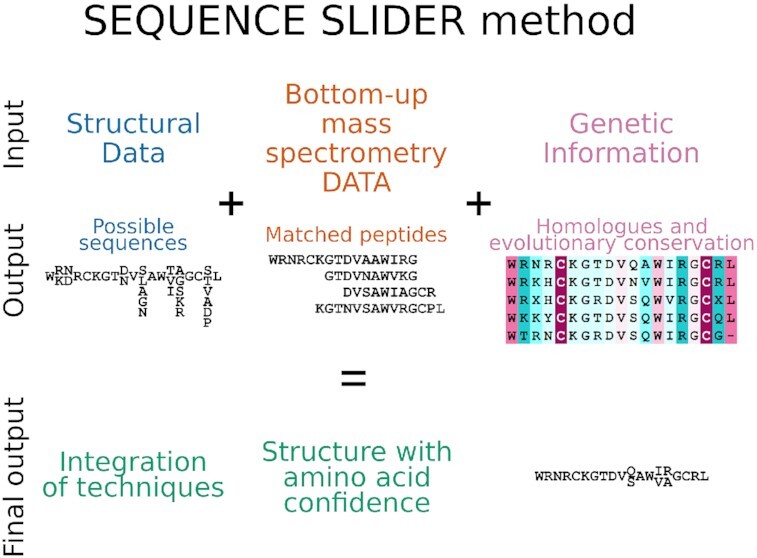
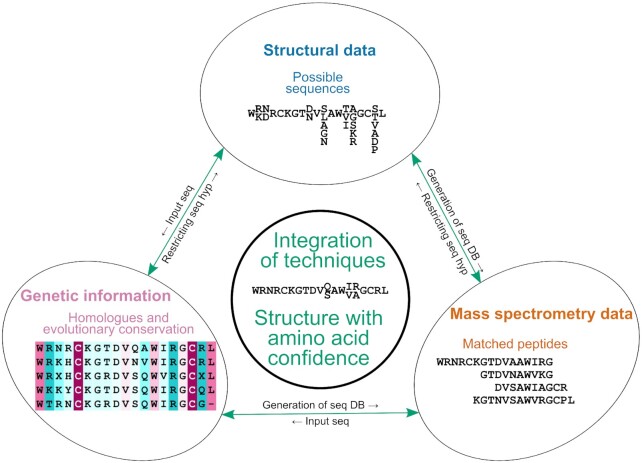
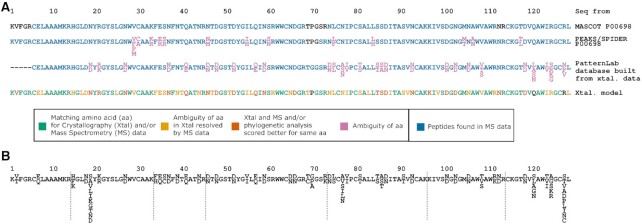
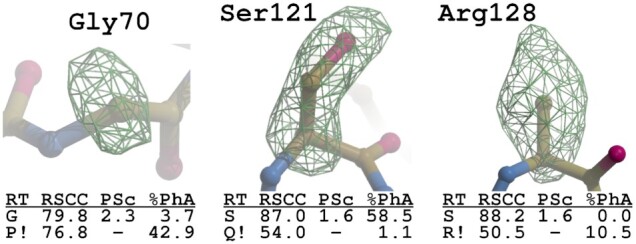
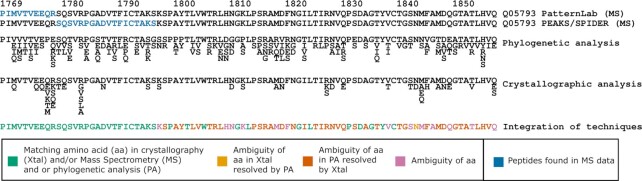
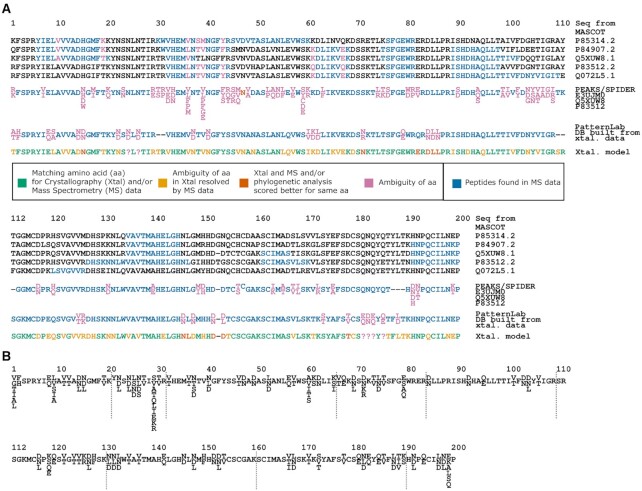
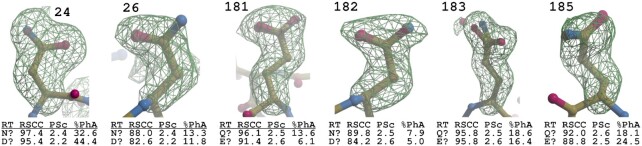
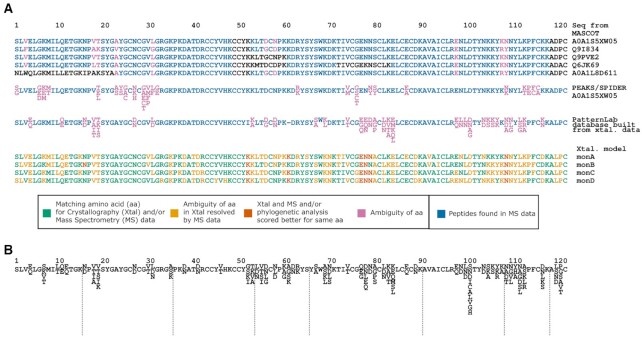
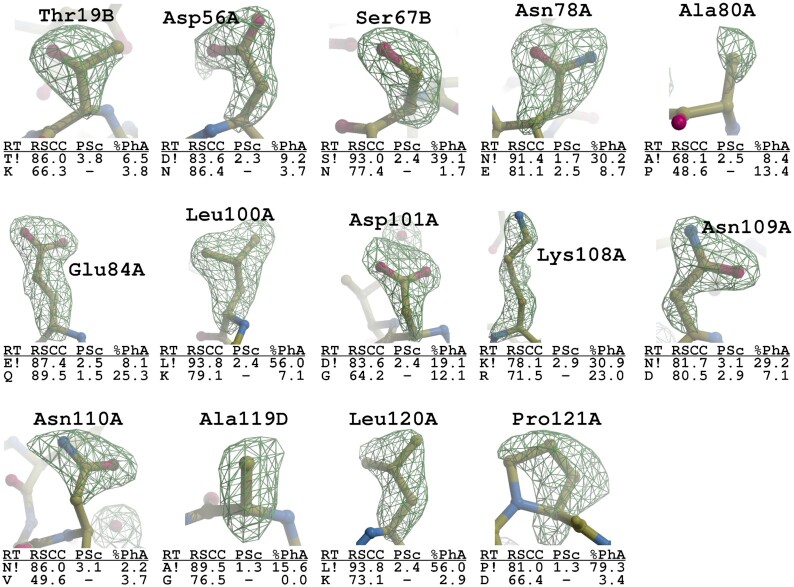
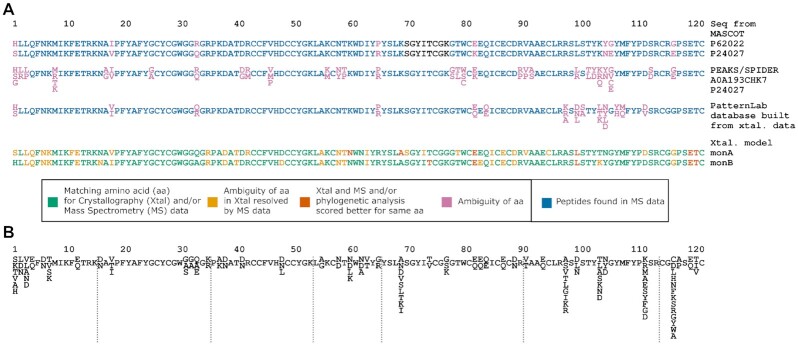
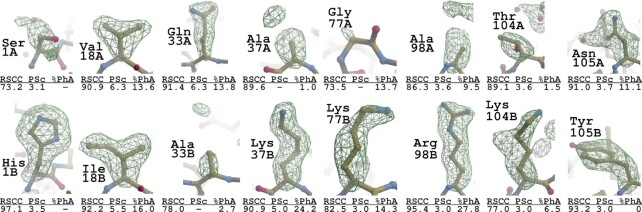
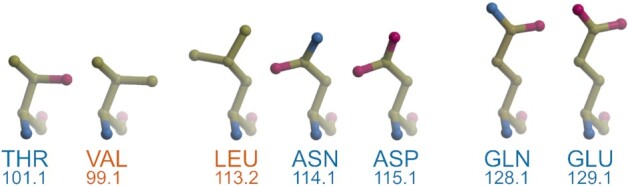
Proteins isolated from natural sources can be composed of a mixture of isoforms with similar physicochemical properties that coexist in the final steps of purification. Yet, even where unverified, the assumed sequence is enforced throughout the structural studies. Herein, we propose a novel perspective to address the usually neglected sequence heterogeneity of natural products by integrating biophysical, genetic and structural data in our program SEQUENCE SLIDER. The aim is to assess the evidence supporting chemical composition in structure determination. Locally, we interrogate the experimental map to establish which side chains are supported by the structural data, and the genetic information relating sequence conservation is integrated into this statistic. Hence, we build a constrained peptide database, containing most probable sequences to interpret mass spectrometry data (MS). In parallel, we perform MS de novo sequencing with genomic-based algorithms to detect point mutations. We calibrated SLIDER with Gallus gallus lysozyme, whose sequence is unequivocally established and numerous natural isoforms are reported. We used SLIDER to characterize a metalloproteinase and a phospholipase A2-like protein from the venom of Bothrops moojeni and a crotoxin from Crotalus durissus collilineatus. This integrated approach offers a more realistic structural descriptor to characterize macromolecules isolated from natural sources.
Overview
The claims and statistics of this paper haven’t been checked yet.
Run the check — free, no account needed. It reads the open-access text and checks the sources it cites.
Integrity signals
Registry
Cites
Statistics
Figures
Verification
Claims the paper makes
The claims and statistics of this paper haven’t been checked yet.
Run the check — free, no account needed. It reads the open-access text and checks the sources it cites.
Self-check
Percentages, sums and reported differences re-computed from the paper’s own numbers.
The self-check needs the paper’s full text.
Citations
Cites
Highly accurate protein structure prediction with AlphaFold
Jumper, J., Evans, R., Pritzel, A., Green, T., Figurnov, M., Ronneberger, O., Tunyasuvunakool, K., Bates, R., Žídek, A., Potapenko, A., et al. (2021) · Nature · doi:10.1038/s41586-021-03819-2 · Cited by 43,764
[20] Processing of X-ray diffraction data collected in oscillation mode
Otwinowski, Z., & Minor, W. (1997) · Methods in Enzymology · doi:10.1016/s0076-6879(97)76066-x · Cited by 33,475
Coot : model-building tools for molecular graphics
Emsley, P., & Cowtan, K. (2004) · Acta Crystallographica Section D Biological Crystallography · doi:10.1107/s0907444904019158 · Cited by 30,571
Features and development of Coot
Emsley, P., Lohkamp, B., Scott, W. G., & Cowtan, K. (2010) · Acta Crystallographica Section D Biological Crystallography · doi:10.1107/s0907444910007493 · Cited by 29,915
Phaser crystallographic software
McCoy, A. J., Grosse-Kunstleve, R. W., Adams, P. D., Winn, M. D., Storoni, L. C., & Read, R. J. (2007) · Journal of Applied Crystallography · doi:10.1107/s0021889807021206 · Cited by 20,612
Kabsch, W. (2010) · Acta Crystallographica Section D Biological Crystallography · doi:10.1107/s0907444909047337 · Cited by 16,463
Overview of the CCP 4 suite and current developments
Winn, M. D., Ballard, C. C., Cowtan, K. D., Dodson, E. J., Emsley, P., Evans, P. R., Keegan, R. M., Krissinel, E. B., Leslie, A. G. W., McCoy, A., et al. (2011) · Acta Crystallographica Section D Biological Crystallography · doi:10.1107/s0907444910045749 · Cited by 12,353
Database resources of the National Center for Biotechnology Information: update
Wheeler, D. L., Church, D. M., Edgar, R., Federhen, S., Helmberg, W., Madden, T. L., Pontius, J. U., Schuler, G. D., Schriml, L. M., Sequeira, E., et al. (2003) · Nucleic Acids Research · doi:10.1093/nar/gkh073 · Cited by 10,692
UniProt: a worldwide hub of protein knowledge
The UniProt Consortium (2019) · Nucleic Acids Research · doi:10.1093/nar/gky1049 · Cited by 7,698
Accelerated Profile HMM Searches
Eddy, S. R. (2011) · PLoS Computational Biology · doi:10.1371/journal.pcbi.1002195 · Cited by 6,975
Metadata
- Authors
- Borges, R. J., Salvador, G. H. M., Pimenta, D. C., dos Santos, L. D., Fontes, M. R. M., & Usón, I.
- Affiliations
- Consejo Superior de Investigaciones Científicas (ES)
- Departament of Biophysics and Pharmacology, Biosciences Institute, São Paulo State University (UNESP), Botucatu, São Paulo 18618-689, Brazil
- Instituto Butantan (BR)
- Universidade Estadual Paulista (Unesp) (BR)
- Institució Catalana de Recerca i Estudis Avançats (ES)
- Corresponding author
- Borges, Rafael J
- Venue
- Nucleic Acids Research
- Publisher
- Oxford University Press (OUP)
- Published
- 2022-02-01
- Volume
- 50
- Issue
- 9
- Pages
- e50-e50
- ISSN
- 0305-1048 (ISSN-L)
- 1362-4962
- PMC
- PMC9122596
- OpenAlex
- W4210433582
- Cited by
- 5
- References
- 89
- Citations by year
- 2025: 1 · 2024: 2 · 2023: 1 · 2022: 1
- FWCI
- 0.45
- Type
- journal article
- Language
- en
- Open access
- gold
- doi.org
- Licence
- Locations
- Nucleic Acids Research (publishedVersion, cc-by-nc)
- bioRxiv (Cold Spring Harbor Laboratory) (acceptedVersion, cc-by-nd)
- PubMed Central (publishedVersion, cc-by-nc)
- PubMed (publishedVersion)
- LA Referencia (Red Federada de Repositorios Institucionales de Publicaciones Científicas) (publishedVersion, other-oa)
- DIGITAL.CSIC (Spanish National Research Council (CSIC)) (submittedVersion, cc-by-nc-nd)
- Funders
- São Paulo Research Foundation (2015/17286–0, 2019/05958-4, 2020/10143–7)
- FAPESP (2016/24191–8)
- Ministerio de Ciencia e Innovación (PGC2018-101370-BI00 AEI/FEDER/UE)
- CNPq (301974/2019–5, 302883/2017–7)
- Topics
- Physical Sciences › Chemistry › Spectroscopy › Advanced Proteomics Techniques and Applications
- Physical Sciences › Chemistry › Spectroscopy › Mass Spectrometry Techniques and Applications
- Life Sciences › Pharmacology, Toxicology and Pharmaceutics › Toxicology › Venomous Animal Envenomation and Studies
- Keywords
- protein isoforms, sequence heterogeneity, natural products, de novo sequencing, mass spectrometry, sequence conservation, point mutation detection, metalloproteinases, phospholipase A2, crotoxin, Crotalus durissus collilineatus, lysozyme, venom proteins
- MeSH terms
- Animals, Crotalid Venoms, Crotoxin, Software, Crotalus, Protein Isoforms, Complex Mixtures, Phospholipases A2
About these checks
Registry, retraction, Cites and statistics results are computed, not judged, with one exception: a printed reference that no index lists is read once by a model before it counts as a citation error. Claims are extracted by a model and kept only when their quote appears verbatim in the text; each cited source is then checked, with a model’s help, for whether it says what the claim relies on. Those verdicts can be wrong — read the claim’s quote and the cited source before relying on one.
Statistics and arithmetic are recomputed, not judged.
Confidence bands are shown only for fields calibrated on our annotated test set. None is calibrated yet, so no band is shown.
What counts as a claim ›How we measure confidence ›How we check this ›
Are you an author, or do you see a problem with this page? Request a review
How to cite
Cite CoChat for the checks on this page, and the paper for its own findings.
- This page
- CoChat. (2026). Citation check: SEQUENCE SLIDER: integration of structural and genetic data to characterize isoforms from natural sources. https://app.cochat.ai/papers/10.1093/nar/gkac029
- The paper
- Borges, R. J., Salvador, G. H. M., Pimenta, D. C., dos Santos, L. D., Fontes, M. R. M., & Usón, I. (2022). SEQUENCE SLIDER: integration of structural and genetic data to characterize isoforms from natural sources. Nucleic Acids Research. https://doi.org/10.1093/nar/gkac029
Data sources
Bibliographic data: Semantic Scholar, OpenAlex, Crossref.
Contains information from the Semantic Scholar Academic Graph Datasets, made available under the ODC Attribution License (ODC-BY 1.0).
Semantic Scholar’s data is described in: Kinney, R., et al. (2023). The Semantic Scholar Open Data Platform. arXiv:2301.10140.
