

scQTLbase: an integrated human single-cell eQTL database
Open accessThe DOI matches its Crossref record; 24 of the 24 references it cites were found in a registry or an index.
Abstract
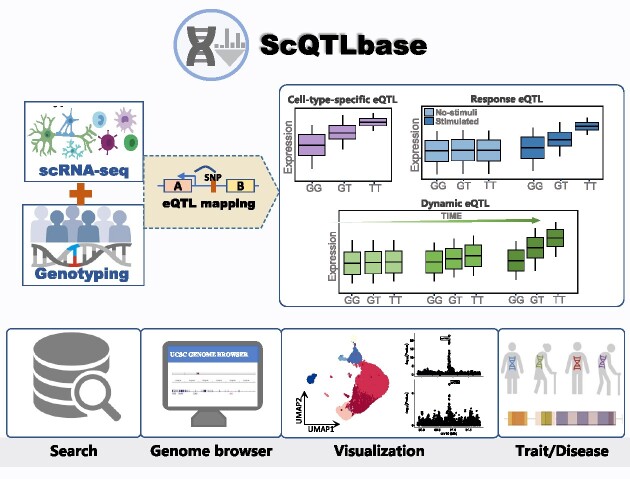
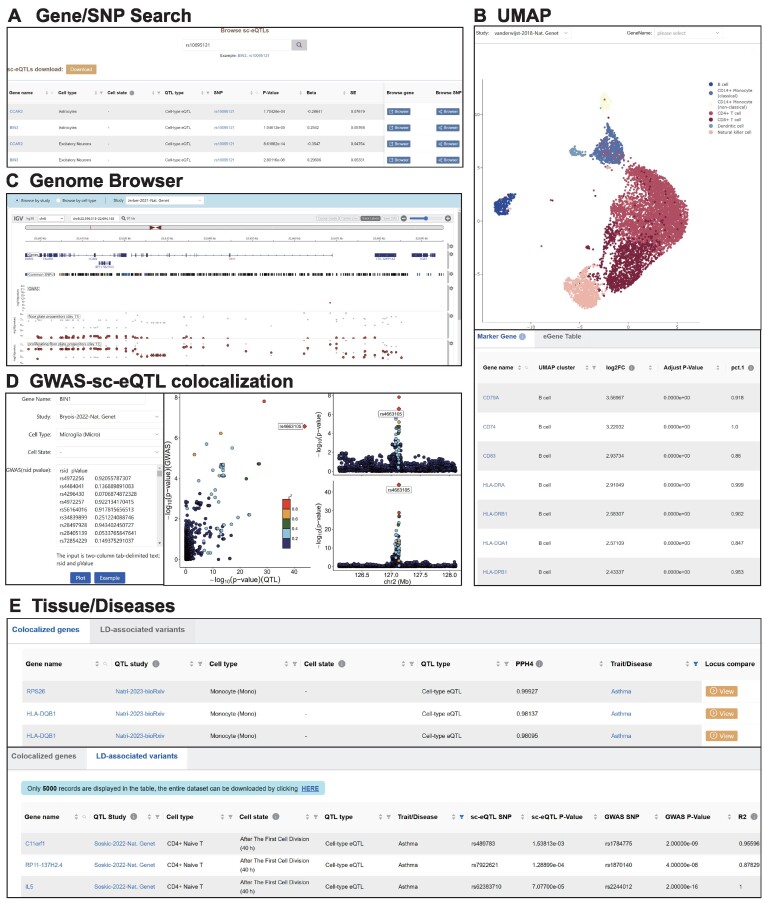
Genome-wide association studies (GWAS) have identified numerous genetic variants associated with diseases and traits. However, the functional interpretation of these variants remains challenging. Expression quantitative trait loci (eQTLs) have been widely used to identify mutations linked to disease, yet they explain only 20–50% of disease-related variants. Single-cell eQTLs (sc-eQTLs) studies provide an immense opportunity to identify new disease risk genes with expanded eQTL scales and transcriptional regulation at a much finer resolution. However, there is no comprehensive database dedicated to single-cell eQTLs that users can use to search, analyse and visualize them. Therefore, we developed the scQTLbase (http://bioinfo.szbl.ac.cn/scQTLbase), the first integrated human sc-eQTLs portal, featuring 304 datasets spanning 57 cell types and 95 cell states. It contains ∼16 million SNPs significantly associated with cell-type/state gene expression and ∼0.69 million disease-associated sc-eQTLs from 3 333 traits/diseases. In addition, scQTLbase offers sc-eQTL search, gene expression visualization in UMAP plots, a genome browser, and colocalization visualization based on the GWAS dataset of interest. scQTLbase provides a one-stop portal for sc-eQTLs that will significantly advance the discovery of disease susceptibility genes.
Overview
The claims and statistics of this paper haven’t been checked yet.
Free: it reads the open-access text and checks the first 5 claims that cite a source we can check. Create a free account to check every claim.
Integrity signals
Registry
Cites
Statistics
Figures

Verification
Claims the paper makes
The claims and statistics of this paper haven’t been checked yet.
Free: it reads the open-access text and checks the first 5 claims that cite a source we can check. Create a free account to check every claim.
Claims other papers make about this one
Each is checked against this paper’s own text: does it say what the citing paper says it does?
The source backs part of the claim, not all of it — or backs it for a different population, condition or comparison.
In the citing paper
“Recently, Ding et al. constructed the first integrated human sceQTL database, which comprises ∼ 16 million SNPs and ∼ 0.69 million sceQTLs [95]”
From Single-cell sequencing to multi-omics: technologies and applications (2024) · cites this paper as [95]
Experimental — accuracy not yet measured
Self-check
Percentages, sums and reported differences re-computed from the paper’s own numbers.
The self-check needs the paper’s full text.
Citations
Cites
Integrated analysis of multimodal single-cell data
Hao, Y., Hao, S., Andersen-Nissen, E., Mauck, W. M., Zheng, S., Butler, A., Lee, M. J., Wilk, A. J., Darby, C., Zagar, M., et al. (2020) · doi:10.1101/2020.10.12.335331 · Cited by 15,508 · cited 1×
“To address the challenge of inconsistent cell type names across different studies and datasets, we obtained expert-annotated cell type reference datasets from Azimuth ( 18 ).”
MethodUMAP: Uniform Manifold Approximation and Projection
McInnes, L., Healy, J., Saul, N., & Großberger, L. (2018) · Journal of Open Source Software · doi:10.21105/joss.00861 · Cited by 9,826
dbSNP: the NCBI database of genetic variation
Sherry, S. T. (2001) · Nucleic Acids Research · doi:10.1093/nar/29.1.308 · Cited by 7,502
The GTEx Consortium atlas of genetic regulatory effects across human tissues
The GTEx Consortium, Aguet, F., Anand, S., Ardlie, K. G., Gabriel, S., Getz, G. A., Graubert, A., Hadley, K., Handsaker, R. E., Huang, K. H., et al. (2020) · Science · doi:10.1126/science.aaz1776 · Cited by 5,547
Giambartolomei, C., Vukcevic, D., Schadt, E. E., Franke, L., Hingorani, A. D., Wallace, C., & Plagnol, V. (2014) · PLoS Genetics · doi:10.1371/journal.pgen.1004383 · Cited by 4,261
Integration of summary data from GWAS and eQTL studies predicts complex trait gene targets
Zhu, Z., Zhang, F., Hu, H., Bakshi, A., Robinson, M. R., Powell, J. E., Montgomery, G. W., Goddard, M. E., Wray, N. R., Visscher, P. M., et al. (2016) · Nature Genetics · doi:10.1038/ng.3538 · Cited by 3,352
Võsa, U., Claringbould, A., Westra, H.-J., Bonder, M. J., Deelen, P., Zeng, B., Kirsten, H., Saha, A., Kreuzhuber, R., Yazar, S., et al. (2021) · Nature Genetics · doi:10.1038/s41588-021-00913-z · Cited by 2,607 · cited 1×
“…sc-eQTL studies have been published so far ( 11 ), and large collaborative efforts, such as the eQTLGen Consortium and the DICE project, have provided valuable resources and greatly facilitated our understanding of how genetic variants influence gene regulation at the cellular level ( 15 ,16 ).”
BackgroundThe NHGRI-EBI GWAS Catalog: knowledgebase and deposition resource
Sollis, E., Mosaku, A., Abid, A., Buniello, A., Cerezo, M., Gil, L., Groza, T., Güneş, O., Hall, P., Hayhurst, J., et al. (2023) · Nucleic Acids Research · doi:10.1093/nar/gkac1010 · Cited by 1,641 · cited 2×
“Next, we gathered significant SNPs from 3 333 GWAS datasets (Supplementary Table S3) collected in NHGRI GWAS catalog ( 1 ) and filtered out those without dbSNP identifiers.”
BackgroundMethodInduced pluripotent stem cell technology: a decade of progress.
Shi, Y., Inoue, H., Wu, J. C., & Yamanaka, S. (2017) · Nature Reviews Drug Discovery · doi:10.1038/nrd.2016.245 · Cited by 1,525 · cited 1×
“For example, PBMCs comprise various immune cells, red blood cells and platelets, whereas iPSCs possess the potential to differentiate into multiple cell types, including neurons, cardiomyocytes and hepatocytes ( 23 ).”
BackgroundImpact of Genetic Polymorphisms on Human Immune Cell Gene Expression
Schmiedel, B. J., Singh, D., Madrigal, A., Valdovino-Gonzalez, A. G., White, B. M., Zapardiel-Gonzalo, J., Ha, B., Altay, G., Greenbaum, J. A., McVicker, G., et al. (2018) · Cell · doi:10.1016/j.cell.2018.10.022 · Cited by 867 · cited 1×
“…sc-eQTL studies have been published so far ( 11 ), and large collaborative efforts, such as the eQTLGen Consortium and the DICE project, have provided valuable resources and greatly facilitated our understanding of how genetic variants influence gene regulation at the cellular level ( 15 ,16 ).”
Background
Cited by
Single-cell sequencing to multi-omics: technologies and applications
Wu, X., Yang, X., Dai, Y., Zhao, Z., Zhu, J., Guo, H., & Yang, R. (2024) · Biomarker Research · doi:10.1186/s40364-024-00643-4 · Cited by 222
“Recently, Ding et al. constructed the first integrated human sceQTL database, which comprises ∼ 16 million SNPs and ∼ 0.69 million sceQTLs [95], providing a valuable resource for disease susceptibility gene discovery.”
BackgroundInfluentialGene-environment interactions within a precision environmental health framework
Motsinger‐Reif, A. A., Reif, D. M., Akhtari, F. S., House, J. S., Campbell, C. R., Messier, K. P., Fargo, D. C., Bowen, T. A., Nadadur, S. S., Schmitt, C., et al. (2024) · Cell Genomics · doi:10.1016/j.xgen.2024.100591 · Cited by 112
Ying, H., Wu, X., Jia, X., Yang, Q., Liu, H., Zhao, H., Chen, Z., Xu, M., Wang, T., Li, M., et al. (2025) · EBioMedicine · doi:10.1016/j.ebiom.2025.105596 · Cited by 36
Malik, R., Beaufort, N., Li, J., Tanaka, K., Georgakis, M. K., He, Y., Koido, M., Terao, C., Japan, B., Anderson, C. D., et al. (2024) · Nature Cardiovascular Research · doi:10.1038/s44161-024-00475-3 · Cited by 24
Hong, Y., Wang, Y., Shu, W., Li, J., Mi, Y., Chen, H., & Chen, C. (2025) · Ageing Research Reviews · doi:10.1016/j.arr.2025.102835 · Cited by 20
Metadata
- Authors
- Ding, R., Wang, Q., Gong, L., Zhang, T., Zou, X., Xiong, K., Liao, Q., Plass, M., & Li, L.
- Affiliations
- Shenzhen Bay Laboratory (CN)
- Ningbo University (CN)
- Institut d'Investigació Biomédica de Bellvitge (ES)
- Corresponding author
- Li, Lei
- ORCID
- Venue
- Nucleic Acids Research
- Publisher
- Oxford University Press (OUP)
- Published
- 2023-10-04
- Volume
- 52
- Issue
- D1
- Pages
- D1010-D1017
- ISSN
- 0305-1048 (ISSN-L)
- 1362-4962
- PMC
- PMC10767909
- OpenAlex
- W4387327142
- Cited by
- 62
- References
- 23
- Citations by year
- 2026: 31 · 2025: 19 · 2024: 12
- FWCI
- 10.28
- Type
- journal article
- Language
- en
- Open access
- gold
- doi.org
- Licence
- Locations
- Nucleic Acids Research (publishedVersion, cc-by-nc)
- PubMed Central (publishedVersion, cc-by-nc)
- PubMed (publishedVersion)
- Funders
- National Natural Science Foundation of China (32100533, 32370721)
- Shenzhen Bay Laboratory (SZBL2021080601001)
- Spanish Ministry of Science and Innovation (RYC2018-024564-I)
- Topics
- Life Sciences › Biochemistry, Genetics and Molecular Biology › Genetics › Genetic Associations and Epidemiology
- Life Sciences › Biochemistry, Genetics and Molecular Biology › Molecular Biology › Single-cell and spatial transcriptomics
- Life Sciences › Biochemistry, Genetics and Molecular Biology › Molecular Biology › Genomics and Chromatin Dynamics
- Keywords
- single-cell eQTL, expression quantitative trait loci, risk genes, cell type-specific gene expression, cell states, single-cell transcriptomics, genome browser, gene expression visualization
- MeSH terms
- Gene Expression Regulation, Humans, Phenotype, Genetic Predisposition to Disease, Polymorphism, Single Nucleotide, Databases, Genetic, Quantitative Trait Loci, Genome-Wide Association Study
About these checks
Registry, retraction, Cites and statistics results are computed, not judged, with one exception: a printed reference that no index lists is read once by a model before it counts as a citation error. Claims are extracted by a model and kept only when their quote appears verbatim in the text; each cited source is then checked, with a model’s help, for whether it says what the claim relies on. Those verdicts can be wrong — read the claim’s quote and the cited source before relying on one.
Statistics and arithmetic are recomputed, not judged.
Confidence bands are shown only for fields calibrated on our annotated test set. None is calibrated yet, so no band is shown.
What counts as a claim ›How we measure confidence ›How we check this ›
Are you an author, or do you see a problem with this page? Request a review
How to cite
Cite CoChat for the checks on this page, and the paper for its own findings.
- This page
- CoChat. (2026). Citation check: scQTLbase: an integrated human single-cell eQTL database. https://app.cochat.ai/papers/10.1093/nar/gkad781
- The paper
- Ding, R., Wang, Q., Gong, L., Zhang, T., Zou, X., Xiong, K., Liao, Q., Plass, M., & Li, L. (2024). scQTLbase: an integrated human single-cell eQTL database. Nucleic Acids Research. https://doi.org/10.1093/nar/gkad781
Data sources
Bibliographic data: Semantic Scholar, OpenAlex, Crossref.
Contains information from the Semantic Scholar Academic Graph Datasets, made available under the ODC Attribution License (ODC-BY 1.0).
Semantic Scholar’s data is described in: Kinney, R., et al. (2023). The Semantic Scholar Open Data Platform. arXiv:2301.10140.
