

TDP1 splice-site mutation causes HAP1 cell hypersensitivity to topoisomerase I inhibition
Open accessThe DOI matches its Crossref record; 64 of the 64 references it cites were found in a registry or an index.
Abstract
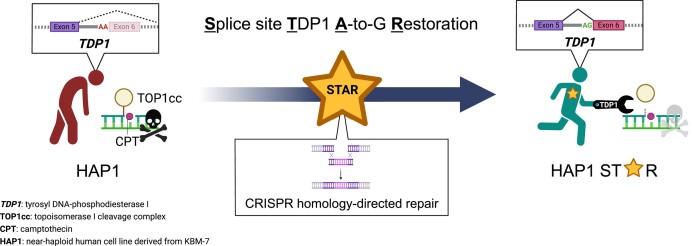
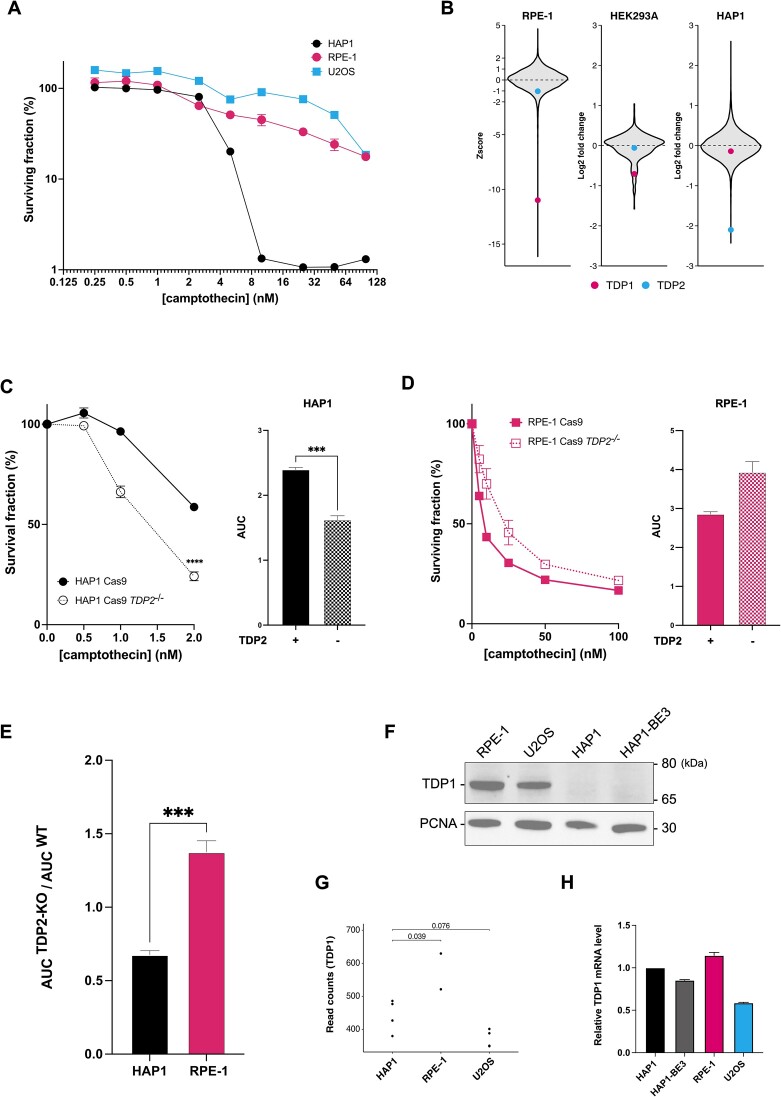
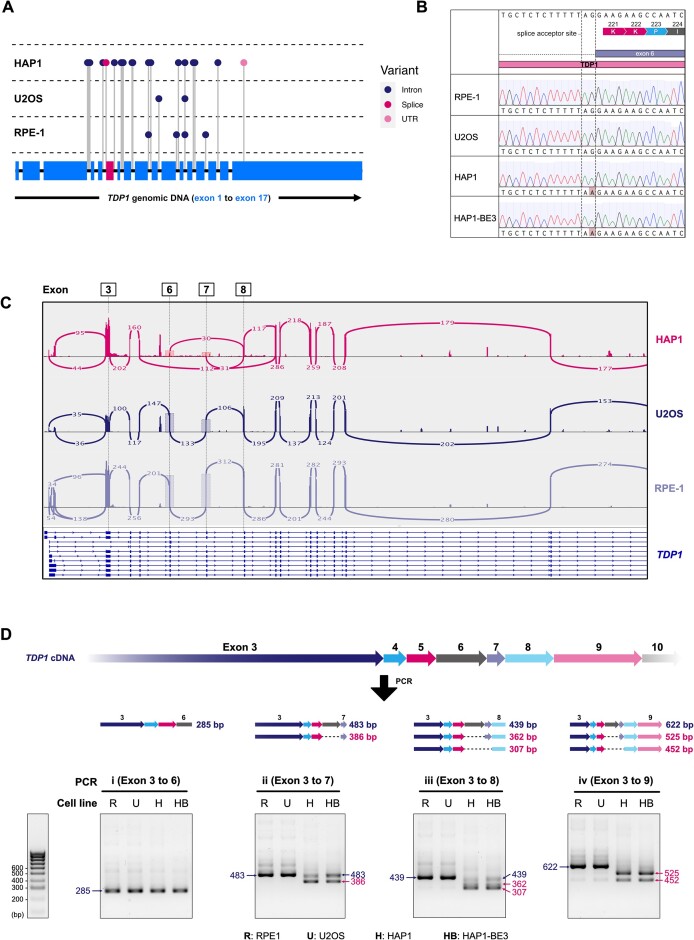
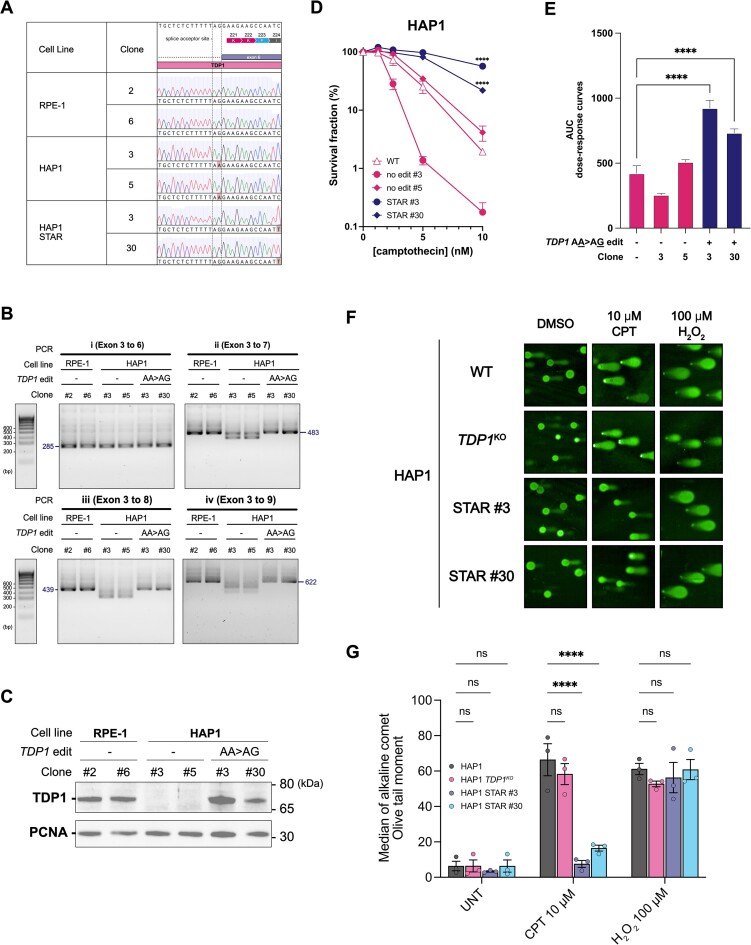
HAP1 is a near-haploid human cell line commonly used for mutagenesis and genome editing studies due to its hemizygous nature. We noticed an unusual hypersensitivity of HAP1 to camptothecin, an antineoplastic drug that stabilizes topoisomerase I cleavage complexes (TOP1ccs). We have attributed this hypersensitivity to a deficiency of TDP1, a key phosphodiesterase involved in resolving abortive TOP1ccs. Through whole-exome sequencing and subsequent restoration of TDP1 protein via CRISPR-Cas9 endogenous genome editing, we demonstrate that TDP1 deficiency and camptothecin hypersensitivity in HAP1 cells are a result of a splice-site mutation (TDP1 c.660-1G > A) that causes exon skipping and TDP1 loss of function. The lack of TDP1 in HAP1 cells should be considered when studying topoisomerase-associated DNA lesions and when generalizing mechanisms of DNA damage repair using HAP1 cells. Finally, we also report the generation of HAP1 STAR clones with restored TDP1 expression and function, which may be useful in further studies to probe cellular phenotypes relating to TOP1cc repair.
Overview
The claims and statistics of this paper haven’t been checked yet.
Free: it reads the open-access text and checks the first 5 claims that cite a source we can check. Create a free account to check every claim.
Integrity signals
Registry
Cites
Statistics
Figures
Verification
Claims the paper makes
The claims and statistics of this paper haven’t been checked yet.
Free: it reads the open-access text and checks the first 5 claims that cite a source we can check. Create a free account to check every claim.
Claims other papers make about this one
Each is checked against this paper’s own text: does it say what the citing paper says it does?
The source backs part of the claim, not all of it — or backs it for a different population, condition or comparison.
In the citing paper
“TOPI inhibitor-induced SSBs require tyrosyl-DNA phosphodiesterase 1 (TDP1)-mediated excision repair and homologous recombination pathways for repair, so mCRPC tumors harboring HRD may exhibit increased sensitivity to TOPI inhibitor-carrying ADCs36,37.”
From The evolving landscape of antibody-drug conjugates (ADCs) for treatment of prostate cancer (2025) · cites this paper as [36]
Experimental — accuracy not yet measuredThe source backs part of the claim, not all of it — or backs it for a different population, condition or comparison.
In the citing paper
“TOPI inhibitor-induced SSBs require tyrosyl-DNA phosphodiesterase 1 (TDP1)-mediated excision repair and homologous recombination pathways for repair, so mCRPC tumors harboring HRD may exhibit increased sensitivity to TOPI inhibitor-carrying ADCs36,37.”
From The evolving landscape of antibody-drug conjugates (ADCs) for treatment of prostate cancer (2025) · cites this paper as [36]
Experimental — accuracy not yet measured
Self-check
Percentages, sums and reported differences re-computed from the paper’s own numbers.
The self-check needs the paper’s full text.
Citations
Cites
Moderated estimation of fold change and dispersion for RNA-seq data with DESeq2
Love, M. I., Huber, W., & Anders, S. (2014) · Genome Biology · doi:10.1186/s13059-014-0550-8 · Cited by 95,106
The Sequence Alignment/Map format and SAMtools
Li, H., Handsaker, B., Wysoker, A., Fennell, T., Ruan, J., Homer, N., Marth, G., Abecasis, G., Durbin, R., & 1000 Genome Project Data Processing Subgroup (2009) · Bioinformatics · doi:10.1093/bioinformatics/btp352 · Cited by 62,041
Fast gapped-read alignment with Bowtie 2
Langmead, B., & Salzberg, S. L. (2012) · Nature Methods · doi:10.1038/nmeth.1923 · Cited by 56,400
Wickham, H. (2016) · Use R! · doi:10.1007/978-3-319-24277-4 · Cited by 33,115
Robinson, J. T., Thorvaldsdóttir, H., Winckler, W., Guttman, M., Lander, E. S., Getz, G., & Mesirov, J. P. (2011) · Nature Biotechnology · doi:10.1038/nbt.1754 · Cited by 15,390
Graph-based genome alignment and genotyping with HISAT2 and HISAT-genotype
Kim, D., Paggi, J. M., Park, C., Bennett, C., & Salzberg, S. L. (2019) · Nature Biotechnology · doi:10.1038/s41587-019-0201-4 · Cited by 15,022
Salmon provides fast and bias-aware quantification of transcript expression
Patro, R., Duggal, G., Love, M. I., Irizarry, R. A., & Kingsford, C. (2017) · Nature Methods · doi:10.1038/nmeth.4197 · Cited by 12,700
MultiQC: summarize analysis results for multiple tools and samples in a single report
Ewels, P., Magnusson, M., Lundin, S., & Käller, M. (2016) · Bioinformatics · doi:10.1093/bioinformatics/btw354 · Cited by 10,143
Software for Computing and Annotating Genomic Ranges
Lawrence, M., Huber, W., Pagès, H., Aboyoun, P., Carlson, M., Gentleman, R., Morgan, M. T., & Carey, V. J. (2013) · PLoS Computational Biology · doi:10.1371/journal.pcbi.1003118 · Cited by 4,398
Differential analyses for RNA-seq: transcript-level estimates improve gene-level inferences
Soneson, C., Love, M. I., & Robinson, M. D. (2015) · F1000Research · doi:10.12688/f1000research.7563.1 · Cited by 3,929
Cited by
The evolving landscape of antibody-drug conjugates (ADCs) for treatment of prostate cancer
Lin, C., Hadfield, M. J., Santopietro, A., Lagos, G., Cheng, L., El-Deiry, W. S., Aggarwal, R., Mega, A., Hyams, E., & Carneiro, B. A. (2025) · npj Precision Oncology · doi:10.1038/s41698-025-01131-0 · Cited by 20
Shapiro, I. E., Maschke, C., Michaux, J., Pak, H., Wessling, L., Verkerk, T., Spaapen, R. M., & Bassani‐Sternberg, M. (2025) · Molecular & Cellular Proteomics · doi:10.1016/j.mcpro.2025.100951 · Cited by 12
“…of noncanonical peptides, we searched the immunopeptidome data against a reference database comprising canonical and noncanonical sequences ( e.g. , long noncoding RNAs and pseudogenes), found to be expressed in HAP1 transcriptomics data (15), applying group-speci fi c FDR thresholds of 3% (17).”
Loss of CTLH component MAEA impairs DNA repair and replication and leads to developmental delay
Hough, S. H., Jhujh, S. S., Awwad, S. W., Lewis, O., Lam, S., Thomas, J. C., Mosler, T., Bader, A. S., Bartik, L. E., McKee, S. A., et al. (2025) · EMBO Molecular Medicine · doi:10.1038/s44321-025-00352-x · Cited by 2
“Goh et al recently showed that HAP1 cells are unusually sensitive to camptothecin due a debilitating mutation in TDP1 (Goh et al, 2025).”
Self-citationThe MYB transcription factor APL is a rational target for base editing to engineer flowering time
Zhao, Z., Liang, H., Wu, C., Ni, Y., Wang, F., Feng, F., Zhang, X., Liu, J., Yi, J., Du, X., et al. (2026) · The Plant Cell · doi:10.1093/plcell/koag215 · Cited by 3
Loss of CTLH component MAEA impairs DNA repair and replication and leads to developmental delayPreprint
Hough, S. H., Jhujh, S. S., Awwad, S. W., Lam, S., Thomas, J. C., Lewis, O., Mosler, T., Bader, A. S., Bartik, L. E., McKee, S. A., et al. (2025) · bioRxiv (Cold Spring Harbor Laboratory) · doi:10.1101/2025.07.23.666279
Self-citation
Metadata
- Authors
- Goh, C. G., Bader, A. S., Tran, T.-A., Belotserkovskaya, R., D’Alessandro, G., & Jackson, S. P.
- Affiliations
- University of Cambridge (GB)
- Corresponding author
- Jackson, Stephen P
- Venue
- Nucleic Acids Research
- Publisher
- Oxford University Press (OUP)
- Published
- 2024-12-11
- Volume
- 53
- Issue
- 2
- ISSN
- 0305-1048 (ISSN-L)
- 1362-4962
- PMC
- PMC11754736
- OpenAlex
- W4405283282
- Semantic Scholar
- 7891032e07f96c869d97db1867e4b8a4b2832cd9
- Cited by
- 5
- References
- 64
- Citations by year
- 2026: 1 · 2025: 4
- FWCI
- 0.68
- Type
- journal article
- Language
- en
- Open access
- gold
- doi.org
- Licence
- Locations
- Nucleic Acids Research (publishedVersion, cc-by)
- PubMed Central (publishedVersion, cc-by)
- PubMed (publishedVersion)
- Apollo (University of Cambridge) (acceptedVersion, cc-by)
- Apollo (University of Cambridge) (submittedVersion, cc-by)
- Apollo (cc-by)
- Funders
- Cancer Research UK (DRCPGM\100005, A:29580)
- ERC Synergy Award (855741)
- A*STAR National Science Scholarship
- CRUK RadNet Cambridge Award (C17918/A28870)
- Wellcome (227014/Z/23/Z)
- University of Cambridge
- Topics
- Life Sciences › Biochemistry, Genetics and Molecular Biology › Molecular Biology › Cancer therapeutics and mechanisms
- Life Sciences › Biochemistry, Genetics and Molecular Biology › Molecular Biology › DNA Repair Mechanisms
- Life Sciences › Biochemistry, Genetics and Molecular Biology › Molecular Biology › CRISPR and Genetic Engineering
- Keywords
- TDP1, topoisomerase I, camptothecin, topoisomerase I cleavage complexes, splice site mutation, exon skipping, HAP1 cells, DNA repair, loss of function
- MeSH terms
- Gene Editing, Camptothecin, Cell Line, DNA Topoisomerases, Type I, Exons, Humans, Mutation, Phosphoric Diester Hydrolases, RNA Splice Sites, Topoisomerase I Inhibitors, CRISPR-Cas Systems
About these checks
Registry, retraction, Cites and statistics results are computed, not judged, with one exception: a printed reference that no index lists is read once by a model before it counts as a citation error. Claims are extracted by a model and kept only when their quote appears verbatim in the text; each cited source is then checked, with a model’s help, for whether it says what the claim relies on. Those verdicts can be wrong — read the claim’s quote and the cited source before relying on one.
Statistics and arithmetic are recomputed, not judged.
Confidence bands are shown only for fields calibrated on our annotated test set. None is calibrated yet, so no band is shown.
What counts as a claim ›How we measure confidence ›How we check this ›
Are you an author, or do you see a problem with this page? Request a review
Data sources
Bibliographic data: Semantic Scholar, OpenAlex, Crossref.
Contains information from the Semantic Scholar Academic Graph Datasets, made available under the ODC Attribution License (ODC-BY 1.0).
Semantic Scholar’s data is described in: Kinney, R., et al. (2023). The Semantic Scholar Open Data Platform. arXiv:2301.10140.
