

Functional and structural characterization of the integrase from the prototype foamy virus
Open accessThe DOI matches its Crossref record; 85 of the 86 references it cites were found in a registry or an index.
Abstract
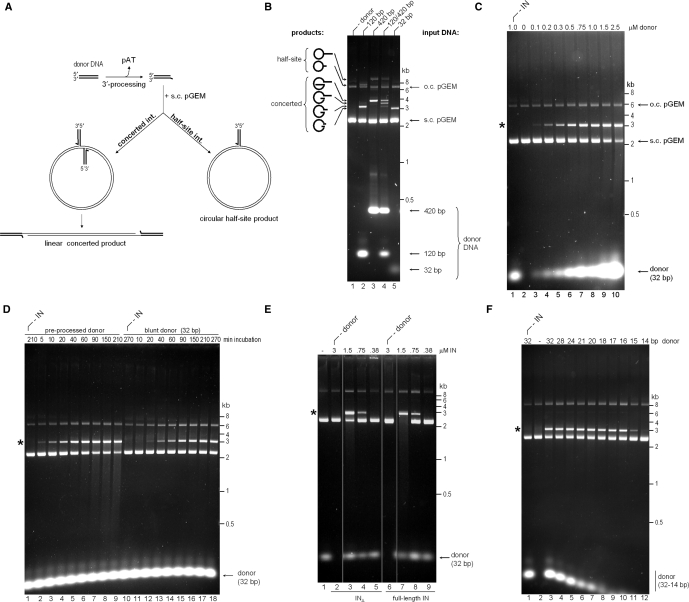
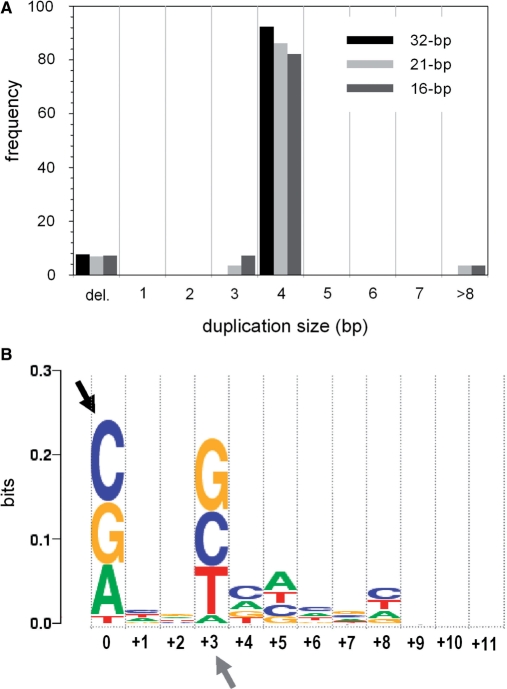
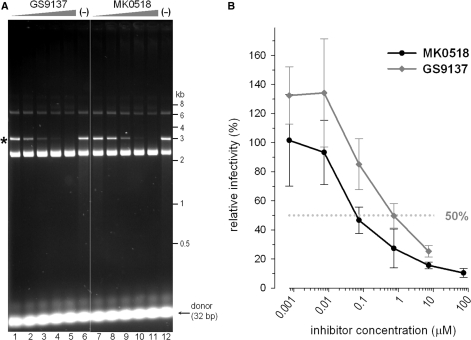
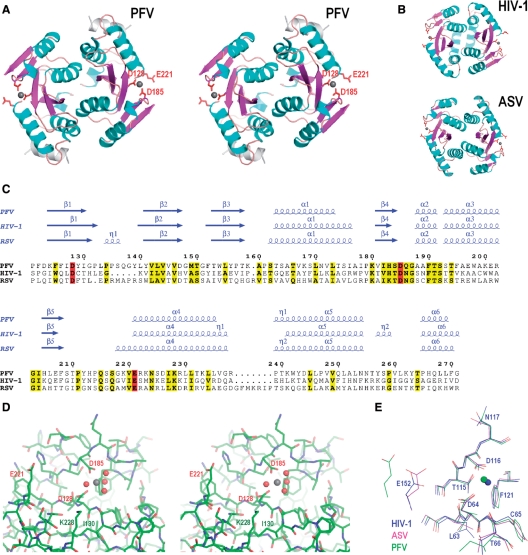
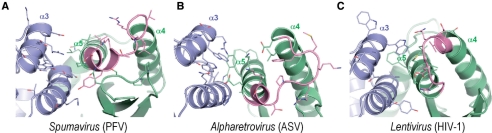
Establishment of the stable provirus is an essential step in retroviral replication, orchestrated by integrase (IN), a virus-derived enzyme. Until now, available structural information was limited to the INs of human immunodeficiency virus type 1 (HIV-1), avian sarcoma virus (ASV) and their close orthologs from the Lentivirus and Alpharetrovirus genera. Here, we characterized the in vitro activity of the prototype foamy virus (PFV) IN from the Spumavirus genus and determined the three-dimensional structure of its catalytic core domain (CCD). Recombinant PFV IN displayed robust and almost exclusively concerted integration activity in vitro utilizing donor DNA substrates as short as 16 bp, underscoring its significance as a model for detailed structural studies. Comparison of the HIV-1, ASV and PFV CCD structures highlighted both conserved as well as unique structural features such as organization of the active site and the putative host factor binding face. Despite possessing very limited sequence identity to its HIV counterpart, PFV IN was sensitive to HIV IN strand transfer inhibitors, suggesting that this class of inhibitors target the most conserved features of retroviral IN-DNA complexes.
Overview
The claims and statistics of this paper haven’t been checked yet.
Free: it reads the open-access text and checks the first 5 claims that cite a source we can check. Create a free account to check every claim.
Integrity signals
Registry
Cites
Statistics
Figures
Verification
Claims the paper makes
The claims and statistics of this paper haven’t been checked yet.
Free: it reads the open-access text and checks the first 5 claims that cite a source we can check. Create a free account to check every claim.
Claims other papers make about this one
Each is checked against this paper’s own text: does it say what the citing paper says it does?
The cited source says what the claim attributes to it.
In the citing paper
“Because retroviral IN active sites are highly conserved, INSTIs are broadly active across the retroviral family32,158,159 save the occasional example when an IN residue, such as Ser150 in ASLV IN, confers baseline resistance, in this case to elvitegravir39,160.”
From Structure and function of retroviral integrase (2022) · cites this paper as [158]
Self-check
Percentages, sums and reported differences re-computed from the paper’s own numbers.
The self-check needs the paper’s full text.
Citations
Cites
Sheldrick, G. M. (2008) · Acta Crystallographica Section A Foundations of Crystallography · doi:10.1107/s0108767307043930 · Cited by 87,804
Coot : model-building tools for molecular graphics
Emsley, P., & Cowtan, K. (2004) · Acta Crystallographica Section D Biological Crystallography · doi:10.1107/s0907444904019158 · Cited by 30,571
Phaser crystallographic software
McCoy, A. J., Grosse-Kunstleve, R. W., Adams, P. D., Winn, M. D., Storoni, L. C., & Read, R. J. (2007) · Journal of Applied Crystallography · doi:10.1107/s0021889807021206 · Cited by 20,612
The CCP4 suite: programs for protein crystallography
Collaborative Computational Project, N. 4. (1994) · Acta Crystallographica Section D Biological Crystallography · doi:10.1107/s0907444994003112 · Cited by 17,270
Refinement of Macromolecular Structures by the Maximum-Likelihood Method
Murshudov, G. N., Vagin, A. A., & Dodson, E. J. (1997) · Acta Crystallographica Section D Biological Crystallography · doi:10.1107/s0907444996012255 · Cited by 14,742 · cited 2×
“The final model containing 139 protein residues, 48 water molecules and one Mg atom was built using iterative cycles of real space refinement in COOT (61), simulated annealing/restrained refinement in PHENIX (62) and restrained refinement in REFMAC (63) against a highenergy remote dataset collected to 2.20 A ˚ at = 0.…”
MethodInfluentialWebLogo: A Sequence Logo Generator: Figure 1
Crooks, G. E., Hon, G., Chandonia, J.-M., & Brenner, S. E. (2004) · Genome Research · doi:10.1101/gr.849004 · Cited by 12,386 · cited 1×
“The height of each logo is proportional to the frequency of the corresponding nucleotide within the alignment, while the height of each stack of logos reflects the level of conservation at each position. The figure was created using WebLogo ( 83 ).”
MethodScaling and assessment of data quality
Evans, P. (2006) · Acta Crystallographica Section D Biological Crystallography · doi:10.1107/s0907444905036693 · Cited by 4,374
PHENIX : building new software for automated crystallographic structure determination
Adams, P. D., Grosse-Kunstleve, R. W., Hung, L.-W., Ioerger, T. R., McCoy, A. J., Moriarty, N. W., Read, R. J., Sacchettini, J. C., Sauter, N. K., & Terwilliger, T. C. (2002) · Acta Crystallographica Section D Biological Crystallography · doi:10.1107/s0907444902016657 · Cited by 4,361
ESPript: analysis of multiple sequence alignments in PostScript.
Gouet, P., Courcelle, E., Stuart, D. I., & M√©toz, F. (1999) · Bioinformatics · doi:10.1093/bioinformatics/15.4.305 · Cited by 2,951 · cited 1×
“Residue numbering corresponds to HIV-1 IN. (A), (B), (D) and (E) were created with PyMOL (DeLano Scientific, http://www.pymol.org), and (C) with ESPript ( 84 ).”
MethodAutomated protein model building combined with iterative structure refinement.
Anastassis Perrakis, A., Morris, R. J., & Lamzin, V. S. (1999) · Nature Structural Biology · doi:10.1038/8263 · Cited by 2,431 · cited 1×
“The structure factors and phases were used as input to ARP/wARP (60) for automated model building.”
Method
Research works printed but not linked: 1
- Leslie AGW Recent changes to the MOSFLM package for processing film and image plate data Joint CCP4 + ESF-EAMCB Newsletter on Protein Crystallography. 1992
Cited by
Retroviral intasome assembly and inhibition of DNA strand transfer
Hare, S., Gupta, S. S., Valkov, E., Engelman, A., & Cherepanov, P. (2010) · Nature · doi:10.1038/nature08784 · Cited by 678
Self-citationThe structural biology of HIV-1: mechanistic and therapeutic insights
Engelman, A., & Cherepanov, P. (2012) · Nature Reviews Microbiology · doi:10.1038/nrmicro2747 · Cited by 424
“The clinically approved HIV-1 IN inhibitor, raltegravir, and similar small molecules that are in development preferentially inhibit DNA strand transfer activity; fortuitously, IN strand transfer inhibitors (INSTIs) harbour broad antiretroviral activit”
BackgroundSelf-citationMolecular mechanisms of retroviral integrase inhibition and the evolution of viral resistance
Hare, S., Vos, A. M., Clayton, R. F., Thuring, J. W., Cummings, M. D., & Cherepanov, P. (2010) · Proceedings of the National Academy of Sciences · doi:10.1073/pnas.1010246107 · Cited by 305
“Presumably, tighter binding INSTIs would better compensate for the energetic penalty associated with reordering the active sites of mutant INs.”
BackgroundMethodInfluentialSelf-citationThe mechanism of retroviral integration from X-ray structures of its key intermediates
Maertens, G. N., Hare, S., & Cherepanov, P. (2010) · Nature · doi:10.1038/nature09517 · Cited by 296
Self-citationHare, S., Smith, S. J., Métifiot, M., Jaxa-Chamiec, A., Pommier, Y., Hughes, S. H., & Cherepanov, P. (2011) · Molecular Pharmacology · doi:10.1124/mol.111.073189 · Cited by 264
“Although the IN active site is not fully structured in the absence of viral DNA, because of disorder of the flexible loop and the active site glutamic acid, the remainder of the local structure superposes remarkably well across retroviral genera (Valkov et al., 2009).”
BackgroundSelf-citation
Metadata
- Authors
- Valkov, E., Gupta, S. S., Hare, S., Helander, A., Roversi, P., McClure, M., & Cherepanov, P.
- Affiliations
- Imperial College London (GB)
- University of Oxford (GB)
- Corresponding author
- Cherepanov, Peter
- Venue
- Nucleic Acids Research
- Publisher
- Oxford University Press (OUP)
- Published
- 2008-11-26
- Volume
- 37
- Issue
- 1
- Pages
- 243-255
- ISSN
- 0305-1048 (ISSN-L)
- 1362-4962
- PMC
- PMC2615609
- OpenAlex
- W2001281718
- Cited by
- 130
- References
- 86
- Citations by year
- 2026: 2 · 2024: 1 · 2023: 2 · 2021: 7 · 2020: 3 · 2019: 7 · 2018: 6 · 2017: 9 · 2016: 5 · 2015: 15 · 2014: 12 · 2013: 10 · 2012: 13
- FWCI
- 4.27
- Type
- journal article
- Language
- en
- Open access
- gold
- doi.org
- Licence
- Locations
- Nucleic Acids Research (publishedVersion, cc-by-nc)
- Europe PMC (PubMed Central) (publishedVersion, cc-by-nc)
- PubMed Central (publishedVersion, cc-by-nc)
- PubMed (publishedVersion)
- Sussex Research Online (University of Sussex) (submittedVersion, cc-by-nc)
- Figshare (submittedVersion, cc-by-nc)
- Funders
- European Synchrotron Radiation Facility
- Topics
- Life Sciences › Immunology and Microbiology › Virology › HIV Research and Treatment
- Health Sciences › Medicine › Infectious Diseases › HIV/AIDS drug development and treatment
- Life Sciences › Biochemistry, Genetics and Molecular Biology › Genetics › Virus-based gene therapy research
- Keywords
- retroviral integrase, integrase strand transfer inhibitors, HIV-1 integrase, proviral integration
- MeSH terms
- Amino Acid Sequence, Animals, Cell Line, Crystallography, Dogs, Enzyme Inhibitors, Humans, Models, Molecular, Molecular Sequence Data, Recombinant Proteins, Viral Proteins, Spumavirus, Sequence Analysis, DNA, Integrases, Catalytic Domain
About these checks
Registry, retraction, Cites and statistics results are computed, not judged, with one exception: a printed reference that no index lists is read once by a model before it counts as a citation error. Claims are extracted by a model and kept only when their quote appears verbatim in the text; each cited source is then checked, with a model’s help, for whether it says what the claim relies on. Those verdicts can be wrong — read the claim’s quote and the cited source before relying on one.
Statistics and arithmetic are recomputed, not judged.
Confidence bands are shown only for fields calibrated on our annotated test set. None is calibrated yet, so no band is shown.
What counts as a claim ›How we measure confidence ›How we check this ›
Are you an author, or do you see a problem with this page? Request a review
Data sources
Bibliographic data: Semantic Scholar, OpenAlex, Crossref.
Contains information from the Semantic Scholar Academic Graph Datasets, made available under the ODC Attribution License (ODC-BY 1.0).
Semantic Scholar’s data is described in: Kinney, R., et al. (2023). The Semantic Scholar Open Data Platform. arXiv:2301.10140.
