

The DOI matches its Crossref record; 64 of the 65 references it cites were found in a registry or an index.
AutismKB: an evidence-based knowledgebase of autism genetics
Open accessAbstract
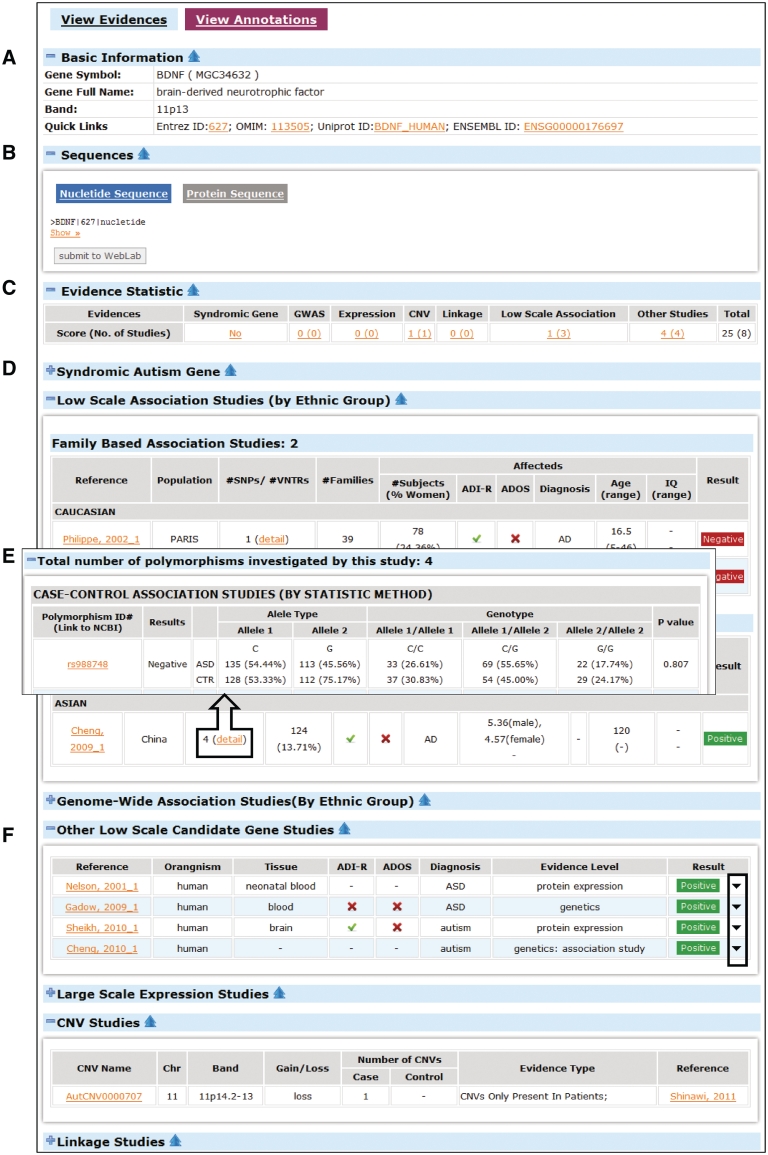
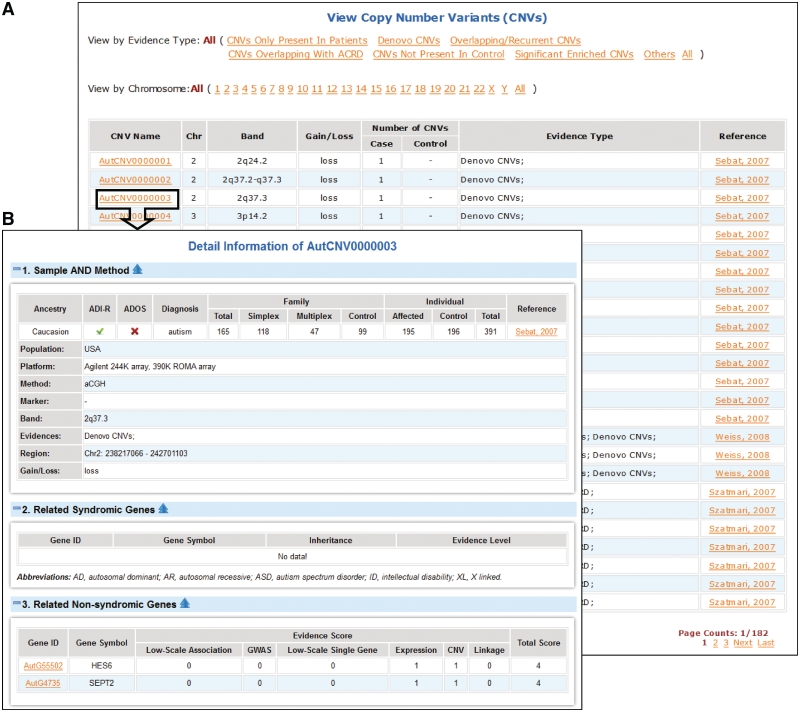
Autism spectrum disorder (ASD) is a heterogeneous neurodevelopmental disorder with a prevalence of 0.9-2.6%. Twin studies showed a heritability of 38-90%, indicating strong genetic contributions. Yet it is unclear how many genes have been associated with ASD and how strong the evidence is. A comprehensive review and analysis of literature and data may bring a clearer big picture of autism genetics. We show that as many as 2193 genes, 2806 SNPs/VNTRs, 4544 copy number variations (CNVs) and 158 linkage regions have been associated with ASD by GWAS, genome-wide CNV studies, linkage analyses, low-scale genetic association studies, expression profiling and other low-scale experimental studies. To evaluate the evidence, we collected metadata about each study including clinical and demographic features, experimental design and statistical significance, and used a scoring and ranking approach to select a core data set of 434 high-confidence genes. The genes mapped to pathways including neuroactive ligand-receptor interaction, synapse transmission and axon guidance. To better understand the genes we parsed over 30 databases to retrieve extensive data about expression patterns, protein interactions, animal models and pharmacogenetics. We constructed a MySQL-based online database and share it with the broader autism research community at http://autismkb.cbi.pku.edu.cn, supporting sophisticated browsing and searching functionalities.
Overview
The claims and statistics of this paper haven’t been checked yet.
Run the check — free, no account needed. It reads the open-access text and checks the sources it cites.
Integrity signals
Registry
Cites
Statistics
Figures
Verification
Claims the paper makes
The claims and statistics of this paper haven’t been checked yet.
Run the check — free, no account needed. It reads the open-access text and checks the sources it cites.
Claims other papers make about this one
Each is checked against this paper’s own text: does it say what the citing paper says it does?
In the citing paper
“Previous work has crafted curated lists of genes implicated in autism spectrum disorders (ASDs) [1-5], and in some cases developed loosely defined “evidence scores” for entries [6-8]. Such efforts are incomplete, non-systematic and static.”
From SFARI Gene 2.0: a community-driven knowledgebase for the autism spectrum disorders (ASDs) (2013) · cites this paper as [8]
Self-check
Percentages, sums and reported differences re-computed from the paper’s own numbers.
The self-check needs the paper’s full text.
Citations
Cites
Systematic and integrative analysis of large gene lists using DAVID bioinformatics resources
Huang, D. W., Sherman, B. T., & Lempicki, R. A. (2009) · Nature Protocols · doi:10.1038/nprot.2008.211 · Cited by 35,890
Ultrafast and memory-efficient alignment of short DNA sequences to the human genome.
Langmead, B., Trapnell, C., Pop, M., & Salzberg, S. L. (2009) · Genome Biology · doi:10.1186/gb-2009-10-3-r25 · Cited by 21,849
Trapnell, C., Williams, B. A., Pertea, G., Mortazavi, A., Kwan, G., van Baren, M. J., Salzberg, S. L., Wold, B. J., & Pachter, L. (2010) · Nature Biotechnology · doi:10.1038/nbt.1621 · Cited by 15,556
Mapping and quantifying mammalian transcriptomes by RNA-Seq
Mortazavi, A., Williams, B. A., McCue, K., Schaeffer, L., & Wold, B. (2008) · Nature Methods · doi:10.1038/nmeth.1226 · Cited by 13,696
TopHat: discovering splice junctions with RNA-Seq
Trapnell, C., Pachter, L. S., & Salzberg, S. L. (2009) · Bioinformatics · doi:10.1093/bioinformatics/btp120 · Cited by 11,682
Database resources of the National Center for Biotechnology Information: update
Wheeler, D. L. (2003) · Nucleic Acids Research · doi:10.1093/nar/gkh073 · Cited by 10,695
KEGG for linking genomes to life and the environment
Kanehisa, M. I., Araki, M., Goto, S., Hattori, M., Hirakawa, M., Itoh, M., Katayama, T., Kawashima, S., Okuda, S., Tokimatsu, T., et al. (2007) · Nucleic Acids Research · doi:10.1093/nar/gkm882 · Cited by 6,828
Alternative isoform regulation in human tissue transcriptomes
Wang, E. T., Sandberg, R., Luo, S., Khrebtukova, I., Zhang, L., Mayr, C., Kingsmore, S. F., Schroth, G. P., & Burge, C. B. (2008) · Nature · doi:10.1038/nature07509 · Cited by 5,181
KOBAS 2.0: a web server for annotation and identification of enriched pathways and diseases
Xie, C., Mao, X., Huang, J., Ding, Y., Wu, J., Dong, S., Kong, L., Gao, G., Li, C., & Wei, L. (2011) · Nucleic Acids Research · doi:10.1093/nar/gkr483 · Cited by 5,078
Self-citationDiagnostic and Statistical Manual of Mental Disorders ( DSM ‐ IV ‐ TR )
Segal, D. L. (2010) · Wiley eBooks · doi:10.1002/9780470479216.corpsy0271 · Cited by 4,687
Cited by
Sorted by citations
SFARI Gene 2.0: a community-driven knowledgebase for the autism spectrum disorders (ASDs)
Abrahams, B. S., Arking, D. E., Campbell, D. B., Mefford, H. C., Morrow, E. M., Weiss, L. A., Menashe, I., Wadkins, T., Banerjee-Basu, S., & Packer, A. (2013) · Molecular Autism · doi:10.1186/2040-2392-4-36 · Cited by 873
“Letter to the Editor Previous work has crafted curated lists of genes implicated in autism spectrum disorders (ASDs) [1-5], and in some cases developed loosely defined “evidence scores” for entries [6-8].”
Sugathan, A., Biagioli, M., Golzio, C., Erdin, S., Blumenthal, I., Manavalan, P., Ragavendran, A., Brand, H., Lucente, D., Miles, J., et al. (2014) · Proceedings of the National Academy of Sciences · doi:10.1073/pnas.1405266111 · Cited by 342
miRWalk Database for miRNA–Target Interactions
Dweep, H., Gretz, N., & Sticht, C. (2014) · Methods in molecular biology · doi:10.1007/978-1-4939-1062-5_25 · Cited by 324
Nankova, B. B., Agarwal, R., MacFabe, D. F., & La Gamma, E. F. (2014) · PLoS ONE · doi:10.1371/journal.pone.0103740 · Cited by 294
Autism Spectrum Disorder and the Cerebellum
Becker, E. B. E., & Stoodley, C. J. (2013) · International review of neurobiology · doi:10.1016/b978-0-12-418700-9.00001-0 · Cited by 292
Metadata
- Authors
- Xu, L.-M., Li, J.-R., Huang, Y., Zhao, M., Tang, X., & Wei, L.
- Affiliations
- Peking University (CN)
- Corresponding author
- Wei, Liping
- Venue
- Nucleic Acids Research
- Publisher
- Oxford University Press (OUP)
- Published
- 2011-12-01
- Volume
- 40
- Issue
- D1
- Pages
- D1016-D1022
- ISSN
- 0305-1048 (ISSN-L)
- 1362-4962
- PMC
- PMC3245106
- OpenAlex
- W2039778388
- Cited by
- 179
- References
- 65
- Citations by year
- 2026: 4 · 2025: 9 · 2024: 5 · 2023: 6 · 2022: 9 · 2021: 6 · 2020: 14 · 2019: 8 · 2018: 19 · 2017: 14 · 2016: 16 · 2015: 14 · 2014: 21 · 2013: 22 · 2012: 12
- FWCI
- 8.94
- Type
- journal article
- Language
- en
- Open access
- gold
- doi.org
- Licence
- Locations
- Nucleic Acids Research (publishedVersion, cc-by-nc)
- PubMed Central (publishedVersion, cc-by-nc)
- PubMed (publishedVersion)
- HighWire Press Open Archive (submittedVersion)
- Funders
- National Natural Science Foundation of China (31025014, 2011CBA01102)
- Topics
- Life Sciences › Neuroscience › Cognitive Neuroscience › Autism Spectrum Disorder Research
- Life Sciences › Biochemistry, Genetics and Molecular Biology › Genetics › Genetics and Neurodevelopmental Disorders
- Life Sciences › Biochemistry, Genetics and Molecular Biology › Genetics › Genetic Associations and Epidemiology
- Keywords
- autism spectrum disorder, autism genetics, gene ranking, copy number variation, single nucleotide polymorphisms, linkage region, neurodevelopmental disorders, axon guidance, neuroactive ligand-receptor interaction, gene expression profiling, protein-protein interaction, animal models, pharmacogenetics
- MeSH terms
- Autistic Disorder, Humans, Genetic Linkage, User-Computer Interface, Genetic Variation, Databases, Genetic, Knowledge Bases, Molecular Sequence Annotation
About these checks
Registry, retraction, Cites and statistics results are computed, not judged, with one exception: a printed reference that no index lists is read once by a model before it counts as a citation error. Claims are extracted by a model and kept only when their quote appears verbatim in the text; each cited source is then checked, with a model’s help, for whether it says what the claim relies on. Those verdicts can be wrong — read the claim’s quote and the cited source before relying on one.
Statistics and arithmetic are recomputed, not judged.
Confidence bands are shown only for fields calibrated on our annotated test set. None is calibrated yet, so no band is shown.
What counts as a claim ›How we measure confidence ›How we check this ›
Are you an author, or do you see a problem with this page? Request a review
