

The DOI matches its Crossref record; 54 of the 54 references it cites were found in a registry or an index.
Nucleoside modifications in RNA limit activation of 2'-5'-oligoadenylate synthetase and increase resistance to cleavage by RNase L
Open accessAbstract
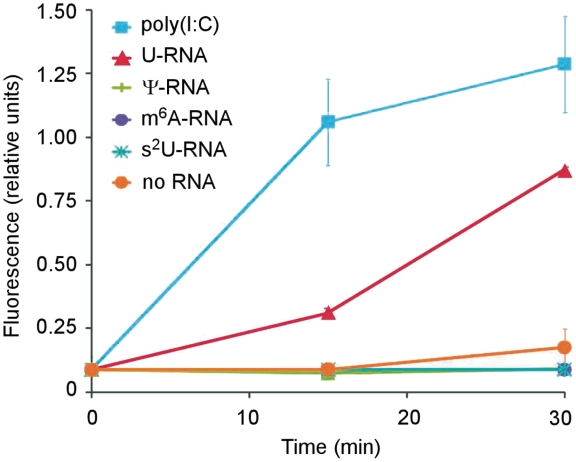
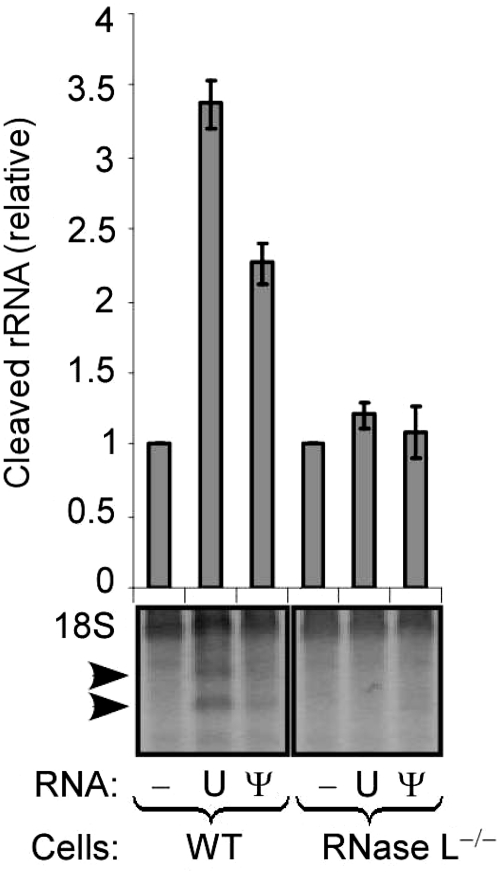
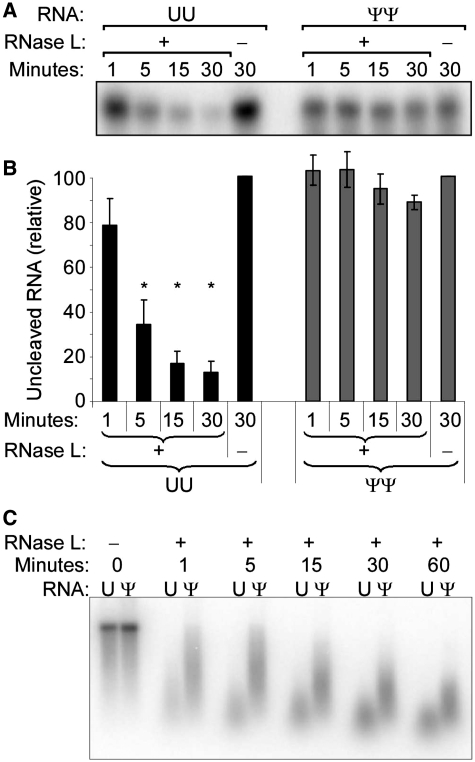
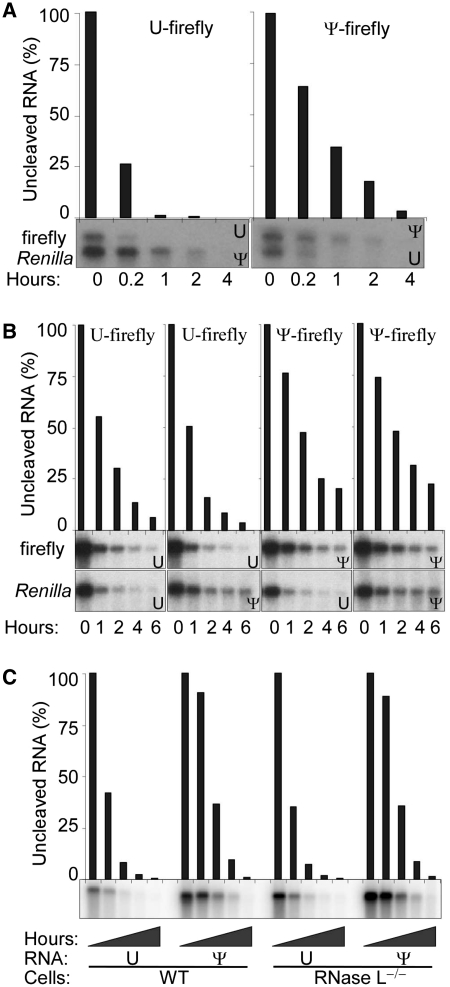
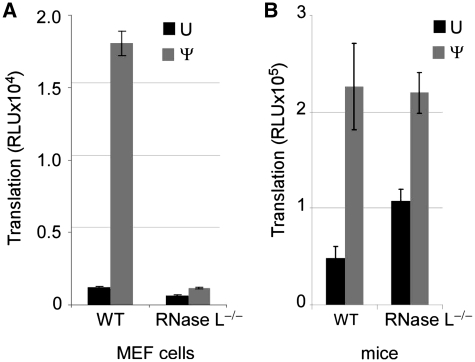
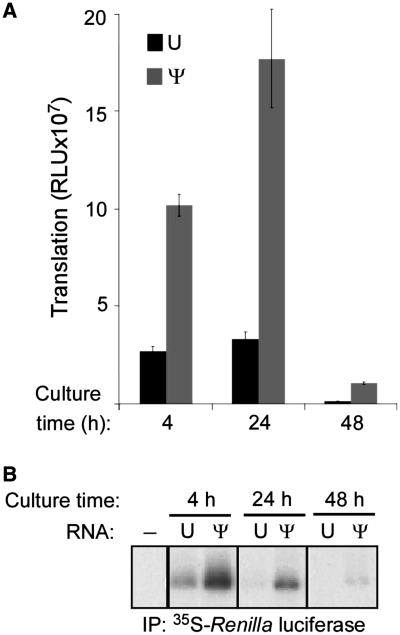
The interferon-induced enzymes 2'-5'-oligoadenylate synthetase (OAS) and RNase L are key components of innate immunity involved in sensory and effector functions following viral infections. Upon binding target RNA, OAS is activated to produce 2'-5'-linked oligoadenylates (2-5A) that activate RNase L, which then cleaves single-stranded self and non-self RNA. Modified nucleosides that are present in cellular transcripts have been shown to suppress activation of several RNA sensors. Here, we demonstrate that in vitro transcribed, unmodified RNA activates OAS, induces RNase L-mediated ribosomal RNA (rRNA) cleavage and is rapidly cleaved by RNase L. In contrast, RNA containing modified nucleosides activates OAS less efficiently and induces limited rRNA cleavage. Nucleoside modifications also make RNA resistant to cleavage by RNase L. Examining translation in RNase L(-/-) cells and mice confirmed that RNase L activity reduces translation of unmodified mRNA, which is not observed with modified mRNA. Additionally, mRNA containing the nucleoside modification pseudouridine is translated longer and has an extended half-life. The observation that modified nucleosides in RNA reduce 2-5A pathway activation joins OAS and RNase L to the list of RNA sensors and effectors whose functions are limited when RNA is modified, confirming the role of nucleoside modifications in suppressing immune recognition of RNA.
Overview
The claims and statistics of this paper haven’t been checked yet.
Run the check — free, no account needed. It reads the open-access text and checks the sources it cites.
Integrity signals
Registry
Cites
Statistics
Figures
Verification
Claims the paper makes
The claims and statistics of this paper haven’t been checked yet.
Run the check — free, no account needed. It reads the open-access text and checks the sources it cites.
Claims other papers make about this one
Each is checked against this paper’s own text: does it say what the citing paper says it does?
The cited source says what the claim attributes to it.
In the citing paper
“Nucleoside-modified mRNA can reduce the activation of TLRs, retinoic acid-inducible gene I (RIG-I), protein kinase R (PKR), and 2′-5′-oligoadenylate synthetase (OAS). Additionally, nucleoside modification increases translation activity and resistance against RNase L-mediated degradation.54,81,173–176”
From Advances in COVID-19 mRNA vaccine development (2022) · cites this paper as [175]
The cited source says what the claim attributes to it.
In the citing paper
“Transferring this concept to in vitro transcribed mRNA, for instance, pseudouridine-containing mRNAs reduced activation of known RNA sensors substantially.”
From Sequence-engineered mRNA without chemical nucleoside modifications enables an effective protein therapy in large animals (2015) · cites this paper as [21]
The cited source says what the claim attributes to it.
In the citing paper
“In addition, nucleoside modifications are well known to limit or even inhibit RNA sensor engagement.20,21,22”
From Sequence-engineered mRNA without chemical nucleoside modifications enables an effective protein therapy in large animals (2015) · cites this paper as [21]
In the citing paper
“These alterations possibly lead to a blunted specific immune response.37,133, 134, 135”
From COVID-19 mRNA vaccines: Platforms and current developments (2022) · cites this paper as [135]
Self-check
Percentages, sums and reported differences re-computed from the paper’s own numbers.
The self-check needs the paper’s full text.
Citations
Cites
Karikó, K., Buckstein, M., Ni, H., & Weissman, D. (2005) · Immunity · doi:10.1016/j.immuni.2005.06.008 · Cited by 2,728
5'-Triphosphate RNA Is the Ligand for RIG-I
Hornung, V., Ellegast, J., Kim, S., Brzózka, K., Jung, A., Kato, H., Poeck, H., Akira, S., Conzelmann, K.-K., Schlee, M., et al. (2006) · Science · doi:10.1126/science.1132505 · Cited by 2,474
Karikó, K., Muramatsu, H., Welsh, F. A., Ludwig, J., Kato, H., Akira, S., & Weissman, D. (2008) · Molecular Therapy · doi:10.1038/mt.2008.200 · Cited by 1,930
Self-citationmRNA is an endogenous ligand for toll-like receptor 3
Karikó, K., Ni, H., Capodici, J., Lamphier, M., & Weissman, D. (2004) · Journal of Biological Chemistry · doi:10.1074/jbc.m310175200 · Cited by 1,062
Self-citation2′-O methylation of the viral mRNA cap evades host restriction by IFIT family members
Daffis, S., Szretter, K. J., Schriewer, J. M., Li, J., Youn, S., Errett, J. S., Lin, T., Schneller, S. W., Züst, R., Dong, H., et al. (2010) · Nature · doi:10.1038/nature09489 · Cited by 910
Züst, R., Cervantes-Barragan, L., Habjan, M., Maier, R., Neuman, B. W., Ziebuhr, J., Szretter, K. J., Baker, S. C., Barchet, W., Diamond, M. S., et al. (2011) · Nature Immunology · doi:10.1038/ni.1979 · Cited by 811
Incorporation of pseudouridine into mRNA enhances translation by diminishing PKR activation
Anderson, B. R., Muramatsu, H., Nallagatla, S. R., Bevilacqua, P. C., Sansing, L. H., Weissman, D., & Karikó, K. (2010) · Nucleic Acids Research · doi:10.1093/nar/gkq347 · Cited by 682
Self-citationSmall self-RNA generated by RNase L amplifies antiviral innate immunity
Malathi, K., Dong, B., Gale, M., & Silverman, R. H. (2007) · Nature · doi:10.1038/nature06042 · Cited by 663
Modification and Editing of RNA
Auffinger, P., Grosjean, H., & Benne, R. (1998) · ASM Press eBooks · doi:10.1128/9781555818296 · Cited by 643
Pseudouridine in RNA: What, Where, How, and Why
Charette, M., & Gray, M. W. (2000) · IUBMB Life · doi:10.1080/152165400410182 · Cited by 600
Research works printed but not linked: 2
- 2005, 23, 165
- 1995, 165, 233
Cited by
Sorted by citations
mRNA vaccines — a new era in vaccinology
Pardi, N., Hogan, M. J., Porter, F. W., & Weissman, D. (2018) · Nature Reviews Drug Discovery · doi:10.1038/nrd.2017.243 · Cited by 4,667
Non-viral vectors for gene-based therapy
Yin, H., Kanasty, R. L., Eltoukhy, A. A., Vegas, A. J., Dorkin, J. R., & Anderson, D. G. (2014) · Nature Reviews Genetics · doi:10.1038/nrg3763 · Cited by 3,123
mRNA-based therapeutics--developing a new class of drugs
Sahin, U., Karikó, K., & Türeci, Ö. (2014) · Nature Reviews Drug Discovery · doi:10.1038/nrd4278 · Cited by 2,474
Self-citationTherapeutic siRNA: state of the art
Hu, B., Zhong, L., Weng, Y., Peng, L., Huang, Y., Zhao, Y., & Liang, X.-J. (2020) · Signal Transduction and Targeted Therapy · doi:10.1038/s41392-020-0207-x · Cited by 1,586
Modified mRNA vaccines protect against zika virus infection
Richner, J. M., Himansu, S., Dowd, K. A., Butler, S. L., Salazar, V., Fox, J. M., Julander, J. G., Tang, W. W., Shresta, S., Pierson, T. C., et al. (2017) · Cell · doi:10.1016/j.cell.2017.02.017 · Cited by 909
Metadata
- Authors
- Anderson, B. R., Muramatsu, H., Jha, B. K., Silverman, R. H., Weissman, D., & Kariko, K.
- Affiliations
- University of Pennsylvania (US)
- Cleveland Clinic (US)
- Venue
- Nucleic Acids Research
- Publisher
- Oxford University Press (OUP)
- Published
- 2011-08-03
- Volume
- 39
- Issue
- 21
- Pages
- 9329-9338
- ISSN
- 0305-1048 (ISSN-L)
- 1362-4962
- PMC
- PMC3241635
- OpenAlex
- W2071136305
- Cited by
- 356
- References
- 54
- Citations by year
- 2026: 30 · 2025: 40 · 2024: 39 · 2023: 49 · 2022: 43 · 2021: 51 · 2020: 19 · 2019: 17 · 2018: 14 · 2017: 13 · 2016: 6 · 2015: 12 · 2014: 6 · 2013: 7 · 2012: 9
- FWCI
- 3.26
- Type
- journal article
- Language
- en
- Open access
- gold
- doi.org
- Licence
- Locations
- Nucleic Acids Research (publishedVersion, cc-by-nc)
- Europe PMC (PubMed Central) (publishedVersion, cc-by-nc)
- PubMed Central (publishedVersion, cc-by-nc)
- PubMed (publishedVersion)
- Funders
- National Institutes of Health (T32 GM- 07229)
- National Heart, Lung, and Blood Institute (R42HL087688, R42HL87688)
- National Cancer Institute (R01CA044059)
- National Institute of General Medical Sciences (T32GM007229, T32GM07229)
- National Institute of Allergy and Infectious Diseases (R01 AI50484, R01AI050484)
- National Institute of Diabetes and Digestive and Kidney Diseases (T32DK007748, T32 DK-07748)
- National Institute of Neurological Disorders and Stroke (R01NS029331)
- National Institute of Dental and Craniofacial Research (R21DE019059)
- National Center for Research Resources (T32RR007063)
- Topics
- Life Sciences › Immunology and Microbiology › Immunology › interferon and immune responses
- Life Sciences › Biochemistry, Genetics and Molecular Biology › Molecular Biology › RNA regulation and disease
- Life Sciences › Biochemistry, Genetics and Molecular Biology › Molecular Biology › RNA modifications and cancer
- Keywords
- nucleoside modification, RNA, 2',5'-oligoadenylate synthetase, RNase L, pseudouridine, mRNA translation, mRNA stability, RNA sensors, innate immunity, interferon signaling, viral RNA sensing, immune evasion
- MeSH terms
- Animals, Cells, Cultured, Endoribonucleases, Half-Life, Humans, Nucleosides, Pseudouridine, RNA, RNA, Ribosomal, Protein Biosynthesis, Uridine, 2',5'-Oligoadenylate Synthetase, Mice
About these checks
Registry, retraction, Cites and statistics results are computed, not judged, with one exception: a printed reference that no index lists is read once by a model before it counts as a citation error. Claims are extracted by a model and kept only when their quote appears verbatim in the text; each cited source is then checked, with a model’s help, for whether it says what the claim relies on. Those verdicts can be wrong — read the claim’s quote and the cited source before relying on one.
Statistics and arithmetic are recomputed, not judged.
Confidence bands are shown only for fields calibrated on our annotated test set. None is calibrated yet, so no band is shown.
What counts as a claim ›How we measure confidence ›How we check this ›
Are you an author, or do you see a problem with this page? Request a review
