

The DOI matches its Crossref record; 54 of the 54 references it cites were found in a registry or an index.
Nucleoside modifications in RNA limit activation of 2'-5'-oligoadenylate synthetase and increase resistance to cleavage by RNase L
Open accessAbstract
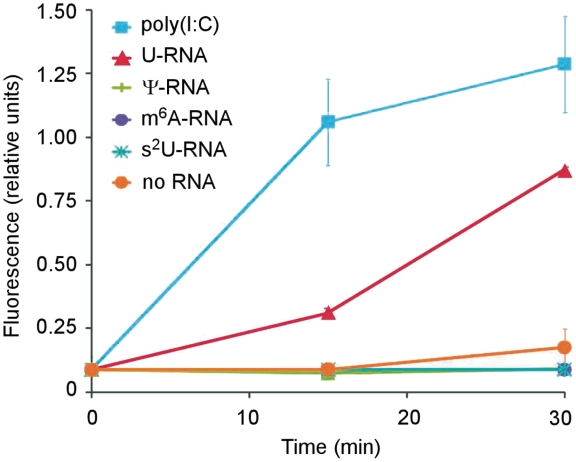
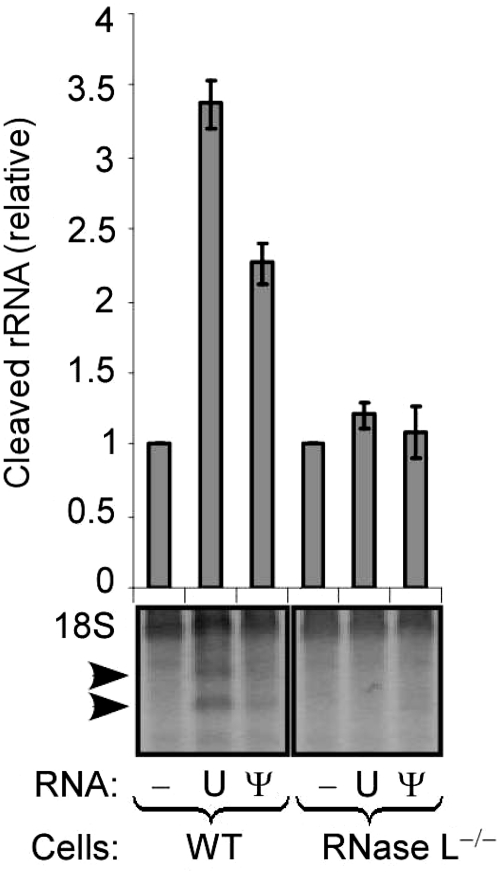
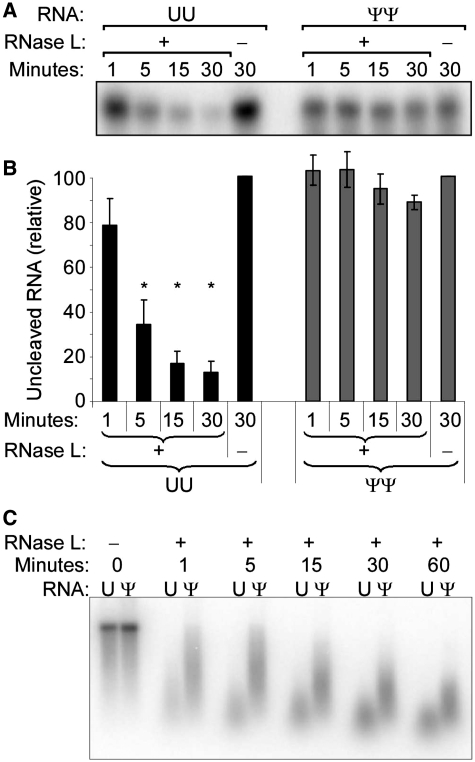
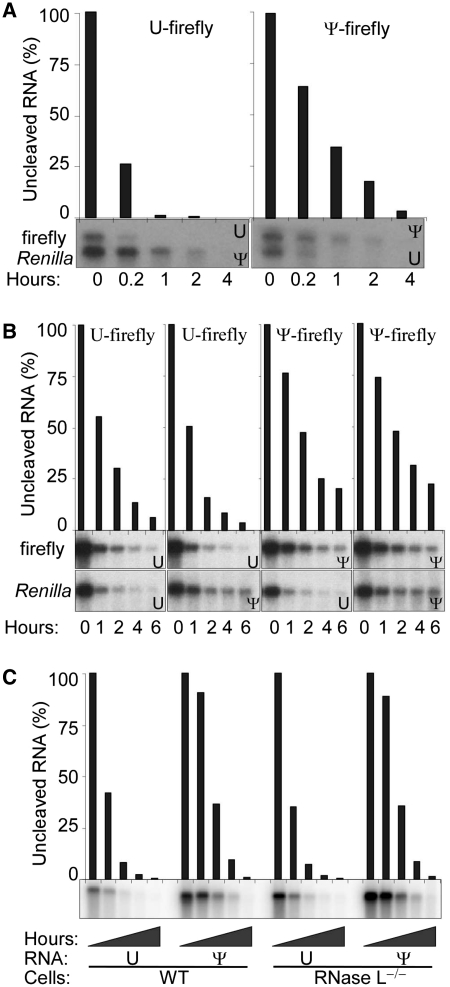
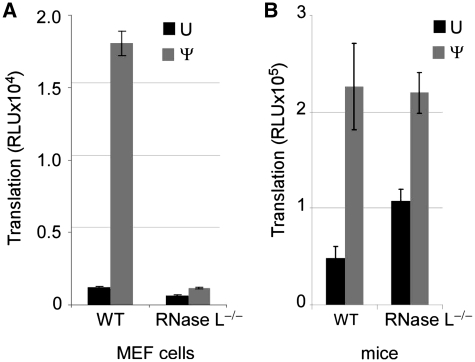
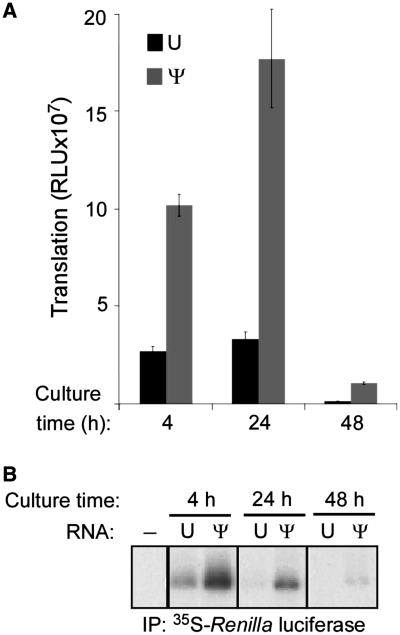
The interferon-induced enzymes 2'-5'-oligoadenylate synthetase (OAS) and RNase L are key components of innate immunity involved in sensory and effector functions following viral infections. Upon binding target RNA, OAS is activated to produce 2'-5'-linked oligoadenylates (2-5A) that activate RNase L, which then cleaves single-stranded self and non-self RNA. Modified nucleosides that are present in cellular transcripts have been shown to suppress activation of several RNA sensors. Here, we demonstrate that in vitro transcribed, unmodified RNA activates OAS, induces RNase L-mediated ribosomal RNA (rRNA) cleavage and is rapidly cleaved by RNase L. In contrast, RNA containing modified nucleosides activates OAS less efficiently and induces limited rRNA cleavage. Nucleoside modifications also make RNA resistant to cleavage by RNase L. Examining translation in RNase L(-/-) cells and mice confirmed that RNase L activity reduces translation of unmodified mRNA, which is not observed with modified mRNA. Additionally, mRNA containing the nucleoside modification pseudouridine is translated longer and has an extended half-life. The observation that modified nucleosides in RNA reduce 2-5A pathway activation joins OAS and RNase L to the list of RNA sensors and effectors whose functions are limited when RNA is modified, confirming the role of nucleoside modifications in suppressing immune recognition of RNA.
Overview
The claims and statistics of this paper haven’t been checked yet.
Run the check — free, no account needed. It reads the open-access text and checks the sources it cites.
Integrity signals
Registry
Cites
Statistics
Figures
Verification
Claims the paper makes
The claims and statistics of this paper haven’t been checked yet.
Run the check — free, no account needed. It reads the open-access text and checks the sources it cites.
Claims other papers make about this one
Each is checked against this paper’s own text: does it say what the citing paper says it does?
The cited source says what the claim attributes to it.
In the citing paper
“Transferring this concept to in vitro transcribed mRNA, for instance, pseudouridine-containing mRNAs reduced activation of known RNA sensors substantially.”
From Sequence-engineered mRNA without chemical nucleoside modifications enables an effective protein therapy in large animals (2015) · cites this paper as [21]
The cited source says what the claim attributes to it.
In the citing paper
“In addition, nucleoside modifications are well known to limit or even inhibit RNA sensor engagement.20,21,22”
From Sequence-engineered mRNA without chemical nucleoside modifications enables an effective protein therapy in large animals (2015) · cites this paper as [21]
In the citing paper
“Nucleoside-modified mRNA can reduce the activation of TLRs, retinoic acid-inducible gene I (RIG-I), protein kinase R (PKR), and 2′-5′-oligoadenylate synthetase (OAS). Additionally, nucleoside modification increases translation activity and resistance against RNase L-mediated degradation.54,81,173–176”
From Advances in COVID-19 mRNA vaccine development (2022) · cites this paper as [175]
In the citing paper
“These alterations possibly lead to a blunted specific immune response.37,133, 134, 135”
From COVID-19 mRNA vaccines: Platforms and current developments (2022) · cites this paper as [135]
Self-check
Percentages, sums and reported differences re-computed from the paper’s own numbers.
The self-check needs the paper’s full text.
Citations
Cites
Karikó, K., Buckstein, M., Ni, H., & Weissman, D. (2005) · Immunity · doi:10.1016/j.immuni.2005.06.008 · Cited by 2,728
5'-Triphosphate RNA Is the Ligand for RIG-I
Hornung, V., Ellegast, J., Kim, S., Brzózka, K., Jung, A., Kato, H., Poeck, H., Akira, S., Conzelmann, K.-K., Schlee, M., et al. (2006) · Science · doi:10.1126/science.1132505 · Cited by 2,474
Karikó, K., Muramatsu, H., Welsh, F. A., Ludwig, J., Kato, H., Akira, S., & Weissman, D. (2008) · Molecular Therapy · doi:10.1038/mt.2008.200 · Cited by 1,930
Self-citationmRNA is an endogenous ligand for toll-like receptor 3
Karikó, K., Ni, H., Capodici, J., Lamphier, M., & Weissman, D. (2004) · Journal of Biological Chemistry · doi:10.1074/jbc.m310175200 · Cited by 1,062
Self-citation2′-O methylation of the viral mRNA cap evades host restriction by IFIT family members
Daffis, S., Szretter, K. J., Schriewer, J. M., Li, J., Youn, S., Errett, J. S., Lin, T., Schneller, S. W., Züst, R., Dong, H., et al. (2010) · Nature · doi:10.1038/nature09489 · Cited by 910
Züst, R., Cervantes-Barragan, L., Habjan, M., Maier, R., Neuman, B. W., Ziebuhr, J., Szretter, K. J., Baker, S. C., Barchet, W., Diamond, M. S., et al. (2011) · Nature Immunology · doi:10.1038/ni.1979 · Cited by 811
Incorporation of pseudouridine into mRNA enhances translation by diminishing PKR activation
Anderson, B. R., Muramatsu, H., Nallagatla, S. R., Bevilacqua, P. C., Sansing, L. H., Weissman, D., & Karikó, K. (2010) · Nucleic Acids Research · doi:10.1093/nar/gkq347 · Cited by 682
Self-citationSmall self-RNA generated by RNase L amplifies antiviral innate immunity
Malathi, K., Dong, B., Gale, M., & Silverman, R. H. (2007) · Nature · doi:10.1038/nature06042 · Cited by 663
Modification and Editing of RNA
Auffinger, P., Grosjean, H., & Benne, R. (1998) · ASM Press eBooks · doi:10.1128/9781555818296 · Cited by 643
Pseudouridine in RNA: What, Where, How, and Why
Charette, M., & Gray, M. W. (2000) · IUBMB Life · doi:10.1080/152165400410182 · Cited by 577
Research works printed but not linked: 2
- 2005, 23, 165
- 1995, 165, 233
Cited by
Sorted by citations
mRNA vaccines — a new era in vaccinology
Pardi, N., Hogan, M. J., Porter, F. W., & Weissman, D. (2018) · Nature Reviews Drug Discovery · doi:10.1038/nrd.2017.243 · Cited by 4,667
Non-viral vectors for gene-based therapy
Yin, H., Kanasty, R. L., Eltoukhy, A. A., Vegas, A. J., Dorkin, J. R., & Anderson, D. G. (2014) · Nature Reviews Genetics · doi:10.1038/nrg3763 · Cited by 3,123
mRNA-based therapeutics--developing a new class of drugs
Sahin, U., Karikó, K., & Türeci, Ö. (2014) · Nature Reviews Drug Discovery · doi:10.1038/nrd4278 · Cited by 2,474
Self-citationTherapeutic siRNA: state of the art
Hu, B., Zhong, L., Weng, Y., Peng, L., Huang, Y., Zhao, Y., & Liang, X.-J. (2020) · Signal Transduction and Targeted Therapy · doi:10.1038/s41392-020-0207-x · Cited by 1,586
Modified mRNA vaccines protect against zika virus infection
Richner, J. M., Himansu, S., Dowd, K. A., Butler, S. L., Salazar, V., Fox, J. M., Julander, J. G., Tang, W. W., Shresta, S., Pierson, T. C., et al. (2017) · Cell · doi:10.1016/j.cell.2017.02.017 · Cited by 909
Karikó, K., Muramatsu, H., Ludwig, J., & Weissman, D. (2011) · Nucleic Acids Research · doi:10.1093/nar/gkr695 · Cited by 898
The epitranscriptome beyond m6A
Wiener, D., & Schwartz, S. (2020) · Nature Reviews Genetics · doi:10.1038/s41576-020-00295-8 · Cited by 733
Andries, O., Mc Cafferty, S., De Smedt, S. C., Weiss, R., Sanders, N. N., & Kitada, T. (2015) · Journal of Controlled Release · doi:10.1016/j.jconrel.2015.08.051 · Cited by 701
Bahl, K., Senn, J. J., Yuzhakov, O., Bulychev, A., Brito, L. A., Hassett, K. J., Laska, M. E., Smith, M., Almarsson, Ö., Thompson, J., et al. (2017) · Molecular Therapy · doi:10.1016/j.ymthe.2017.03.035 · Cited by 642
Developing mRNA-vaccine technologies
Schlake, T., Thess, A., Fotin-Mleczek, M., & Kallen, K.-J. (2012) · RNA Biology · doi:10.4161/rna.22269 · Cited by 622
Advances in COVID-19 mRNA vaccine development
Fang, E., Liu, X., Li, M., Zhang, Z., Song, L., Zhu, B., Wu, X., Liu, J., Zhao, D., & Li, Y. (2022) · Signal Transduction and Targeted Therapy · doi:10.1038/s41392-022-00950-y · Cited by 601
mRNA as a Transformative Technology for Vaccine Development to Control Infectious Diseases
Maruggi, G., Zhang, C., Li, J., Ulmer, J. B., & Yu, D. (2019) · Molecular Therapy · doi:10.1016/j.ymthe.2019.01.020 · Cited by 507
Thess, A., Grund, S., Mui, B. L., Hope, M. J., Baumhof, P., Fotin-Mleczek, M., & Schlake, T. (2015) · Molecular Therapy · doi:10.1038/mt.2015.103 · Cited by 513
Innate immune mechanisms of mRNA vaccines
Verbeke, R., Hogan, M. J., Loré, K., & Pardi, N. (2022) · Immunity · doi:10.1016/j.immuni.2022.10.014 · Cited by 535
The landscape of mRNA nanomedicine
Huang, X., Kong, N., Zhang, X., Cao, Y., Langer, R., & Tao, W. (2022) · Nature Medicine · doi:10.1038/s41591-022-02061-1 · Cited by 511
Vogel, A. B., Lambert, L., Kinnear, E., Busse, D., Erbar, S., Reuter, K. C., Wicke, L., Perkovic, M., Beissert, T., Haas, H., et al. (2018) · Molecular Therapy · doi:10.1016/j.ymthe.2017.11.017 · Cited by 501
Liang, F., Lindgren, G., Lin, A., Thompson, E. A., Ols, S., Röhss, J., John, S., Hassett, K., Yuzhakov, O., Bahl, K., et al. (2017) · Molecular Therapy · doi:10.1016/j.ymthe.2017.08.006 · Cited by 395
Nanotechnologies in delivery of mRNA therapeutics using nonviral vector-based delivery systems
Guan, S., & Rosenecker, J. (2017) · Gene Therapy · doi:10.1038/gt.2017.5 · Cited by 389
mRNA Vaccine Era—Mechanisms, Drug Platform and Clinical Prospection
Xu, S., Yang, K., Li, R., & Zhang, L. (2020) · International Journal of Molecular Sciences · doi:10.3390/ijms21186582 · Cited by 368
Three decades of messenger RNA vaccine development
Verbeke, R., Lentacker, I., De Smedt, S. C., & Dewitte, H. (2019) · Nano Today · doi:10.1016/j.nantod.2019.100766 · Cited by 342
mRNA vaccines for COVID-19: what, why and how
Park, J. W., Lagniton, P. N. P., Liu, Y., & Xu, R.-H. (2021) · International Journal of Biological Sciences · doi:10.7150/ijbs.59233 · Cited by 321
COVID-19 mRNA vaccines: Platforms and current developments
Szabó, G. T., Mahiny, A. J., & Vlatkovic, I. (2022) · Molecular Therapy · doi:10.1016/j.ymthe.2022.02.016 · Cited by 308
Karikó, K., Muramatsu, H., Keller, J. M., & Weissman, D. (2012) · Molecular Therapy · doi:10.1038/mt.2012.7 · Cited by 282
Svitkin, Y. V., Cheng, Y. M., Chakraborty, T., Presnyak, V., John, M., & Sonenberg, N. (2017) · Nucleic Acids Research · doi:10.1093/nar/gkx135 · Cited by 278
The Critical Contribution of Pseudouridine to mRNA COVID-19 Vaccines
Morais, P., Adachi, H., & Yu, Y. (2021) · Frontiers in Cell and Developmental Biology · doi:10.3389/fcell.2021.789427 · Cited by 281
Circular RNA vaccine in disease prevention and treatment
Niu, D., Wu, Y., & Lian, J. (2023) · Signal Transduction and Targeted Therapy · doi:10.1038/s41392-023-01561-x · Cited by 281
Vaidyanathan, S., Azizian, K. T., Haque, A. K. M. A., Henderson, J. M., Hendel, A., Shore, S., Antony, J. S., Hogrefe, R. I., Kormann, M. S. D., Porteus, M. H., et al. (2018) · Molecular Therapy Nucleic Acids · doi:10.1016/j.omtn.2018.06.010 · Cited by 262
mRNA Vaccines in the COVID-19 Pandemic and Beyond
Hogan, M. J., & Pardi, N. (2021) · Annual Review of Medicine · doi:10.1146/annurev-med-042420-112725 · Cited by 256
Controlling timing and location in vaccines
Irvine, D. J., Aung, A., & Silva, M. (2020) · Advanced Drug Delivery Reviews · doi:10.1016/j.addr.2020.06.019 · Cited by 255
Engineering siRNA therapeutics: challenges and strategies
Zaidi, S. S. A., Fatima, F., Zaidi, S. A. A., Zhou, D., Deng, W., & Liu, S. (2023) · Journal of Nanobiotechnology · doi:10.1186/s12951-023-02147-z · Cited by 280
Weissman, D. (2015) · Expert Review of Vaccines · doi:10.1586/14760584.2015.973859 · Cited by 228
Islam, M. A., Jamie, R., Reesor, E., Zope, H. R., Tao, W., Lim, M., Ding, J., Chen, Y., Aduluso, D., Zetter, B. R., et al. (2020) · Biomaterials · doi:10.1016/j.biomaterials.2020.120431 · Cited by 220
Pseudouridine: Still mysterious, but never a fake (uridine)!
Spenkuch, F., Motorin, Y., & Helm, M. (2014) · RNA Biology · doi:10.4161/15476286.2014.992278 · Cited by 220
In Vitro Transcription of Long RNA Containing Modified Nucleosides
Pardi, N., Muramatsu, H., Weissman, D., & Karikó, K. (2012) · Methods in molecular biology · doi:10.1007/978-1-62703-260-5_2 · Cited by 204
How mRNA therapeutics are entering the monoclonal antibody field
Van Hoecke, L., & Roose, K. (2019) · Journal of Translational Medicine · doi:10.1186/s12967-019-1804-8 · Cited by 205
Kauffman, K. J., Mir, F. F., Jhunjhunwala, S., Kaczmarek, J. C., Hurtado, J. E., Yang, J. H., Webber, M. J., Kowalski, P. S., Heartlein, M. W., DeRosa, F., et al. (2016) · Biomaterials · doi:10.1016/j.biomaterials.2016.09.006 · Cited by 195
Rational designs of in vivo CRISPR-Cas delivery systems
Xu, C., Chen, G., Luo, Y., Zhang, Y., Zhao, G., Lu, Z.-D., Czarna, A., Gu, Z., & Wang, J. (2019) · Advanced Drug Delivery Reviews · doi:10.1016/j.addr.2019.11.005 · Cited by 186
Role of main RNA modifications in cancer: N6-methyladenosine, 5-methylcytosine, and pseudouridine
Xue, C., Chu, Q., Zheng, Q., Jiang, S., Bao, Z., Su, Y., Lü, J., & Li, L. (2022) · Signal Transduction and Targeted Therapy · doi:10.1038/s41392-022-01003-0 · Cited by 188
Carlsson, L. G., Clarke, J. C., Yen, C. Y. T., Gregoire, F. M., Albery, T., Billger, M. A., Egnell, A., Gan, L., Jennbacken, K., Johansson, E., et al. (2018) · Molecular Therapy — Methods & Clinical Development · doi:10.1016/j.omtm.2018.04.003 · Cited by 186
Gao, Y., Vasic, R., Song, Y., Teng, R. W., Liu, C., Gbyli, R., Biancon, G., Nelakanti, R. V., Lobben, K., Kudo, E., et al. (2020) · Immunity · doi:10.1016/j.immuni.2020.05.003 · Cited by 185
Zhang, J., Chen, B., Gan, C., Sun, H., Zhang, J., & Feng, L. (2023) · International Journal of Nanomedicine · doi:10.2147/ijn.s436038 · Cited by 190
Research Advances on the Stability of mRNA Vaccines
Cheng, F., Wang, Y., Bai, Y., Liang, Z., Mao, Q., Liu, D., Wu, X., & Xu, M. (2023) · Viruses · doi:10.3390/v15030668 · Cited by 177
Minnaert, A.-K., Vanluchene, H., Verbeke, R., Lentacker, I., De Smedt, S. C., Raemdonck, K., Sanders, N. N., & Remaut, K. (2021) · Advanced Drug Delivery Reviews · doi:10.1016/j.addr.2021.113900 · Cited by 157
da Silva, J. R., Rodrigues, K. B., Pelegrin, G. F., Sales, N. S., Muramatsu, H., Silva, M. D. O., Porchia, B. F. M. M., Moreno, A. C. R., Aps, L. R. M. M., Venceslau-Carvalho, A. A., et al. (2023) · Science Translational Medicine · doi:10.1126/scitranslmed.abn3464 · Cited by 150
Nanomedicine-Based Approaches for mRNA Delivery
Uchida, S., Perche, F., Pichon, C., & Cabral, H. (2020) · Molecular Pharmaceutics · doi:10.1021/acs.molpharmaceut.0c00618 · Cited by 139
Van der Jeught, K., De Koker, S., Bialkowski, L., Heirman, C., Tjok Joe, P., Perche, F., Maenhout, S., Bevers, S., Broos, K., Deswarte, K., et al. (2018) · ACS Nano · doi:10.1021/acsnano.8b00966 · Cited by 139
Immunogenicity of In Vitro -Transcribed RNA
Mu, X. N., & Hur, S. (2021) · Accounts of Chemical Research · doi:10.1021/acs.accounts.1c00521 · Cited by 143
Nanomaterials for Therapeutic RNA Delivery
Han, X., Mitchell, M. J., & Nie, G. (2020) · Matter · doi:10.1016/j.matt.2020.09.020 · Cited by 138
Foster, J., Choudhari, N., Perazzelli, J., Storm, J., Hofmann, T. J., Jain, P., Storm, P. B., Pardi, N., Weissman, D., Waanders, A. J., et al. (2018) · Human Gene Therapy · doi:10.1089/hum.2018.145 · Cited by 138
Verbeke, R., Lentacker, I., Wayteck, L., Breckpot, K., Van Bockstal, M., Descamps, B., Vanhove, C., De Smedt, S. C., & Dewitte, H. (2017) · Journal of Controlled Release · doi:10.1016/j.jconrel.2017.09.041 · Cited by 132
Lint, S. V., Renmans, D., Broos, K., Goethals, L., Maenhout, S. K., Benteyn, D., Goyvaerts, C., Four, S. D., der Jeught, K. V., Bialkowski, L., et al. (2016) · Cancer Immunology Research · doi:10.1158/2326-6066.cir-15-0163 · Cited by 130
mRNA as novel technology for passive immunotherapy
Schlake, T., Theß, A., Thran, M., & Jordan, I. (2018) · Cellular and Molecular Life Sciences · doi:10.1007/s00018-018-2935-4 · Cited by 135
Tavakoli, S., Nabizadeh, M., Makhamreh, A. K., Gamper, H., McCormick, C. A., Rezapour, N. K., Hou, Y., Wanunu, M., & Rouhanifard, S. H. (2023) · Nature Communications · doi:10.1038/s41467-023-35858-w · Cited by 116
Biomedical applications of mRNA nanomedicine
Xiong, Q., Lee, G. Y., Ding, J., Li, W., & Shi, J. (2018) · Nano Research · doi:10.1007/s12274-018-2146-1 · Cited by 125
De Beuckelaer, A., Pollard, C., Van Lint, S., Roose, K., Van Hoecke, L., Naessens, T., Udhayakumar, V. K., Smet, M., Sanders, N., Lienenklaus, S., et al. (2016) · Molecular Therapy · doi:10.1038/mt.2016.161 · Cited by 122
RNA regulation of the antiviral protein 2′‐5′‐oligoadenylate synthetase
Schwartz, S. L., & Conn, G. L. (2019) · Wiley Interdisciplinary Reviews - RNA · doi:10.1002/wrna.1534 · Cited by 119
Jerjes, W., Theodossiou, T. A., Hirschberg, H., Høgset, A., Weyergang, A., Selbo, P. K., Hamdoon, Z., Hopper, C., & Berg, K. (2020) · Journal of Clinical Medicine · doi:10.3390/jcm9020528 · Cited by 116
Delivery of mRNA Therapeutics for the Treatment of Hepatic Diseases
Trepotec, Z., Lichtenegger, E., Plank, C., Aneja, M. K., & Rudolph, C. (2019) · Molecular Therapy · doi:10.1016/j.ymthe.2018.12.012 · Cited by 115
RNA Mediated toll-like receptor stimulation in health and disease
Dalpke, A. H., & Helm, M. (2012) · RNA Biology · doi:10.4161/rna.20206 · Cited by 113
Designing a novel mRNA vaccine against SARS-CoV-2: An immunoinformatics approach
Ahammad, I., & Lira, S. S. (2020) · International Journal of Biological Macromolecules · doi:10.1016/j.ijbiomac.2020.06.213 · Cited by 112
Engineering of the current nucleoside-modified mRNA-LNP vaccines against SARS-CoV-2
Granados-Riveron, J. T., & Aquino‐Jarquín, G. (2021) · Biomedicine & Pharmacotherapy · doi:10.1016/j.biopha.2021.111953 · Cited by 115
Tse, S., McKinney, K. M., Walker, W., Nguyen, M., Iacovelli, J., Small, C. G., Hopson, K., Zaks, T. Z., & Huang, E. (2021) · Molecular Therapy · doi:10.1016/j.ymthe.2021.03.002 · Cited by 114
Recent Developments in mRNA-Based Protein Supplementation Therapy to Target Lung Diseases
Sahu, I., Haque, A. K. M. A., Weidensee, B., Weinmann, P., & Kormann, M. S. D. (2019) · Molecular Therapy · doi:10.1016/j.ymthe.2019.02.019 · Cited by 104
Recent developments of RNA-based vaccines in cancer immunotherapy
Faghfuri, E., Pourfarzi, F., Faghfouri, A. H., Shadbad, M. A., Hajiasgharzadeh, K., & Baradaran, B. (2020) · Expert Opinion on Biological Therapy · doi:10.1080/14712598.2020.1815704 · Cited by 100
Long-Read Sequencing – A Powerful Tool in Viral Transcriptome Research
Boldogkői, Z., Moldován, N., Balázs, Z., Snyder, M. P., & Tombácz, D. (2019) · Trends in Microbiology · doi:10.1016/j.tim.2019.01.010 · Cited by 96
The advent of clinical self-amplifying RNA vaccines
Casmil, I. C., Jin, J., Won, E.-J., Huang, C., Liao, S., Cha‐Molstad, H., & Blakney, A. K. (2025) · Molecular Therapy · doi:10.1016/j.ymthe.2025.03.060 · Cited by 111
Emerging roles for RNA degradation in viral replication and antiviral defense
Abernathy, E., & Glaunsinger, B. A. (2015) · Virology · doi:10.1016/j.virol.2015.02.007 · Cited by 98
Lipid nanoparticle chemistry determines how nucleoside base modifications alter mRNA delivery
Melamed, J. R., Hajj, K. A., Chaudhary, N., Strelkova, D., Arral, M. L., Pardi, N., Alameh, M., Miller, J. B., Farbiak, L., Siegwart, D. J., et al. (2021) · Journal of Controlled Release · doi:10.1016/j.jconrel.2021.11.022 · Cited by 101
Advancements of in vitro transcribed mRNA (IVT mRNA) to enable translation into the clinics
Kang, D. D., Li, H., & Dong, Y. (2023) · Advanced Drug Delivery Reviews · doi:10.1016/j.addr.2023.114961 · Cited by 100
CRISPR/Cas9 Delivery System Engineering for Genome Editing in Therapeutic Applications
Cheng, H., Zhang, F., & Ding, Y. (2021) · Pharmaceutics · doi:10.3390/pharmaceutics13101649 · Cited by 99
The Pivotal Role of Chemical Modifications in mRNA Therapeutics
Liu, A., & Wang, X. (2022) · Frontiers in Cell and Developmental Biology · doi:10.3389/fcell.2022.901510 · Cited by 102
mRNA: A Novel Avenue to Antibody Therapy?
Schlake, T., Thran, M., Fiedler, K., Heidenreich, R., Petsch, B., & Fotin‐Mleczek, M. (2019) · Molecular Therapy · doi:10.1016/j.ymthe.2019.03.002 · Cited by 93
RNA chemistry and therapeutics
Wang, S., Weissman, D., & Dong, Y. (2025) · Nature Reviews Drug Discovery · doi:10.1038/s41573-025-01237-x · Cited by 102
Synthetic modified messenger RNA for therapeutic applications
Gao, M., Zhang, Q., Feng, X.-H., & Liu, J. (2021) · Acta Biomaterialia · doi:10.1016/j.actbio.2021.06.020 · Cited by 89
Current State of the First COVID-19 Vaccines
Prüβ, B. M. (2021) · Vaccines · doi:10.3390/vaccines9010030 · Cited by 90
Cell-Penetrating Peptides: Emerging Tools for mRNA Delivery
Yokoo, H., Oba, M., & Uchida, S. (2021) · Pharmaceutics · doi:10.3390/pharmaceutics14010078 · Cited by 87
Ripoll, M., Bernard, M., Vaure, C., Bazin, E., Commandeur, S., Perkov, V., Lemdani, K., Nicolaï, M., Bonifassi, P., Kichler, A., et al. (2022) · Biomaterials · doi:10.1016/j.biomaterials.2022.121570 · Cited by 89
Mallory, K. L., Taylor, J. A., Zou, X., Waghela, I. N., Schneider, C. G., Sibilo, M. Q., Punde, N. M., Perazzo, L., Savransky, T., Sedegah, M., et al. (2021) · npj Vaccines · doi:10.1038/s41541-021-00345-0 · Cited by 87
mRNA in cancer immunotherapy: beyond a source of antigen
Hoecke, L. V., Verbeke, R., Dewitte, H., Lentacker, I., Vermaelen, K. Y., Breckpot, K., & Lint, S. V. (2021) · Molecular Cancer · doi:10.1186/s12943-021-01329-3 · Cited by 84
HIV mRNA Vaccines—Progress and Future Paths
Mu, Z., Haynes, B. F., & Cain, D. W. (2021) · Vaccines · doi:10.3390/vaccines9020134 · Cited by 84
Kirschman, J. L., Bhosle, S. M., Vanover, D. A., Blanchard, E. L., Loomis, K. H., Zurla, C., Murray, K. A., Lam, B. C., & Santangelo, P. J. (2017) · Nucleic Acids Research · doi:10.1093/nar/gkx290 · Cited by 77
In vitro evolution of enhanced RNA replicons for immunotherapy
Li, Y., Teague, B., Zhang, Y., Su, Z., Porter, E., Dobosh, B., Wagner, T., Irvine, D. J., & Weiss, R. (2019) · Scientific Reports · doi:10.1038/s41598-019-43422-0 · Cited by 71
The mRNA Vaccine Revolution: COVID-19 Has Launched the Future of Vaccinology
Ye, Z., Harmon, J., Ni, W., Li, Y., Wich, D., & Xu, Q. (2023) · ACS Nano · doi:10.1021/acsnano.2c12584 · Cited by 71
Translation—A tug of war during viral infection
Rozman, B., Fisher, T., & Stern‐Ginossar, N. (2022) · Molecular Cell · doi:10.1016/j.molcel.2022.10.012 · Cited by 75
mRNA vaccines: The future of prevention of viral infections?
Rzymski, P., Szuster‐Ciesielska, A., Dzieciątkowski, T., Gwenzi, W., & Fal, A. (2023) · Journal of Medical Virology · doi:10.1002/jmv.28572 · Cited by 75
Feng, Z., Zhang, X., Zhou, J., Li, Q., Chu, L., Di, G., Xu, Z., Chen, Q., Wang, M., Jiang, X., et al. (2023) · Nature Cancer · doi:10.1038/s43018-023-00650-8 · Cited by 70
Chen, S., Zaifman, J., Kulkarni, J. A., Zhigaltsev, I. V., Tam, Y. K., Ciufolini, M. A., Tam, Y. Y. C., & Cullis, P. R. (2018) · Journal of Controlled Release · doi:10.1016/j.jconrel.2018.07.026 · Cited by 68
Epitranscriptomic marks: Emerging modulators of RNA virus gene expression
Netzband, R., & Pager, C. T. (2019) · Wiley Interdisciplinary Reviews - RNA · doi:10.1002/wrna.1576 · Cited by 64
Devoldere, J., Peynshaert, K., Dewitte, H., Vanhove, C., Groef, L. D., Moons, L., Özcan, S. Y., Dalkara, D., Smedt, S. C. D., & Remaut, K. (2019) · Journal of Controlled Release · doi:10.1016/j.jconrel.2019.06.042 · Cited by 70
The life and death of RNA across temperatures
Becskei, A., & Rahaman, S. (2022) · Computational and Structural Biotechnology Journal · doi:10.1016/j.csbj.2022.08.008 · Cited by 72
Why U matters: detection and functions of pseudouridine modifications in mRNAs
Rodell, R., Robalin, N., & Martínez, N. M. (2023) · Trends in Biochemical Sciences · doi:10.1016/j.tibs.2023.10.008 · Cited by 65
The Epitranscriptome and Innate Immunity
O’Connell, M. A., Mannion, N., & Keegan, L. P. (2015) · PLoS Genetics · doi:10.1371/journal.pgen.1005687 · Cited by 65
Bernard, M., Bazin, E., Petiot, N., Lemdani, K., Commandeur, S., Verdelet, C., Margot, S., Perkov, V., Ripoll, M., Garinot, M., et al. (2023) · Molecular Therapy — Nucleic Acids · doi:10.1016/j.omtn.2023.05.004 · Cited by 63
Rimbach, K., Kaiser, S., Helm, M., Dalpke, A. H., & Eigenbrod, T. (2015) · Journal of Innate Immunity · doi:10.1159/000375460 · Cited by 61
Ongoing Clinical Trials of Nonviral siRNA Therapeutics
Narasipura, E. A., VanKeulen‐Miller, R., Ma, Y., & Fenton, O. S. (2023) · Bioconjugate Chemistry · doi:10.1021/acs.bioconjchem.3c00205 · Cited by 66
Understanding the impact of in vitro transcription byproducts and contaminants
Lenk, R., Kleindienst, W., Szabó, G. T., Baiersdörfer, M., Boros, G., Keller, J. M., Mahiny, A. J., & Vlatkovic, I. (2024) · Frontiers in Molecular Biosciences · doi:10.3389/fmolb.2024.1426129 · Cited by 63
Intracellular Routing and Recognition of Lipid-Based mRNA Nanoparticles
Delehedde, C., Even, L., Midoux, P., Pichon, C., & Perche, F. (2021) · Pharmaceutics · doi:10.3390/pharmaceutics13070945 · Cited by 60
RNA vaccines for cancer: Principles to practice
Guasp, P., Reiche, C., Sethna, Z. M., & Balachandran, V. P. (2024) · Cancer Cell · doi:10.1016/j.ccell.2024.05.005 · Cited by 62
Advances of mRNA vaccine in tumor: a maze of opportunities and challenges
Yuan, Y., Gao, F., Chang, Y., Zhao, Q., & He, X. (2023) · Biomarker Research · doi:10.1186/s40364-023-00449-w · Cited by 60
Clinical development of therapeutic mRNA applications
Żak, M. M., & Zangi, L. (2025) · Molecular Therapy · doi:10.1016/j.ymthe.2025.03.034 · Cited by 68
Metadata
- Authors
- Anderson, B. R., Muramatsu, H., Jha, B. K., Silverman, R. H., Weissman, D., & Kariko, K.
- Affiliations
- University of Pennsylvania (US)
- Cleveland Clinic (US)
- Venue
- Nucleic Acids Research
- Publisher
- Oxford University Press (OUP)
- Published
- 2011-08-03
- Volume
- 39
- Issue
- 21
- Pages
- 9329-9338
- ISSN
- 0305-1048 (ISSN-L)
- 1362-4962
- PMC
- PMC3241635
- OpenAlex
- W2071136305
- Cited by
- 356
- References
- 54
- Citations by year
- 2026: 30 · 2025: 40 · 2024: 39 · 2023: 49 · 2022: 43 · 2021: 51 · 2020: 19 · 2019: 17 · 2018: 14 · 2017: 13 · 2016: 6 · 2015: 12 · 2014: 6 · 2013: 7 · 2012: 9
- FWCI
- 3.26
- Type
- journal article
- Language
- en
- Open access
- gold
- doi.org
- Licence
- Locations
- Nucleic Acids Research (publishedVersion, cc-by-nc)
- Europe PMC (PubMed Central) (publishedVersion, cc-by-nc)
- PubMed Central (publishedVersion, cc-by-nc)
- PubMed (publishedVersion)
- Funders
- National Institutes of Health (T32 GM- 07229)
- National Heart, Lung, and Blood Institute (R42HL087688, R42HL87688)
- National Cancer Institute (R01CA044059)
- National Institute of General Medical Sciences (T32GM007229, T32GM07229)
- National Institute of Allergy and Infectious Diseases (R01 AI50484, R01AI050484)
- National Institute of Diabetes and Digestive and Kidney Diseases (T32DK007748, T32 DK-07748)
- National Institute of Neurological Disorders and Stroke (R01NS029331)
- National Institute of Dental and Craniofacial Research (R21DE019059)
- National Center for Research Resources (T32RR007063)
- Topics
- Life Sciences › Immunology and Microbiology › Immunology › interferon and immune responses
- Life Sciences › Biochemistry, Genetics and Molecular Biology › Molecular Biology › RNA regulation and disease
- Life Sciences › Biochemistry, Genetics and Molecular Biology › Molecular Biology › RNA modifications and cancer
- Keywords
- nucleoside modification, RNA, 2',5'-oligoadenylate synthetase, RNase L, pseudouridine, mRNA translation, mRNA stability, RNA sensors, innate immunity, interferon signaling, viral RNA sensing, immune evasion
- MeSH terms
- Animals, Cells, Cultured, Endoribonucleases, Half-Life, Humans, Nucleosides, Pseudouridine, RNA, RNA, Ribosomal, Protein Biosynthesis, Uridine, 2',5'-Oligoadenylate Synthetase, Mice
About these checks
Registry, retraction, Cites and statistics results are computed, not judged, with one exception: a printed reference that no index lists is read once by a model before it counts as a citation error. Claims are extracted by a model and kept only when their quote appears verbatim in the text; each cited source is then checked, with a model’s help, for whether it says what the claim relies on. Those verdicts can be wrong — read the claim’s quote and the cited source before relying on one.
Statistics and arithmetic are recomputed, not judged.
Confidence bands are shown only for fields calibrated on our annotated test set. None is calibrated yet, so no band is shown.
What counts as a claim ›How we measure confidence ›How we check this ›
Are you an author, or do you see a problem with this page? Request a review
