

The DOI matches its Crossref record; 47 of the 48 references it cites were found in a registry or an index.
Self-organization of domain structures by DNA-loop-extruding enzymes
Open accessAbstract
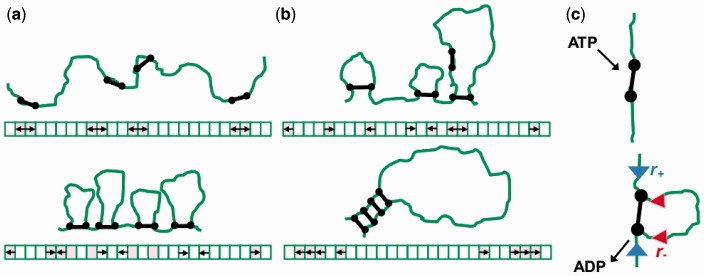
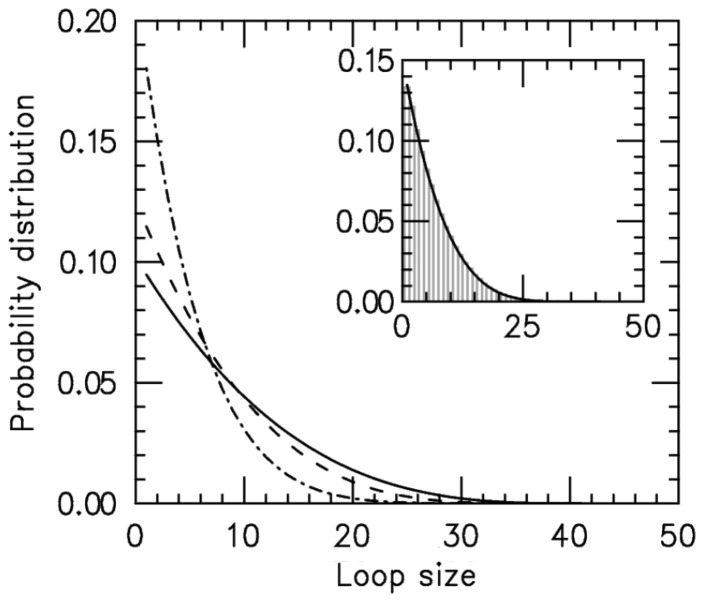
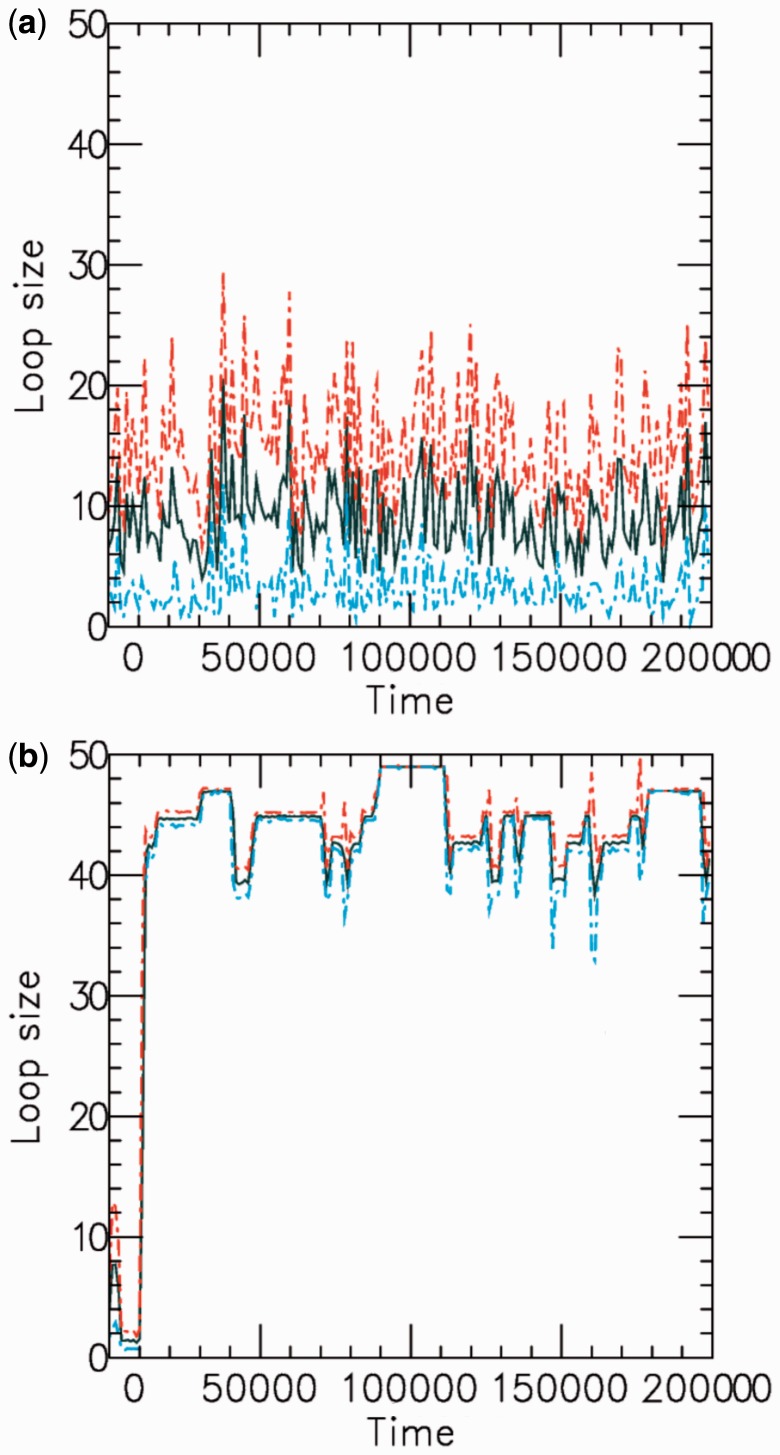
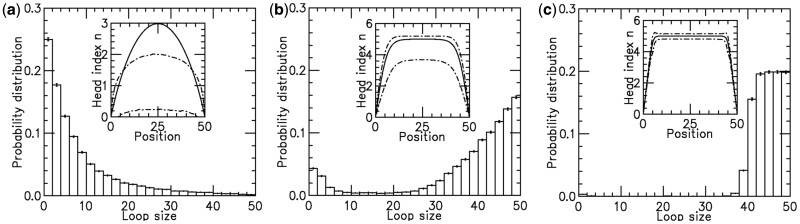
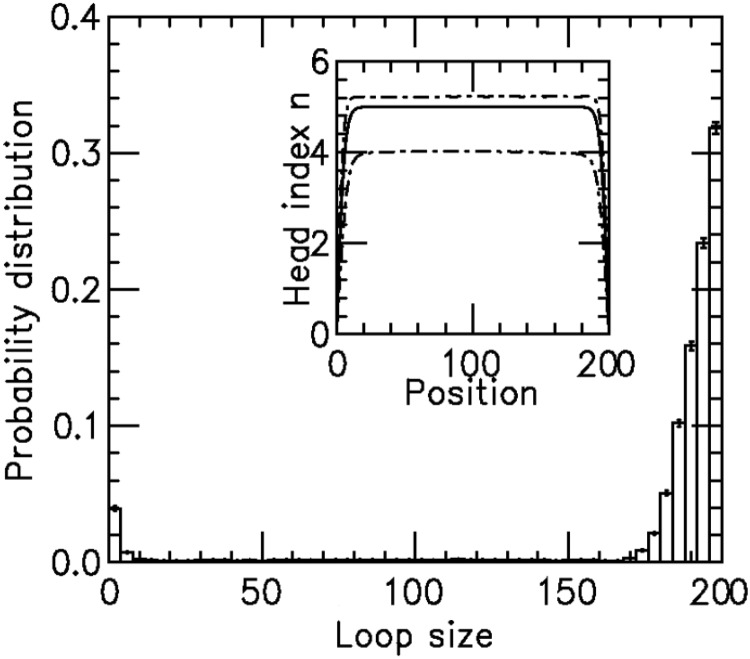
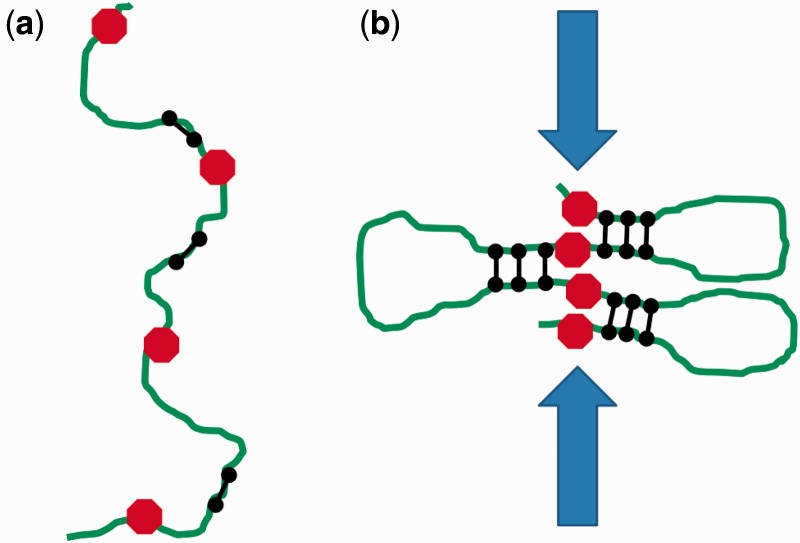
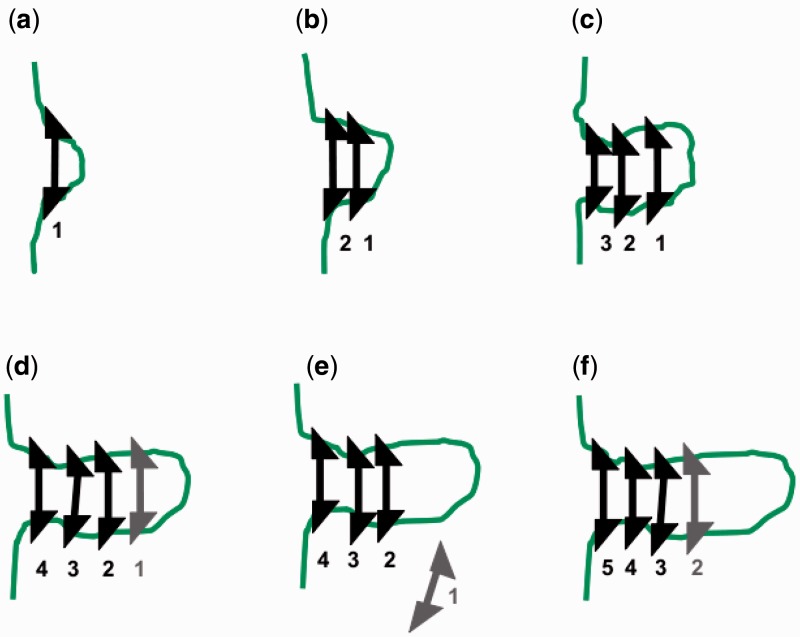
The long chromosomal DNAs of cells are organized into loop domains much larger in size than individual DNA-binding enzymes, presenting the question of how formation of such structures is controlled. We present a model for generation of defined chromosomal loops, based on molecular machines consisting of two coupled and oppositely directed motile elements which extrude loops from the double helix along which they translocate, while excluding one another sterically. If these machines do not dissociate from DNA (infinite processivity), a disordered, exponential steady-state distribution of small loops is obtained. However, if dissociation and rebinding of the machines occurs at a finite rate (finite processivity), the steady state qualitatively changes to a highly ordered 'stacked' configuration with suppressed fluctuations, organizing a single large, stable loop domain anchored by several machines. The size of the resulting domain can be simply regulated by boundary elements, which halt the progress of the extrusion machines. Possible realizations of these types of molecular machines are discussed, with a major focus on structural maintenance of chromosome complexes and also with discussion of type I restriction enzymes. This mechanism could explain the geometrically uniform folding of eukaryote mitotic chromosomes, through extrusion of pre-programmed loops and concomitant chromosome compaction.
Overview
The claims and statistics of this paper haven’t been checked yet.
Run the check — free, no account needed. It reads the open-access text and checks the sources it cites.
Integrity signals
Registry
Cites
Statistics
Figures
Verification
Claims the paper makes
The claims and statistics of this paper haven’t been checked yet.
Run the check — free, no account needed. It reads the open-access text and checks the sources it cites.
Claims other papers make about this one
Each is checked against this paper’s own text: does it say what the citing paper says it does?
In the citing paper
“this favors a linear tracking mechanism,47 known as the “loop extrusion model”.8,9,48”
From Recent evidence that TADs and chromatin loops are dynamic structures (2018) · cites this paper as [48]
Self-check
Percentages, sums and reported differences re-computed from the paper’s own numbers.
The self-check needs the paper’s full text.
Citations
Cites
Table of Integrals, Series, and Products
(1980) · Elsevier eBooks · doi:10.1016/c2013-0-10754-4 · Cited by 19,385
Exact stochastic simulation of coupled chemical reactions
Gillespie, D. T. (1977) · The Journal of Physical Chemistry · doi:10.1021/j100540a008 · Cited by 10,215
Scaling Concepts in Polymer Physics
de Gennes, P. G., & Witten, T. A. (1980) · Physics Today · doi:10.1063/1.2914118 · Cited by 9,348
Comprehensive Mapping of Long-Range Interactions Reveals Folding Principles of the Human Genome
Lieberman-Aiden, E., van Berkum, N. L., Williams, L., Imakaev, M., Ragoczy, T., Telling, A., Amit, I., Lajoie, B. R., Sabo, P. J., Dorschner, M. O., et al. (2009) · Science · doi:10.1126/science.1181369 · Cited by 8,898 · cited 1×
“Furthermore, analyses of DNA juxtapositions inside eukaryote nuclei reveal that loci up to tens of megabases apart along chromosomes are positioned near one another in the nucleus (9,10), with statistical properties inconsistent with randompolymer organization (10).”
BackgroundCapturing Chromosome Conformation
Dekker, J., Rippe, K., Dekker, M., & Kleckner, N. (2002) · Science · doi:10.1126/science.1067799 · Cited by 3,652
Mediator and cohesin connect gene expression and chromatin architecture
Kagey, M. H., Newman, J. J., Bilodeau, S., Zhan, Y., Orlando, D. A., van Berkum, N. L., Ebmeier, C. C., Goossens, J., Rahl, P. B., Levine, S. S., et al. (2010) · Nature · doi:10.1038/nature09380 · Cited by 1,939
Cohesin mediates transcriptional insulation by CCCTC-binding factor
Wendt, K. S., Yoshida, K., Itoh, T., Bando, M., Koch, B., Schirghuber, E., Tsutsumi, S., Nagae, G., Ishihara, K., Mishiro, T., et al. (2008) · Nature · doi:10.1038/nature06634 · Cited by 1,193 · cited 1×
“It is thought that ‘chromatin-bridging’ proteins (12) somehow stabilize these loop structures, but the processes by which sequence-defined chromatin loops are established and maintained are unknown.”
BackgroundChromosome territories – a functional nuclear landscape
Cremer, T., Cremer, M., Dietzel, S., Müller, S., Solovei, I. V., & Fakan, S. (2006) · Current Opinion in Cell Biology · doi:10.1016/j.ceb.2006.04.007 · Cited by 601 · cited 1×
“In eukaryote cells, interphase chromosomes in differentiated cells occupy distinct territories (8).”
BackgroundOno, T., Losada, A., Hirano, M., Myers, M., Neuwald, A. F., & Hirano, T. (2003) · Cell · doi:10.1016/s0092-8674(03)00724-4 · Cited by 588
A heterodimeric coiled-coil protein required for mitotic chromosome condensation in vitro.
Hirano, T., & Mitchison, T. (1994) · Cell · doi:10.1016/0092-8674(94)90254-2 · Cited by 559 · cited 1×
“Immuno-inactivation of condensin complexes in Xenopus egg extracts (an in vitro system capable of assembling mitotic chromosomes) (22), or siRNA depletion of even one subunit of condensin complexes (23,24) in tissue culture cells, causes defective mitotic chromosome condensation.”
Background
Research works printed but not linked: 2
- 2009, PHYS A, 389, 2997
- 1999, Cell, 98, 239:248
Cited by
Sorted by citations
Formation of chromosomal domains by loop extrusion
Fudenberg, G., Imakaev, M., Lu, C., Goloborodko, A., Abdennur, N., & Mirny, L. A. (2016) · Cell Reports · doi:10.1016/j.celrep.2016.04.085 · Cited by 2,003
Cohesin Loss Eliminates All Loop Domains
Rao, S. S. P., Huang, S.-C., Glenn St Hilaire, B., Engreitz, J. M., Perez, E. M., Kieffer-Kwon, K.-R., Sanborn, A. L., Johnstone, S. E., Bascom, G. D., Bochkov, I. D., et al. (2017) · Cell · doi:10.1016/j.cell.2017.09.026 · Cited by 1,883
“We (Sanborn et al., 2015) and others (Alipour and Marko, 2012; Fudenberg et al., 2016; Nasmyth, 2001) have hypothesized that the underlying physical process is the formation of loops by extrusion.”
BackgroundSanborn, A. L., Rao, S. S. P., Huang, S.-C., Durand, N. C., Huntley, M. H., Jewett, A. I., Bochkov, I. D., Chinnappan, D., Cutkosky, A., Li, J., et al. (2015) · Proceedings of the National Academy of Sciences · doi:10.1073/pnas.1518552112 · Cited by 1,730
Organizational principles of 3D genome architecture
Rowley, M. J., & Corces, V. G. (2018) · Nature Reviews Genetics · doi:10.1038/s41576-018-0060-8 · Cited by 1,171
Organization of the mitotic chromosome
Naumova, N., Imakaev, M., Fudenberg, G., Zhan, Y., Lajoie, B. R., Mirny, L. A., & Dekker, J. (2013) · Science · doi:10.1126/science.1236083 · Cited by 976
Metadata
- Authors
- Alipour, E., & Marko, J. F.
- Affiliations
- UConn Health (US)
- Northwestern University (US)
- Corresponding author
- Alipour, E.
- Marko, J. F.
- Venue
- Nucleic Acids Research
- Publisher
- Oxford University Press (OUP)
- Published
- 2012-10-15
- Volume
- 40
- Issue
- 22
- Pages
- 11202-11212
- ISSN
- 0305-1048 (ISSN-L)
- 1362-4962
- PMC
- PMC3526278
- OpenAlex
- W2100148696
- Cited by
- 540
- References
- 48
- Citations by year
- 2026: 26 · 2025: 45 · 2024: 44 · 2023: 46 · 2022: 38 · 2021: 55 · 2020: 71 · 2019: 61 · 2018: 54 · 2017: 52 · 2016: 27 · 2015: 10 · 2014: 7 · 2013: 3
- FWCI
- 2.56
- Type
- journal article
- Language
- en
- Open access
- gold
- doi.org
- Licence
- Locations
- Nucleic Acids Research (publishedVersion, cc-by-nc)
- Europe PMC (PubMed Central) (publishedVersion, cc-by-nc)
- PubMed Central (publishedVersion, cc-by-nc)
- PubMed (publishedVersion)
- HighWire Press Open Archive (submittedVersion)
- Funders
- National Science Foundation (1206868, 1022117, 0715099)
- National Institutes of Health (MCB-1022117, DMR-1206868)
- National Cancer Institute (U54CA143869)
- Division of Materials Research (DMR-1206868)
- Topics
- Life Sciences › Biochemistry, Genetics and Molecular Biology › Molecular Biology › Genomics and Chromatin Dynamics
- Life Sciences › Biochemistry, Genetics and Molecular Biology › Molecular Biology › Diffusion and Search Dynamics
- Life Sciences › Biochemistry, Genetics and Molecular Biology › Molecular Biology › DNA Repair Mechanisms
- Keywords
- DNA loop extrusion, self-organization, molecular machines, DNA translocation, processivity, loop size distribution, chromosome compaction, type I restriction enzymes, boundary elements
- MeSH terms
- Chromosomes, Computer Simulation, DNA, Enzymes, Models, Genetic, Nucleic Acid Conformation
About these checks
Registry, retraction, Cites and statistics results are computed, not judged, with one exception: a printed reference that no index lists is read once by a model before it counts as a citation error. Claims are extracted by a model and kept only when their quote appears verbatim in the text; each cited source is then checked, with a model’s help, for whether it says what the claim relies on. Those verdicts can be wrong — read the claim’s quote and the cited source before relying on one.
Statistics and arithmetic are recomputed, not judged.
Confidence bands are shown only for fields calibrated on our annotated test set. None is calibrated yet, so no band is shown.
What counts as a claim ›How we measure confidence ›How we check this ›
Are you an author, or do you see a problem with this page? Request a review
