

DNASU plasmid and PSI: biology-materials repositories: resources to accelerate biological research
Open accessThe DOI matches its Crossref record; 25 of the 25 references it cites were found in a registry or an index.
Abstract
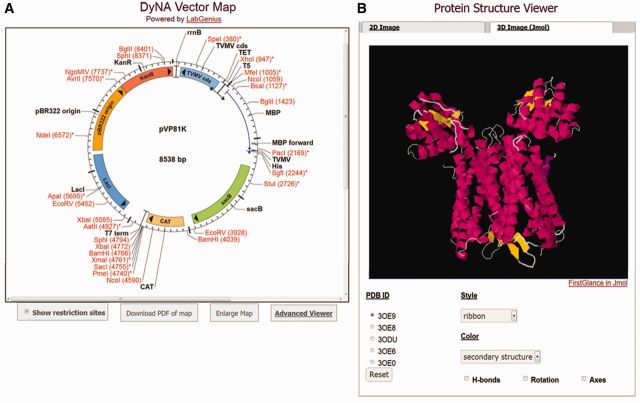
The mission of the DNASU Plasmid Repository is to accelerate research by providing high-quality, annotated plasmid samples and online plasmid resources to the research community through the curated DNASU database, website and repository (http://dnasu.asu.edu or http://dnasu.org). The collection includes plasmids from grant-funded, high-throughput cloning projects performed in our laboratory, plasmids from external researchers, and large collections from consortia such as the ORFeome Collaboration and the NIGMS-funded Protein Structure Initiative: Biology (PSI:Biology). Through DNASU, researchers can search for and access detailed information about each plasmid such as the full length gene insert sequence, vector information, associated publications, and links to external resources that provide additional protein annotations and experimental protocols. Plasmids can be requested directly through the DNASU website. DNASU and the PSI:Biology-Materials Repositories were previously described in the 2010 NAR Database Issue (Cormier, C.Y., Mohr, S.E., Zuo, D., Hu, Y., Rolfs, A., Kramer, J., Taycher, E., Kelley, F., Fiacco, M., Turnbull, G. et al. (2010) Protein Structure Initiative Material Repository: an open shared public resource of structural genomics plasmids for the biological community. Nucleic Acids Res., 38, D743-D749.). In this update we will describe the plasmid collection and highlight the new features in the website redesign, including new browse/search options, plasmid annotations and a dynamic vector mapping feature that was developed in collaboration with LabGenius. Overall, these plasmid resources continue to enable research with the goal of elucidating the role of proteins in both normal biological processes and disease.
Overview
The claims and statistics of this paper haven’t been checked yet.
Free: it reads the open-access text and checks the first 5 claims that cite a source we can check. Create a free account to check every claim.
Integrity signals
Registry
Cites
Statistics
Figures
Verification
Claims the paper makes
The claims and statistics of this paper haven’t been checked yet.
Free: it reads the open-access text and checks the first 5 claims that cite a source we can check. Create a free account to check every claim.
Self-check
Percentages, sums and reported differences re-computed from the paper’s own numbers.
The self-check needs the paper’s full text.
Citations
Cites
The Arabidopsis Information Resource (TAIR): improved gene annotation and new tools
Lamesch, P., Berardini, T. Z., Li, D., Swarbreck, D., Wilks, C., Sasidharan, R., Muller, R., Dreher, K., Alexander, D. L., Garcia-Hernandez, M., et al. (2012) · Nucleic Acids Research · doi:10.1093/nar/gkr1090 · Cited by 2,399
Activities at the Universal Protein Resource (UniProt)
(2014) · Nucleic Acids Research · doi:10.1093/nar/gkt1140 · Cited by 1,735
SMART 7: recent updates to the protein domain annotation resource
Letunic, I., Doerks, T., & Bork, P. (2012) · Nucleic Acids Research · doi:10.1093/nar/gkr931 · Cited by 1,721 · cited 1×
“de/) (11) with an E value threshold of 0.”
BackgroundUpdate on activities at the Universal Protein Resource (UniProt) in 2013
The UniProt Consortium (2012) · Nucleic Acids Research · doi:10.1093/nar/gks1068 · Cited by 672
A public genome-scale lentiviral expression library of human ORFs
Yang, X., Boehm, J. S., Yang, X., Salehi-Ashtiani, K., Hao, T., Shen, Y., Lubonja, R., Thomas, S. R., Alkan, O., Bhimdi, T., et al. (2011) · Nature Methods · doi:10.1038/nmeth.1638 · Cited by 570 · cited 3×
“1 collection both in a Gateway entry vector and lentiviral expression vector (9), and whole genome collections from yeast and a variety of pathogens.”
BackgroundThe RCSB Protein Data Bank: new resources for research and education
Rose, P. W., Bi, C., Bluhm, W. F., Christie, C. H., Dimitropoulos, D., Dutta, S., Green, R. K., Goodsell, D. S., Prlić, A., Quesada, M., et al. (2012) · Nucleic Acids Research · doi:10.1093/nar/gks1200 · Cited by 527
Klock, H. E., & Lesley, S. A. (2009) · Methods in Molecular Biology · doi:10.1007/978-1-59745-196-3_6 · Cited by 305 · cited 1×
“Many of these vectors also take advantage of fast ligationindependent technologies such as Gateway (16), Ligation Independent Cloning (LIC) [representative publications (17,18)] and Polymerase Incomplete Primer Extension (PIPE) (19), allowing for rapid and easy cloning of a gene insert into the vector of interest.”
BackgroundhORFeome v3.1: A resource of human open reading frames representing over 10,000 human genes
Lamesch, P., Li, N., Milstein, S., Fan, C., Hao, T., Szabo, G., Hu, Z., Venkatesan, K., Bethel, G., Martin, P., et al. (2007) · Genomics · doi:10.1016/j.ygeno.2006.11.012 · Cited by 277
A Family of LIC Vectors for High-Throughput Cloning and Purification of Proteins
Eschenfeldt, W. H., Lucy, S., Millard, C. S., Joachimiak, A., & Mark, I. D. (2009) · Methods in Molecular Biology · doi:10.1007/978-1-59745-196-3_7 · Cited by 268 · cited 1×
“Many of these vectors also take advantage of fast ligationindependent technologies such as Gateway (16), Ligation Independent Cloning (LIC) [representative publications (17,18)] and Polymerase Incomplete Primer Extension (PIPE) (19), allowing for rapid and easy cloning of a gene insert into the vector of interest.”
BackgroundGabanyi, M. J., Adams, P. D., Arnold, K., Bordoli, L., Carter, L. G., Flippen-Andersen, J., Gifford, L. K., Haas, J., Kouranov, A., McLaughlin, W. A., et al. (2011) · Journal of Structural and Functional Genomics · doi:10.1007/s10969-011-9106-2 · Cited by 81
Cited by
A reference map of the human binary protein interactome
Luck, K., Kim, D.-K., Lambourne, L., Spirohn, K., Begg, B. E., Bian, W., Brignall, R., Cafarelli, T., Campos-Laborie, F. J., Charloteaux, B., et al. (2020) · Nature · doi:10.1038/s41586-020-2188-x · Cited by 1,197
White, P. J., McGarrah, R. W., Grimsrud, P. A., Tso, S.-C., Yang, W.-H., Haldeman, J. M., Grenier-Larouche, T., An, J., Lapworth, A. L., Astapova, I., et al. (2018) · Cell Metabolism · doi:10.1016/j.cmet.2018.04.015 · Cited by 365
Mitochondrial Protein Interaction Mapping Identifies Regulators of Respiratory Chain Function
Floyd, B. J., Wilkerson, E. M., Veling, M. T., Minogue, C. E., Xia, C., Beebe, E. T., Wrobel, R. L., Cho, H., Kremer, L. S., Alston, C. L., et al. (2016) · Molecular Cell · doi:10.1016/j.molcel.2016.06.033 · Cited by 264
“Mitochondrial open reading frames were obtained from The Broad Institute and DNASU (Seiler et al., 2014) and cloned into a pcDNA3.”
A comprehensive library of human transcription factors for cell fate engineering
Ng, A. H. M., Khoshakhlagh, P., Rojo Arias, J. E., Pasquini, G., Wang, K., Swiersy, A., Shipman, S. L., Appleton, E., Kiaee, K., Kohman, R. E., et al. (2021) · Nature Biotechnology · doi:10.1038/s41587-020-0742-6 · Cited by 240
Hansen, C. G., Ng, Y. L. D., Lam, W.-L. M., Plouffe, S. W., & Guan, K.-L. (2015) · Cell Research · doi:10.1038/cr.2015.140 · Cited by 212
Metadata
- Authors
- Seiler, C. Y., Park, J. G., Sharma, A., Hunter, P., Surapaneni, P., Sedillo, C., Field, J., Algar, R., Price, A., Steel, J., Throop, A., Fiacco, M., & LaBaer, J.
- Affiliations
- LabGenius (United Kingdom) (GB)
- Arizona State University (US)
- Corresponding author
- Seiler, Catherine Y.
- LaBaer, Joshua
- Venue
- Nucleic Acids Research
- Publisher
- Oxford University Press (OUP)
- Published
- 2013-11-12
- Volume
- 42
- Issue
- D1
- Pages
- D1253-D1260
- ISSN
- 0305-1048 (ISSN-L)
- 1362-4962
- PMC
- PMC3964992
- OpenAlex
- W2024970329
- Cited by
- 224
- References
- 25
- Citations by year
- 2026: 14 · 2025: 14 · 2024: 11 · 2023: 15 · 2022: 12 · 2021: 24 · 2020: 22 · 2019: 16 · 2018: 20 · 2017: 21 · 2016: 17 · 2015: 24 · 2014: 14
- FWCI
- 53.59
- Type
- journal article
- Language
- en
- Open access
- gold
- doi.org
- Locations
- Nucleic Acids Research (publishedVersion, cc-by)
- Europe PMC (PubMed Central) (publishedVersion, cc-by)
- PubMed Central (publishedVersion, cc-by)
- PubMed (publishedVersion)
- Arizona State University Library Digital Repository (Arizona State University) (submittedVersion, cc-by)
- Funders
- Virginia G. Piper Charitable Trust
- National Institute of General Medical Sciences (U01GM098912)
- Topics
- Physical Sciences › Computer Science › Information Systems › Research Data Management Practices
- Life Sciences › Biochemistry, Genetics and Molecular Biology › Structural Biology › Enzyme Structure and Function
- Social Sciences › Decision Sciences › Information Systems and Management › Scientific Computing and Data Management
- Keywords
- Protein Structure Initiative, structural genomics, plasmid database, plasmid annotation, vector mapping, high-throughput cloning
- MeSH terms
- Genes, Genetic Vectors, Humans, Plasmids, Recombinant Proteins, Biological Specimen Banks, Internet, Databases, Genetic, Molecular Sequence Annotation
About these checks
Registry, retraction, Cites and statistics results are computed, not judged, with one exception: a printed reference that no index lists is read once by a model before it counts as a citation error. Claims are extracted by a model and kept only when their quote appears verbatim in the text; each cited source is then checked, with a model’s help, for whether it says what the claim relies on. Those verdicts can be wrong — read the claim’s quote and the cited source before relying on one.
Statistics and arithmetic are recomputed, not judged.
Confidence bands are shown only for fields calibrated on our annotated test set. None is calibrated yet, so no band is shown.
What counts as a claim ›How we measure confidence ›How we check this ›
Are you an author, or do you see a problem with this page? Request a review
Data sources
Bibliographic data: Semantic Scholar, OpenAlex, Crossref.
Contains information from the Semantic Scholar Academic Graph Datasets, made available under the ODC Attribution License (ODC-BY 1.0).
Semantic Scholar’s data is described in: Kinney, R., et al. (2023). The Semantic Scholar Open Data Platform. arXiv:2301.10140.
