

The DOI matches its Crossref record; 2 of the 2 references it cites were found in a registry or an index.
deepTools2: a next generation web server for deep-sequencing data analysis
Open accessAbstract
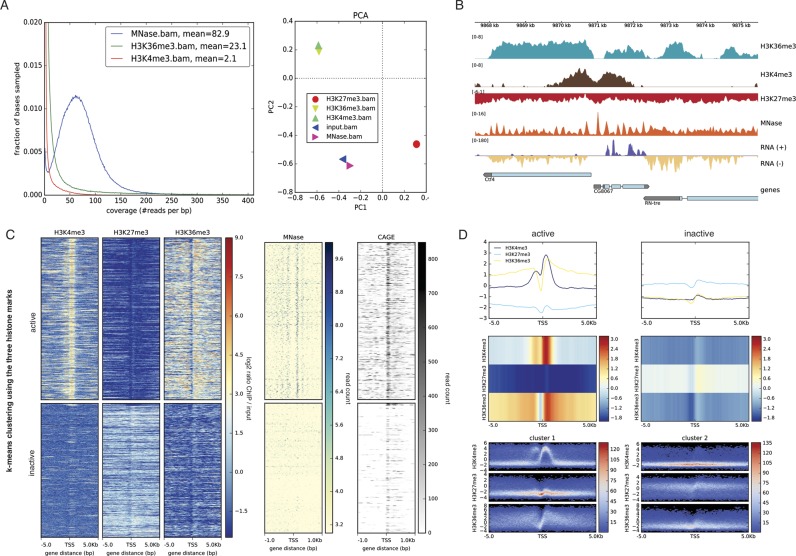
We present an update to our Galaxy-based web server for processing and visualizing deeply sequenced data. Its core tool set, deepTools, allows users to perform complete bioinformatic workflows ranging from quality controls and normalizations of aligned reads to integrative analyses, including clustering and visualization approaches. Since we first described our deepTools Galaxy server in 2014, we have implemented new solutions for many requests from the community and our users. Here, we introduce significant enhancements and new tools to further improve data visualization and interpretation. deepTools continue to be open to all users and freely available as a web service at deeptools.ie-freiburg.mpg.de The new deepTools2 suite can be easily deployed within any Galaxy framework via the toolshed repository, and we also provide source code for command line usage under Linux and Mac OS X. A public and documented API for access to deepTools functionality is also available.
Overview
The claims and statistics of this paper haven’t been checked yet.
Run the check — free, no account needed. It reads the open-access text and checks the sources it cites.
Integrity signals
Registry
Cites
Statistics
Figures
Verification
Claims the paper makes
The claims and statistics of this paper haven’t been checked yet.
Run the check — free, no account needed. It reads the open-access text and checks the sources it cites.
Claims other papers make about this one
Each is checked against this paper’s own text: does it say what the citing paper says it does?
The cited source says what the claim attributes to it.
In the citing paper
“Bigwigs were generated with the bamCoverage function from deepTools (82) with scaling factors calculated using the formula (human reads in input) / (mouse reads in input) / (human reads in ChIP) x 15000000 (83, 84).”
From Synergy between regulatory elements can render cohesin dispensable for distal enhancer function (2026) · cites this paper as [82]
The cited source says what the claim attributes to it.
In the citing paper
“For genome-wide profiles and peak overlaps, peaks were filtered for a minimum signal of 1000 and then generated using the plotProfile function in deepTools2 (82) centered on peaks called from control (DMSO) cells and separated by replicate.”
From Synergy between regulatory elements can render cohesin dispensable for distal enhancer function (2026) · cites this paper as [82]
Self-check
Percentages, sums and reported differences re-computed from the paper’s own numbers.
The self-check needs the paper’s full text.
Citations
Cites
The Sequence Alignment/Map format and SAMtools
Li, H., Handsaker, B., Wysoker, A., Fennell, T., Ruan, J., Homer, N., Marth, G., Abecasis, G., Durbin, R., & 1000 Genome Project Data Processing Subgroup (2009) · Bioinformatics · doi:10.1093/bioinformatics/btp352 · Cited by 62,041
Integrative analysis of 111 reference human epigenomes
Roadmap Epigenomics Consortium, Kundaje, A., Meuleman, W., Ernst, J., Bilenky, M., Yen, A., Heravi-Moussavi, A., Kheradpour, P., Zhang, Z., Wang, J., et al. (2015) · Nature · doi:10.1038/nature14248 · Cited by 6,368
Research works printed but not linked: 16
- 10.1111/cgf.12096 · DOI
- 10.1093/bioinformatics/btu775 · DOI
- 10.1016/j.molcel.2010.05.004 · DOI · Paper page
- 10.1186/1471-2164-15-284 · DOI
- Ramírez F. Dündar F. Diehl S. Grüning B.A. Manke T. deepTools: a flexible platform for exploring deep-sequencing data. 2014;42:W187-W191. · DOI · Paper page
- Hillman-Jackson J. Clements D. Blankenberg D. Taylor J. Nekrutenko A.Galaxy Team . Using Galaxy to perform large-scale interactive data analyses. Curr. Protoc. Bioinformatics 2012. Chapter 10, Unit 10.5–10.5.47. · DOI
- 10.1093/nar/gkv1275 · DOI
- 10.1038/nprot.2012.101 · DOI
- 10.1101/gr.136184.111 · DOI · Paper page
- 10.1186/gb4161 · DOI
- 10.1038/nature11247 · DOI · Paper page
- 10.1016/j.cell.2015.04.044 · DOI · Paper page
- 10.1101/gad.201327.112 · DOI · Paper page
- 10.1038/nmeth.1985 · DOI
- 10.1016/j.molcel.2015.08.024 · DOI
- 10.1016/j.molcel.2013.12.029 · DOI
Cited by
Sorted by citations
Comprehensive Integration of Single-Cell Data
Stuart, T., Butler, A., Hoffman, P., Hafemeister, C., Papalexi, E., Mauck, W. M., Hao, Y., Stoeckius, M., Smibert, P., & Satija, R. (2019) · Cell · doi:10.1016/j.cell.2019.05.031 · Cited by 15,453
The Galaxy platform for accessible, reproducible and collaborative biomedical analyses: 2018 update
Afgan, E., Baker, D., Batut, B., van den Beek, M., Bouvier, D., Čech, M., Chilton, J., Clements, D., Coraor, N., Grüning, B. A., et al. (2018) · Nucleic Acids Research · doi:10.1093/nar/gky379 · Cited by 3,662
Self-citationImpact of cytosine methylation on DNA binding specificities of human transcription factors
Yin, Y., Morgunova, E., Jolma, A., Kaasinen, E., Sahu, B., Khund-Sayeed, S., Das, P. K., Kivioja, T., Dave, K., Zhong, F., et al. (2017) · Science · doi:10.1126/science.aaj2239 · Cited by 1,257
TOX is a critical regulator of tumour-specific T cell differentiation
Scott, A. C., Dündar, F., Zumbo, P., Chandran, S. S., Klebanoff, C. A., Shakiba, M., Trivedi, P., Menocal, L., Appleby, H., Camara, S., et al. (2019) · Nature · doi:10.1038/s41586-019-1324-y · Cited by 1,106
Self-citationA Single-Cell Atlas of In Vivo Mammalian Chromatin Accessibility
Cusanovich, D. A., Hill, A. J., Aghamirzaie, D., Daza, R. M., Pliner, H. A., Berletch, J. B., Filippova, G. N., Huang, X., Christiansen, L., DeWitt, W. S., et al. (2018) · Cell · doi:10.1016/j.cell.2018.06.052 · Cited by 759
Metadata
- Authors
- Ramírez, F., Ryan, D. P., Grüning, B., Bhardwaj, V., Kilpert, F., Richter, A. S., Heyne, S., Dündar, F., & Manke, T.
- Affiliations
- Max Planck Institute of Immunobiology and Epigenetics (DE)
- University of Freiburg (DE)
- Weill Cornell Medicine (US)
- Corresponding author
- Manke, Thomas
- ORCID
- Venue
- Nucleic Acids Research
- Publisher
- Oxford University Press (OUP)
- Published
- 2016-04-13
- Volume
- 44
- Issue
- W1
- Pages
- W160-W165
- ISSN
- 0305-1048 (ISSN-L)
- 1362-4962
- PMC
- PMC4987876
- OpenAlex
- W2341539131
- Cited by
- 8,096
- References
- 2
- Citations by year
- 2026: 1065 · 2025: 1325 · 2024: 1238 · 2023: 1188 · 2022: 1018 · 2021: 941 · 2020: 602 · 2019: 393 · 2018: 234 · 2017: 85 · 2016: 5
- FWCI
- 124.25
- Type
- journal article
- Language
- en
- Open access
- gold
- doi.org
- Licence
- Locations
- Nucleic Acids Research (publishedVersion, cc-by-nc)
- Europe PMC (PubMed Central) (publishedVersion, cc-by-nc)
- PubMed Central (publishedVersion, cc-by-nc)
- PubMed (publishedVersion)
- FreiDok plus (Universitätsbibliothek Freiburg) (submittedVersion, other-oa)
- HighWire Press Open Archive (submittedVersion)
- MPG.PuRe (Max Planck Society) (submittedVersion)
- Funders
- Deutsche Forschungsgemeinschaft (SFB 992)
- Topics
- Life Sciences › Biochemistry, Genetics and Molecular Biology › Molecular Biology › Genomics and Phylogenetic Studies
- Life Sciences › Biochemistry, Genetics and Molecular Biology › Molecular Biology › Genomics and Chromatin Dynamics
- Social Sciences › Decision Sciences › Information Systems and Management › Scientific Computing and Data Management
- Keywords
- read normalization, read quality control, read clustering, data visualization
- MeSH terms
- Animals, Base Sequence, Computer Graphics, Drosophila melanogaster, Humans, Software, Information Storage and Retrieval, Sequence Alignment, Sequence Analysis, DNA, Computational Biology, Internet, High-Throughput Nucleotide Sequencing
About these checks
Registry, retraction, Cites and statistics results are computed, not judged, with one exception: a printed reference that no index lists is read once by a model before it counts as a citation error. Claims are extracted by a model and kept only when their quote appears verbatim in the text; each cited source is then checked, with a model’s help, for whether it says what the claim relies on. Those verdicts can be wrong — read the claim’s quote and the cited source before relying on one.
Statistics and arithmetic are recomputed, not judged.
Confidence bands are shown only for fields calibrated on our annotated test set. None is calibrated yet, so no band is shown.
What counts as a claim ›How we measure confidence ›How we check this ›
Are you an author, or do you see a problem with this page? Request a review
