

The DOI matches its Crossref record; 1 of the 1 references it cites were found in a registry or an index.
Evidence of High Mortality and Increasing Burden of Sepsis in a Regional Sample of the New Zealand Population
Abstract
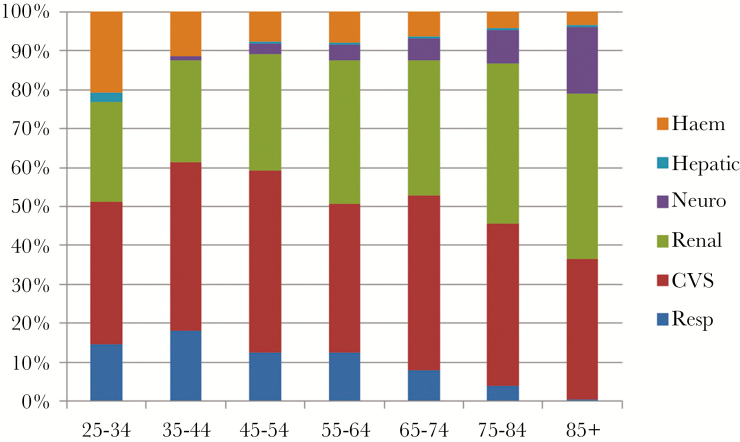
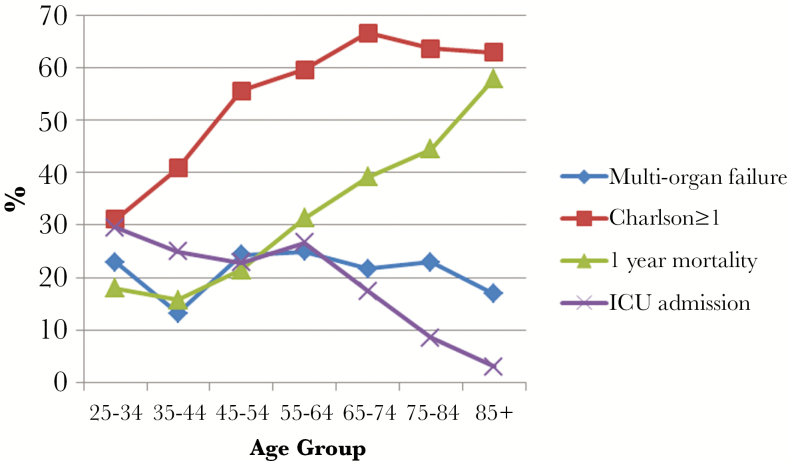
Background: Sepsis is a life-threatening complication of infection. The incidence of sepsis is thought to be on the increase, but estimates making use of administrative data in the United States may be affected by administrative bias. Methods: We studied the population-based incidence of sepsis in the Waikato region of New Zealand from 2007 to 2012 using International Classification of Diseases, Tenth Revision, Australian Modification, which lacks a specific code for sepsis. Results: Between 2007 and 2012, 1643 patients met coding criteria for sepsis in our hospitals. Sixty-three percent of patients were 65 or over, 17% of cases were admitted to an intensive care unit, and the in-hospital and 1-year mortality with sepsis was 19% and 38%, respectively. Age-standardized rate ratios (ASRRs) demonstrated that sepsis was associated with male sex (ASRR 1.4; 95% confidence interval [CI], 1.23–1.59), Maori ethnicity (ASRR 3.22 compared with non-Maori; 95% CI, 2.85–3.65), study year (ASRR 1.62 comparing 2012 with 2008; 95% CI, 1.18–2.24), and socioeconomic deprivation (ASRR 1.72 comparing the highest with the lowest quintile of socioeconomic deprivation; 95% CI, 1.5–1.97). Multiorgan failure was present in approximately 20% of cases in all age groups. Intensive care unit admission rate fell from 30% amongst 25- to 34-year-olds to less than 10% amongst those aged 75 and over. Conclusions: In a 9% sample of the New Zealand population, the incidence of sepsis increased by 62% over a 5-year period. Maori, elderly, and disadvantaged populations were most affected.
Overview
The claims and statistics of this paper haven’t been checked yet.
Run the check — free, no account needed. It reads the open-access text and checks the sources it cites.
Integrity signals
Registry
Cites
Statistics
Figures
Verification
Claims the paper makes
The claims and statistics of this paper haven’t been checked yet.
Run the check — free, no account needed. It reads the open-access text and checks the sources it cites.
Claims other papers make about this one
Each is checked against this paper’s own text: does it say what the citing paper says it does?
The source backs part of the claim, not all of it — or backs it for a different population, condition or comparison.
In the citing paper
“For example, Māori patients in New Zealand are 2–3 fold more likely to develop sepsis than non‐Māori, and across all age groups are more likely to die of sepsis than non‐Māori patients”
From On race, human variation, and who gets and dies of sepsis (2022) · cites this paper as Huggan et al., 2017
Experimental — accuracy not yet measured
Self-check
Percentages, sums and reported differences re-computed from the paper’s own numbers.
The self-check needs the paper’s full text.
Citations
Cites
Danese, A., Moffitt, T. E., Harrington, H., Milne, B. J., Polanczyk, G., Pariante, C. M., Poulton, R., & Caspi, A. (2009) · Archives of Pediatrics & Adolescent Medicine · doi:10.1001/archpediatrics.2009.214 · Cited by 1,165
Research works printed but not linked: 32
- Singer, 2016, The Third International Consensus Definitions for Sepsis and Septic Shock (Sepsis-3), JAMA, 315, 801, 10.1001/jama.2016.0287 · DOI · Paper page
- Levy, 2003, 2001 SCCM/ESICM/ACCP/ATS/SIS International Sepsis Definitions Conference, Crit Care Med, 29, 530
- Fleischmann, 2016, Assessment of global incidence and mortality of hospital-treated sepsis. Current estimates and limitations, Am J Respir Crit Care Med, 193, 259, 10.1164/rccm.201504-0781OC · DOI · Paper page
- Gaieski, 2013, Benchmarking the incidence and mortality of severe sepsis in the United States, Crit Care Med, 41, 1167, 10.1097/CCM.0b013e31827c09f8 · DOI
- Rhee, 2015, Comparison of trends in sepsis incidence and coding using administrative claims versus objective clinical data, Clin Infect Dis, 60, 88, 10.1093/cid/ciu750 · DOI
- Rhee, 2015, Improving documentation and coding for acute organ dysfunction biases estimates of changing sepsis severity and burden: a retrospective study, Crit Care, 19, 338, 10.1186/s13054-015-1048-9 · DOI
- Gohil, 2016, Impact of policies on the rise in sepsis incidence, 2000–2010, Clin Infect Dis, 62, 695, 10.1093/cid/civ1019 · DOI
- Rhee, 2014, Regulatory mandates for sepsis care–reasons for caution, N Engl J Med, 370, 1673, 10.1056/NEJMp1400276 · DOI
- Beck, 2007, Physician coding and reimbursement, Ochsner J, 7, 8
- Baker, 2012, Increasing incidence of serious infectious diseases and inequalities in New Zealand: a national epidemiological study, Lancet, 379, 1112, 10.1016/S0140-6736(11)61780-7 · DOI · Paper page
- Angus, 2001, Epidemiology of severe sepsis in the United States: analysis of incidence, outcome, and associated costs of care, Crit Care Med, 29, 1303, 10.1097/00003246-200107000-00002 · DOI · Paper page
- Sundararajan, 2005, Epidemiology of sepsis in Victoria, Australia, Crit Care Med, 33, 71, 10.1097/01.CCM.0000150027.98160.80 · DOI
- Quan, 2005, Coding algorithms for defining comorbidities in ICD-9-CM and ICD-10 administrative data, Med Care, 43, 1130, 10.1097/01.mlr.0000182534.19832.83 · DOI · Paper page
- Salmond, 2007, NZDep2006 Index of Deprivation, 1
- Pearson, 2013, Cumulative disadvantage? Exploring relationships between neighbourhood deprivation trends (1991 to 2006) and mortality in New Zealand, Int J Health Geogr, 12, 38, 10.1186/1476-072X-12-38 · DOI
- Jolley, 2015, Validity of administrative data in recording sepsis: a systematic review, Crit Care, 19, 139, 10.1186/s13054-015-0847-3 · DOI
- Jolley, 2015, Validation and optimisation of an ICD-10-coded case definition for sepsis using administrative health data, BMJ Open, 5, e009487, 10.1136/bmjopen-2015-009487 · DOI
- Wang, 2015, Discharge diagnoses versus medical record review in the identification of community-acquired sepsis, Crit Care, 19, 42, 10.1186/s13054-015-0771-6 · DOI
- Kaukonen, 2014, Mortality related to severe sepsis and septic shock among critically Ill patients in Australia and New Zealand, 2000–2012, JAMA, 311, 1308, 10.1001/jama.2014.2637 · DOI · Paper page
- Tsertsvadze, 2016, Community-onset sepsis and its public health burden: a systematic review, Syst Rev, 5, 81, 10.1186/s13643-016-0243-3 · DOI
- Linde-Zwirble, 2004, Severe sepsis epidemiology: sampling, selection, and society, Crit Care, 8, 222, 10.1186/cc2917 · DOI
- Iwashyna, 2012, Population burden of long-term survivorship after severe sepsis in older Americans, J Am Geriatr Soc, 60, 1070, 10.1111/j.1532-5415.2012.03989.x · DOI
- Poulton, 2002, Association between children’s experience of socioeconomic disadvantage and adult health: a life-course study, Lancet, 360, 1640, 10.1016/S0140-6736(02)11602-3 · DOI · Paper page
- Wang, 2012, Chronic medical conditions and risk of sepsis, PLoS One, 7, e48307, 10.1371/journal.pone.0048307 · DOI · Paper page
- Wang, 2013, High-sensitivity C-reactive protein and risk of sepsis, PLoS One, 8, e69232, 10.1371/journal.pone.0069232 · DOI
- Zhang, 2013, Infectious Diseases Attributable to Household Crowding in New Zealand: A Systematic Review and Burden of Disease Estimate
- Wang, 2013, Obesity and risk of sepsis: a population-based cohort study. Obesity, 10.1002/oby.20468 · DOI
- Kumar, 2014, The association of lacking insurance with outcomes of severe sepsis: retrospective analysis of an administrative database, Crit Care Med, 42, 583, 10.1097/01.ccm.0000435667.15070.9c · DOI
- Koch, 2013, Effect of socioeconomic status on mortality after bacteremia in working-age patients. A Danish population-based cohort study, PLoS One, 8, e70082, 10.1371/journal.pone.0070082 · DOI · Paper page
- Ng, 2014, Global, regional, and national prevalence of overweight and obesity in children and adults during 1980–2013: a systematic analysis for the Global Burden of Disease Study 2013, Lancet, 384, 766, 10.1016/S0140-6736(14)60460-8 · DOI · Paper page
- Fleischmann, 2016, Assessment of global incidence and mortality of hospital-treated sepsis. Current estimates and limitations, Am J Respir Crit Care Med, 193, 259, 10.1164/rccm.201504-0781OC · DOI · Paper page
- Sands, 1997, Epidemiology of sepsis syndrome in 8 academic medical centers, JAMA, 278, 234, 10.1001/jama.1997.03550030074038 · DOI
Cited by
Sorted by citations
Fleischmann-Struzek, C., Mellhammar, L., Rose, N., Cassini, A., Rudd, K. E., Schlattmann, P., Allegranzi, B., & Reinhart, K. (2020) · Intensive Care Medicine · doi:10.1007/s00134-020-06151-x · Cited by 982
On race, human variation, and who gets and dies of sepsis
Brinkworth, J. F., & Shaw, J. G. (2022) · American Journal of Biological Anthropology · doi:10.1002/ajpa.24527 · Cited by 9
Metadata
- Authors
- Huggan, P. J., Bell, A., Waetford, J., Obertova, Z., & Lawrenson, R.
- Affiliations
- Waikato District Health Board, Hamilton, New Zealand
- Faculty of Medicine, University of Otago, Dunedin, New Zealand
- Faculty of Medicine and Health Sciences, University of Auckland, New Zealand; and
- Venue
- Open Forum Infectious Diseases
- Publisher
- Oxford University Press (OUP)
- Published
- 2017
- Volume
- 4
- Issue
- 3
- ISSN
- 2328-8957
- PMC
- PMC5597865
- Cited by
- 13
- References
- 1
- Language
- en
About these checks
Registry, retraction, Cites and statistics results are computed, not judged, with one exception: a printed reference that no index lists is read once by a model before it counts as a citation error. Claims are extracted by a model and kept only when their quote appears verbatim in the text; each cited source is then checked, with a model’s help, for whether it says what the claim relies on. Those verdicts can be wrong — read the claim’s quote and the cited source before relying on one.
Statistics and arithmetic are recomputed, not judged.
Confidence bands are shown only for fields calibrated on our annotated test set. None is calibrated yet, so no band is shown.
What counts as a claim ›How we measure confidence ›How we check this ›
Are you an author, or do you see a problem with this page? Request a review
How to cite
Cite CoChat for the checks on this page, and the paper for its own findings.
- This page
- CoChat. (2026). Citation check: Evidence of High Mortality and Increasing Burden of Sepsis in a Regional Sample of the New Zealand Population. https://app.cochat.ai/papers/10.1093/ofid/ofx106
- The paper
- Huggan, P. J., Bell, A., Waetford, J., Obertova, Z., & Lawrenson, R. (2017). Evidence of High Mortality and Increasing Burden of Sepsis in a Regional Sample of the New Zealand Population. Open Forum Infectious Diseases. https://doi.org/10.1093/ofid/ofx106
